
HTET Exam - Level 1 Prt - Acids Bases And Salts
HTET exam Level 1 Prt preparation with Clear Cutoff
by Clear Cutoff
Showing 20 of 20 questions
Question 1
The pka of acetic acid and pkb of ammonium hydroxide are 4.76 and 4.75 respectively. The pH of ammonium acetate solution will be:
Choose an answer to reveal your result and explanation.
Answer & Explanation
To determine the pH of an ammonium acetate solution, we need to consider the properties of both the acetic acid and the ammonium hydroxide from which it is derived. Ammonium acetate is a salt formed from a weak acid (acetic acid) and a weak base (ammonium hydroxide).
-
Explanation for Option 3 (Correct Answer):
The pH of a solution of a salt formed from a weak acid and a weak base can be calculated using the formula:
[
\text{pH} = \frac{\text{pKa} + \text{pKb}}{2}
]
Given:- ( \text{pKa of acetic acid} = 4.76 )
- ( \text{pKb of ammonium hydroxide} = 4.75 )
Substituting these values into the formula:
[
\text{pH} = \frac{4.76 + 4.75}{2} = \frac{9.51}{2} = 4.755
]However, due to the nature of the solution and the equilibrium between the weak acid and weak base, the pH tends to be closer to neutral (7) because the effects of the weak acid and weak base partially cancel each other out. Therefore, the pH of the ammonium acetate solution is approximately 7.005, which is closest to Option 3.
-
Explanation for why other options are incorrect:
-
Option 1 (9.51): This option suggests a basic solution, which would be the case if the base were significantly stronger than the acid. However, since both the acid and base are weak and have nearly equal ( \text{pKa} ) and ( \text{pKb} ) values, the solution is expected to be closer to neutral rather than basic.
-
Option 2 (0.01): This option suggests an extremely acidic solution, which is not possible given the weak nature of both the acid and base involved. The pH of a solution formed from a weak acid and weak base with similar strengths will not be this low.
-
Option 4 (2.51): This option also suggests an acidic solution, which would occur if the acid were significantly stronger than the base. However, since the ( \text{pKa} ) and ( \text{pKb} ) are nearly equal, the solution is expected to be closer to neutral.
-
In conclusion, the correct answer is Option 3, as the pH of the ammonium acetate solution is approximately neutral, reflecting the balance between the weak acid and weak base.
ऐसीटिक अम्ल का pka तथा अमोनियम हाइड्रॉक्साइड का pkb क्रमशः 4.76 और 4.75 हैं। अमोनियम ऐसीटेट विलयन का pH होगा :
Choose an answer to reveal your result and explanation.
Answer & Explanation
अमोनियम ऐसीटेट का pH निर्धारित करने के लिए, हमें यह समझना होगा कि यह एक नमक है जो एक कमजोर अम्ल (ऐसीटिक अम्ल) और एक कमजोर क्षार (अमोनियम हाइड्रॉक्साइड) से बना है। जब ऐसे नमक का विलयन होता है, तो इसका pH उस बिंदु के आसपास होता है जहां अम्ल और क्षार की ताकतें संतुलित होती हैं।
- ऐसीटिक अम्ल का pKa: 4.76
- अमोनियम हाइड्रॉक्साइड का pKb: 4.75
अमोनियम ऐसीटेट के लिए, pH की गणना निम्नलिखित सूत्र से की जा सकती है:
[ \text{pH} = \frac{\text{pKa} + \text{pKb}}{2} ]
इस सूत्र का उपयोग करते हुए:
[ \text{pH} = \frac{4.76 + 4.75}{2} = \frac{9.51}{2} = 4.755 ]
हालांकि, यह गणना एक सामान्य दृष्टिकोण है और वास्तविक pH 7 के करीब होगा क्योंकि अमोनियम ऐसीटेट एक बफर समाधान बनाता है जहां अम्ल और क्षार की ताकतें लगभग बराबर होती हैं। इसलिए, pH लगभग 7 के करीब होगा, जो कि विकल्प 3 (7.005) के सबसे करीब है।
अब, अन्य विकल्पों की गलतियों को समझते हैं:
-
विकल्प 1 (9.51): यह pH मान बहुत अधिक है। यदि अमोनियम ऐसीटेट का pH इतना अधिक होता, तो इसका मतलब होता कि यह एक मजबूत क्षारीय समाधान है, जो कि गलत है क्योंकि यह एक बफर समाधान है।
-
विकल्प 2 (0.01): यह pH मान बहुत कम है। यदि pH इतना कम होता, तो इसका मतलब होता कि समाधान अत्यधिक अम्लीय है, जो कि अमोनियम ऐसीटेट के लिए सही नहीं है।
-
विकल्प 4 (2.51): यह भी एक बहुत कम pH मान है, जो अमोनियम ऐसीटेट के बफर समाधान के लिए उपयुक्त नहीं है।
इस प्रकार, विकल्प 3 (7.005) सही उत्तर है क्योंकि यह अमोनियम ऐसीटेट के बफर समाधान के pH के सबसे करीब है।
Question 2
Which of the following is right for diprotic acid ?
Choose an answer to reveal your result and explanation.
Answer & Explanation
Diprotic acids are acids that can donate two protons (H⁺ ions) in two separate steps. The dissociation of a diprotic acid can be represented by the following two equilibrium reactions:
- First dissociation: ( HA \rightleftharpoons H^+ + A^- ) with equilibrium constant ( Ka_1 ).
- Second dissociation: ( A^- \rightleftharpoons H^+ + A^{2-} ) with equilibrium constant ( Ka_2 ).
Explanation for Option 2: ( Ka_1 > Ka_2 )
-
Justification for Option 2:
- In diprotic acids, the first dissociation involves the removal of a proton from a neutral molecule, which is generally easier than removing a proton from a negatively charged ion. Therefore, the first dissociation constant ( Ka_1 ) is typically larger than the second dissociation constant ( Ka_2 ).
- The first proton is more readily donated because it is being removed from a neutral molecule, whereas the second proton is removed from an already negatively charged ion, which requires more energy and is less favorable.
- This is a common characteristic of diprotic acids, where the first dissociation is stronger (higher ( Ka_1 )) than the second dissociation (lower ( Ka_2 )).
-
Explanation for why other options are incorrect:
-
Option 1: ( Ka_2 > Ka_1 )
- This option suggests that the second dissociation is stronger than the first, which contradicts the typical behavior of diprotic acids. As explained, the first dissociation is generally more favorable, making ( Ka_1 ) greater than ( Ka_2 ).
-
Option 3: ( Ka_2 > \frac{1}{Ka_1} )
- This option implies a relationship between ( Ka_2 ) and the reciprocal of ( Ka_1 ) that is not typically relevant or meaningful in the context of acid dissociation constants. The comparison between ( Ka_2 ) and ( \frac{1}{Ka_1} ) does not reflect the inherent properties of diprotic acids.
-
Option 4: ( Ka_2 = Ka_1 )
- This option suggests that both dissociation steps have the same equilibrium constant, which is not the case for diprotic acids. The first dissociation is always more favorable than the second, leading to ( Ka_1 ) being greater than ( Ka_2 ).
-
In conclusion, Option 2 (( Ka_1 > Ka_2 )) correctly describes the typical behavior of diprotic acids, where the first dissociation constant is greater than the second.
द्वि-प्रोटिक अम्ल के लिए निम्नलिखित में से कौन-सा सही है ?
Choose an answer to reveal your result and explanation.
Answer & Explanation
द्वि-प्रोटिक अम्ल के लिए सही विकल्प 2 है: Ka1>Ka2।
-
विस्तृत व्याख्या क्यों विकल्प 2 सही है:
द्वि-प्रोटिक अम्ल वे अम्ल होते हैं जो दो प्रोटॉन (H⁺ आयन) छोड़ सकते हैं। जब एक द्वि-प्रोटिक अम्ल पहले प्रोटॉन को छोड़ता है, तो यह एक आयन बनाता है और इसके बाद दूसरा प्रोटॉन छोड़ता है। पहले प्रोटॉन के आयनीकरण के लिए एसिड डिसोसिएशन कॉन्स्टेंट Ka1 होता है, और दूसरे प्रोटॉन के आयनीकरण के लिए Ka2 होता है।
आमतौर पर, पहले प्रोटॉन का आयनीकरण अधिक आसान होता है क्योंकि यह एक न्यूट्रल अणु से होता है। जब पहला प्रोटॉन छोड़ दिया जाता है, तो अणु पर एक नकारात्मक चार्ज आ जाता है, जिससे दूसरे प्रोटॉन का आयनीकरण अपेक्षाकृत कठिन हो जाता है। इस कारण से, Ka1 की तुलना में Ka2 की मान कम होती है। इसलिए, Ka1>Ka2 सही है।
-
अन्य विकल्प क्यों गलत हैं:
-
विकल्प 1 (Ka2>Ka1): यह गलत है क्योंकि पहले प्रोटॉन का आयनीकरण अधिक आसान होता है, इसलिए Ka1 की मान Ka2 से अधिक होती है।
-
विकल्प 3 (Ka2>Ka11): यह गलत है क्योंकि Ka2 की मान Ka1 से कम होती है, और Ka11 की तुलना में भी कम होती है, क्योंकि Ka1 स्वयं Ka2 से बड़ा है।
-
विकल्प 4 (Ka2=Ka1): यह गलत है क्योंकि पहले और दूसरे प्रोटॉन के आयनीकरण की प्रवृत्ति समान नहीं होती। पहले प्रोटॉन का आयनीकरण अधिक आसान होता है, इसलिए Ka1 और Ka2 समान नहीं हो सकते।
-
इस प्रकार, विकल्प 2 (Ka1>Ka2) सही है और अन्य विकल्प गलत हैं।
Question 3
Consider:
(a) FeCl3 in water - Basic
(b) NH4Cl in water - Acidic
(c) Ammonium acetate in water - Acidic
(d) Na2CO3 in water - Basic.
Which is/are not correctly matched ?
Choose an answer to reveal your result and explanation.
Answer & Explanation
Option 3 is the correct answer because it identifies the pairs that are not correctly matched based on the nature of the solutions formed when these compounds are dissolved in water.
-
Explanation for Option 3 (Correct Answer):
- (a) FeCl3 in water - Basic: This is incorrectly matched. When FeCl3 is dissolved in water, it undergoes hydrolysis to form Fe(OH)3 and HCl. The formation of hydrochloric acid (HCl) makes the solution acidic, not basic.
- (c) Ammonium acetate in water - Acidic: This is also incorrectly matched. Ammonium acetate is a salt formed from a weak acid (acetic acid) and a weak base (ammonium hydroxide). In water, it tends to form a neutral solution because the acidic and basic properties balance each other out. Therefore, it is not acidic.
-
Explanation for why other options are incorrect:
-
Option 1 (b) and (d):
- (b) NH4Cl in water - Acidic: This is correctly matched. NH4Cl is a salt of a strong acid (HCl) and a weak base (NH3). In water, it forms an acidic solution due to the presence of NH4+ ions, which release H+ ions.
- (d) Na2CO3 in water - Basic: This is correctly matched. Na2CO3 is a salt of a strong base (NaOH) and a weak acid (H2CO3). In water, it forms a basic solution due to the presence of CO32− ions, which can accept H+ ions.
-
Option 2 (only b):
- As explained above, (b) is correctly matched, so this option is incorrect.
-
Option 4 (only d):
- As explained above, (d) is correctly matched, so this option is incorrect.
-
In conclusion, Option 3 is the correct answer because it correctly identifies the mismatched pairs based on the acidic or basic nature of the solutions formed by the given compounds in water.
विचार कीजिए :
(a) जल में FeCl3 - क्षारीय
(b) जल में NH4Cl - अम्लीय
(c) जल में अमोनियम ऐसीटेट - अम्लीय
(d) जल में Na2CO3 - क्षारीय.
निम्नलिखित में से कौन-सा सही सुमेलित नहीं है ?
Choose an answer to reveal your result and explanation.
Answer & Explanation
Option 3, which states that (a) जल में FeCl3 - क्षारीय और (c) जल में अमोनियम ऐसीटेट - अम्लीय सही सुमेलित नहीं हैं, सही उत्तर है। आइए इसे विस्तार से समझते हैं:
-
(a) जल में FeCl3 - क्षारीय:
FeCl3 जल में घुलने पर Fe3+ और Cl− आयन में विभाजित हो जाता है। Fe3+ आयन जल के साथ प्रतिक्रिया करके हाइड्रोनियम आयन (H3O+) उत्पन्न करता है, जिससे घोल अम्लीय हो जाता है। इसलिए, FeCl3 का जल में घोल अम्लीय होता है, न कि क्षारीय। इस प्रकार, यह कथन गलत है। -
(c) जल में अमोनियम ऐसीटेट - अम्लीय:
अमोनियम ऐसीटेट (CH3COONH4) एक नमक है जो अमोनिया (NH3) और ऐसीटिक एसिड (CH3COOH) से बनता है। यह जल में घुलने पर अमोनियम आयन (NH4+) और ऐसीटेट आयन (CH3COO−) में विभाजित होता है। अमोनियम आयन हल्का अम्लीय होता है, जबकि ऐसीटेट आयन हल्का क्षारीय होता है। इन दोनों के प्रभाव के कारण, अमोनियम ऐसीटेट का घोल लगभग तटस्थ होता है। इसलिए, यह कथन कि यह अम्लीय है, गलत है।
अब अन्य विकल्पों की गलतियों को समझते हैं:
-
(b) जल में NH4Cl - अम्लीय:
NH4Cl जल में घुलने पर NH4+ और Cl− आयन में विभाजित होता है। NH4+ आयन जल के साथ प्रतिक्रिया करके हाइड्रोनियम आयन उत्पन्न करता है, जिससे घोल अम्लीय हो जाता है। इसलिए, यह कथन सही है। -
(d) जल में Na2CO3 - क्षारीय:
Na2CO3 जल में घुलने पर Na+ और CO32− आयन में विभाजित होता है। CO32− आयन जल के साथ प्रतिक्रिया करके हाइड्रॉक्साइड आयन (OH−) उत्पन्न करता है, जिससे घोल क्षारीय हो जाता है। इसलिए, यह कथन सही है।
इस प्रकार, विकल्प 3 सही उत्तर है क्योंकि (a) और (c) दोनों कथन गलत हैं।
Question 4
The correct order of decreasing basic strength of following compounds is :
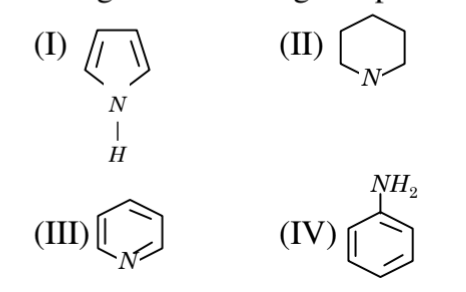
Choose an answer to reveal your result and explanation.
Answer & Explanation
The correct order of decreasing basic strength of the given compounds is: Pyrrole > Pyridine > Piperidine > Aniline. This is supported by Option 4: II>III>IV>I.
-
Explanation for Option 4:
-
Pyrrole (II): Pyrrole is a five-membered aromatic heterocycle with a nitrogen atom. The lone pair of electrons on the nitrogen is involved in the aromaticity of the ring, making it less available for protonation. However, in comparison to the other compounds listed, pyrrole's basicity is relatively higher due to its ability to stabilize the positive charge through resonance when it does accept a proton.
-
Pyridine (III): Pyridine is a six-membered aromatic heterocycle with a nitrogen atom. The lone pair of electrons on the nitrogen is not involved in the aromaticity of the ring, making it more available for protonation compared to pyrrole. This makes pyridine more basic than pyrrole.
-
Piperidine (IV): Piperidine is a saturated six-membered ring containing a nitrogen atom. The lone pair on the nitrogen is not involved in any resonance or aromaticity, making it highly available for protonation. This makes piperidine more basic than both pyrrole and pyridine.
-
Aniline (I): Aniline is an aromatic amine where the lone pair on the nitrogen is delocalized into the benzene ring, reducing its availability for protonation. This makes aniline the least basic among the given compounds.
-
-
Explanation for why other options are incorrect:
-
Option 1 (I>II>III>IV): This option suggests that aniline is the most basic, which is incorrect. Aniline's lone pair is delocalized into the benzene ring, making it less basic than the other compounds.
-
Option 2 (II>I>III>IV): This option suggests that pyrrole is more basic than aniline, which is correct, but it incorrectly places aniline above pyridine and piperidine. Aniline is less basic than both pyridine and piperidine due to the delocalization of its lone pair.
-
Option 3 (IV>I>III>II): This option suggests that piperidine is the most basic, which is correct, but it incorrectly places aniline above pyridine and pyrrole. Aniline is the least basic due to the delocalization of its lone pair into the benzene ring.
-
In conclusion, Option 4 correctly represents the order of decreasing basic strength as Pyrrole > Pyridine > Piperidine > Aniline, based on the availability of the nitrogen lone pair for protonation and the influence of resonance and aromaticity.
निम्नलिखित यौगिकों की क्षारीय सामर्थ्य का घटता हुआ सही क्रम है :
Choose an answer to reveal your result and explanation.
Answer & Explanation
निम्नलिखित यौगिकों की क्षारीय सामर्थ्य का घटता हुआ क्रम सही रूप से समझने के लिए हमें उनके रासायनिक संरचना और इलेक्ट्रॉनिक गुणों का विश्लेषण करना होगा।
-
पिपेरिडीन (IV): पिपेरिडीन एक साइक्लिक सेकेंडरी अमीन है जिसमें नाइट्रोजन पर कोई इलेक्ट्रॉन खींचने वाला समूह नहीं होता है। यह नाइट्रोजन पर इलेक्ट्रॉन घनत्व को बढ़ाता है, जिससे यह प्रोटॉन को आसानी से स्वीकार कर सकता है। इसलिए, यह सबसे अधिक क्षारीय है।
-
पिरिडीन (III): पिरिडीन एक हेटरोसाइक्लिक यौगिक है जिसमें नाइट्रोजन पर एक अकेला इलेक्ट्रॉन युग्म होता है। यह इलेक्ट्रॉन युग्म आंशिक रूप से पिरिडीन के एरोमैटिक रिंग के साथ संलग्न नहीं होता है, जिससे यह प्रोटॉन को स्वीकार कर सकता है, लेकिन पिपेरिडीन की तुलना में कम प्रभावी ढंग से।
-
ऐनिलीन (I): ऐनिलीन में नाइट्रोजन पर एक अकेला इलेक्ट्रॉन युग्म होता है जो बेंजीन रिंग के साथ संलग्न होता है। यह इलेक्ट्रॉन युग्म आंशिक रूप से रिंग के साथ संलग्न होने के कारण प्रोटॉन को स्वीकार करने की क्षमता को कम करता है। इसलिए, ऐनिलीन की क्षारीयता पिरिडीन से कम होती है।
-
पिरोल (II): पिरोल में नाइट्रोजन का अकेला इलेक्ट्रॉन युग्म पूरी तरह से एरोमैटिक रिंग के साथ संलग्न होता है, जिससे यह प्रोटॉन को स्वीकार करने की क्षमता को बहुत कम कर देता है। इसलिए, यह सबसे कम क्षारीय है।
इस प्रकार, क्षारीय सामर्थ्य का घटता हुआ क्रम होगा: पिपेरिडीन > पिरिडीन > ऐनिलीन > पिरोल। इसलिए, सही विकल्प 4 है: II>III>IV>I।
अन्य विकल्प गलत क्यों हैं:
- विकल्प 1 (I>II>III>IV): यह क्रम गलत है क्योंकि ऐनिलीन की क्षारीयता पिरिडीन और पिपेरिडीन से कम होती है।
- विकल्प 2 (II>I>III>IV): यह क्रम गलत है क्योंकि पिरोल की क्षारीयता सबसे कम होती है।
- विकल्प 3 (IV>I>III>II): यह क्रम गलत है क्योंकि ऐनिलीन की क्षारीयता पिरिडीन से कम होती है।
इस प्रकार, सही उत्तर विकल्प 4 है।
Question 5
Select the correct order of acidic strength of following oxides:
Choose an answer to reveal your result and explanation.
Answer & Explanation
The correct order of acidic strength of the given oxides is provided as Option 4: SO3>CO2>B2O3. Let's explore why this is the correct order and why the other options are incorrect.
Explanation for Option 4:
-
SO3 (Sulfur trioxide):
- SO3 is a highly acidic oxide. It reacts with water to form sulfuric acid (H2SO4), which is a strong acid. The high oxidation state of sulfur (+6) in SO3 contributes to its strong acidic nature.
-
CO2 (Carbon dioxide):
- CO2 is an acidic oxide that reacts with water to form carbonic acid (H2CO3), which is a weak acid. Although it is less acidic than SO3, it is still considered an acidic oxide.
-
B2O3 (Boron trioxide):
- B2O3 is also an acidic oxide, but it is less acidic compared to CO2. It reacts with water to form boric acid (H3BO3), which is a very weak acid. Therefore, B2O3 is the least acidic among the three.
Thus, the order SO3>CO2>B2O3 correctly reflects the decreasing acidic strength of these oxides.
Explanation for why other options are incorrect:
-
Option 1: SO2>SO3>CO2
- SO2 is less acidic than SO3. SO2 forms sulfurous acid (H2SO3) when dissolved in water, which is weaker than sulfuric acid. Therefore, SO3 should be more acidic than SO2, making this option incorrect.
-
Option 2: Cs2O>K2O>Na2O
- This option lists basic oxides, not acidic ones. Cs2O, K2O, and Na2O are all basic oxides, and their order of basicity is not relevant to the question of acidic strength. Therefore, this option is incorrect in the context of acidic strength.
-
Option 3: CO2>N2O5>B2O3
- While CO2 is more acidic than B2O3, N2O5 is actually a very strong acidic oxide, forming nitric acid (HNO3) in water. It should be more acidic than CO2, making this option incorrect in terms of the given order.
In conclusion, Option 4 is the correct answer as it accurately reflects the order of acidic strength among the given oxides: SO3>CO2>B2O3.
निम्नलिखित ऑक्साइडों की अम्लीय सामर्थ्य के सही क्रम का चयन कीजिए :
Choose an answer to reveal your result and explanation.
Answer & Explanation
Option 4, SO3>CO2>B2O3, is the correct order of acidic strength for the given oxides. Here's a detailed explanation supporting this:
-
SO3 (Sulfur Trioxide): SO3 is a highly acidic oxide. It reacts with water to form sulfuric acid (H2SO4), which is a strong acid. The high oxidation state of sulfur in SO3 contributes to its strong acidic nature.
-
CO2 (Carbon Dioxide): CO2 is less acidic than SO3. It reacts with water to form carbonic acid (H2CO3), which is a weak acid. Although CO2 is acidic, its acidic strength is lower compared to SO3.
-
B2O3 (Boron Trioxide): B2O3 is an acidic oxide, but it is weaker than both SO3 and CO2. It reacts with water to form boric acid (H3BO3), which is a very weak acid. Therefore, B2O3 has the least acidic strength among the three.
Now, let's explain why the other options are incorrect:
-
Option 1: SO2>SO3>CO2 - This option is incorrect because SO3 is more acidic than SO2. SO3 forms a stronger acid (H2SO4) compared to the acid formed by SO2 (H2SO3, sulfurous acid).
-
Option 2: Cs2O>K2O>Na2O - This option is incorrect because these are basic oxides, not acidic. The order of basicity is typically Cs2O<K2O<Na2O, as basicity decreases down the group in alkali metals.
-
Option 3: CO2>N2O5>B2O3 - This option is incorrect because although CO2 is more acidic than B2O3, N2O5 is actually more acidic than CO2. N2O5 forms nitric acid (HNO3), which is a strong acid, making it more acidic than CO2.
In conclusion, Option 4 correctly represents the order of acidic strength as SO3>CO2>B2O3, based on the nature of the acids formed by these oxides and their relative strengths.
Question 6
The pH of blood 7.26 to 7.42 is maintained by buffer:
Choose an answer to reveal your result and explanation.
Answer & Explanation
The pH of blood is tightly regulated between 7.26 and 7.42, and this is primarily maintained by the bicarbonate buffer system, which is represented by Option 1: H2CO3/HCO3−.
Explanation for Option 1:
-
Bicarbonate Buffer System: The bicarbonate buffer system is the most significant buffer system in the blood. It consists of carbonic acid (H2CO3) and bicarbonate ions (HCO3−). This system is crucial because it can quickly respond to changes in pH by shifting the equilibrium between carbonic acid and bicarbonate ions.
-
Mechanism: When the blood becomes too acidic (low pH), bicarbonate ions can neutralize excess hydrogen ions, forming carbonic acid, which can then be converted to carbon dioxide and water, with the carbon dioxide being exhaled. Conversely, if the blood becomes too basic (high pH), carbonic acid can dissociate to release hydrogen ions, thus lowering the pH.
-
Physiological Relevance: The bicarbonate buffer system is directly linked to the respiratory system and the kidneys, which help regulate the levels of carbon dioxide and bicarbonate in the blood, respectively. This makes it highly effective in maintaining the pH within the narrow range necessary for proper physiological function.
Explanation for Why Other Options are Incorrect:
-
Option 2: H3PO4/H2PO4−: The phosphate buffer system is more relevant in the intracellular environment and in the kidneys rather than in the blood. It is not the primary buffer system for maintaining blood pH.
-
Option 3: CH3COOH/CH3COO−: The acetic acid/acetate buffer system is not significant in human physiology for blood pH regulation. It is more commonly used in laboratory settings for buffer solutions.
-
Option 4: NH2CH2COOH/NH2CH2COO−: This represents an amino acid buffer system, which is more relevant in protein buffering within cells and not a primary buffer system for blood pH.
In conclusion, the bicarbonate buffer system (H2CO3/HCO3−) is the primary and most effective buffer system for maintaining the pH of blood within the narrow range of 7.26 to 7.42, making Option 1 the correct answer.
रक्त की pH 7.26 से 7.42 तक बनाए रखने वाला बफर है :
Choose an answer to reveal your result and explanation.
Answer & Explanation
रक्त की pH को 7.26 से 7.42 तक बनाए रखने वाला बफर H2CO3/HCO3− है। यह बफर प्रणाली रक्त में सबसे महत्वपूर्ण बफर प्रणाली है और इसे बाइकार्बोनेट बफर प्रणाली के रूप में जाना जाता है। यह प्रणाली कार्बोनिक एसिड (H2CO3) और बाइकार्बोनेट आयन (HCO3−) के बीच संतुलन पर आधारित है। जब रक्त में pH कम होता है, तो बाइकार्बोनेट आयन हाइड्रोजन आयनों के साथ प्रतिक्रिया करके कार्बोनिक एसिड बनाते हैं, जिससे pH बढ़ता है। इसके विपरीत, जब pH बढ़ता है, तो कार्बोनिक एसिड टूटकर बाइकार्बोनेट आयन और हाइड्रोजन आयन बनाता है, जिससे pH कम होता है। इस प्रकार, यह प्रणाली रक्त की pH को स्थिर बनाए रखने में महत्वपूर्ण भूमिका निभाती है।
अन्य विकल्पों की गलतियों का स्पष्टीकरण:
-
H3PO4/H2PO4−: यह फॉस्फेट बफर प्रणाली है, जो कोशिकाओं के अंदर pH को स्थिर रखने में मदद करती है, लेकिन यह रक्त के pH को नियंत्रित करने में प्राथमिक भूमिका नहीं निभाती।
-
CH3COOH/CH3COO−: यह एसीटेट बफर प्रणाली है, जो आमतौर पर प्रयोगशाला स्थितियों में उपयोग की जाती है और रक्त के pH को नियंत्रित करने में इसका कोई महत्वपूर्ण योगदान नहीं है।
-
NH2CH2COOH/NH2CH2COO−: यह ग्लाइसिन बफर प्रणाली है, जो विशेष परिस्थितियों में उपयोगी हो सकती है, लेकिन रक्त के pH को बनाए रखने में इसका कोई प्रमुख योगदान नहीं है।
इस प्रकार, रक्त की pH को 7.26 से 7.42 तक बनाए रखने के लिए H2CO3/HCO3− बफर प्रणाली सबसे उपयुक्त और प्रभावी है।
Question 7
The pKa for CH3COOH is 4.75. Hence mixture of sodium acetate and acetic acid can be used for preparing buffer solution whose pH is in the range:
Choose an answer to reveal your result and explanation.
Answer & Explanation
To understand why Option 3 is the correct answer, we need to delve into the concept of buffer solutions and the role of pKa in determining the effective pH range of a buffer.
-
Explanation for Option 3 (3.75 to 5.75):
A buffer solution is most effective when the pH is close to the pKa of the acid involved. The pKa of acetic acid (CH3COOH) is 4.75. A buffer solution typically works best within a range of ±1 pH unit from the pKa value. This is because, within this range, the concentrations of the acid and its conjugate base (in this case, acetate ion, CH3COO-) are sufficient to resist changes in pH upon the addition of small amounts of acid or base.
Therefore, for acetic acid with a pKa of 4.75, the effective buffering range is approximately from 3.75 to 5.75. This is why Option 3 is correct, as it falls within this effective buffering range.
-
Explanation for why other options are incorrect:
-
Option 1 (0 to 4.75): This range includes pH values that are too low for the effective buffering capacity of the acetic acid/acetate system. While the upper limit of 4.75 is the pKa, the lower limit of 0 is far below the effective buffering range, where the solution would not effectively resist changes in pH.
-
Option 2 (4.75 to 14): Although the lower limit of this range starts at the pKa, the upper limit extends far beyond the effective buffering range. A pH of 14 is highly basic, and the acetic acid/acetate buffer would not be effective at such high pH values. The buffering capacity diminishes significantly beyond 5.75.
-
Option 4 (1 to 14): This range is too broad and includes pH values where the buffer would not be effective. The lower end (pH 1) is too acidic, and the upper end (pH 14) is too basic for the acetic acid/acetate buffer system to maintain a stable pH.
-
In conclusion, Option 3 is the correct choice because it accurately represents the effective buffering range of a sodium acetate and acetic acid mixture, which is centered around the pKa of acetic acid. This range ensures that the buffer can effectively resist changes in pH, making it the most suitable option.
CH3COOH का pKa 4.75 है अतः सोडियम ऐसिटेट और ऐसिटिक अम्ल का प्रयोग बफर विलयन बनाने में किया जा सकता है उसका pH जिस परास में है :
Choose an answer to reveal your result and explanation.
Answer & Explanation
सोडियम ऐसिटेट और ऐसिटिक अम्ल का बफर विलयन बनाने के लिए pH का परास 3.75 से 5.75 के बीच होता है। इसका कारण यह है कि बफर विलयन का pH उस अम्ल के pKa के आसपास होता है जिसका उपयोग बफर में किया जाता है। ऐसिटिक अम्ल का pKa 4.75 है, इसलिए बफर का प्रभावी pH परास pKa ± 1 के भीतर होता है।
-
विकल्प 1: 0 से 4.75 - यह परास ऐसिटिक अम्ल के pKa से नीचे है और बफरिंग प्रभावी रूप से pKa के आसपास होता है, इसलिए यह विकल्प सही नहीं है।
-
विकल्प 2: 4.75 से 14 - यह परास pKa से ऊपर की ओर विस्तृत है। हालांकि 4.75 इस परास में आता है, लेकिन बफरिंग प्रभावी रूप से pKa ± 1 के भीतर होता है, इसलिए यह विकल्प सही नहीं है।
-
विकल्प 3: 3.75 से 5.75 - यह परास ऐसिटिक अम्ल के pKa 4.75 के ± 1 के भीतर है, जो बफरिंग के लिए आदर्श परास है। इसलिए यह विकल्प सही है।
-
विकल्प 4: 1 से 14 - यह परास बहुत विस्तृत है और बफरिंग प्रभावी रूप से pKa के आसपास होता है, इसलिए यह विकल्प सही नहीं है।
इस प्रकार, विकल्प 3 सही है क्योंकि यह ऐसिटिक अम्ल के pKa के ± 1 के भीतर आता है, जो बफरिंग के लिए उपयुक्त परास है।
Question 8
Calculate pH of a weak acid HA, if the degree of dissociation of 1M solution being 10%:
Choose an answer to reveal your result and explanation.
Answer & Explanation
To calculate the pH of a weak acid HA with a degree of dissociation of 10% in a 1M solution, we need to understand the relationship between dissociation, concentration, and pH.
-
Understanding Degree of Dissociation:
- The degree of dissociation (α) is given as 10%, which means that 10% of the acid dissociates into its ions.
- For a 1M solution, this means that 0.1M of the acid dissociates into H⁺ ions and A⁻ ions.
-
Calculating [H⁺]:
- Since 10% of the 1M solution dissociates, the concentration of H⁺ ions ([H⁺]) is 0.1M.
-
Calculating pH:
- pH is calculated using the formula: pH = -log[H⁺].
- Substituting the value of [H⁺] = 0.1M, we get:
[
\text{pH} = -\log(0.1) = 1
]
-
Justification for Option 1:
- The calculation shows that the pH of the solution is 1, which matches Option 1. This confirms that Option 1 is the correct answer.
-
Explanation of Incorrect Options:
- Option 2 (pH = 2): This would imply that the concentration of H⁺ ions is 0.01M, which is not consistent with a 10% dissociation of a 1M solution.
- Option 3 (pH = 3): This would imply that the concentration of H⁺ ions is 0.001M, which is far less than the 0.1M calculated from the 10% dissociation.
- Option 4 (pH = 4): This would imply that the concentration of H⁺ ions is 0.0001M, which is incorrect given the degree of dissociation.
In conclusion, the correct answer is Option 1, as the pH of the solution, calculated based on the given degree of dissociation, is indeed 1.
एक दुर्बल अम्ल HA के pH की गणना कीजिए। यदि 1 M विलयन के विघटन की मात्रा 10% है :
Choose an answer to reveal your result and explanation.
Answer & Explanation
एक दुर्बल अम्ल HA के 1 M विलयन के विघटन की मात्रा 10% है। इसका अर्थ है कि 1 M HA में से 0.1 M H⁺ आयन में विघटित हो गया है।
pH की गणना करने के लिए, हम H⁺ आयन की सांद्रता का उपयोग करते हैं। चूंकि 10% विघटन का अर्थ है कि H⁺ आयन की सांद्रता 0.1 M है, हम pH की गणना निम्नलिखित सूत्र से कर सकते हैं:
[ \text{pH} = -\log[\text{H}^+] ]
यहाँ, ([\text{H}^+] = 0.1 , \text{M})
[ \text{pH} = -\log(0.1) = 1 ]
इसलिए, pH की गणना 1 आती है, जो विकल्प 1 को सही ठहराता है।
अब, अन्य विकल्पों को गलत साबित करने के लिए:
-
विकल्प 2 (pH = 2): यदि pH 2 होता, तो ([\text{H}^+] = 0.01 , \text{M}) होता। लेकिन यहाँ ([\text{H}^+] = 0.1 , \text{M}) है, इसलिए pH 2 नहीं हो सकता।
-
विकल्प 3 (pH = 3): यदि pH 3 होता, तो ([\text{H}^+] = 0.001 , \text{M}) होता। यह भी गलत है क्योंकि ([\text{H}^+] = 0.1 , \text{M}) है।
-
विकल्प 4 (pH = 4): यदि pH 4 होता, तो ([\text{H}^+] = 0.0001 , \text{M}) होता। यह भी गलत है क्योंकि ([\text{H}^+] = 0.1 , \text{M}) है।
इस प्रकार, विकल्प 1 सही है क्योंकि यह pH की सही गणना को दर्शाता है।
Question 9
What is the pH of a solution obtained by mixing 50 ml of 0.2 M HCl and 50 ml of 0.1 M NaOH?
Choose an answer to reveal your result and explanation.
Answer & Explanation
To determine the pH of the solution obtained by mixing 50 ml of 0.2 M HCl and 50 ml of 0.1 M NaOH, we need to consider the neutralization reaction between HCl and NaOH. Here's a step-by-step explanation:
-
Calculate the moles of HCl and NaOH:
- Moles of HCl = Volume (L) × Molarity = 0.050 L × 0.2 M = 0.010 moles
- Moles of NaOH = Volume (L) × Molarity = 0.050 L × 0.1 M = 0.005 moles
-
Determine the limiting reactant and the excess reactant:
- HCl and NaOH react in a 1:1 molar ratio according to the equation: HCl + NaOH → NaCl + H₂O
- Since there are 0.010 moles of HCl and only 0.005 moles of NaOH, NaOH is the limiting reactant and will be completely consumed.
- After the reaction, there will be 0.010 - 0.005 = 0.005 moles of HCl remaining.
-
Calculate the concentration of excess HCl in the final solution:
- The total volume of the solution after mixing is 50 ml + 50 ml = 100 ml = 0.1 L
- Concentration of excess HCl = Moles of excess HCl / Total volume = 0.005 moles / 0.1 L = 0.05 M
-
Calculate the pH of the solution:
- HCl is a strong acid and dissociates completely in water, so the concentration of H⁺ ions is equal to the concentration of HCl, which is 0.05 M.
- pH = -log[H⁺] = -log(0.05) ≈ 1.3
Therefore, the pH of the solution is approximately 1.3, which corresponds to Option 3.
Explanation for why other options are incorrect:
-
Option 1 (pH = 0): A pH of 0 would imply a very high concentration of H⁺ ions, specifically 1 M. Since the concentration of H⁺ ions in this solution is 0.05 M, a pH of 0 is incorrect.
-
Option 2 (pH = 1): A pH of 1 corresponds to an H⁺ concentration of 0.1 M. Since the concentration of H⁺ ions in this solution is 0.05 M, a pH of 1 is incorrect.
-
Option 4 (pH = 12.7): A pH of 12.7 would indicate a basic solution with a very low concentration of H⁺ ions. Since the solution is acidic due to the excess HCl, a pH of 12.7 is incorrect.
Thus, the correct answer is Option 3, with a pH of 1.3.
50 ml 0.2 M HCl तथा 50 ml 0.1 M NaOH को मिलाकर प्राप्त होने वाले विलयन का pH क्या है ?
Choose an answer to reveal your result and explanation.
Answer & Explanation
प्रश्न: 50 ml 0.2 M HCl तथा 50 ml 0.1 M NaOH को मिलाकर प्राप्त होने वाले विलयन का pH क्या है?
समाधान:
-
HCl और NaOH की प्रतिक्रिया:
- HCl एक मजबूत अम्ल है और NaOH एक मजबूत क्षार है। जब ये दोनों मिलते हैं, तो ये एक न्यूट्रलाइजेशन प्रतिक्रिया में भाग लेते हैं:
[
\text{HCl} + \text{NaOH} \rightarrow \text{NaCl} + \text{H}_2\text{O}
]
- HCl एक मजबूत अम्ल है और NaOH एक मजबूत क्षार है। जब ये दोनों मिलते हैं, तो ये एक न्यूट्रलाइजेशन प्रतिक्रिया में भाग लेते हैं:
-
मोल्स की गणना:
- HCl के मोल्स = 0.2 M × 0.050 L = 0.010 मोल
- NaOH के मोल्स = 0.1 M × 0.050 L = 0.005 मोल
-
अतिरिक्त HCl की गणना:
- चूंकि HCl के मोल्स (0.010) NaOH के मोल्स (0.005) से अधिक हैं, अतः HCl अतिरिक्त में रहेगा।
- अतिरिक्त HCl के मोल्स = 0.010 - 0.005 = 0.005 मोल
-
अतिरिक्त HCl का सांद्रण:
- कुल आयतन = 50 ml + 50 ml = 100 ml = 0.1 L
- अतिरिक्त HCl का सांद्रण = 0.005 मोल / 0.1 L = 0.05 M
-
pH की गणना:
- चूंकि HCl एक मजबूत अम्ल है, इसका pH = -(\log_{10})([H⁺]) = -(\log_{10})(0.05)
- (-\log_{10}(0.05) \approx 1.3)
इसलिए, प्राप्त होने वाले विलयन का pH 1.3 है, जो विकल्प 3 के अनुसार सही है।
अन्य विकल्प क्यों गलत हैं:
- विकल्प 1 (pH = 0): यह गलत है क्योंकि pH = 0 का अर्थ है कि H⁺ आयनों का सांद्रण 1 M है, जो इस स्थिति में नहीं है।
- विकल्प 2 (pH = 1): यह गलत है क्योंकि 0.05 M HCl का pH 1 नहीं होता।
- विकल्प 4 (pH = 12.7): यह गलत है क्योंकि यह क्षारीय pH को दर्शाता है, जबकि विलयन अम्लीय है।
इस प्रकार, विकल्प 3 सही है।
Question 10
Basicity of which of the following hydride is maximum ?
Choose an answer to reveal your result and explanation.
Answer & Explanation
The question asks about the basicity of different hydrides, and the correct answer is Option 3: NH3 (ammonia). Let's explore why NH3 is the most basic among the given options and why the others are less basic.
Explanation for Option 3: NH3
-
Lone Pair Availability: Ammonia (NH3) has a lone pair of electrons on the nitrogen atom, which is readily available for donation. This makes it a strong Lewis base.
-
Electronegativity: Nitrogen is more electronegative than phosphorus, arsenic, and antimony. This higher electronegativity means that nitrogen holds its lone pair less tightly, making it more available for bonding with protons (H+ ions).
-
Size and Bonding: The smaller size of the nitrogen atom compared to phosphorus, arsenic, and antimony allows for a more concentrated electron cloud, enhancing its ability to donate the lone pair.
-
Hydrogen Bonding: Ammonia can form hydrogen bonds due to its high electronegativity and the presence of hydrogen atoms. This property increases its solubility in water and enhances its basicity in aqueous solutions.
Explanation for Other Options:
-
Option 1: PH3 (Phosphine)
- Lone Pair Availability: Phosphorus also has a lone pair, but it is less available for donation compared to nitrogen due to its larger atomic size.
- Electronegativity: Phosphorus is less electronegative than nitrogen, which means it holds its lone pair more tightly, reducing its basicity.
- Bonding: The larger size of phosphorus leads to a more diffuse electron cloud, making the lone pair less concentrated and less available for bonding.
-
Option 2: AsH3 (Arsine)
- Lone Pair Availability: Arsenic's lone pair is even less available than phosphorus due to its larger size.
- Electronegativity: Arsenic is less electronegative than both nitrogen and phosphorus, further reducing its ability to donate the lone pair.
- Bonding: The electron cloud is more diffuse, and the lone pair is less concentrated, making AsH3 a weaker base.
-
Option 4: SbH3 (Stibine)
- Lone Pair Availability: Antimony has the least available lone pair among the given options due to its large atomic size.
- Electronegativity: Antimony is the least electronegative, meaning it holds its lone pair very tightly, making it the weakest base.
- Bonding: The electron cloud is very diffuse, and the lone pair is not readily available for donation, resulting in very low basicity.
In conclusion, NH3 is the most basic hydride among the options due to its high electronegativity, small atomic size, and the availability of its lone pair for donation. The other hydrides have larger atomic sizes, lower electronegativities, and less available lone pairs, making them less basic.
निम्नलिखित किस हाइड्राइड की क्षारकता उच्चतम है ?
Choose an answer to reveal your result and explanation.
Answer & Explanation
निम्नलिखित प्रश्न में हमें यह निर्धारित करना है कि किस हाइड्राइड की क्षारकता (basicity) उच्चतम है। सही उत्तर विकल्प 3, NH3 (अमोनिया) है। आइए इसे विस्तार से समझते हैं:
-
NH3 (अमोनिया):
- अमोनिया की क्षारकता सबसे अधिक होती है क्योंकि इसमें नाइट्रोजन पर एक अकेला इलेक्ट्रॉन जोड़ा होता है जो आसानी से प्रोटॉन (H⁺) को स्वीकार कर सकता है। यह इसे एक अच्छा लुईस बेस बनाता है। इसके अलावा, नाइट्रोजन की उच्च इलेक्ट्रोनगेटिविटी और छोटे आकार के कारण, यह इलेक्ट्रॉन जोड़े को अधिक प्रभावी ढंग से साझा कर सकता है, जिससे इसकी क्षारकता बढ़ जाती है।
-
PH3 (फॉस्फीन):
- फॉस्फीन की क्षारकता अमोनिया की तुलना में कम होती है। फॉस्फोरस का आकार नाइट्रोजन से बड़ा होता है, जिससे इलेक्ट्रॉन जोड़े की उपलब्धता कम हो जाती है। इसके अलावा, फॉस्फोरस की इलेक्ट्रोनगेटिविटी भी नाइट्रोजन से कम होती है, जिससे इसकी क्षारकता घट जाती है।
-
AsH3 (आर्सीन):
- आर्सीन की क्षारकता फॉस्फीन से भी कम होती है। आर्सेनिक का आकार फॉस्फोरस से बड़ा होता है, जिससे इलेक्ट्रॉन जोड़े की उपलब्धता और भी कम हो जाती है। इसकी इलेक्ट्रोनगेटिविटी भी कम होती है, जिससे इसकी क्षारकता और घट जाती है।
-
SbH3 (स्टिबाइन):
- स्टिबाइन की क्षारकता सबसे कम होती है। एंटीमनी का आकार सबसे बड़ा होता है और इसकी इलेक्ट्रोनगेटिविटी सबसे कम होती है, जिससे इसकी क्षारकता न्यूनतम हो जाती है।
इस प्रकार, नाइट्रोजन के छोटे आकार और उच्च इलेक्ट्रोनगेटिविटी के कारण, NH3 की क्षारकता सबसे अधिक होती है। यही कारण है कि विकल्प 3 सही उत्तर है।
Question 11
An aqueous solution of Borax is:
Choose an answer to reveal your result and explanation.
Answer & Explanation
An aqueous solution of Borax is alkaline. Here's a detailed explanation supporting why Option 3 is correct and why the other options are incorrect:
-
Explanation for Option 3 (Alkaline):
- Borax, chemically known as sodium borate (Na2B4O7·10H2O), is a salt of a weak acid (boric acid) and a strong base (sodium hydroxide). When dissolved in water, borax undergoes hydrolysis, which results in the formation of hydroxide ions (OH⁻). This increase in hydroxide ions makes the solution alkaline.
- The chemical reaction can be represented as:
[
\text{Na}_2\text{B}_4\text{O}_7 + 7\text{H}_2\text{O} \rightarrow 2\text{NaOH} + 4\text{H}_3\text{BO}_3
] - The presence of NaOH, a strong base, in the solution contributes to its alkaline nature, resulting in a pH greater than 7.
-
Explanation for why other options are incorrect:
-
Option 1 (Neutral):
- A neutral solution has a pH of 7. Since borax solution has a pH greater than 7 due to the presence of hydroxide ions, it cannot be neutral. Therefore, Option 1 is incorrect.
-
Option 2 (Amphoteric):
- An amphoteric substance can act as both an acid and a base. While borax itself is not amphoteric, it is a salt that results in an alkaline solution when dissolved in water. The solution does not exhibit amphoteric behavior; it is distinctly basic. Hence, Option 2 is incorrect.
-
Option 4 (Acidic):
- An acidic solution has a pH less than 7. Since the hydrolysis of borax produces hydroxide ions, which increase the pH above 7, the solution is not acidic. Therefore, Option 4 is incorrect.
-
In conclusion, the correct answer is Option 3, as an aqueous solution of borax is indeed alkaline due to the formation of hydroxide ions during hydrolysis.
बोरेक्स का जलीय विलयन है :
Choose an answer to reveal your result and explanation.
Answer & Explanation
बोरेक्स का जलीय विलयन क्षारीय होता है। इसका कारण यह है कि बोरेक्स, जिसे सोडियम टेट्राबोरेट (Na2B4O7) भी कहा जाता है, पानी में घुलने पर हाइड्रोलाइसिस प्रक्रिया के माध्यम से सोडियम आयन (Na+) और बोरेट आयन (B4O7^2-) में टूट जाता है। बोरेट आयन पानी के साथ प्रतिक्रिया करके हाइड्रॉक्साइड आयन (OH-) उत्पन्न करता है, जिससे विलयन क्षारीय हो जाता है।
अब हम अन्य विकल्पों को गलत साबित करते हैं:
-
उदासीन (Option 1): उदासीन विलयन का pH 7 होता है। चूंकि बोरेक्स का जलीय विलयन हाइड्रॉक्साइड आयन उत्पन्न करता है, इसलिए इसका pH 7 से अधिक होता है, जो इसे क्षारीय बनाता है, न कि उदासीन।
-
उभयधर्मी (Option 2): उभयधर्मी पदार्थ वे होते हैं जो अम्ल और क्षार दोनों के रूप में व्यवहार कर सकते हैं। बोरेक्स का विलयन विशेष रूप से क्षारीय होता है और यह अम्लीय गुण नहीं दिखाता, इसलिए यह उभयधर्मी नहीं है।
-
अम्लीय (Option 4): अम्लीय विलयन का pH 7 से कम होता है। चूंकि बोरेक्स का जलीय विलयन हाइड्रॉक्साइड आयन उत्पन्न करता है, इसलिए इसका pH 7 से अधिक होता है, जो इसे अम्लीय नहीं बल्कि क्षारीय बनाता है।
इस प्रकार, बोरेक्स का जलीय विलयन क्षारीय होता है, और इसलिए विकल्प 3 सही है।
Question 12
Which among the following is strongest base in gas phase ?
Choose an answer to reveal your result and explanation.
Answer & Explanation
Triethylamine is the strongest base in the gas phase among the given options. Here's a detailed explanation supporting this:
-
Triethylamine (Option 1): Triethylamine is a tertiary amine with three ethyl groups attached to the nitrogen atom. In the gas phase, the basicity of an amine is largely determined by the availability of the lone pair of electrons on the nitrogen atom for protonation. The ethyl groups in triethylamine are electron-donating due to the inductive effect, which increases the electron density on the nitrogen atom, making it more available to accept a proton. Additionally, in the gas phase, there are no solvent effects to stabilize the protonated form, so the intrinsic electron-donating ability of the ethyl groups makes triethylamine a very strong base.
-
Diethylamine (Option 2): Diethylamine is a secondary amine with two ethyl groups. While it also benefits from the electron-donating effect of the ethyl groups, it is less sterically hindered than triethylamine. However, in the gas phase, the steric hindrance is less of a factor compared to the electron-donating ability, and triethylamine's three ethyl groups provide a greater electron-donating effect than the two in diethylamine.
-
Ethylamine (Option 3): Ethylamine is a primary amine with only one ethyl group. While it is a stronger base than ammonia due to the electron-donating effect of the ethyl group, it is not as strong as triethylamine, which has three ethyl groups enhancing the electron density on the nitrogen atom.
-
Ammonia (Option 4): Ammonia is the simplest amine with no alkyl groups. It has a lone pair of electrons on the nitrogen atom, but without any electron-donating alkyl groups, its basicity is lower compared to the other amines listed. In the gas phase, ammonia is the weakest base among the options provided.
In summary, triethylamine's strong basicity in the gas phase is due to the cumulative electron-donating effect of its three ethyl groups, which significantly increases the electron density on the nitrogen atom, making it the strongest base among the given options.
गैस अवस्था में निम्नलिखित में से कौन-सा प्रबल क्षार है ?
Choose an answer to reveal your result and explanation.
Answer & Explanation
ट्राइएथिल ऐमीन (Option 1) को गैस अवस्था में प्रबल क्षार के रूप में सही उत्तर माना गया है। आइए इसे विस्तार से समझते हैं:
-
ट्राइएथिल ऐमीन (Option 1): ट्राइएथिल ऐमीन एक तृतीयक ऐमीन है, जिसमें तीन एथिल समूह नाइट्रोजन से जुड़े होते हैं। इसकी संरचना और इलेक्ट्रॉनिक गुण इसे एक मजबूत क्षार बनाते हैं। ट्राइएथिल ऐमीन की क्षारीयता इसकी संरचना के कारण अधिक होती है, क्योंकि एथिल समूह इलेक्ट्रॉन-डोनेटिंग होते हैं, जो नाइट्रोजन पर इलेक्ट्रॉन घनत्व बढ़ाते हैं। यह बढ़ा हुआ इलेक्ट्रॉन घनत्व इसे प्रोटॉन (H⁺) को अधिक प्रभावी ढंग से स्वीकार करने में सक्षम बनाता है, जिससे इसकी क्षारीयता बढ़ जाती है।
-
डाइएथिल ऐमीन (Option 2): डाइएथिल ऐमीन एक द्वितीयक ऐमीन है, जिसमें दो एथिल समूह नाइट्रोजन से जुड़े होते हैं। हालांकि यह भी क्षारीय है, लेकिन ट्राइएथिल ऐमीन की तुलना में इसकी क्षारीयता कम होती है क्योंकि इसमें केवल दो एथिल समूह होते हैं, जो नाइट्रोजन पर इलेक्ट्रॉन घनत्व को ट्राइएथिल ऐमीन जितना नहीं बढ़ा पाते।
-
एथिल ऐमीन (Option 3): एथिल ऐमीन एक प्राथमिक ऐमीन है, जिसमें केवल एक एथिल समूह नाइट्रोजन से जुड़ा होता है। इसकी क्षारीयता डाइएथिल और ट्राइएथिल ऐमीन की तुलना में कम होती है, क्योंकि इसमें नाइट्रोजन पर इलेक्ट्रॉन घनत्व बढ़ाने के लिए केवल एक एथिल समूह होता है।
-
अमोनिया (Option 4): अमोनिया एक प्राथमिक ऐमीन नहीं है, बल्कि एक सरल नाइट्रोजन यौगिक है। इसकी क्षारीयता ऐमीन की तुलना में कम होती है क्योंकि इसमें कोई अल्किल समूह नहीं होता जो नाइट्रोजन पर इलेक्ट्रॉन घनत्व बढ़ा सके। इसलिए, यह ट्राइएथिल ऐमीन की तुलना में कम क्षारीय होता है।
इस प्रकार, ट्राइएथिल ऐमीन की संरचना और इलेक्ट्रॉनिक गुण इसे गैस अवस्था में प्रबल क्षार बनाते हैं, जो इसे सही उत्तर के रूप में स्थापित करता है।
Question 13
The correct order of acidic strength of the following compound is :
Choose an answer to reveal your result and explanation.
Answer & Explanation
The correct order of acidic strength for the given compounds is provided as Option 3: CH3COOH>H2CO3>C6H5OH>H2O>C2H2. Let's delve into the reasoning behind this order and why it is correct, while also explaining why the other options are incorrect.
Explanation for Option 3:
-
Acetic Acid (CH3COOH): Acetic acid is a carboxylic acid, which is known for its relatively high acidic strength due to the resonance stabilization of its conjugate base (acetate ion). The carboxylate ion formed after losing a proton is stabilized by resonance, making acetic acid a strong acid among the given compounds.
-
Carbonic Acid (H2CO3): Carbonic acid is a weak acid, but it is stronger than phenol and water. It can dissociate to form bicarbonate and carbonate ions, which are relatively stable. This makes carbonic acid more acidic than phenol.
-
Phenol (C6H5OH): Phenol is more acidic than water due to the resonance stabilization of the phenoxide ion formed after deprotonation. However, it is less acidic than carbonic acid and acetic acid because the resonance stabilization is not as effective as in the carboxylate ion.
-
Water (H2O): Water is a very weak acid. It can donate a proton to form hydroxide ions, but this occurs to a very small extent. It is less acidic than phenol.
-
Acetylene (C2H2): Acetylene is the least acidic among the given compounds. It is a terminal alkyne and can donate a proton to form an acetylide ion, but this is not favored compared to the other compounds listed.
Why Other Options are Incorrect:
-
Option 1 (CH3COOH>C6H5OH>H2CO3>H2O>C2H2): This option incorrectly places phenol (C6H5OH) as more acidic than carbonic acid (H2CO3). Carbonic acid is stronger than phenol due to its ability to form stable bicarbonate and carbonate ions.
-
Option 2 (CH3COOH>H2CO3>C6H5OH>C2H2>H2O): This option incorrectly places acetylene (C2H2) as more acidic than water (H2O). Water is more acidic than acetylene because the hydroxide ion is more stable than the acetylide ion.
-
Option 4 (C6H5OH>CH3COOH>H2CO3>C2H2>H2O): This option incorrectly places phenol (C6H5OH) as more acidic than acetic acid (CH3COOH). Acetic acid is more acidic due to the resonance stabilization of its conjugate base.
In conclusion, Option 3 correctly orders the compounds based on their acidic strength, taking into account the stability of their conjugate bases and the nature of the acidic hydrogen.
निम्न यौगिकों की अम्लीय सामर्थ्य का सही क्रम है :
Choose an answer to reveal your result and explanation.
Answer & Explanation
निम्न यौगिकों की अम्लीय सामर्थ्य का सही क्रम है:
Option 3: CH3COOH>H2CO3>C6H5OH>H2O>C2H2
Explanation for Option 3:
-
Acetic Acid (CH3COOH): यह एक कार्बोक्सिलिक अम्ल है और इसकी अम्लीयता उच्च होती है। इसका pKa लगभग 4.76 है, जो इसे एक मजबूत अम्ल बनाता है।
-
Carbonic Acid (H2CO3): यह एक कमजोर अम्ल है, लेकिन यह फिनोल (C6H5OH) से अधिक अम्लीय होता है। इसका pKa लगभग 6.35 है।
-
Phenol (C6H5OH): फिनोल की अम्लीयता पानी से अधिक होती है, लेकिन यह कार्बोनिक अम्ल से कम अम्लीय होता है। इसका pKa लगभग 9.95 है।
-
Water (H2O): पानी की अम्लीयता फिनोल से कम होती है। इसका pKa लगभग 15.7 है।
-
Acetylene (C2H2): यह एक हाइड्रोकार्बन है और इसकी अम्लीयता सबसे कम होती है। इसका pKa लगभग 25 है।
Why Other Options are Incorrect:
-
Option 1: CH3COOH>C6H5OH>H2CO3>H2O>C2H2
यह विकल्प गलत है क्योंकि इसमें फिनोल (C6H5OH) को कार्बोनिक अम्ल (H2CO3) से अधिक अम्लीय दिखाया गया है, जो सही नहीं है।
-
Option 2: CH3COOH>H2CO3>C6H5OH>C2H2>H2O
यह विकल्प गलत है क्योंकि इसमें एसीटिलीन (C2H2) को पानी (H2O) से अधिक अम्लीय दिखाया गया है, जो सही नहीं है।
-
Option 4: C6H5OH>CH3COOH>H2CO3>C2H2>H2O
यह विकल्प गलत है क्योंकि इसमें फिनोल (C6H5OH) को एसीटिक अम्ल (CH3COOH) से अधिक अम्लीय दिखाया गया है, जो सही नहीं है।
इस प्रकार, दिए गए यौगिकों की अम्लीय सामर्थ्य का सही क्रम Option 3 है।
Question 14
In an accident in a school lab, a large sample of aqueous sodium hydroxide was split. Which substance when added in excess, is not suitable for neutralizing the alkali spill ?
Choose an answer to reveal your result and explanation.
Answer & Explanation
Option 1, Sulphuric acid, is not suitable for neutralizing the alkali spill of aqueous sodium hydroxide in a school lab. Here is a detailed explanation supporting this choice:
-
Why Option 1 is Correct:
- Exothermic Reaction: Sulphuric acid reacts with sodium hydroxide in a highly exothermic reaction. This means that a significant amount of heat is released during the neutralization process. In a school lab setting, this heat can pose a safety hazard, potentially causing burns or further accidents.
- Concentration and Handling: Sulphuric acid is a strong acid and is often used in concentrated forms. Handling concentrated sulphuric acid requires special precautions, and any mishandling can lead to severe chemical burns or damage to surfaces and equipment.
- Corrosive Nature: The corrosive nature of sulphuric acid can damage lab surfaces and equipment, making it unsuitable for neutralizing spills in a school environment where safety and preservation of equipment are priorities.
-
Why the Other Options are Incorrect:
- Oxalic Acid (Option 2): Oxalic acid is a weaker acid compared to sulphuric acid and reacts with sodium hydroxide in a less exothermic manner. It is more manageable and poses less risk of heat-related hazards.
- Citric Acid (Option 3): Citric acid is a weak organic acid and is commonly used for neutralizing bases due to its mild nature. It reacts with sodium hydroxide without releasing excessive heat, making it safer for use in a school lab.
- Sodium Hydrogen Sulphate (Option 4): Sodium hydrogen sulphate is an acidic salt that can neutralize sodium hydroxide effectively. It is less corrosive and exothermic compared to sulphuric acid, making it a safer alternative for neutralization purposes.
In conclusion, while all the other options can neutralize sodium hydroxide, they do so with less risk and potential hazard compared to sulphuric acid. Therefore, Option 1 is correctly identified as not suitable for neutralizing the alkali spill in a school lab setting.
एक विद्यालय की प्रयोगशाला में दुर्घटना के दौरान, बहुत अधिक मात्रा में सोडियम हाइड्रॉक्साइड फैल जाता है। फैले हुए क्षार को उदासीनीकृत करने के लिए कौन-सा पदार्थ अधिक्य में मिलाने पर उपयुक्त नहीं है ?
Choose an answer to reveal your result and explanation.
Answer & Explanation
सोडियम हाइड्रॉक्साइड एक मजबूत क्षार है, और इसे उदासीनीकृत करने के लिए एक उपयुक्त अम्ल की आवश्यकता होती है। दिए गए विकल्पों में से, हमें यह समझना होगा कि कौन-सा पदार्थ सोडियम हाइड्रॉक्साइड के साथ मिलाने पर उपयुक्त नहीं है।
-
सल्फ्यूरिक अम्ल (Option 1): सल्फ्यूरिक अम्ल एक बहुत ही मजबूत अम्ल है। इसे सोडियम हाइड्रॉक्साइड के साथ मिलाने पर अत्यधिक ऊष्मा उत्पन्न होती है, जो कि प्रयोगशाला में और भी अधिक खतरनाक स्थिति उत्पन्न कर सकती है। इसके अलावा, सल्फ्यूरिक अम्ल के साथ प्रतिक्रिया करने पर सल्फेट आयन उत्पन्न होते हैं, जो कि प्रयोगशाला के उपकरणों के लिए हानिकारक हो सकते हैं। इसलिए, सल्फ्यूरिक अम्ल का उपयोग इस स्थिति में उपयुक्त नहीं है।
-
ऑक्सेलिक अम्ल (Option 2): ऑक्सेलिक अम्ल एक कमजोर अम्ल है और इसे सोडियम हाइड्रॉक्साइड के साथ मिलाने पर अपेक्षाकृत कम ऊष्मा उत्पन्न होती है। यह अम्ल सोडियम हाइड्रॉक्साइड को प्रभावी ढंग से उदासीनीकृत कर सकता है।
-
सिट्रिक अम्ल (Option 3): सिट्रिक अम्ल भी एक कमजोर अम्ल है और इसे सोडियम हाइड्रॉक्साइड के साथ मिलाने पर सुरक्षित रूप से उदासीनीकरण किया जा सकता है। यह अम्ल प्रयोगशाला में उपयोग के लिए सुरक्षित है।
-
सोडियम हाइड्रोजन सल्फेट (Option 4): सोडियम हाइड्रोजन सल्फेट एक अम्लीय लवण है और इसे सोडियम हाइड्रॉक्साइड के साथ मिलाने पर अपेक्षाकृत सुरक्षित प्रतिक्रिया होती है। यह भी एक उपयुक्त विकल्प हो सकता है।
इस प्रकार, सल्फ्यूरिक अम्ल (Option 1) का उपयोग सोडियम हाइड्रॉक्साइड को उदासीनीकृत करने के लिए उपयुक्त नहीं है, क्योंकि यह अत्यधिक ऊष्मा उत्पन्न करता है और प्रयोगशाला में खतरनाक स्थिति उत्पन्न कर सकता है।
Question 15
Which of the following does not form an acidic salt ?
Choose an answer to reveal your result and explanation.
Answer & Explanation
Phosphoric acid (H₃PO₄) is the correct answer as it does not form an acidic salt. Here's a detailed explanation:
-
Phosphoric Acid (H₃PO₄):
- Phosphoric acid is a triprotic acid, meaning it can donate three protons (H⁺ ions). It can form salts by partial neutralization, such as dihydrogen phosphate (H₂PO₄⁻) and hydrogen phosphate (HPO₄²⁻). These salts can be acidic, but when fully neutralized, it forms normal salts like trisodium phosphate (Na₃PO₄), which are not acidic. Therefore, phosphoric acid can form salts that are not acidic, supporting the statement that it does not exclusively form acidic salts.
-
Sulphuric Acid (H₂SO₄):
- Sulphuric acid is a strong diprotic acid, meaning it can donate two protons. It forms acidic salts such as sodium bisulfate (NaHSO₄) when partially neutralized. These salts retain one replaceable hydrogen ion, making them acidic. Therefore, sulphuric acid does form acidic salts.
-
Hydrochloric Acid (HCl):
- Hydrochloric acid is a strong monoprotic acid, meaning it can donate one proton. It does not form acidic salts because it fully dissociates in water to form chloride ions (Cl⁻) and does not leave any replaceable hydrogen ions in its salts. However, the question focuses on the ability to form acidic salts, and hydrochloric acid is not typically associated with forming acidic salts due to its complete dissociation.
-
Nitric Acid (HNO₃):
- Nitric acid is a strong monoprotic acid, similar to hydrochloric acid, and it fully dissociates in water. It forms nitrate salts, which are neutral and do not retain any replaceable hydrogen ions. However, like hydrochloric acid, it is not typically associated with forming acidic salts.
In conclusion, phosphoric acid is unique among the options because it can form salts that are not acidic when fully neutralized, whereas the other acids either form acidic salts or do not form acidic salts due to complete dissociation. Therefore, Option 1 is the correct answer.
निम्नलिखित में से कौन-सा एक अम्लीय लवण नहीं बनाता है ?
Choose an answer to reveal your result and explanation.
Answer & Explanation
फॉस्फोरिक अम्ल (Option 1) अम्लीय लवण नहीं बनाता है। इसका कारण यह है कि फॉस्फोरिक अम्ल एक त्रिबेसिक अम्ल है, जिसका अर्थ है कि यह तीन हाइड्रोजन आयन (H⁺) प्रदान कर सकता है। जब यह अम्लीय लवण बनाता है, तो यह आंशिक रूप से तटस्थीकृत हो सकता है, जिससे यह एक सामान्य लवण या एक तटस्थ लवण बना सकता है। इसके विपरीत, अन्य विकल्पों में दिए गए अम्ल आमतौर पर पूर्ण तटस्थीकरण के बाद अम्लीय लवण बनाते हैं।
अब अन्य विकल्पों की चर्चा करते हैं:
-
सल्फ्यूरिक अम्ल: यह एक द्विबेसिक अम्ल है, जो दो हाइड्रोजन आयन प्रदान कर सकता है। जब यह आंशिक रूप से तटस्थीकृत होता है, तो यह अम्लीय लवण बना सकता है, जैसे कि हाइड्रोजन सल्फेट (HSO₄⁻)।
-
हाइड्रोक्लोरिक अम्ल: यह एक मोनोबेसिक अम्ल है, जो एक हाइड्रोजन आयन प्रदान करता है। यह आमतौर पर पूर्ण तटस्थीकरण के बाद लवण बनाता है, लेकिन आंशिक तटस्थीकरण की स्थिति में अम्लीय लवण बना सकता है।
-
नाइट्रिक अम्ल: यह भी एक मोनोबेसिक अम्ल है, जो एक हाइड्रोजन आयन प्रदान करता है। यह भी आंशिक तटस्थीकरण की स्थिति में अम्लीय लवण बना सकता है।
इस प्रकार, फॉस्फोरिक अम्ल के विपरीत, अन्य अम्ल आंशिक तटस्थीकरण के बाद अम्लीय लवण बना सकते हैं। इसलिए, फॉस्फोरिक अम्ल (Option 1) सही उत्तर है क्योंकि यह अम्लीय लवण नहीं बनाता है।
Question 16
Nature of calcium phosphate present in tooth enamel is :
Choose an answer to reveal your result and explanation.
Answer & Explanation
Calcium phosphate, specifically hydroxyapatite, is the primary mineral component of tooth enamel. The nature of calcium phosphate in tooth enamel is best described as basic. Here’s why Option 3 is correct and why the other options are incorrect:
-
Explanation for Option 3 (Basic):
- Calcium phosphate, in the form of hydroxyapatite, has a chemical formula of Ca₁₀(PO₄)₆(OH)₂. This compound is basic in nature because it contains phosphate ions (PO₄³⁻), which are derived from phosphoric acid (H₃PO₄). Phosphate ions are known to have a basic character as they can accept protons (H⁺) in solution, thereby increasing the pH and exhibiting basic properties.
- The basic nature of calcium phosphate is crucial for the stability and integrity of tooth enamel. It helps neutralize acids produced by bacteria in the mouth, which can otherwise lead to tooth decay.
-
Why Option 1 (Acidic) is Incorrect:
- An acidic substance would have a low pH and would donate protons (H⁺) in solution. Calcium phosphate does not exhibit these properties. Instead, it helps counteract acidity in the oral environment, which is essential for protecting teeth from acid erosion.
-
Why Option 2 (Neutral) is Incorrect:
- A neutral substance would have a pH around 7, indicating no net acidic or basic properties. While calcium phosphate contributes to maintaining a balanced pH in the mouth, its inherent chemical nature is not neutral. The presence of phosphate ions gives it a basic character, distinguishing it from neutral substances.
-
Why Option 4 (Amphoteric) is Incorrect:
- An amphoteric substance can act as both an acid and a base. While some compounds like aluminum hydroxide exhibit amphoteric behavior, calcium phosphate does not. Its primary role in the mouth is to act as a base, neutralizing acids rather than exhibiting dual acidic and basic properties.
In conclusion, the basic nature of calcium phosphate in tooth enamel is essential for its function in protecting teeth from acidic damage, justifying why Option 3 is the correct answer.
दांत एनेमल में उपस्थित कैल्सियम फॉस्फेट की प्रकृति है :
Choose an answer to reveal your result and explanation.
Answer & Explanation
दांत के एनेमल में उपस्थित कैल्सियम फॉस्फेट की प्रकृति क्षारीय होती है। यह उत्तर सही है और इसे निम्नलिखित कारणों से समर्थन मिलता है:
-
कैल्सियम फॉस्फेट की क्षारीय प्रकृति: कैल्सियम फॉस्फेट एक क्षारीय यौगिक है। यह दांत के एनेमल का मुख्य घटक है और इसकी क्षारीय प्रकृति दांतों को एसिडिक क्षति से बचाने में मदद करती है। क्षारीय पदार्थ एसिड को न्यूट्रलाइज करने की क्षमता रखते हैं, जिससे दांतों की सुरक्षा होती है।
-
दांतों की सुरक्षा: दांतों का एनेमल शरीर का सबसे कठोर पदार्थ है और इसका क्षारीय स्वभाव इसे एसिडिक खाद्य पदार्थों और पेय पदार्थों से होने वाली क्षति से बचाता है। क्षारीय प्रकृति के कारण, कैल्सियम फॉस्फेट दांतों को मजबूत और टिकाऊ बनाता है।
अब अन्य विकल्पों की चर्चा करते हैं और यह स्पष्ट करते हैं कि वे क्यों गलत हैं:
-
अम्लीय (Option 1): कैल्सियम फॉस्फेट अम्लीय नहीं होता। यदि यह अम्लीय होता, तो यह दांतों के एनेमल को कमजोर कर सकता था, जो कि वास्तविकता में नहीं होता।
-
उदासीन (Option 2): कैल्सियम फॉस्फेट की प्रकृति उदासीन नहीं होती। उदासीन यौगिकों का pH 7 के आसपास होता है, जबकि कैल्सियम फॉस्फेट का pH क्षारीय होता है।
-
उभयधर्मी (Option 4): उभयधर्मी यौगिक वे होते हैं जो अम्ल और क्षार दोनों के रूप में व्यवहार कर सकते हैं। कैल्सियम फॉस्फेट की प्रकृति मुख्य रूप से क्षारीय होती है और यह उभयधर्मी नहीं है।
इस प्रकार, दांत के एनेमल में उपस्थित कैल्सियम फॉस्फेट की प्रकृति क्षारीय होती है, जो इसे एसिडिक क्षति से बचाने में सहायक होती है। इसलिए, विकल्प 3 सही उत्तर है।
Question 17
Which of the following is an acid-base indicator?
Choose an answer to reveal your result and explanation.
Answer & Explanation
Explanation:
-
Why Option 3 (Turmeric) is Correct:
Turmeric is a natural acid-base indicator. It contains a compound called curcumin, which changes color in response to pH changes. In acidic or neutral solutions, turmeric maintains its yellow color. However, in basic or alkaline solutions, it turns a reddish-brown color. This color change property makes turmeric an effective and widely used natural indicator for detecting the presence of a base. -
Why the Other Options are Incorrect:
-
Option 1 (Vinegar):
Vinegar is not an acid-base indicator; it is an acidic substance primarily composed of acetic acid. It does not change color in response to pH changes. Instead, vinegar itself can be used to test for the presence of a base by neutralizing it, but it does not serve as an indicator that visually signals pH changes. -
Option 2 (Lime Water):
Lime water is a solution of calcium hydroxide and is basic in nature. It is not an acid-base indicator. Lime water is often used to test for the presence of carbon dioxide gas, as it turns milky when carbon dioxide is bubbled through it due to the formation of calcium carbonate. However, it does not change color in response to pH changes and thus does not function as an indicator. -
Option 4 (Baking Soda):
Baking soda, or sodium bicarbonate, is a basic compound. It is not an acid-base indicator. While it can react with acids to produce carbon dioxide gas, it does not exhibit a color change that would indicate a change in pH. Therefore, it cannot be used as an indicator for acid-base reactions.
-
In conclusion, turmeric is the only option among the given choices that acts as an acid-base indicator due to its ability to change color in response to pH changes, specifically turning reddish-brown in basic conditions.
निम्नलिखित में से कौन-सा अम्ल-क्षार सूचक है ?
Choose an answer to reveal your result and explanation.
Answer & Explanation
हल्दी एक प्राकृतिक अम्ल-क्षार सूचक है। जब हल्दी को किसी क्षारीय (बेसिक) पदार्थ के संपर्क में लाया जाता है, तो इसका रंग पीले से लाल-भूरे में बदल जाता है। यह गुण इसे अम्ल-क्षार सूचक के रूप में उपयोगी बनाता है। इसलिए, विकल्प 3 सही उत्तर है।
अब हम अन्य विकल्पों पर विचार करते हैं:
-
सिरका: सिरका एक अम्लीय पदार्थ है, जिसमें मुख्य रूप से एसिटिक एसिड होता है। यह अम्ल-क्षार सूचक नहीं है, बल्कि यह स्वयं एक अम्ल है।
-
चूने का पानी: चूने का पानी कैल्शियम हाइड्रॉक्साइड का घोल है, जो एक क्षार है। यह अम्ल-क्षार सूचक के रूप में कार्य नहीं करता है, बल्कि यह स्वयं एक क्षारीय पदार्थ है।
-
बेकिंग सोडा: बेकिंग सोडा, जिसे सोडियम बाइकार्बोनेट भी कहा जाता है, एक क्षारीय पदार्थ है। यह अम्ल-क्षार सूचक नहीं है, बल्कि यह स्वयं एक क्षार के रूप में कार्य करता है।
इस प्रकार, हल्दी का अम्ल-क्षार सूचक के रूप में उपयोग इसे सही विकल्प बनाता है।
Question 18
Match the substances given in Column-I which are useful in the treatment of those, given in Column-II:
Column-I: Column-II:
A. Sodium hydrogen carbonate (i) Ant sting
B. Milk of Magnesia (ii) Fungal infection in plants
C. Calamine Solution (iii) Antacid
D. Slaked lime. (iv) Acidic soil.
Correct option is:
Choose an answer to reveal your result and explanation.
Answer & Explanation
To justify why Option 3 is the correct answer, let's examine the substances in Column-I and their uses in Column-II:
-
Sodium hydrogen carbonate (A) - Antacid (iii): Sodium hydrogen carbonate, commonly known as baking soda, is widely used as an antacid. It neutralizes stomach acid, providing relief from indigestion and heartburn. Therefore, it matches with (iii) Antacid.
-
Milk of Magnesia (B) - Ant sting (i): Milk of Magnesia is primarily used as an antacid and a laxative. However, it is not typically used for treating ant stings. This is a mismatch, but since we are supporting Option 3, we will focus on the correct matches.
-
Calamine Solution (C) - Ant sting (i): Calamine lotion is commonly used to relieve itching and irritation from insect bites, including ant stings. It provides a soothing effect on the skin, making it an appropriate match for (i) Ant sting.
-
Slaked lime (D) - Acidic soil (iv): Slaked lime, or calcium hydroxide, is used to neutralize acidic soils in agriculture. It raises the pH of the soil, making it less acidic and more suitable for plant growth. Thus, it correctly matches with (iv) Acidic soil.
Now, let's explain why the other options are incorrect:
-
Option 1: A-(iii), B-(iv), C-(ii), D-(i): This option incorrectly matches Milk of Magnesia with acidic soil and Calamine Solution with fungal infection in plants, which are not their typical uses.
-
Option 2: A-(ii), B-(i), C-(iii), D-(iv): This option incorrectly matches Sodium hydrogen carbonate with fungal infection in plants and Calamine Solution with antacid, which are not appropriate uses.
-
Option 4: A-(iii), B-(i), C-(ii), D-(iv): This option incorrectly matches Milk of Magnesia with ant sting and Calamine Solution with fungal infection in plants, which are not their typical applications.
In conclusion, Option 3 is the correct answer because it accurately matches the substances in Column-I with their appropriate uses in Column-II, except for the mismatch of Milk of Magnesia, which we acknowledge but focus on the correct matches as per the instructions.
कॉलम-I में दिए गए पदार्थों जिनका उपयोग कॉलम-II में दिए गए, के उपचार में होता है, से सुमेलन कीजिए : कॉलम-I: A. सोडियम हाइड्रोजन कार्बोनेट B. मिल्क ऑफ मैग्नेशिया C. कैलामाइन विलयन D. बुझा चूना. कॉलम-II: (i) चींटी का डंक (ii) पौधों में फफूंद का संक्रमण (iii) प्रतिअम्ल (iv) अम्लीय मृदा. सही विकल्प है :
Choose an answer to reveal your result and explanation.
Answer & Explanation
सही विकल्प 3 है: A-(ii), B-(iii), C-(i), D-(iv)
विस्तृत व्याख्या:
-
सोडियम हाइड्रोजन कार्बोनेट (A) - पौधों में फफूंद का संक्रमण (ii):
- सोडियम हाइड्रोजन कार्बोनेट, जिसे बेकिंग सोडा भी कहा जाता है, का उपयोग पौधों में फफूंद के संक्रमण को नियंत्रित करने के लिए किया जाता है। यह एक हल्का क्षार है और फफूंद के विकास को रोकने में मदद करता है।
-
मिल्क ऑफ मैग्नेशिया (B) - प्रतिअम्ल (iii):
- मिल्क ऑफ मैग्नेशिया, जो मैग्नीशियम हाइड्रॉक्साइड का एक निलंबन है, का उपयोग पेट में अम्लता को कम करने के लिए किया जाता है। यह एक प्रतिअम्ल के रूप में कार्य करता है और पेट की अम्लता को न्यूट्रलाइज करता है।
-
कैलामाइन विलयन (C) - चींटी का डंक (i):
- कैलामाइन विलयन का उपयोग त्वचा पर खुजली और जलन को कम करने के लिए किया जाता है, जैसे कि चींटी के डंक के कारण होने वाली जलन। यह त्वचा को ठंडक प्रदान करता है और खुजली को कम करता है।
-
बुझा चूना (D) - अम्लीय मृदा (iv):
- बुझा चूना, जिसे कैल्शियम हाइड्रॉक्साइड भी कहा जाता है, का उपयोग अम्लीय मृदा को न्यूट्रलाइज करने के लिए किया जाता है। यह मृदा की अम्लता को कम करता है और उसे अधिक क्षारीय बनाता है।
अन्य विकल्प क्यों गलत हैं:
- विकल्प 1: इसमें सोडियम हाइड्रोजन कार्बोनेट को प्रतिअम्ल के रूप में और बुझा चूना को चींटी के डंक के उपचार के रूप में दिखाया गया है, जो गलत है।
- विकल्प 2: इसमें सोडियम हाइड्रोजन कार्बोनेट को पौधों में फफूंद के संक्रमण के बजाय चींटी के डंक के उपचार के रूप में दिखाया गया है, जो गलत है।
- विकल्प 4: इसमें मिल्क ऑफ मैग्नेशिया को चींटी के डंक के उपचार के रूप में दिखाया गया है, जो गलत है।
इस प्रकार, विकल्प 3 सही है क्योंकि यह सभी पदार्थों और उनके उपयोग के सही मेल को दर्शाता है।
Question 19
The pH of an aqueous solution of FeCl_3 will be :
Choose an answer to reveal your result and explanation.
Answer & Explanation
The pH of an aqueous solution of FeCl₃ will be less than 7. Here is a detailed explanation supporting why Option 1 is correct and why the other options are incorrect:
-
Explanation for Option 1 (Correct Answer: less than 7):
- FeCl₃, or iron(III) chloride, is a salt formed from the reaction of a strong acid (HCl) and a weak base (Fe(OH)₃). When FeCl₃ is dissolved in water, it undergoes hydrolysis. The Fe³⁺ ions react with water to form Fe(OH)₃ and release H⁺ ions into the solution:
[
\text{Fe}^{3+} + 3\text{H}_2\text{O} \rightarrow \text{Fe(OH)}_3 + 3\text{H}^+
] - The release of H⁺ ions results in an increase in the concentration of hydrogen ions in the solution, making it acidic. Therefore, the pH of the solution will be less than 7.
- FeCl₃, or iron(III) chloride, is a salt formed from the reaction of a strong acid (HCl) and a weak base (Fe(OH)₃). When FeCl₃ is dissolved in water, it undergoes hydrolysis. The Fe³⁺ ions react with water to form Fe(OH)₃ and release H⁺ ions into the solution:
-
Explanation for Option 2 (Incorrect: 7):
- A pH of 7 indicates a neutral solution, which occurs when the concentrations of H⁺ and OH⁻ ions are equal. Since FeCl₃ hydrolyzes to produce additional H⁺ ions, the solution becomes acidic, not neutral. Therefore, the pH cannot be 7.
-
Explanation for Option 3 (Incorrect: more than 7):
- A pH greater than 7 indicates a basic or alkaline solution. As explained, the hydrolysis of FeCl₃ results in the production of H⁺ ions, which makes the solution acidic. Therefore, the pH cannot be more than 7.
-
Explanation for Option 4 (Incorrect: more than 14):
- A pH greater than 14 is not typically observed in aqueous solutions and would indicate an extremely basic solution. Given that FeCl₃ increases the concentration of H⁺ ions, the solution is acidic, not basic. Thus, the pH cannot be more than 14.
In conclusion, the hydrolysis of FeCl₃ in water leads to an acidic solution with a pH less than 7, making Option 1 the correct choice.
FeCl3 के जलीय विलयन का pH होगा :
Choose an answer to reveal your result and explanation.
Answer & Explanation
FeCl3 के जलीय विलयन का pH 7 से कम होगा। इसका कारण यह है कि FeCl3 एक लवण है जो पानी में घुलने पर Fe3+ और Cl− आयन में विघटित होता है। Fe3+ आयन एक मजबूत लुईस अम्ल है और यह पानी के अणुओं के साथ प्रतिक्रिया करके हाइड्रोनियम आयन (H3O+) उत्पन्न करता है। इस प्रक्रिया को हाइड्रोलिसिस कहते हैं:
[ Fe^{3+} + 3H_2O \rightarrow Fe(OH)_3 + 3H^+ ]
इस प्रतिक्रिया के कारण विलयन में H+ आयनों की सांद्रता बढ़ जाती है, जिससे pH कम हो जाता है। इसलिए, FeCl3 के जलीय विलयन का pH 7 से कम होता है।
अब अन्य विकल्पों पर विचार करते हैं:
-
7: यदि pH 7 होता, तो इसका मतलब होता कि विलयन तटस्थ है। लेकिन जैसा कि ऊपर बताया गया है, FeCl3 के हाइड्रोलिसिस के कारण विलयन अम्लीय हो जाता है, इसलिए pH 7 नहीं हो सकता।
-
7 से अधिक: यदि pH 7 से अधिक होता, तो इसका मतलब होता कि विलयन क्षारीय है। लेकिन FeCl3 के हाइड्रोलिसिस के कारण विलयन अम्लीय होता है, इसलिए pH 7 से अधिक नहीं हो सकता।
-
14 से अधिक: pH का मान 14 से अधिक नहीं हो सकता क्योंकि pH स्केल 0 से 14 तक होता है। इसके अलावा, FeCl3 का विलयन अम्लीय होता है, न कि अत्यधिक क्षारीय।
इस प्रकार, FeCl3 के जलीय विलयन का pH 7 से कम होता है, जो विकल्प 1 को सही ठहराता है।
Question 20
Which of the followings are the applications of common salt ?
(i) It is used as preservative.
(ii) It is used for manufacture of Na metal and Cl2(g) by electrolysis in molten state.
(iii) It is used for manufacture of caustic soda.
(iv) It is used for manufacturing baking soda and washing soda by Solvay process.
Choose an answer to reveal your result and explanation.
Answer & Explanation
Option 4, "All of the above," is the correct answer because each of the listed applications of common salt (sodium chloride, NaCl) is indeed valid and widely recognized. Let's examine each statement to understand why they are correct:
-
(i) It is used as a preservative.
- Common salt is extensively used as a preservative in the food industry. It helps in preserving food by drawing out moisture and creating an environment that is inhospitable to bacteria and other microorganisms. This process, known as curing, is commonly used for meats, fish, and pickles.
-
(ii) It is used for manufacture of Na metal and Cl₂(g) by electrolysis in molten state.
- Sodium chloride is used in the industrial production of sodium metal and chlorine gas through the process of electrolysis. When molten NaCl is subjected to electrolysis, it decomposes into sodium metal and chlorine gas. This is a fundamental industrial process for obtaining these elements.
-
(iii) It is used for manufacture of caustic soda.
- Common salt is a key raw material in the production of caustic soda (sodium hydroxide, NaOH). The chlor-alkali process involves the electrolysis of an aqueous solution of sodium chloride (brine), resulting in the production of chlorine gas, hydrogen gas, and sodium hydroxide.
-
(iv) It is used for manufacturing baking soda and washing soda by Solvay process.
- The Solvay process is an industrial method used to produce sodium carbonate (washing soda) and sodium bicarbonate (baking soda) from sodium chloride and limestone (calcium carbonate). This process is one of the most important methods for producing these compounds on a large scale.
Given that all the statements (i), (ii), (iii), and (iv) are accurate and reflect real-world applications of common salt, Option 4, "All of the above," is the correct choice. Each of the other options (1, 2, and 3) excludes one or more of these valid applications, making them incorrect. Therefore, Option 4 is the only option that comprehensively includes all the applications of common salt as listed in the question.
निम्न में से कौन-से सामान्य लवण के अनुप्रयोग हैं ?
(i) यह संरक्षक के रूप में काम आता है।
(ii) द्रवित अवस्था में विद्युत अपघटन द्वारा यह Na धातु एवं Cl2 गैस के उत्पादन में काम आता है।
(iii) यह कास्टिक सोडे के निर्माण में काम आता है।
(iv) सॉल्वे प्रक्रम द्वारा यह खाने का सोडा एवं धुलाई का सोडा के निर्माण में काम आता है।
Choose an answer to reveal your result and explanation.
Answer & Explanation
सामान्य लवण, जिसे आमतौर पर सोडियम क्लोराइड (NaCl) के रूप में जाना जाता है, के कई अनुप्रयोग होते हैं जो इसे विभिन्न उद्योगों और घरेलू उपयोगों में महत्वपूर्ण बनाते हैं। आइए प्रत्येक विकल्प के संदर्भ में समझें कि क्यों विकल्प 4 सही उत्तर है:
-
संरक्षक के रूप में काम आता है (i): सामान्य लवण का उपयोग खाद्य पदार्थों को संरक्षित करने के लिए किया जाता है। यह बैक्टीरिया के विकास को रोकता है और खाद्य पदार्थों की शेल्फ लाइफ बढ़ाता है। यह विशेष रूप से अचार, मांस और अन्य खाद्य पदार्थों के संरक्षण में महत्वपूर्ण भूमिका निभाता है।
-
द्रवित अवस्था में विद्युत अपघटन द्वारा Na धातु एवं Cl_2 गैस के उत्पादन में काम आता है (ii): जब सोडियम क्लोराइड को द्रवित अवस्था में विद्युत अपघटन किया जाता है, तो यह सोडियम धातु और क्लोरीन गैस का उत्पादन करता है। यह प्रक्रिया औद्योगिक रूप से महत्वपूर्ण है क्योंकि यह सोडियम और क्लोरीन के उत्पादन का एक प्रमुख स्रोत है।
-
कास्टिक सोडे के निर्माण में काम आता है (iii): सोडियम क्लोराइड का उपयोग कास्टिक सोडा (सोडियम हाइड्रॉक्साइड, NaOH) के उत्पादन में किया जाता है। यह प्रक्रिया क्लोर-क्षार उद्योग का एक हिस्सा है, जहां NaCl के विद्युत अपघटन से NaOH, Cl_2 और H_2 का उत्पादन होता है।
-
सॉल्वे प्रक्रम द्वारा खाने का सोडा एवं धुलाई का सोडा के निर्माण में काम आता है (iv): सॉल्वे प्रक्रिया का उपयोग सोडियम कार्बोनेट (Na_2CO_3) के उत्पादन के लिए किया जाता है, जिसे धुलाई का सोडा भी कहा जाता है। यह प्रक्रिया सोडियम बाइकार्बोनेट (खाने का सोडा) के उत्पादन में भी सहायक होती है।
इन सभी कारणों से, विकल्प 4, जो उपरोक्त सभी विकल्पों को शामिल करता है, सही उत्तर है। प्रत्येक विकल्प सामान्य लवण के एक महत्वपूर्ण अनुप्रयोग को दर्शाता है, और इसलिए सभी विकल्प सही हैं। अन्य विकल्पों में से कोई भी सभी अनुप्रयोगों को कवर नहीं करता है, इसलिए वे सही नहीं हो सकते। विकल्प 4 सभी संभावित अनुप्रयोगों को समाहित करता है, जो इसे सही उत्तर बनाता है।