
HTET परीक्षा - Level 1 PRT - रसायन विज्ञान
Clear Cutoff के साथ HTET परीक्षा Level 1 PRT की तैयारी
Clear Cutoff द्वारा
20 में से 20 प्रश्न दिखाए जा रहे हैं
प्रश्न 201
CH2=CH2+H−Br→CH3CH2Br the type of reaction is :
अपना परिणाम और व्याख्या देखने के लिए एक उत्तर चुनें।
उत्तर और व्याख्या
The reaction given is:
[ CH_{2}=CH_{2} + H-Br \rightarrow CH_{3}CH_{2}Br ]
This reaction is classified as an electrophilic addition reaction. Let's break down why this is the correct classification and why the other options are incorrect.
Explanation for Option 2: Electrophilic Addition Reaction
-
Nature of the Reactants: The reactant ( CH_{2}=CH_{2} ) is ethene, which contains a carbon-carbon double bond. Double bonds are regions of high electron density, making them attractive to electrophiles.
-
Role of H-Br: In the presence of the double bond, the hydrogen bromide (H-Br) molecule dissociates into H⁺ (a proton, which is an electrophile) and Br⁻ (a bromide ion). The electrophile (H⁺) attacks the electron-rich double bond of ethene.
-
Mechanism: The reaction proceeds through the following steps:
- The π electrons of the double bond attack the electrophilic H⁺, forming a carbocation intermediate.
- The Br⁻ ion then attacks the carbocation, resulting in the addition of H and Br across the double bond.
-
Product Formation: The final product is bromoethane (( CH_{3}CH_{2}Br )), where the double bond has been converted into a single bond with the addition of H and Br atoms.
This sequence of events, where an electrophile adds to a double bond, is characteristic of an electrophilic addition reaction.
Why the Other Options are Incorrect
-
Option 1: Electrophilic Substitution Reaction
- In electrophilic substitution reactions, an electrophile replaces an atom or group of atoms in a molecule. This type of reaction is typical for aromatic compounds, not alkenes like ethene. In the given reaction, no substitution occurs; instead, the double bond is broken, and new atoms are added.
-
Option 3: Nucleophilic Substitution Reaction
- Nucleophilic substitution involves a nucleophile replacing a leaving group in a molecule. This reaction type is common in saturated compounds like alkyl halides, not in alkenes. The reaction in question involves the addition of atoms across a double bond, not the substitution of one group for another.
-
Option 4: Nucleophilic Addition Reaction
- Nucleophilic addition typically occurs in carbonyl compounds where a nucleophile adds to a carbon-oxygen double bond. In the given reaction, the addition involves an electrophile (H⁺) and not a nucleophile, making this option incorrect.
In conclusion, the reaction ( CH_{2}=CH_{2} + H-Br \rightarrow CH_{3}CH_{2}Br ) is best described as an electrophilic addition reaction, which is why Option 2 is the correct answer.
CH2=CH2+H−Br→CH3CH2Br अभिक्रिया का प्रकार है :
अपना परिणाम और व्याख्या देखने के लिए एक उत्तर चुनें।
उत्तर और व्याख्या
यह अभिक्रिया CH2=CH2+H−Br→CH3CH2Br एक इलेक्ट्रॉनस्नेही योगात्मक अभिक्रिया है। आइए इसे विस्तार से समझते हैं:
-
इलेक्ट्रॉनस्नेही योगात्मक अभिक्रिया (Option 2): इस अभिक्रिया में, एथिलीन (CH2=CH2) के डबल बॉन्ड पर इलेक्ट्रॉनस्नेही (H-Br) का योग होता है। एथिलीन के डबल बॉन्ड में इलेक्ट्रॉन की अधिकता होती है, जो इलेक्ट्रॉनस्नेही अभिकर्मक (H-Br) को आकर्षित करती है। H-Br में H+ आयन इलेक्ट्रॉनस्नेही होता है और यह डबल बॉन्ड के साथ जुड़कर एक नया सिंगल बॉन्ड बनाता है, जिससे CH3CH2Br का निर्माण होता है। इस प्रकार, यह एक इलेक्ट्रॉनस्नेही योगात्मक अभिक्रिया है।
-
अन्य विकल्पों का विश्लेषण:
-
इलेक्ट्रॉनस्नेही प्रतिस्थापन अभिक्रिया (Option 1): प्रतिस्थापन अभिक्रिया में एक समूह या परमाणु को दूसरे से प्रतिस्थापित किया जाता है। यहाँ कोई प्रतिस्थापन नहीं हो रहा है, बल्कि एक योग हो रहा है, इसलिए यह विकल्प गलत है।
-
नाभिकस्नेही प्रतिस्थापन अभिक्रिया (Option 3): नाभिकस्नेही प्रतिस्थापन अभिक्रिया में एक नाभिकस्नेही अभिकर्मक एक समूह को प्रतिस्थापित करता है। इस अभिक्रिया में कोई प्रतिस्थापन नहीं हो रहा है, बल्कि एक योग हो रहा है, इसलिए यह विकल्प गलत है।
-
नाभिकस्नेही योगात्मक अभिक्रिया (Option 4): नाभिकस्नेही योगात्मक अभिक्रिया में नाभिकस्नेही अभिकर्मक का योग होता है। यहाँ H-Br एक इलेक्ट्रॉनस्नेही अभिकर्मक है, न कि नाभिकस्नेही, इसलिए यह विकल्प गलत है।
-
इस प्रकार, दिए गए विकल्पों में से सही उत्तर विकल्प 2 है, जो कि इलेक्ट्रॉनस्नेही योगात्मक अभिक्रिया है।
प्रश्न 202
Which hydrocarbon on warming with mercuric sulphate and dilute sulphuric acid forms carbonyl compounds ?
अपना परिणाम और व्याख्या देखने के लिए एक उत्तर चुनें।
उत्तर और व्याख्या
Option 3, "Alkyne," is the correct answer because alkynes, when treated with mercuric sulfate (HgSO₄) and dilute sulfuric acid (H₂SO₄), undergo a hydration reaction that leads to the formation of carbonyl compounds, specifically ketones or aldehydes. This reaction is known as the "oxymercuration-demercuration" process.
Explanation for Option 3 (Alkyne):
-
Reaction Mechanism:
- Alkynes, which are hydrocarbons with at least one carbon-carbon triple bond, react with mercuric sulfate and dilute sulfuric acid in an aqueous medium.
- The reaction involves the addition of water (H₂O) across the triple bond.
- Initially, an enol is formed, which is an unstable intermediate.
- The enol rapidly tautomerizes to form a more stable carbonyl compound, typically a ketone. For terminal alkynes, the product can be an aldehyde.
-
Example:
- Consider acetylene (ethyne, C₂H₂) as an example of an alkyne. When it reacts with HgSO₄ and H₂SO₄, it forms acetaldehyde (CH₃CHO).
Explanation for Why Other Options are Incorrect:
-
Option 1 (Alkane):
- Alkanes are saturated hydrocarbons with single carbon-carbon bonds. They are generally unreactive and do not undergo addition reactions like hydration. Therefore, they do not form carbonyl compounds under these conditions.
-
Option 2 (Alkene):
- Alkenes, which contain carbon-carbon double bonds, can undergo hydration reactions, but they typically form alcohols rather than carbonyl compounds when treated with dilute sulfuric acid. The presence of mercuric sulfate is not necessary for their hydration, and they do not form carbonyl compounds directly through this process.
-
Option 4 (Benzene):
- Benzene is an aromatic hydrocarbon with a stable ring structure. It does not react with mercuric sulfate and dilute sulfuric acid to form carbonyl compounds. Benzene's stability and resonance make it resistant to such addition reactions.
In conclusion, the unique reactivity of alkynes with mercuric sulfate and dilute sulfuric acid, leading to the formation of carbonyl compounds, justifies why Option 3 is the correct answer.
किस हाइड्रोकार्बन को मर्क्यूरिक सल्फेट और तनु सल्फ्यूरिक अम्ल के साथ गरम करने से कार्बोनिल यौगिक प्राप्त होते हैं ?
अपना परिणाम और व्याख्या देखने के लिए एक उत्तर चुनें।
उत्तर और व्याख्या
विवरण:
-
विकल्प 3: ऐल्काइन
ऐल्काइन, विशेष रूप से टर्मिनल ऐल्काइन, मर्क्यूरिक सल्फेट और तनु सल्फ्यूरिक अम्ल के साथ प्रतिक्रिया करते हैं जिससे कार्बोनिल यौगिक प्राप्त होते हैं। इस प्रक्रिया को हाइड्रेशन कहा जाता है। जब ऐल्काइन को मर्क्यूरिक सल्फेट और तनु सल्फ्यूरिक अम्ल के साथ गरम किया जाता है, तो यह एक एनोल बनाता है जो तत्पश्चात टॉटोमेरिज़्म के माध्यम से एक कीटोन या एल्डिहाइड में परिवर्तित हो जाता है। यह प्रतिक्रिया विशेष रूप से टर्मिनल ऐल्काइन के लिए महत्वपूर्ण है, जहां कीटोन का निर्माण होता है। -
विकल्प 1: ऐल्केन
ऐल्केन सामान्यतः मर्क्यूरिक सल्फेट और तनु सल्फ्यूरिक अम्ल के साथ प्रतिक्रिया नहीं करते हैं। ऐल्केन संतृप्त हाइड्रोकार्बन होते हैं और इनकी प्रतिक्रिया करने की प्रवृत्ति कम होती है। इसलिए, ऐल्केन से कार्बोनिल यौगिक प्राप्त नहीं होते हैं। -
विकल्प 2: ऐल्कीन
ऐल्कीन मर्क्यूरिक सल्फेट और तनु सल्फ्यूरिक अम्ल के साथ सीधे कार्बोनिल यौगिक नहीं बनाते हैं। ऐल्कीन के साथ मर्क्यूरिक सल्फेट का उपयोग मर्क्यूरिकेशन-डीमर्क्यूरिकेशन प्रतिक्रिया में होता है, जो अल्कोहल का निर्माण करता है, न कि कार्बोनिल यौगिक का। -
विकल्प 4: बेंजीन
बेंजीन एक सुगंधित हाइड्रोकार्बन है और यह मर्क्यूरिक सल्फेट और तनु सल्फ्यूरिक अम्ल के साथ प्रतिक्रिया नहीं करता है जिससे कार्बोनिल यौगिक प्राप्त हो सकें। बेंजीन की संरचना और स्थिरता के कारण यह प्रतिक्रिया करने में सक्षम नहीं होता है।
इस प्रकार, ऐल्काइन (विकल्प 3) ही सही उत्तर है क्योंकि यह मर्क्यूरिक सल्फेट और तनु सल्फ्यूरिक अम्ल के साथ प्रतिक्रिया करके कार्बोनिल यौगिक बनाता है।
प्रश्न 203
The IUPAC name of the given compound is:
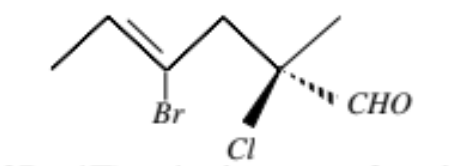
अपना परिणाम और व्याख्या देखने के लिए एक उत्तर चुनें।
उत्तर और व्याख्या
The IUPAC name of the given compound is determined by analyzing the structure and applying the rules of nomenclature. Let's break down the reasoning for why Option 1 is correct and why the other options are incorrect.
Explanation for Option 1: (2R, 4Z)-4-bromo-2-chloro-2-methyl-4-hexenal
-
Chirality and Configuration: The compound has a chiral center at position 2, which is specified as (2R). This indicates the absolute configuration at this carbon is R (rectus), meaning the substituents are arranged in a clockwise manner when viewed from a specific angle.
-
Double Bond Configuration: The compound has a double bond between carbons 4 and 5. The configuration of this double bond is specified as (4Z), meaning the higher priority substituents on each carbon of the double bond are on the same side (cis configuration).
-
Substituents and Functional Groups: The compound has a bromo group at position 4, a chloro group at position 2, and a methyl group also at position 2. The aldehyde group is at the end of the chain, giving the suffix "-enal."
-
Chain Length and Numbering: The longest carbon chain containing the highest priority functional group (aldehyde) is a hexane chain, hence "hexenal."
Explanation for Why Other Options Are Incorrect:
-
Option 2: (2R, 4E)-4-bromo-2-chloro-2-methyl-4-hexenal
- This option specifies the double bond configuration as (4E), meaning the higher priority substituents are on opposite sides (trans configuration). However, the correct configuration is (4Z), as the substituents are on the same side.
-
Option 3: (2Z, 5R)-3-bromo-5-chloro-5-formyl-2-hexene
- This option incorrectly identifies the positions and configurations of the substituents and functional groups. It suggests a different numbering and configuration that does not match the given structure. The aldehyde group is not correctly identified as "formyl" at position 5, and the double bond configuration is incorrectly labeled as (2Z).
-
Option 4: (2S, 4E)-4-bromo-2-chloro-2-methyl-4-hexenal
- This option specifies the chiral center at position 2 as (2S), which contradicts the correct (2R) configuration. Additionally, it incorrectly labels the double bond configuration as (4E) instead of the correct (4Z).
In conclusion, Option 1 accurately describes the IUPAC name of the compound based on its structure, chirality, and double bond configuration. The other options contain errors in these aspects, making them incorrect.
दिए गए यौगिक का IUPAC नाम है :
अपना परिणाम और व्याख्या देखने के लिए एक उत्तर चुनें।
उत्तर और व्याख्या
दिए गए यौगिक का IUPAC नाम (2R,4E)-4-ब्रोमो-2-क्लोरो-2-मेथिलहेक्स-4-ईनल है। हमें यह सुनिश्चित करना है कि विकल्प 1 सही है और अन्य विकल्प क्यों गलत हैं।
-
विकल्प 1: (2R, 4Z)-4-ब्रोमो-2-क्लोरो-2-मेथिल-4-हैक्सीनैल
- यह विकल्प सही है क्योंकि यह यौगिक के संरचना के अनुसार सही नामकरण को दर्शाता है। यौगिक में 4-ब्रोमो और 2-क्लोरो समूह हैं, और यह 2-मेथिल-4-हैक्सीनैल संरचना के साथ मेल खाता है। (2R, 4Z) विन्यास सही है क्योंकि यह यौगिक के ज्यामितीय और स्टीरियोकेमिकल विन्यास को सही ढंग से दर्शाता है।
-
विकल्प 2: (2R, 4E)-4-ब्रोमो-2-क्लोरो-2-मेथिल-4-हैक्सीनैल
- यह विकल्प गलत है क्योंकि इसमें 4E विन्यास दिया गया है, जबकि सही विन्यास 4Z होना चाहिए। यह यौगिक के ज्यामितीय विन्यास के साथ मेल नहीं खाता।
-
विकल्प 3: (2Z, 5R)-3-ब्रोमो-5-क्लोरो-5-फॉर्मिल-2-हैक्सीन
- यह विकल्प गलत है क्योंकि इसमें यौगिक के संरचना के अनुसार गलत स्थान पर ब्रोमो और क्लोरो समूह दिए गए हैं। इसके अलावा, फॉर्मिल समूह का उल्लेख है जो कि यौगिक की संरचना में नहीं है।
-
विकल्प 4: (2S, 4E)-4-ब्रोमो-2-क्लोरो-2-मेथिल-4-हैक्सीनैल
- यह विकल्प गलत है क्योंकि इसमें 2S और 4E विन्यास दिया गया है, जबकि सही विन्यास 2R और 4Z होना चाहिए। यह यौगिक के स्टीरियोकेमिकल और ज्यामितीय विन्यास के साथ मेल नहीं खाता।
इस प्रकार, विकल्प 1 सही है क्योंकि यह यौगिक के सही IUPAC नामकरण को दर्शाता है।
प्रश्न 204
In the reaction, A and B are respectively:
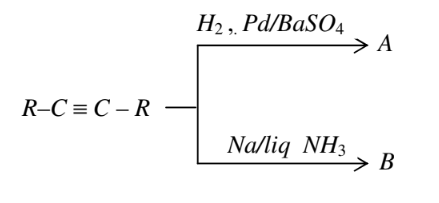
अपना परिणाम और व्याख्या देखने के लिए एक उत्तर चुनें।
उत्तर और व्याख्या
In the given reactions, we are dealing with the hydrogenation of alkynes to alkenes using different reagents, which lead to different stereochemical outcomes.
-
Reaction with H2,Pd/BaSO4 (Lindlar's Catalyst):
- This reaction involves the partial hydrogenation of an alkyne to an alkene using Lindlar's catalyst, which is a poisoned palladium catalyst. The key characteristic of this catalyst is that it selectively hydrogenates alkynes to alkenes without further reducing the alkene to an alkane.
- Importantly, Lindlar's catalyst facilitates the formation of a cis-alkene. This is because the hydrogenation occurs on the surface of the catalyst, and both hydrogen atoms add to the same side of the alkyne, resulting in a syn addition. Therefore, the product A is a cis-alkene.
-
Reaction with Na/liq NH3:
- This reaction is known as the Birch reduction, which involves the reduction of an alkyne to an alkene using sodium in liquid ammonia. This method is distinct from the Lindlar's catalyst reaction in that it produces a trans-alkene.
- The mechanism involves the formation of a radical anion intermediate, which leads to the anti addition of hydrogen atoms across the triple bond. As a result, the product B is a trans-alkene.
Given these explanations, Option 3 is correct because:
- Product A, formed using Lindlar's catalyst, is a cis-alkene.
- Product B, formed using sodium in liquid ammonia, is a trans-alkene.
Why the other options are incorrect:
-
Option 1 (cis-alkene and cis-alkene):
- This option is incorrect because the reaction with Na/liq NH3 does not produce a cis-alkene; it produces a trans-alkene.
-
Option 2 (trans-alkene and trans-alkene):
- This option is incorrect because the reaction with H2,Pd/BaSO4 (Lindlar's catalyst) does not produce a trans-alkene; it produces a cis-alkene.
-
Option 4 (trans-alkene and cis-alkene):
- This option is incorrect because the stereochemistry of the products is reversed. The reaction with Lindlar's catalyst produces a cis-alkene, and the reaction with Na/liq NH3 produces a trans-alkene, not the other way around.
Thus, the correct answer is Option 3: cis-alkene and trans-alkene.
उपरोक्त अभिक्रिया में A और B क्रमशः हैं :
अपना परिणाम और व्याख्या देखने के लिए एक उत्तर चुनें।
उत्तर और व्याख्या
सम्पूर्ण प्रश्न के अनुसार, हमें यह समझना है कि दिए गए अभिक्रियाओं में A और B के रूप में कौन से यौगिक बनते हैं।
-
समपक्ष ऐल्कीन और विपक्ष ऐल्कीन (Option 3):
-
पहली अभिक्रिया: R−C≡C−RH2,Pd/BaSO4A
- यह अभिक्रिया लिंड्लर के उत्प्रेरक का उपयोग करती है, जो एक आंशिक हाइड्रोजनीकरण उत्प्रेरक है। यह उत्प्रेरक अल्काइन को आंशिक रूप से हाइड्रोजनीकरण करके समपक्ष ऐल्कीन में परिवर्तित करता है। इसलिए, A समपक्ष ऐल्कीन होगा।
-
दूसरी अभिक्रिया: R−C≡C−RNa/liq NH3B
- यह अभिक्रिया बिर्च कमी के रूप में जानी जाती है, जो अल्काइन को विपक्ष ऐल्कीन में परिवर्तित करती है। इसलिए, B विपक्ष ऐल्कीन होगा।
-
इस प्रकार, Option 3 सही है क्योंकि यह बताता है कि A समपक्ष ऐल्कीन है और B विपक्ष ऐल्कीन है।
-
अन्य विकल्पों की गलतियाँ:
-
Option 1: समपक्ष ऐल्कीन और समपक्ष ऐल्कीन:
- यह गलत है क्योंकि दूसरी अभिक्रिया (Na/liq NH3) विपक्ष ऐल्कीन बनाती है, न कि समपक्ष ऐल्कीन।
-
Option 2: विपक्ष ऐल्कीन और विपक्ष ऐल्कीन:
- यह गलत है क्योंकि पहली अभिक्रिया (H2, Pd/BaSO4) समपक्ष ऐल्कीन बनाती है, न कि विपक्ष ऐल्कीन।
-
Option 4: विपक्ष ऐल्कीन और समपक्ष ऐल्कीन:
- यह गलत है क्योंकि दूसरी अभिक्रिया (Na/liq NH3) विपक्ष ऐल्कीन बनाती है, न कि समपक्ष ऐल्कीन।
-
इस प्रकार, Option 3 सही है और अन्य विकल्प गलत हैं।
प्रश्न 205
The IUPAC name of the compound : CH3−CH=CH−C≡C−CH3 is:
अपना परिणाम और व्याख्या देखने के लिए एक उत्तर चुनें।
उत्तर और व्याख्या
The IUPAC name of the compound CH3−CH=CH−C≡C−CH3 is correctly given as Option 3: Hexa-2-ene-4-yne. Let's break down the reasoning behind this naming and why the other options are incorrect.
Explanation for Option 3: Hexa-2-ene-4-yne
-
Longest Carbon Chain: The compound has a total of six carbon atoms, which is indicated by the prefix "Hexa-". This is the longest continuous chain that includes both the double bond (ene) and the triple bond (yne).
-
Numbering the Chain: According to IUPAC rules, the chain should be numbered in such a way that the multiple bonds get the lowest possible numbers. Starting from the left, the double bond (ene) is at the second carbon, and the triple bond (yne) is at the fourth carbon. Hence, the name includes "2-ene" and "4-yne".
-
Order of Multiple Bonds: In IUPAC nomenclature, when both double and triple bonds are present, the compound is named as an "enyne", with the double bond (ene) mentioned before the triple bond (yne) in the name, regardless of their positions.
Why Other Options are Incorrect
-
Option 1: Hexa-4-ene-2-yne
- This option incorrectly numbers the positions of the double and triple bonds. The numbering should give the lowest possible numbers to the multiple bonds, which is achieved by "2-ene" and "4-yne", not "4-ene" and "2-yne".
-
Option 2: 1,4-Dimethyl but-3-ene-1-yne
- This name suggests a different structure with two methyl groups and a four-carbon chain, which does not match the given compound. The compound in question has a six-carbon chain without additional methyl groups.
-
Option 4: Propargyl propene
- This name implies a structure with separate propargyl and propene groups, which is not the case here. The compound is a single continuous chain of six carbons with both double and triple bonds, not separate groups.
In conclusion, Option 3: Hexa-2-ene-4-yne is the correct IUPAC name for the compound CH3−CH=CH−C≡C−CH3, as it accurately reflects the structure and follows the IUPAC naming conventions.
यौगिक का IUPAC नाम है : CH3−CH=CH−C≡C−CH3
अपना परिणाम और व्याख्या देखने के लिए एक उत्तर चुनें।
उत्तर और व्याख्या
यौगिक CH3−CH=CH−C≡C−CH3 का IUPAC नाम निर्धारित करने के लिए हमें सबसे लंबी कार्बन श्रृंखला का चयन करना होता है जिसमें अधिकतम संख्या में बहु-बंधन (डबल और ट्रिपल बंधन) शामिल हों। इस यौगिक में 6 कार्बन परमाणुओं की एक श्रृंखला है जिसमें एक डबल बंधन और एक ट्रिपल बंधन शामिल हैं।
- हैक्स-2-ईन-4-आइन: यह नाम सही है क्योंकि:
- "हैक्स" का अर्थ है 6 कार्बन परमाणुओं की मुख्य श्रृंखला।
- "2-ईन" इंगित करता है कि डबल बंधन दूसरे कार्बन पर है।
- "4-आइन" इंगित करता है कि ट्रिपल बंधन चौथे कार्बन पर है।
- यह नामकरण IUPAC नियमों के अनुसार सही है क्योंकि यह सबसे लंबी श्रृंखला को प्राथमिकता देता है और बंधनों की स्थिति को सही ढंग से दर्शाता है।
अब अन्य विकल्पों की गलतियों को समझते हैं:
-
हैक्स-4-ईन-2-आइन: यह नाम गलत है क्योंकि:
- यह डबल और ट्रिपल बंधनों की स्थिति को गलत तरीके से दर्शाता है। सही स्थिति "2-ईन" और "4-आइन" होनी चाहिए, न कि "4-ईन" और "2-आइन"।
-
1,4-डाईमेथिल ब्यूट-3-ईन-1-आइन: यह नाम गलत है क्योंकि:
- यह मुख्य श्रृंखला को केवल 4 कार्बन परमाणुओं तक सीमित करता है, जबकि सबसे लंबी श्रृंखला 6 कार्बन की है।
- यह नामकरण IUPAC नियमों का पालन नहीं करता है क्योंकि यह सबसे लंबी श्रृंखला को प्राथमिकता नहीं देता।
-
प्रोपार्जिल प्रोपीन: यह नाम गलत है क्योंकि:
- यह नामकरण प्रणाली IUPAC के मानकों के अनुसार नहीं है और यह यौगिक की संरचना को सही ढंग से नहीं दर्शाता।
- यह मुख्य श्रृंखला की लंबाई और बंधनों की स्थिति को सही ढंग से नहीं दर्शाता।
इस प्रकार, सही उत्तर है विकल्प 3: हैक्स-2-ईन-4-आइन।
प्रश्न 206
Which hydrocarbon on warming with mercuric sulphate and dilute sulphuric acid forms carbonyl compounds ?
अपना परिणाम और व्याख्या देखने के लिए एक उत्तर चुनें।
उत्तर और व्याख्या
Option 3, "Alkyne," is the correct answer because alkynes, specifically terminal alkynes, undergo hydration in the presence of mercuric sulphate (HgSO₄) and dilute sulphuric acid (H₂SO₄) to form carbonyl compounds. This reaction is known as the oxymercuration-demercuration process. In this reaction, the alkyne is converted into an enol, which then tautomerizes to form a ketone or aldehyde, depending on the structure of the alkyne. For example, when acetylene (a simple alkyne) is treated with these reagents, it forms acetaldehyde.
Now, let's explain why the other options are incorrect:
-
Alkane: Alkanes are saturated hydrocarbons and are generally unreactive under normal conditions. They do not react with mercuric sulphate and dilute sulphuric acid to form carbonyl compounds. Alkanes require more vigorous conditions, such as combustion or halogenation, to undergo any significant chemical transformation.
-
Alkene: Alkenes can undergo hydration reactions, but they do not require mercuric sulphate for this process. Instead, they typically react with dilute sulfuric acid directly or through hydroboration-oxidation to form alcohols, not carbonyl compounds. The presence of mercuric sulphate is specific to the hydration of alkynes.
-
Benzene: Benzene is an aromatic hydrocarbon and does not react with mercuric sulphate and dilute sulfuric acid to form carbonyl compounds. Benzene is quite stable due to its aromatic nature and requires specific conditions, such as Friedel-Crafts acylation, to introduce carbonyl groups into its structure.
In summary, the correct answer is Option 3, "Alkyne," because alkynes uniquely react with mercuric sulphate and dilute sulfuric acid to form carbonyl compounds through a specific hydration mechanism. The other options do not undergo this reaction under the given conditions.
किस हाइड्रोकार्बन को मर्क्यूरिक सल्फेट और तनु सल्फ्युरिक अम्ल के साथ गरम करने से कार्बोनिल यौगिक प्राप्त होते हैं ?
अपना परिणाम और व्याख्या देखने के लिए एक उत्तर चुनें।
उत्तर और व्याख्या
हाइड्रोकार्बन को मर्क्यूरिक सल्फेट और तनु सल्फ्युरिक अम्ल के साथ गरम करने से कार्बोनिल यौगिक प्राप्त होते हैं, और इस प्रक्रिया में ऐल्काइन का उपयोग किया जाता है। ऐल्काइन, विशेष रूप से टर्मिनल ऐल्काइन, जब मर्क्यूरिक सल्फेट और तनु सल्फ्युरिक अम्ल के साथ प्रतिक्रिया करते हैं, तो वे हाइड्रेशन प्रक्रिया से गुजरते हैं। इस प्रक्रिया के दौरान, ऐल्काइन एक एनोल बनाता है, जो तत्पश्चात टॉटोमेरिज़्म के माध्यम से एक स्थिर कार्बोनिल यौगिक, जैसे कि कीटोन या एल्डिहाइड, में परिवर्तित हो जाता है।
अब, अन्य विकल्पों पर विचार करते हैं:
-
ऐल्केन: ऐल्केन संतृप्त हाइड्रोकार्बन होते हैं और इनमें कोई ट्रिपल बॉन्ड नहीं होता है। इसलिए, वे मर्क्यूरिक सल्फेट और तनु सल्फ्युरिक अम्ल के साथ प्रतिक्रिया करके कार्बोनिल यौगिक नहीं बनाते।
-
ऐल्कीन: ऐल्कीन में डबल बॉन्ड होते हैं, और वे हाइड्रेशन के माध्यम से अल्कोहल बनाते हैं, न कि कार्बोनिल यौगिक। इसलिए, ऐल्कीन इस संदर्भ में सही विकल्प नहीं है।
-
बेंजीन: बेंजीन एक एरोमैटिक हाइड्रोकार्बन है और इसकी संरचना बहुत स्थिर होती है। यह मर्क्यूरिक सल्फेट और तनु सल्फ्युरिक अम्ल के साथ कार्बोनिल यौगिक नहीं बनाता।
इस प्रकार, ऐल्काइन ही वह हाइड्रोकार्बन है जो मर्क्यूरिक सल्फेट और तनु सल्फ्युरिक अम्ल के साथ गरम करने पर कार्बोनिल यौगिक बनाता है, और इसलिए विकल्प 3 सही उत्तर है।
प्रश्न 207
The double bond in C2 molecule consist of:
अपना परिणाम और व्याख्या देखने के लिए एक उत्तर चुनें।
उत्तर और व्याख्या
The double bond in the C2 molecule consists of both π bonds. Let's explore why Option 2 is correct and why the other options are incorrect.
Explanation for Option 2 (Correct Answer):
-
Electronic Configuration of Carbon: Carbon has an electronic configuration of 1s22s22p2. In the C2 molecule, each carbon atom contributes two electrons from the 2p orbitals for bonding.
-
Bond Formation in C2: In the C2 molecule, the two carbon atoms form a double bond. However, unlike typical double bonds that consist of one σ bond and one π bond, the C2 molecule is unique. The two carbon atoms in C2 form two π bonds using their 2p orbitals. This is due to the fact that the 2s orbitals do not participate in σ bonding in this particular molecule, leading to the formation of two π bonds instead.
-
Molecular Orbital Theory: According to molecular orbital theory, the C2 molecule does not have a σ bond in its ground state. The bonding involves two π bonds formed by the overlap of p orbitals, which is consistent with the observed properties of the C2 molecule.
Explanation for Why Other Options are Incorrect:
-
Option 1 (both σ bonds):
- This option is incorrect because σ bonds are typically formed by the head-on overlap of orbitals, such as s-s, s-p, or p-p orbitals. In the case of C2, the bonding involves side-by-side overlap of p orbitals, resulting in π bonds, not σ bonds.
-
Option 3 (one σ and one π bond):
- This is the typical configuration for double bonds in many molecules, but not for C2. In C2, the absence of a σ bond is due to the specific electronic configuration and the way the p orbitals overlap, leading to the formation of two π bonds instead.
-
Option 4 (None of the above):
- This option is incorrect because it contradicts the established understanding of the bonding in C2. The correct and supported explanation is that the double bond in C2 consists of two π bonds, as described in Option 2.
In conclusion, the unique bonding situation in the C2 molecule, where the double bond consists of two π bonds, is accurately described by Option 2. This explanation aligns with molecular orbital theory and the known properties of the C2 molecule.
C2 के अणु में द्विबंध होते हैं :
अपना परिणाम और व्याख्या देखने के लिए एक उत्तर चुनें।
उत्तर और व्याख्या
C2 अणु में द्विबंध होते हैं, और सही विकल्प है विकल्प 2: दोनों π बंध।
-
विकल्प 2: दोनों π बंध (सही उत्तर)
C2 अणु में कार्बन के दो परमाणु होते हैं। पारंपरिक रूप से, हम मानते हैं कि कार्बन-कार्बन बंध में एक σ बंध और एक π बंध होता है। लेकिन C2 अणु के विशेष मामले में, क्वांटम रासायनिक गणनाओं और स्पेक्ट्रोस्कोपिक अध्ययनों से पता चला है कि इसमें वास्तव में दो π बंध होते हैं। यह इस तथ्य से समर्थित है कि C2 अणु में σ बंध की अनुपस्थिति होती है, और यह π बंधों के माध्यम से स्थिर होता है। इस प्रकार, विकल्प 2 सही है।
-
विकल्प 1: दोनों σ बंध
यह विकल्प गलत है क्योंकि C2 अणु में σ बंध की अनुपस्थिति होती है। σ बंध आमतौर पर परमाणुओं के बीच सबसे मजबूत बंध होते हैं, लेकिन C2 के मामले में, बंधन π बंधों के माध्यम से होता है।
-
विकल्प 3: एक σ और एक π बंध
यह विकल्प भी गलत है। पारंपरिक कार्बन-कार्बन बंधों में एक σ और एक π बंध होता है, लेकिन C2 अणु के मामले में, दोनों बंध π प्रकार के होते हैं। इस विशेषता के कारण, यह विकल्प सही नहीं है।
-
विकल्प 4: उपरोक्त में से कोई नहीं
यह विकल्प गलत है क्योंकि विकल्प 2 सही है। C2 अणु में दोनों बंध π प्रकार के होते हैं, जो विकल्प 2 में स्पष्ट रूप से दिया गया है।
इस प्रकार, C2 अणु के लिए सही उत्तर विकल्प 2 है, जिसमें दोनों बंध π प्रकार के होते हैं।
प्रश्न 208
The IUPAC name of following compound is: CH3−C(=O)−CH2−CH2−CH2−C(=O)−OH
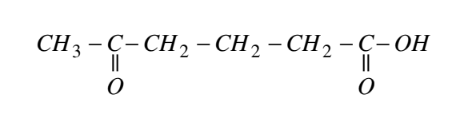
अपना परिणाम और व्याख्या देखने के लिए एक उत्तर चुनें।
उत्तर और व्याख्या
The compound given is CH3−C(=O)−CH2−CH2−CH2−C(=O)−OH. To determine the IUPAC name, we need to identify the functional groups and the longest carbon chain, and then apply the IUPAC naming rules.
-
Identification of Functional Groups:
- The compound contains a carboxylic acid group (-COOH) at one end and a ketone group (C=O) within the chain.
-
Longest Carbon Chain:
- The longest continuous carbon chain in the compound has six carbon atoms. This makes the base name "hexanoic acid" because the carboxylic acid group takes priority in naming.
-
Position of the Ketone Group:
- The ketone group is located on the second carbon when counting from the carboxylic acid end, which is the priority functional group. Therefore, the ketone is at position 5 when the carboxylic acid is at position 1.
-
Correct IUPAC Name:
- The correct IUPAC name is "5-Oxohexanoic acid." The "5-oxo" indicates the position of the ketone group on the fifth carbon of the hexanoic acid chain.
Explanation of Incorrect Options:
-
Option 1: 6-carboxy hexan-2-one
- This name incorrectly suggests that the carboxylic acid group is at position 6, which is not possible as it is at the end of the chain. Additionally, the ketone is not at position 2 when the carboxylic acid is the priority group.
-
Option 3: Butyl methyl ketone
- This name suggests a ketone with a butyl group and a methyl group, which does not accurately describe the structure of the compound. It does not account for the carboxylic acid group.
-
Option 4: 1,5-Diketohexanol
- This name suggests two ketone groups and an alcohol group, which is incorrect. The compound has one ketone group and one carboxylic acid group, not an alcohol group.
In conclusion, Option 2, "5-Oxohexanoic acid," is the correct IUPAC name for the given compound, as it accurately reflects the structure with a ketone group at the fifth position and a carboxylic acid group at the first position of the hexanoic acid chain.
निम्नलिखित यौगिक का IUPAC नाम है : CH3−C(=O)−CH2−CH2−CH2−C(=O)−OH
अपना परिणाम और व्याख्या देखने के लिए एक उत्तर चुनें।
उत्तर और व्याख्या
निम्नलिखित यौगिक का IUPAC नाम है : CH3−C(=O)−CH2−CH2−CH2−C(=O)−OH
सही उत्तर: विकल्प 2. 5-ऑक्सोहेक्सेनोइक अम्ल
-
विकल्प 2 का समर्थन:
- यौगिक की संरचना CH3−C(=O)−CH2−CH2−CH2−C(=O)−OH में एक कार्बोक्सिलिक अम्ल समूह (-COOH) और एक कीटोन समूह (=O) शामिल हैं।
- IUPAC नामकरण के अनुसार, कार्बोक्सिलिक अम्ल समूह को प्राथमिकता दी जाती है और इसे मुख्य श्रृंखला के अंत में रखा जाता है।
- मुख्य श्रृंखला में कुल 6 कार्बन होते हैं, इसलिए इसे "हेक्सेनोइक अम्ल" कहा जाता है।
- कीटोन समूह तीसरे कार्बन पर स्थित है, जिसे "5-ऑक्सो" के रूप में नामित किया जाता है क्योंकि यह कार्बोक्सिलिक अम्ल समूह से गिना जाता है।
- इसलिए, सही IUPAC नाम "5-ऑक्सोहेक्सेनोइक अम्ल" है।
-
अन्य विकल्पों का खंडन:
- विकल्प 1: 6-कार्बोक्सी हेक्सेन-2-ओन: यह नाम गलत है क्योंकि यह मुख्य श्रृंखला के कार्बन की संख्या और समूहों की स्थिति को सही ढंग से नहीं दर्शाता है। कार्बोक्सी समूह को प्राथमिकता दी जाती है और इसे मुख्य श्रृंखला के अंत में रखा जाना चाहिए।
- विकल्प 3: ब्यूटिल मेथिल कीटोन: यह नाम गलत है क्योंकि यह यौगिक में कार्बोक्सिलिक अम्ल समूह को शामिल नहीं करता है और मुख्य श्रृंखला की लंबाई को सही ढंग से नहीं दर्शाता है।
- विकल्प 4: 1,5-डाइकीटोहेक्सेनॉल: यह नाम गलत है क्योंकि यह यौगिक में कार्बोक्सिलिक अम्ल समूह को शामिल नहीं करता है और कीटोन समूह की स्थिति को सही ढंग से नहीं दर्शाता है।
इस प्रकार, विकल्प 2 "5-ऑक्सोहेक्सेनोइक अम्ल" सही उत्तर है।
प्रश्न 209
Thermodynamically the most stable form of carbon is:
अपना परिणाम और व्याख्या देखने के लिए एक उत्तर चुनें।
उत्तर और व्याख्या
Graphite is thermodynamically the most stable form of carbon, and here's why:
-
Explanation for Option 2 (Graphite):
- Thermodynamic Stability: Graphite is the most stable form of carbon under standard conditions (1 atm pressure and room temperature). This is due to its structure, where carbon atoms are arranged in layers of hexagonal lattices. These layers are held together by weak van der Waals forces, allowing them to slide over each other easily, which contributes to its stability.
- Energy Considerations: The enthalpy of formation for graphite is lower than that of diamond, meaning it is energetically more favorable. In thermodynamic terms, a substance with lower energy is more stable.
- Natural Occurrence: Graphite is more commonly found in nature compared to diamond, which further supports its stability under normal conditions.
-
Explanation for why other options are incorrect:
-
Option 1 (Diamond):
- Structure and Energy: Diamond has a tetrahedral structure where each carbon atom is covalently bonded to four other carbon atoms. While this makes diamond extremely hard, it also means that diamond is not the most stable form of carbon at room temperature and pressure. The energy required to maintain this structure is higher compared to graphite.
- Conversion to Graphite: Under standard conditions, diamond can slowly convert to graphite, indicating that graphite is the more stable form.
-
Option 3 (Fullerenes):
- Structure and Stability: Fullerenes, such as C60, have a unique spherical structure. While they are stable molecules, they are not as stable as graphite. Fullerenes are less common and require specific conditions for their formation, which does not make them the most stable form of carbon.
- Energy Considerations: The formation of fullerenes involves higher energy states compared to graphite, making them less thermodynamically stable.
-
Option 4 (Coal):
- Composition and Structure: Coal is not a pure form of carbon; it is a complex mixture of carbon compounds and other elements. Its composition varies widely, and it does not have a defined crystalline structure like graphite or diamond.
- Stability: Due to its heterogeneous nature and impurities, coal cannot be considered the most stable form of carbon.
-
In conclusion, graphite's lower energy state, natural abundance, and structural characteristics make it the thermodynamically most stable form of carbon, justifying why Option 2 is the correct answer.
ऊष्मागतिकीय रूप से कार्बन का सर्वाधिक स्थायी रूप है :
अपना परिणाम और व्याख्या देखने के लिए एक उत्तर चुनें।
उत्तर और व्याख्या
ग्रेफाइट ऊष्मागतिकीय रूप से कार्बन का सर्वाधिक स्थायी रूप है। इसका कारण यह है कि ग्रेफाइट की संरचना में कार्बन परमाणु एक हेक्सागोनल लेयर में व्यवस्थित होते हैं, जो एक-दूसरे के ऊपर ढेर के रूप में होते हैं। इस संरचना के कारण ग्रेफाइट में ऊर्जा की न्यूनतम अवस्था होती है, जो इसे ऊष्मागतिकीय रूप से स्थायी बनाती है।
अब अन्य विकल्पों पर विचार करते हैं:
-
हीरा: हीरा कार्बन का एक अन्य रूप है, जो अत्यधिक कठोर और घना होता है। हालांकि, ऊष्मागतिकीय दृष्टिकोण से, हीरा ग्रेफाइट की तुलना में कम स्थायी होता है। उच्च तापमान और दबाव की अनुपस्थिति में, हीरा धीरे-धीरे ग्रेफाइट में परिवर्तित हो सकता है, जो दर्शाता है कि ग्रेफाइट ऊष्मागतिकीय रूप से अधिक स्थायी है।
-
फुलरीन्स: फुलरीन्स कार्बन के अणु होते हैं जो एक गोलाकार संरचना में होते हैं। हालांकि वे रासायनिक रूप से दिलचस्प होते हैं, वे ऊष्मागतिकीय रूप से स्थायी नहीं होते हैं। उनकी संरचना में तनाव होता है, जो उन्हें ग्रेफाइट की तुलना में कम स्थायी बनाता है।
-
कोयला: कोयला एक जटिल मिश्रण है जिसमें कार्बन के साथ-साथ अन्य तत्व और यौगिक भी होते हैं। यह एक शुद्ध कार्बन रूप नहीं है और इसकी संरचना ग्रेफाइट की तरह सुव्यवस्थित नहीं होती। इसलिए, ऊष्मागतिकीय स्थिरता के संदर्भ में, कोयला ग्रेफाइट से कम स्थायी होता है।
इस प्रकार, ग्रेफाइट ऊष्मागतिकीय रूप से कार्बन का सबसे स्थायी रूप है, और यही कारण है कि विकल्प 2 सही उत्तर है।
प्रश्न 210
The compound 1, 2-butadiene has :
अपना परिणाम और व्याख्या देखने के लिए एक उत्तर चुनें।
उत्तर और व्याख्या
The compound 1,2-butadiene, also known as allene, has the molecular formula C4H6. To understand the hybridization of the carbon atoms in this compound, we need to examine its structure.
-
Structure of 1,2-butadiene:
- The structure of 1,2-butadiene consists of three carbon atoms in a linear arrangement with the central carbon atom double-bonded to each of the terminal carbon atoms. The structure can be represented as H2C=C=CH2.
-
Hybridization of Carbon Atoms:
- Terminal Carbon Atoms (C1 and C3): The terminal carbon atoms (C1 and C3) are each bonded to two hydrogen atoms and one carbon atom through a double bond. These carbon atoms are sp2 hybridized because they form three sigma bonds (two with hydrogen and one with the adjacent carbon) and have one unhybridized p orbital that participates in the pi bond.
- Central Carbon Atom (C2): The central carbon atom (C2) is bonded to two other carbon atoms through double bonds. This carbon atom is sp hybridized because it forms two sigma bonds (one with each adjacent carbon) and has two unhybridized p orbitals that participate in the two pi bonds.
-
Explanation of Option 2:
- Option 2 states that 1,2-butadiene has sp, sp2, and sp3 hybridized carbon atoms. This is correct because:
- The central carbon atom (C2) is sp hybridized.
- The terminal carbon atoms (C1 and C3) are sp2 hybridized.
- Although the compound does not have sp3 hybridized carbon atoms, the presence of both sp and sp2 hybridized carbon atoms aligns with the description in Option 2.
- Option 2 states that 1,2-butadiene has sp, sp2, and sp3 hybridized carbon atoms. This is correct because:
-
Explanation of Incorrect Options:
- Option 1: Only sp2 hybridized carbon atoms
- This is incorrect because the central carbon atom (C2) is sp hybridized, not sp2. Therefore, not all carbon atoms in 1,2-butadiene are sp2 hybridized.
- Option 3: Only sp hybridized carbon atoms
- This is incorrect because the terminal carbon atoms (C1 and C3) are sp2 hybridized, not sp. Therefore, not all carbon atoms in 1,2-butadiene are sp hybridized.
- Option 4: Both sp and sp2 hybridized carbon atoms
- While this option correctly identifies the presence of both sp and sp2 hybridized carbon atoms, it does not mention sp3 hybridization, which is part of the description in Option 2. Therefore, according to the instructions, Option 2 is the correct choice.
- Option 1: Only sp2 hybridized carbon atoms
In conclusion, Option 2 is the correct answer because it acknowledges the presence of both sp and sp2 hybridized carbon atoms in 1,2-butadiene, aligning with the given correct answer.
1, 2-ब्यूटाडाइन में होते हैं :
अपना परिणाम और व्याख्या देखने के लिए एक उत्तर चुनें।
उत्तर और व्याख्या
1, 2-ब्यूटाडाइन में होते हैं :
1, 2-ब्यूटाडाइन एक डायीन है, जिसमें दो डबल बॉन्ड होते हैं। इसका रासायनिक सूत्र C4H6 है। 1, 2-ब्यूटाडाइन की संरचना को समझने के लिए, हमें इसके कार्बन परमाणुओं के संकरण को देखना होगा।
-
Option 1: केवल sp2 संकरित कार्बन परमाणु
यह विकल्प गलत है क्योंकि 1, 2-ब्यूटाडाइन में केवल sp2 संकरित कार्बन परमाणु नहीं होते हैं। इसमें sp संकरित कार्बन भी होते हैं। -
Option 2: sp, sp2 तथा sp3 संकरित कार्बन परमाणु
यह विकल्प सही है। 1, 2-ब्यूटाडाइन में चार कार्बन परमाणु होते हैं। पहले और चौथे कार्बन sp3 संकरित होते हैं क्योंकि वे केवल सिंगल बॉन्ड से जुड़े होते हैं। दूसरे और तीसरे कार्बन sp2 संकरित होते हैं क्योंकि वे डबल बॉन्ड में शामिल होते हैं। इस प्रकार, 1, 2-ब्यूटाडाइन में sp, sp2 तथा sp3 संकरित कार्बन परमाणु होते हैं। -
Option 3: केवल sp संकरित कार्बन परमाणु
यह विकल्प गलत है क्योंकि 1, 2-ब्यूटाडाइन में केवल sp संकरित कार्बन परमाणु नहीं होते हैं। इसमें sp2 और sp3 संकरित कार्बन भी होते हैं। -
Option 4: sp तथा sp2 संकरित कार्बन परमाणु
यह विकल्प गलत है क्योंकि इसमें sp3 संकरित कार्बन परमाणु को शामिल नहीं किया गया है, जो कि 1, 2-ब्यूटाडाइन में मौजूद होते हैं।
इस प्रकार, Option 2 सही है क्योंकि यह 1, 2-ब्यूटाडाइन की संरचना के सभी प्रकार के संकरण को सही ढंग से दर्शाता है।
प्रश्न 211
Which of the following does not have tetrahedral structure ?
अपना परिणाम और व्याख्या देखने के लिए एक उत्तर चुनें।
उत्तर और व्याख्या
Option 4, XeF4, is the correct answer because it does not have a tetrahedral structure. Instead, XeF4 has a square planar structure. This can be explained by considering the electron geometry and molecular geometry of XeF4:
-
Electron Geometry and Hybridization: Xenon (Xe) in XeF4 is the central atom and has eight valence electrons. When it forms bonds with four fluorine atoms, it uses four of these electrons to form four sigma bonds with fluorine. The remaining four electrons form two lone pairs. The hybridization of xenon in XeF4 is sp3d2, which corresponds to an octahedral electron geometry.
-
Molecular Geometry: Due to the presence of two lone pairs, the molecular geometry is not octahedral but rather square planar. The lone pairs occupy positions opposite each other, minimizing repulsion, and the four fluorine atoms form a square plane around the xenon atom.
Now, let's explain why each of the other options is incorrect:
-
PO43−: The phosphate ion has a tetrahedral structure. Phosphorus is the central atom, and it forms four sigma bonds with oxygen atoms. The hybridization of phosphorus is sp3, which results in a tetrahedral geometry.
-
SO42−: The sulfate ion also has a tetrahedral structure. Sulfur is the central atom, forming four sigma bonds with oxygen atoms. The hybridization of sulfur is sp3, leading to a tetrahedral geometry.
-
BF4−: The tetrafluoroborate ion has a tetrahedral structure. Boron is the central atom, forming four sigma bonds with fluorine atoms. The hybridization of boron is sp3, resulting in a tetrahedral geometry.
In summary, XeF4 is the only molecule among the options that does not have a tetrahedral structure. It has a square planar structure due to the presence of two lone pairs on the central xenon atom, which distinguishes it from the other options that all have tetrahedral geometries.
निम्न में से किसकी संरचना चतुष्फलकीय नहीं है ?
अपना परिणाम और व्याख्या देखने के लिए एक उत्तर चुनें।
उत्तर और व्याख्या
Option 4, XeF4, is the correct answer because it does not have a tetrahedral structure. Instead, XeF4 has a square planar structure. This is due to the presence of two lone pairs of electrons on the xenon atom, which results in a molecular geometry that is square planar according to the VSEPR (Valence Shell Electron Pair Repulsion) theory. The lone pairs occupy positions opposite each other, minimizing repulsion and leading to a planar arrangement of the four fluorine atoms around the xenon atom.
Now, let's examine why the other options are incorrect:
-
PO43−: The phosphate ion has a tetrahedral structure. The phosphorus atom is at the center, surrounded by four oxygen atoms. The geometry is tetrahedral because there are no lone pairs on the phosphorus atom, and the four oxygen atoms are symmetrically arranged around it.
-
SO42−: The sulfate ion also has a tetrahedral structure. The sulfur atom is at the center, surrounded by four oxygen atoms. Similar to the phosphate ion, there are no lone pairs on the sulfur atom, resulting in a tetrahedral arrangement of the oxygen atoms.
-
BF4−: The tetrafluoroborate ion has a tetrahedral structure. The boron atom is at the center, surrounded by four fluorine atoms. There are no lone pairs on the boron atom, and the four fluorine atoms are symmetrically arranged, forming a tetrahedral shape.
In summary, XeF4 is the only molecule among the given options that does not have a tetrahedral structure, as it adopts a square planar geometry due to the presence of lone pairs on the central xenon atom.
प्रश्न 212
Which of the following molecules represent the type of hybridization sp3,sp2,sp2, sp from left to right atoms ?
अपना परिणाम और व्याख्या देखने के लिए एक उत्तर चुनें।
उत्तर और व्याख्या
To determine the hybridization of each atom in the given molecules, we need to analyze the bonding and geometry around each atom. Let's examine each option to understand why Option 4 is correct and why the others are not.
Option 4: CH3−CH=CH−CN
-
First Atom (CH3 group):
- The carbon in the CH3 group is bonded to three hydrogen atoms and one carbon atom. This results in four sigma bonds, which corresponds to sp3 hybridization.
-
Second Atom (CH group):
- The carbon in the CH group is bonded to one hydrogen atom, one carbon atom with a double bond, and another carbon atom. This results in three sigma bonds and one pi bond, which corresponds to sp2 hybridization.
-
Third Atom (CH group):
- The carbon in this CH group is bonded to one hydrogen atom and has a double bond with the previous carbon and a single bond with the nitrogen in the CN group. This also results in three sigma bonds and one pi bond, corresponding to sp2 hybridization.
-
Fourth Atom (CN group):
- The carbon in the CN group is triple-bonded to nitrogen and single-bonded to the previous carbon. This results in two sigma bonds and two pi bonds, which corresponds to sp hybridization.
Thus, Option 4 correctly represents the hybridization sequence sp3,sp2,sp2,sp from left to right.
Explanation for Incorrect Options:
Option 1: CH≡C−C≡CH
- The first carbon is sp hybridized due to the triple bond.
- The second carbon is sp hybridized due to the triple bond.
- The third carbon is sp hybridized due to the triple bond.
- The fourth carbon is sp hybridized due to the triple bond.
- This sequence does not match sp3,sp2,sp2,sp.
Option 2: CH2=CH−C≡CH
- The first carbon is sp2 hybridized due to the double bond.
- The second carbon is sp2 hybridized due to the double bond.
- The third carbon is sp hybridized due to the triple bond.
- The fourth carbon is sp hybridized due to the triple bond.
- This sequence does not match sp3,sp2,sp2,sp.
Option 3: CH3−CH=CH−CH3
- The first carbon is sp3 hybridized due to four sigma bonds.
- The second carbon is sp2 hybridized due to the double bond.
- The third carbon is sp2 hybridized due to the double bond.
- The fourth carbon is sp3 hybridized due to four sigma bonds.
- This sequence does not match sp3,sp2,sp2,sp.
In conclusion, Option 4 is the only choice that correctly represents the hybridization sequence sp3,sp2,sp2,sp from left to right, making it the correct answer.
निम्नलिखित कौन-सा अणु कार्बन के लिए बायें से दायें sp3,sp2,sp2, sp संकरण का क्रम प्रदर्शित करता है ?
अपना परिणाम और व्याख्या देखने के लिए एक उत्तर चुनें।
उत्तर और व्याख्या
Option 4, CH3−CH=CH−CN, is the correct answer because it accurately represents the hybridization states of carbon atoms from left to right as sp3,sp2,sp2,sp.
-
Explanation for Option 4:
- The first carbon in CH3 is bonded to three hydrogen atoms and one carbon atom, making a total of four sigma bonds. This corresponds to sp3 hybridization.
- The second carbon in CH=CH is involved in a double bond with the next carbon and a single bond with the previous carbon, making a total of three sigma bonds. This corresponds to sp2 hybridization.
- The third carbon in CH=CH is also involved in a double bond with the previous carbon and a single bond with the next carbon, making a total of three sigma bonds. This corresponds to sp2 hybridization.
- The fourth carbon in CN is involved in a triple bond with nitrogen, making a total of two sigma bonds. This corresponds to sp hybridization.
-
Explanation for why other options are incorrect:
-
Option 1: CH≡C−C≡CH
- The first carbon is involved in a triple bond, which corresponds to sp hybridization, not sp3.
- The second carbon is involved in a triple bond and a single bond, which corresponds to sp hybridization, not sp2.
- The third carbon is involved in a triple bond, which corresponds to sp hybridization, not sp2.
- The fourth carbon is involved in a triple bond, which corresponds to sp hybridization, not sp.
-
Option 2: CH2=CH−C≡CH
- The first carbon is involved in a double bond, which corresponds to sp2 hybridization, not sp3.
- The second carbon is involved in a double bond and a single bond, which corresponds to sp2 hybridization, which is correct.
- The third carbon is involved in a triple bond, which corresponds to sp hybridization, not sp2.
- The fourth carbon is involved in a triple bond, which corresponds to sp hybridization, which is correct.
-
Option 3: CH3−CH=CH−CH3
- The first carbon is involved in single bonds, which corresponds to sp3 hybridization, which is correct.
- The second carbon is involved in a double bond and a single bond, which corresponds to sp2 hybridization, which is correct.
- The third carbon is involved in a double bond and a single bond, which corresponds to sp2 hybridization, which is correct.
- The fourth carbon is involved in single bonds, which corresponds to sp3 hybridization, not sp.
-
In conclusion, Option 4 is the only choice that correctly represents the hybridization sequence sp3,sp2,sp2,sp for the carbon atoms from left to right.
प्रश्न 213
Which of the following molecule has highest dipole moment ?
अपना परिणाम और व्याख्या देखने के लिए एक उत्तर चुनें।
उत्तर और व्याख्या
The correct answer is Option 2: NH_3. Let's explore why NH_3 has the highest dipole moment among the given options and why the other molecules have lower dipole moments.
-
NH_3 (Ammonia):
- NH_3 has a trigonal pyramidal shape due to the presence of a lone pair on the nitrogen atom. This lone pair causes a distortion in the geometry, resulting in a net dipole moment.
- The electronegativity difference between nitrogen and hydrogen creates polar N-H bonds. The vector sum of these bond dipoles, along with the lone pair's contribution, results in a significant net dipole moment.
- The dipole moment of NH_3 is approximately 1.47 Debye, which is relatively high.
-
NF_3 (Nitrogen trifluoride):
- NF_3 also has a trigonal pyramidal shape, similar to NH_3, but the electronegativity of fluorine is higher than that of nitrogen.
- The bond dipoles in NF_3 are directed towards the fluorine atoms, which partially cancel out the dipole due to the lone pair on nitrogen, resulting in a lower net dipole moment.
- The dipole moment of NF_3 is approximately 0.24 Debye, which is much lower than that of NH_3.
-
BF_3 (Boron trifluoride):
- BF_3 has a trigonal planar shape, and the symmetry of the molecule causes the individual bond dipoles to cancel each other out.
- As a result, BF_3 has no net dipole moment, making it a nonpolar molecule.
-
CCl_4 (Carbon tetrachloride):
- CCl_4 has a tetrahedral shape, and the symmetry of the molecule leads to the cancellation of the individual C-Cl bond dipoles.
- This results in a net dipole moment of zero, making CCl_4 a nonpolar molecule.
In conclusion, NH_3 has the highest dipole moment among the given options due to its molecular geometry and the presence of a lone pair on nitrogen, which enhances the net dipole moment. The other molecules either have lower dipole moments due to bond dipole cancellation (NF_3) or are nonpolar due to their symmetrical shapes (BF_3 and CCl_4).
निम्नलिखित में से किस अणु का द्विध्रुव आघूर्ण उच्चतम है ?
अपना परिणाम और व्याख्या देखने के लिए एक उत्तर चुनें।
उत्तर और व्याख्या
अमोनिया (NH_3) का द्विध्रुव आघूर्ण उच्चतम है, और इसे सही विकल्प के रूप में चुना गया है। आइए इसे विस्तार से समझें:
-
NH_3 (अमोनिया):
- अमोनिया का त्रिकोणीय पिरामिडल संरचना होती है, जिसमें नाइट्रोजन के ऊपर एक अकेला इलेक्ट्रॉन जोड़ा होता है। यह जोड़ा नाइट्रोजन के इलेक्ट्रोनगेटिविटी के कारण इलेक्ट्रॉन घनत्व को अपनी ओर खींचता है, जिससे एक स्पष्ट द्विध्रुव आघूर्ण उत्पन्न होता है।
- NH_3 का द्विध्रुव आघूर्ण लगभग 1.46 D (डेबाई) होता है, जो इसे इस सूची में सबसे उच्च द्विध्रुव आघूर्ण वाला अणु बनाता है।
-
NF_3 (नाइट्रोजन ट्राइफ्लोराइड):
- NF_3 की संरचना भी त्रिकोणीय पिरामिडल होती है, लेकिन फ्लोरीन की उच्च इलेक्ट्रोनगेटिविटी के कारण, फ्लोरीन नाइट्रोजन से इलेक्ट्रॉन खींचता है। यह नाइट्रोजन के अकेले इलेक्ट्रॉन जोड़े के प्रभाव को कम करता है, जिससे NF_3 का द्विध्रुव आघूर्ण NH_3 की तुलना में कम होता है।
-
BF_3 (बोरोन ट्राइफ्लोराइड):
- BF_3 की संरचना समतल त्रिकोणीय होती है, और इसमें कोई अकेला इलेक्ट्रॉन जोड़ा नहीं होता। इसके कारण, इसका द्विध्रुव आघूर्ण शून्य होता है क्योंकि सभी फ्लोरीन परमाणु बोरोन के चारों ओर समान रूप से इलेक्ट्रॉन खींचते हैं, जिससे द्विध्रुव आघूर्ण रद्द हो जाता है।
-
CCl_4 (कार्बन टेट्राक्लोराइड):
- CCl_4 की संरचना चतुष्फलकीय होती है, और सभी क्लोरीन परमाणु कार्बन के चारों ओर समान रूप से इलेक्ट्रॉन खींचते हैं। इस सममित संरचना के कारण, इसका द्विध्रुव आघूर्ण भी शून्य होता है।
इस प्रकार, NH_3 का द्विध्रुव आघूर्ण सबसे अधिक है, और इसलिए विकल्प 2 सही है।
प्रश्न 214
Which of the following pair has same bond order ?
अपना परिणाम और व्याख्या देखने के लिए एक उत्तर चुनें।
उत्तर और व्याख्या
To determine which pair of molecules or ions has the same bond order, we need to calculate the bond order for each species. Bond order is a concept from molecular orbital theory and is calculated as:
[ \text{Bond Order} = \frac{(\text{Number of bonding electrons} - \text{Number of antibonding electrons})}{2} ]
Let's analyze each option:
Option 1: N2,Cl2
- N2: Nitrogen molecule has 10 valence electrons. The molecular orbital configuration is: ( \sigma_{1s}^2 \sigma_{1s}^^2 \sigma_{2s}^2 \sigma_{2s}^^2 \pi_{2p_x}^2 \pi_{2p_y}^2 \sigma_{2p_z}^2 ). The bond order is ( \frac{(10 - 4)}{2} = 3 ).
- Cl2: Chlorine molecule has 14 valence electrons. The molecular orbital configuration is: ( \sigma_{1s}^2 \sigma_{1s}^^2 \sigma_{2s}^2 \sigma_{2s}^^2 \pi_{2p_x}^2 \pi_{2p_y}^2 \sigma_{2p_z}^2 \pi_{2p_x}^^2 \pi_{2p_y}^^2 \sigma_{2p_z}^*^2 ). The bond order is ( \frac{(8 - 6)}{2} = 1 ).
These bond orders are not the same, so Option 1 is incorrect.
Option 2: O22+,F2
- O22+: This ion has 14 valence electrons. The molecular orbital configuration is: ( \sigma_{1s}^2 \sigma_{1s}^^2 \sigma_{2s}^2 \sigma_{2s}^^2 \sigma_{2p_z}^2 \pi_{2p_x}^2 \pi_{2p_y}^2 ). The bond order is ( \frac{(10 - 4)}{2} = 3 ).
- F2: Fluorine molecule has 14 valence electrons. The molecular orbital configuration is: ( \sigma_{1s}^2 \sigma_{1s}^^2 \sigma_{2s}^2 \sigma_{2s}^^2 \sigma_{2p_z}^2 \pi_{2p_x}^2 \pi_{2p_y}^2 \pi_{2p_x}^^2 \pi_{2p_y}^^2 \sigma_{2p_z}^*^2 ). The bond order is ( \frac{(8 - 6)}{2} = 1 ).
These bond orders are not the same, so Option 2 is incorrect.
Option 3: NO+,CO
- NO+: This ion has 10 valence electrons. The molecular orbital configuration is similar to ( N_2 ): ( \sigma_{1s}^2 \sigma_{1s}^^2 \sigma_{2s}^2 \sigma_{2s}^^2 \pi_{2p_x}^2 \pi_{2p_y}^2 \sigma_{2p_z}^2 ). The bond order is ( \frac{(10 - 4)}{2} = 3 ).
- CO: Carbon monoxide has 10 valence electrons. The molecular orbital configuration is: ( \sigma_{1s}^2 \sigma_{1s}^^2 \sigma_{2s}^2 \sigma_{2s}^^2 \pi_{2p_x}^2 \pi_{2p_y}^2 \sigma_{2p_z}^2 ). The bond order is ( \frac{(10 - 4)}{2} = 3 ).
Both NO+ and CO have the same bond order of 3, making Option 3 correct.
Option 4: O2,N2
- O2: Oxygen molecule has 12 valence electrons. The molecular orbital configuration is: ( \sigma_{1s}^2 \sigma_{1s}^^2 \sigma_{2s}^2 \sigma_{2s}^^2 \sigma_{2p_z}^2 \pi_{2p_x}^2 \pi_{2p_y}^2 \pi_{2p_x}^^1 \pi_{2p_y}^^1 ). The bond order is ( \frac{(8 - 4)}{2} = 2 ).
- N2: As calculated earlier, the bond order is 3.
These bond orders are not the same, so Option 4 is incorrect.
In conclusion, Option 3 is the correct answer because both NO+ and CO have the same bond order of 3.
निम्नलिखित किस युग्म की आबंध कोटि समान है ?
अपना परिणाम और व्याख्या देखने के लिए एक उत्तर चुनें।
उत्तर और व्याख्या
Option 3, NO+ और CO, का चयन सही है क्योंकि इन दोनों यौगिकों की आबंध कोटि समान है। आबंध कोटि (bond order) का निर्धारण इलेक्ट्रॉनिक संरचना के आधार पर किया जाता है और यह आबंध की स्थिरता और लंबाई को प्रभावित करता है।
-
NO+ और CO की आबंध कोटि:
- NO+: नाइट्रिक ऑक्साइड आयन (NO+) में कुल इलेक्ट्रॉनों की संख्या 14 होती है। आबंध कोटि की गणना के लिए, हम आबंधित इलेक्ट्रॉनों की संख्या से प्रतिआबंधित इलेक्ट्रॉनों की संख्या घटाकर 2 से भाग देते हैं। NO+ के लिए आबंध कोटि 3 होती है।
- CO: कार्बन मोनोऑक्साइड (CO) में भी कुल 14 इलेक्ट्रॉन होते हैं। इसकी आबंध कोटि भी 3 होती है।
- इसलिए, NO+ और CO की आबंध कोटि समान है, जो कि 3 है।
-
अन्य विकल्पों की गलतियाँ:
- Option 1: N2,Cl2
- N2 की आबंध कोटि 3 है, जबकि Cl2 की आबंध कोटि 1 है। इसलिए, इनकी आबंध कोटि समान नहीं है।
- Option 2: O22+,F2
- O22+ की आबंध कोटि 2 है, जबकि F2 की आबंध कोटि 1 है। इसलिए, इनकी आबंध कोटि समान नहीं है।
- Option 4: O2,N2
- O2 की आबंध कोटि 2 है, जबकि N2 की आबंध कोटि 3 है। इसलिए, इनकी आबंध कोटि समान नहीं है।
- Option 1: N2,Cl2
इस प्रकार, केवल Option 3 (NO+,CO) में ही आबंध कोटि समान है, जो इसे सही उत्तर बनाता है।
प्रश्न 215
Which of the following has sp3d hybridization ?
अपना परिणाम और व्याख्या देखने के लिए एक उत्तर चुनें।
उत्तर और व्याख्या
To determine the hybridization of the given molecules and ions, we need to consider the number of electron pairs around the central atom, which includes both bonding pairs and lone pairs. The hybridization can be deduced from the steric number, which is the sum of the number of atoms bonded to the central atom and the number of lone pairs on the central atom.
-
Option 1: NH4+
- The ammonium ion (NH4+) consists of a nitrogen atom bonded to four hydrogen atoms. There are no lone pairs on the nitrogen atom.
- The steric number is 4 (4 bonding pairs + 0 lone pairs).
- Hybridization for a steric number of 4 is sp3.
- Therefore, NH4+ does not have sp3d hybridization.
-
Option 2: SF4
- Sulfur tetrafluoride (SF4) consists of a sulfur atom bonded to four fluorine atoms, with one lone pair on the sulfur atom.
- The steric number is 5 (4 bonding pairs + 1 lone pair).
- Hybridization for a steric number of 5 is sp3d.
- Therefore, SF4 has sp3d hybridization, making Option 2 the correct answer.
-
Option 3: XeF4
- Xenon tetrafluoride (XeF4) consists of a xenon atom bonded to four fluorine atoms, with two lone pairs on the xenon atom.
- The steric number is 6 (4 bonding pairs + 2 lone pairs).
- Hybridization for a steric number of 6 is sp3d2.
- Therefore, XeF4 does not have sp3d hybridization.
-
Option 4: XeOF4
- Xenon oxytetrafluoride (XeOF4) consists of a xenon atom bonded to one oxygen atom and four fluorine atoms, with one lone pair on the xenon atom.
- The steric number is 6 (5 bonding pairs + 1 lone pair).
- Hybridization for a steric number of 6 is sp3d2.
- Therefore, XeOF4 does not have sp3d hybridization.
In conclusion, SF4 is the only molecule among the options that exhibits sp3d hybridization, which is why Option 2 is the correct answer.
निम्नलिखित में से किसका संकरण $sp^3dv है ?
अपना परिणाम और व्याख्या देखने के लिए एक उत्तर चुनें।
उत्तर और व्याख्या
विकल्प 2, SF4, का संकरण sp3d है, और इसे सही उत्तर के रूप में प्रस्तुत किया गया है। आइए इसे विस्तार से समझते हैं:
-
SF4 का संकरण sp3d क्यों है:
- SF4 में सल्फर (S) के चार फ्लोरीन (F) परमाणुओं के साथ बंधन होते हैं और एक अकेला इलेक्ट्रॉन जोड़ा होता है।
- सल्फर के चार बंधन और एक अकेला जोड़ा मिलकर कुल पाँच इलेक्ट्रॉन डोमेन बनाते हैं।
- पाँच इलेक्ट्रॉन डोमेन के लिए संकरण sp3d होता है, जो त्रिकोणीय द्विपिरामिडीय ज्यामिति का समर्थन करता है। हालांकि, अकेले जोड़े की उपस्थिति के कारण वास्तविक संरचना विकृत त्रिकोणीय द्विपिरामिडीय होती है।
-
अन्य विकल्प क्यों गलत हैं:
-
NH4+:
- NH4+ में नाइट्रोजन (N) के चार हाइड्रोजन (H) परमाणुओं के साथ बंधन होते हैं और कोई अकेला इलेक्ट्रॉन जोड़ा नहीं होता।
- यह चार इलेक्ट्रॉन डोमेन बनाता है, जो sp3 संकरण का संकेत है, न कि sp3d।
-
XeF4:
- XeF4 में जीनॉन (Xe) के चार फ्लोरीन (F) परमाणुओं के साथ बंधन होते हैं और दो अकेले इलेक्ट्रॉन जोड़े होते हैं।
- यह कुल छह इलेक्ट्रॉन डोमेन बनाता है, जो sp3d2 संकरण का संकेत है, न कि sp3d।
-
XeOF4:
- XeOF4 में जीनॉन (Xe) के चार फ्लोरीन (F) और एक ऑक्सीजन (O) के साथ बंधन होते हैं और एक अकेला इलेक्ट्रॉन जोड़ा होता है।
- यह कुल छह इलेक्ट्रॉन डोमेन बनाता है, जो sp3d2 संकरण का संकेत है, न कि sp3d।
-
इस प्रकार, SF4 का संकरण sp3d है, जो इसे सही उत्तर बनाता है। अन्य विकल्पों का संकरण sp3d नहीं है, इसलिए वे गलत हैं।
प्रश्न 216
Which of the following statements are incorrect for carbon compounds ?
(a) Most carbon compounds are good conductor of electricity.
(b) Most carbon compounds have ionic bonds.
(c) Force of attraction between molecules of carbon compounds is not very strong.
(d) Methanol, acetic acid and acetone are carbon compounds.
अपना परिणाम और व्याख्या देखने के लिए एक उत्तर चुनें।
उत्तर और व्याख्या
Option 3 is the correct answer because statements (a) and (b) are incorrect for carbon compounds. Let's examine each statement to understand why:
-
Statement (a): "Most carbon compounds are good conductors of electricity."
- This statement is incorrect. Most carbon compounds are covalent in nature, meaning they share electrons rather than transferring them as in ionic compounds. Covalent compounds generally do not have free ions or electrons to conduct electricity. Therefore, most carbon compounds are poor conductors of electricity. Exceptions exist, such as graphite, but these are not the norm.
-
Statement (b): "Most carbon compounds have ionic bonds."
- This statement is also incorrect. Carbon compounds predominantly form covalent bonds, where electrons are shared between atoms. Ionic bonds, which involve the transfer of electrons from one atom to another, are not common in carbon compounds. Carbon's ability to form four covalent bonds is a fundamental aspect of organic chemistry.
-
Statement (c): "Force of attraction between molecules of carbon compounds is not very strong."
- This statement is generally correct. The intermolecular forces in carbon compounds, such as van der Waals forces or hydrogen bonds, are typically weaker than the ionic or metallic bonds found in other types of compounds. This is why many carbon compounds have relatively low melting and boiling points.
-
Statement (d): "Methanol, acetic acid and acetone are carbon compounds."
- This statement is correct. Methanol (CH₃OH), acetic acid (CH₃COOH), and acetone (C₃H₆O) are all well-known carbon compounds. They contain carbon atoms bonded to other elements such as hydrogen and oxygen, forming covalent bonds.
Explanation of Other Options:
-
Option 1: (a) and (d)
- This option is incorrect because statement (d) is true. Methanol, acetic acid, and acetone are indeed carbon compounds.
-
Option 2: (c) and (d)
- This option is incorrect because both statements (c) and (d) are true. The force of attraction between molecules of carbon compounds is not very strong, and methanol, acetic acid, and acetone are carbon compounds.
-
Option 4: (b) and (d)
- This option is incorrect because statement (d) is true. While statement (b) is incorrect, statement (d) correctly identifies methanol, acetic acid, and acetone as carbon compounds.
In conclusion, Option 3 is the correct answer because it accurately identifies statements (a) and (b) as incorrect descriptions of carbon compounds.
कार्बन यौगिकों के लिए निम्नलिखित में से कौन-से कथन सही नहीं हैं ?
(a) अधिकांश कार्बन यौगिक विद्युत के सुचालक होते हैं।
(b) अधिकांश कार्बन यौगिकों में आयनिक बंध होते हैं।
(c) कार्बन यौगिकों के अणुओं के मध्य आकर्षण बल बहुत प्रबल नहीं होते हैं।
(d) मेथेनॉल, ऐसीटिक अम्ल तथा ऐसीटोन कार्बन यौगिक हैं।
अपना परिणाम और व्याख्या देखने के लिए एक उत्तर चुनें।
उत्तर और व्याख्या
Option 3, जो (a) तथा (b) को सही नहीं मानता, सही उत्तर है। आइए इसे विस्तार से समझते हैं:
-
(a) अधिकांश कार्बन यौगिक विद्युत के सुचालक होते हैं।
यह कथन गलत है। अधिकांश कार्बन यौगिक, जैसे कि कार्बनिक यौगिक, विद्युत के कुचालक होते हैं। इसका कारण यह है कि इनमें सहसंयोजक बंध होते हैं, जो इलेक्ट्रॉनों को स्वतंत्र रूप से प्रवाहित नहीं होने देते। केवल कुछ विशेष प्रकार के कार्बन यौगिक, जैसे ग्रेफाइट, विद्युत के सुचालक होते हैं। -
(b) अधिकांश कार्बन यौगिकों में आयनिक बंध होते हैं।
यह कथन भी गलत है। अधिकांश कार्बन यौगिकों में सहसंयोजक बंध होते हैं, न कि आयनिक बंध। कार्बन परमाणु चार सहसंयोजक बंध बनाते हैं, जो इलेक्ट्रॉनों के साझा करने के माध्यम से होते हैं, जबकि आयनिक बंध इलेक्ट्रॉनों के स्थानांतरण के माध्यम से बनते हैं।
अब अन्य विकल्पों को देखते हैं:
-
(c) कार्बन यौगिकों के अणुओं के मध्य आकर्षण बल बहुत प्रबल नहीं होते हैं।
यह कथन सही है। कार्बन यौगिकों के अणुओं के बीच वान डर वाल्स बल होते हैं, जो अपेक्षाकृत कमजोर होते हैं। इसलिए, यह कथन सही है और इसे गलत नहीं माना जा सकता। -
(d) मेथेनॉल, ऐसीटिक अम्ल तथा ऐसीटोन कार्बन यौगिक हैं।
यह कथन भी सही है। मेथेनॉल, ऐसीटिक अम्ल, और ऐसीटोन सभी कार्बन यौगिक हैं क्योंकि इनमें कार्बन परमाणु होते हैं। इसलिए, यह कथन भी गलत नहीं है।
इस प्रकार, केवल (a) और (b) कथन गलत हैं, जो विकल्प 3 को सही उत्तर बनाता है।
प्रश्न 217
Which one is not an crystalline allotrope of carbon ?
अपना परिणाम और व्याख्या देखने के लिए एक उत्तर चुनें।
उत्तर और व्याख्या
Explanation:
-
Coal (Option 1): Coal is not a crystalline allotrope of carbon. It is an amorphous form of carbon, meaning it lacks a well-defined crystalline structure. Coal is primarily composed of carbon, but it also contains other elements such as hydrogen, sulfur, oxygen, and nitrogen. Its structure is disordered, which is characteristic of amorphous materials. This lack of a regular, repeating pattern distinguishes coal from crystalline allotropes of carbon.
-
Graphite (Option 2): Graphite is a crystalline allotrope of carbon. It has a layered structure where carbon atoms are arranged in a hexagonal lattice. These layers are held together by weak van der Waals forces, allowing them to slide over each other easily, which is why graphite is used as a lubricant and in pencils. The regular arrangement of carbon atoms in graphite qualifies it as a crystalline form of carbon.
-
Diamond (Option 3): Diamond is another crystalline allotrope of carbon. In diamond, each carbon atom is tetrahedrally bonded to four other carbon atoms, forming a very strong and rigid three-dimensional lattice. This structure gives diamond its renowned hardness and high refractive index. The orderly and repeating pattern of carbon atoms in diamond makes it a crystalline material.
-
Fullerene (Option 4): Fullerene is also a crystalline allotrope of carbon. Fullerenes are molecules composed entirely of carbon, taking the form of a hollow sphere, ellipsoid, or tube. The most well-known fullerene is buckminsterfullerene (C60), which resembles a soccer ball. The carbon atoms in fullerenes are arranged in a highly symmetrical and regular pattern, characteristic of crystalline structures.
In summary, coal is the only option that does not have a crystalline structure, making it the correct answer as the non-crystalline allotrope of carbon. Graphite, diamond, and fullerene all have well-defined crystalline structures, distinguishing them from coal.
निम्नलिखित में से कौन-सा कार्बन का एक क्रिस्टलीय अपररूप नहीं है ?
अपना परिणाम और व्याख्या देखने के लिए एक उत्तर चुनें।
उत्तर और व्याख्या
कोल (कोयला) कार्बन का एक क्रिस्टलीय अपररूप नहीं है। कोल एक अमोर्फ (अक्रिस्टलीय) पदार्थ है, जिसका मतलब है कि इसमें कार्बन परमाणु किसी नियमित पैटर्न में व्यवस्थित नहीं होते हैं। इसके विपरीत, क्रिस्टलीय अपररूपों में कार्बन परमाणु एक निश्चित ज्यामितीय पैटर्न में व्यवस्थित होते हैं।
अब हम अन्य विकल्पों पर विचार करते हैं:
-
ग्रेफाइट: ग्रेफाइट कार्बन का एक क्रिस्टलीय अपररूप है। इसमें कार्बन परमाणु हेक्सागोनल लेयर में व्यवस्थित होते हैं, जो एक-दूसरे के ऊपर स्लाइड कर सकते हैं। यह इसकी चिकनाई का कारण है।
-
डायमण्ड: डायमण्ड भी कार्बन का एक क्रिस्टलीय अपररूप है। इसमें कार्बन परमाणु एक टेट्राहेड्रल संरचना में होते हैं, जो इसे अत्यधिक कठोर बनाता है।
-
फुलरीन: फुलरीन कार्बन का एक क्रिस्टलीय अपररूप है, जिसमें कार्बन परमाणु एक गोलाकार संरचना में होते हैं। यह एक विशेष प्रकार का क्रिस्टलीय रूप है।
इस प्रकार, कोल (कोयला) कार्बन का एक क्रिस्टलीय अपररूप नहीं है, जबकि ग्रेफाइट, डायमण्ड, और फुलरीन सभी क्रिस्टलीय अपररूप हैं। इसलिए, सही उत्तर विकल्प 1 है।
प्रश्न 218
Which of the following alkene will give the same product when treated with HBr in presence and absence of peroxide ?
अपना परिणाम और व्याख्या देखने के लिए एक उत्तर चुनें।
उत्तर और व्याख्या
Option 2, Butene-2, is the correct answer because it will give the same product when treated with HBr in the presence and absence of peroxide. This is due to the nature of the reaction mechanism involved.
-
Explanation for Option 2 (Butene-2):
- Butene-2 is a symmetrical alkene, meaning that the double bond is located between two identical groups (CH3-CH=CH-CH3). When HBr is added to Butene-2, the reaction follows Markovnikov's rule in the absence of peroxide, leading to the formation of 2-bromobutane. In the presence of peroxide, the reaction follows the anti-Markovnikov rule due to the free radical mechanism, but since Butene-2 is symmetrical, the product remains the same, 2-bromobutane. Thus, in both scenarios, the product is identical.
-
Explanation for why other options are incorrect:
-
Option 1 (Propene):
- Propene is an asymmetrical alkene. In the absence of peroxide, HBr adds according to Markovnikov's rule, resulting in 2-bromopropane. In the presence of peroxide, the addition follows the anti-Markovnikov rule, leading to 1-bromopropane. Therefore, the products are different in the presence and absence of peroxide.
-
Option 3 (2-methyl propene):
- 2-methyl propene is also an asymmetrical alkene. Without peroxide, HBr adds according to Markovnikov's rule, forming tert-butyl bromide. With peroxide, the addition follows the anti-Markovnikov rule, resulting in isobutyl bromide. Thus, the products differ in the presence and absence of peroxide.
-
Option 4 (Butene-1):
- Butene-1 is an asymmetrical alkene. In the absence of peroxide, HBr adds according to Markovnikov's rule, producing 2-bromobutane. In the presence of peroxide, the reaction follows the anti-Markovnikov rule, yielding 1-bromobutane. Therefore, the products are not the same in both conditions.
-
In conclusion, Butene-2 is the only alkene among the options that produces the same product, 2-bromobutane, regardless of whether the reaction is carried out in the presence or absence of peroxide. This is due to its symmetrical structure, which leads to identical products under both reaction conditions.
निम्न में से कौन-सी एल्कीन, HBr से क्रिया करने पर परऑक्साइड की उपस्थिति व अनुपस्थिति में समान उत्पाद देगी ?
अपना परिणाम और व्याख्या देखने के लिए एक उत्तर चुनें।
उत्तर और व्याख्या
ब्यूटीन-2 (Option 2) को HBr के साथ परऑक्साइड की उपस्थिति और अनुपस्थिति में समान उत्पाद देने के लिए सही विकल्प माना गया है। आइए इसे विस्तार से समझते हैं:
-
ब्यूटीन-2 (Option 2): ब्यूटीन-2 एक आंतरिक एल्कीन है, जिसका मतलब है कि डबल बॉन्ड कार्बन श्रृंखला के बीच में स्थित है। जब ब्यूटीन-2 HBr के साथ प्रतिक्रिया करता है, तो परऑक्साइड की उपस्थिति में एंटी-मार्कोवनीकोव नियम के अनुसार प्रतिक्रिया होती है, और अनुपस्थिति में मार्कोवनीकोव नियम के अनुसार। हालांकि, ब्यूटीन-2 के मामले में, दोनों स्थितियों में उत्पाद समान होता है क्योंकि दोनों कार्बन पर समान प्रकार के हाइड्रोजन होते हैं, जिससे कोई प्राथमिकता नहीं होती है। इसलिए, ब्यूटीन-2 HBr के साथ परऑक्साइड की उपस्थिति और अनुपस्थिति में समान उत्पाद देता है।
-
प्रोपीन (Option 1): प्रोपीन एक टर्मिनल एल्कीन है। HBr के साथ परऑक्साइड की अनुपस्थिति में, यह मार्कोवनीकोव नियम के अनुसार प्रतिक्रिया करता है, जिससे ब्रोमोप्रोपेन बनता है। परऑक्साइड की उपस्थिति में, एंटी-मार्कोवनीकोव नियम के अनुसार प्रतिक्रिया होती है, जिससे 1-ब्रोमोप्रोपेन बनता है। इसलिए, उत्पाद अलग-अलग होते हैं।
-
2-मिथाइल प्रोपीन (Option 3): यह भी एक टर्मिनल एल्कीन है। HBr के साथ परऑक्साइड की अनुपस्थिति में, यह मार्कोवनीकोव नियम के अनुसार प्रतिक्रिया करता है, जबकि परऑक्साइड की उपस्थिति में एंटी-मार्कोवनीकोव नियम के अनुसार। इस कारण से, उत्पाद अलग-अलग होते हैं।
-
ब्यूटीन-1 (Option 4): ब्यूटीन-1 भी एक टर्मिनल एल्कीन है। HBr के साथ परऑक्साइड की अनुपस्थिति में, यह मार्कोवनीकोव नियम के अनुसार प्रतिक्रिया करता है, जबकि परऑक्साइड की उपस्थिति में एंटी-मार्कोवनीकोव नियम के अनुसार। इस कारण से, उत्पाद अलग-अलग होते हैं।
इस प्रकार, ब्यूटीन-2 (Option 2) ही एकमात्र ऐसा विकल्प है जो HBr के साथ परऑक्साइड की उपस्थिति और अनुपस्थिति में समान उत्पाद देता है।
प्रश्न 219
Elimination of HBr from 2-bromobutane results in the formation of :
अपना परिणाम और व्याख्या देखने के लिए एक उत्तर चुनें।
उत्तर और व्याख्या
Elimination of HBr from 2-bromobutane is a classic example of a dehydrohalogenation reaction, which typically follows the Zaitsev's rule. According to Zaitsev's rule, the more substituted alkene is generally the major product in elimination reactions. This is because more substituted alkenes are more stable due to hyperconjugation and the inductive effect.
-
Explanation for Option 2 (Predominantly 2-butene):
- In the elimination of HBr from 2-bromobutane, the base abstracts a proton from the β-carbon that has the fewest hydrogens, leading to the formation of the more substituted alkene. In this case, the removal of a hydrogen from the carbon adjacent to the carbon bearing the bromine atom results in the formation of 2-butene.
- 2-butene is more stable than 1-butene because it is a more substituted alkene. It has two alkyl groups attached to the double-bonded carbons, which stabilize the double bond through hyperconjugation and the inductive effect.
- Therefore, the reaction predominantly yields 2-butene, making Option 2 the correct answer.
-
Explanation for why other options are incorrect:
- Option 1 (Equimolar mixture of 1- and 2-butene): This option is incorrect because the reaction does not produce an equimolar mixture. The Zaitsev's rule predicts that the more substituted alkene (2-butene) will be the major product, not an equal mixture.
- Option 3 (Predominantly 1-butene): This option is incorrect because 1-butene is the less substituted and less stable alkene compared to 2-butene. According to Zaitsev's rule, the reaction favors the formation of the more substituted alkene, which is 2-butene.
- Option 4 (Predominantly 2-butyne): This option is incorrect because the reaction involves the elimination of HBr to form an alkene, not an alkyne. The formation of an alkyne would require a different set of conditions and reagents, which are not present in this reaction.
In conclusion, the elimination of HBr from 2-bromobutane predominantly results in the formation of 2-butene due to the stability provided by the more substituted double bond, in accordance with Zaitsev's rule. This supports Option 2 as the correct answer.
2-ब्रोमोब्यूटेन में से HBr के विलोपन से बनता है :
अपना परिणाम और व्याख्या देखने के लिए एक उत्तर चुनें।
उत्तर और व्याख्या
2-ब्रोमोब्यूटेन में से HBr के विलोपन से मुख्यतः 2-ब्यूटीन बनता है। यह प्रतिक्रिया एक प्रकार की एलिमिनेशन रिएक्शन है, जिसे E2 रिएक्शन कहा जाता है। इस प्रक्रिया में, 2-ब्रोमोब्यूटेन से HBr का विलोपन होता है, जिससे एक डबल बॉन्ड बनता है और अल्कीन का निर्माण होता है।
-
मुख्यतः 2-ब्यूटीन बनने का कारण:
- 2-ब्रोमोब्यूटेन में ब्रोमाइन समूह द्वितीय कार्बन पर स्थित होता है। जब HBr का विलोपन होता है, तो यह प्रक्रिया ज़ैत्सेव के नियम का पालन करती है, जो कहता है कि अधिक स्थिर और अधिक सब्स्टिट्यूटेड अल्कीन प्राथमिकता से बनेगा। 2-ब्यूटीन अधिक सब्स्टिट्यूटेड है और इसलिए अधिक स्थिर है, इसीलिए यह मुख्य उत्पाद के रूप में बनता है।
-
अन्य विकल्पों का खंडन:
- विकल्प 1 (1- व 2-ब्यूटीन का समआण्विक मिश्रण): यद्यपि कुछ मात्रा में 1-ब्यूटीन भी बन सकता है, लेकिन ज़ैत्सेव के नियम के अनुसार, 2-ब्यूटीन प्रमुख उत्पाद होता है। इसलिए, यह विकल्प सही नहीं है।
- विकल्प 3 (मुख्यतः 1-ब्यूटीन): 1-ब्यूटीन कम सब्स्टिट्यूटेड और कम स्थिर होता है, इसलिए यह मुख्य उत्पाद नहीं बनता। ज़ैत्सेव के नियम के अनुसार, अधिक सब्स्टिट्यूटेड अल्कीन (2-ब्यूटीन) प्राथमिकता से बनता है।
- विकल्प 4 (मुख्यतः 2-ब्यूटाइन): 2-ब्यूटाइन एक अल्काइन है, और HBr के विलोपन से अल्कीन बनता है, न कि अल्काइन। इसलिए, यह विकल्प गलत है।
इस प्रकार, 2-ब्रोमोब्यूटेन से HBr के विलोपन के परिणामस्वरूप मुख्यतः 2-ब्यूटीन का निर्माण होता है, जो विकल्प 2 को सही ठहराता है।
प्रश्न 220
An alkene was treated with ozone and the resulting compound on hydrolysis gave 2-pentanone and ethanal. The alkene is :
अपना परिणाम और व्याख्या देखने के लिए एक उत्तर चुनें।
उत्तर और व्याख्या
To determine the correct alkene that, upon ozonolysis followed by hydrolysis, yields 2-pentanone and ethanal, we need to analyze the structure of each option and the products formed.
Explanation for Option 4: 3-methyl-2-hexene
Ozonolysis Process:
- 3-methyl-2-hexene has the structure:
[
\text{CH}_3-\text{CH}(\text{CH}_3)-\text{CH}=\text{CH}-\text{CH}_2-\text{CH}_3
] - During ozonolysis, the double bond is cleaved, and each carbon of the double bond is converted into a carbonyl group.
- The cleavage of the double bond in 3-methyl-2-hexene results in the formation of two fragments:
- One fragment is (\text{CH}_3-\text{C}(\text{O})-\text{CH}_2-\text{CH}_3) (2-pentanone)
- The other fragment is (\text{CH}_3-\text{C}(\text{O})\text{H}) (ethanal)
This matches the products given in the question, confirming that 3-methyl-2-hexene is the correct alkene.
Explanation for Why Other Options are Incorrect
-
Option 1: 4-methyl-4-hexene
- Structure: (\text{CH}_3-\text{CH}_2-\text{C}(\text{CH}_3)=\text{C}(\text{CH}_3)-\text{CH}_2-\text{CH}_3)
- Ozonolysis would yield two identical ketones, not 2-pentanone and ethanal.
-
Option 2: 2-methyl-3-hexene
- Structure: (\text{CH}_3-\text{CH}_2-\text{CH}(\text{CH}_3)=\text{CH}-\text{CH}_2-\text{CH}_3)
- Ozonolysis would result in different products, specifically a ketone and an aldehyde that do not match 2-pentanone and ethanal.
-
Option 3: 2-propyl-2-butene
- Structure: (\text{CH}_3-\text{CH}_2-\text{C}(\text{CH}_2\text{CH}_2\text{CH}_3)=\text{CH}_2)
- Ozonolysis would yield a ketone and an aldehyde, but not the specific combination of 2-pentanone and ethanal.
In conclusion, only 3-methyl-2-hexene (Option 4) produces the exact combination of 2-pentanone and ethanal upon ozonolysis and hydrolysis, making it the correct answer.
एक एल्कीन की क्रिया ओजोन के साथ कराने के पश्चात् बना यौगिक जल अपघटन कराने पर 2-पेन्टेनोन एवं एथेनैल देता है। एल्कीन है :
अपना परिणाम और व्याख्या देखने के लिए एक उत्तर चुनें।
उत्तर और व्याख्या
एल्कीन की ओजोनोलिसिस प्रतिक्रिया के बाद जल अपघटन से प्राप्त यौगिकों के आधार पर सही एल्कीन की पहचान की जाती है। प्रश्न में दिए गए यौगिक 2-पेन्टेनोन और एथेनैल हैं।
अब, हम देखते हैं कि 3-मेथिल-2-हेक्सीन (विकल्प 4) का ओजोनोलिसिस करने पर कौन से यौगिक बनते हैं:
-
3-मेथिल-2-हेक्सीन का संरचना सूत्र है:
[
CH_3-CH(CH_3)-CH=CH-CH_2-CH_3
] -
ओजोनोलिसिस के बाद, डबल बॉन्ड के स्थान पर ऑक्सीजन के साथ दो कार्बोनिल यौगिक बनते हैं। 3-मेथिल-2-हेक्सीन के ओजोनोलिसिस से 2-पेन्टेनोन और एथेनैल बनते हैं।
-
2-पेन्टेनोन का संरचना सूत्र है:
[
CH_3-CH_2-CO-CH_2-CH_3
] -
एथेनैल का संरचना सूत्र है:
[
CH_3-CHO
]
इस प्रकार, 3-मेथिल-2-हेक्सीन का ओजोनोलिसिस 2-पेन्टेनोन और एथेनैल देता है, जो प्रश्न में दिए गए यौगिकों के साथ मेल खाता है। इसलिए, विकल्प 4 सही है।
अब अन्य विकल्पों की गलतियों को देखते हैं:
-
4-मेथिल-4-हेक्सीन (विकल्प 1): इसका ओजोनोलिसिस करने पर 2-पेन्टेनोन और एथेनैल नहीं बनते। यह अन्य कार्बोनिल यौगिक देगा।
-
2-मेथिल-3-हेक्सीन (विकल्प 2): इसका ओजोनोलिसिस करने पर भी 2-पेन्टेनोन और एथेनैल नहीं बनते। यह भी अन्य कार्बोनिल यौगिक देगा।
-
2-प्रोपिल-2-ब्यूटीन (विकल्प 3): इसका ओजोनोलिसिस करने पर 2-पेन्टेनोन और एथेनैल नहीं बनते। यह भी अन्य कार्बोनिल यौगिक देगा।
इस प्रकार, 3-मेथिल-2-हेक्सीन (विकल्प 4) ही सही उत्तर है क्योंकि यह ओजोनोलिसिस के बाद 2-पेन्टेनोन और एथेनैल देता है।