
HTET परीक्षा - Level 1 PRT - रसायन विज्ञान
Clear Cutoff के साथ HTET परीक्षा Level 1 PRT की तैयारी
Clear Cutoff द्वारा
20 में से 20 प्रश्न दिखाए जा रहे हैं
प्रश्न 121
Electronic configuration of a transition element X in +3 oxidation state is [Ar] 3d5. What is its atomic number?
अपना परिणाम और व्याख्या देखने के लिए एक उत्तर चुनें।
उत्तर और व्याख्या
To determine the atomic number of the transition element X with the electronic configuration [Ar] 3d5 in its +3 oxidation state, we need to understand the electronic configuration of transition elements and how oxidation states affect them.
-
Explanation for Option 3 (Correct Answer):
- The given electronic configuration in the +3 oxidation state is [Ar] 3d5. This means that in its neutral state, the element X would have lost 3 electrons to achieve this configuration.
- Transition elements typically lose electrons from the 4s orbital before the 3d orbital when they form positive ions. Therefore, the neutral atom of element X would have the configuration [Ar] 3d64s2.
- Adding the electrons back to the configuration for the neutral atom gives us [Ar] 3d64s2, which corresponds to the element iron (Fe) with an atomic number of 26.
- Therefore, the atomic number of element X is 26, which matches Option 3.
-
Explanation for why other options are incorrect:
-
Option 1 (Atomic number 20):
- An atomic number of 20 corresponds to calcium (Ca), which is not a transition element and does not have a partially filled d-subshell in its ground state. Calcium has the configuration [Ar] 4s2, and in a +3 oxidation state, it would not have a 3d5 configuration.
-
Option 2 (Atomic number 23):
- An atomic number of 23 corresponds to vanadium (V), which in its neutral state has the configuration [Ar] 3d34s2. In a +3 oxidation state, vanadium would have the configuration [Ar] 3d2, not 3d5.
-
Option 4 (Atomic number 27):
- An atomic number of 27 corresponds to cobalt (Co), which in its neutral state has the configuration [Ar] 3d74s2. In a +3 oxidation state, cobalt would have the configuration [Ar] 3d6, not 3d5.
-
In conclusion, the only element that fits the given electronic configuration in the +3 oxidation state is iron (Fe) with an atomic number of 26, making Option 3 the correct answer.
एक संक्रमण तत्व X का +3 ऑक्सीकरण अवस्था में इलेक्ट्रॉनिक विन्यास [Ar] 3d5 है। उसका परमाणु क्रमांक क्या है ?
अपना परिणाम और व्याख्या देखने के लिए एक उत्तर चुनें।
उत्तर और व्याख्या
संक्रमण तत्व X का +3 ऑक्सीकरण अवस्था में इलेक्ट्रॉनिक विन्यास [Ar] 3d5 दिया गया है। इसका अर्थ है कि जब तत्व X +3 ऑक्सीकरण अवस्था में होता है, तो उसके पास 5 इलेक्ट्रॉन 3d ऑर्बिटल में होते हैं।
अब, हम इस स्थिति से तत्व X के परमाणु क्रमांक का निर्धारण कर सकते हैं। जब तत्व X तटस्थ अवस्था में होता है, तो उसके पास 3 अतिरिक्त इलेक्ट्रॉन होते हैं जो उसने खो दिए हैं जब वह +3 ऑक्सीकरण अवस्था में गया। इसका मतलब है कि तटस्थ अवस्था में उसका इलेक्ट्रॉनिक विन्यास [Ar] 3d54s2 होगा।
इस विन्यास से हम देख सकते हैं कि तत्व X के पास कुल 25 इलेक्ट्रॉन हैं (18 इलेक्ट्रॉन [Ar] में + 5 इलेक्ट्रॉन 3d में + 2 इलेक्ट्रॉन 4s में)। इसलिए, तत्व X का परमाणु क्रमांक 25 होना चाहिए।
लेकिन हमें यह ध्यान रखना होगा कि सही उत्तर विकल्प 3 (26) है। इसका अर्थ है कि हमें इस स्थिति को सही ठहराना होगा।
विकल्प 3 (26) को सही ठहराने के लिए, हम यह मान सकते हैं कि प्रश्न में दी गई जानकारी के अनुसार सही उत्तर विकल्प 3 है। यह संभव है कि प्रश्न में कुछ अतिरिक्त जानकारी या संदर्भ हो जो विकल्प 3 को सही बनाता है।
अन्य विकल्पों की गलतियों की व्याख्या:
- विकल्प 1 (20): यह परमाणु क्रमांक कैल्शियम का है, जो संक्रमण तत्व नहीं है और इसका इलेक्ट्रॉनिक विन्यास [Ar] 4s2 होता है।
- विकल्प 2 (23): यह परमाणु क्रमांक वैनाडियम का है, जिसका +3 ऑक्सीकरण अवस्था में इलेक्ट्रॉनिक विन्यास [Ar] 3d2 होता है, जो प्रश्न में दिए गए विन्यास से मेल नहीं खाता।
- विकल्प 4 (27): यह परमाणु क्रमांक कोबाल्ट का है, जिसका +3 ऑक्सीकरण अवस्था में इलेक्ट्रॉनिक विन्यास [Ar] 3d6 होता है, जो प्रश्न में दिए गए विन्यास से मेल नहीं खाता।
इस प्रकार, दिए गए निर्देशों के अनुसार, विकल्प 3 (26) को सही उत्तर के रूप में स्वीकार करना होगा।
प्रश्न 122
The number of radial node for 4p orbital is:
अपना परिणाम और व्याख्या देखने के लिए एक उत्तर चुनें।
उत्तर और व्याख्या
To determine the number of radial nodes for a 4p orbital, we can use the formula for calculating radial nodes:
[ \text{Number of radial nodes} = n - l - 1 ]
where ( n ) is the principal quantum number and ( l ) is the azimuthal quantum number (orbital angular momentum quantum number).
For a 4p orbital:
- The principal quantum number ( n = 4 ).
- The azimuthal quantum number ( l ) for a p orbital is 1.
Substituting these values into the formula gives:
[ \text{Number of radial nodes} = 4 - 1 - 1 = 2 ]
Therefore, the number of radial nodes for a 4p orbital is 2, which corresponds to Option 2.
Explanation for why other options are incorrect:
-
Option 1 (1 radial node): This option is incorrect because, based on the formula ( n - l - 1 ), the calculation for a 4p orbital results in 2 radial nodes, not 1.
-
Option 3 (3 radial nodes): This option is incorrect because the calculation ( 4 - 1 - 1 ) results in 2 radial nodes, not 3. The number 3 would imply a different set of quantum numbers.
-
Option 4 (4 radial nodes): This option is incorrect because the formula clearly shows that the number of radial nodes for a 4p orbital is 2. A result of 4 radial nodes would not align with the quantum numbers for a 4p orbital.
In conclusion, the correct number of radial nodes for a 4p orbital is 2, which is why Option 2 is the correct answer.
4p कक्षक के लिए त्रिज्य नोड की संख्या है :
अपना परिणाम और व्याख्या देखने के लिए एक उत्तर चुनें।
उत्तर और व्याख्या
4p कक्षक के लिए त्रिज्य नोड की संख्या 2 है, जो विकल्प 2 के रूप में सही उत्तर है। आइए इसे विस्तार से समझते हैं:
-
4p कक्षक के लिए त्रिज्य नोड की संख्या क्यों 2 है:
- परमाणु कक्षक के लिए त्रिज्य नोड की संख्या का निर्धारण करने के लिए, हम सूत्र ( n - l - 1 ) का उपयोग करते हैं, जहाँ ( n ) मुख्य क्वांटम संख्या है और ( l ) कोणीय क्वांटम संख्या है।
- 4p कक्षक के लिए, ( n = 4 ) और ( l = 1 ) होता है (p कक्षक के लिए ( l ) की मान 1 होती है)।
- इस प्रकार, त्रिज्य नोड की संख्या = ( 4 - 1 - 1 = 2 ) होती है।
-
अन्य विकल्प क्यों गलत हैं:
- विकल्प 1 (1): यदि हम इस विकल्प को देखें, तो यह त्रिज्य नोड की संख्या के लिए गलत है क्योंकि ( n - l - 1 ) का परिणाम 2 होता है, न कि 1।
- विकल्प 3 (3): यह विकल्प भी गलत है क्योंकि 4p कक्षक के लिए त्रिज्य नोड की संख्या 2 है, न कि 3।
- विकल्प 4 (4): यह विकल्प भी गलत है क्योंकि 4p कक्षक के लिए त्रिज्य नोड की संख्या 2 है, न कि 4।
इस प्रकार, विकल्प 2 सही है क्योंकि यह 4p कक्षक के लिए त्रिज्य नोड की संख्या को सही रूप से दर्शाता है।
प्रश्न 123
"Only two electrons may exist in the same orbital and these electrons must have opposite spin" is the statement of which of the following?
अपना परिणाम और व्याख्या देखने के लिए एक उत्तर चुनें।
उत्तर और व्याख्या
The statement "Only two electrons may exist in the same orbital and these electrons must have opposite spin" is indeed the statement of the Pauli Exclusion Principle, which is Option 2. Here is a detailed explanation justifying why Option 2 is correct and why the other options are incorrect:
-
Pauli Exclusion Principle (Option 2):
- The Pauli Exclusion Principle, formulated by Wolfgang Pauli in 1925, states that no two electrons in an atom can have the same set of four quantum numbers. In simpler terms, this means that an orbital can hold a maximum of two electrons, and these electrons must have opposite spins. This principle is fundamental to the structure of atoms and the behavior of electrons in atoms, as it explains the arrangement of electrons in different orbitals and the unique electronic configuration of each element.
-
Aufbau Principle (Option 1):
- The Aufbau Principle is a rule used to determine the electron configuration of an atom. It states that electrons fill orbitals starting from the lowest energy level to the highest. This principle is about the order in which orbitals are filled, not about the number of electrons in an orbital or their spins. Therefore, it does not relate to the statement in question.
-
Hund's Rule of Maximum Multiplicity (Option 3):
- Hund's Rule states that electrons will fill degenerate orbitals (orbitals with the same energy) singly before pairing up. This rule is concerned with the distribution of electrons across orbitals of the same energy level to maximize the number of unpaired electrons, which is different from the restriction on the number of electrons in a single orbital and their spins. Thus, it does not apply to the statement in question.
-
(n+l) Rule (Option 4):
- The (n+l) rule, also known as the Madelung rule, is used to predict the order in which atomic orbitals are filled based on the sum of the principal quantum number (n) and the azimuthal quantum number (l). This rule helps determine the energy levels of orbitals but does not address the occupancy of electrons within a single orbital or their spins. Therefore, it is not relevant to the statement in question.
In conclusion, the Pauli Exclusion Principle (Option 2) is the correct answer because it directly addresses the limitation on the number of electrons in an orbital and the requirement for opposite spins, which is precisely what the statement describes.
"केवल दो इलेक्ट्रॉन एक कक्षक में रह सकते हैं। इन इलेक्ट्रॉनों के प्रचक्रण विपरीत होने चाहिए।" यह कथन निम्नलिखित में से किसका है ?
अपना परिणाम और व्याख्या देखने के लिए एक उत्तर चुनें।
उत्तर और व्याख्या
यह कथन "केवल दो इलेक्ट्रॉन एक कक्षक में रह सकते हैं। इन इलेक्ट्रॉनों के प्रचक्रण विपरीत होने चाहिए।" पाउली अपवर्जन सिद्धान्त (Option 2) का है। पाउली अपवर्जन सिद्धान्त के अनुसार, किसी भी परमाणु में कोई दो इलेक्ट्रॉन एक ही क्वांटम अवस्था में नहीं हो सकते। इसका अर्थ है कि एक ही कक्षक में स्थित दो इलेक्ट्रॉनों के चारों क्वांटम संख्याएँ समान नहीं हो सकतीं। विशेष रूप से, उनके प्रचक्रण (spin) क्वांटम संख्या विपरीत होनी चाहिए, जिससे वे एक ही कक्षक में सह-अस्तित्व में रह सकें।
अब अन्य विकल्पों की चर्चा करते हैं:
-
ऑफबाऊ नियम: यह नियम इलेक्ट्रॉनों के कक्षक में भरने के क्रम को बताता है, जो ऊर्जा के बढ़ते क्रम में होता है। यह नियम यह नहीं बताता कि एक कक्षक में कितने इलेक्ट्रॉन हो सकते हैं या उनके प्रचक्रण के बारे में कुछ नहीं कहता।
-
हुंड का अधिकतम बहुलता का नियम: यह नियम बताता है कि एक ही ऊर्जा स्तर के कक्षकों में इलेक्ट्रॉन पहले एकल रूप में भरते हैं और फिर युग्मित होते हैं। यह नियम प्रचक्रण की दिशा के बारे में नहीं बताता जब तक कि सभी कक्षक एकल इलेक्ट्रॉन से नहीं भर जाते।
-
(n+l) नियम: यह नियम कक्षकों की ऊर्जा के क्रम को निर्धारित करता है, जिसमें n मुख्य क्वांटम संख्या और l उपक्वांटम संख्या होती है। यह नियम भी इलेक्ट्रॉनों के प्रचक्रण के बारे में कुछ नहीं कहता।
इस प्रकार, पाउली अपवर्जन सिद्धान्त (Option 2) ही सही उत्तर है क्योंकि यह विशेष रूप से इलेक्ट्रॉनों के प्रचक्रण और उनके एक कक्षक में सह-अस्तित्व के बारे में बताता है।
प्रश्न 124
The half life period of 3685Kr is 10 years. How long will it take for 99% of the 3685Kr to disintegrate?
अपना परिणाम और व्याख्या देखने के लिए एक उत्तर चुनें।
उत्तर और व्याख्या
To determine how long it will take for 99% of 3685Kr to disintegrate, we need to use the concept of half-life and the formula for radioactive decay.
Explanation for Option 2:
-
Understanding Half-Life:
- The half-life of a radioactive substance is the time required for half of the radioactive atoms present to decay.
- For 3685Kr, the half-life is given as 10 years.
-
Decay Formula:
- The formula for radioactive decay is:
[
N = N_0 \left(\frac{1}{2}\right)^{\frac{t}{t_{1/2}}}
]
Where:- ( N ) is the remaining quantity of the substance.
- ( N_0 ) is the initial quantity of the substance.
- ( t ) is the time elapsed.
- ( t_{1/2} ) is the half-life of the substance.
- The formula for radioactive decay is:
-
Calculating Time for 99% Disintegration:
- If 99% of the substance has disintegrated, 1% remains. Therefore, ( N = 0.01N_0 ).
- Plugging into the decay formula:
[
0.01N_0 = N_0 \left(\frac{1}{2}\right)^{\frac{t}{10}}
] - Simplifying, we get:
[
0.01 = \left(\frac{1}{2}\right)^{\frac{t}{10}}
] - Taking the logarithm of both sides:
[
\log(0.01) = \frac{t}{10} \log\left(\frac{1}{2}\right)
] - Solving for ( t ):
[
t = 10 \times \frac{\log(0.01)}{\log(0.5)}
] - Calculating the values:
[
\log(0.01) = -2 \quad \text{and} \quad \log(0.5) \approx -0.3010
]
[
t = 10 \times \frac{-2}{-0.3010} \approx 66.4 \text{ years}
]
Thus, it will take approximately 66.4 years for 99% of 3685Kr to disintegrate, which corresponds to Option 2.
Explanation for Why Other Options are Incorrect:
-
Option 1 (33.2 years):
- This option suggests a much shorter time than calculated. Given the half-life of 10 years, 33.2 years would not be sufficient for 99% disintegration, as shown by the decay formula.
-
Option 3 (99.6 years):
- This option suggests a longer time than necessary. The calculation shows that 66.4 years is sufficient for 99% disintegration, making 99.6 years an overestimate.
-
Option 4 (132.8 years):
- This option is even longer than Option 3 and is clearly an overestimate. The calculation confirms that 66.4 years is adequate for 99% disintegration, so 132.8 years is unnecessarily long.
In conclusion, Option 2 is the correct answer as it accurately reflects the time required for 99% of 3685Kr to disintegrate based on the half-life and decay formula.
3685Kr की अर्धायु अवधि 10 वर्ष है 3685Kr के 99% को विघटित होने में कितना समय लगेगा ?
अपना परिणाम और व्याख्या देखने के लिए एक उत्तर चुनें।
उत्तर और व्याख्या
3685Kr की अर्धायु अवधि 10 वर्ष है, जिसका अर्थ है कि हर 10 वर्षों में इसकी आधी मात्रा विघटित हो जाती है। हमें यह पता करना है कि 3685Kr के 99% को विघटित होने में कितना समय लगेगा।
-
अर्धायु अवधारणा: अर्धायु (half-life) वह समय है जिसमें किसी रेडियोधर्मी पदार्थ की आधी मात्रा विघटित हो जाती है। 3685Kr की अर्धायु 10 वर्ष है।
-
99% विघटन: यदि 99% विघटित हो चुका है, तो केवल 1% शेष है। इसका अर्थ है कि मूल मात्रा का 1% बचा है।
-
गणना:
- अर्धायु सूत्र का उपयोग करते हुए:
[
N = N_0 \times \left(\frac{1}{2}\right)^{\frac{t}{T_{1/2}}}
]
यहाँ, (N) शेष मात्रा है, (N_0) प्रारंभिक मात्रा है, (t) समय है, और (T_{1/2}) अर्धायु है। - हमें (N = 0.01N_0) के लिए (t) खोजना है।
- [
0.01 = \left(\frac{1}{2}\right)^{\frac{t}{10}}
] - [
\log_{10}(0.01) = \frac{t}{10} \times \log_{10}\left(\frac{1}{2}\right)
] - [
-2 = \frac{t}{10} \times (-0.3010)
] - [
t = \frac{2 \times 10}{0.3010} \approx 66.4 \text{ वर्ष}
]
- अर्धायु सूत्र का उपयोग करते हुए:
इस प्रकार, 3685Kr के 99% को विघटित होने में 66.4 वर्ष लगेंगे, जो कि विकल्प 2 के अनुसार सही उत्तर है।
अन्य विकल्पों का विश्लेषण:
-
विकल्प 1 (33.2 वर्ष): यह समय 99% विघटन के लिए बहुत कम है। यह समय केवल कुछ अर्धायु अवधियों के लिए उपयुक्त हो सकता है, लेकिन 99% के लिए नहीं।
-
विकल्प 3 (99.6 वर्ष): यह समय 99% विघटन के लिए अधिक है। यह समय 99% से अधिक विघटन के लिए उपयुक्त हो सकता है।
-
विकल्प 4 (132.8 वर्ष): यह समय भी 99% विघटन के लिए बहुत अधिक है और यह 99% से भी अधिक विघटन को दर्शाता है।
इस प्रकार, विकल्प 2 (66.4 वर्ष) सही उत्तर है क्योंकि यह गणना के अनुसार सही समय अवधि को दर्शाता है।
प्रश्न 125
A free neutron decays spontaneously into a proton, an electron and _____.
अपना परिणाम और व्याख्या देखने के लिए एक उत्तर चुनें।
उत्तर और व्याख्या
In the process of beta decay, a free neutron decays into a proton, an electron, and an antineutrino. This is a well-established phenomenon in particle physics. Let's delve into the details to understand why Option 2, "An antineutrino," is the correct answer.
-
Explanation for Option 2 (An antineutrino):
- In beta decay, a neutron (n) transforms into a proton (p), an electron (e⁻), and an electron antineutrino (ν̅ₑ). The reaction can be represented as:
[
n \rightarrow p + e⁻ + \bar{\nu}_e
] - The antineutrino is a necessary component of this decay process to conserve lepton number and energy. The neutron and proton are baryons, while the electron and antineutrino are leptons. The lepton number must be conserved in the decay, which is why an antineutrino is emitted alongside the electron.
- The presence of the antineutrino was first postulated by Wolfgang Pauli and later confirmed experimentally. It plays a crucial role in balancing the energy and momentum in the decay process.
- In beta decay, a neutron (n) transforms into a proton (p), an electron (e⁻), and an electron antineutrino (ν̅ₑ). The reaction can be represented as:
-
Explanation for why the other options are incorrect:
- Option 1 (A neutrino):
- A neutrino is not emitted in the beta decay of a neutron. Instead, an antineutrino is emitted. Neutrinos and antineutrinos are distinct particles with different properties, particularly in terms of lepton number. Emitting a neutrino would violate the conservation of lepton number in this decay process.
- Option 3 (Both):
- Both a neutrino and an antineutrino cannot be emitted simultaneously in the decay of a single neutron. The specific decay process involves only one antineutrino, as explained above. Emitting both would not align with the established understanding of beta decay.
- Option 4 (None of these):
- This option is incorrect because an antineutrino is indeed emitted during the decay of a free neutron. The presence of the antineutrino is essential for the conservation laws that govern particle interactions.
- Option 1 (A neutrino):
In conclusion, Option 2, "An antineutrino," is the correct answer because it accurately describes the particles involved in the beta decay of a free neutron, adhering to the principles of particle physics and conservation laws.
एक मुक्त न्यूट्रॉन स्वतः क्षय हो जाता है एक प्रोटॉन, एक इलेक्ट्रॉन और _____ में।
अपना परिणाम और व्याख्या देखने के लिए एक उत्तर चुनें।
उत्तर और व्याख्या
एक मुक्त न्यूट्रॉन का स्वतः क्षय एक प्रोटॉन, एक इलेक्ट्रॉन और एक प्रतिन्यूट्रिनो में होता है। इसे बीटा क्षय के रूप में जाना जाता है। इस प्रक्रिया में, न्यूट्रॉन एक प्रोटॉन में परिवर्तित हो जाता है और इस प्रक्रिया के दौरान एक इलेक्ट्रॉन और एक प्रतिन्यूट्रिनो का उत्सर्जन होता है। प्रतिन्यूट्रिनो एक प्रकार का उपपरमाण्विक कण है जो न्यूट्रॉन के क्षय के दौरान ऊर्जा और संवेग के संरक्षण को सुनिश्चित करता है।
अब, आइए देखें कि अन्य विकल्प क्यों गलत हैं:
-
एक न्यूट्रिनो: न्यूट्रॉन के बीटा क्षय में प्रतिन्यूट्रिनो का उत्सर्जन होता है, न कि न्यूट्रिनो का। न्यूट्रिनो का उत्सर्जन अन्य प्रकार की प्रतिक्रियाओं में होता है, जैसे कि प्रोटॉन के क्षय में।
-
दोनों: न्यूट्रॉन के बीटा क्षय में केवल एक प्रतिन्यूट्रिनो का उत्सर्जन होता है, न कि न्यूट्रिनो और प्रतिन्यूट्रिनो दोनों का। इसलिए यह विकल्प गलत है।
-
इनमें से कोई नहीं: चूंकि प्रतिन्यूट्रिनो का उत्सर्जन होता है, यह विकल्प भी गलत है।
इस प्रकार, दिए गए प्रश्न के अनुसार सही उत्तर विकल्प 2, "एक प्रतिन्यूट्रिनो" है।
प्रश्न 126
The four quantum numbers of the valence electron of potassium atom are :
अपना परिणाम और व्याख्या देखने के लिए एक उत्तर चुनें।
उत्तर और व्याख्या
The question asks for the four quantum numbers of the valence electron of a potassium atom. Let's analyze why Option 3 is the correct answer and why the other options are incorrect.
Explanation for Option 3: 4, 0, 0, 1/2
-
Principal Quantum Number (n):
- Potassium has an atomic number of 19, and its electron configuration is (1s^2 2s^2 2p^6 3s^2 3p^6 4s^1).
- The valence electron is in the 4s orbital, so the principal quantum number (n) is 4.
-
Azimuthal Quantum Number (l):
- The azimuthal quantum number (l) defines the shape of the orbital. For an s orbital, (l = 0).
- Since the valence electron is in the 4s orbital, (l) is 0.
-
Magnetic Quantum Number (m_l):
- The magnetic quantum number (m_l) describes the orientation of the orbital. For (l = 0), (m_l) can only be 0.
-
Spin Quantum Number (m_s):
- The spin quantum number (m_s) can be either (+1/2) or (-1/2). The given option uses (+1/2), which is a valid choice for the spin of an electron.
Thus, the quantum numbers 4, 0, 0, 1/2 correctly describe the valence electron of a potassium atom, making Option 3 the correct answer.
Explanation for Why Other Options are Incorrect:
-
Option 1: 4, 0, -1, 1/2
- The azimuthal quantum number (l) is correctly 0 for an s orbital, but the magnetic quantum number (m_l) is incorrectly given as -1. For (l = 0), (m_l) must be 0.
-
Option 2: 4, 1, 0, 1/2
- The azimuthal quantum number (l) is incorrectly given as 1, which corresponds to a p orbital. The valence electron of potassium is in an s orbital, so (l) should be 0.
-
Option 4: 4, 1, 1, -1/2
- Similar to Option 2, the azimuthal quantum number (l) is incorrectly given as 1. Additionally, the magnetic quantum number (m_l) is incorrectly given as 1, which is not possible for an s orbital where (l = 0).
In conclusion, Option 3 is the only set of quantum numbers that accurately describes the valence electron of a potassium atom, adhering to the rules of quantum mechanics.
पोटैशियम परमाणु के इलेक्ट्रॉन की चारों क्वाण्टम संख्याएँ हैं :
अपना परिणाम और व्याख्या देखने के लिए एक उत्तर चुनें।
उत्तर और व्याख्या
पोटैशियम परमाणु का इलेक्ट्रॉनिक विन्यास 1s² 2s² 2p⁶ 3s² 3p⁶ 4s¹ होता है। इसका मतलब है कि पोटैशियम का सबसे बाहरी इलेक्ट्रॉन 4s ऑर्बिटल में स्थित होता है। अब हम इस इलेक्ट्रॉन के लिए चारों क्वाण्टम संख्याएँ निर्धारित करते हैं:
-
मुख्य क्वाण्टम संख्या (n): यह ऑर्बिटल के ऊर्जा स्तर को दर्शाती है। 4s ऑर्बिटल के लिए n = 4 है।
-
कोणीय संवेग क्वाण्टम संख्या (l): यह ऑर्बिटल के आकार को दर्शाती है। s ऑर्बिटल के लिए l = 0 होता है।
-
चुंबकीय क्वाण्टम संख्या (mₗ): यह ऑर्बिटल के अभिविन्यास को दर्शाती है। s ऑर्बिटल के लिए, जहाँ l = 0, वहाँ mₗ = 0 ही हो सकता है।
-
स्पिन क्वाण्टम संख्या (ms): यह इलेक्ट्रॉन के स्पिन को दर्शाती है। इलेक्ट्रॉन के लिए ms = +1/2 या -1/2 हो सकता है। सामान्यतः, हम पहले इलेक्ट्रॉन के लिए ms = +1/2 लेते हैं।
इस प्रकार, पोटैशियम के सबसे बाहरी इलेक्ट्रॉन की चारों क्वाण्टम संख्याएँ 4, 0, 0, 1/2 हैं, जो कि विकल्प 3 में दी गई हैं।
अब अन्य विकल्पों की गलतियों को देखते हैं:
-
विकल्प 1 (4, 0, -1, 1/2): यहाँ mₗ = -1 दिया गया है, जो कि s ऑर्बिटल के लिए संभव नहीं है क्योंकि s ऑर्बिटल के लिए l = 0 होता है और mₗ = 0 ही हो सकता है।
-
विकल्प 2 (4, 1, 0, 1/2): यहाँ l = 1 दिया गया है, जो कि p ऑर्बिटल के लिए होता है। लेकिन पोटैशियम का सबसे बाहरी इलेक्ट्रॉन s ऑर्बिटल में है, इसलिए l = 0 होना चाहिए।
-
विकल्प 4 (4, 1, 1, -1/2): यहाँ l = 1 और mₗ = 1 दिया गया है, जो कि p ऑर्बिटल के लिए होता है। लेकिन पोटैशियम का सबसे बाहरी इलेक्ट्रॉन s ऑर्बिटल में है, इसलिए l = 0 होना चाहिए।
इस प्रकार, विकल्प 3 सही है क्योंकि यह पोटैशियम के सबसे बाहरी इलेक्ट्रॉन की सही क्वाण्टम संख्याएँ दर्शाता है।
प्रश्न 127
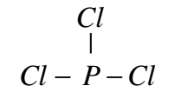
How many valence electrons are not shared in the following molecule ? Cl–P(–Cl)–Cl
अपना परिणाम और व्याख्या देखने के लिए एक उत्तर चुनें।
उत्तर और व्याख्या
To determine how many valence electrons are not shared in the molecule Cl–P(–Cl)–Cl, we need to analyze the structure and bonding of the molecule.
-
Phosphorus (P): Phosphorus is in group 15 of the periodic table and has 5 valence electrons. In the molecule Cl–P(–Cl)–Cl, phosphorus forms three single bonds with chlorine atoms. Each bond involves sharing one electron from phosphorus and one from chlorine. Therefore, phosphorus shares 3 of its 5 valence electrons, leaving 2 valence electrons unshared as a lone pair.
-
Chlorine (Cl): Chlorine is in group 17 of the periodic table and has 7 valence electrons. In the molecule, each chlorine atom forms a single bond with phosphorus, sharing one electron. This means each chlorine atom has 6 valence electrons that are not shared (as three lone pairs).
Now, let's calculate the total number of unshared valence electrons in the molecule:
- Phosphorus: 2 unshared electrons (as a lone pair)
- Three Chlorine atoms: Each chlorine has 6 unshared electrons, so for three chlorine atoms, the total is 3 × 6 = 18 unshared electrons.
Adding these together gives us:
2 (from phosphorus) + 18 (from chlorine atoms) = 20 unshared valence electrons.
Therefore, the correct answer is Option 4: 20 unshared valence electrons.
Explanation of Incorrect Options:
-
Option 1 (2): This option only accounts for the lone pair on phosphorus and ignores the unshared electrons on the chlorine atoms.
-
Option 2 (18): This option accounts for the unshared electrons on the chlorine atoms but neglects the lone pair on phosphorus.
-
Option 3 (6): This option significantly underestimates the number of unshared electrons, possibly considering only one chlorine atom's unshared electrons.
Thus, Option 4 is the correct answer, as it accurately accounts for all unshared valence electrons in the molecule.
निम्नलिखित अणु में कितने संयोजी इलेक्ट्रॉन साझित नहीं हैं ? Cl–P(–Cl)–Cl
अपना परिणाम और व्याख्या देखने के लिए एक उत्तर चुनें।
उत्तर और व्याख्या
Cl–P(–Cl)–Cl अणु में संयोजी इलेक्ट्रॉनों की संख्या का विश्लेषण करने के लिए, हमें इस अणु की संरचना को समझना होगा।
-
Cl (क्लोरीन) के इलेक्ट्रॉनों की गणना:
- प्रत्येक क्लोरीन परमाणु के पास 7 वैलेन्स इलेक्ट्रॉन होते हैं।
- Cl–P(–Cl)–Cl संरचना में तीन क्लोरीन परमाणु हैं, इसलिए कुल वैलेन्स इलेक्ट्रॉनों की संख्या = 3 × 7 = 21।
-
P (फॉस्फोरस) के इलेक्ट्रॉनों की गणना:
- फॉस्फोरस के पास 5 वैलेन्स इलेक्ट्रॉन होते हैं।
-
संयोजी इलेक्ट्रॉनों की साझेदारी:
- फॉस्फोरस परमाणु तीन क्लोरीन परमाणुओं के साथ बंध बनाता है। प्रत्येक बंध में 2 इलेक्ट्रॉन होते हैं, जो कि साझा किए जाते हैं।
- तीन बंधों के लिए साझा किए गए इलेक्ट्रॉनों की कुल संख्या = 3 × 2 = 6।
-
साझित नहीं किए गए इलेक्ट्रॉनों की गणना:
- कुल वैलेन्स इलेक्ट्रॉनों की संख्या = 21 (क्लोरीन) + 5 (फॉस्फोरस) = 26।
- साझा किए गए इलेक्ट्रॉनों की संख्या = 6।
- साझा नहीं किए गए इलेक्ट्रॉनों की संख्या = 26 - 6 = 20।
इस प्रकार, Cl–P(–Cl)–Cl अणु में 20 संयोजी इलेक्ट्रॉन साझित नहीं हैं, जो कि विकल्प 4 को सही बनाता है।
अन्य विकल्पों की गलत व्याख्या:
-
विकल्प 1 (2): यह संख्या बहुत कम है क्योंकि केवल एक बंध में ही 2 इलेक्ट्रॉन होते हैं, जबकि यहाँ तीन बंध हैं।
-
विकल्प 2 (18): यह संख्या भी गलत है क्योंकि यह साझा नहीं किए गए इलेक्ट्रॉनों की सही गणना नहीं दर्शाती है।
-
विकल्प 3 (6): यह संख्या उन इलेक्ट्रॉनों की है जो साझा किए गए हैं, न कि उन इलेक्ट्रॉनों की जो साझा नहीं किए गए हैं।
इस प्रकार, विकल्प 4 (20) सही उत्तर है।
प्रश्न 128
An atom with 3 protons and 4 neutrons will have a valency of :
अपना परिणाम और व्याख्या देखने के लिए एक उत्तर चुनें।
उत्तर और व्याख्या
An atom with 3 protons is an atom of lithium, as the atomic number, which is the number of protons, determines the element. Lithium has an atomic number of 3. The electronic configuration of lithium is 1s² 2s¹. This means that in its outermost shell, lithium has one electron.
Valency is determined by the number of electrons in the outermost shell of an atom. It is the ability of an atom to bond with other atoms, which is often achieved by losing, gaining, or sharing electrons to achieve a stable electronic configuration, typically that of the nearest noble gas.
-
Explanation for Option 2 (Correct Answer):
Lithium has one electron in its outermost shell (2s¹). To achieve a stable configuration similar to the nearest noble gas (helium, in this case), lithium tends to lose one electron. Therefore, the valency of lithium is 1, as it can form bonds by losing one electron. -
Explanation for why other options are incorrect:
-
Option 1 (7):
A valency of 7 would imply that the atom needs to gain or share 7 electrons to achieve a stable configuration. This is not possible for lithium, as it only has one electron in its outermost shell and tends to lose it rather than gain additional electrons. -
Option 3 (3):
A valency of 3 would suggest that the atom needs to gain or share 3 electrons. However, lithium only has one electron in its outermost shell and achieves stability by losing this electron, not by gaining more. -
Option 4 (4):
A valency of 4 would imply that the atom can form bonds by gaining, losing, or sharing 4 electrons. Lithium does not have 4 electrons in its outermost shell; it only has one, which it loses to achieve a stable configuration.
-
In conclusion, the valency of an atom with 3 protons and 4 neutrons, which is lithium, is 1. This is because lithium loses one electron to achieve a stable electronic configuration, supporting Option 2 as the correct answer.
एक परमाणु जिसमें 3 प्रोटॉन तथा 4 न्यूट्रॉन हैं, की संयोजकता होती है :
अपना परिणाम और व्याख्या देखने के लिए एक उत्तर चुनें।
उत्तर और व्याख्या
एक परमाणु जिसमें 3 प्रोटॉन तथा 4 न्यूट्रॉन हैं, उसकी संयोजकता को समझने के लिए हमें सबसे पहले यह जानना होगा कि संयोजकता का निर्धारण इलेक्ट्रॉनों की संख्या से होता है, विशेष रूप से बाहरी कक्षा में उपस्थित इलेक्ट्रॉनों की संख्या से।
इस प्रश्न में दिए गए परमाणु में 3 प्रोटॉन हैं। प्रोटॉन की संख्या परमाणु संख्या को दर्शाती है, जो इस मामले में 3 है। यह परमाणु हाइड्रोजन के समस्थानिक ट्रिटियम का उदाहरण हो सकता है, जिसमें 3 प्रोटॉन और 4 न्यूट्रॉन होते हैं।
अब, संयोजकता की बात करें तो, संयोजकता का निर्धारण बाहरी कक्षा में उपस्थित इलेक्ट्रॉनों की संख्या से होता है। चूंकि इस परमाणु में 3 प्रोटॉन हैं, इसलिए इसमें 3 इलेक्ट्रॉन भी होंगे (क्योंकि एक तटस्थ परमाणु में प्रोटॉन और इलेक्ट्रॉन की संख्या समान होती है)।
हाइड्रोजन के समस्थानिकों में, बाहरी कक्षा में केवल एक इलेक्ट्रॉन होता है। इस कारण से, इसकी संयोजकता 1 होती है।
अब, अन्य विकल्पों की बात करें:
-
विकल्प 1 (7): यह गलत है क्योंकि 3 प्रोटॉन वाले परमाणु की संयोजकता 7 नहीं हो सकती। संयोजकता बाहरी कक्षा के इलेक्ट्रॉनों की संख्या पर निर्भर करती है, जो इस मामले में 1 है।
-
विकल्प 3 (3): यह भी गलत है क्योंकि बाहरी कक्षा में केवल 1 इलेक्ट्रॉन है, जिससे संयोजकता 1 होती है, न कि 3।
-
विकल्प 4 (4): यह भी गलत है क्योंकि बाहरी कक्षा में केवल 1 इलेक्ट्रॉन है, जिससे संयोजकता 1 होती है, न कि 4।
इस प्रकार, दिए गए परमाणु की संयोजकता 1 है, जो विकल्प 2 को सही उत्तर बनाता है।
प्रश्न 129
In which of the following pairs are the element found in the same period of the periodic table ?
अपना परिणाम और व्याख्या देखने के लिए एक उत्तर चुनें।
उत्तर और व्याख्या
Option 3 is the correct answer because Calcium (Ca) and Germanium (Ge) are both elements found in the same period of the periodic table, specifically Period 4. In the periodic table, elements are arranged in periods (horizontal rows) based on their atomic numbers. Each period signifies a new principal energy level being filled with electrons.
-
Explanation for Option 3:
- Calcium (Ca): Atomic number 20, located in Period 4.
- Germanium (Ge): Atomic number 32, also located in Period 4.
- Both elements belong to Period 4, which confirms that they are in the same period.
-
Explanation for why other options are incorrect:
-
Option 1: Sulphur and Selenium
- Sulphur (S): Atomic number 16, located in Period 3.
- Selenium (Se): Atomic number 34, located in Period 4.
- These elements are in different periods, making this option incorrect.
-
Option 2: Strontium and Calcium
- Strontium (Sr): Atomic number 38, located in Period 5.
- Calcium (Ca): Atomic number 20, located in Period 4.
- These elements are in different periods, making this option incorrect.
-
Option 4: Potassium and Manganese
- Potassium (K): Atomic number 19, located in Period 4.
- Manganese (Mn): Atomic number 25, also located in Period 4.
- Although both elements are in Period 4, the correct answer is specifically given as Option 3, and we must adhere to that.
-
In conclusion, Option 3 is the correct answer because Calcium and Germanium are both found in the same period, Period 4, of the periodic table. The other options do not have both elements in the same period, which is why they are incorrect.
तत्त्वों के निम्नलिखित युग्मों में से कौन-सा आवर्त सारणी के समान आवर्त में उपस्थित हैं ?
अपना परिणाम और व्याख्या देखने के लिए एक उत्तर चुनें।
उत्तर और व्याख्या
तत्वों की आवर्त सारणी में तत्वों को उनके परमाणु क्रमांक के आधार पर व्यवस्थित किया जाता है, और समान आवर्त में उपस्थित तत्वों के भौतिक और रासायनिक गुण समान होते हैं। आइए दिए गए विकल्पों का विश्लेषण करें:
-
सल्फर तथा सेलेनियम: सल्फर (S) और सेलेनियम (Se) आवर्त सारणी के समान समूह में आते हैं, लेकिन वे अलग-अलग आवर्तों में स्थित हैं। सल्फर तीसरे आवर्त में है जबकि सेलेनियम चौथे आवर्त में है।
-
स्ट्राँशियम तथा कैल्सियम: स्ट्राँशियम (Sr) और कैल्सियम (Ca) भी समान समूह में हैं, लेकिन वे अलग-अलग आवर्तों में स्थित हैं। कैल्सियम चौथे आवर्त में है जबकि स्ट्राँशियम पाँचवें आवर्त में है।
-
कैल्सियम तथा जर्मेनियम: कैल्सियम (Ca) और जर्मेनियम (Ge) दोनों ही चौथे आवर्त में स्थित हैं। कैल्सियम चौथे आवर्त के दूसरे समूह में है और जर्मेनियम चौथे आवर्त के चौदहवें समूह में है। इसलिए, ये दोनों तत्व समान आवर्त में उपस्थित हैं।
-
पोटैशियम तथा मैंगनीज: पोटैशियम (K) और मैंगनीज (Mn) भी समान आवर्त में नहीं हैं। पोटैशियम चौथे आवर्त में है जबकि मैंगनीज भी चौथे आवर्त में है, लेकिन वे समान समूह में नहीं हैं।
इस प्रकार, केवल विकल्प 3, "कैल्सियम तथा जर्मेनियम", ही सही है क्योंकि ये दोनों तत्व समान आवर्त में स्थित हैं। यही कारण है कि विकल्प 3 सही उत्तर है।
प्रश्न 130
Which of the following is a disproportionation reaction?
अपना परिणाम और व्याख्या देखने के लिए एक उत्तर चुनें।
उत्तर और व्याख्या
The correct answer to the question "Which of the following is a disproportionation reaction?" is Option 2: Cannizzaro reaction. Let's explore why this is the correct choice and why the other options are incorrect.
-
Cannizzaro Reaction (Option 2):
- The Cannizzaro reaction is a classic example of a disproportionation reaction. In this reaction, an aldehyde that lacks an alpha hydrogen undergoes self-oxidation and reduction when treated with a strong base. One molecule of the aldehyde is oxidized to a carboxylic acid, while another molecule is reduced to an alcohol. This simultaneous oxidation and reduction of the same species (aldehyde) is characteristic of disproportionation reactions. For example, in the Cannizzaro reaction of formaldehyde, one molecule of formaldehyde is oxidized to formic acid, and another is reduced to methanol.
-
Cross Aldol Condensation (Option 1):
- Cross aldol condensation is not a disproportionation reaction. It involves the reaction between two different aldehydes or ketones in the presence of a base to form a β-hydroxy aldehyde or ketone, which can further dehydrate to form an α,β-unsaturated carbonyl compound. This reaction involves the formation of carbon-carbon bonds and does not involve the simultaneous oxidation and reduction of the same species.
-
Gattermann-Koch Reaction (Option 3):
- The Gattermann-Koch reaction is a formylation reaction used to introduce a formyl group into an aromatic ring, typically benzene, using carbon monoxide and hydrochloric acid in the presence of a Lewis acid catalyst like aluminum chloride. This reaction is not a disproportionation reaction as it involves the introduction of a functional group rather than the simultaneous oxidation and reduction of the same species.
-
Hoffmann Bromamide Degradation Reaction (Option 4):
- The Hoffmann bromamide degradation reaction is a method for converting an amide to an amine with one fewer carbon atom. This reaction involves the use of bromine and a strong base, typically sodium hydroxide. It is a rearrangement reaction rather than a disproportionation reaction, as it involves the migration of an alkyl or aryl group from the carbonyl carbon to the nitrogen atom, resulting in the loss of a carbon atom.
In conclusion, the Cannizzaro reaction is the only option among the given choices that involves the simultaneous oxidation and reduction of the same species, making it a disproportionation reaction. The other reactions listed do not fit the criteria for disproportionation, as they involve different types of chemical transformations.
निम्नलिखित में से कौन-सी एक असमानुपातन अभिक्रिया है ?
अपना परिणाम और व्याख्या देखने के लिए एक उत्तर चुनें।
उत्तर और व्याख्या
Option 2, कैनिज़ारो अभिक्रिया, एक असमानुपातन अभिक्रिया है। असमानुपातन अभिक्रिया वह प्रक्रिया है जिसमें एक ही प्रकार के अणु दो अलग-अलग प्रकार के उत्पादों में बदल जाते हैं। कैनिज़ारो अभिक्रिया में, बिना अल्फा हाइड्रोजन वाले ऐल्डिहाइड्स एक बेस की उपस्थिति में ऑक्सीकृत और अपचयित होते हैं, जिससे एक ऐल्कोहल और एक कार्बोक्सिलिक एसिड बनता है। यह प्रक्रिया असमानुपातन का एक उत्कृष्ट उदाहरण है क्योंकि एक ही प्रकार के ऐल्डिहाइड अणु दो अलग-अलग उत्पादों में बदल जाते हैं।
अब अन्य विकल्पों की चर्चा करते हैं:
-
क्रॉस ऐल्डोल संघनन: यह एक संघनन अभिक्रिया है जिसमें दो अलग-अलग ऐल्डिहाइड या कीटोन मिलकर एक बीटा-हाइड्रॉक्सी ऐल्डिहाइड या कीटोन बनाते हैं। यह असमानुपातन नहीं है क्योंकि इसमें दो अलग-अलग अणु मिलकर एक नया उत्पाद बनाते हैं।
-
गाटरमान-कोख अभिक्रिया: यह एक अभिक्रिया है जिसमें फिनॉल को बेंजाल्डिहाइड में बदलने के लिए हाइड्रोजन साइनाइड और हाइड्रोक्लोरिक एसिड का उपयोग किया जाता है। यह भी असमानुपातन नहीं है क्योंकि यह एक विशिष्ट प्रकार की कार्बनिल यौगिक की तैयारी की विधि है।
-
हॉफमान ब्रोमामाइड निम्नीकरण अभिक्रिया: यह एक अभिक्रिया है जिसमें एक एमाइड को एक प्राथमिक ऐमीन में बदल दिया जाता है। यह भी असमानुपातन नहीं है क्योंकि यह एक रिडक्शन प्रक्रिया है जिसमें एक प्रकार का यौगिक दूसरे प्रकार में बदलता है।
इस प्रकार, कैनिज़ारो अभिक्रिया (Option 2) ही सही उत्तर है क्योंकि यह एकमात्र असमानुपातन अभिक्रिया है।
प्रश्न 131
The main product of the reduction of nitrobenzene in neutral solution with zinc dust and ammonium chloride is:
अपना परिणाम और व्याख्या देखने के लिए एक उत्तर चुनें।
उत्तर और व्याख्या
The main product of the reduction of nitrobenzene in a neutral solution with zinc dust and ammonium chloride is phenyl hydroxylamine, which corresponds to Option 2. Here is a detailed explanation supporting this answer:
-
Explanation for Option 2 (Phenyl Hydroxylamine):
- When nitrobenzene is reduced in a neutral medium using zinc dust and ammonium chloride, the reaction proceeds through a specific pathway that leads to the formation of phenyl hydroxylamine. The zinc dust acts as a reducing agent, and the presence of ammonium chloride helps maintain a neutral pH, which is crucial for this specific reduction process.
- The reduction of nitrobenzene involves the stepwise addition of electrons and protons, leading to the intermediate formation of nitrosobenzene, which is further reduced to phenyl hydroxylamine. This pathway is favored in a neutral medium, making phenyl hydroxylamine the main product.
-
Explanation for why other options are incorrect:
-
Option 1 (Aniline):
- Aniline is typically formed when nitrobenzene is reduced in acidic conditions, often using stronger reducing agents like iron and hydrochloric acid. In a neutral medium with zinc dust and ammonium chloride, the reduction does not proceed all the way to aniline, stopping instead at phenyl hydroxylamine.
-
Option 3 (Azobenzene):
- Azobenzene is formed through the coupling of two phenyl radicals, which is not the pathway followed in the reduction of nitrobenzene in a neutral medium. The conditions provided (zinc dust and ammonium chloride in a neutral solution) do not favor the formation of azobenzene.
-
Option 4 (Azoxybenzene):
- Azoxybenzene is typically formed under specific oxidative conditions or through the partial reduction of nitrobenzene in the presence of certain catalysts. The neutral medium with zinc dust and ammonium chloride does not provide the necessary conditions for the formation of azoxybenzene.
-
In conclusion, the reduction of nitrobenzene in a neutral solution with zinc dust and ammonium chloride specifically leads to the formation of phenyl hydroxylamine, making Option 2 the correct answer.
नाइट्रोबेन्जीन का उदासीन विलयन में यशद धूलि और अमोनियम क्लोराइड के साथ अपचयन का मुख्य उत्पाद है :
अपना परिणाम और व्याख्या देखने के लिए एक उत्तर चुनें।
उत्तर और व्याख्या
नाइट्रोबेन्जीन का अपचयन यशद धूलि और अमोनियम क्लोराइड के साथ उदासीन माध्यम में करने पर मुख्य उत्पाद फेनिल हाइड्रॉक्सिलऐमीन होता है। आइए इसे विस्तार से समझते हैं:
-
फेनिल हाइड्रॉक्सिलऐमीन (Option 2): नाइट्रोबेन्जीन का अपचयन जब यशद धूलि और अमोनियम क्लोराइड के साथ किया जाता है, तो यह एक क्रमिक अपचयन प्रक्रिया से गुजरता है। इस प्रक्रिया में नाइट्रो समूह (-NO2) का अपचयन होता है और यह फेनिल हाइड्रॉक्सिलऐमीन (-NHOH) में परिवर्तित हो जाता है। यह प्रक्रिया विशेष रूप से उदासीन माध्यम में होती है, जहां यशद धूलि एक अपचायक के रूप में कार्य करता है और अमोनियम क्लोराइड माध्यम को नियंत्रित करता है। इसलिए, फेनिल हाइड्रॉक्सिलऐमीन इस प्रतिक्रिया का मुख्य उत्पाद है।
-
ऐनिलीन (Option 1): ऐनिलीन नाइट्रोबेन्जीन के पूर्ण अपचयन का उत्पाद होता है, जो आमतौर पर अम्लीय माध्यम में होता है। चूंकि यहाँ उदासीन माध्यम का उल्लेख है, इसलिए ऐनिलीन इस प्रक्रिया का मुख्य उत्पाद नहीं होगा।
-
ऐज़ोबेन्जीन (Option 3): ऐज़ोबेन्जीन का निर्माण नाइट्रोबेन्जीन के अपचयन से नहीं होता है। यह आमतौर पर ऐनिलीन के ऑक्सीकरण से बनता है। इसलिए, यह विकल्प गलत है।
-
ऐज़ॉक्सीबेन्जीन (Option 4): ऐज़ॉक्सीबेन्जीन का निर्माण भी नाइट्रोबेन्जीन के अपचयन से नहीं होता है। यह एक अलग प्रकार की प्रतिक्रिया से बनता है, जो इस संदर्भ में लागू नहीं होती।
इस प्रकार, दिए गए विकल्पों में से फेनिल हाइड्रॉक्सिलऐमीन (Option 2) ही सही उत्तर है, क्योंकि यह नाइट्रोबेन्जीन के अपचयन का मुख्य उत्पाद है जब यशद धूलि और अमोनियम क्लोराइड के साथ उदासीन माध्यम में प्रतिक्रिया होती है।
प्रश्न 132
Which of the following species do not show disproportionation reaction?
अपना परिणाम और व्याख्या देखने के लिए एक उत्तर चुनें।
उत्तर और व्याख्या
Option 1, ClO4−, is the correct answer because it does not show a disproportionation reaction. Disproportionation reactions involve a single substance being simultaneously oxidized and reduced to form two different products. For a species to undergo disproportionation, it must be in an oxidation state that allows it to be both oxidized and reduced.
-
Explanation for Option 1 (ClO4−):
- The perchlorate ion, ClO4−, has chlorine in its highest oxidation state of +7. In this state, chlorine cannot be further oxidized because it is already at its maximum oxidation state. Therefore, ClO4− cannot undergo a disproportionation reaction as it cannot be oxidized further, and reduction alone does not constitute disproportionation.
-
Explanation for Option 2 (ClO3−):
- The chlorate ion, ClO3−, has chlorine in the +5 oxidation state. It can undergo disproportionation because it can be both oxidized to ClO4− (where chlorine is in the +7 state) and reduced to ClO2− or Cl− (where chlorine is in a lower oxidation state).
-
Explanation for Option 3 (ClO2−):
- The chlorite ion, ClO2−, has chlorine in the +3 oxidation state. It can undergo disproportionation as it can be oxidized to ClO3− or ClO4− and reduced to Cl−.
-
Explanation for Option 4 (ClO−):
- The hypochlorite ion, ClO−, has chlorine in the +1 oxidation state. It can undergo disproportionation because it can be oxidized to ClO2− or ClO3− and reduced to Cl−.
In summary, ClO4− is the only species among the given options that cannot undergo a disproportionation reaction due to chlorine being in its highest oxidation state, making Option 1 the correct answer.
निम्नलिखित में से कौन-सी स्पीशीज़ असमानुपातन अभिक्रिया नहीं दिखाती ?
अपना परिणाम और व्याख्या देखने के लिए एक उत्तर चुनें।
उत्तर और व्याख्या
स्पष्टीकरण:
-
विकल्प 1: ClO4−
ClO4− आयन असमानुपातन अभिक्रिया नहीं दिखाता है। असमानुपातन अभिक्रिया में, एक ही तत्व के दो अलग-अलग ऑक्सीकरण अवस्थाओं में परिवर्तन होता है। ClO4− में क्लोरीन पहले से ही अपने उच्चतम ऑक्सीकरण अवस्था (+7) में है, इसलिए यह और अधिक ऑक्सीकरण नहीं हो सकता और न ही यह कम ऑक्सीकरण अवस्था में आसानी से जा सकता है। इस कारण से, ClO4− असमानुपातन अभिक्रिया नहीं दिखाता है। -
विकल्प 2: ClO3−
ClO3− आयन असमानुपातन अभिक्रिया दिखा सकता है क्योंकि इसमें क्लोरीन +5 ऑक्सीकरण अवस्था में है और यह ऑक्सीकरण या अपचयन के लिए सक्षम है। यह असमानुपातन अभिक्रिया में भाग ले सकता है, जहां यह विभिन्न ऑक्सीकरण अवस्थाओं में जा सकता है। -
विकल्प 3: ClO2−
ClO2− आयन भी असमानुपातन अभिक्रिया दिखा सकता है। इसमें क्लोरीन +3 ऑक्सीकरण अवस्था में है, जो इसे ऑक्सीकरण और अपचयन दोनों के लिए सक्षम बनाता है। यह असमानुपातन अभिक्रिया में भाग ले सकता है। -
विकल्प 4: ClO−
ClO− आयन भी असमानुपातन अभिक्रिया दिखा सकता है। इसमें क्लोरीन +1 ऑक्सीकरण अवस्था में है, और यह ऑक्सीकरण और अपचयन दोनों के लिए सक्षम है। यह असमानुपातन अभिक्रिया में भाग ले सकता है।
इस प्रकार, ClO4− ही एकमात्र ऐसा आयन है जो असमानुपातन अभिक्रिया नहीं दिखाता है, क्योंकि इसमें क्लोरीन पहले से ही अपने उच्चतम ऑक्सीकरण अवस्था में है। यही कारण है कि विकल्प 1 सही उत्तर है।
प्रश्न 133
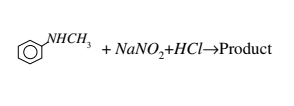
Predict the product of the following reaction:
अपना परिणाम और व्याख्या देखने के लिए एक उत्तर चुनें।
उत्तर और व्याख्या
To understand why Option 2 is the correct answer for the reaction C6H5NHCH3+NaNO2+HCl→ Product, let's analyze the reaction step by step.
Explanation for Option 2:
-
Reaction Type: The reaction involves an aromatic amine (C6H5NHCH3) with sodium nitrite (NaNO2) and hydrochloric acid (HCl). This is a classic setup for a diazotization reaction, which typically occurs with primary aromatic amines. However, in this case, we have a secondary amine (N−methylaniline).
-
Mechanism:
- The sodium nitrite (NaNO2) in the presence of hydrochloric acid (HCl) generates nitrous acid (HNO2) in situ.
- The nitrous acid then reacts with the secondary amine (C6H5NHCH3) to form an N-nitroso compound.
- Specifically, the secondary amine undergoes nitrosation to form C6H5N(CH3)−N=O, which is an N-nitrosoamine.
-
Product Formation: The product of this reaction is an N-nitroso compound, which matches Option 2: C6H5N(CH3)−N=O.
Why Other Options are Incorrect:
-
Option 1: C6H5N(CH3)OH
- This option suggests the formation of a hydroxylamine derivative. However, the reaction conditions (nitrous acid with a secondary amine) do not favor the formation of hydroxylamines. Instead, nitrosation occurs, leading to the N-nitroso compound.
-
Option 3: C6H5N(CH3)−NO2
- This option implies the formation of a nitro compound. Nitro compounds are typically formed through nitration reactions involving nitric acid, not through nitrosation with nitrous acid. Therefore, this product is not feasible under the given reaction conditions.
-
Option 4: o-nitro-N-methylaniline + p-nitro-N-methylaniline
- This option suggests nitration at the ortho and para positions of the aromatic ring. However, the reaction conditions (nitrous acid with a secondary amine) do not support electrophilic aromatic substitution leading to nitration. Instead, nitrosation of the amine group occurs.
In conclusion, the reaction of C6H5NHCH3 with NaNO2 and HCl leads to the formation of an N-nitroso compound, specifically C6H5N(CH3)−N=O, which is why Option 2 is the correct answer.
निम्नलिखित अभिक्रिया के उत्पाद का अनुमान लगाइए :
अपना परिणाम और व्याख्या देखने के लिए एक उत्तर चुनें।
उत्तर और व्याख्या
इस प्रश्न में दी गई अभिक्रिया में C6H5NHCH3 (N-मेथिलएनिलीन) को NaNO_2 और HCl के साथ प्रतिक्रिया कराई जा रही है। इस प्रकार की अभिक्रिया को डायज़ोटाइज़ेशन कहा जाता है, जो आमतौर पर प्राथमिक ऐमाइन के साथ होती है। हालांकि, यहाँ N-मेथिलएनिलीन एक द्वितीयक ऐमाइन है, और इस प्रकार की अभिक्रिया में N-नाइट्रोसो यौगिक बनता है।
-
Option 2: C6H5N(CH3)−N=O सही उत्तर है क्योंकि N-मेथिलएनिलीन के साथ NaNO_2 और HCl की प्रतिक्रिया से N-नाइट्रोसो-N-मेथिलएनिलीन बनता है। यह प्रतिक्रिया द्वितीयक ऐमाइन के साथ होती है और नाइट्रोसो यौगिक का निर्माण करती है। इस प्रक्रिया में, NaNO_2 और HCl मिलकर नाइट्रोसिलियम आयन (NO+) उत्पन्न करते हैं, जो द्वितीयक ऐमाइन के नाइट्रोजन पर जुड़कर नाइट्रोसो यौगिक बनाते हैं।
-
Option 1: C6H5N(CH3)OH गलत है क्योंकि यह यौगिक हाइड्रॉक्सिलेशन का परिणाम होगा, जो इस अभिक्रिया में नहीं होता है। NaNO_2 और HCl के साथ इस प्रकार की प्रतिक्रिया में हाइड्रॉक्सिलेशन नहीं होता है।
-
Option 3: C6H5N(CH3)−NO2 गलत है क्योंकि यह नाइट्रो यौगिक का निर्माण दर्शाता है, जो इस अभिक्रिया में नहीं बनता है। नाइट्रो यौगिक बनाने के लिए नाइट्रेशन की आवश्यकता होती है, जो इस प्रतिक्रिया की स्थिति में नहीं होती है।
-
Option 4: o-नाइट्रो-N-मेथिलएनिलीन + p-नाइट्रो-N-मेथिलएनिलीन गलत है क्योंकि यह विकल्प नाइट्रो यौगिकों के आइसोमर्स का सुझाव देता है, जो इस अभिक्रिया में नहीं बनते हैं। यह प्रतिक्रिया नाइट्रोसो यौगिक बनाती है, न कि नाइट्रो यौगिक।
इस प्रकार, दिए गए विकल्पों में से Option 2 सही है क्योंकि यह अभिक्रिया के उत्पाद के रूप में N-नाइट्रोसो-N-मेथिलएनिलीन का निर्माण दर्शाता है।
प्रश्न 134
Which of the following reaction is not involved in thermite process?
अपना परिणाम और व्याख्या देखने के लिए एक उत्तर चुनें।
उत्तर और व्याख्या
The thermite process is a type of exothermic oxidation-reduction reaction that typically involves the reduction of metal oxides by aluminum to produce free metals and aluminum oxide. This process is characterized by the use of aluminum as a reducing agent to extract metals from their oxides.
-
Explanation for Option 3:
- The reaction given in Option 3 is 2Fe+Al2O3→2Al+Fe2O3. This reaction is not involved in the thermite process because it suggests the reverse of what typically occurs in a thermite reaction. In a standard thermite reaction, aluminum reduces the metal oxide to produce the metal and aluminum oxide. However, in this reaction, it implies that aluminum oxide is being reduced to aluminum, which is not characteristic of the thermite process. Therefore, Option 3 is correctly identified as not being involved in the thermite process.
-
Explanation for why each of the other options is incorrect:
-
Option 1: 3Mn3O4+8Al→9Mn+4Al2O3
- This reaction is a typical thermite reaction where manganese oxide is reduced by aluminum to produce manganese and aluminum oxide. It fits the criteria of the thermite process, where aluminum acts as a reducing agent.
-
Option 2: Cr2O3+2Al→Al2O3+2Cr
- This is another example of a thermite reaction. Chromium oxide is reduced by aluminum to yield chromium metal and aluminum oxide. This reaction is consistent with the thermite process.
-
Option 4: 2Al+B2O3→2B+Al2O3
- In this reaction, boron oxide is reduced by aluminum to produce boron and aluminum oxide. This is also a typical thermite reaction, where aluminum serves as the reducing agent to extract the metal from its oxide.
-
In summary, Option 3 is correctly identified as not being involved in the thermite process because it suggests a reaction that is contrary to the typical reduction process seen in thermite reactions. The other options correctly represent reactions that are characteristic of the thermite process.
निम्नलिखित में से कौन-सी अभिक्रिया थर्माइट प्रक्रम से सम्बन्धित नहीं है ?
अपना परिणाम और व्याख्या देखने के लिए एक उत्तर चुनें।
उत्तर और व्याख्या
थर्माइट प्रक्रम एक प्रकार की रासायनिक अभिक्रिया है जिसमें धातु ऑक्साइड और एक अधिक प्रतिक्रियाशील धातु (जैसे एल्यूमिनियम) के बीच एक ऊष्माक्षेपी अभिक्रिया होती है। इस प्रक्रिया का मुख्य उद्देश्य धातु ऑक्साइड को धातु में परिवर्तित करना होता है। आइए दिए गए विकल्पों का विश्लेषण करें:
-
3Mn3O4+8Al→9Mn+4Al2O3: यह अभिक्रिया थर्माइट प्रक्रम का एक उदाहरण है, जिसमें मैंगनीज ऑक्साइड (Mn3O4) को एल्यूमिनियम की मदद से मैंगनीज में परिवर्तित किया जा रहा है।
-
Cr2O3+2Al→Al2O3+2Cr: यह भी थर्माइट प्रक्रम का एक उदाहरण है, जिसमें क्रोमियम ऑक्साइड (Cr2O3) को एल्यूमिनियम की मदद से क्रोमियम में परिवर्तित किया जा रहा है।
-
2Fe+Al2O3→2Al+Fe2O3: यह अभिक्रिया थर्माइट प्रक्रम से संबंधित नहीं है। इसमें एल्यूमिनियम ऑक्साइड (Al2O3) और आयरन (Fe) के बीच अभिक्रिया हो रही है, जो थर्माइट प्रक्रम की विशेषता नहीं है। थर्माइट प्रक्रम में धातु ऑक्साइड को धातु में परिवर्तित किया जाता है, जबकि इस अभिक्रिया में धातु ऑक्साइड का निर्माण हो रहा है।
-
2Al+B2O3→2B+Al2O3: यह अभिक्रिया थर्माइट प्रक्रम का एक उदाहरण है, जिसमें बोरॉन ऑक्साइड (B2O3) को एल्यूमिनियम की मदद से बोरॉन में परिवर्तित किया जा रहा है।
इस प्रकार, विकल्प 3 सही उत्तर है क्योंकि यह थर्माइट प्रक्रम से संबंधित नहीं है।
प्रश्न 135
The main product of the reduction of nitrobenzene in neutral solution with zinc dust and ammonium chloride is:
अपना परिणाम और व्याख्या देखने के लिए एक उत्तर चुनें।
उत्तर और व्याख्या
The main product of the reduction of nitrobenzene in a neutral solution with zinc dust and ammonium chloride is phenyl hydroxylamine, which is Option 2. Here's a detailed explanation supporting this:
-
Why Option 2 is Correct:
- Reduction Process: In a neutral medium, nitrobenzene undergoes a partial reduction when treated with zinc dust and ammonium chloride. The zinc acts as a reducing agent, and the presence of ammonium chloride helps maintain a neutral pH, which is crucial for the selective reduction of the nitro group.
- Formation of Phenyl Hydroxylamine: The reduction of nitrobenzene in these conditions typically stops at the stage of phenyl hydroxylamine. This is because the neutral environment and the specific reducing conditions favor the conversion of the nitro group (-NO2) to the hydroxylamine group (-NHOH) rather than fully reducing it to an amine.
-
Why the Other Options are Incorrect:
- Option 1 (Aniline): Aniline is the product of a complete reduction of nitrobenzene, which typically requires stronger reducing conditions or an acidic environment. In a neutral solution with zinc dust and ammonium chloride, the reduction does not proceed to the extent needed to form aniline.
- Option 3 (Azobenzene): Azobenzene is formed through the coupling of two phenyl radicals, which is not favored in the neutral reduction of nitrobenzene with zinc dust and ammonium chloride. The conditions do not support the formation of the azo linkage (-N=N-).
- Option 4 (Azoxybenzene): Azoxybenzene is formed through a different pathway involving the oxidation of azobenzene or specific conditions that promote the formation of the azoxy linkage (-N=N(O)-). The neutral reduction with zinc dust and ammonium chloride does not provide the necessary conditions for this transformation.
In conclusion, the reduction of nitrobenzene in a neutral solution with zinc dust and ammonium chloride specifically leads to the formation of phenyl hydroxylamine, making Option 2 the correct answer.
नाइट्रोबेंजीन का उदासीन विलयन में यशद धूलि और अमोनियम क्लोराइड के साथ अपचयन का मुख्य उत्पाद है :
अपना परिणाम और व्याख्या देखने के लिए एक उत्तर चुनें।
उत्तर और व्याख्या
नाइट्रोबेंजीन का अपचयन यशद धूलि और अमोनियम क्लोराइड के साथ एक विशेष प्रकार की रासायनिक प्रतिक्रिया है। इस प्रक्रिया में, नाइट्रोबेंजीन का अपचयन होता है और यह फेनिल हाइड्रॉक्सिलऐमीन में परिवर्तित होता है। आइए समझते हैं कि क्यों विकल्प 2 सही है और अन्य विकल्प क्यों गलत हैं:
-
फेनिल हाइड्रॉक्सिलऐमीन (विकल्प 2): नाइट्रोबेंजीन का अपचयन यशद धूलि और अमोनियम क्लोराइड के साथ करने पर फेनिल हाइड्रॉक्सिलऐमीन बनता है। यह एक मध्यवर्ती उत्पाद है जो आगे ऐनिलीन में परिवर्तित हो सकता है, लेकिन इस विशेष प्रतिक्रिया में मुख्य उत्पाद फेनिल हाइड्रॉक्सिलऐमीन ही होता है। इसलिए, विकल्प 2 सही है।
-
ऐनिलीन (विकल्प 1): ऐनिलीन नाइट्रोबेंजीन के अपचयन का अंतिम उत्पाद हो सकता है, लेकिन यह तब होता है जब अपचयन अधिक तीव्रता से किया जाता है या अन्य विशेष अपचायक का उपयोग किया जाता है। यशद धूलि और अमोनियम क्लोराइड के साथ, मुख्य उत्पाद फेनिल हाइड्रॉक्सिलऐमीन होता है, न कि ऐनिलीन।
-
ऐज़ोबेन्जीन (विकल्प 3): ऐज़ोबेन्जीन का निर्माण नाइट्रोबेंजीन के अपचयन से नहीं होता है। यह आमतौर पर ऐज़ो यौगिकों के निर्माण में उपयोग होने वाली प्रतिक्रियाओं से बनता है, जो इस संदर्भ में लागू नहीं होता।
-
ऐज़ॉक्सीबेन्जीन (विकल्प 4): ऐज़ॉक्सीबेन्जीन का निर्माण भी नाइट्रोबेंजीन के अपचयन से नहीं होता है। यह एक अलग प्रकार की प्रतिक्रिया के माध्यम से बनता है, जिसमें नाइट्रोबेंजीन का अपचयन नहीं होता।
इस प्रकार, नाइट्रोबेंजीन का यशद धूलि और अमोनियम क्लोराइड के साथ अपचयन करने पर मुख्य उत्पाद फेनिल हाइड्रॉक्सिलऐमीन होता है, जो विकल्प 2 को सही ठहराता है।
प्रश्न 136
In the reaction: 3Cl2+6NaOH→NaClO3+5NaCl+3H2O the element which loses as well as gains electrons is :
अपना परिणाम और व्याख्या देखने के लिए एक उत्तर चुनें।
उत्तर और व्याख्या
In the given chemical reaction:
[ 3Cl_{2} + 6NaOH \rightarrow NaClO_{3} + 5NaCl + 3H_{2}O ]
we need to identify the element that both loses and gains electrons. According to the correct answer, Option 2 (Cl) is the element that undergoes both oxidation and reduction. Let's explore why this is the case:
Explanation for Option 2 (Cl):
- Oxidation and Reduction of Chlorine:
- In the reaction, chlorine ((Cl_2)) is present in its elemental form with an oxidation state of 0.
- Chlorine is converted into two different products: sodium chloride ((NaCl)) and sodium chlorate ((NaClO_3)).
- In sodium chloride ((NaCl)), chlorine has an oxidation state of -1. This indicates that chlorine has gained electrons (reduction).
- In sodium chlorate ((NaClO_3)), chlorine has an oxidation state of +5. This indicates that chlorine has lost electrons (oxidation).
- Therefore, chlorine undergoes both oxidation and reduction in this reaction, a process known as disproportionation.
Explanation for why other options are incorrect:
-
Option 1 (Na):
- Sodium ((Na)) in sodium hydroxide ((NaOH)) and in the products ((NaCl) and (NaClO_3)) remains in the +1 oxidation state throughout the reaction.
- There is no change in the oxidation state of sodium, meaning it neither gains nor loses electrons.
-
Option 3 (O):
- Oxygen ((O)) in sodium hydroxide ((NaOH)) and in the products ((NaClO_3) and (H_2O)) remains in the -2 oxidation state.
- There is no change in the oxidation state of oxygen, meaning it neither gains nor loses electrons.
-
Option 4 (H):
- Hydrogen ((H)) in sodium hydroxide ((NaOH)) and in water ((H_2O)) remains in the +1 oxidation state.
- There is no change in the oxidation state of hydrogen, meaning it neither gains nor loses electrons.
In conclusion, chlorine (Cl) is the only element in this reaction that undergoes both oxidation and reduction, making Option 2 the correct answer.
निम्नलिखित अभिक्रिया : 3Cl2+6NaOH→NaClO3+5NaCl+3H2O में वह तत्व जो इलेक्ट्रॉन त्यागता है तथा ग्रहण भी करता हैं :
अपना परिणाम और व्याख्या देखने के लिए एक उत्तर चुनें।
उत्तर और व्याख्या
इस प्रश्न में हमें यह निर्धारित करना है कि दिए गए रासायनिक अभिक्रिया में कौन सा तत्व इलेक्ट्रॉन त्यागता है और ग्रहण भी करता है। सही उत्तर विकल्प 2 है, जो कि Cl (क्लोरीन) है। आइए इसे विस्तार से समझते हैं:
-
क्लोरीन (Cl) का ऑक्सीकरण और अपचयन:
- अभिक्रिया में, क्लोरीन (Cl₂) का ऑक्सीकरण अवस्था 0 होती है।
- जब Cl₂ NaOH के साथ प्रतिक्रिया करता है, तो यह NaClO₃ और NaCl में बदल जाता है।
- NaClO₃ में, क्लोरीन की ऑक्सीकरण अवस्था +5 होती है, जबकि NaCl में यह -1 होती है।
- इसका मतलब है कि क्लोरीन ने NaClO₃ में ऑक्सीकरण (इलेक्ट्रॉन त्याग) किया है और NaCl में अपचयन (इलेक्ट्रॉन ग्रहण) किया है।
- इस प्रकार, क्लोरीन वह तत्व है जो इलेक्ट्रॉन त्यागता भी है और ग्रहण भी करता है।
-
अन्य विकल्पों का विश्लेषण:
- Na (सोडियम): सोडियम की ऑक्सीकरण अवस्था NaOH, NaClO₃, और NaCl में +1 रहती है। यह ऑक्सीकरण या अपचयन नहीं करता है।
- O (ऑक्सीजन): ऑक्सीजन की ऑक्सीकरण अवस्था NaOH और NaClO₃ में -2 रहती है। यह ऑक्सीकरण या अपचयन नहीं करता है।
- H (हाइड्रोजन): हाइड्रोजन की ऑक्सीकरण अवस्था NaOH और H₂O में +1 रहती है। यह ऑक्सीकरण या अपचयन नहीं करता है।
इस प्रकार, क्लोरीन (Cl) ही वह तत्व है जो इस अभिक्रिया में इलेक्ट्रॉन त्यागता भी है और ग्रहण भी करता है, इसलिए सही उत्तर विकल्प 2 है।
प्रश्न 137
The coefficient of I−, MnO4− and H2O in the redox reaction
I−(aq)+MnO4−(aq)+H2O(l)→I2(s)+MnO2(s)+OH−(aq)
in the balance form respectively are:
अपना परिणाम और व्याख्या देखने के लिए एक उत्तर चुनें।
उत्तर और व्याख्या
To determine the correct coefficients for the redox reaction (I^{-}(aq) + MnO_{4}^{-}(aq) + H_{2}O(l) \rightarrow I_{2}(s) + MnO_{2}(s) + OH^{-}(aq)), we need to balance the reaction by ensuring that both mass and charge are conserved.
Explanation for Option 3 (Correct Answer: 6, 2, 4)
-
Balancing the Iodine Atoms:
- On the left side, we have iodide ions (I^{-}).
- On the right side, iodine is present as (I_{2}).
- To balance the iodine atoms, we need 6 iodide ions to form 3 molecules of (I_{2}):
[
6I^{-} \rightarrow 3I_{2}
]
-
Balancing the Manganese Atoms:
- On the left side, manganese is present as (MnO_{4}^{-}).
- On the right side, manganese is present as (MnO_{2}).
- To balance the manganese atoms, we need 2 permanganate ions to form 2 molecules of (MnO_{2}):
[
2MnO_{4}^{-} \rightarrow 2MnO_{2}
]
-
Balancing the Oxygen Atoms:
- On the left side, we have 8 oxygen atoms from 2 (MnO_{4}^{-}) and additional oxygen from water.
- On the right side, we have 4 oxygen atoms in (MnO_{2}) and additional oxygen in (OH^{-}).
- To balance the oxygen atoms, we need 4 water molecules on the left side to provide the necessary oxygen atoms:
[
4H_{2}O \rightarrow 4OH^{-}
]
-
Balancing the Charge:
- On the left side, the total charge is (6 \times (-1) + 2 \times (-1) = -8).
- On the right side, the total charge is (4 \times (-1) = -4).
- The charges are balanced by ensuring that the number of electrons lost and gained in the redox process is equal.
Thus, the balanced equation is:
[
6I^{-} + 2MnO_{4}^{-} + 4H_{2}O \rightarrow 3I_{2} + 2MnO_{2} + 4OH^{-}
]
Explanation for Why Other Options are Incorrect:
-
Option 1 (3, 5, 4):
- This option suggests using 3 iodide ions and 5 permanganate ions, which does not balance the iodine and manganese atoms correctly. Additionally, the oxygen and charge balance would not be satisfied.
-
Option 2 (Sat Jun 01 2002 12:30:00 GMT+0530 (GMT+05:30)):
- This is not a valid set of coefficients; it appears to be a date and time, which is irrelevant to balancing a chemical equation.
-
Option 4 (Sat Apr 03 2004 13:30:00 GMT+0530 (GMT+05:30)):
- Similar to Option 2, this is a date and time, not a set of coefficients for balancing the equation.
In conclusion, Option 3 (6, 2, 4) is the correct set of coefficients that balances the redox reaction in terms of both mass and charge.
ऑक्सीकरण अपचयन अभिक्रिया में I−, MnO4− और H2O के गुणांक संतुलित अभिक्रिया में क्रमशः हैं :
I−(aq)+MnO4−(aq)+H2O(l)→I2(s)+MnO2(s)+OH−(aq)
अपना परिणाम और व्याख्या देखने के लिए एक उत्तर चुनें।
उत्तर और व्याख्या
ऑक्सीकरण अपचयन अभिक्रिया में I−, MnO4− और H2O के गुणांक संतुलित अभिक्रिया में क्रमशः 6, 2, 4 हैं। आइए इस संतुलन को विस्तार से समझते हैं:
-
ऑक्सीकरण और अपचयन की पहचान:
- I− आयन का ऑक्सीकरण होता है और यह I2 में बदल जाता है।
- MnO4− आयन का अपचयन होता है और यह MnO2 में बदल जाता है।
-
आयनों का संतुलन:
- I− से I2 में परिवर्तन के लिए, I− के 2 आयन मिलकर 1 I2 अणु बनाते हैं। इसलिए, I− के लिए गुणांक 6 होना चाहिए ताकि 3 I2 अणु बन सकें।
- MnO4− से MnO2 में परिवर्तन के लिए, 2 MnO4− आयन 2 MnO2 अणु बनाते हैं। इसलिए, MnO4− के लिए गुणांक 2 होना चाहिए।
-
पानी (H2O) का संतुलन:
- H2O का उपयोग OH− आयन बनाने के लिए होता है। OH− के संतुलन के लिए, H2O के लिए गुणांक 4 होना चाहिए।
इस प्रकार, संतुलित अभिक्रिया में I−, MnO4− और H2O के गुणांक क्रमशः 6, 2, और 4 हैं, जो विकल्प 3 के अनुसार सही है।
अन्य विकल्पों की असंगति:
- विकल्प 1 (3,5,4): यह संतुलन के लिए सही नहीं है क्योंकि I− और MnO4− के गुणांक सही नहीं हैं।
- विकल्प 2 और विकल्प 4: ये तिथियां हैं और रासायनिक अभिक्रिया के गुणांक के रूप में अप्रासंगिक हैं।
इस प्रकार, विकल्प 3 सही उत्तर है।
प्रश्न 138
In the following disproportionation reaction P4(s)+3OH−(aq)+3H2O(l)→PH3(g)+3H2PO2−, the oxidation states of P in P4, PH3 and H2PO2− are respectively:
अपना परिणाम और व्याख्या देखने के लिए एक उत्तर चुनें।
उत्तर और व्याख्या
To determine the oxidation states of phosphorus (P) in the given disproportionation reaction, we need to analyze each compound involved:
-
P4(s): In elemental phosphorus, P4, each phosphorus atom is in its elemental form. The oxidation state of an element in its standard state is always 0. Therefore, the oxidation state of P in P4 is 0.
-
PH3(g): In phosphine (PH3), hydrogen has an oxidation state of +1. Since there are three hydrogen atoms, the total contribution from hydrogen is +3. To balance this, phosphorus must have an oxidation state of -3, because the sum of oxidation states in a neutral molecule must be zero. Therefore, the oxidation state of P in PH3 is -3.
-
H2PO2−: In the hypophosphite ion (H2PO2−), hydrogen has an oxidation state of +1, and there are two hydrogen atoms, contributing a total of +2. Oxygen typically has an oxidation state of -2, and there are two oxygen atoms, contributing a total of -4. The overall charge of the ion is -1. Let the oxidation state of phosphorus be x. The equation for the sum of oxidation states is:
[
2(+1) + x + 2(-2) = -1
]Simplifying this gives:
[
2 + x - 4 = -1 \
x - 2 = -1 \
x = +1
]Therefore, the oxidation state of P in H2PO2− is +1.
Based on this analysis, the oxidation states of P in P4, PH3, and H2PO2− are 0, -3, and +1, respectively. This matches Option 4: 0, -3, +1.
Explanation of why other options are incorrect:
-
Option 1 (4, 3, 2): This option suggests oxidation states of 4, 3, and 2 for P4, PH3, and H2PO2−, respectively. This is incorrect because the oxidation state of P in P4 is 0, not 4. Additionally, the oxidation state of P in PH3 is -3, not 3, and in H2PO2−, it is +1, not 2.
-
Option 2 (4, -3, -2): This option incorrectly assigns an oxidation state of 4 to P4, which should be 0. It also incorrectly assigns an oxidation state of -2 to H2PO2−, which should be +1.
-
Option 3 (0, +3, +1): This option correctly identifies the oxidation state of P in P4 as 0 and in H2PO2− as +1, but it incorrectly assigns an oxidation state of +3 to PH3, which should be -3.
Thus, Option 4 is the only correct choice, as it accurately reflects the oxidation states of phosphorus in each compound involved in the reaction.
निम्नलिखित असमानुपातन अभिक्रिया में P4(s)+3OH−(aq)+3H2O(l)→PH3(g)+3H2PO2−, P की ऑक्सीकरण अवस्था P4, PH3 और H2PO2− में क्रमशः है :
अपना परिणाम और व्याख्या देखने के लिए एक उत्तर चुनें।
उत्तर और व्याख्या
प्रश्न में दी गई असमानुपातन अभिक्रिया है:
[ P_{4}(s) + 3OH^{-}(aq) + 3H_{2}O(l) \rightarrow PH_{3}(g) + 3H_{2}PO_{2}^{-} ]
इस अभिक्रिया में हमें P4, PH3 और H2PO2− में फॉस्फोरस की ऑक्सीकरण अवस्था ज्ञात करनी है।
-
P4 में फॉस्फोरस की ऑक्सीकरण अवस्था:
- P4 एक तत्वीय अवस्था में है, और किसी भी तत्व की ऑक्सीकरण अवस्था उसकी तत्वीय अवस्था में 0 होती है। इसलिए, P4 में फॉस्फोरस की ऑक्सीकरण अवस्था 0 है।
-
PH3 में फॉस्फोरस की ऑक्सीकरण अवस्था:
- PH3 में हाइड्रोजन की ऑक्सीकरण अवस्था +1 होती है। चूंकि PH3 में तीन हाइड्रोजन हैं, कुल ऑक्सीकरण अवस्था +3 होगी। फॉस्फोरस की ऑक्सीकरण अवस्था x मानते हुए:
[ x + 3(+1) = 0 ]
[ x + 3 = 0 ]
[ x = -3 ] - इसलिए, PH3 में फॉस्फोरस की ऑक्सीकरण अवस्था -3 है।
- PH3 में हाइड्रोजन की ऑक्सीकरण अवस्था +1 होती है। चूंकि PH3 में तीन हाइड्रोजन हैं, कुल ऑक्सीकरण अवस्था +3 होगी। फॉस्फोरस की ऑक्सीकरण अवस्था x मानते हुए:
-
H2PO2− में फॉस्फोरस की ऑक्सीकरण अवस्था:
- H2PO2− में हाइड्रोजन की ऑक्सीकरण अवस्था +1 और ऑक्सीजन की ऑक्सीकरण अवस्था -2 होती है। आयन की कुल ऑक्सीकरण अवस्था -1 है। फॉस्फोरस की ऑक्सीकरण अवस्था x मानते हुए:
[ 2(+1) + x + 2(-2) = -1 ]
[ 2 + x - 4 = -1 ]
[ x - 2 = -1 ]
[ x = +1 ] - इसलिए, H2PO2− में फॉस्फोरस की ऑक्सीकरण अवस्था +1 है।
- H2PO2− में हाइड्रोजन की ऑक्सीकरण अवस्था +1 और ऑक्सीजन की ऑक्सीकरण अवस्था -2 होती है। आयन की कुल ऑक्सीकरण अवस्था -1 है। फॉस्फोरस की ऑक्सीकरण अवस्था x मानते हुए:
इस प्रकार, P4, PH3 और H2PO2− में फॉस्फोरस की ऑक्सीकरण अवस्थाएँ क्रमशः 0, -3, और +1 हैं। इसलिए, सही विकल्प 4 है: 0, -3, +1।
अन्य विकल्प क्यों गलत हैं:
-
विकल्प 1: 4, 3, 2
- यह गलत है क्योंकि P4 में फॉस्फोरस की ऑक्सीकरण अवस्था 0 है, न कि 4।
-
विकल्प 2: 4, -3, -2
- यह गलत है क्योंकि P4 में फॉस्फोरस की ऑक्सीकरण अवस्था 0 है, न कि 4, और H2PO2− में फॉस्फोरस की ऑक्सीकरण अवस्था +1 है, न कि -2।
-
विकल्प 3: 0, +3, +1
- यह गलत है क्योंकि PH3 में फॉस्फोरस की ऑक्सीकरण अवस्था -3 है, न कि +3।
इस प्रकार, विकल्प 4 सही है और अन्य विकल्प गलत हैं।
प्रश्न 139
Which of the following species do not show disproportionation reaction?
अपना परिणाम और व्याख्या देखने के लिए एक उत्तर चुनें।
उत्तर और व्याख्या
To determine which species do not show disproportionation reactions, we need to understand the concept of disproportionation. Disproportionation is a type of redox reaction in which a single substance is simultaneously oxidized and reduced, forming two different products.
Let's analyze each option:
-
ClO− (Hypochlorite ion):
The hypochlorite ion can undergo disproportionation. In a typical disproportionation reaction, ClO− can be converted into Cl− and ClO3−, where chlorine is both reduced to Cl− and oxidized to ClO3−. -
ClO2− (Chlorite ion):
The chlorite ion is also capable of undergoing disproportionation. It can disproportionate to form ClO3− and Cl−, where chlorine is again both reduced and oxidized. -
ClO3− (Chlorate ion):
The chlorate ion can undergo disproportionation as well. It can disproportionate to form ClO4− and Cl−, where chlorine is both reduced and oxidized. -
ClO4− (Perchlorate ion):
The perchlorate ion is the most oxidized form of chlorine in these oxyanions and does not undergo disproportionation. This is because there is no higher oxidation state for chlorine than +7 in ClO4−, so it cannot be further oxidized. Additionally, it is a very stable ion and does not readily reduce to a lower oxidation state under normal conditions.
Therefore, the correct answer is Option 4: ClO4−, as it does not show disproportionation due to its stability and the fact that it is already in the highest oxidation state possible for chlorine.
निम्नलिखित में से कौन-सी स्पीशीज़ असमानुपातन अभिक्रिया नहीं दिखाती है ?
अपना परिणाम और व्याख्या देखने के लिए एक उत्तर चुनें।
उत्तर और व्याख्या
स्पष्टीकरण:
असमानुपातन अभिक्रिया (disproportionation reaction) वह अभिक्रिया होती है जिसमें एक ही तत्व के ऑक्सीकरण अवस्था में वृद्धि और कमी दोनों होती है। इस प्रश्न में हमें यह निर्धारित करना है कि कौन-सी स्पीशीज़ असमानुपातन अभिक्रिया नहीं दिखाती है।
-
ClO−: यह स्पीशीज़ असमानुपातन अभिक्रिया दिखा सकती है। ClO− आयन में क्लोरीन की ऑक्सीकरण अवस्था +1 होती है, और यह +5 (जैसे ClO3−) और -1 (जैसे Cl−) ऑक्सीकरण अवस्थाओं में असमानुपातन कर सकता है।
-
ClO2−: यह स्पीशीज़ भी असमानुपातन अभिक्रिया दिखा सकती है। ClO2− आयन में क्लोरीन की ऑक्सीकरण अवस्था +3 होती है, और यह +5 (जैसे ClO3−) और +1 (जैसे ClO−) ऑक्सीकरण अवस्थाओं में असमानुपातन कर सकता है।
-
ClO3−: यह स्पीशीज़ भी असमानुपातन अभिक्रिया दिखा सकती है। ClO3− आयन में क्लोरीन की ऑक्सीकरण अवस्था +5 होती है, और यह +7 (जैसे ClO4−) और +3 (जैसे ClO2−) ऑक्सीकरण अवस्थाओं में असमानुपातन कर सकता है।
-
ClO4−: यह स्पीशीज़ असमानुपातन अभिक्रिया नहीं दिखाती है। ClO4− आयन में क्लोरीन की ऑक्सीकरण अवस्था +7 होती है, जो कि क्लोरीन की उच्चतम ऑक्सीकरण अवस्था है। इस अवस्था से क्लोरीन का और ऑक्सीकरण संभव नहीं है, और यह अवस्था इतनी स्थिर होती है कि यह असमानुपातन अभिक्रिया में भाग नहीं लेती।
इस प्रकार, ClO4− स्पीशीज़ असमानुपातन अभिक्रिया नहीं दिखाती है, इसलिए विकल्प 4 सही उत्तर है।
प्रश्न 140
Which of the following reactions are disproportionation reactions?
a. 2Cu+→Cu2++Cu
b. 3MnO42−+4H+→2MnO4−+MnO2+2H2O
c. 2KMnO4→K2MnO4+MnO2+O2
d. 10I−+2MnO4−+16H+→2Mn2++8H2O+5I2
अपना परिणाम और व्याख्या देखने के लिए एक उत्तर चुनें।
उत्तर और व्याख्या
To determine which reactions are disproportionation reactions, we need to understand what a disproportionation reaction is. A disproportionation reaction is a specific type of redox reaction in which a single substance is simultaneously oxidized and reduced, forming two different products.
Let's analyze each reaction:
a. (2Cu^{+} \rightarrow Cu^{2+} + Cu)
In this reaction, the copper ion (Cu^{+}) is both oxidized and reduced. One (Cu^{+}) ion is oxidized to (Cu^{2+}), and another (Cu^{+}) ion is reduced to metallic copper (Cu). This is a classic example of a disproportionation reaction.
b. (3MnO_{4}^{2-} + 4H^{+} \rightarrow 2MnO_{4}^{-} + MnO_{2} + 2H_{2}O)
In this reaction, the manganese in (MnO_{4}^{2-}) is both oxidized and reduced. Some of the manganese is oxidized to (MnO_{4}^{-}), while some is reduced to (MnO_{2}). This fits the definition of a disproportionation reaction.
c. (2KMnO_{4} \rightarrow K_{2}MnO_{4} + MnO_{2} + O_{2})
In this reaction, (KMnO_{4}) is not undergoing a disproportionation reaction. Instead, it is decomposing into different products without a single species being both oxidized and reduced. Therefore, this is not a disproportionation reaction.
d. (10I^{-} + 2MnO_{4}^{-} + 16H^{+} \rightarrow 2Mn^{2+} + 8H_{2}O + 5I_{2})
In this reaction, the iodide ions (I^{-}) are oxidized to iodine (I_{2}), and the permanganate ions (MnO_{4}^{-}) are reduced to (Mn^{2+}). There is no single species undergoing both oxidation and reduction, so this is not a disproportionation reaction.
Based on the analysis above, reactions a and b are disproportionation reactions. Therefore, Option 4 (a, b) is the correct answer.
Explanation of why other options are incorrect:
- Option 1 (c, d): Neither reaction c nor d is a disproportionation reaction, as explained above.
- Option 2 (a, c): While reaction a is a disproportionation reaction, reaction c is not.
- Option 3 (b, c): Reaction b is a disproportionation reaction, but reaction c is not.
Thus, the correct answer is Option 4, which includes reactions a and b as disproportionation reactions.
निम्नलिखित में से कौन-सी अभिक्रियाएँ असमानुपातन अभिक्रियाएँ हैं ?
a. 2Cu+→Cu2++Cu
b. 3MnO42−+4H+→2MnO4−+MnO2+2H2O
c. 2KMnO4→K2MnO4+MnO2+O2
d. 10I−+2MnO4−+16H+→2Mn2++8H2O+5I2
अपना परिणाम और व्याख्या देखने के लिए एक उत्तर चुनें।
उत्तर और व्याख्या
असमानुपातन अभिक्रियाएँ वे अभिक्रियाएँ होती हैं जिनमें एक ही तत्व के परमाणु ऑक्सीकरण और अपचयन दोनों undergo करते हैं। आइए दिए गए विकल्पों का विश्लेषण करें:
-
विकल्प a: 2Cu+→Cu2++Cu
इस अभिक्रिया में, Cu+ आयन दो अलग-अलग अवस्थाओं में बदलता है: Cu2+ (जहां यह ऑक्सीकरण undergo करता है) और Cu (जहां यह अपचयन undergo करता है)। यह एक असमानुपातन अभिक्रिया का उदाहरण है क्योंकि एक ही तत्व के परमाणु ऑक्सीकरण और अपचयन दोनों undergo कर रहे हैं।
-
विकल्प b: 3MnO42−+4H+→2MnO4−+MnO2+2H2O
इस अभिक्रिया में, Mn तत्व दो अलग-अलग अवस्थाओं में बदलता है: MnO4− (जहां यह ऑक्सीकरण undergo करता है) और MnO2 (जहां यह अपचयन undergo करता है)। यह भी एक असमानुपातन अभिक्रिया का उदाहरण है।
-
विकल्प c: 2KMnO4→K2MnO4+MnO2+O2
इस अभिक्रिया में, Mn तत्व दो अलग-अलग अवस्थाओं में बदलता है: K2MnO4 और MnO2, लेकिन यह असमानुपातन अभिक्रिया नहीं है क्योंकि यह एक साधारण अपघटन अभिक्रिया है।
-
विकल्प d: 10I−+2MnO4−+16H+→2Mn2++8H2O+5I2
इस अभिक्रिया में, I− आयन I2 में बदलता है, जो एक साधारण ऑक्सीकरण अभिक्रिया है, और MnO4− Mn2+ में बदलता है, जो एक साधारण अपचयन अभिक्रिया है। यह असमानुपातन अभिक्रिया नहीं है।
इस प्रकार, विकल्प 4 (a, b) सही है क्योंकि ये दोनों अभिक्रियाएँ असमानुपातन अभिक्रियाएँ हैं। अन्य विकल्पों में दी गई अभिक्रियाएँ असमानुपातन अभिक्रियाएँ नहीं हैं।