
HTET परीक्षा - Level 1 Prt - क्या हमारे आस-पास के पदार्थ शुद्ध हैं?
Clear Cutoff के साथ HTET परीक्षा Level 1 Prt की तैयारी
Clear Cutoff द्वारा
20 में से 20 प्रश्न दिखाए जा रहे हैं
प्रश्न 21
Which of the following gases forms carboxyhaemoglobin ?
अपना परिणाम और व्याख्या देखने के लिए एक उत्तर चुनें।
उत्तर और व्याख्या
Carboxyhaemoglobin is a compound formed when carbon monoxide (CO) binds with hemoglobin in the blood. Here is a detailed explanation of why Option 1 is correct and why the other options are incorrect:
-
Option 1: CO (Carbon Monoxide)
- Carbon monoxide is a colorless, odorless gas that can bind with hemoglobin to form carboxyhaemoglobin. This binding is much stronger than the binding of oxygen to hemoglobin, which means that even small amounts of carbon monoxide can significantly reduce the blood's ability to carry oxygen. This is why carbon monoxide is so dangerous and can lead to carbon monoxide poisoning. The formation of carboxyhaemoglobin is a key reason why exposure to carbon monoxide is hazardous to health.
-
Option 2: CO2 (Carbon Dioxide)
- Carbon dioxide does not form carboxyhaemoglobin. Instead, it is transported in the blood in three main forms: dissolved in plasma, chemically bound to hemoglobin as carbaminohemoglobin, and as bicarbonate ions. While carbon dioxide does interact with hemoglobin, it does not form carboxyhaemoglobin.
-
Option 3: CH4 (Methane)
- Methane is a simple hydrocarbon and does not interact with hemoglobin to form any compound similar to carboxyhaemoglobin. Methane is primarily a greenhouse gas and does not have a direct effect on hemoglobin in the blood.
-
Option 4: O2 (Oxygen)
- Oxygen binds to hemoglobin to form oxyhemoglobin, not carboxyhaemoglobin. The binding of oxygen to hemoglobin is essential for the transport of oxygen from the lungs to the tissues. Oxygen does not form carboxyhaemoglobin; instead, it competes with carbon monoxide for binding sites on hemoglobin.
In conclusion, Option 1 (CO) is the correct answer because carbon monoxide is the specific gas that forms carboxyhaemoglobin by binding with hemoglobin, thereby reducing the blood's oxygen-carrying capacity. The other options do not form carboxyhaemoglobin and are therefore incorrect in this context.
निम्नलिखित में से कौन-सी गैस कार्बोक्सी हीमोग्लोबिन बनाती है ?
अपना परिणाम और व्याख्या देखने के लिए एक उत्तर चुनें।
उत्तर और व्याख्या
कार्बोक्सी हीमोग्लोबिन का निर्माण कार्बन मोनोऑक्साइड (CO) गैस के साथ होता है। जब कार्बन मोनोऑक्साइड साँस के माध्यम से शरीर में प्रवेश करती है, तो यह हीमोग्लोबिन के साथ मिलकर कार्बोक्सी हीमोग्लोबिन बनाती है। यह प्रक्रिया इसलिए होती है क्योंकि कार्बन मोनोऑक्साइड का हीमोग्लोबिन के साथ संबंध ऑक्सीजन की तुलना में लगभग 200 गुना अधिक मजबूत होता है। इस कारण से, कार्बन मोनोऑक्साइड हीमोग्लोबिन के ऑक्सीजन को बाँधने की क्षमता को बाधित करती है, जिससे शरीर में ऑक्सीजन की कमी हो सकती है और यह स्थिति विषाक्त हो सकती है।
अब हम अन्य विकल्पों पर विचार करते हैं:
-
CO2 (कार्बन डाइऑक्साइड): यह गैस कार्बोक्सी हीमोग्लोबिन नहीं बनाती है। कार्बन डाइऑक्साइड शरीर में हीमोग्लोबिन के साथ मिलकर कार्बामिनो हीमोग्लोबिन बनाती है, लेकिन यह प्रक्रिया ऑक्सीजन के परिवहन को बाधित नहीं करती है जैसे कि कार्बन मोनोऑक्साइड करती है।
-
CH4 (मीथेन): मीथेन एक साधारण हाइड्रोकार्बन गैस है और यह हीमोग्लोबिन के साथ कोई विशेष यौगिक नहीं बनाती है। इसका कार्बोक्सी हीमोग्लोबिन के निर्माण में कोई योगदान नहीं है।
-
O2 (ऑक्सीजन): ऑक्सीजन हीमोग्लोबिन के साथ मिलकर ऑक्सीहीमोग्लोबिन बनाती है, जो शरीर के विभिन्न हिस्सों में ऑक्सीजन के परिवहन के लिए आवश्यक है। यह कार्बोक्सी हीमोग्लोबिन नहीं बनाती है।
इस प्रकार, कार्बोक्सी हीमोग्लोबिन के निर्माण के लिए सही उत्तर विकल्प 1, CO (कार्बन मोनोऑक्साइड) है।
प्रश्न 22
Which of the following oxoacids of sulphur has peroxide linkage ?
अपना परिणाम और व्याख्या देखने के लिए एक उत्तर चुनें।
उत्तर और व्याख्या
The correct answer is Option 3: H2S2O8, which is known as peroxodisulfuric acid. This oxoacid of sulfur is characterized by the presence of a peroxide linkage. Let's delve into the details to understand why this is the case and why the other options do not have a peroxide linkage.
-
Explanation for Option 3 (H2S2O8):
- Peroxodisulfuric acid, H2S2O8, contains a peroxide linkage, which is an -O-O- bond. This is a distinctive feature of this acid, setting it apart from other sulfur oxoacids. The structure of H2S2O8 includes two sulfur atoms, each bonded to four oxygen atoms, with one of the oxygen atoms forming a bridge between the two sulfur atoms through a peroxide linkage. This peroxide linkage is what qualifies H2S2O8 as the correct answer.
-
Explanation for why other options are incorrect:
-
Option 1 (H2SO3):
- H2SO3 is known as sulfurous acid. It does not contain a peroxide linkage. Instead, it consists of a sulfur atom bonded to three oxygen atoms, with one of the oxygen atoms forming a double bond with sulfur and the other two forming single bonds. There is no -O-O- bond present in this structure.
-
Option 2 (H2SO4):
- H2SO4 is sulfuric acid. Similar to sulfurous acid, it does not have a peroxide linkage. The structure of sulfuric acid includes a sulfur atom bonded to four oxygen atoms, with two of them forming double bonds and the other two forming single bonds with hydrogen atoms. Again, there is no -O-O- bond in this structure.
-
Option 4 (H2S2O7):
- H2S2O7 is known as pyrosulfuric acid or oleum. This acid consists of two sulfur atoms, each bonded to four oxygen atoms, with one oxygen atom forming a bridge between the two sulfur atoms. However, this bridging oxygen does not form a peroxide linkage; it is a simple oxygen bridge without the -O-O- bond characteristic of a peroxide linkage.
-
In conclusion, H2S2O8 is the only oxoacid among the given options that contains a peroxide linkage, making Option 3 the correct answer.
सल्फर के निम्नलिखित किस ऑक्सो अम्ल में परऑक्साइड लिंकेज है ?
अपना परिणाम और व्याख्या देखने के लिए एक उत्तर चुनें।
उत्तर और व्याख्या
सल्फर के ऑक्सो अम्लों में परऑक्साइड लिंकेज की उपस्थिति को समझने के लिए, हमें उनके रासायनिक संरचनाओं का विश्लेषण करना होगा।
-
H2SO3 (सल्फ्यूरस एसिड): यह सल्फर का ऑक्सो अम्ल है जिसमें सल्फर की ऑक्सीकरण अवस्था +4 होती है। इसकी संरचना में परऑक्साइड लिंकेज नहीं होता है। यह मुख्य रूप से सल्फर और ऑक्सीजन के बीच साधारण डबल बॉन्ड और हाइड्रोजन के साथ सिंगल बॉन्ड के रूप में मौजूद होता है।
-
H2SO4 (सल्फ्यूरिक एसिड): यह सल्फर का एक और ऑक्सो अम्ल है जिसमें सल्फर की ऑक्सीकरण अवस्था +6 होती है। इसकी संरचना में भी परऑक्साइड लिंकेज नहीं होता है। यह सल्फर और ऑक्सीजन के बीच साधारण डबल बॉन्ड और हाइड्रोजन के साथ सिंगल बॉन्ड के रूप में मौजूद होता है।
-
H2S2O8 (पेरोक्सोडिसल्फ्यूरिक एसिड या मार्शल्स एसिड): यह सल्फर का ऑक्सो अम्ल है जिसमें परऑक्साइड लिंकेज मौजूद होता है। इसकी संरचना में दो सल्फर परमाणु होते हैं जो एक परऑक्साइड (O-O) लिंकेज के माध्यम से जुड़े होते हैं। यह विशेषता इसे अन्य सल्फर ऑक्सो अम्लों से अलग बनाती है और यही कारण है कि इस विकल्प को सही उत्तर के रूप में चुना गया है।
-
H2S2O7 (पायरोसल्फ्यूरिक एसिड): यह सल्फर का ऑक्सो अम्ल है जिसमें सल्फर की ऑक्सीकरण अवस्था +6 होती है। इसकी संरचना में परऑक्साइड लिंकेज नहीं होता है। यह दो सल्फ्यूरिक एसिड इकाइयों के संघनन से बनता है और इसमें साधारण ऑक्सीजन ब्रिज होता है।
इस प्रकार, H2S2O8 (पेरोक्सोडिसल्फ्यूरिक एसिड) ही एकमात्र ऐसा ऑक्सो अम्ल है जिसमें परऑक्साइड लिंकेज मौजूद होता है, इसलिए विकल्प 3 सही उत्तर है।
प्रश्न 23
Presence of S2− ion gives violet colour with which of the following?
अपना परिणाम और व्याख्या देखने के लिए एक उत्तर चुनें।
उत्तर और व्याख्या
Presence of S2− ion gives violet color with Na2[Fe(CN)5NO], which is Option 4. Here's why this is the correct answer:
-
Explanation for Option 4 (Na2[Fe(CN)5NO]):
- The compound Na2[Fe(CN)5NO] is known as sodium nitroprusside. When S2− ions are present, they react with sodium nitroprusside to form a complex that exhibits a violet color. This reaction is specific and is used as a qualitative test for the presence of sulfide ions (S2−). The formation of this violet-colored complex is due to the interaction between the sulfide ions and the nitroprusside ion, which leads to a change in the electronic structure and results in the observed color change.
-
Explanation for why other options are incorrect:
-
Option 1 (K2Cr2O7):
- Potassium dichromate (K2Cr2O7) is an oxidizing agent and does not specifically react with S2− ions to produce a violet color. Instead, it may oxidize sulfide ions to sulfur or sulfate, but this reaction does not result in a violet color. Therefore, it is not the correct choice for detecting S2− ions through a color change.
-
Option 2 (KMnO4):
- Potassium permanganate (KMnO4) is another strong oxidizing agent. It can oxidize S2− ions, but the reaction typically results in the formation of manganese dioxide (MnO2) and sulfate ions, which do not produce a violet color. The color change associated with KMnO4 is usually due to its own reduction, not the formation of a violet complex with S2− ions.
-
Option 3 (Pb(CH3COO)2):
- Lead acetate (Pb(CH3COO)2) reacts with S2− ions to form lead sulfide (PbS), which is a black precipitate. This reaction is used to detect sulfide ions, but it does not produce a violet color. The formation of a black precipitate is distinct from the violet color observed with sodium nitroprusside.
-
In conclusion, Option 4 (Na2[Fe(CN)5NO]) is the correct answer because it specifically reacts with S2− ions to produce a violet color, which is a characteristic and well-known test for the presence of sulfide ions. The other options do not produce this specific color change with S2− ions.
S2− आयन की उपस्थिति, निम्नलिखित में से किसके साथ बैंगनी रंग देता है ?
अपना परिणाम और व्याख्या देखने के लिए एक उत्तर चुनें।
उत्तर और व्याख्या
S2− आयन की उपस्थिति में बैंगनी रंग का निर्माण Na2[Fe(CN)5NO] के साथ होता है। यह प्रतिक्रिया एक विशेष प्रकार की रासायनिक प्रतिक्रिया है जिसमें S2− आयन और Na2[Fe(CN)5NO] के बीच एक जटिल यौगिक का निर्माण होता है, जो बैंगनी रंग का होता है। इस प्रतिक्रिया के दौरान, S2− आयन Na2[Fe(CN)5NO] के साथ मिलकर एक नया यौगिक बनाता है, जो बैंगनी रंग का होता है।
अब, अन्य विकल्पों की चर्चा करते हैं:
-
K2Cr2O7: यह एक ऑक्सीडाइजिंग एजेंट है और S2− आयन के साथ बैंगनी रंग नहीं देता है। यह आमतौर पर ऑक्सीडेशन प्रतिक्रियाओं में प्रयोग होता है।
-
KMnO4: यह भी एक शक्तिशाली ऑक्सीडाइजिंग एजेंट है और S2− आयन के साथ बैंगनी रंग नहीं देता है। यह अक्सर ऑक्सीडेशन के लिए प्रयोग किया जाता है और इसका रंग स्वयं बैंगनी होता है, लेकिन यह S2− के साथ प्रतिक्रिया करके बैंगनी रंग नहीं बनाता।
-
Pb(CH3COO)2: यह लेड(II) एसीटेट है और S2− आयन के साथ बैंगनी रंग नहीं देता है। यह आमतौर पर सल्फाइड आयनों के साथ सफेद या काले रंग का लेड सल्फाइड बनाता है।
इस प्रकार, Na2[Fe(CN)5NO] के साथ S2− आयन की प्रतिक्रिया ही बैंगनी रंग का निर्माण करती है, जो इसे सही विकल्प बनाता है।
प्रश्न 24
Excess of which ion in drinking water causes methemoglobinemia ?
अपना परिणाम और व्याख्या देखने के लिए एक उत्तर चुनें।
उत्तर और व्याख्या
Methemoglobinemia, also known as "blue baby syndrome," is a condition where an abnormal amount of methemoglobin is produced in the blood. Methemoglobin is a form of hemoglobin that contains ferric [Fe3+] iron and has a decreased ability to bind oxygen, leading to reduced oxygen delivery to tissues.
-
Explanation for Option 3 (NO3−):
- Nitrate ions (NO3−) in drinking water are known to cause methemoglobinemia, particularly in infants. When ingested, nitrates can be converted into nitrites (NO2−) in the body. Nitrites can oxidize the iron in hemoglobin from the ferrous (Fe2+) to the ferric (Fe3+) state, forming methemoglobin. This form of hemoglobin cannot effectively release oxygen to body tissues, leading to symptoms of oxygen deprivation.
- Infants are particularly susceptible to this condition because their digestive systems are more likely to convert nitrates to nitrites, and their hemoglobin is more easily oxidized. This is why high levels of nitrates in drinking water are a significant health concern and are regulated by health authorities.
-
Explanation for why other options are incorrect:
- Option 1 (F−): Fluoride ions are not associated with methemoglobinemia. While excessive fluoride can lead to dental and skeletal fluorosis, it does not affect hemoglobin or oxygen transport in the blood.
- Option 2 (SO42−): Sulfate ions are not linked to methemoglobinemia. High levels of sulfate in drinking water can cause a laxative effect and gastrointestinal discomfort, but they do not interfere with hemoglobin function.
- Option 4 (Cl−): Chloride ions are a normal component of body fluids and are not associated with methemoglobinemia. Chloride is essential for maintaining fluid balance and acid-base balance in the body, and it does not affect the oxygen-carrying capacity of hemoglobin.
In conclusion, the presence of excess nitrate ions (NO3−) in drinking water is the specific cause of methemoglobinemia, making Option 3 the correct answer.
पीने के पानी में किस आयन के आधिक्य से मेथेमोग्लोबीनेमिया होता है ?
अपना परिणाम और व्याख्या देखने के लिए एक उत्तर चुनें।
उत्तर और व्याख्या
मेथेमोग्लोबीनेमिया एक स्वास्थ्य स्थिति है जिसमें रक्त में मेथेमोग्लोबिन का स्तर बढ़ जाता है, जिससे ऑक्सीजन का परिवहन प्रभावित होता है। यह स्थिति विशेष रूप से शिशुओं में गंभीर हो सकती है और इसे "ब्लू बेबी सिंड्रोम" के रूप में भी जाना जाता है।
अब हम प्रत्येक विकल्प का विश्लेषण करते हैं:
-
F− (फ्लोराइड आयन): फ्लोराइड का मुख्य रूप से दांतों के स्वास्थ्य से संबंध होता है। फ्लोराइड की अधिकता से फ्लोरोसिस हो सकता है, लेकिन यह मेथेमोग्लोबीनेमिया का कारण नहीं बनता है।
-
SO42− (सल्फेट आयन): सल्फेट आयन का अधिकता से मुख्य रूप से पेट की समस्याएं हो सकती हैं, जैसे कि दस्त, लेकिन यह मेथेमोग्लोबीनेमिया का कारण नहीं बनता है।
-
NO3− (नाइट्रेट आयन): नाइट्रेट आयन का अधिकता पीने के पानी में मेथेमोग्लोबीनेमिया का मुख्य कारण है। जब नाइट्रेट शरीर में प्रवेश करता है, तो यह नाइट्राइट में परिवर्तित हो सकता है, जो हीमोग्लोबिन को मेथेमोग्लोबिन में बदल देता है। मेथेमोग्लोबिन ऑक्सीजन को प्रभावी रूप से बांध नहीं सकता, जिससे ऑक्सीजन की कमी हो सकती है। इसलिए, नाइट्रेट आयन का अधिकता मेथेमोग्लोबीनेमिया का कारण बनता है।
-
Cl− (क्लोराइड आयन): क्लोराइड आयन का मुख्य रूप से शरीर में इलेक्ट्रोलाइट संतुलन बनाए रखने में भूमिका होती है। इसका मेथेमोग्लोबीनेमिया से कोई सीधा संबंध नहीं है।
इस प्रकार, पीने के पानी में नाइट्रेट आयन (NO3−) की अधिकता मेथेमोग्लोबीनेमिया का कारण बनती है, इसलिए विकल्प 3 सही है।
प्रश्न 25
The monomers of glyptal are:
अपना परिणाम और व्याख्या देखने के लिए एक उत्तर चुनें।
उत्तर और व्याख्या
Glyptal is a type of polyester resin, and its monomers are ethylene glycol and phthalic acid. Here's a detailed explanation of why Option 3 is correct and why the other options are incorrect:
-
Explanation for Option 3 (Correct Answer):
- Ethylene Glycol and Phthalic Acid: Glyptal is synthesized through a polycondensation reaction between ethylene glycol and phthalic acid (or its anhydride form, phthalic anhydride). Ethylene glycol is a diol, and phthalic acid is a dicarboxylic acid. When these two compounds react, they form ester linkages, resulting in the formation of a polyester resin. Glyptal is commonly used in paints, coatings, and as an insulating material due to its excellent adhesive and protective properties.
-
Explanation for why other options are incorrect:
-
Option 1: Phenol and Formaldehyde
- Phenol and formaldehyde are the monomers for phenolic resins, such as Bakelite, not glyptal. These resins are formed through a condensation reaction between phenol and formaldehyde, resulting in a thermosetting polymer. This is distinctly different from the polyester structure of glyptal.
-
Option 2: Styrene
- Styrene is a monomer used to produce polystyrene, a different type of polymer. Polystyrene is a thermoplastic polymer, whereas glyptal is a thermosetting polyester resin. Styrene does not react with phthalic acid or ethylene glycol to form glyptal.
-
Option 4: Ethylene Glycol and Terephthalic Acid
- Ethylene glycol and terephthalic acid are the monomers for polyethylene terephthalate (PET), not glyptal. PET is another type of polyester, commonly used in fibers for clothing and containers for liquids and foods. While both PET and glyptal are polyesters, they are made from different dicarboxylic acids (terephthalic acid for PET and phthalic acid for glyptal).
-
In conclusion, Option 3 is the correct answer because glyptal is specifically synthesized from ethylene glycol and phthalic acid, forming a polyester resin with unique properties suitable for its applications.
ग्लिप्टल के एकलक हैं :
अपना परिणाम और व्याख्या देखने के लिए एक उत्तर चुनें।
उत्तर और व्याख्या
ग्लिप्टल के एकलक एथिलीन ग्लाइकॉल और थैलिक अम्ल होते हैं, जो विकल्प 3 में दिए गए हैं। ग्लिप्टल एक प्रकार का अल्काइड रेजिन है, जो मुख्य रूप से पेंट और कोटिंग्स में उपयोग किया जाता है। इसे बनाने के लिए एथिलीन ग्लाइकॉल और थैलिक अम्ल का पॉलीमराइजेशन किया जाता है। यह पॉलीमराइजेशन प्रक्रिया ग्लिप्टल रेजिन की संरचना और गुणों को निर्धारित करती है, जिससे यह विभिन्न औद्योगिक अनुप्रयोगों के लिए उपयुक्त बनता है।
अब, अन्य विकल्पों की चर्चा करते हैं:
-
फीनॉल और फॉर्मेल्डिहाइड: ये एकलक बैकेलाइट के निर्माण में उपयोग होते हैं, जो एक प्रकार का थर्मोसेटिंग प्लास्टिक है। यह ग्लिप्टल के निर्माण में उपयोग नहीं होते।
-
स्टाइरीन: स्टाइरीन का उपयोग मुख्य रूप से पॉलीस्टाइरीन और अन्य कोपॉलिमर के निर्माण में होता है। यह ग्लिप्टल के निर्माण में शामिल नहीं होता।
-
एथिलीन ग्लाइकॉल और टेरेफ्थैलिक अम्ल: ये एकलक पॉलीएस्टर, विशेष रूप से पॉलीएथिलीन टेरेफ्थालेट (PET) के निर्माण में उपयोग होते हैं। यह ग्लिप्टल के निर्माण में उपयोग नहीं होते।
इस प्रकार, एथिलीन ग्लाइकॉल और थैलिक अम्ल (विकल्प 3) ही सही उत्तर हैं क्योंकि ये ग्लिप्टल के निर्माण के लिए आवश्यक एकलक हैं।
प्रश्न 26
Primary amide RCONH2 shows two absorption bonds between 3400-3500 cm−1 on treatment with P2O5, the compound formed absorbs at:
अपना परिणाम और व्याख्या देखने के लिए एक उत्तर चुनें।
उत्तर और व्याख्या
When a primary amide (RCONH2) is treated with phosphorus pentoxide (P2O5), it undergoes dehydration to form a nitrile (RCN). This transformation is a well-known reaction in organic chemistry where the amide loses water to form the corresponding nitrile.
-
Explanation for Option 3 (2256 cm−1):
- Nitriles are characterized by a strong absorption band in the infrared (IR) spectrum due to the carbon-nitrogen triple bond (C≡N). This absorption typically occurs around 2250 cm−1 to 2260 cm−1. Therefore, the compound formed after the dehydration of the primary amide by P2O5 is a nitrile, which absorbs at 2256 cm−1. This aligns perfectly with the given correct answer, Option 3.
-
Explanation for why other options are incorrect:
- Option 1 (3500 cm−1): This region is typically associated with O-H or N-H stretching vibrations. Since the amide is converted to a nitrile, there are no O-H or N-H bonds present in the nitrile, making this option incorrect.
- Option 2 (3250 cm−1): This region is also associated with N-H stretching vibrations, which are present in amides but not in nitriles. Since the amide is converted to a nitrile, this absorption would not be observed, making this option incorrect.
- Option 4 (1650 cm−1): This region is typically associated with C=O stretching vibrations found in amides. However, in the conversion to a nitrile, the C=O bond is lost, and thus this absorption would not be present in the nitrile, making this option incorrect.
In conclusion, the correct answer is Option 3 (2256 cm−1) because it corresponds to the characteristic absorption of the carbon-nitrogen triple bond in nitriles, which is the product formed from the dehydration of the primary amide with P2O5.
प्राथमिक ऐमाइड RCONH2, 3400-3500 cm−1 के बीच दो अवशोषण बैण्ड प्रदर्शित करता है, P2O5 से अभिकृत करने पर बनने वाला यौगिक अवशोषित करेगा :
अपना परिणाम और व्याख्या देखने के लिए एक उत्तर चुनें।
उत्तर और व्याख्या
प्राथमिक ऐमाइड RCONH2 को जब P2O5 के साथ अभिकृत किया जाता है, तो यह एक निर्जलीकरण अभिक्रिया होती है। इस प्रक्रिया में प्राथमिक ऐमाइड से नाइट्राइल (RCN) का निर्माण होता है। नाइट्राइल यौगिकों की एक विशेषता यह होती है कि वे C≡N (ट्रिपल बॉन्ड) के कारण 2256 cm−1 के आसपास अवशोषण दिखाते हैं।
अब, आइए देखते हैं कि क्यों विकल्प 3 सही है और अन्य विकल्प गलत हैं:
-
विकल्प 1: 3500 cm−1 - यह अवशोषण बैंड आमतौर पर O−H या N−H स्ट्रेचिंग के लिए होता है, जो कि ऐमाइड के लिए प्रासंगिक हो सकता है, लेकिन नाइट्राइल के लिए नहीं। नाइट्राइल में N−H बांड नहीं होता है, इसलिए यह विकल्प गलत है।
-
विकल्प 2: 3250 cm−1 - यह बैंड भी N−H स्ट्रेचिंग के लिए हो सकता है, जो कि ऐमाइड के लिए प्रासंगिक है। लेकिन नाइट्राइल में N−H बांड नहीं होता है, इसलिए यह विकल्प भी गलत है।
-
विकल्प 3: 2256 cm−1 - यह बैंड C≡N ट्रिपल बॉन्ड के स्ट्रेचिंग के लिए होता है, जो कि नाइट्राइल यौगिकों की पहचान है। चूंकि P2O5 के साथ अभिक्रिया के बाद नाइट्राइल बनता है, इसलिए यह विकल्प सही है।
-
विकल्प 4: 1650 cm−1 - यह बैंड आमतौर पर C=C या C=O स्ट्रेचिंग के लिए होता है, जो कि नाइट्राइल के लिए प्रासंगिक नहीं है। इसलिए यह विकल्प गलत है।
इस प्रकार, विकल्प 3 सही है क्योंकि यह नाइट्राइल के C≡N ट्रिपल बॉन्ड के स्ट्रेचिंग को दर्शाता है, जो कि P2O5 के साथ प्राथमिक ऐमाइड की अभिक्रिया के बाद बनता है।
प्रश्न 27
Excess of which ion in drinking water causes 'blue baby syndrome'?
अपना परिणाम और व्याख्या देखने के लिए एक उत्तर चुनें।
उत्तर और व्याख्या
Option 2, NO3− (nitrate ion), is the correct answer because an excess of nitrate ions in drinking water is known to cause "blue baby syndrome," also known as methemoglobinemia. This condition occurs when nitrate is converted to nitrite in the body, which then reacts with hemoglobin to form methemoglobin. Methemoglobin is unable to effectively release oxygen to body tissues, leading to oxygen deficiency and resulting in the characteristic blue tint to the skin, particularly in infants.
Here's why the other options are incorrect:
-
F− (fluoride ion): While fluoride is important for dental health in small amounts, excessive fluoride can lead to dental and skeletal fluorosis, not blue baby syndrome. Fluoride does not interfere with oxygen transport in the blood.
-
SO42− (sulfate ion): High levels of sulfate in drinking water can cause a laxative effect and dehydration, especially in infants, but it does not cause blue baby syndrome. Sulfate does not affect hemoglobin or oxygen transport.
-
Cl− (chloride ion): Chloride is a common component of salts and is generally not harmful at typical concentrations found in drinking water. It does not cause blue baby syndrome and does not interfere with the blood's ability to carry oxygen.
In summary, the presence of excess nitrate ions in drinking water is specifically linked to blue baby syndrome due to their conversion to nitrites, which impair the oxygen-carrying capacity of hemoglobin. This makes Option 2 the correct choice.
पीने के पानी में किस आयन के आधिक्य से 'ब्लू बेबी सिन्ड्रोम' होता है ?
अपना परिणाम और व्याख्या देखने के लिए एक उत्तर चुनें।
उत्तर और व्याख्या
'ब्लू बेबी सिन्ड्रोम' या 'मेटहेमोग्लोबिनेमिया' एक स्वास्थ्य स्थिति है जो मुख्यतः शिशुओं में होती है। यह स्थिति तब उत्पन्न होती है जब पीने के पानी में नाइट्रेट (NO3−) आयन की उच्च मात्रा होती है। नाइट्रेट शरीर में जाकर नाइट्राइट में परिवर्तित हो जाता है, जो हीमोग्लोबिन को मेटहेमोग्लोबिन में बदल देता है। मेटहेमोग्लोबिन ऑक्सीजन को प्रभावी रूप से बांध नहीं पाता, जिससे शरीर के ऊतकों में ऑक्सीजन की कमी हो जाती है और त्वचा का रंग नीला पड़ने लगता है, जिसे 'ब्लू बेबी सिन्ड्रोम' कहा जाता है। इसलिए, विकल्प 2 सही है।
अब अन्य विकल्पों की बात करें:
-
F− (फ्लोराइड आयन): फ्लोराइड का उच्च स्तर दांतों और हड्डियों पर प्रभाव डाल सकता है, जैसे कि फ्लोरोसिस, लेकिन यह 'ब्लू बेबी सिन्ड्रोम' का कारण नहीं बनता।
-
SO42− (सल्फेट आयन): सल्फेट का उच्च स्तर पानी में स्वाद को प्रभावित कर सकता है और कभी-कभी पेट की समस्याएं उत्पन्न कर सकता है, लेकिन यह 'ब्लू बेबी सिन्ड्रोम' से संबंधित नहीं है।
-
Cl− (क्लोराइड आयन): क्लोराइड आयन आमतौर पर पानी में नमक के रूप में पाया जाता है और इसका उच्च स्तर पानी के स्वाद को प्रभावित कर सकता है, लेकिन यह 'ब्लू बेबी सिन्ड्रोम' का कारण नहीं बनता।
इस प्रकार, 'ब्लू बेबी सिन्ड्रोम' का मुख्य कारण नाइट्रेट (NO3−) आयन का उच्च स्तर है, जो विकल्प 2 को सही ठहराता है।
प्रश्न 28
Which of the following is not an intensive property?
अपना परिणाम और व्याख्या देखने के लिए एक उत्तर चुनें।
उत्तर और व्याख्या
Internal energy is not an intensive property, and here's why:
-
Internal Energy (Option 1): Internal energy is an extensive property, meaning it depends on the amount of substance present. Extensive properties are additive for independent, non-interacting subsystems. For example, if you have two separate systems, each with a certain internal energy, the total internal energy is the sum of the internal energies of the two systems. This characteristic makes internal energy dependent on the size or extent of the system, which is why it is not an intensive property.
-
Density (Option 2): Density is an intensive property because it does not depend on the amount of substance present. It is defined as mass per unit volume. Whether you have a small sample or a large sample of a substance, the density remains the same. This constancy across different sample sizes is a hallmark of intensive properties.
-
Temperature (Option 3): Temperature is also an intensive property. It is a measure of the average kinetic energy of the particles in a substance and does not change with the size of the system. For instance, the temperature of a cup of water is the same as the temperature of a liter of water, assuming they are in thermal equilibrium.
-
Pressure (Option 4): Pressure is an intensive property as well. It is defined as force per unit area and remains constant regardless of the system's size. For example, the pressure exerted by a gas in a container is the same whether the container is large or small, provided the conditions are the same.
In summary, internal energy is the correct answer as it is an extensive property, unlike density, temperature, and pressure, which are intensive properties.
निम्नलिखित में से कौन-सा गहन गुण नहीं है ?
अपना परिणाम और व्याख्या देखने के लिए एक उत्तर चुनें।
उत्तर और व्याख्या
गहन गुण वे गुण होते हैं जो पदार्थ की मात्रा पर निर्भर नहीं करते हैं। अब हम दिए गए विकल्पों का विश्लेषण करते हैं:
-
आंतरिक ऊर्जा: आंतरिक ऊर्जा एक व्यापक गुण है, क्योंकि यह पदार्थ की कुल मात्रा पर निर्भर करती है। यदि आप किसी पदार्थ की मात्रा को बढ़ाते हैं, तो उसकी आंतरिक ऊर्जा भी बढ़ेगी। इसलिए, आंतरिक ऊर्जा गहन गुण नहीं है।
-
घनत्व: घनत्व एक गहन गुण है। यह पदार्थ की मात्रा पर निर्भर नहीं करता है, बल्कि यह पदार्थ के द्रव्यमान और आयतन के अनुपात से निर्धारित होता है। चाहे आप किसी पदार्थ की मात्रा को बढ़ाएं या घटाएं, उसका घनत्व समान रहेगा।
-
ताप: ताप भी एक गहन गुण है। यह पदार्थ की मात्रा पर निर्भर नहीं करता है। चाहे आप किसी पदार्थ की मात्रा को बढ़ाएं या घटाएं, उसका तापमान समान रहेगा।
-
दाब: दाब भी एक गहन गुण है। यह भी पदार्थ की मात्रा पर निर्भर नहीं करता है। चाहे आप किसी पदार्थ की मात्रा को बढ़ाएं या घटाएं, उसका दाब समान रहेगा।
इस प्रकार, आंतरिक ऊर्जा एकमात्र ऐसा गुण है जो गहन नहीं है, क्योंकि यह पदार्थ की कुल मात्रा पर निर्भर करता है। यही कारण है कि विकल्प 1 सही उत्तर है।
प्रश्न 29
On treating sodium fusion extract with sodium nitroprusside, appearance of violet colour is due to which of the following?
अपना परिणाम और व्याख्या देखने के लिए एक उत्तर चुनें।
उत्तर और व्याख्या
सोडियम फ्यूजन एक्सट्रैक्ट को सोडियम नाइट्रोप्रुसाइड के साथ उपचारित करने पर, बैंगनी रंग का प्रकट होना विकल्प 3 के कारण होता है, जो है [Fe(CN)5NOS]4−। आइए इसे विस्तार से समझें:
-
विकल्प 3: [Fe(CN)5NOS]4−
जब सोडियम फ्यूजन एक्सट्रैक्ट में सल्फर उपस्थित होता है और इसे सोडियम नाइट्रोप्रुसाइड के साथ मिलाया जाता है, तो यह [Fe(CN)5NOS]4− आयन का निर्माण करता है। यह आयन बैंगनी रंग का होता है, जो इस प्रतिक्रिया का विशिष्ट संकेत है। इस प्रकार, सल्फर की उपस्थिति के कारण बैंगनी रंग का प्रकट होना विकल्प 3 के कारण होता है। -
विकल्प 1: Fe4[Fe(CN)6]3
यह यौगिक एक सामान्य फेरोसाइनाइड है और इसका बैंगनी रंग के प्रकट होने से कोई संबंध नहीं है। यह प्रतिक्रिया में शामिल नहीं होता है और इसलिए यह विकल्प गलत है। -
विकल्प 2: [Fe(CN)5NO]2−
यह आयन नाइट्रोप्रुसाइड आयन है, जो सोडियम नाइट्रोप्रुसाइड का हिस्सा है। हालांकि, यह आयन बैंगनी रंग के लिए जिम्मेदार नहीं है। यह प्रतिक्रिया में सल्फर के साथ नहीं जुड़ता है, इसलिए यह विकल्प गलत है। -
विकल्प 4: Fe(SCN)]2+
यह आयन थायोसाइनाइट आयन के साथ आयरन का यौगिक है, जो लाल रंग का होता है, न कि बैंगनी। इसलिए, यह विकल्प भी गलत है।
इस प्रकार, बैंगनी रंग का प्रकट होना विशेष रूप से [Fe(CN)5NOS]4− आयन के निर्माण के कारण होता है, जो विकल्प 3 है।
सोडियम संगलन निष्कर्ष को सोडियम नाइट्रोप्रुसाइड के साथ अभिकृत करने पर बैंगनी रंग का बनना निम्नलिखित में से किसके कारण है ?
अपना परिणाम और व्याख्या देखने के लिए एक उत्तर चुनें।
उत्तर और व्याख्या
सोडियम संगलन निष्कर्ष को सोडियम नाइट्रोप्रुसाइड के साथ अभिकृत करने पर बैंगनी रंग का बनना Fe(CN)5NOS]4− के कारण होता है। आइए इसे विस्तार से समझें:
-
Option 3: Fe(CN)5NOS]4−
जब सोडियम संगलन निष्कर्ष को सोडियम नाइट्रोप्रुसाइड के साथ अभिकृत किया जाता है, तो यह Fe(CN)5NOS]4− आयन का निर्माण करता है। यह आयन बैंगनी रंग का होता है, जो इस प्रतिक्रिया का विशिष्ट संकेत है। यह प्रतिक्रिया विशेष रूप से नाइट्रोप्रुसाइड आयन के साथ होती है, जो नाइट्रिक ऑक्साइड (NO) के साथ संयोजन में एक जटिल आयन बनाता है, जिससे बैंगनी रंग उत्पन्न होता है। -
Option 1: Fe4[Fe(CN)6]3
यह एक फेरोफेरिसाइनाइड यौगिक है, जो आमतौर पर नीले रंग का होता है, जिसे 'प्रशियन ब्लू' के रूप में जाना जाता है। यह बैंगनी रंग उत्पन्न नहीं करता है, इसलिए यह विकल्प गलत है। -
Option 2: [Fe(CN)5NO]2−
यह आयन नाइट्रोप्रुसाइड आयन है, जो स्वयं बैंगनी रंग नहीं देता है। यह प्रतिक्रिया के लिए आवश्यक है, लेकिन बैंगनी रंग का कारण नहीं है। इसलिए यह विकल्प सही नहीं है। -
Option 4: Fe(SCN)]2+
यह आयन थायोसाइनाइट के साथ आयरन का यौगिक है, जो लाल रंग का होता है, न कि बैंगनी। इसलिए यह विकल्प भी गलत है।
इस प्रकार, सोडियम संगलन निष्कर्ष को सोडियम नाइट्रोप्रुसाइड के साथ अभिकृत करने पर बैंगनी रंग का बनना विशेष रूप से Fe(CN)5NOS]4− आयन के कारण होता है, जो विकल्प 3 को सही ठहराता है।
प्रश्न 30
The antiseptic action of dettol is due to :
अपना परिणाम और व्याख्या देखने के लिए एक उत्तर चुनें।
उत्तर और व्याख्या
Dettol is a widely used antiseptic product, and its antiseptic action is primarily due to the presence of chloroxylenol, which is Option 2. Chloroxylenol is a chemical compound known for its antimicrobial properties, making it effective in killing bacteria and fungi. It works by disrupting the cell walls of microorganisms, leading to their death and thus preventing infections. This makes chloroxylenol an ideal ingredient in antiseptic formulations like Dettol, which are used to clean wounds and disinfect surfaces.
Now, let's examine why the other options are incorrect:
-
Chlorobenzene: This compound is an aromatic organic compound used primarily as a solvent in the production of other chemicals. It does not possess significant antiseptic properties and is not used for antimicrobial purposes. Therefore, it is not responsible for the antiseptic action of Dettol.
-
Chloroquine: Chloroquine is a medication used to prevent and treat malaria. It has no antiseptic properties and is not used in formulations like Dettol. Its primary function is as an antimalarial drug, not as an antimicrobial agent for topical use.
-
Chloroacetylene: This is a highly reactive and unstable compound used in chemical synthesis. It is not used in antiseptic products and does not have antimicrobial properties. Its instability and reactivity make it unsuitable for use in consumer products like Dettol.
In conclusion, chloroxylenol (Option 2) is the correct answer because it is the active ingredient in Dettol responsible for its antiseptic action, effectively killing bacteria and fungi to prevent infections. The other options do not have the necessary properties to serve as antiseptics in this context.
डिटॉल के पूतिरोधी गुण का कारण है :
अपना परिणाम और व्याख्या देखने के लिए एक उत्तर चुनें।
उत्तर और व्याख्या
डिटॉल के पूतिरोधी गुण का कारण क्लोरोजाइलिनॉल (Option 2) है। क्लोरोजाइलिनॉल एक सक्रिय घटक है जो डिटॉल में मुख्य रूप से उपयोग किया जाता है। यह एक प्रभावी एंटीसेप्टिक और एंटीबैक्टीरियल एजेंट है, जो बैक्टीरिया और अन्य सूक्ष्मजीवों को मारने में सक्षम है। इसके कारण, डिटॉल का उपयोग घावों की सफाई, त्वचा की सुरक्षा, और सतहों को कीटाणुरहित करने के लिए किया जाता है।
अब अन्य विकल्पों की चर्चा करते हैं:
-
क्लोरोबेन्जीन: यह एक कार्बनिक यौगिक है जो औद्योगिक उपयोग में आता है, लेकिन इसका एंटीसेप्टिक या पूतिरोधी गुण नहीं होता। इसलिए, यह डिटॉल के पूतिरोधी गुण का कारण नहीं हो सकता।
-
क्लोरोक्विन: यह एक दवा है जो मलेरिया के उपचार में उपयोग की जाती है। इसका कोई एंटीसेप्टिक या पूतिरोधी गुण नहीं होता, इसलिए यह डिटॉल के पूतिरोधी गुण का कारण नहीं हो सकता।
-
क्लोरोएसीटिलीन: यह एक रासायनिक यौगिक है जिसका उपयोग औद्योगिक प्रक्रियाओं में होता है, लेकिन इसका कोई एंटीसेप्टिक या पूतिरोधी गुण नहीं होता। इसलिए, यह डिटॉल के पूतिरोधी गुण का कारण नहीं हो सकता।
इस प्रकार, क्लोरोजाइलिनॉल (Option 2) ही वह सही विकल्प है जो डिटॉल के पूतिरोधी गुण का कारण है।
प्रश्न 31
Which of the following pair gives 1° carbonium ion by heterolysis of C-Br bond ?
अपना परिणाम और व्याख्या देखने के लिए एक उत्तर चुनें।
उत्तर और व्याख्या
To understand why Option 3 is the correct answer, we need to analyze the structure of the compounds and the stability of the carbonium ions formed by the heterolysis of the C-Br bond.
Explanation for Option 3: Neo-pentyl bromide, iso-butyl bromide
-
Neo-pentyl bromide:
- Structure: (CH₃)₃CCH₂Br
- When the C-Br bond undergoes heterolysis, the resulting carbonium ion is a primary (1°) carbonium ion because the positively charged carbon is attached to only one other carbon atom.
-
Iso-butyl bromide:
- Structure: (CH₃)₂CHCH₂Br
- Similarly, the heterolysis of the C-Br bond in iso-butyl bromide results in a primary (1°) carbonium ion. The positively charged carbon is attached to only one other carbon atom.
Both neo-pentyl bromide and iso-butyl bromide form primary carbonium ions upon heterolysis of the C-Br bond, which is why Option 3 is correct.
Explanation for why other options are incorrect:
-
Option 1: Isopropyl bromide, isobutyl bromide
- Isopropyl bromide: (CH₃)₂CHBr forms a secondary (2°) carbonium ion, not a primary one, because the positively charged carbon is attached to two other carbon atoms.
- Isobutyl bromide: As explained above, it forms a primary carbonium ion, but since isopropyl bromide does not, this option is incorrect.
-
Option 2: Isobutyl bromide, sec-butyl bromide
- Sec-butyl bromide: CH₃CHBrCH₂CH₃ forms a secondary (2°) carbonium ion, not a primary one, because the positively charged carbon is attached to two other carbon atoms.
- Isobutyl bromide: Forms a primary carbonium ion, but sec-butyl bromide does not, making this option incorrect.
-
Option 4: Active amyl bromide, iso-propyl bromide
- Active amyl bromide: This is a less common name, but typically refers to a structure that forms a secondary or tertiary carbonium ion, not a primary one.
- Iso-propyl bromide: As explained, forms a secondary carbonium ion.
- Neither compound in this pair forms a primary carbonium ion, making this option incorrect.
In conclusion, Option 3 is the only pair where both compounds form primary carbonium ions upon the heterolysis of the C-Br bond, which is why it is the correct answer.
निम्न में से कौन-सा युग्म C-Br बन्ध के विषमांश बन्ध विदलन से 1° कार्बोनियम आयन देता है ?
अपना परिणाम और व्याख्या देखने के लिए एक उत्तर चुनें।
उत्तर और व्याख्या
Option 3, which includes नियोपेन्टिल ब्रोमाइड और आइसोब्यूटिल ब्रोमाइड, सही उत्तर है क्योंकि ये यौगिक C-Br बन्ध के विषमांश बन्ध विदलन से 1° कार्बोनियम आयन उत्पन्न करते हैं।
-
नियोपेन्टिल ब्रोमाइड: नियोपेन्टिल ब्रोमाइड में, ब्रोमाइड समूह एक प्राथमिक कार्बन से जुड़ा होता है। जब C-Br बन्ध का विषमांश बन्ध विदलन होता है, तो यह एक प्राथमिक कार्बोनियम आयन उत्पन्न करता है। हालांकि, नियोपेन्टिल कार्बोकैटायन अस्थिर होता है, लेकिन प्रश्न में केवल 1° कार्बोनियम आयन के निर्माण की बात की गई है।
-
आइसोब्यूटिल ब्रोमाइड: आइसोब्यूटिल ब्रोमाइड में भी ब्रोमाइड समूह एक प्राथमिक कार्बन से जुड़ा होता है। C-Br बन्ध के विषमांश बन्ध विदलन से यह भी 1° कार्बोनियम आयन उत्पन्न करता है।
अब, अन्य विकल्पों को गलत साबित करते हैं:
-
आइसोप्रोपिल ब्रोमाइड, आइसोब्यूटिल ब्रोमाइड: आइसोप्रोपिल ब्रोमाइड में ब्रोमाइड समूह एक द्वितीयक कार्बन से जुड़ा होता है, जो 2° कार्बोनियम आयन उत्पन्न करता है, न कि 1°।
-
आइसोब्यूटिल ब्रोमाइड, द्वितीयक ब्यूटिल ब्रोमाइड: द्वितीयक ब्यूटिल ब्रोमाइड में ब्रोमाइड समूह एक द्वितीयक कार्बन से जुड़ा होता है, जो 2° कार्बोनियम आयन उत्पन्न करता है।
-
सक्रिय एमिल ब्रोमाइड, आइसोप्रोपिल ब्रोमाइड: सक्रिय एमिल ब्रोमाइड और आइसोप्रोपिल ब्रोमाइड दोनों ही द्वितीयक कार्बन से जुड़े होते हैं, जो 2° कार्बोनियम आयन उत्पन्न करते हैं।
इस प्रकार, विकल्प 3 सही है क्योंकि यह दोनों यौगिक 1° कार्बोनियम आयन उत्पन्न करते हैं।
प्रश्न 32
Match List-I with List-II and select the correct answer by using the codes given below the list :
List-I (Alloy) : List-II (Constituent)
(a) Brass : (i) Cu and Sn
(b) Bronze : (ii) Al, Cu, Mg and Mn
(c) Duralumin : (iii) Al and Mg
(d) Magnellium : (iv) Cu and Zn
Code :
अपना परिणाम और व्याख्या देखने के लिए एक उत्तर चुनें।
उत्तर और व्याख्या
Option 2 is the correct answer for matching List-I (Alloy) with List-II (Constituent). Let's examine why this option is correct and why the others are not.
Explanation for Option 2:
-
Brass (a) : Cu and Zn (iv)
- Brass is an alloy primarily composed of copper (Cu) and zinc (Zn). This combination gives brass its characteristic properties, such as malleability and resistance to corrosion. Therefore, the correct match for brass is Cu and Zn.
-
Bronze (b) : Cu and Sn (i)
- Bronze is an alloy consisting mainly of copper (Cu) and tin (Sn). This alloy is known for its hardness and durability, making it suitable for various applications, including sculptures and medals. Thus, the correct match for bronze is Cu and Sn.
-
Duralumin (c) : Al, Cu, Mg and Mn (ii)
- Duralumin is a strong, lightweight alloy primarily composed of aluminum (Al), with copper (Cu), magnesium (Mg), and manganese (Mn) as additional constituents. This combination enhances its strength and makes it ideal for aircraft construction. Therefore, the correct match for duralumin is Al, Cu, Mg, and Mn.
-
Magnellium (d) : Al and Mg (iii)
- Magnalium is an alloy made from aluminum (Al) and magnesium (Mg). It is known for being lightweight and having good strength, making it useful in applications like aircraft and automotive parts. Thus, the correct match for magnalium is Al and Mg.
Why Other Options are Incorrect:
-
Option 1:
- This option incorrectly matches brass with Cu and Sn, which is actually the composition of bronze. It also mismatches the other alloys, making it incorrect.
-
Option 3:
- This option incorrectly matches duralumin with Al and Mg, which is the composition of magnalium. It also mismatches the other alloys, making it incorrect.
-
Option 4:
- This option incorrectly matches brass with Cu and Sn, which is the composition of bronze, and mismatches the other alloys, making it incorrect.
In conclusion, Option 2 correctly matches each alloy with its respective constituents, based on the standard compositions of these alloys. This is why Option 2 is the correct answer.
सूची-I को सूची-II के साथ सुमेलित कीजिए तथा सूची के नीचे दिये गये कूटों की सहायता से सही उत्तर का चयन कीजिए :
सूची-I (मिश्रधातु) : सूची-II (घटक)
(a) पीतल : (i) Cu एवं Sn
(b) कांसा : (ii) Al, Cu, Mg एवं Mn
(c) ड्यूरेलुमिन : (iii) Al एवं Mg
(d) मैगनेलियम : (iv) Cu एवं Zn
कूट :
अपना परिणाम और व्याख्या देखने के लिए एक उत्तर चुनें।
उत्तर और व्याख्या
Option 2 is the correct answer because it accurately matches the alloys in सूची-I with their respective components in सूची-II based on their standard compositions:
-
पीतल (Brass): This is an alloy primarily composed of Copper (Cu) and Zinc (Zn). Therefore, the correct match is (a)(iv).
-
कांसा (Bronze): This alloy is traditionally made from Copper (Cu) and Tin (Sn). Hence, the correct match is (b)(i).
-
ड्यूरेलुमिन (Duralumin): This is an alloy that consists of Aluminum (Al), Copper (Cu), Magnesium (Mg), and Manganese (Mn). Thus, the correct match is (c)(ii).
-
मैगनेलियम (Magnalium): This alloy is composed of Aluminum (Al) and Magnesium (Mg). Therefore, the correct match is (d)(iii).
Now, let's explain why the other options are incorrect:
-
Option 1: This option incorrectly matches पीतल with (i) Cu एवं Sn, कांसा with (iv) Cu एवं Zn, ड्यूरेलुमिन with (ii) Al, Cu, Mg एवं Mn, and मैगनेलियम with (iii) Al एवं Mg. The incorrect matches for पीतल and कांसा make this option incorrect.
-
Option 3: This option incorrectly matches ड्यूरेलुमिन with (iii) Al एवं Mg and मैगनेलियम with (ii) Al, Cu, Mg एवं Mn. The incorrect matches for these alloys make this option incorrect.
-
Option 4: This option incorrectly matches पीतल with (i) Cu एवं Sn and कांसा with (iii) Al एवं Mg. The incorrect matches for these alloys make this option incorrect.
In conclusion, Option 2 is the only option that correctly matches each alloy in सूची-I with its corresponding components in सूची-II, based on their standard compositions.
प्रश्न 33
Which of the following is not used asartificial sweetner ?
अपना परिणाम और व्याख्या देखने के लिए एक उत्तर चुनें।
उत्तर और व्याख्या
Option 4, Norethindrone, is the correct answer because it is not used as an artificial sweetener. Norethindrone is a synthetic progestin, which is a type of hormone used in birth control pills and hormone replacement therapy. Its primary function is to prevent ovulation and manage menstrual disorders, not to sweeten food or beverages.
Now, let's explain why each of the other options is incorrect:
-
Aspartame: Aspartame is a widely used artificial sweetener. It is commonly found in diet sodas, sugar-free gum, and various low-calorie food products. Aspartame is known for its ability to provide sweetness without the calories associated with sugar.
-
Sucralose: Sucralose is another popular artificial sweetener. It is used in a variety of food and beverage products, including baked goods, soft drinks, and dairy products. Sucralose is known for its stability at high temperatures, making it suitable for cooking and baking.
-
Saccharin: Saccharin is one of the oldest artificial sweeteners and is used in many sugar-free and diet products. It is often found in tabletop sweeteners and is known for its intense sweetness, which is much greater than that of sugar.
In summary, Options 1, 2, and 3 are all artificial sweeteners used to provide sweetness without the calories of sugar. Option 4, Norethindrone, is not an artificial sweetener but a hormone used for medical purposes, which is why it is the correct answer.
अधोलिखित में से किसका उपयोग कृत्रिममधुरक के रूप में नहीं होता है ?
अपना परिणाम और व्याख्या देखने के लिए एक उत्तर चुनें।
उत्तर और व्याख्या
निम्नलिखित प्रश्न में, हमें यह निर्धारित करना है कि कौन सा विकल्प कृत्रिममधुरक के रूप में उपयोग नहीं होता है। सही उत्तर विकल्प 4, नॉरएथिनड्रॉन है। आइए इसे विस्तार से समझते हैं:
-
नॉरएथिनड्रॉन (Option 4): नॉरएथिनड्रॉन एक सिंथेटिक प्रोजेस्टिन है, जो हार्मोनल गर्भनिरोधक के रूप में उपयोग किया जाता है। इसका उपयोग मुख्य रूप से गर्भनिरोधक गोलियों में होता है और यह हार्मोनल असंतुलन के उपचार में भी सहायक होता है। यह किसी भी प्रकार से कृत्रिममधुरक के रूप में उपयोग नहीं होता है, इसलिए यह सही उत्तर है।
-
ऐस्पार्टम (Option 1): ऐस्पार्टम एक व्यापक रूप से उपयोग किया जाने वाला कृत्रिममधुरक है। यह चीनी के विकल्प के रूप में कई खाद्य और पेय पदार्थों में पाया जाता है। इसका उपयोग विशेष रूप से कम कैलोरी वाले उत्पादों में किया जाता है।
-
सुक्रोलोज़ (Option 2): सुक्रोलोज़ भी एक लोकप्रिय कृत्रिममधुरक है। यह चीनी से लगभग 600 गुना अधिक मीठा होता है और इसका उपयोग विभिन्न खाद्य पदार्थों और पेय में किया जाता है। यह कैलोरी मुक्त होता है और मधुमेह रोगियों के लिए भी उपयुक्त है।
-
सैकरीन (Option 3): सैकरीन एक और प्रसिद्ध कृत्रिममधुरक है, जो चीनी से 300 से 400 गुना अधिक मीठा होता है। इसका उपयोग विशेष रूप से उन उत्पादों में किया जाता है जहां कैलोरी की मात्रा को कम रखना आवश्यक होता है।
इस प्रकार, नॉरएथिनड्रॉन का उपयोग कृत्रिममधुरक के रूप में नहीं होता है, जबकि अन्य सभी विकल्प कृत्रिममधुरक के रूप में उपयोग किए जाते हैं। इसलिए, सही उत्तर विकल्प 4 है।
प्रश्न 34
Which of the following group is meta directing group for incoming eletrophile in benzene ring ?
अपना परिणाम और व्याख्या देखने के लिए एक उत्तर चुनें।
उत्तर और व्याख्या
Option 1, -CHO, is the correct answer as a meta-directing group for an incoming electrophile in a benzene ring. Here's why:
-
Explanation for Option 1 (-CHO):
- The -CHO group, also known as the aldehyde group, is an electron-withdrawing group. It decreases the electron density on the benzene ring through a resonance effect, which makes the ortho and para positions less favorable for electrophilic attack. As a result, the meta position becomes relatively more favorable for electrophilic substitution. This is because the positive charge developed during the intermediate carbocation formation is less destabilized at the meta position compared to the ortho and para positions.
-
Explanation for why other options are incorrect:
-
Option 2 (−NH2):
- The −NH2 group is an electron-donating group due to its ability to donate electrons through resonance. This increases the electron density at the ortho and para positions, making them more favorable for electrophilic substitution. Therefore, −NH2 is an ortho/para-directing group, not a meta-directing group.
-
Option 3 (−OH):
- Similar to −NH2, the −OH group is also an electron-donating group. It donates electrons through resonance, enhancing the electron density at the ortho and para positions. This makes −OH an ortho/para-directing group, not a meta-directing group.
-
Option 4 (−OCH3):
- The −OCH3 group is another electron-donating group. It donates electrons through resonance, increasing the electron density at the ortho and para positions. Consequently, −OCH3 is an ortho/para-directing group, not a meta-directing group.
-
In summary, the -CHO group is the only option among the given choices that acts as a meta-directing group due to its electron-withdrawing nature, which makes the meta position more favorable for electrophilic substitution.
निम्नलिखित में से कौन-सा समूह बेंजीन वलय में आने वाले इलेक्ट्रॉनस्नेही के लिए मेटा निर्देशीसमूह है ?
अपना परिणाम और व्याख्या देखने के लिए एक उत्तर चुनें।
उत्तर और व्याख्या
समूह बेंजीन वलय में आने वाले इलेक्ट्रॉनस्नेही (electrophile) के लिए मेटा निर्देशी समूह का चयन करते समय, हमें यह देखना होता है कि कौन-सा समूह इलेक्ट्रॉन खींचने वाला होता है और बेंजीन वलय में इलेक्ट्रॉन घनत्व को कम करता है।
-
-CHO (Option 1): यह एक इलेक्ट्रॉन खींचने वाला समूह है। यह समूह इलेक्ट्रॉन को अपनी ओर खींचता है, जिससे बेंजीन वलय में इलेक्ट्रॉन घनत्व कम हो जाता है। इस कारण से, यह समूह मेटा निर्देशी होता है। जब इलेक्ट्रॉनस्नेही बेंजीन वलय पर हमला करता है, तो -CHO समूह के कारण इलेक्ट्रॉन घनत्व मेटा स्थिति पर अधिक होता है, जिससे इलेक्ट्रॉनस्नेही मेटा स्थिति पर जुड़ता है। इसलिए, -CHO समूह मेटा निर्देशी समूह है।
-
−NH2 (Option 2): यह एक इलेक्ट्रॉन दाता समूह है। यह समूह बेंजीन वलय में इलेक्ट्रॉन घनत्व को बढ़ाता है और ऑर्थो और पैरा स्थिति पर इलेक्ट्रॉनस्नेही के लिए निर्देशित करता है। इसलिए, यह मेटा निर्देशी नहीं है।
-
−OH (Option 3): यह भी एक इलेक्ट्रॉन दाता समूह है। यह बेंजीन वलय में इलेक्ट्रॉन घनत्व को बढ़ाता है और ऑर्थो और पैरा स्थिति पर इलेक्ट्रॉनस्नेही के लिए निर्देशित करता है। इसलिए, यह मेटा निर्देशी नहीं है।
-
−OCH3 (Option 4): यह भी एक इलेक्ट्रॉन दाता समूह है। यह बेंजीन वलय में इलेक्ट्रॉन घनत्व को बढ़ाता है और ऑर्थो और पैरा स्थिति पर इलेक्ट्रॉनस्नेही के लिए निर्देशित करता है। इसलिए, यह मेटा निर्देशी नहीं है।
इस प्रकार, -CHO समूह ही एकमात्र ऐसा समूह है जो इलेक्ट्रॉन खींचने वाला है और मेटा निर्देशी है। यही कारण है कि विकल्प 1 सही उत्तर है।
प्रश्न 35
$RNH_2 + CHCl_3 + KOH \xrightarrow{\Delta} ?
\text{The product of above reaction is :}$
अपना परिणाम और व्याख्या देखने के लिए एक उत्तर चुनें।
उत्तर और व्याख्या
The reaction in question is known as the Carbylamine reaction or Hofmann isocyanide synthesis. This reaction involves the treatment of a primary amine (RNH₂) with chloroform (CHCl₃) and a strong base, typically potassium hydroxide (KOH), under heating (Δ). The product of this reaction is an isocyanide, also known as a carbylamine, which is represented by the formula RNC.
-
Explanation for Option 4 (RNC):
- The Carbylamine reaction specifically converts primary amines into isocyanides (RNC) when reacted with chloroform and a strong base like KOH. The mechanism involves the formation of dichlorocarbene (:CCl₂) from chloroform, which then reacts with the primary amine to form the isocyanide. This is a well-documented and characteristic reaction for primary amines, leading to the formation of the isocyanide product, RNC.
-
Explanation for why other options are incorrect:
- Option 1 (RCl): This option suggests the formation of an alkyl chloride. However, the reaction conditions and reagents used in the Carbylamine reaction do not facilitate the substitution of the amine group with a chlorine atom. Therefore, RCl is not the product of this reaction.
- Option 2 (ROH): This option suggests the formation of an alcohol. The Carbylamine reaction does not involve any mechanism or pathway that would lead to the formation of an alcohol. The reagents and conditions are not suitable for converting an amine to an alcohol.
- Option 3 (RCN): This option suggests the formation of a nitrile. While nitriles can be formed from amines through different reactions, the Carbylamine reaction specifically leads to the formation of isocyanides, not nitriles. The presence of chloroform and the reaction conditions are not conducive to forming a nitrile in this context.
In conclusion, the Carbylamine reaction is a specific transformation that results in the formation of an isocyanide (RNC) from a primary amine, chloroform, and a strong base. Therefore, Option 4 (RNC) is the correct answer.
RNH2+CHCl3+KOHΔ ?उपरोक्त अभिक्रिया का उत्पाद है :
अपना परिणाम और व्याख्या देखने के लिए एक उत्तर चुनें।
उत्तर और व्याख्या
उपरोक्त अभिक्रिया में RNH2, CHCl3, और KOH की उपस्थिति में गर्मी (Δ) दी जाती है। यह अभिक्रिया कार्बाइल अमीन प्रतिक्रिया (Carbylamine reaction) के रूप में जानी जाती है। इस प्रतिक्रिया में प्राथमिक ऐमाइन (RNH2), क्लोरोफॉर्म (CHCl3), और क्षार (KOH) के साथ प्रतिक्रिया करता है और आइसोसाइनाइड (RNC) का निर्माण करता है।
-
Option 4: RNC (सही उत्तर)
कार्बाइल अमीन प्रतिक्रिया के दौरान, प्राथमिक ऐमाइन, क्लोरोफॉर्म और क्षार के साथ प्रतिक्रिया करता है और आइसोसाइनाइड (RNC) का निर्माण होता है। यह प्रतिक्रिया विशेष रूप से प्राथमिक ऐमाइन के लिए होती है और इसका उत्पाद आइसोसाइनाइड होता है, जो एक तीव्र गंध वाला यौगिक है। -
Option 1: RCl (गलत उत्तर)
RCl का निर्माण तब होता है जब ऐमाइन की जगह अल्कोहल या अन्य हाइड्रॉक्सिल यौगिक होते हैं, जो हाइड्रोजन क्लोराइड के साथ प्रतिक्रिया करते हैं। इस विशेष प्रतिक्रिया में RCl का निर्माण नहीं होता है। -
Option 2: ROH (गलत उत्तर)
ROH का निर्माण तब होता है जब अल्कोहल का निर्माण होता है, जो इस प्रतिक्रिया में नहीं होता है। इस प्रतिक्रिया में ऐमाइन और क्लोरोफॉर्म के बीच कोई ऐसा इंटरमीडिएट नहीं बनता जो अल्कोहल का निर्माण करे। -
Option 3: RCN (गलत उत्तर)
RCN का निर्माण साइनाइड आयन के साथ प्रतिक्रिया के दौरान होता है, जो इस प्रतिक्रिया में नहीं होता है। इस प्रतिक्रिया में आइसोसाइनाइड (RNC) का निर्माण होता है, न कि नाइट्राइल (RCN) का।
इस प्रकार, दिए गए विकल्पों में से Option 4 (RNC) सही उत्तर है क्योंकि यह कार्बाइल अमीन प्रतिक्रिया का विशिष्ट उत्पाद है।
प्रश्न 36
Identify 'A' and 'B' :
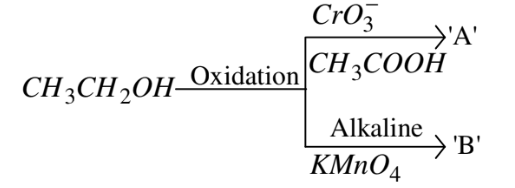
अपना परिणाम और व्याख्या देखने के लिए एक उत्तर चुनें।
उत्तर और व्याख्या
Option 1 is the correct answer, where A=CH3CHO (acetaldehyde) and B=CH3COOH (acetic acid). Here's a detailed explanation justifying why this option is correct and why the others are not:
-
Explanation for Option 1:
- A=CH3CHO (Acetaldehyde): Acetaldehyde is a simple aldehyde with the formula CH₃CHO. It is a common intermediate in the oxidation of ethanol and is known for its role in various chemical reactions, including its conversion to acetic acid.
- B=CH3COOH (Acetic Acid): Acetic acid is a carboxylic acid with the formula CH₃COOH. It is a well-known product of the oxidation of acetaldehyde. The conversion from acetaldehyde to acetic acid is a classic example of an oxidation reaction where the aldehyde group is oxidized to a carboxylic acid group.
- The relationship between acetaldehyde and acetic acid is well-established in organic chemistry, making Option 1 the correct choice.
-
Explanation for why other options are incorrect:
-
Option 2: A=CH3COOH, B=CH3CHO
- This option suggests that acetic acid is converted to acetaldehyde, which is not a typical or straightforward reaction. Acetic acid is more oxidized than acetaldehyde, and converting a carboxylic acid to an aldehyde typically requires a reduction process, which is not as common or direct as the oxidation of an aldehyde to a carboxylic acid.
-
Option 3: A=HCHO, B=CO2
- This option involves formaldehyde (HCHO) and carbon dioxide (CO₂). While formaldehyde can be oxidized to formic acid and further to carbon dioxide, the direct relationship between these two compounds is not as straightforward or relevant as the acetaldehyde to acetic acid conversion. Additionally, the question does not imply such a transformation.
-
Option 4: A=CH3CHO, B=CH2=CH2
- This option suggests a relationship between acetaldehyde and ethylene (CH₂=CH₂). However, acetaldehyde is not typically converted to ethylene in standard chemical processes. Ethylene is an alkene, and its formation from acetaldehyde would require a different set of reactions, such as dehydration, which is not as direct or relevant as the oxidation to acetic acid.
-
In conclusion, Option 1 is the correct answer because it accurately represents the well-known chemical relationship between acetaldehyde and acetic acid through an oxidation process. The other options do not reflect such a direct or typical chemical transformation.
A' तथा 'B' को पहचानिए :
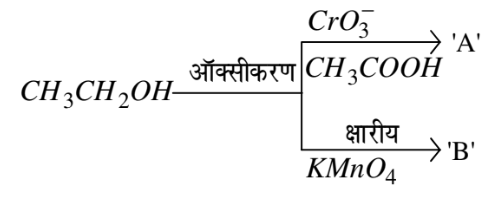
अपना परिणाम और व्याख्या देखने के लिए एक उत्तर चुनें।
उत्तर और व्याख्या
Option 1 is the correct answer: A=CH3CHO, B=CH3COOH. Let's provide a detailed explanation to justify why this option is correct and why the other options are incorrect.
Explanation for Option 1:
-
Chemical Identity:
- A=CH3CHO is acetaldehyde, a simple aldehyde with the formula CH₃CHO. It is characterized by the presence of a carbonyl group (C=O) bonded to a hydrogen atom and a methyl group.
- B=CH3COOH is acetic acid, a carboxylic acid with the formula CH₃COOH. It contains a carboxyl group (COOH), which is a defining feature of carboxylic acids.
-
Chemical Properties:
- Acetaldehyde (CH₃CHO) is known for its role as an intermediate in the oxidation of ethanol and can be further oxidized to acetic acid (CH₃COOH).
- Acetic acid (CH₃COOH) is a well-known weak acid, commonly found in vinegar, and is the oxidized form of acetaldehyde.
-
Logical Sequence:
- The conversion from acetaldehyde to acetic acid is a common oxidation reaction, which aligns with the identification of A as CH₃CHO and B as CH₃COOH.
Explanation for Why Other Options are Incorrect:
-
Option 2: A=CH3COOH, B=CH3CHO
- This option suggests that A is acetic acid and B is acetaldehyde. However, this does not align with the typical chemical transformation processes, as acetic acid is the oxidized form of acetaldehyde, not the other way around.
-
Option 3: A=HCHO, B=CO2
- Here, A is formaldehyde (HCHO) and B is carbon dioxide (CO₂). Formaldehyde is a different aldehyde and does not directly relate to the conversion or identification of acetaldehyde and acetic acid. Additionally, carbon dioxide is a simple oxide of carbon, not directly related to the compounds in question.
-
Option 4: A=CH3CHO, B=CH2=CH2
- In this option, A is correctly identified as acetaldehyde (CH₃CHO), but B is ethylene (CH₂=CH₂), an alkene. Ethylene is not related to the oxidation or transformation processes involving acetaldehyde and acetic acid.
In conclusion, Option 1 correctly identifies A as acetaldehyde and B as acetic acid, which is consistent with their chemical identities and typical reaction pathways. The other options do not accurately represent the relationship or transformation between these two compounds.
प्रश्न 37
When crystals of lead nitrate are heated strongly in a dry test tube :
अपना परिणाम और व्याख्या देखने के लिए एक उत्तर चुनें।
उत्तर और व्याख्या
When crystals of lead nitrate are heated strongly in a dry test tube, a yellow residue is left. This is because lead nitrate undergoes thermal decomposition when heated. The chemical reaction can be represented as follows:
[ \text{2Pb(NO}_3\text{)}_2 \rightarrow \text{2PbO} + \text{4NO}_2 + \text{O}_2 ]
-
Explanation for Option 4 (Correct Answer):
- When lead nitrate is heated, it decomposes to form lead(II) oxide (PbO), nitrogen dioxide (NO₂), and oxygen (O₂). The lead(II) oxide is a yellow solid, which is the residue left in the test tube. This yellow residue is characteristic of lead(II) oxide, confirming that Option 4 is correct.
-
Explanation for why other options are incorrect:
-
Option 1: A brown residue is left
- This option is incorrect because the residue left after the decomposition of lead nitrate is yellow, not brown. The brown color observed during the reaction is due to the release of nitrogen dioxide gas (NO₂), which is a brown gas, but it does not form a residue.
-
Option 2: White fumes appear in the tube
- This option is incorrect because the decomposition of lead nitrate does not produce white fumes. The gases released are nitrogen dioxide (NO₂), which is brown, and oxygen (O₂), which is colorless. There are no white fumes involved in this reaction.
-
Option 3: Crystals immediately vaporise
- This option is incorrect because lead nitrate does not vaporize upon heating. Instead, it decomposes into solid lead(II) oxide and gaseous products. The solid residue left is yellow lead(II) oxide, not vaporized crystals.
-
In conclusion, the correct answer is Option 4, as the decomposition of lead nitrate results in a yellow residue of lead(II) oxide, supporting the given correct answer.
एक शुष्क परखनली में जब लैड नाइट्रेट क्रिस्टलों को तेजी से गरम किया जाता है, तो :
अपना परिणाम और व्याख्या देखने के लिए एक उत्तर चुनें।
उत्तर और व्याख्या
जब लैड नाइट्रेट (Pb(NO₃)₂) क्रिस्टलों को एक शुष्क परखनली में तेजी से गरम किया जाता है, तो यह थर्मल डीकंपोजिशन प्रक्रिया से गुजरता है। इस प्रक्रिया के दौरान, लैड नाइट्रेट का विघटन होता है और यह लैड ऑक्साइड (PbO), नाइट्रोजन डाइऑक्साइड (NO₂), और ऑक्सीजन (O₂) में परिवर्तित हो जाता है। लैड ऑक्साइड एक पीला ठोस अवशेष है, जो परखनली में बचता है। इसलिए, विकल्प 4 "एक पीला अवशेष बचता है" सही उत्तर है।
अब अन्य विकल्पों की गलतियों को समझते हैं:
-
विकल्प 1: "एक भूरा अवशेष बचता है" - यह गलत है क्योंकि लैड ऑक्साइड पीले रंग का होता है, न कि भूरा।
-
विकल्प 2: "परखनली में श्वेत धूम प्रकट होते हैं" - यह गलत है क्योंकि लैड नाइट्रेट के विघटन से नाइट्रोजन डाइऑक्साइड गैस उत्पन्न होती है, जो भूरे रंग की होती है, न कि श्वेत धूम।
-
विकल्प 3: "क्रिस्टल शीघ्र वाष्पीकृत हो जाते हैं" - यह गलत है क्योंकि लैड नाइट्रेट का विघटन होता है, वाष्पीकरण नहीं। इस प्रक्रिया में ठोस अवशेष (लैड ऑक्साइड) बचता है।
इस प्रकार, विकल्प 4 सही है क्योंकि यह लैड नाइट्रेट के थर्मल डीकंपोजिशन के परिणामस्वरूप उत्पन्न पीले अवशेष (लैड ऑक्साइड) को सही ढंग से दर्शाता है।
प्रश्न 38
Which of the following property does not describe a compound?
अपना परिणाम और व्याख्या देखने के लिए एक उत्तर चुनें।
उत्तर और व्याख्या
Option 4 is the correct answer because it states that a compound "is mixed in any proportion by mass," which does not accurately describe a compound. Compounds have a fixed composition with elements combined in definite proportions by mass. This means that the ratio of the elements in a compound is always constant, regardless of the amount of the compound. For example, water (H₂O) is always composed of hydrogen and oxygen in a 2:1 ratio by mass.
Now, let's explain why each of the other options is incorrect:
-
Option 1: It cannot be separated into its constituents by physical means.
- This statement is true for compounds. Compounds are chemically bonded, and their constituent elements cannot be separated by physical means such as filtration or distillation. Instead, chemical reactions are required to break the bonds and separate the elements.
-
Option 2: It is composed of two or more elements.
- This is also true for compounds. By definition, a compound is a substance formed when two or more elements are chemically bonded together. For example, sodium chloride (NaCl) is a compound composed of sodium and chlorine.
-
Option 3: It is a pure substance.
- This statement is correct for compounds. A pure substance has a uniform and definite composition, and compounds fit this description because they consist of molecules that are all identical in composition and structure.
In summary, Option 4 is the correct answer because it inaccurately describes a compound as being mixed in any proportion by mass, which contradicts the fixed and definite composition that characterizes compounds. The other options correctly describe properties of compounds, reinforcing why Option 4 is the only incorrect statement.
निम्नलिखित में से कौन-सा गुण यौगिक की व्याख्या नहीं करता है ?
अपना परिणाम और व्याख्या देखने के लिए एक उत्तर चुनें।
उत्तर और व्याख्या
यौगिक एक रासायनिक पदार्थ है जो दो या दो से अधिक तत्वों के निश्चित अनुपात में संयोजन से बनता है। आइए दिए गए विकल्पों की व्याख्या करें और समझें कि क्यों विकल्प 4 सही उत्तर है:
-
भौतिक प्रक्रमों के द्वारा इसे, इसके अवयवों में पृथक नहीं किया जा सकता है।
यह कथन सही है क्योंकि यौगिकों को उनके अवयवों में पृथक करने के लिए रासायनिक विधियों की आवश्यकता होती है, न कि भौतिक विधियों की। उदाहरण के लिए, पानी (H₂O) को हाइड्रोजन और ऑक्सीजन में विभाजित करने के लिए विद्युत अपघटन की आवश्यकता होती है। -
यह दो अथवा अधिक तत्वों से मिलकर बना होता है।
यह भी सही है क्योंकि यौगिकों की परिभाषा ही यही है कि वे दो या अधिक तत्वों के संयोजन से बनते हैं। जैसे कि कार्बन डाइऑक्साइड (CO₂) कार्बन और ऑक्सीजन से मिलकर बना होता है। -
यह एक शुद्ध पदार्थ है।
यह कथन भी सही है क्योंकि यौगिक एक समान रासायनिक संरचना और गुणधर्मों वाला शुद्ध पदार्थ होता है। उदाहरण के लिए, किसी भी नमूने में पानी का रासायनिक संघटन H₂O ही होगा। -
इसे द्रव्यमान के किसी भी अनुपात में मिलाकर बनाया जा सकता है।
यह कथन गलत है और यही कारण है कि यह सही उत्तर है। यौगिकों का निर्माण तत्वों के निश्चित द्रव्यमान अनुपात में होता है। उदाहरण के लिए, पानी हमेशा 2:1 के हाइड्रोजन और ऑक्सीजन के अनुपात में बनता है। इसे किसी भी अन्य अनुपात में नहीं बनाया जा सकता।
इस प्रकार, विकल्प 4 यौगिक की व्याख्या नहीं करता है क्योंकि यौगिकों का निर्माण निश्चित अनुपात में होता है, न कि किसी भी द्रव्यमान अनुपात में।
प्रश्न 39
Two chemical substances X and Y combine together to form a product P which contains both X and Y :
X + Y → P
X and Y cannot be broken down into simpler substances by simple chemical reactions. Which of the following statements concerning X, Y and P are correct?
(i) P is a compound
(ii) X and Y are compounds
(iii) X and Y are elements
(iv) P has a fixed composition
अपना परिणाम और व्याख्या देखने के लिए एक उत्तर चुनें।
उत्तर और व्याख्या
Option 4 is the correct answer, which includes statements (i), (iii), and (iv). Let's break down why this option is correct and why the others are not.
-
Explanation for Option 4:
-
(i) P is a compound: This statement is correct because a compound is a substance formed when two or more elements are chemically bonded together. In the given reaction, X and Y combine to form P, which means P is a compound containing both X and Y.
-
(iii) X and Y are elements: This statement is correct because elements are substances that cannot be broken down into simpler substances by simple chemical reactions. The problem states that X and Y cannot be broken down further, indicating that they are elements.
-
(iv) P has a fixed composition: This statement is correct because compounds have a fixed composition. This means that the ratio of elements in a compound is always the same. Since P is a compound formed from X and Y, it will have a fixed composition.
-
-
Why the other options are incorrect:
-
Option 1 (i), (ii), and (iii): This option is incorrect because it includes statement (ii), which claims that X and Y are compounds. This contradicts the information given in the question that X and Y cannot be broken down into simpler substances, which is a characteristic of elements, not compounds.
-
Option 2 (i), (ii), and (iv): This option is incorrect for the same reason as Option 1. It includes statement (ii), which incorrectly identifies X and Y as compounds.
-
Option 3 (ii), (iii), and (iv): This option is incorrect because it includes statement (ii), which is incorrect for the reasons mentioned above. Additionally, it excludes statement (i), which is correct as P is indeed a compound.
-
In summary, Option 4 is the only option that correctly identifies P as a compound, X and Y as elements, and acknowledges that P has a fixed composition. This aligns with the fundamental definitions of elements and compounds in chemistry.
रासायनिक पदार्थ X तथा Y आपस में संयुक्त होकर उत्पाद P बनाते हैं जिसमें X तथा Y दोनों हैं :
X + Y → P
सामान्य रासायनिक अभिक्रियाओं के द्वारा X तथा Y को सरल पदार्थों में नहीं तोड़ा जा सकता है। X, Y तथा P के संदर्भ में निम्नलिखित में से कौन-सा कथन सही है ?
(i) P एक यौगिक है
(ii) X तथा Y यौगिक हैं
(iii) X तथा Y तत्व हैं
(iv) P का निश्चित संघटन होता है
अपना परिणाम और व्याख्या देखने के लिए एक उत्तर चुनें।
उत्तर और व्याख्या
सही उत्तर विकल्प 4 है: (i), (iii) तथा (iv)। आइए इसे विस्तार से समझते हैं:
-
P एक यौगिक है (i):
- रासायनिक अभिक्रिया X + Y → P में, X और Y मिलकर P बनाते हैं। जब दो या दो से अधिक तत्व रासायनिक रूप से मिलकर एक नया पदार्थ बनाते हैं, तो वह पदार्थ एक यौगिक कहलाता है। इसलिए, P एक यौगिक है।
-
X तथा Y तत्व हैं (iii):
- प्रश्न में कहा गया है कि X और Y को सामान्य रासायनिक अभिक्रियाओं द्वारा सरल पदार्थों में नहीं तोड़ा जा सकता। यह गुण तत्वों का होता है, क्योंकि तत्व वे मूलभूत पदार्थ होते हैं जिन्हें रासायनिक विधियों द्वारा और सरल पदार्थों में नहीं तोड़ा जा सकता। इसलिए, X और Y तत्व हैं।
-
P का निश्चित संघटन होता है (iv):
- यौगिकों की एक विशेषता यह होती है कि उनका संघटन निश्चित होता है। इसका अर्थ है कि किसी यौगिक में शामिल तत्व एक निश्चित अनुपात में होते हैं। चूंकि P एक यौगिक है, इसलिए इसका निश्चित संघटन होता है।
अब देखते हैं कि अन्य विकल्प क्यों गलत हैं:
-
विकल्प 1 (i), (ii) तथा (iii): इसमें कहा गया है कि X तथा Y यौगिक हैं, जो गलत है क्योंकि X और Y तत्व हैं, जैसा कि ऊपर समझाया गया है।
-
विकल्प 2 (i), (ii) तथा (iv): इसमें भी X तथा Y को यौगिक बताया गया है, जो गलत है। X और Y तत्व हैं।
-
विकल्प 3 (ii), (iii) तथा (iv): इसमें X तथा Y को यौगिक बताया गया है, जो गलत है। X और Y तत्व हैं।
इस प्रकार, विकल्प 4 सही है क्योंकि यह सभी सही कथनों को शामिल करता है: P एक यौगिक है, X और Y तत्व हैं, और P का निश्चित संघटन होता है।
प्रश्न 40
Match the mixture given in Column - I with their method of separation given in Column - II : Column - I – Column - II
(a) Oil mixed with water – (i) Sieving
(b) Iron powder mixed with flour – (ii) Decantation
(c) Salt mixed with water – (iii) Magnet with water
(d) Kidney beans mixed with rice flour – (iv) Evaporation
अपना परिणाम और व्याख्या देखने के लिए एक उत्तर चुनें।
उत्तर और व्याख्या
Option 2 is the correct answer because it accurately matches each mixture in Column - I with the appropriate method of separation in Column - II based on the physical properties of the components involved.
-
(a) Oil mixed with water – (ii) Decantation: Oil and water are immiscible liquids, meaning they do not mix. Decantation is a suitable method for separating such mixtures because it involves pouring off the top layer (oil) after allowing the mixture to settle, leaving the denser water behind.
-
(b) Iron powder mixed with flour – (iii) Magnet: Iron is a magnetic material, whereas flour is not. Using a magnet is an effective method to separate iron powder from flour because the magnet will attract the iron particles, leaving the flour behind.
-
(c) Salt mixed with water – (iv) Evaporation: Salt dissolves in water to form a homogeneous solution. Evaporation is the appropriate method to separate salt from water because it involves heating the solution until the water evaporates, leaving the salt crystals behind.
-
(d) Kidney beans mixed with rice flour – (i) Sieving: Kidney beans are much larger in size compared to rice flour particles. Sieving is an effective method for separating mixtures with components of different sizes, as the flour will pass through the sieve while the larger kidney beans are retained.
Now, let's explain why the other options are incorrect:
-
Option 1: This option incorrectly matches (c) Salt mixed with water with (i) Sieving, which is not suitable because sieving cannot separate dissolved substances. It also matches (d) Kidney beans mixed with rice flour with (ii) Decantation, which is inappropriate because decantation is used for separating immiscible liquids, not solid mixtures.
-
Option 3: This option incorrectly matches (a) Oil mixed with water with (iv) Evaporation, which is not suitable because evaporation is used for separating dissolved solids from liquids, not immiscible liquids. It also matches (b) Iron powder mixed with flour with (i) Sieving, which is ineffective because sieving cannot separate magnetic materials from non-magnetic ones.
-
Option 4: This option incorrectly matches (c) Salt mixed with water with (i) Sieving, which is not suitable for separating dissolved substances. It also matches (d) Kidney beans mixed with rice flour with (iv) Evaporation, which is inappropriate because evaporation is used for separating dissolved solids from liquids, not solid mixtures.
Therefore, Option 2 is the only option that correctly matches each mixture with its appropriate method of separation.
कॉलम I में दिए गए मिश्रण का मिलान कॉलम - II में दिए गए उनके पृथक्करण की विधि से कीजिए :
कॉलम - I – कॉलम - II
(a) जल में तेल का मिश्रण – (i) छानना
(b) आटे में मिला हुआ लोहे का चूर्ण – (ii) निथारना
(c) जल में नमक का मिश्रण – (iii) चुम्बक
(d) चावल के आटे में राजमा मिला हुआ – (iv) वाष्पन
अपना परिणाम और व्याख्या देखने के लिए एक उत्तर चुनें।
उत्तर और व्याख्या
सही उत्तर विकल्प 2 है। आइए इसे विस्तार से समझते हैं:
-
(a) जल में तेल का मिश्रण – (ii) निथारना:
- तेल और पानी का मिश्रण दो अलग-अलग घनत्व वाले तरल पदार्थ होते हैं। तेल पानी के ऊपर तैरता है क्योंकि इसका घनत्व पानी से कम होता है। इस प्रकार, निथारने की विधि का उपयोग करके तेल को पानी से अलग किया जा सकता है। निथारना एक ऐसी प्रक्रिया है जिसमें दो असमिश्रणीय तरल पदार्थों को अलग किया जाता है।
-
(b) आटे में मिला हुआ लोहे का चूर्ण – (iii) चुम्बक:
- लोहे का चूर्ण चुम्बकीय गुणों वाला होता है। इसलिए, चुम्बक का उपयोग करके इसे आटे से आसानी से अलग किया जा सकता है। चुम्बक लोहे के कणों को आकर्षित करेगा और उन्हें आटे से अलग कर देगा।
-
(c) जल में नमक का मिश्रण – (iv) वाष्पन:
- नमक पानी में घुलनशील होता है और एक समान मिश्रण बनाता है। वाष्पन की प्रक्रिया का उपयोग करके, पानी को वाष्पित किया जा सकता है, जिससे नमक पीछे रह जाता है। यह विधि नमक को पानी से अलग करने के लिए उपयुक्त है।
-
(d) चावल के आटे में राजमा मिला हुआ – (i) छानना:
- चावल के आटे और राजमा के आकार में काफी अंतर होता है। छानने की प्रक्रिया का उपयोग करके, बड़े आकार के राजमा को छोटे आकार के चावल के आटे से अलग किया जा सकता है।
अब, आइए देखें कि अन्य विकल्प क्यों गलत हैं:
- विकल्प 1: इसमें (c) जल में नमक का मिश्रण – (i) छानना दिया गया है, जो गलत है क्योंकि नमक पानी में घुल जाता है और छानने से अलग नहीं किया जा सकता।
- विकल्प 3: इसमें (a) जल में तेल का मिश्रण – (iv) वाष्पन दिया गया है, जो गलत है क्योंकि वाष्पन तेल और पानी को अलग करने के लिए उपयुक्त नहीं है।
- विकल्प 4: इसमें (c) जल में नमक का मिश्रण – (i) छानना और (d) चावल के आटे में राजमा मिला हुआ – (iv) वाष्पन दिया गया है, जो गलत है क्योंकि ये विधियाँ इन मिश्रणों को अलग करने के लिए उपयुक्त नहीं हैं।
इस प्रकार, विकल्प 2 सही उत्तर है क्योंकि यह सभी मिश्रणों के लिए सही पृथक्करण विधियाँ प्रदान करता है।