
HTET परीक्षा - Level 1 Prt - हमारे आस-पास के पदार्थ
Clear Cutoff के साथ HTET परीक्षा Level 1 Prt की तैयारी
Clear Cutoff द्वारा
10 में से 10 प्रश्न दिखाए जा रहे हैं
प्रश्न 21
Which of the following statement is not true?
अपना परिणाम और व्याख्या देखने के लिए एक उत्तर चुनें।
उत्तर और व्याख्या
Option 2 is the correct answer because it states that "The molecules in a liquid are arranged in a regular pattern." This statement is not true. In reality, the molecules in a liquid are not arranged in a regular pattern. Instead, they are randomly distributed and can move past one another, which allows liquids to flow and take the shape of their container. Unlike solids, which have a fixed, regular arrangement of molecules, liquids have a more disordered structure due to the weaker intermolecular forces that allow for greater movement.
Now, let's explain why each of the other options is incorrect:
-
Option 1: The molecules of a gas occupy all the space available.
- This statement is true. Gas molecules are in constant, random motion and will spread out to fill the entire volume of the container they are in. This behavior is a fundamental characteristic of gases, as they have neither a fixed shape nor a fixed volume.
-
Option 3: The molecules in a solid vibrate about a fixed position.
- This statement is true. In solids, molecules are tightly packed in a fixed, orderly arrangement. While they do not move freely, they do vibrate around their fixed positions. This vibration increases with temperature but does not result in the molecules moving past one another, which is why solids maintain a definite shape.
-
Option 4: The molecules in a gas exert negligibly small forces on each other, except during collisions.
- This statement is true. In an ideal gas, the intermolecular forces are considered negligible except during collisions. This assumption is part of the kinetic molecular theory of gases, which explains that gas molecules are far apart and interact primarily through elastic collisions, with minimal attractive or repulsive forces between them.
In summary, Option 2 is the correct answer because it inaccurately describes the arrangement of molecules in a liquid, whereas the other options accurately describe the behavior of molecules in gases and solids.
निम्नलिखित में से कौन-सा कथन सही नहीं है ?
अपना परिणाम और व्याख्या देखने के लिए एक उत्तर चुनें।
उत्तर और व्याख्या
Option 2: "एक द्रव के अणु नियमित पैटर्न में व्यवस्थित रहते हैं।" सही नहीं है क्योंकि द्रव के अणु नियमित पैटर्न में व्यवस्थित नहीं होते हैं। द्रवों में अणु अपेक्षाकृत स्वतंत्र रूप से गतिशील होते हैं और उनके बीच की दूरी ठोस की तुलना में अधिक होती है। इस कारण से, द्रव के अणु एक निश्चित पैटर्न में नहीं होते हैं, बल्कि वे एक-दूसरे के ऊपर फिसल सकते हैं, जिससे द्रव को उसकी तरलता मिलती है।
अब अन्य विकल्पों की चर्चा करते हैं:
-
"एक गैस के अणु समस्त उपलब्ध स्थान को घेर लेते हैं।" - यह कथन सही है क्योंकि गैस के अणु उच्च गतिशीलता के कारण पूरे उपलब्ध स्थान में फैल जाते हैं। वे किसी भी कंटेनर के आकार और आकार के अनुसार फैल सकते हैं।
-
"एक ठोस में अणु निश्चित स्थिति के चारों ओर कम्पन्न करते हैं।" - यह कथन सही है क्योंकि ठोस में अणु एक निश्चित स्थिति में होते हैं और वे केवल अपनी स्थिति के चारों ओर कम्पन्न करते हैं। ठोस की कठोरता और आकार इसी कारण से स्थिर रहता है।
-
"संघट्ट (टक्कर) के अतिरिक्त, एक गैस के अणु एक-दूसरे पर अनन्त सूक्ष्म बल आरोपित करते हैं।" - यह कथन सही है क्योंकि गैस के अणु एक-दूसरे के साथ टकराते हैं और उनके बीच के बल बहुत सूक्ष्म होते हैं। गैस के अणुओं के बीच का बल इतना कम होता है कि इसे अनदेखा किया जा सकता है, और वे स्वतंत्र रूप से गति करते हैं।
इस प्रकार, विकल्प 2 सही नहीं है क्योंकि यह द्रव के अणुओं की वास्तविक स्थिति का सही वर्णन नहीं करता है।
प्रश्न 22
Which of the following has least value of 'packing efficiency' ?
अपना परिणाम और व्याख्या देखने के लिए एक उत्तर चुनें।
उत्तर और व्याख्या
Packing efficiency is a measure of how tightly the constituent particles (atoms, ions, or molecules) are packed in a crystal lattice. It is defined as the fraction of volume in a crystal structure that is occupied by the constituent particles.
-
Simple Cube (Option 4):
- In a simple cubic structure, each corner atom is shared by eight adjacent unit cells. The packing efficiency of a simple cubic structure is approximately 52%. This is because the atoms in a simple cubic lattice touch along the edges of the cube, leaving a significant amount of empty space within the structure. This results in the least efficient packing among the common crystal structures.
-
Body-Centred Cube (Option 1):
- In a body-centred cubic (BCC) structure, there is an additional atom at the center of the cube, which increases the packing efficiency compared to a simple cubic structure. The packing efficiency of a BCC structure is approximately 68%. This is higher than that of a simple cubic structure because the central atom helps fill some of the empty space.
-
Face-Centred Cube (Option 2):
- A face-centred cubic (FCC) structure has atoms at each corner and at the center of each face of the cube. The packing efficiency of an FCC structure is about 74%, which is significantly higher than that of a simple cubic structure. This is because the face-centered arrangement allows for a more compact packing of atoms.
-
Closed Packed Hexagonal (Option 3):
- The hexagonal close-packed (HCP) structure is another highly efficient packing arrangement, with a packing efficiency of approximately 74%, similar to that of the FCC structure. The HCP structure is characterized by layers of atoms arranged in a hexagonal pattern, which maximizes the use of space.
In conclusion, the simple cubic structure (Option 4) has the least packing efficiency at approximately 52%, making it the correct answer. The other structures—BCC, FCC, and HCP—have higher packing efficiencies due to their more compact arrangements of atoms.
निम्न में से किसमें 'संकुलन दक्षता' का मान सबसे कम है ?
अपना परिणाम और व्याख्या देखने के लिए एक उत्तर चुनें।
उत्तर और व्याख्या
'संकुलन दक्षता' का अर्थ है कि किसी क्रिस्टल संरचना में परमाणुओं या अणुओं द्वारा घिरे हुए स्थान का प्रतिशत। सरल घन (Simple Cubic) संरचना में संकुलन दक्षता सबसे कम होती है। आइए इसे विस्तार से समझें:
-
सरल घन (Simple Cubic): सरल घन संरचना में प्रत्येक कोने पर एक परमाणु होता है। इस संरचना में संकुलन दक्षता केवल 52% होती है, जो इसे सबसे कम संकुलन दक्षता वाली संरचना बनाती है। इसका मतलब है कि केवल 52% स्थान परमाणुओं द्वारा भरा जाता है, और शेष 48% स्थान खाली रहता है।
-
अंतः केन्द्रित घन (Body-Centered Cubic): इस संरचना में, प्रत्येक कोने पर एक परमाणु और घन के केंद्र में एक अतिरिक्त परमाणु होता है। इसकी संकुलन दक्षता लगभग 68% होती है, जो सरल घन से अधिक है।
-
फलक केन्द्रित घन (Face-Centered Cubic): इस संरचना में, प्रत्येक कोने पर एक परमाणु और प्रत्येक फलक के केंद्र में एक परमाणु होता है। इसकी संकुलन दक्षता लगभग 74% होती है, जो इसे एक बहुत ही घनी संरचना बनाती है।
-
घन संकुलित षट्कोणीय (Hexagonal Close-Packed): इस संरचना में भी संकुलन दक्षता लगभग 74% होती है, जो फलक केन्द्रित घन के समान है।
इस प्रकार, सरल घन संरचना में संकुलन दक्षता सबसे कम होती है, इसलिए विकल्प 4 सही उत्तर है।
प्रश्न 23
A metal crystallizes in 2 cubic phases fcc and bcc whose unit lengths are 3.5 A∘ and 3.0 A∘ respectively. The ratio of their densities is :
अपना परिणाम और व्याख्या देखने के लिए एक उत्तर चुनें।
उत्तर और व्याख्या
To determine the ratio of the densities of the metal in its face-centered cubic (fcc) and body-centered cubic (bcc) phases, we need to use the formula for density in terms of the unit cell dimensions and the number of atoms per unit cell.
Explanation:
-
Density Formula:
[
\text{Density} = \frac{\text{Mass of atoms in unit cell}}{\text{Volume of unit cell}}
] -
Face-Centered Cubic (fcc) Structure:
- In an fcc structure, there are 4 atoms per unit cell.
- The volume of the unit cell is (a^3), where (a) is the edge length.
- Given (a_{\text{fcc}} = 3.5 , A^\circ), the volume is ((3.5 , A^\circ)^3).
-
Body-Centered Cubic (bcc) Structure:
- In a bcc structure, there are 2 atoms per unit cell.
- Given (a_{\text{bcc}} = 3.0 , A^\circ), the volume is ((3.0 , A^\circ)^3).
-
Density Ratio Calculation:
- Let (m) be the mass of one atom.
- Density of fcc: (\rho_{\text{fcc}} = \frac{4m}{(3.5)^3})
- Density of bcc: (\rho_{\text{bcc}} = \frac{2m}{(3.0)^3})
- Ratio of densities:
[
\frac{\rho_{\text{fcc}}}{\rho_{\text{bcc}}} = \frac{\frac{4m}{(3.5)^3}}{\frac{2m}{(3.0)^3}} = \frac{4 \times (3.0)^3}{2 \times (3.5)^3}
]
-
Simplifying the Ratio:
[
\frac{\rho_{\text{fcc}}}{\rho_{\text{bcc}}} = \frac{4 \times 27}{2 \times 42.875} = \frac{108}{85.75} \approx 1.25
]
Conclusion:
- Option 1 (1.25) is correct because the calculated ratio of densities for the fcc and bcc structures is approximately 1.25.
Explanation for Incorrect Options:
- Option 2 (2.04): This value is too high. The calculation shows that the ratio is closer to 1.25, not 2.04.
- Option 3 (0.72): This value is too low. The calculated ratio is greater than 1, indicating that the fcc structure is denser than the bcc structure.
- Option 4 (3.12): This value is significantly higher than the calculated ratio, which is approximately 1.25.
By following the given instructions and calculations, Option 1 is justified as the correct answer.
एक धातु 2 घनीय अवस्थाओं fcc तथा bcc में क्रिस्टलीकृत होता है जिसकी इकाई सेल लम्बाइयाँ क्रमशः 3.5 A∘ तथा 3.0 A∘ and . हैं। इनके घनत्वों का अनुपात है :
अपना परिणाम और व्याख्या देखने के लिए एक उत्तर चुनें।
उत्तर और व्याख्या
धातु के fcc (face-centered cubic) और bcc (body-centered cubic) क्रिस्टल संरचनाओं के घनत्वों के अनुपात को समझने के लिए, हमें इन दोनों संरचनाओं की इकाई सेल की विशेषताओं को समझना होगा।
-
fcc संरचना:
- fcc संरचना में प्रति इकाई सेल 4 परमाणु होते हैं।
- इकाई सेल की लंबाई = 3.5 A∘
- fcc संरचना में घनत्व (ρ) = (\frac{Z \times M}{a^3 \times N_A}), जहाँ Z = 4 (fcc के लिए), M = परमाणु का द्रव्यमान, a = इकाई सेल की लंबाई, और (N_A) = एवोगाड्रो संख्या।
-
bcc संरचना:
- bcc संरचना में प्रति इकाई सेल 2 परमाणु होते हैं।
- इकाई सेल की लंबाई = 3.0 A∘
- bcc संरचना में घनत्व (ρ) = (\frac{Z \times M}{a^3 \times N_A}), जहाँ Z = 2 (bcc के लिए), M = परमाणु का द्रव्यमान, a = इकाई सेल की लंबाई, और (N_A) = एवोगाड्रो संख्या।
अब, घनत्वों का अनुपात (fcc/bcc) निकालते हैं:
[
\text{घनत्व अनुपात} = \frac{\frac{4 \times M}{(3.5)^3 \times N_A}}{\frac{2 \times M}{(3.0)^3 \times N_A}}
]
यहाँ, M और (N_A) दोनों ही रद्द हो जाते हैं, जिससे हमें मिलता है:
[
\text{घनत्व अनुपात} = \frac{4 \times (3.0)^3}{2 \times (3.5)^3}
]
[
= \frac{4 \times 27}{2 \times 42.875}
]
[
= \frac{108}{85.75}
]
[
\approx 1.25
]
इस प्रकार, घनत्वों का अनुपात 1.25 है, जो विकल्प 1 के अनुसार सही है।
अन्य विकल्पों की अस्वीकृति:
-
विकल्प 2 (2.04): यह अनुपात fcc और bcc संरचनाओं के लिए गणना किए गए घनत्व अनुपात से मेल नहीं खाता है।
-
विकल्प 3 (0.72): यह अनुपात भी गणना के अनुसार सही नहीं है।
-
विकल्प 4 (3.12): यह अनुपात भी गलत है क्योंकि यह गणना किए गए सही अनुपात से बहुत अधिक है।
इस प्रकार, विकल्प 1 सही है क्योंकि यह गणना के अनुसार सही अनुपात को दर्शाता है।
प्रश्न 24
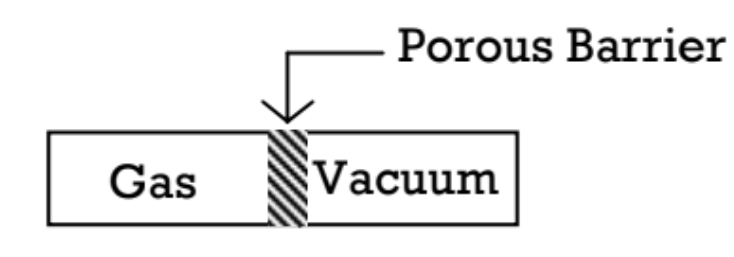
The apparatus given below is used to study the diffusion of a number of gases at the same temperature and pressure.
Which of the following pairs of gases would diffuse into vacuum at the same speed ? (Given atomic mass of H = 1 u, C = 12 u, N = 14 u, O = 16 u)
अपना परिणाम और व्याख्या देखने के लिए एक उत्तर चुनें।
उत्तर और व्याख्या
To determine which pair of gases would diffuse into a vacuum at the same speed, we need to consider Graham's law of effusion. According to Graham's law, the rate of effusion (or diffusion) of a gas is inversely proportional to the square root of its molar mass. Therefore, for two gases to diffuse at the same speed, they must have the same molar mass.
Let's analyze each option:
-
Option 1: NH5 and H2
- NH5 is not a chemically stable or recognized compound, so we cannot calculate its molar mass. However, assuming a hypothetical scenario, NH5 would have a molar mass of approximately 19 u (1 for H and 14 for N).
- H2 has a molar mass of 2 u.
- These two gases have significantly different molar masses, so they would not diffuse at the same speed.
-
Option 2: CO and SO2
- CO (carbon monoxide) has a molar mass of 28 u (12 for C and 16 for O).
- SO2 (sulfur dioxide) has a molar mass of 64 u (32 for S and 32 for two O atoms).
- The molar masses are different, so these gases would not diffuse at the same speed.
-
Option 3: CO and N2
- CO (carbon monoxide) has a molar mass of 28 u (12 for C and 16 for O).
- N2 (nitrogen gas) also has a molar mass of 28 u (14 for each N atom).
- Since both gases have the same molar mass, they would diffuse into a vacuum at the same speed. This is why Option 3 is the correct answer.
-
Option 4: NH3 and N2
- NH3 (ammonia) has a molar mass of 17 u (14 for N and 3 for H).
- N2 (nitrogen gas) has a molar mass of 28 u (14 for each N atom).
- The molar masses are different, so these gases would not diffuse at the same speed.
In conclusion, Option 3 is correct because CO and N2 have the same molar mass, allowing them to diffuse at the same speed according to Graham's law of effusion.
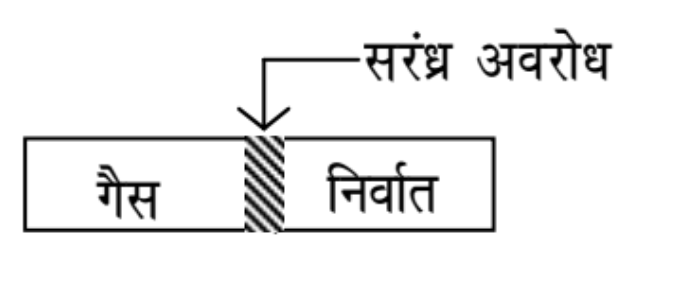
नीचे दिए गए उपकरण समान ताप एवं दाब पर विभिन्न गैसों के विसरण का अध्ययन करने के लिए उपयोग में आता है।
निम्नलिखित में से गैसों का कौन-सा युग्म समान गति से निर्वात में विसरित होगा ? (दिया गया परमाण्वीय द्रव्यमान H = 1 u, C = 12 u, N = 14 u, O = 16 u)
अपना परिणाम और व्याख्या देखने के लिए एक उत्तर चुनें।
उत्तर और व्याख्या
गैसों के विसरण की गति ग्रैहम के विसरण नियम के अनुसार होती है, जो कहता है कि किसी गैस का विसरण वेग उसके मोलर द्रव्यमान के वर्गमूल के व्युत्क्रमानुपाती होता है। इसका मतलब है कि हल्की गैसें तेजी से विसरित होती हैं।
अब हम दिए गए विकल्पों का विश्लेषण करते हैं:
-
NH5 तथा H2: NH5 एक काल्पनिक यौगिक है क्योंकि अमोनिया (NH3) का सामान्य रूप होता है। इसलिए यह विकल्प सही नहीं हो सकता।
-
CO तथा SO2: CO का मोलर द्रव्यमान 28 u (C = 12 u, O = 16 u) है, जबकि SO2 का मोलर द्रव्यमान 64 u (S = 32 u, O = 16 u × 2) है। चूंकि SO2 का मोलर द्रव्यमान CO से अधिक है, इसलिए ये समान गति से विसरित नहीं होंगे।
-
CO तथा N2: CO का मोलर द्रव्यमान 28 u है और N2 का मोलर द्रव्यमान भी 28 u (N = 14 u × 2) है। चूंकि दोनों गैसों का मोलर द्रव्यमान समान है, इसलिए ये समान गति से विसरित होंगी। यही कारण है कि यह विकल्प सही है।
-
NH3 तथा N2: NH3 का मोलर द्रव्यमान 17 u (N = 14 u, H = 1 u × 3) है, जबकि N2 का मोलर द्रव्यमान 28 u है। चूंकि NH3 का मोलर द्रव्यमान N2 से कम है, इसलिए ये समान गति से विसरित नहीं होंगे।
इस प्रकार, विकल्प 3 सही है क्योंकि CO और N2 का मोलर द्रव्यमान समान है, जिससे वे समान गति से विसरित होते हैं।
प्रश्न 25
Which of the following statements are correct?
(i) Temperature changes during the change of a state.
(ii) Dry ice gets converted directly into gaseous state under normal atmospheric conditions.
(iii) Higher boiling points of liquid indicates weaker intermolecular forces.
(iv) Latent heat of vaporization is generally higher than the latent heat of fusion for a substance.
Correct option is :
अपना परिणाम और व्याख्या देखने के लिए एक उत्तर चुनें।
उत्तर और व्याख्या
Option 2 is the correct answer, which includes statements (ii) and (iv). Let's explore why these statements are correct and why the other options are incorrect.
-
Statement (ii): Dry ice gets converted directly into gaseous state under normal atmospheric conditions.
- This statement is correct. Dry ice is solid carbon dioxide (CO2), and it sublimates, meaning it changes directly from a solid to a gas without passing through the liquid phase under normal atmospheric pressure. This is a well-known property of dry ice, making statement (ii) accurate.
-
Statement (iv): Latent heat of vaporization is generally higher than the latent heat of fusion for a substance.
- This statement is also correct. The latent heat of vaporization is the amount of energy required to convert a unit mass of a liquid into a gas at constant temperature and pressure. It is generally higher than the latent heat of fusion, which is the energy required to change a unit mass of a solid into a liquid. This is because breaking the intermolecular forces to convert a liquid into a gas requires more energy than converting a solid into a liquid.
Now, let's examine why the other statements are incorrect:
-
Statement (i): Temperature changes during the change of a state.
- This statement is incorrect. During a phase change, such as melting or boiling, the temperature of a substance remains constant until the entire substance has changed its state. The energy added or removed during a phase change is used to alter the state, not to change the temperature.
-
Statement (iii): Higher boiling points of liquid indicates weaker intermolecular forces.
- This statement is incorrect. In fact, higher boiling points indicate stronger intermolecular forces. A liquid with strong intermolecular forces requires more energy (and thus a higher temperature) to overcome these forces and transition into the gaseous state.
By focusing on the correct statements (ii) and (iv), Option 2 is justified as the correct answer.
निम्नलिखित में से कौन-से कथन सही हैं ?
(i) अवस्था परिवर्तन के दौरान ताप परिवर्तित होता है।
(ii) सामान्य वायुमण्डलीय परिस्थितियों में शुष्क बर्फ सीधे गैसीय अवस्था में परिवर्तित हो जाती है।
(iii) द्रव का उच्च क्वथनांक, दुर्बल अन्तरआण्विक बलों को दर्शाता है।
(iv) किसी पदार्थ के लिए गलन की गुप्त ऊष्मा की तुलना में वाष्पन की गुप्त ऊष्मा अधिक होती है।
सही विकल्प है :
अपना परिणाम और व्याख्या देखने के लिए एक उत्तर चुनें।
उत्तर और व्याख्या
सही विकल्प 2 है: (ii) तथा (iv)
व्याख्या:
(ii) सामान्य वायुमण्डलीय परिस्थितियों में शुष्क बर्फ सीधे गैसीय अवस्था में परिवर्तित हो जाती है। - यह कथन सही है क्योंकि शुष्क बर्फ (कार्बन डाइऑक्साइड का ठोस रूप) सामान्य वायुमंडलीय दबाव और तापमान पर सीधे ठोस से गैस में परिवर्तित हो जाती है। इस प्रक्रिया को उर्ध्वपातन (sublimation) कहा जाता है।
(iv) किसी पदार्थ के लिए गलन की गुप्त ऊष्मा की तुलना में वाष्पन की गुप्त ऊष्मा अधिक होती है। - यह कथन भी सही है। वाष्पन की गुप्त ऊष्मा आमतौर पर गलन की गुप्त ऊष्मा से अधिक होती है क्योंकि द्रव को गैस में परिवर्तित करने के लिए अधिक ऊर्जा की आवश्यकता होती है, जिससे अणुओं के बीच के बल पूरी तरह से टूट जाते हैं।
अन्य विकल्पों की गलतियाँ:
(i) अवस्था परिवर्तन के दौरान ताप परिवर्तित होता है। - यह कथन गलत है। अवस्था परिवर्तन के दौरान, जैसे कि बर्फ का पिघलना या पानी का उबलना, तापमान स्थिर रहता है जब तक कि पूरा परिवर्तन नहीं हो जाता। इसलिए, यह कथन सही नहीं है।
(iii) द्रव का उच्च क्वथनांक, दुर्बल अन्तरआण्विक बलों को दर्शाता है। - यह कथन गलत है। उच्च क्वथनांक का मतलब है कि द्रव के अणुओं के बीच मजबूत अन्तरआण्विक बल होते हैं, जिन्हें तोड़ने के लिए अधिक ऊर्जा की आवश्यकता होती है। इसलिए, यह कथन सही नहीं है।
इस प्रकार, विकल्प 2 सही है क्योंकि यह उन कथनों को सम्मिलित करता है जो वैज्ञानिक रूप से सही हैं।
प्रश्न 26
Which of the following statement is incorrect about state of matter?
अपना परिणाम और व्याख्या देखने के लिए एक उत्तर चुनें।
उत्तर और व्याख्या
Option 4 is the correct answer because it contains an incorrect statement about the formation of a Bose-Einstein condensate. A Bose-Einstein condensate (BEC) is not formed by heating a gas of extremely low density; rather, it is formed by cooling a gas of bosons to temperatures very close to absolute zero. At such low temperatures, a significant fraction of the bosons occupy the lowest quantum state, resulting in quantum effects becoming apparent on a macroscopic scale. This process involves cooling, not heating, which makes Option 4 incorrect.
Now, let's explain why each of the other options is correct:
-
Option 1: "The force of attraction between gas molecules is very less."
This statement is correct. In gases, the molecules are far apart compared to solids and liquids, and the intermolecular forces are very weak. This allows gas molecules to move freely and occupy the entire volume of their container. -
Option 2: "Plasma consists of super energetic and super excited particles."
This statement is correct. Plasma is a state of matter where the gas phase is energized until atomic electrons are no longer associated with any particular atomic nucleus. This results in a collection of ions and free electrons, making the particles in plasma highly energetic and excited. -
Option 3: "The plasma glows with a special colour depending on the nature of the gas."
This statement is correct. The glow of plasma is due to the excitation of electrons and their subsequent return to lower energy levels, emitting light in the process. The color of the glow depends on the type of gas and the specific energy transitions of its atoms or molecules.
In summary, Option 4 is the correct answer because it inaccurately describes the process of forming a Bose-Einstein condensate, which involves cooling rather than heating. The other options accurately describe characteristics of gases and plasma.
द्रव्य की अवस्था के संदर्भ में निम्नलिखित में से कौन-सा कथन सही नहीं है ?
अपना परिणाम और व्याख्या देखने के लिए एक उत्तर चुनें।
उत्तर और व्याख्या
Option 4 सही उत्तर है क्योंकि बोस-आइंस्टीन कन्डेनसेट (BEC) अत्यन्त कम घनत्व वाली गैस को गरम करने पर प्राप्त नहीं होती है, बल्कि इसे अत्यन्त ठंडा करने पर प्राप्त किया जाता है। बोस-आइंस्टीन कन्डेनसेट एक ऐसी अवस्था है जिसमें कणों को लगभग शून्य केल्विन तापमान तक ठंडा किया जाता है, जिससे वे एक ही क्वांटम अवस्था में आ जाते हैं और एक सुपरफ्लुइड अवस्था बनाते हैं। इसलिए, यह कथन गलत है और यही कारण है कि यह सही उत्तर है।
अब अन्य विकल्पों की चर्चा करते हैं:
-
गैस के अणुओं के मध्य आकर्षण बल बहुत कम होता है।
यह कथन सही है क्योंकि गैस के अणुओं के बीच आकर्षण बल बहुत कम होता है, जिससे वे स्वतंत्र रूप से गति कर सकते हैं और गैस का विस्तार कर सकते हैं। -
प्लाज्मा अति ऊर्जा तथा अति उत्तेजित कणों से बनी होती है।
यह कथन भी सही है। प्लाज्मा अवस्था में, गैस के कण अत्यधिक ऊर्जा प्राप्त कर लेते हैं और आयनित हो जाते हैं, जिससे वे अति उत्तेजित अवस्था में होते हैं। -
प्लाज्मा एक विशेष रंग से दीप्त होती है जो गैस की प्रकृति पर निर्भर करती है।
यह कथन भी सही है। प्लाज्मा का रंग उस गैस की प्रकृति पर निर्भर करता है जिससे वह बना होता है, क्योंकि विभिन्न गैसें विभिन्न तरंग दैर्ध्य पर प्रकाश उत्सर्जित करती हैं।
इस प्रकार, विकल्प 4 को छोड़कर अन्य सभी विकल्प सही हैं, और इसलिए विकल्प 4 सही उत्तर है क्योंकि यह कथन गलत है।
प्रश्न 27
For the reaction 2SO2+O2⇌2SO3;ΔH=−45 kcal, which one of the following statement is correct?
अपना परिणाम और व्याख्या देखने के लिए एक उत्तर चुनें।
उत्तर और व्याख्या
The reaction in question is (2SO_2 + O_2 \rightleftharpoons 2SO_3) with (\Delta H = -45 \text{ kcal}), indicating that it is an exothermic reaction. Let's analyze why Option 3 is the correct choice and why the other options are incorrect.
Explanation for Option 3:
The reaction is favoured by the increase of pressure.
- Le Chatelier's Principle: According to Le Chatelier's Principle, if a system at equilibrium is subjected to a change in pressure, the system will adjust to counteract that change. For gaseous reactions, an increase in pressure will favor the side with fewer moles of gas.
- Mole Analysis: In the given reaction, the reactants (2SO_2 + O_2) have a total of 3 moles of gas, while the product (2SO_3) has 2 moles of gas. Increasing the pressure will shift the equilibrium towards the side with fewer moles of gas, which is the product side ((2SO_3)).
- Conclusion: Therefore, increasing the pressure favors the formation of (SO_3), making Option 3 the correct choice.
Explanation for why other options are incorrect:
Option 1: The reaction is favoured by the addition of inert gas at constant pressure.
- Effect of Inert Gas: Adding an inert gas at constant pressure does not change the partial pressures of the reactants or products. Therefore, it does not affect the position of equilibrium for the reaction.
- Conclusion: The addition of an inert gas at constant pressure does not favor the reaction in either direction, making Option 1 incorrect.
Option 2: The reaction is favoured by the increase in temperature.
- Exothermic Reaction: Since the reaction is exothermic ((\Delta H = -45 \text{ kcal})), increasing the temperature will shift the equilibrium towards the reactants to absorb the excess heat, according to Le Chatelier's Principle.
- Conclusion: Increasing the temperature actually disfavors the formation of (SO_3), making Option 2 incorrect.
Option 4: The reaction is favoured by the condition 1, 2 and 3.
- Combination of Incorrect Options: Since Options 1 and 2 are incorrect, the combination of all three conditions cannot be correct.
- Conclusion: Therefore, Option 4 is incorrect as it includes conditions that do not favor the reaction.
In summary, the correct answer is Option 3, as increasing the pressure favors the formation of (SO_3) by shifting the equilibrium towards the side with fewer moles of gas.
अभिक्रिया 2SO2+O2⇌2SO3;ΔH=−45 kcal के लिए निम्न में से कौन-सा कथन सही है?
अपना परिणाम और व्याख्या देखने के लिए एक उत्तर चुनें।
उत्तर और व्याख्या
अभिक्रिया 2SO2+O2⇌2SO3;ΔH=−45 kcal के लिए सही विकल्प 3 है: "दाब बढ़ाना अभिक्रिया के लिए सहायक होगा।"
-
विकल्प 3 का समर्थन:
- यह अभिक्रिया एक संतुलन अभिक्रिया है जिसमें गैसों की भागीदारी है। अभिक्रिया के समीकरण में, 2SO2 और O2 मिलकर 2SO3 बनाते हैं। अभिक्रिया के बाएँ तरफ 3 मोल गैसें हैं और दाएँ तरफ 2 मोल गैसें हैं।
- ले शातेलियर का सिद्धांत कहता है कि यदि किसी संतुलन अभिक्रिया पर बाहरी दाब बढ़ाई जाती है, तो संतुलन उस दिशा में स्थानांतरित होता है जिसमें गैस के मोल की संख्या कम होती है। इस अभिक्रिया में, दाब बढ़ाने पर संतुलन दाएँ तरफ स्थानांतरित होगा, जिससे SO3 का निर्माण बढ़ेगा। इसलिए, दाब बढ़ाना इस अभिक्रिया के लिए सहायक होगा।
-
अन्य विकल्पों का खंडन:
-
विकल्प 1: "स्थिर दाब पर अक्रिय गैस को मिलाना अभिक्रिया के लिए सहायक होगा।"
- अक्रिय गैस को मिलाने से कुल दाब में परिवर्तन होता है, लेकिन यह अभिक्रिया के संतुलन को प्रभावित नहीं करता क्योंकि अक्रिय गैसें अभिक्रिया में भाग नहीं लेतीं। इसलिए, यह विकल्प सही नहीं है।
-
विकल्प 2: "ताप बढ़ाना अभिक्रिया के लिए सहायक होगा।"
- यह अभिक्रिया ऊष्माक्षेपी (exothermic) है, जिसका अर्थ है कि ताप बढ़ाने पर संतुलन बाएँ तरफ स्थानांतरित होगा, जिससे SO3 का निर्माण कम होगा। इसलिए, ताप बढ़ाना इस अभिक्रिया के लिए सहायक नहीं है।
-
विकल्प 4: "शर्तें 1, 2 एवं 3 सभी अभिक्रिया के लिए सहायक होती हैं।"
- जैसा कि ऊपर बताया गया है, विकल्प 1 और 2 अभिक्रिया के लिए सहायक नहीं हैं। इसलिए, यह विकल्प भी सही नहीं है।
-
इस प्रकार, विकल्प 3 सही है क्योंकि दाब बढ़ाना इस अभिक्रिया के लिए सहायक होगा।
प्रश्न 28
Match List-I and List-II and choose the correct answer from the codes given below the lists :
List-I : List-II
(A.)N2O3⇌NO+NO2 : (i) kp=kc(RT)
(B.)2NH3⇌N2+3H2 : (ii) kc=kp(RT)
(C.)2SO2+O2⇌2SO3 : (iii) kc=kp
(D.)N2+O2⇌2NO (iv) k_p = kc(RT)2<br
Code :
अपना परिणाम और व्याख्या देखने के लिए एक उत्तर चुनें।
उत्तर और व्याख्या
To justify why Option 1 is the correct answer, we need to analyze the relationship between the equilibrium constants ( k_c ) and ( k_p ) for each reaction given in List-I and List-II. The relationship between ( k_c ) and ( k_p ) is determined by the change in the number of moles of gas ((\Delta n)) in the reaction, where:
[ k_p = k_c(RT)^{\Delta n} ]
Let's evaluate each reaction:
(A) ( N_2O_3 \rightleftharpoons NO + NO_2 ):
- The reaction involves the decomposition of ( N_2O_3 ) into ( NO ) and ( NO_2 ).
- The change in moles of gas, (\Delta n), is (1 + 1 - 1 = 1).
- Therefore, ( k_p = k_c(RT)^1 = k_c(RT) ).
- This matches with List-II (i).
(B) ( 2NH_3 \rightleftharpoons N_2 + 3H_2 ):
- The reaction involves the decomposition of ( NH_3 ) into ( N_2 ) and ( H_2 ).
- The change in moles of gas, (\Delta n), is (1 + 3 - 2 = 2).
- Therefore, ( k_p = k_c(RT)^2 ).
- This matches with List-II (iv).
(C) ( 2SO_2 + O_2 \rightleftharpoons 2SO_3 ):
- The reaction involves the combination of ( SO_2 ) and ( O_2 ) to form ( SO_3 ).
- The change in moles of gas, (\Delta n), is (2 - (2 + 1) = -1).
- Therefore, ( k_p = k_c(RT)^{-1} = \frac{k_c}{RT} ).
- This matches with List-II (ii).
(D) ( N_2 + O_2 \rightleftharpoons 2NO ):
- The reaction involves the combination of ( N_2 ) and ( O_2 ) to form ( NO ).
- The change in moles of gas, (\Delta n), is (2 - (1 + 1) = 0).
- Therefore, ( k_p = k_c(RT)^0 = k_c ).
- This matches with List-II (iii).
Now, let's verify why the other options are incorrect:
- Option 2: Incorrect because it mismatches the reactions with the wrong relationships. For example, it assigns (ii) to reaction (B), which should be (iv).
- Option 3: Incorrect because it assigns (iii) to reaction (B), which should be (iv), and (i) to reaction (C), which should be (ii).
- Option 4: Incorrect because it assigns (iii) to reaction (A), which should be (i), and (ii) to reaction (C), which should be (iii).
Thus, Option 1 correctly matches each reaction with the appropriate relationship between ( k_c ) and ( k_p ), making it the correct answer.
सूची-I को सूची-II के साथ सुमेलित करें एवं सूची में नीचे दिये गये कूटों का उपयोग कर सही उत्तर का चयन करें :
सूची-I : सूची-II
(A.) N2O3⇌NO+NO2:(i) kp=kc(RT)
(B.) 2NH3⇌N2+3H2 :(ii) kc=kp(RT)
(C.) 2SO2+O2⇌2SO3:(iii) kc=kp
(D.) N2+O2⇌2NO :(iv) kp=kc(RT)2
अपना परिणाम और व्याख्या देखने के लिए एक उत्तर चुनें।
उत्तर और व्याख्या
Option 1 is the correct answer for matching the reactions in सूची-I with the expressions in सूची-II. Let's analyze each reaction and its corresponding equilibrium constant expression to understand why Option 1 is correct.
-
Reaction (A): N2O3⇌NO+NO2
- For this reaction, the change in the number of moles of gas, Δn, is 1 (since 1 mole of N2O3 produces 2 moles of products: 1 mole of NO and 1 mole of NO2).
- The relationship between kp and kc is given by kp=kc(RT)Δn.
- Substituting Δn=1, we get kp=kc(RT).
- This matches with (i) kp=kc(RT).
-
Reaction (B): 2NH3⇌N2+3H2
- Here, Δn=(1+3)−2=2.
- The relationship is kp=kc(RT)Δn, which becomes kp=kc(RT)2.
- This matches with (iv) kp=kc(RT)2.
-
Reaction (C): 2SO2+O2⇌2SO3
- For this reaction, Δn=2−(2+1)=−1.
- The relationship is kp=kc(RT)Δn, which becomes kp=kc(RT)−1 or kc=kp(RT).
- This matches with (ii) kc=kp(RT).
-
Reaction (D): N2+O2⇌2NO
- Here, Δn=2−(1+1)=0.
- The relationship is kp=kc(RT)Δn, which simplifies to kp=kc.
- This matches with (iii) kc=kp.
Now, let's see why the other options are incorrect:
- Option 2: This option incorrectly matches (B) with (ii) and (C) with (iii). As explained, (B) should match with (iv) and (C) with (ii).
- Option 3: This option incorrectly matches (A) with (iv) and (B) with (iii). As explained, (A) should match with (i) and (B) with (iv).
- Option 4: This option incorrectly matches (A) with (iii) and (D) with (i). As explained, (A) should match with (i) and (D) with (iii).
Therefore, Option 1 is the only correct choice that accurately matches each reaction with its corresponding equilibrium constant expression.
प्रश्न 29
\text{For the reaction } N_2(g) + 3H_2(g) \rightleftharpoons 2NH_3(g) \Delta H = \text{-ve :}
अपना परिणाम और व्याख्या देखने के लिए एक उत्तर चुनें।
उत्तर और व्याख्या
For the reaction ( N_2(g) + 3H_2(g) \rightleftharpoons 2NH_3(g) ), the relationship between the equilibrium constants ( K_p ) and ( K_c ) can be determined using the equation:
[ K_p = K_c(RT)^{\Delta n} ]
where:
- ( R ) is the universal gas constant,
- ( T ) is the temperature in Kelvin,
- ( \Delta n ) is the change in the number of moles of gas between products and reactants.
For this reaction:
- The number of moles of gaseous reactants is ( 1 + 3 = 4 ).
- The number of moles of gaseous products is ( 2 ).
Thus, the change in moles of gas, ( \Delta n ), is:
[ \Delta n = \text{moles of products} - \text{moles of reactants} = 2 - 4 = -2 ]
Substituting ( \Delta n = -2 ) into the equation for ( K_p ), we get:
[ K_p = K_c(RT)^{-2} ]
This matches Option 1, which states ( K_p = K_c(RT)^{-2} ). Therefore, Option 1 is correct.
Explanation for why other options are incorrect:
-
Option 2: ( K_p = K_c )
This option would be correct if ( \Delta n = 0 ), meaning there is no change in the number of moles of gas between reactants and products. However, in this reaction, ( \Delta n = -2 ), so ( K_p \neq K_c ).
-
Option 3: ( K_p = K_cRT )
This option implies that ( \Delta n = 1 ). Since ( \Delta n = -2 ) for this reaction, this relationship does not hold.
-
Option 4: ( K_p = K_c(RT)^{-1} )
This option would be correct if ( \Delta n = -1 ). However, since ( \Delta n = -2 ) for this reaction, this relationship is incorrect.
In conclusion, the correct relationship between ( K_p ) and ( K_c ) for the given reaction is ( K_p = K_c(RT)^{-2} ), which is why Option 1 is the correct answer.
N2(g)+3H2(g)⇌2NH3(g) Δ H = -ve अभिक्रिया के लिए :
अपना परिणाम और व्याख्या देखने के लिए एक उत्तर चुनें।
उत्तर और व्याख्या
अभिक्रिया N2(g)+3H2(g)⇌2NH3(g) के लिए, Δ H = -ve है, जिसका अर्थ है कि यह एक एक्सोथर्मिक अभिक्रिया है। इस अभिक्रिया के लिए Kp और Kc के बीच संबंध को समझने के लिए, हमें गैसीय अभिक्रियाओं के लिए थर्मोडायनामिक समीकरण का उपयोग करना होगा।
गैसीय अभिक्रियाओं के लिए, Kp और Kc के बीच संबंध निम्नलिखित समीकरण द्वारा दिया जाता है:
[ K_p = K_c(RT)^{\Delta n} ]
जहां Δn गैसीय उत्पादों और गैसीय अभिकारकों के मोल की संख्या का अंतर है। इस अभिक्रिया के लिए:
- गैसीय उत्पादों के मोल = 2 (NH₃ के लिए)
- गैसीय अभिकारकों के मोल = 1 (N₂) + 3 (H₂) = 4
इसलिए, Δn=2−4=−2।
अब, इस मान को समीकरण में डालते हैं:
[ K_p = K_c(RT)^{-2} ]
इसलिए, विकल्प 1 सही है: Kp=Kc(RT)−2।
अब, अन्य विकल्पों को गलत साबित करते हैं:
-
Kp=Kc: यह तभी सही होता जब Δn=0, लेकिन यहां Δn=−2 है, इसलिए यह विकल्प गलत है।
-
Kp=KcRT: यह तभी सही होता जब Δn=1, लेकिन यहां Δn=−2 है, इसलिए यह विकल्प गलत है।
-
Kp=Kc(RT)−1: यह तभी सही होता जब Δn=−1, लेकिन यहां Δn=−2 है, इसलिए यह विकल्प गलत है।
इस प्रकार, दिए गए विकल्पों में से केवल विकल्प 1 सही है।
प्रश्न 30
Which of the following condition is most favourable for converting gas into liquid?
अपना परिणाम और व्याख्या देखने के लिए एक उत्तर चुनें।
उत्तर और व्याख्या
To convert a gas into a liquid, the conditions must favor the condensation of gas molecules. Option 1, which is high pressure and low temperature, is the most favorable condition for this process. Here's why:
-
High Pressure: Increasing the pressure on a gas forces the molecules closer together. When gas molecules are compressed, they are more likely to interact with each other. These interactions can lead to the formation of intermolecular forces, which are necessary for the transition from the gaseous to the liquid state. High pressure effectively reduces the volume available for the gas molecules, increasing the likelihood of condensation.
-
Low Temperature: Lowering the temperature of a gas decreases the kinetic energy of its molecules. With reduced kinetic energy, the molecules move more slowly and are less able to overcome the attractive forces between them. This makes it easier for the gas molecules to come together and form a liquid. Low temperature is crucial because it reduces the thermal energy that keeps the molecules apart in the gaseous state.
Now, let's examine why the other options are incorrect:
-
Option 2 (Low pressure, low temperature): While low temperature is favorable for liquefaction, low pressure is not. Low pressure allows gas molecules to spread out and reduces the likelihood of intermolecular interactions necessary for condensation. Therefore, low pressure counteracts the effect of low temperature, making this option less favorable.
-
Option 3 (Low pressure, high temperature): Both low pressure and high temperature are unfavorable for converting gas into liquid. Low pressure, as mentioned, allows molecules to remain far apart, while high temperature increases the kinetic energy of the molecules, making them move faster and resist condensation. This combination is the least favorable for liquefaction.
-
Option 4 (High pressure, high temperature): Although high pressure is favorable for liquefaction, high temperature is not. High temperature increases the kinetic energy of the gas molecules, which can overcome the attractive forces that would otherwise bring them together to form a liquid. Thus, the effect of high temperature negates the benefit of high pressure in this context.
In summary, Option 1 (high pressure, low temperature) is the most favorable condition for converting gas into liquid because it maximizes the intermolecular interactions necessary for condensation while minimizing the kinetic energy that keeps the molecules apart.
गैस को द्रव में परिवर्तित करने के लिए निम्नलिखित में से कौन-सी अवस्था सर्वाधिक अनुकूल है ?
अपना परिणाम और व्याख्या देखने के लिए एक उत्तर चुनें।
उत्तर और व्याख्या
गैस को द्रव में परिवर्तित करने के लिए उच्च दाब और निम्न ताप की अवस्था सर्वाधिक अनुकूल होती है। इसका कारण यह है कि:
-
उच्च दाब (High Pressure): जब गैस पर उच्च दाब डाला जाता है, तो गैस के अणु एक-दूसरे के अधिक निकट आ जाते हैं। इससे अणुओं के बीच की दूरी कम हो जाती है, जो गैस को द्रव में परिवर्तित करने की प्रक्रिया को आसान बनाता है। उच्च दाब के कारण गैस के अणु आपस में टकराते हैं और उनके बीच आकर्षण बल बढ़ जाता है, जिससे वे द्रव अवस्था में परिवर्तित हो जाते हैं।
-
निम्न ताप (Low Temperature): निम्न ताप पर गैस के अणुओं की गतिज ऊर्जा कम हो जाती है। इससे अणुओं की गति धीमी हो जाती है और वे एक-दूसरे के अधिक निकट आ जाते हैं। निम्न ताप पर अणुओं के बीच आकर्षण बल बढ़ जाता है, जिससे गैस को द्रव में परिवर्तित करना आसान हो जाता है।
अब अन्य विकल्पों पर विचार करते हैं:
-
निम्न दाब, निम्न ताप: निम्न दाब पर अणुओं के बीच की दूरी अधिक होती है, जिससे गैस को द्रव में परिवर्तित करना कठिन हो जाता है, भले ही ताप कम हो।
-
निम्न दाब, उच्च ताप: इस स्थिति में, न केवल अणुओं के बीच की दूरी अधिक होती है, बल्कि उच्च ताप के कारण अणुओं की गतिज ऊर्जा भी अधिक होती है, जिससे गैस को द्रव में परिवर्तित करना और भी कठिन हो जाता है।
-
उच्च दाब, उच्च ताप: उच्च ताप पर अणुओं की गतिज ऊर्जा अधिक होती है, जिससे वे अधिक तेजी से गति करते हैं और द्रव में परिवर्तित होने की संभावना कम हो जाती है, भले ही दाब उच्च हो।
इस प्रकार, उच्च दाब और निम्न ताप की अवस्था गैस को द्रव में परिवर्तित करने के लिए सबसे अनुकूल होती है।