
HTET Exam Level 2 TGT
HTET exam Level 2 TGT preparation with Clear Cutoff
Verified Answers and Explanations
by Clear Cutoff
Showing 20 of 20 questions
Question 321
A square frame of side ’L’ carries a current I. The magnetic field at its centre is B. The same current is passed through a circular coil having the same perimeter as the square. The magnetic field at the centre of the circular coil is B′. The ratio of B′B is :
Choose an answer to reveal your result and explanation.
Answer & Explanation
To determine the ratio (\frac{B}{B'}), where (B) is the magnetic field at the center of a square frame and (B') is the magnetic field at the center of a circular coil with the same perimeter, we need to analyze the magnetic fields produced by both geometries.
Explanation:
-
Square Frame:
- The side of the square is (L).
- The perimeter of the square is (4L).
- The magnetic field at the center of a square loop carrying current (I) is given by:
[
B = \frac{2\sqrt{2} \mu_0 I}{\pi L}
] - This formula is derived from the Biot-Savart law, considering the contribution of each side of the square to the magnetic field at the center.
-
Circular Coil:
- The perimeter of the circular coil is the same as that of the square, i.e., (2\pi R = 4L).
- Solving for (R), the radius of the circle, we get (R = \frac{2L}{\pi}).
- The magnetic field at the center of a circular loop carrying current (I) is given by:
[
B' = \frac{\mu_0 I}{2R}
] - Substituting (R = \frac{2L}{\pi}) into the equation for (B'), we get:
[
B' = \frac{\mu_0 I \pi}{4L}
]
-
Ratio (\frac{B}{B'}):
- Now, we calculate the ratio (\frac{B}{B'}):
[
\frac{B}{B'} = \frac{\frac{2\sqrt{2} \mu_0 I}{\pi L}}{\frac{\mu_0 I \pi}{4L}}
] - Simplifying the expression:
[
\frac{B}{B'} = \frac{2\sqrt{2}}{\pi} \times \frac{4L}{\pi L} = \frac{8\sqrt{2}}{\pi^2}
]
- Now, we calculate the ratio (\frac{B}{B'}):
Conclusion:
- Option 1: (\frac{8\sqrt{2}}{\pi^2}) is indeed the correct answer as derived from the calculations above.
Explanation of Incorrect Options:
-
Option 2: (\frac{8\sqrt{2}}{\pi^3})
- This option incorrectly includes an extra factor of (\pi) in the denominator, which does not match the derived expression.
-
Option 3: (\frac{8\sqrt{2}}{\pi})
- This option lacks the necessary (\pi^2) in the denominator, leading to an incorrect ratio.
-
Option 4: (\frac{4\sqrt{2}}{\pi^2})
- This option incorrectly halves the numerator, which does not align with the derived expression.
By following the logical derivation and calculations, Option 1 is confirmed as the correct answer.
भुजा 'L' के एक वर्गाकार फ्रेम में धारा प्रवाहित होती है। इसके केंद्र पर चुम्बकीय क्षेत्र B है। समान धारा को वर्ग के समान परिमिति वाली एक वृत्ताकार कुण्डली से प्रवाहित किया जाता है। वृत्ताकार कुण्डली के केन्द्र पर चुम्बकीय क्षेत्र B' है।B′B का अनुपात है :
Choose an answer to reveal your result and explanation.
Answer & Explanation
भुजा 'L' के एक वर्गाकार फ्रेम में धारा प्रवाहित होती है और इसके केंद्र पर चुम्बकीय क्षेत्र B है। समान धारा को वर्ग के समान परिमिति वाली एक वृत्ताकार कुण्डली से प्रवाहित किया जाता है और इसके केन्द्र पर चुम्बकीय क्षेत्र B' है। हमें B′B का अनुपात ज्ञात करना है।
-
वर्गाकार फ्रेम के लिए चुम्बकीय क्षेत्र (B):
- वर्गाकार फ्रेम की प्रत्येक भुजा पर धारा प्रवाहित होने के कारण, केंद्र पर चुम्बकीय क्षेत्र का योगदान चारों भुजाओं से होता है।
- प्रत्येक भुजा के लिए चुम्बकीय क्षेत्र का योगदान 4πμ0I⋅L2 होता है।
- चार भुजाओं के लिए कुल चुम्बकीय क्षेत्र: B=4×4πμ0I⋅L2=πL2μ0I
-
वृत्ताकार कुण्डली के लिए चुम्बकीय क्षेत्र (B'):
- वृत्ताकार कुण्डली के केंद्र पर चुम्बकीय क्षेत्र B′=2Rμ0I होता है, जहाँ R वृत्त की त्रिज्या है।
- चूंकि वृत्त की परिमिति वर्ग के परिमिति के बराबर है, 2πR=4L या R=π2L।
- अतः B′=2⋅π2Lμ0I=4Lμ0Iπ
-
B′B का अनुपात:
- B′B=4Lμ0IππL2μ0I=π2×μ0Iπ4L×Lμ0I=π28
-
सही उत्तर:
- B′B=π282, जो विकल्प 1 के अनुसार सही है।
-
अन्य विकल्प क्यों गलत हैं:
- विकल्प 2: π382 - यह अनुपात π3 के साथ गलत है क्योंकि सही अनुपात π2 के साथ है।
- विकल्प 3: π82 - यह अनुपात π के साथ गलत है क्योंकि सही अनुपात π2 के साथ है।
- विकल्प 4: π242 - यह अनुपात π282 के बजाय π242 है, जो गलत है।
इस प्रकार, दिए गए सही उत्तर विकल्प 1 को समर्थन मिलता है।
Question 322
Where is the lower end of a lightning conductor fixed in the building ?
Choose an answer to reveal your result and explanation.
Answer & Explanation
A lightning conductor is a device used to protect buildings from the damaging effects of lightning strikes. It is designed to safely direct the electrical discharge from a lightning strike into the ground, thereby preventing damage to the structure.
-
Explanation for Option 4 (inside the ground):
- The lower end of a lightning conductor is fixed inside the ground because the primary purpose of the conductor is to provide a direct path for the electrical current to safely dissipate into the earth. By grounding the conductor, the electrical charge from a lightning strike is harmlessly transferred into the ground, minimizing the risk of fire, structural damage, or injury to occupants. The grounding system is a crucial component of the lightning protection system, ensuring that the electrical energy is effectively and safely dispersed.
-
Explanation for why other options are incorrect:
-
Option 1 (at the top):
- While the top of the building is where the lightning conductor begins, with a pointed rod to attract the lightning, the lower end must be grounded to complete the circuit. Simply having the conductor at the top without grounding it would not provide a safe path for the electrical discharge, rendering the system ineffective.
-
Option 2 (at a window):
- Fixing the lower end of a lightning conductor at a window would be ineffective and dangerous. Windows are not designed to handle electrical discharges, and placing the conductor's end here would not allow the electrical current to be safely directed into the ground. This could lead to potential damage to the building and pose a safety hazard to occupants.
-
Option 3 (at the base floor):
- While the base floor is closer to the ground, simply terminating the conductor at the base floor does not ensure that the electrical charge is safely dissipated into the earth. The conductor must be connected to a grounding system that extends into the ground to effectively neutralize the electrical energy from a lightning strike.
-
In conclusion, the correct placement of the lower end of a lightning conductor is inside the ground, as this ensures the safe and effective dissipation of electrical energy, protecting the building and its occupants from the dangers of lightning strikes.
भवन में तड़ित चालक का निचला सिरा कहाँ लगा होता है ?
Choose an answer to reveal your result and explanation.
Answer & Explanation
तड़ित चालक का निचला सिरा जमीन के अंदर लगाया जाता है, और यह विकल्प 4 को सही ठहराता है। तड़ित चालक का मुख्य उद्देश्य बिजली के झटके से भवन को सुरक्षित रखना है। जब बिजली गिरती है, तो तड़ित चालक बिजली को सीधे जमीन में प्रवाहित करता है, जिससे भवन और उसके निवासियों की सुरक्षा सुनिश्चित होती है।
अब हम अन्य विकल्पों को गलत साबित करते हैं:
-
शीर्ष पर: तड़ित चालक का शीर्ष सिरा भवन के शीर्ष पर होता है ताकि वह बिजली को आकर्षित कर सके। लेकिन निचला सिरा शीर्ष पर नहीं होता।
-
एक खिड़की पर: खिड़की पर तड़ित चालक का सिरा लगाना अव्यवहारिक है क्योंकि यह बिजली को सुरक्षित रूप से जमीन में प्रवाहित नहीं कर सकता।
-
आधार सतह पर: आधार सतह पर तड़ित चालक का सिरा लगाने से बिजली का प्रवाह सही तरीके से जमीन में नहीं हो पाएगा, जिससे सुरक्षा खतरे में पड़ सकती है।
इस प्रकार, तड़ित चालक का निचला सिरा जमीन के अंदर लगाया जाता है ताकि बिजली को सुरक्षित रूप से जमीन में प्रवाहित किया जा सके, और यह विकल्प 4 को सही ठहराता है।
Question 323
Which of the following statement is not true?
Choose an answer to reveal your result and explanation.
Answer & Explanation
Option 2 is the correct answer because it states that "The molecules in a liquid are arranged in a regular pattern." This statement is not true. In reality, the molecules in a liquid are not arranged in a regular pattern. Instead, they are randomly distributed and can move past one another, which allows liquids to flow and take the shape of their container. Unlike solids, which have a fixed, regular arrangement of molecules, liquids have a more disordered structure due to the weaker intermolecular forces that allow for greater movement.
Now, let's explain why each of the other options is incorrect:
-
Option 1: The molecules of a gas occupy all the space available.
- This statement is true. Gas molecules are in constant, random motion and will spread out to fill the entire volume of the container they are in. This behavior is a fundamental characteristic of gases, as they have neither a fixed shape nor a fixed volume.
-
Option 3: The molecules in a solid vibrate about a fixed position.
- This statement is true. In solids, molecules are tightly packed in a fixed, orderly arrangement. While they do not move freely, they do vibrate around their fixed positions. This vibration increases with temperature but does not result in the molecules moving past one another, which is why solids maintain a definite shape.
-
Option 4: The molecules in a gas exert negligibly small forces on each other, except during collisions.
- This statement is true. In an ideal gas, the intermolecular forces are considered negligible except during collisions. This assumption is part of the kinetic molecular theory of gases, which explains that gas molecules are far apart and interact primarily through elastic collisions, with minimal attractive or repulsive forces between them.
In summary, Option 2 is the correct answer because it inaccurately describes the arrangement of molecules in a liquid, whereas the other options accurately describe the behavior of molecules in gases and solids.
निम्नलिखित में से कौन-सा कथन सही नहीं है ?
Choose an answer to reveal your result and explanation.
Answer & Explanation
Option 2: "एक द्रव के अणु नियमित पैटर्न में व्यवस्थित रहते हैं।" सही नहीं है क्योंकि द्रव के अणु नियमित पैटर्न में व्यवस्थित नहीं होते हैं। द्रवों में अणु अपेक्षाकृत स्वतंत्र रूप से गतिशील होते हैं और उनके बीच की दूरी ठोस की तुलना में अधिक होती है। इस कारण से, द्रव के अणु एक निश्चित पैटर्न में नहीं होते हैं, बल्कि वे एक-दूसरे के ऊपर फिसल सकते हैं, जिससे द्रव को उसकी तरलता मिलती है।
अब अन्य विकल्पों की चर्चा करते हैं:
-
"एक गैस के अणु समस्त उपलब्ध स्थान को घेर लेते हैं।" - यह कथन सही है क्योंकि गैस के अणु उच्च गतिशीलता के कारण पूरे उपलब्ध स्थान में फैल जाते हैं। वे किसी भी कंटेनर के आकार और आकार के अनुसार फैल सकते हैं।
-
"एक ठोस में अणु निश्चित स्थिति के चारों ओर कम्पन्न करते हैं।" - यह कथन सही है क्योंकि ठोस में अणु एक निश्चित स्थिति में होते हैं और वे केवल अपनी स्थिति के चारों ओर कम्पन्न करते हैं। ठोस की कठोरता और आकार इसी कारण से स्थिर रहता है।
-
"संघट्ट (टक्कर) के अतिरिक्त, एक गैस के अणु एक-दूसरे पर अनन्त सूक्ष्म बल आरोपित करते हैं।" - यह कथन सही है क्योंकि गैस के अणु एक-दूसरे के साथ टकराते हैं और उनके बीच के बल बहुत सूक्ष्म होते हैं। गैस के अणुओं के बीच का बल इतना कम होता है कि इसे अनदेखा किया जा सकता है, और वे स्वतंत्र रूप से गति करते हैं।
इस प्रकार, विकल्प 2 सही नहीं है क्योंकि यह द्रव के अणुओं की वास्तविक स्थिति का सही वर्णन नहीं करता है।
Question 324
Identify 'A' and 'B' :
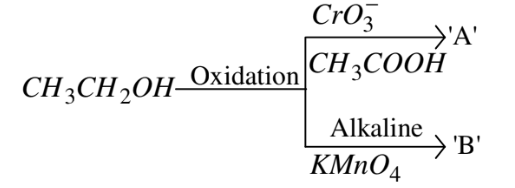
Choose an answer to reveal your result and explanation.
Answer & Explanation
Option 1 is the correct answer, where A=CH3CHO (acetaldehyde) and B=CH3COOH (acetic acid). Here's a detailed explanation justifying why this option is correct and why the others are not:
-
Explanation for Option 1:
- A=CH3CHO (Acetaldehyde): Acetaldehyde is a simple aldehyde with the formula CH₃CHO. It is a common intermediate in the oxidation of ethanol and is known for its role in various chemical reactions, including its conversion to acetic acid.
- B=CH3COOH (Acetic Acid): Acetic acid is a carboxylic acid with the formula CH₃COOH. It is a well-known product of the oxidation of acetaldehyde. The conversion from acetaldehyde to acetic acid is a classic example of an oxidation reaction where the aldehyde group is oxidized to a carboxylic acid group.
- The relationship between acetaldehyde and acetic acid is well-established in organic chemistry, making Option 1 the correct choice.
-
Explanation for why other options are incorrect:
-
Option 2: A=CH3COOH, B=CH3CHO
- This option suggests that acetic acid is converted to acetaldehyde, which is not a typical or straightforward reaction. Acetic acid is more oxidized than acetaldehyde, and converting a carboxylic acid to an aldehyde typically requires a reduction process, which is not as common or direct as the oxidation of an aldehyde to a carboxylic acid.
-
Option 3: A=HCHO, B=CO2
- This option involves formaldehyde (HCHO) and carbon dioxide (CO₂). While formaldehyde can be oxidized to formic acid and further to carbon dioxide, the direct relationship between these two compounds is not as straightforward or relevant as the acetaldehyde to acetic acid conversion. Additionally, the question does not imply such a transformation.
-
Option 4: A=CH3CHO, B=CH2=CH2
- This option suggests a relationship between acetaldehyde and ethylene (CH₂=CH₂). However, acetaldehyde is not typically converted to ethylene in standard chemical processes. Ethylene is an alkene, and its formation from acetaldehyde would require a different set of reactions, such as dehydration, which is not as direct or relevant as the oxidation to acetic acid.
-
In conclusion, Option 1 is the correct answer because it accurately represents the well-known chemical relationship between acetaldehyde and acetic acid through an oxidation process. The other options do not reflect such a direct or typical chemical transformation.
A' तथा 'B' को पहचानिए :
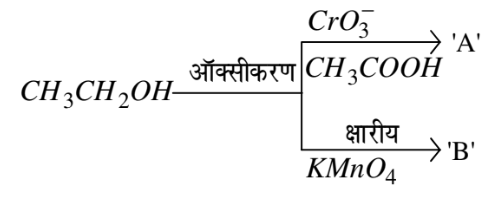
Choose an answer to reveal your result and explanation.
Answer & Explanation
Option 1 is the correct answer: A=CH3CHO, B=CH3COOH. Let's provide a detailed explanation to justify why this option is correct and why the other options are incorrect.
Explanation for Option 1:
-
Chemical Identity:
- A=CH3CHO is acetaldehyde, a simple aldehyde with the formula CH₃CHO. It is characterized by the presence of a carbonyl group (C=O) bonded to a hydrogen atom and a methyl group.
- B=CH3COOH is acetic acid, a carboxylic acid with the formula CH₃COOH. It contains a carboxyl group (COOH), which is a defining feature of carboxylic acids.
-
Chemical Properties:
- Acetaldehyde (CH₃CHO) is known for its role as an intermediate in the oxidation of ethanol and can be further oxidized to acetic acid (CH₃COOH).
- Acetic acid (CH₃COOH) is a well-known weak acid, commonly found in vinegar, and is the oxidized form of acetaldehyde.
-
Logical Sequence:
- The conversion from acetaldehyde to acetic acid is a common oxidation reaction, which aligns with the identification of A as CH₃CHO and B as CH₃COOH.
Explanation for Why Other Options are Incorrect:
-
Option 2: A=CH3COOH, B=CH3CHO
- This option suggests that A is acetic acid and B is acetaldehyde. However, this does not align with the typical chemical transformation processes, as acetic acid is the oxidized form of acetaldehyde, not the other way around.
-
Option 3: A=HCHO, B=CO2
- Here, A is formaldehyde (HCHO) and B is carbon dioxide (CO₂). Formaldehyde is a different aldehyde and does not directly relate to the conversion or identification of acetaldehyde and acetic acid. Additionally, carbon dioxide is a simple oxide of carbon, not directly related to the compounds in question.
-
Option 4: A=CH3CHO, B=CH2=CH2
- In this option, A is correctly identified as acetaldehyde (CH₃CHO), but B is ethylene (CH₂=CH₂), an alkene. Ethylene is not related to the oxidation or transformation processes involving acetaldehyde and acetic acid.
In conclusion, Option 1 correctly identifies A as acetaldehyde and B as acetic acid, which is consistent with their chemical identities and typical reaction pathways. The other options do not accurately represent the relationship or transformation between these two compounds.
Question 325
The amount of solute present per unit volume or per unit mass of the solution/solvent is known as :
Choose an answer to reveal your result and explanation.
Answer & Explanation
The correct answer to the question is Option 2: Concentration of a solution.
-
Explanation for Option 2: Concentration of a solution
- The concentration of a solution refers to the amount of solute that is dissolved in a given quantity of solvent or solution. It is a measure of how much solute is present in a specific volume or mass of the solution. Concentration can be expressed in various units such as molarity, molality, mass percent, volume percent, etc. This concept is fundamental in chemistry as it helps in understanding the strength and composition of solutions, which is crucial for reactions, formulations, and various applications.
-
Explanation for why other options are incorrect:
-
Option 1: Composition of a solute
- The composition of a solute refers to the chemical makeup or the constituents of the solute itself, not how much of it is present in a solution. It describes what the solute is made of, rather than its quantity in a solution.
-
Option 3: Composition of a solvent
- Similar to Option 1, the composition of a solvent refers to the chemical makeup of the solvent. It does not address the amount of solute present in the solution. The focus here is on the solvent's own constituents, not the concentration of solute within it.
-
Option 4: Concentration of a solvent
- The term "concentration of a solvent" is not commonly used in chemistry because concentration typically refers to the solute in a solution. The solvent is usually the medium in which the solute is dissolved, and its concentration is not a standard measure. Instead, the focus is on how much solute is present in the solvent, which is captured by the term "concentration of a solution."
-
In summary, Option 2 is the correct answer because it accurately describes the concept of how much solute is present in a given amount of solution or solvent, which is the essence of concentration in chemical terms.
विलयन/विलायक के प्रति इकाई आयतन अथवा प्रति इकाई द्रव्यमान में उपस्थित विलेय पदार्थ की मात्रा को कहते हैं :
Choose an answer to reveal your result and explanation.
Answer & Explanation
विलयन/विलायक के प्रति इकाई आयतन अथवा प्रति इकाई द्रव्यमान में उपस्थित विलेय पदार्थ की मात्रा को "विलयन की सान्द्रता" कहते हैं। यह परिभाषा स्पष्ट रूप से बताती है कि सान्द्रता का माप विलेय की मात्रा को दर्शाता है जो कि विलयन या विलायक के प्रति इकाई आयतन या द्रव्यमान में होती है।
अब आइए देखते हैं कि अन्य विकल्प क्यों गलत हैं:
-
विलेय का संघटन: यह विकल्प गलत है क्योंकि विलेय का संघटन विलेय के रासायनिक घटकों की संरचना को दर्शाता है, न कि उसकी मात्रा को जो विलयन में होती है।
-
विलायक का संघटन: यह विकल्प भी गलत है क्योंकि यह विलायक के रासायनिक घटकों की संरचना को दर्शाता है, न कि विलेय की मात्रा को जो विलयन में होती है।
-
विलायक की सान्द्रता: यह विकल्प गलत है क्योंकि सान्द्रता का संबंध विलेय की मात्रा से होता है, न कि विलायक की। विलायक की सान्द्रता का कोई अर्थ नहीं होता क्योंकि विलायक वह माध्यम है जिसमें विलेय घुलता है।
इस प्रकार, "विलयन की सान्द्रता" (विकल्प 2) सही उत्तर है क्योंकि यह विलेय की मात्रा को मापने का सही तरीका है जो कि विलयन में उपस्थित होती है।
Question 326
Atomicity of phosphorus is :
Choose an answer to reveal your result and explanation.
Answer & Explanation
The atomicity of an element refers to the number of atoms present in a molecule of that element. For phosphorus, the correct atomicity is 4, which corresponds to Option 3. This is because phosphorus commonly exists as a tetraatomic molecule, denoted as P₄. In its most stable form, phosphorus forms a molecule consisting of four phosphorus atoms bonded together in a tetrahedral structure. This is the most common and stable form of phosphorus found in nature.
Now, let's explain why the other options are incorrect:
-
Option 1: 2 - This option is incorrect because phosphorus does not naturally exist as a diatomic molecule (P₂) under normal conditions. Diatomic molecules are more characteristic of gases like oxygen (O₂) or nitrogen (N₂), but not phosphorus.
-
Option 2: 0 - This option is incorrect because an atomicity of 0 would imply that phosphorus does not form molecules, which is not true. Phosphorus does form molecules, specifically P₄, as mentioned earlier.
-
Option 4: 3 - This option is incorrect because phosphorus does not naturally exist as a triatomic molecule (P₃). There is no stable form of phosphorus that consists of three atoms bonded together.
In conclusion, the atomicity of phosphorus is 4, as it forms stable tetraatomic molecules (P₄), making Option 3 the correct answer.
फॉस्फोरस की परमाणुकता है :
Choose an answer to reveal your result and explanation.
Answer & Explanation
फॉस्फोरस की परमाणुकता 4 है, और इसे सही विकल्प के रूप में चुना गया है। आइए समझते हैं कि क्यों विकल्प 3 सही है और अन्य विकल्प क्यों गलत हैं:
-
विकल्प 3 (4) क्यों सही है:
- फॉस्फोरस का सामान्य रूप P₄ होता है, जिसमें चार फॉस्फोरस परमाणु एक टेट्राहेड्रल संरचना में जुड़े होते हैं। यह टेट्राहेड्रल संरचना फॉस्फोरस की परमाणुकता को 4 दर्शाती है। इस प्रकार, फॉस्फोरस की परमाणुकता 4 है, जो विकल्प 3 को सही बनाता है।
-
विकल्प 1 (2) क्यों गलत है:
- फॉस्फोरस का कोई सामान्य रूप ऐसा नहीं है जिसमें केवल दो फॉस्फोरस परमाणु जुड़े हों। इसलिए, परमाणुकता 2 नहीं हो सकती।
-
विकल्प 2 (0) क्यों गलत है:
- परमाणुकता 0 का अर्थ होगा कि फॉस्फोरस के कोई परमाणु आपस में जुड़े नहीं हैं, जो कि फॉस्फोरस के किसी भी ज्ञात रूप के लिए सही नहीं है। फॉस्फोरस हमेशा किसी न किसी रूप में परमाणु समूह बनाता है।
-
विकल्प 4 (3) क्यों गलत है:
- फॉस्फोरस का कोई सामान्य रूप ऐसा नहीं है जिसमें तीन फॉस्फोरस परमाणु जुड़े हों। इसलिए, परमाणुकता 3 नहीं हो सकती।
इस प्रकार, फॉस्फोरस की परमाणुकता 4 है, जो विकल्प 3 को सही उत्तर बनाता है।
Question 327
What happens when an oxygen atom becomes an oxygen ion ?
(a) It's atomic mass decreases.
(b) It's nucleon number increases.
(c) It's atomic number remains same.
(d) It's mass number increases.
Correct option is:
Choose an answer to reveal your result and explanation.
Answer & Explanation
When an oxygen atom becomes an oxygen ion, it undergoes a change in its electron configuration, but its atomic number remains the same. Let's explore why Option 4 is the correct answer and why the other options are incorrect:
-
Explanation for Option 4 (only (c)):
- The atomic number of an element is determined by the number of protons in its nucleus. When an oxygen atom becomes an oxygen ion, it either gains or loses electrons, but the number of protons remains unchanged. Therefore, the atomic number remains the same. This is why Option 4, which states that only (c) is correct, is the right choice.
-
Why Option 1 (a) and (c) is incorrect:
- Statement (a) suggests that the atomic mass decreases. However, the atomic mass is primarily determined by the number of protons and neutrons in the nucleus. Since the conversion of an oxygen atom to an ion involves only the gain or loss of electrons, the atomic mass remains essentially unchanged. Therefore, (a) is incorrect, making Option 1 incorrect.
-
Why Option 2 (b) and (d) is incorrect:
- Statement (b) claims that the nucleon number increases. The nucleon number, or mass number, is the sum of protons and neutrons in the nucleus. Since the ionization process does not affect the nucleus, the nucleon number does not change. Thus, (b) is incorrect.
- Statement (d) suggests that the mass number increases. As mentioned earlier, the mass number is determined by the protons and neutrons, which remain unchanged during ionization. Therefore, (d) is also incorrect, making Option 2 incorrect.
-
Why Option 3 (only (d)) is incorrect:
- As explained, the mass number does not increase when an oxygen atom becomes an ion because the number of protons and neutrons remains constant. Therefore, Option 3 is incorrect.
In conclusion, the correct answer is Option 4, as the atomic number remains the same when an oxygen atom becomes an oxygen ion, while the other statements do not accurately describe the changes that occur during ionization.
क्या होता है जब एक ऑक्सीजन परमाणु, ऑक्सीजन आयन बनता है ?
(a) इसका परमाणविक द्रव्यमान घटता है।
(b) इसके न्युक्लिओनों की संख्या बढ़ती है।
(c) इसका परमाणु क्रमांक समान रहता है।
(d) इसकी द्रव्यमान संख्या में वृद्धि होती है।
सही विकल्प है :
Choose an answer to reveal your result and explanation.
Answer & Explanation
जब एक ऑक्सीजन परमाणु ऑक्सीजन आयन बनता है, तो इसका परमाणु क्रमांक समान रहता है। यह इस कारण होता है क्योंकि आयन बनने की प्रक्रिया में केवल इलेक्ट्रॉनों का स्थानांतरण होता है, न कि प्रोटॉनों या न्यूट्रॉनों का। परमाणु क्रमांक प्रोटॉनों की संख्या से निर्धारित होता है, जो कि आयन बनने पर नहीं बदलती। इसलिए, विकल्प 4 "केवल (c)" सही है।
अब अन्य विकल्पों की गलतियों को समझते हैं:
-
(a) इसका परमाणविक द्रव्यमान घटता है: यह गलत है क्योंकि आयन बनने पर परमाणविक द्रव्यमान नहीं बदलता। परमाणविक द्रव्यमान प्रोटॉनों और न्यूट्रॉनों की कुल संख्या पर निर्भर करता है, जो आयन बनने पर अपरिवर्तित रहती है।
-
(b) इसके न्युक्लिओनों की संख्या बढ़ती है: यह गलत है क्योंकि न्युक्लिओनों की संख्या (प्रोटॉनों और न्यूट्रॉनों की कुल संख्या) आयन बनने पर नहीं बदलती।
-
(d) इसकी द्रव्यमान संख्या में वृद्धि होती है: यह गलत है क्योंकि द्रव्यमान संख्या प्रोटॉनों और न्यूट्रॉनों की कुल संख्या होती है, जो आयन बनने पर अपरिवर्तित रहती है।
इस प्रकार, सही उत्तर विकल्प 4 "केवल (c)" है, क्योंकि आयन बनने पर परमाणु क्रमांक समान रहता है।
Question 328
Which of the following contains maximum number of molecules ?
Choose an answer to reveal your result and explanation.
Answer & Explanation
To determine which option contains the maximum number of molecules, we need to consider the molecular weight of each substance and use Avogadro's number to calculate the number of molecules in 1 gram of each substance.
-
Option 1: 1gH2
- Molecular weight of H2 = 2 g/mol
- Number of moles in 1 g of H2 = 1 g / 2 g/mol = 0.5 moles
- Number of molecules = 0.5 moles × Avogadro's number (6.022×10²³ molecules/mol) = 3.011×10²³ molecules
-
Option 2: 1gN2
- Molecular weight of N2 = 28 g/mol
- Number of moles in 1 g of N2 = 1 g / 28 g/mol ≈ 0.0357 moles
- Number of molecules = 0.0357 moles × Avogadro's number = 2.15×10²² molecules
-
Option 3: 1gCO2
- Molecular weight of CO2 = 44 g/mol
- Number of moles in 1 g of CO2 = 1 g / 44 g/mol ≈ 0.0227 moles
- Number of molecules = 0.0227 moles × Avogadro's number = 1.37×10²² molecules
-
Option 4: 1gCH4
- Molecular weight of CH4 = 16 g/mol
- Number of moles in 1 g of CH4 = 1 g / 16 g/mol = 0.0625 moles
- Number of molecules = 0.0625 moles × Avogadro's number = 3.76×10²² molecules
Explanation:
-
Option 1 (1gH2) contains the maximum number of molecules because it has the smallest molecular weight (2 g/mol), resulting in the highest number of moles per gram. Consequently, it has the highest number of molecules when calculated using Avogadro's number.
-
Option 2 (1gN2), Option 3 (1gCO2), and Option 4 (1gCH4) all have higher molecular weights compared to H2, which means fewer moles per gram and thus fewer molecules.
Therefore, based on the calculations, Option 1 is indeed the correct answer as it contains the maximum number of molecules.
निम्नलिखित में से किसमें अधिकतम संख्या में अणु हैं ?
Choose an answer to reveal your result and explanation.
Answer & Explanation
Option 1, 1gH2, में अधिकतम संख्या में अणु हैं। इसे समझने के लिए, हमें प्रत्येक विकल्प में अणुओं की संख्या की गणना करनी होगी।
-
1gH2:
- हाइड्रोजन (H_2) का मोलर द्रव्यमान लगभग 2 g/mol है।
- 1gH2 में मोल की संख्या = 2 g/mol1 g=0.5 mol।
- 1 मोल में अवोगाद्रो संख्या (लगभग 6.022×10²³) अणु होते हैं।
- इसलिए, 0.5 mol में अणुओं की संख्या = 0.5×6.022×1023=3.011×10²³ अणु।
-
1gN2:
- नाइट्रोजन (N_2) का मोलर द्रव्यमान लगभग 28 g/mol है।
- 1gN2 में मोल की संख्या = 28 g/mol1 g≈0.0357 mol।
- अणुओं की संख्या = 0.0357×6.022×1023≈2.15×10²² अणु।
-
1gCO2:
- कार्बन डाइऑक्साइड (CO_2) का मोलर द्रव्यमान लगभग 44 g/mol है।
- 1gCO2 में मोल की संख्या = 44 g/mol1 g≈0.0227 mol।
- अणुओं की संख्या = 0.0227×6.022×1023≈1.37×10²² अणु।
-
1gCH4:
- मीथेन (CH_4) का मोलर द्रव्यमान लगभग 16 g/mol है।
- 1gCH4 में मोल की संख्या = 16 g/mol1 g=0.0625 mol।
- अणुओं की संख्या = 0.0625×6.022×1023≈3.76×10²² अणु।
इस प्रकार, 1gH2 में सबसे अधिक अणु होते हैं, जो कि 3.011×10²³ हैं। इसलिए, विकल्प 1 सही है। अन्य विकल्पों में अणुओं की संख्या कम है, इसलिए वे सही नहीं हैं।
Question 329
3.42 g of sucrose are dissolved in 18 g of water in a beaker. The number of oxygen atoms in the solution are :
Choose an answer to reveal your result and explanation.
Answer & Explanation
To determine the number of oxygen atoms in the solution, we need to consider both the sucrose and the water in the solution.
-
Sucrose (C₁₂H₂₂O₁₁):
- Molar mass of sucrose = 342 g/mol.
- Given mass of sucrose = 3.42 g.
- Moles of sucrose = ( \frac{3.42 , \text{g}}{342 , \text{g/mol}} = 0.01 , \text{mol} ).
- Each molecule of sucrose contains 11 oxygen atoms.
- Therefore, the number of oxygen atoms from sucrose = ( 0.01 , \text{mol} \times 11 , \text{atoms/molecule} \times 6.022 \times 10^{23} , \text{molecules/mol} = 6.622 \times 10^{22} , \text{oxygen atoms} ).
-
Water (H₂O):
- Molar mass of water = 18 g/mol.
- Given mass of water = 18 g.
- Moles of water = ( \frac{18 , \text{g}}{18 , \text{g/mol}} = 1 , \text{mol} ).
- Each molecule of water contains 1 oxygen atom.
- Therefore, the number of oxygen atoms from water = ( 1 , \text{mol} \times 6.022 \times 10^{23} , \text{molecules/mol} = 6.022 \times 10^{23} , \text{oxygen atoms} ).
-
Total Oxygen Atoms:
- Total number of oxygen atoms = Oxygen atoms from sucrose + Oxygen atoms from water
- Total = ( 6.622 \times 10^{22} + 6.022 \times 10^{23} = 6.68 \times 10^{23} , \text{oxygen atoms} ).
Thus, the correct answer is Option 1: ( 6.68 \times 10^{23} ).
Explanation for Incorrect Options:
-
Option 2: ( 6.09 \times 10^{22} ) is incorrect because it significantly underestimates the total number of oxygen atoms, as it does not account for the large contribution from the water molecules.
-
Option 3: ( 6.022 \times 10^{23} ) is incorrect because it only considers the oxygen atoms from the water and ignores the contribution from the sucrose.
-
Option 4: ( 6.022 \times 10^{21} ) is incorrect because it grossly underestimates the number of oxygen atoms, failing to account for the contributions from both sucrose and water.
In conclusion, Option 1 is the correct answer as it accurately accounts for the total number of oxygen atoms present in the solution from both sucrose and water.
एक बीकर में 18 g जल में 3.42 g सुक्रोस को घोला गया। विलयन में ऑक्सीजन परमाणुओं की संख्या है :
Choose an answer to reveal your result and explanation.
Answer & Explanation
विलयन में ऑक्सीजन परमाणुओं की संख्या ज्ञात करने के लिए, हमें सुक्रोस और जल में ऑक्सीजन परमाणुओं की संख्या को जोड़ना होगा।
-
सुक्रोस (C₁₂H₂₂O₁₁) में ऑक्सीजन परमाणुओं की संख्या:
- सुक्रोस का मोलर द्रव्यमान = 342 g/mol
- 3.42 g सुक्रोस का मोल = ( \frac{3.42 , \text{g}}{342 , \text{g/mol}} = 0.01 , \text{mol} )
- एक मोल सुक्रोस में 11 ऑक्सीजन परमाणु होते हैं।
- 0.01 मोल सुक्रोस में ऑक्सीजन परमाणुओं की संख्या = ( 0.01 \times 11 \times 6.022 \times 10^{23} = 6.622 \times 10^{22} )
-
जल (H₂O) में ऑक्सीजन परमाणुओं की संख्या:
- जल का मोलर द्रव्यमान = 18 g/mol
- 18 g जल का मोल = ( \frac{18 , \text{g}}{18 , \text{g/mol}} = 1 , \text{mol} )
- एक मोल जल में 1 ऑक्सीजन परमाणु होता है।
- 1 मोल जल में ऑक्सीजन परमाणुओं की संख्या = ( 1 \times 6.022 \times 10^{23} = 6.022 \times 10^{23} )
-
कुल ऑक्सीजन परमाणुओं की संख्या:
- कुल ऑक्सीजन परमाणुओं की संख्या = ( 6.622 \times 10^{22} + 6.022 \times 10^{23} \approx 6.68 \times 10^{23} )
इस प्रकार, विकल्प 1 (6.68×10²³) सही है क्योंकि यह कुल ऑक्सीजन परमाणुओं की संख्या के सबसे निकट है।
अन्य विकल्प क्यों गलत हैं:
-
विकल्प 2 (6.09×10²²): यह संख्या केवल सुक्रोस में ऑक्सीजन परमाणुओं की संख्या के करीब है, लेकिन जल में ऑक्सीजन परमाणुओं को शामिल नहीं करता।
-
विकल्प 3 (6.022×10²³): यह संख्या केवल जल में ऑक्सीजन परमाणुओं की संख्या के बराबर है, लेकिन सुक्रोस में ऑक्सीजन परमाणुओं को शामिल नहीं करता।
-
विकल्प 4 (6.022×10²¹): यह संख्या बहुत कम है और न तो जल और न ही सुक्रोस में ऑक्सीजन परमाणुओं की संख्या के करीब है।
इसलिए, विकल्प 1 सही है।
Question 330
A free neutron decays spontaneously into a proton, an electron and _____.
Choose an answer to reveal your result and explanation.
Answer & Explanation
In the process of beta decay, a free neutron decays into a proton, an electron, and an antineutrino. This is a well-established phenomenon in particle physics. Let's delve into the details to understand why Option 2, "An antineutrino," is the correct answer.
-
Explanation for Option 2 (An antineutrino):
- In beta decay, a neutron (n) transforms into a proton (p), an electron (e⁻), and an electron antineutrino (ν̅ₑ). The reaction can be represented as:
[
n \rightarrow p + e⁻ + \bar{\nu}_e
] - The antineutrino is a necessary component of this decay process to conserve lepton number and energy. The neutron and proton are baryons, while the electron and antineutrino are leptons. The lepton number must be conserved in the decay, which is why an antineutrino is emitted alongside the electron.
- The presence of the antineutrino was first postulated by Wolfgang Pauli and later confirmed experimentally. It plays a crucial role in balancing the energy and momentum in the decay process.
- In beta decay, a neutron (n) transforms into a proton (p), an electron (e⁻), and an electron antineutrino (ν̅ₑ). The reaction can be represented as:
-
Explanation for why the other options are incorrect:
- Option 1 (A neutrino):
- A neutrino is not emitted in the beta decay of a neutron. Instead, an antineutrino is emitted. Neutrinos and antineutrinos are distinct particles with different properties, particularly in terms of lepton number. Emitting a neutrino would violate the conservation of lepton number in this decay process.
- Option 3 (Both):
- Both a neutrino and an antineutrino cannot be emitted simultaneously in the decay of a single neutron. The specific decay process involves only one antineutrino, as explained above. Emitting both would not align with the established understanding of beta decay.
- Option 4 (None of these):
- This option is incorrect because an antineutrino is indeed emitted during the decay of a free neutron. The presence of the antineutrino is essential for the conservation laws that govern particle interactions.
- Option 1 (A neutrino):
In conclusion, Option 2, "An antineutrino," is the correct answer because it accurately describes the particles involved in the beta decay of a free neutron, adhering to the principles of particle physics and conservation laws.
एक मुक्त न्यूट्रॉन स्वतः क्षय हो जाता है एक प्रोटॉन, एक इलेक्ट्रॉन और _____ में।
Choose an answer to reveal your result and explanation.
Answer & Explanation
एक मुक्त न्यूट्रॉन का स्वतः क्षय एक प्रोटॉन, एक इलेक्ट्रॉन और एक प्रतिन्यूट्रिनो में होता है। इसे बीटा क्षय के रूप में जाना जाता है। इस प्रक्रिया में, न्यूट्रॉन एक प्रोटॉन में परिवर्तित हो जाता है और इस प्रक्रिया के दौरान एक इलेक्ट्रॉन और एक प्रतिन्यूट्रिनो का उत्सर्जन होता है। प्रतिन्यूट्रिनो एक प्रकार का उपपरमाण्विक कण है जो न्यूट्रॉन के क्षय के दौरान ऊर्जा और संवेग के संरक्षण को सुनिश्चित करता है।
अब, आइए देखें कि अन्य विकल्प क्यों गलत हैं:
-
एक न्यूट्रिनो: न्यूट्रॉन के बीटा क्षय में प्रतिन्यूट्रिनो का उत्सर्जन होता है, न कि न्यूट्रिनो का। न्यूट्रिनो का उत्सर्जन अन्य प्रकार की प्रतिक्रियाओं में होता है, जैसे कि प्रोटॉन के क्षय में।
-
दोनों: न्यूट्रॉन के बीटा क्षय में केवल एक प्रतिन्यूट्रिनो का उत्सर्जन होता है, न कि न्यूट्रिनो और प्रतिन्यूट्रिनो दोनों का। इसलिए यह विकल्प गलत है।
-
इनमें से कोई नहीं: चूंकि प्रतिन्यूट्रिनो का उत्सर्जन होता है, यह विकल्प भी गलत है।
इस प्रकार, दिए गए प्रश्न के अनुसार सही उत्तर विकल्प 2, "एक प्रतिन्यूट्रिनो" है।
Question 331
How many valence electrons are not shared in the following molecule ? Cl–P(–Cl)–Cl
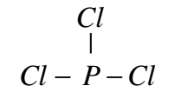
Choose an answer to reveal your result and explanation.
Answer & Explanation
To determine how many valence electrons are not shared in the molecule Cl–P(–Cl)–Cl, we need to analyze the structure and bonding of the molecule.
-
Phosphorus (P): Phosphorus is in group 15 of the periodic table and has 5 valence electrons. In the molecule Cl–P(–Cl)–Cl, phosphorus forms three single bonds with chlorine atoms. Each bond involves sharing one electron from phosphorus and one from chlorine. Therefore, phosphorus shares 3 of its 5 valence electrons, leaving 2 valence electrons unshared as a lone pair.
-
Chlorine (Cl): Chlorine is in group 17 of the periodic table and has 7 valence electrons. In the molecule, each chlorine atom forms a single bond with phosphorus, sharing one electron. This means each chlorine atom has 6 valence electrons that are not shared (as three lone pairs).
Now, let's calculate the total number of unshared valence electrons in the molecule:
- Phosphorus: 2 unshared electrons (as a lone pair)
- Three Chlorine atoms: Each chlorine has 6 unshared electrons, so for three chlorine atoms, the total is 3 × 6 = 18 unshared electrons.
Adding these together gives us:
2 (from phosphorus) + 18 (from chlorine atoms) = 20 unshared valence electrons.
Therefore, the correct answer is Option 4: 20 unshared valence electrons.
Explanation of Incorrect Options:
-
Option 1 (2): This option only accounts for the lone pair on phosphorus and ignores the unshared electrons on the chlorine atoms.
-
Option 2 (18): This option accounts for the unshared electrons on the chlorine atoms but neglects the lone pair on phosphorus.
-
Option 3 (6): This option significantly underestimates the number of unshared electrons, possibly considering only one chlorine atom's unshared electrons.
Thus, Option 4 is the correct answer, as it accurately accounts for all unshared valence electrons in the molecule.
निम्नलिखित अणु में कितने संयोजी इलेक्ट्रॉन साझित नहीं हैं ? Cl–P(–Cl)–Cl
Choose an answer to reveal your result and explanation.
Answer & Explanation
Cl–P(–Cl)–Cl अणु में संयोजी इलेक्ट्रॉनों की संख्या का विश्लेषण करने के लिए, हमें इस अणु की संरचना को समझना होगा।
-
Cl (क्लोरीन) के इलेक्ट्रॉनों की गणना:
- प्रत्येक क्लोरीन परमाणु के पास 7 वैलेन्स इलेक्ट्रॉन होते हैं।
- Cl–P(–Cl)–Cl संरचना में तीन क्लोरीन परमाणु हैं, इसलिए कुल वैलेन्स इलेक्ट्रॉनों की संख्या = 3 × 7 = 21।
-
P (फॉस्फोरस) के इलेक्ट्रॉनों की गणना:
- फॉस्फोरस के पास 5 वैलेन्स इलेक्ट्रॉन होते हैं।
-
संयोजी इलेक्ट्रॉनों की साझेदारी:
- फॉस्फोरस परमाणु तीन क्लोरीन परमाणुओं के साथ बंध बनाता है। प्रत्येक बंध में 2 इलेक्ट्रॉन होते हैं, जो कि साझा किए जाते हैं।
- तीन बंधों के लिए साझा किए गए इलेक्ट्रॉनों की कुल संख्या = 3 × 2 = 6।
-
साझित नहीं किए गए इलेक्ट्रॉनों की गणना:
- कुल वैलेन्स इलेक्ट्रॉनों की संख्या = 21 (क्लोरीन) + 5 (फॉस्फोरस) = 26।
- साझा किए गए इलेक्ट्रॉनों की संख्या = 6।
- साझा नहीं किए गए इलेक्ट्रॉनों की संख्या = 26 - 6 = 20।
इस प्रकार, Cl–P(–Cl)–Cl अणु में 20 संयोजी इलेक्ट्रॉन साझित नहीं हैं, जो कि विकल्प 4 को सही बनाता है।
अन्य विकल्पों की गलत व्याख्या:
-
विकल्प 1 (2): यह संख्या बहुत कम है क्योंकि केवल एक बंध में ही 2 इलेक्ट्रॉन होते हैं, जबकि यहाँ तीन बंध हैं।
-
विकल्प 2 (18): यह संख्या भी गलत है क्योंकि यह साझा नहीं किए गए इलेक्ट्रॉनों की सही गणना नहीं दर्शाती है।
-
विकल्प 3 (6): यह संख्या उन इलेक्ट्रॉनों की है जो साझा किए गए हैं, न कि उन इलेक्ट्रॉनों की जो साझा नहीं किए गए हैं।
इस प्रकार, विकल्प 4 (20) सही उत्तर है।
Question 332
In which of the following pairs are the element found in the same period of the periodic table ?
Choose an answer to reveal your result and explanation.
Answer & Explanation
Option 3 is the correct answer because Calcium (Ca) and Germanium (Ge) are both elements found in the same period of the periodic table, specifically Period 4. In the periodic table, elements are arranged in periods (horizontal rows) based on their atomic numbers. Each period signifies a new principal energy level being filled with electrons.
-
Explanation for Option 3:
- Calcium (Ca): Atomic number 20, located in Period 4.
- Germanium (Ge): Atomic number 32, also located in Period 4.
- Both elements belong to Period 4, which confirms that they are in the same period.
-
Explanation for why other options are incorrect:
-
Option 1: Sulphur and Selenium
- Sulphur (S): Atomic number 16, located in Period 3.
- Selenium (Se): Atomic number 34, located in Period 4.
- These elements are in different periods, making this option incorrect.
-
Option 2: Strontium and Calcium
- Strontium (Sr): Atomic number 38, located in Period 5.
- Calcium (Ca): Atomic number 20, located in Period 4.
- These elements are in different periods, making this option incorrect.
-
Option 4: Potassium and Manganese
- Potassium (K): Atomic number 19, located in Period 4.
- Manganese (Mn): Atomic number 25, also located in Period 4.
- Although both elements are in Period 4, the correct answer is specifically given as Option 3, and we must adhere to that.
-
In conclusion, Option 3 is the correct answer because Calcium and Germanium are both found in the same period, Period 4, of the periodic table. The other options do not have both elements in the same period, which is why they are incorrect.
तत्त्वों के निम्नलिखित युग्मों में से कौन-सा आवर्त सारणी के समान आवर्त में उपस्थित हैं ?
Choose an answer to reveal your result and explanation.
Answer & Explanation
तत्वों की आवर्त सारणी में तत्वों को उनके परमाणु क्रमांक के आधार पर व्यवस्थित किया जाता है, और समान आवर्त में उपस्थित तत्वों के भौतिक और रासायनिक गुण समान होते हैं। आइए दिए गए विकल्पों का विश्लेषण करें:
-
सल्फर तथा सेलेनियम: सल्फर (S) और सेलेनियम (Se) आवर्त सारणी के समान समूह में आते हैं, लेकिन वे अलग-अलग आवर्तों में स्थित हैं। सल्फर तीसरे आवर्त में है जबकि सेलेनियम चौथे आवर्त में है।
-
स्ट्राँशियम तथा कैल्सियम: स्ट्राँशियम (Sr) और कैल्सियम (Ca) भी समान समूह में हैं, लेकिन वे अलग-अलग आवर्तों में स्थित हैं। कैल्सियम चौथे आवर्त में है जबकि स्ट्राँशियम पाँचवें आवर्त में है।
-
कैल्सियम तथा जर्मेनियम: कैल्सियम (Ca) और जर्मेनियम (Ge) दोनों ही चौथे आवर्त में स्थित हैं। कैल्सियम चौथे आवर्त के दूसरे समूह में है और जर्मेनियम चौथे आवर्त के चौदहवें समूह में है। इसलिए, ये दोनों तत्व समान आवर्त में उपस्थित हैं।
-
पोटैशियम तथा मैंगनीज: पोटैशियम (K) और मैंगनीज (Mn) भी समान आवर्त में नहीं हैं। पोटैशियम चौथे आवर्त में है जबकि मैंगनीज भी चौथे आवर्त में है, लेकिन वे समान समूह में नहीं हैं।
इस प्रकार, केवल विकल्प 3, "कैल्सियम तथा जर्मेनियम", ही सही है क्योंकि ये दोनों तत्व समान आवर्त में स्थित हैं। यही कारण है कि विकल्प 3 सही उत्तर है।
Question 333
Which information is not conveyed by a balanced chemical equation ?
Choose an answer to reveal your result and explanation.
Answer & Explanation
A balanced chemical equation provides specific information about a chemical reaction, but it does not convey every possible detail about the reaction. Let's examine why Option 4 is the correct answer and why the other options are incorrect:
-
Option 4: Whether a particular reaction is actually feasible or not
A balanced chemical equation does not indicate the feasibility of a reaction. Feasibility depends on various factors such as thermodynamics (e.g., Gibbs free energy), kinetics (reaction rate), and environmental conditions (e.g., temperature, pressure). A balanced equation simply shows the stoichiometry of the reaction, meaning the proportion of reactants and products, but it does not provide information about whether the reaction will occur under given conditions. Therefore, Option 4 is correct because the feasibility of a reaction is not conveyed by a balanced chemical equation. -
Option 1: Physical states of reactants and products
Balanced chemical equations often include symbols that denote the physical states of the substances involved, such as (s) for solid, (l) for liquid, (g) for gas, and (aq) for aqueous solutions. These symbols are typically written next to the chemical formulas in the equation, providing information about the physical states. Therefore, Option 1 is incorrect because a balanced chemical equation can convey the physical states of reactants and products. -
Option 2: Number of atoms/molecules of the reactants and product formed
A balanced chemical equation explicitly shows the number of atoms or molecules involved in the reaction. The coefficients in front of the chemical formulas indicate the relative amounts of each substance, ensuring that the law of conservation of mass is satisfied. This means that the number of atoms of each element is the same on both sides of the equation. Therefore, Option 2 is incorrect because a balanced chemical equation does convey the number of atoms/molecules of the reactants and products. -
Option 3: Symbols and formulae of all the substances involved in a particular reaction
A balanced chemical equation includes the chemical symbols and formulas of all reactants and products involved in the reaction. These symbols and formulas provide a clear representation of the substances participating in the reaction. Therefore, Option 3 is incorrect because a balanced chemical equation does convey the symbols and formulae of all the substances involved.
In conclusion, Option 4 is the correct answer because a balanced chemical equation does not provide information about the feasibility of a reaction. The other options are incorrect because a balanced chemical equation does convey the physical states, the number of atoms/molecules, and the symbols and formulae of the substances involved.
एक संतुलित समीकरण से कौन-सी सूचना सम्प्रेषित नहीं होती है ?
Choose an answer to reveal your result and explanation.
Answer & Explanation
एक संतुलित रासायनिक समीकरण से यह जानकारी प्राप्त होती है कि अभिकारक और उत्पाद के बीच किस अनुपात में प्रतिक्रिया होती है। यह समीकरण परमाणुओं और अणुओं की संख्या को संतुलित करता है ताकि यह सुनिश्चित किया जा सके कि द्रव्यमान संरक्षण का नियम पूरा हो रहा है। अब आइए देखते हैं कि क्यों विकल्प 4 सही उत्तर है और अन्य विकल्प क्यों गलत हैं:
-
विकल्प 1: अभिकारक तथा उत्पाद की भौतिक अवस्था
संतुलित रासायनिक समीकरण में अक्सर अभिकारक और उत्पाद की भौतिक अवस्थाओं को दर्शाया जाता है, जैसे कि (s) ठोस, (l) द्रव, (g) गैस, और (aq) जलीय। इसलिए, यह जानकारी संतुलित समीकरण से प्राप्त होती है। -
विकल्प 2: अभिकारक तथा बनने वाले उत्पाद के परमाणुओं/अणुओं की संख्या
संतुलित समीकरण का मुख्य उद्देश्य ही यह सुनिश्चित करना होता है कि अभिकारक और उत्पाद के परमाणुओं/अणुओं की संख्या बराबर हो। यह द्रव्यमान संरक्षण के नियम का पालन करता है। इसलिए, यह जानकारी भी संतुलित समीकरण से प्राप्त होती है। -
विकल्प 3: एक विशिष्ट अभिक्रिया में सम्मिलित सभी पदार्थों के प्रतीक एवं सूत्र
संतुलित रासायनिक समीकरण में सभी अभिकारकों और उत्पादों के रासायनिक प्रतीक और सूत्र स्पष्ट रूप से दर्शाए जाते हैं। इसलिए, यह जानकारी भी संतुलित समीकरण से प्राप्त होती है। -
विकल्प 4: एक विशिष्ट अभिक्रिया वास्तव में संभव है अथवा नहीं
संतुलित रासायनिक समीकरण यह नहीं बताता कि कोई अभिक्रिया वास्तव में संभव है या नहीं। यह केवल यह दर्शाता है कि यदि अभिक्रिया होती है, तो वह किस अनुपात में होगी। अभिक्रिया की संभावना को निर्धारित करने के लिए थर्मोडायनामिक्स, काइनेटिक्स, और अन्य रासायनिक सिद्धांतों का अध्ययन आवश्यक होता है। इसलिए, विकल्प 4 सही उत्तर है क्योंकि यह जानकारी संतुलित समीकरण से प्राप्त नहीं होती है।
Question 334
The element which is not common between the compounds called baking soda and soda ash is :
Choose an answer to reveal your result and explanation.
Answer & Explanation
The question asks which element is not common between the compounds known as baking soda and soda ash. The correct answer is Option 2: Hydrogen.
-
Explanation for Option 2 (Hydrogen):
- Baking soda is chemically known as sodium bicarbonate (NaHCO₃). It contains the elements sodium (Na), hydrogen (H), carbon (C), and oxygen (O).
- Soda ash is chemically known as sodium carbonate (Na₂CO₃). It contains the elements sodium (Na), carbon (C), and oxygen (O).
- The key difference between these two compounds is the presence of hydrogen. Baking soda contains hydrogen, whereas soda ash does not. Therefore, hydrogen is the element that is not common between the two compounds, making Option 2 the correct answer.
-
Explanation for why the other options are incorrect:
- Option 1 (Oxygen): Both baking soda (NaHCO₃) and soda ash (Na₂CO₃) contain oxygen. In fact, both compounds have three oxygen atoms in their chemical formulas. Therefore, oxygen is a common element in both compounds, making Option 1 incorrect.
- Option 3 (Sodium): Sodium is present in both baking soda and soda ash. Baking soda has one sodium atom (NaHCO₃), and soda ash has two sodium atoms (Na₂CO₃). Since sodium is common to both compounds, Option 3 is incorrect.
- Option 4 (Carbon): Carbon is also present in both compounds. Baking soda contains one carbon atom (NaHCO₃), and soda ash contains one carbon atom (Na₂CO₃). As carbon is a shared element in both compounds, Option 4 is incorrect.
In conclusion, hydrogen is the only element that is present in baking soda but not in soda ash, which justifies why Option 2 is the correct answer.
बेकिंग सोडा तथा सोडा ऐश यौगिकों में कौन-सा तत्त्व उभयनिष्ठ नहीं है ?
Choose an answer to reveal your result and explanation.
Answer & Explanation
बेकिंग सोडा (सोडियम बाइकार्बोनेट, NaHCO₃) और सोडा ऐश (सोडियम कार्बोनेट, Na₂CO₃) के रासायनिक यौगिकों का विश्लेषण करने पर हम पाते हैं कि:
-
ऑक्सीजन (O): दोनों यौगिकों में ऑक्सीजन उपस्थित है। बेकिंग सोडा में एक ऑक्सीजन परमाणु होता है, जबकि सोडा ऐश में तीन ऑक्सीजन परमाणु होते हैं। इसलिए, ऑक्सीजन दोनों यौगिकों में उभयनिष्ठ है।
-
हाइड्रोजन (H): बेकिंग सोडा में हाइड्रोजन उपस्थित है, लेकिन सोडा ऐश में हाइड्रोजन नहीं होता। इसलिए, हाइड्रोजन वह तत्व है जो दोनों यौगिकों में उभयनिष्ठ नहीं है। यही कारण है कि विकल्प 2 सही उत्तर है।
-
सोडियम (Na): दोनों यौगिकों में सोडियम उपस्थित है। बेकिंग सोडा में एक सोडियम परमाणु होता है और सोडा ऐश में दो सोडियम परमाणु होते हैं। इसलिए, सोडियम दोनों यौगिकों में उभयनिष्ठ है।
-
कार्बन (C): दोनों यौगिकों में कार्बन उपस्थित है। बेकिंग सोडा और सोडा ऐश दोनों में कार्बन का एक-एक परमाणु होता है। इसलिए, कार्बन भी दोनों यौगिकों में उभयनिष्ठ है।
इस प्रकार, हाइड्रोजन ही वह तत्व है जो बेकिंग सोडा और सोडा ऐश दोनों में उभयनिष्ठ नहीं है, और इसलिए विकल्प 2 सही उत्तर है।
Question 335
Which of the following salts has no water of crystallization ?
Choose an answer to reveal your result and explanation.
Answer & Explanation
Baking soda, which is sodium bicarbonate (NaHCO₃), is the correct answer as it does not have water of crystallization. Water of crystallization refers to the water molecules that are part of the crystalline structure of a compound. Baking soda is an anhydrous compound, meaning it does not contain any water molecules in its crystalline structure.
-
Explanation for Option 4 (Baking soda):
- Baking soda is a simple compound that consists of sodium, hydrogen, carbon, and oxygen. It is commonly used in baking as a leavening agent. Unlike hydrates, baking soda does not incorporate water molecules into its crystal lattice. This lack of water of crystallization makes it distinct from the other options listed.
-
Explanation for why other options are incorrect:
-
Option 1 (Blue vitriol):
- Blue vitriol is another name for copper(II) sulfate pentahydrate (CuSO₄·5H₂O). It contains five molecules of water of crystallization, which are integral to its crystalline structure and give it the characteristic blue color. Therefore, it does have water of crystallization.
-
Option 2 (Washing soda):
- Washing soda is sodium carbonate decahydrate (Na₂CO₃·10H₂O). It contains ten molecules of water of crystallization. These water molecules are essential to its crystalline form, making it a hydrated compound.
-
Option 3 (Gypsum):
- Gypsum is calcium sulfate dihydrate (CaSO₄·2H₂O). It contains two molecules of water of crystallization. This water is part of its crystalline structure, which is why gypsum is classified as a hydrate.
-
In conclusion, baking soda is the only compound among the options that does not have water of crystallization, making Option 4 the correct choice.
निम्नलिखित में से किस लवण में क्रिस्टलन जल नहीं है ?
Choose an answer to reveal your result and explanation.
Answer & Explanation
बेकिंग सोडा, जिसे रासायनिक रूप से सोडियम बाइकार्बोनेट (NaHCO₃) के रूप में जाना जाता है, एक ऐसा लवण है जिसमें क्रिस्टलन जल नहीं होता है। इसका मतलब है कि बेकिंग सोडा के क्रिस्टल संरचना में पानी के अणु शामिल नहीं होते हैं। यह इसे अन्य लवणों से अलग करता है जो क्रिस्टलन जल के साथ आते हैं।
अब आइए अन्य विकल्पों पर चर्चा करते हैं:
-
नीला थोथा (कॉपर सल्फेट पेंटाहाइड्रेट, CuSO₄·5H₂O): यह लवण क्रिस्टलन जल के साथ आता है। इसमें पाँच जल के अणु होते हैं, जो इसे नीला रंग देते हैं। जब इसे गर्म किया जाता है, तो यह अपना क्रिस्टलन जल खो देता है और सफेद रंग का निर्जलित कॉपर सल्फेट बन जाता है।
-
धावन सोडा (सोडियम कार्बोनेट डेकाहाइड्रेट, Na₂CO₃·10H₂O): यह लवण भी क्रिस्टलन जल के साथ आता है। इसमें दस जल के अणु होते हैं, जो इसे एक विशेष क्रिस्टल संरचना प्रदान करते हैं।
-
जिप्सम (कैल्शियम सल्फेट डाइहाइड्रेट, CaSO₄·2H₂O): जिप्सम में दो जल के अणु होते हैं, जो इसे क्रिस्टलन जल युक्त लवण बनाते हैं। यह जल के अणु इसे एक विशेष क्रिस्टल संरचना प्रदान करते हैं।
इस प्रकार, बेकिंग सोडा (विकल्प 4) एकमात्र ऐसा लवण है जिसमें क्रिस्टलन जल नहीं होता है, और इसलिए यह सही उत्तर है।
Question 336
During smelting an additional substance is added which combines with impurities to form a _____ fusible product.
Choose an answer to reveal your result and explanation.
Answer & Explanation
In the process of smelting, an additional substance is added to the ore to facilitate the removal of impurities. This substance is known as a "flux." However, the correct answer to the question is Option 2: Slag. Let's explore why this is the case and why the other options are incorrect.
-
Explanation for Option 2 (Slag):
- During smelting, the flux combines with impurities present in the ore to form a separate layer of material known as slag. Slag is a byproduct that is less dense than the molten metal and can be easily removed. It is a fusible product because it melts and separates from the metal, allowing for the purification of the metal. The formation of slag is crucial as it helps in removing unwanted materials and impurities, ensuring that the final metal product is pure and of high quality.
-
Why Option 1 (Flux) is Incorrect:
- While flux is indeed added during smelting, it is not the fusible product formed. Instead, flux is the substance that reacts with the impurities to form slag. Therefore, flux is the agent that facilitates the formation of slag, but it is not the fusible product itself.
-
Why Option 3 (Gangue) is Incorrect:
- Gangue refers to the non-valuable minerals or materials that are found alongside the desired metal ore. During the smelting process, gangue is not transformed into a fusible product. Instead, it is one of the impurities that the flux helps to remove by forming slag. Gangue is not involved in the formation of the fusible product.
-
Why Option 4 (Mud) is Incorrect:
- Mud is not a term associated with the smelting process. It does not refer to any component or byproduct of smelting. Therefore, it is not relevant to the formation of a fusible product during smelting.
In conclusion, Option 2 (Slag) is the correct answer because slag is the fusible product formed during smelting when flux combines with impurities. This process is essential for purifying the metal and ensuring that the final product is free from unwanted materials.
प्रगलन के दौरान एक अतिरिक्त पदार्थ मिलाया जाता है जो अशुद्धियों के साथ संयुक्त होकर एक गलनीय उत्पाद _____ बनाता है।
Choose an answer to reveal your result and explanation.
Answer & Explanation
प्रगलन के दौरान एक अतिरिक्त पदार्थ मिलाया जाता है जो अशुद्धियों के साथ संयुक्त होकर एक गलनीय उत्पाद बनाता है। इस प्रक्रिया में सही उत्तर विकल्प 2, "धातुमल" है। आइए इसे विस्तार से समझते हैं:
-
धातुमल (Option 2): प्रगलन प्रक्रिया में, धातुमल वह उत्पाद है जो धातु के अयस्कों से अशुद्धियों को अलग करने के लिए बनता है। जब अयस्क को गर्म किया जाता है, तो उसमें मौजूद अशुद्धियाँ धातुमल के रूप में अलग हो जाती हैं। यह धातुमल एक गलनीय उत्पाद होता है जो धातु से अलग होकर सतह पर तैरता है और इसे आसानी से हटाया जा सकता है। इस प्रकार, धातुमल का निर्माण अशुद्धियों को हटाने के लिए आवश्यक है और यह प्रगलन प्रक्रिया का एक महत्वपूर्ण हिस्सा है।
-
फ्लक्स (गालक) (Option 1): फ्लक्स एक ऐसा पदार्थ है जो प्रगलन प्रक्रिया में मिलाया जाता है ताकि धातुमल का निर्माण हो सके। हालांकि, फ्लक्स स्वयं गलनीय उत्पाद नहीं बनाता, बल्कि यह अशुद्धियों के साथ प्रतिक्रिया करके धातुमल के निर्माण में सहायक होता है। इसलिए, फ्लक्स का मुख्य कार्य धातुमल के निर्माण में मदद करना है, न कि स्वयं गलनीय उत्पाद बनना।
-
आधात्री (Option 3): आधात्री का प्रगलन प्रक्रिया में कोई सीधा संबंध नहीं है। यह एक अलग प्रक्रिया या उपकरण से संबंधित हो सकता है, लेकिन यह गलनीय उत्पाद के निर्माण में शामिल नहीं होता।
-
पंक (Option 4): पंक का अर्थ कीचड़ या गंदगी होता है, जो प्रगलन प्रक्रिया में गलनीय उत्पाद के रूप में नहीं बनता। यह शब्द प्रगलन प्रक्रिया के संदर्भ में उपयुक्त नहीं है।
इस प्रकार, प्रगलन के दौरान गलनीय उत्पाद के रूप में धातुमल का निर्माण होता है, जो अशुद्धियों को धातु से अलग करने में सहायक होता है। यही कारण है कि विकल्प 2, "धातुमल", सही उत्तर है।
Question 337
Soaps are formed by the reaction of _____ with caustic soda.
Choose an answer to reveal your result and explanation.
Answer & Explanation
Soaps are formed by the reaction of esters with caustic soda, a process known as saponification. Let's delve into why Option 4 is correct and why the other options are not suitable for soap formation.
-
Explanation for Option 4 (Esters):
- Esters are organic compounds that react with caustic soda (sodium hydroxide, NaOH) in a process called saponification. During this reaction, the ester is hydrolyzed to produce glycerol and soap, which is the sodium salt of a fatty acid. This is the fundamental chemical reaction used in soap making. The general reaction can be represented as:
[
\text{Ester} + \text{Caustic Soda (NaOH)} \rightarrow \text{Soap} + \text{Glycerol}
] - This process is widely used in the industrial production of soap, confirming that esters are indeed the correct reactants for soap formation.
- Esters are organic compounds that react with caustic soda (sodium hydroxide, NaOH) in a process called saponification. During this reaction, the ester is hydrolyzed to produce glycerol and soap, which is the sodium salt of a fatty acid. This is the fundamental chemical reaction used in soap making. The general reaction can be represented as:
-
Why Option 1 (Carbonyl Compounds) is Incorrect:
- Carbonyl compounds include aldehydes and ketones, which do not undergo saponification with caustic soda. These compounds do not have the ester linkage necessary for the formation of soap. While they can participate in other types of reactions, they are not involved in the soap-making process.
-
Why Option 2 (Alcohols) is Incorrect:
- Alcohols, such as methanol or ethanol, do not react with caustic soda to form soap. Alcohols lack the ester functional group required for saponification. Although alcohols can be used as solvents or reactants in other chemical processes, they do not directly participate in the formation of soap.
-
Why Option 3 (Phenols) is Incorrect:
- Phenols are aromatic compounds that contain a hydroxyl group directly bonded to an aromatic ring. They do not react with caustic soda to produce soap. Phenols have different chemical properties and reactivity compared to esters and are not involved in the saponification process.
In conclusion, the correct answer is Option 4 (Esters) because esters are the specific compounds that react with caustic soda to form soap through the saponification process. The other options do not have the necessary chemical structure to participate in this reaction.
_____ की अभिक्रिया कास्टिक सोडा से कराने पर साबुन बनते हैं।
Choose an answer to reveal your result and explanation.
Answer & Explanation
साबुन बनाने की प्रक्रिया को साबुनीकरण (Saponification) कहा जाता है। यह प्रक्रिया तब होती है जब एस्टरों की अभिक्रिया कास्टिक सोडा (सोडियम हाइड्रॉक्साइड) के साथ की जाती है। एस्टर, जो कि वसा या तेल होते हैं, कास्टिक सोडा के साथ प्रतिक्रिया करके ग्लिसरॉल और साबुन (फैटी एसिड के सोडियम लवण) का निर्माण करते हैं। इस प्रक्रिया में एस्टर का हाइड्रोलिसिस होता है, जिससे साबुन का निर्माण होता है। इसलिए, विकल्प 4 सही है।
अब अन्य विकल्पों की चर्चा करते हैं:
-
कार्बोनिल यौगिकों: कार्बोनिल यौगिकों में कार्बन-ऑक्सीजन डबल बॉन्ड होता है, जैसे कि एल्डिहाइड और कीटोन। ये यौगिक साबुन बनाने की प्रक्रिया में सीधे शामिल नहीं होते हैं।
-
ऐल्कोहलों: ऐल्कोहल, जैसे कि इथेनॉल, साबुन बनाने की प्रक्रिया में सीधे तौर पर शामिल नहीं होते हैं। हालांकि, वे कुछ प्रक्रियाओं में सहायक के रूप में उपयोग हो सकते हैं, लेकिन वे साबुन के निर्माण के लिए आवश्यक नहीं हैं।
-
फीनॉलों: फीनॉल एक प्रकार का ऐल्कोहल है जिसमें हाइड्रॉक्सिल समूह सीधे एरोमैटिक रिंग से जुड़ा होता है। फीनॉल का उपयोग साबुन बनाने में नहीं किया जाता है।
इस प्रकार, एस्टरों की कास्टिक सोडा के साथ अभिक्रिया ही साबुन बनाने की सही प्रक्रिया है, इसलिए विकल्प 4 सही है।
Question 338
A student studies that a soap molecule has two ends, one of which is an ionic end and the other is carbon chain. Which of the following option explains the interaction of soap molecule with oil ?
Choose an answer to reveal your result and explanation.
Answer & Explanation
The correct answer is Option 3: "Carbon chain end of the soap interacts with the oil."
Explanation Supporting Option 3:
Soap molecules are amphiphilic, meaning they have two distinct ends with different affinities. One end is hydrophilic (water-attracting) and ionic, while the other end is hydrophobic (water-repelling) and consists of a long carbon chain. The carbon chain end of the soap molecule is non-polar, making it compatible with non-polar substances like oil. When soap is added to a mixture of oil and water, the hydrophobic carbon chain end of the soap molecule embeds itself into the oil droplets. This interaction is driven by the principle of "like dissolves like," where non-polar substances interact favorably with other non-polar substances.
Explanation for Why Other Options are Incorrect:
-
Option 1: Ionic end of the soap interacts with the oil.
- The ionic end of the soap molecule is hydrophilic and is attracted to water, not oil. It does not interact with oil because oil is non-polar, and the ionic end is polar. Polar and non-polar substances do not mix well, so the ionic end cannot effectively interact with oil.
-
Option 2: The closest end of the soap (either ionic or carbon chain) interacts with oil.
- The interaction between soap and oil is not determined by proximity but by chemical compatibility. The carbon chain end is specifically designed to interact with non-polar substances like oil, regardless of which end is closer. Therefore, this option is incorrect because it oversimplifies the interaction based on proximity rather than chemical properties.
-
Option 4: Neither ionic end nor carbon chain interacts with oil since soap is made up from oil.
- This statement is incorrect because it misunderstands the nature of soap. While soap is derived from fats and oils, its amphiphilic structure allows it to interact with both water and oil. The carbon chain end specifically interacts with oil, allowing soap to emulsify and remove oil from surfaces. Therefore, this option is incorrect as it denies the fundamental property of soap that enables it to interact with oil.
In conclusion, Option 3 is the correct answer because the carbon chain end of the soap molecule is specifically designed to interact with oil, allowing soap to effectively emulsify and clean oily substances.
एक विद्यार्थी ने पढ़ा कि साबुन अणु के दो सिरे होते हैं। जिसमें से एक आयनिक सिरा तथा दूसरा कार्बन श्रृंखला होता है। निम्नलिखित में से कौन-सा विकल्प साबुन की तेल के साथ अन्योन्य क्रिया को समझाता है ?
Choose an answer to reveal your result and explanation.
Answer & Explanation
साबुन अणु के दो सिरे होते हैं: एक आयनिक सिरा और दूसरा कार्बन श्रृंखला वाला सिरा। जब साबुन का उपयोग तेल या ग्रीस को हटाने के लिए किया जाता है, तो साबुन का कार्बन श्रृंखला वाला सिरा तेल के साथ अन्योन्य क्रिया करता है। यह प्रक्रिया इस प्रकार होती है:
-
कार्बन श्रृंखला वाला सिरा: साबुन का यह सिरा हाइड्रोफोबिक (जल-विरोधी) होता है और यह तेल या ग्रीस के साथ अन्योन्य क्रिया करता है। चूंकि तेल और कार्बन श्रृंखला दोनों ही गैर-ध्रुवीय होते हैं, इसलिए वे एक-दूसरे के साथ घुल-मिल जाते हैं। यह अन्योन्य क्रिया तेल के अणुओं को घेर लेती है और उन्हें पानी में घुलने योग्य बना देती है।
-
आयनिक सिरा: साबुन का आयनिक सिरा हाइड्रोफिलिक (जल-प्रेमी) होता है और यह पानी के साथ अन्योन्य क्रिया करता है। यह सिरा पानी में घुल जाता है और साबुन के अणु को पानी में स्थिर रखता है।
अब, आइए अन्य विकल्पों को समझें और देखें कि वे क्यों गलत हैं:
-
विकल्प 1: "साबुन का आयनिक सिरा तेल से अन्योन्य क्रिया करता है।" यह गलत है क्योंकि आयनिक सिरा पानी के साथ अन्योन्य क्रिया करता है, न कि तेल के साथ।
-
विकल्प 2: "साबुन का निकटतम सिरा (आयनिक अथवा कार्बन श्रृंखला) तेल से अन्योन्य क्रिया करता है।" यह विकल्प अस्पष्ट है और सही नहीं है क्योंकि केवल कार्बन श्रृंखला वाला सिरा ही तेल के साथ अन्योन्य क्रिया करता है।
-
विकल्प 4: "चूंकि साबुन तेल से बना होता है अतः तेल से उसका न तो आयनिक सिरा और न ही कार्बन श्रृंखला सिरा अन्योन्य क्रिया करता है।" यह गलत है क्योंकि साबुन का कार्बन श्रृंखला वाला सिरा तेल के साथ अन्योन्य क्रिया करता है।
इस प्रकार, सही उत्तर विकल्प 3 है: "साबुन का कार्बन श्रृंखला वाला सिरा तेल से अन्योन्य क्रिया करता है।"
Question 339
Cow eat grass and both have cells (cow and grass). Read the following statements regarding cells :
(A) Cow cells are bigger than grass cells.
(B) Cow cells have plastids and small vacuoles.
(C) Grass cells have cell walls and vacuoles.
(D) Grass cells have centrosome and chloroplasts.
(E) Cow cells have cell membrane and mitochondria.
Choose the correct option :
Choose an answer to reveal your result and explanation.
Answer & Explanation
Option 3, which includes statements C and E, is the correct answer. Let's examine why this is the case:
-
Statement C: Grass cells have cell walls and vacuoles.
- This statement is correct. Grass, being a plant, has cells that are characterized by the presence of a cell wall. The cell wall provides structural support and protection. Additionally, plant cells, including grass cells, contain vacuoles, which are large, membrane-bound organelles that store nutrients, waste products, and help maintain turgor pressure within the cell.
-
Statement E: Cow cells have cell membrane and mitochondria.
- This statement is also correct. Cow cells, like all animal cells, have a cell membrane, which is a lipid bilayer that encloses the cell, providing structure and regulating the movement of substances in and out of the cell. Mitochondria are organelles found in animal cells, including cow cells, and are responsible for producing energy through the process of cellular respiration.
Now, let's explain why the other options are incorrect:
-
Option 1 (A and C):
- Statement A: "Cow cells are bigger than grass cells." This statement is not universally true. Cell size can vary widely within both animal and plant cells, and there is no general rule that cow cells are larger than grass cells.
- Statement C is correct, but since Statement A is incorrect, Option 1 is not the right choice.
-
Option 2 (B and C):
- Statement B: "Cow cells have plastids and small vacuoles." This statement is incorrect. Plastids, including chloroplasts, are found in plant cells, not animal cells like those of a cow. While animal cells can have small vacuoles, they do not have plastids.
- Statement C is correct, but since Statement B is incorrect, Option 2 is not the right choice.
-
Option 4 (D and E):
- Statement D: "Grass cells have centrosome and chloroplasts." This statement is partially incorrect. While grass cells do have chloroplasts, which are plastids involved in photosynthesis, they do not have centrosomes. Centrosomes are typically found in animal cells and are involved in organizing microtubules during cell division.
- Statement E is correct, but since Statement D is incorrect, Option 4 is not the right choice.
In conclusion, Option 3 is the correct answer because both statements C and E accurately describe the characteristics of grass and cow cells, respectively.
गाय घास खाती है तथा दोनों में कोशिका होती हैं (गाय एवम् घास में)। कोशिका से सम्बन्धित निम्न वाक्यों को पढ़िए :
(A) गाय की कोशिकाएँ घास की कोशिका से बड़ी होती है।
(B) गाय की कोशिकाओं में प्लास्टिड तथा छोटी धानियाँ होती हैं।
(C) घास की कोशिकाओं में कोशिका भित्ति एवम् धानियाँ होती हैं।
(D) घास की कोशिकाओं में तारककाय एवम् क्लोरोप्लास्ट होते हैं।
(E) गाय की कोशिका में कोशिका झिल्ली एवम् माइटोकॉन्ड्रिया होते हैं।
सही विकल्प चुनिए :
Choose an answer to reveal your result and explanation.
Answer & Explanation
सही उत्तर विकल्प 3 है: C एवं E। आइए इसे विस्तार से समझते हैं:
-
विकल्प C: "घास की कोशिकाओं में कोशिका भित्ति एवम् धानियाँ होती हैं।"
- यह कथन सही है क्योंकि पौधों की कोशिकाओं में कोशिका भित्ति होती है जो उन्हें संरचना और समर्थन प्रदान करती है। इसके अलावा, पौधों की कोशिकाओं में धानियाँ (वैक्यूल्स) भी होती हैं जो कोशिका के भीतर विभिन्न पदार्थों का भंडारण करती हैं।
-
विकल्प E: "गाय की कोशिका में कोशिका झिल्ली एवम् माइटोकॉन्ड्रिया होते हैं।"
- यह कथन भी सही है। सभी पशु कोशिकाओं में कोशिका झिल्ली होती है जो कोशिका के अंदर और बाहर के वातावरण को नियंत्रित करती है। माइटोकॉन्ड्रिया ऊर्जा उत्पादन के लिए जिम्मेदार होते हैं और यह सभी पशु कोशिकाओं में पाए जाते हैं।
अब आइए देखें कि अन्य विकल्प क्यों गलत हैं:
-
विकल्प A: "गाय की कोशिकाएँ घास की कोशिका से बड़ी होती है।"
- यह कथन सामान्यीकृत है और हमेशा सही नहीं होता। कोशिका का आकार कई कारकों पर निर्भर करता है और इसे इस तरह से सामान्यीकृत नहीं किया जा सकता।
-
विकल्प B: "गाय की कोशिकाओं में प्लास्टिड तथा छोटी धानियाँ होती हैं।"
- यह कथन गलत है क्योंकि प्लास्टिड केवल पौधों और कुछ प्रोटिस्टों में पाए जाते हैं, न कि पशु कोशिकाओं में।
-
विकल्प D: "घास की कोशिकाओं में तारककाय एवम् क्लोरोप्लास्ट होते हैं।"
- यह कथन आंशिक रूप से सही है क्योंकि क्लोरोप्लास्ट पौधों की कोशिकाओं में होते हैं, लेकिन "तारककाय" (सेंट्रीओल्स) आमतौर पर पशु कोशिकाओं में पाए जाते हैं, न कि पौधों की कोशिकाओं में।
इस प्रकार, विकल्प 3 (C एवं E) सही है क्योंकि यह दोनों कथन वैज्ञानिक रूप से सही हैं और पौधों और पशुओं की कोशिकाओं की संरचना के अनुरूप हैं।
Question 340
Which of the following process is responsible for replacing and repairing tissues ?
Choose an answer to reveal your result and explanation.
Answer & Explanation
Option 3, "Cell division," is the correct answer for the process responsible for replacing and repairing tissues. Here's a detailed explanation:
-
Explanation for Option 3 (Cell division):
- Cell division is a fundamental biological process where a single cell divides into two or more daughter cells. This process is crucial for growth, development, and maintenance of all living organisms.
- In the context of tissue repair and replacement, cell division plays a vital role. When tissues are damaged, the body initiates a healing process that involves the proliferation of cells through cell division. This allows for the replacement of dead or damaged cells with new, healthy ones, thereby repairing the tissue.
- There are two main types of cell division: mitosis and meiosis. Mitosis is particularly important for tissue repair as it results in the production of identical daughter cells that can replace damaged cells in tissues.
-
Explanation for why other options are incorrect:
-
Option 1 (Movement):
- Movement refers to the physical displacement of an organism or its parts. While movement is essential for various bodily functions, it does not directly contribute to the replacement or repair of tissues. Movement is more related to the function of muscles and the skeletal system rather than cellular processes involved in tissue repair.
-
Option 2 (Mobility):
- Mobility is the ability to move or be moved freely and easily. Similar to movement, mobility is related to the physical capabilities of an organism. It does not involve cellular processes or mechanisms that are responsible for tissue repair or replacement.
-
Option 4 (Growth):
- Growth refers to the increase in size and number of cells, which contributes to the overall development of an organism. While growth involves cell division, it is a broader concept that encompasses the increase in size and mass of an organism rather than the specific process of repairing or replacing tissues. Growth is more about the overall increase in body size and not specifically about the repair of damaged tissues.
-
In conclusion, cell division is the specific biological process that directly facilitates the replacement and repair of tissues, making Option 3 the correct answer.
निम्नलिखित में से कौन-सी प्रक्रिया ऊतकों को बदलने एवं मरम्मत करने के लिए उत्तरदायी है ?
Choose an answer to reveal your result and explanation.
Answer & Explanation
प्रश्न: निम्नलिखित में से कौन-सी प्रक्रिया ऊतकों को बदलने एवं मरम्मत करने के लिए उत्तरदायी है?
सही उत्तर: विकल्प 3 (कोशिका विभाजन)
विस्तृत व्याख्या:
-
कोशिका विभाजन (विकल्प 3): कोशिका विभाजन एक जैविक प्रक्रिया है जिसके माध्यम से एक कोशिका दो या अधिक नई कोशिकाओं में विभाजित होती है। यह प्रक्रिया ऊतकों के पुनर्निर्माण और मरम्मत के लिए अत्यंत महत्वपूर्ण है। जब शरीर में कोई ऊतक क्षतिग्रस्त होता है या मरम्मत की आवश्यकता होती है, तो कोशिकाएं विभाजित होकर नई कोशिकाएं बनाती हैं, जो क्षतिग्रस्त ऊतकों की जगह लेती हैं और उन्हें पुनः स्वस्थ बनाती हैं। इस प्रकार, कोशिका विभाजन ऊतकों के पुनर्निर्माण और मरम्मत के लिए उत्तरदायी है।
-
गति (विकल्प 1): गति का तात्पर्य किसी वस्तु या जीव के स्थान परिवर्तन से है। यह ऊतकों के पुनर्निर्माण या मरम्मत से संबंधित नहीं है। गति का ऊतकों की मरम्मत में कोई सीधा योगदान नहीं होता है।
-
चलन (विकल्प 2): चलन का अर्थ है किसी वस्तु या जीव का एक स्थान से दूसरे स्थान पर जाना। यह भी ऊतकों के पुनर्निर्माण या मरम्मत से संबंधित नहीं है। चलन का ऊतकों की मरम्मत में कोई भूमिका नहीं होती है।
-
वृद्धि (विकल्प 4): वृद्धि का अर्थ है आकार या संख्या में वृद्धि। हालांकि वृद्धि में कोशिका विभाजन शामिल हो सकता है, लेकिन यह विशेष रूप से ऊतकों की मरम्मत के लिए उत्तरदायी नहीं है। वृद्धि का मुख्य उद्देश्य जीव के आकार और द्रव्यमान को बढ़ाना है, न कि क्षतिग्रस्त ऊतकों की मरम्मत करना।
इस प्रकार, कोशिका विभाजन ही वह प्रक्रिया है जो ऊतकों को बदलने और मरम्मत करने के लिए सीधे उत्तरदायी है।