
HTET Exam Level 2 TGT
HTET exam Level 2 TGT preparation with Clear Cutoff
Verified Answers and Explanations
by Clear Cutoff
Showing 20 of 20 questions
Question 201
When an electron is passing through magnetic field, then :
Choose an answer to reveal your result and explanation.
Answer & Explanation
When an electron is passing through a magnetic field, its velocity and energy remain constant. This is because a magnetic field exerts a force on a charged particle like an electron only when it is moving perpendicular to the field. This force is known as the Lorentz force, and it acts perpendicular to both the velocity of the electron and the magnetic field. As a result, the force does not do any work on the electron.
-
Explanation for Option 4 (Correct Answer):
The work done by a force is calculated as the dot product of the force and the displacement in the direction of the force. Since the magnetic force is always perpendicular to the velocity of the electron, the displacement in the direction of the force is zero. Therefore, the work done by the magnetic force is zero, meaning there is no change in the kinetic energy of the electron. Consequently, both the velocity (in terms of magnitude) and energy of the electron remain constant as it moves through the magnetic field. -
Explanation for why Option 1 is incorrect:
Option 1 suggests that the velocity of the electron is increased. However, since the magnetic force does not do work on the electron, it cannot change the magnitude of the electron's velocity. The velocity vector may change direction due to the perpendicular force, but its magnitude remains constant. -
Explanation for why Option 2 is incorrect:
Option 2 suggests that the energy of the electron is increased. The energy of the electron, specifically its kinetic energy, remains constant because the magnetic force does no work on the electron. Since there is no work done, there is no change in energy. -
Explanation for why Option 3 is incorrect:
Option 3 suggests that both velocity and energy are increased. As explained above, the magnetic force does not change the magnitude of the velocity or the energy of the electron. The force only changes the direction of the velocity, not its magnitude, and does not affect the energy.
In conclusion, the correct answer is Option 4 because the magnetic field does not do work on the electron, leaving both its velocity and energy unchanged.
जब एक इलेक्ट्रॉन किसी चुम्बकीय क्षेत्र से होकर गुजरता है, तब :
Choose an answer to reveal your result and explanation.
Answer & Explanation
जब एक इलेक्ट्रॉन किसी चुम्बकीय क्षेत्र से होकर गुजरता है, तब इसका वेग एवं ऊर्जा नियत रहते हैं। आइए इसे विस्तार से समझते हैं:
-
चुम्बकीय क्षेत्र का प्रभाव: चुम्बकीय क्षेत्र का इलेक्ट्रॉन पर केवल दिशा में प्रभाव पड़ता है, न कि उसकी गति की मात्रा (वेग) या ऊर्जा पर। चुम्बकीय क्षेत्र में इलेक्ट्रॉन पर लगने वाला बल हमेशा उसकी गति की दिशा के लंबवत होता है। इस कारण से, यह बल इलेक्ट्रॉन की गति की दिशा को बदल सकता है, लेकिन उसकी गति की मात्रा को नहीं।
-
वेग और ऊर्जा का विश्लेषण:
- वेग: चुम्बकीय क्षेत्र में इलेक्ट्रॉन का वेग नियत रहता है क्योंकि चुम्बकीय बल केवल दिशा बदलता है, गति की मात्रा नहीं। गति की मात्रा में कोई परिवर्तन नहीं होता है।
- ऊर्जा: इलेक्ट्रॉन की गतिज ऊर्जा उसकी गति की मात्रा पर निर्भर करती है। चूंकि गति की मात्रा में कोई परिवर्तन नहीं होता, इसलिए ऊर्जा भी नियत रहती है।
-
अन्य विकल्पों का खंडन:
- विकल्प 1 (इसका वेग बढ़ जाता है): जैसा कि पहले बताया गया, चुम्बकीय बल गति की मात्रा को नहीं बदलता, इसलिए वेग नहीं बढ़ता।
- विकल्प 2 (इसकी ऊर्जा बढ़ जाती है): ऊर्जा गति की मात्रा पर निर्भर करती है, और चूंकि गति की मात्रा नहीं बदलती, ऊर्जा भी नहीं बढ़ती।
- विकल्प 3 (वेग एवं ऊर्जा दोनों बढ़ जाते हैं): चूंकि न तो वेग और न ही ऊर्जा बढ़ती है, यह विकल्प गलत है।
इस प्रकार, सही उत्तर विकल्प 4 है, क्योंकि चुम्बकीय क्षेत्र में इलेक्ट्रॉन का वेग एवं ऊर्जा नियत रहते हैं।
Question 202
Which one of the following is co-curricular activity in science teaching?
Choose an answer to reveal your result and explanation.
Answer & Explanation
In the context of science teaching, a co-curricular activity is an activity that complements the formal curriculum and enhances the learning experience by providing practical, hands-on experiences. Let's explore why Option 1, "Science club," is the correct answer and why the other options are not considered co-curricular activities.
-
Science club (Correct Answer): A science club is a quintessential example of a co-curricular activity. It provides students with opportunities to engage in science-related projects, experiments, and discussions outside the regular classroom setting. Science clubs often organize events like science fairs, guest lectures, and field trips, which help students apply theoretical knowledge in practical situations. These activities foster a deeper understanding of scientific concepts, encourage teamwork, and stimulate interest in science beyond the standard curriculum.
-
Audio-visual aids: Audio-visual aids, such as videos, slideshows, and interactive presentations, are tools used within the classroom to enhance the teaching and learning process. They are part of the instructional materials that support the curriculum but do not constitute an activity outside the regular classroom environment. Therefore, they are not considered co-curricular activities.
-
Text-book: A textbook is a primary educational resource that provides structured content for students to learn from. It is a core component of the formal curriculum and is used for delivering the prescribed syllabus. Textbooks are not activities; they are resources that guide the teaching process within the classroom setting.
-
Blackboard: A blackboard is a traditional teaching tool used by educators to present information, solve problems, and illustrate concepts during classroom instruction. Like audio-visual aids, it is an integral part of the teaching process but does not extend learning beyond the classroom. Hence, it is not classified as a co-curricular activity.
In summary, a science club is the correct answer because it actively engages students in science-related activities outside the traditional classroom environment, enriching their educational experience and fostering a practical understanding of scientific principles.
निम्नलिखित में से कौन-सी विज्ञान शिक्षण में सह-शैक्षणिक गतिविधि है ?
Choose an answer to reveal your result and explanation.
Answer & Explanation
विज्ञान शिक्षण में सह-शैक्षणिक गतिविधियों का उद्देश्य छात्रों को पाठ्यक्रम के बाहर भी विज्ञान के प्रति रुचि और समझ विकसित करने में मदद करना होता है। सह-शैक्षणिक गतिविधियाँ छात्रों को व्यावहारिक अनुभव प्रदान करती हैं और उनके समग्र विकास में योगदान करती हैं। अब हम दिए गए विकल्पों का विश्लेषण करते हैं:
-
विज्ञान क्लब: विज्ञान क्लब एक सह-शैक्षणिक गतिविधि है जो छात्रों को विज्ञान के विभिन्न पहलुओं का अन्वेषण करने का अवसर प्रदान करता है। यह छात्रों को विज्ञान के प्रति रुचि बढ़ाने, वैज्ञानिक सोच विकसित करने और व्यावहारिक अनुभव प्राप्त करने में मदद करता है। विज्ञान क्लब में छात्र विभिन्न परियोजनाओं, प्रयोगों और विज्ञान से संबंधित गतिविधियों में भाग लेते हैं, जो उनके सीखने की प्रक्रिया को समृद्ध बनाता है। इसलिए, यह विकल्प सही है।
-
श्रव्य-दृश्य सहायता: श्रव्य-दृश्य सहायता जैसे कि वीडियो, प्रेजेंटेशन, और अन्य दृश्य सामग्री शिक्षण प्रक्रिया को अधिक प्रभावी बनाती हैं, लेकिन ये मुख्यतः शिक्षण के उपकरण हैं, न कि सह-शैक्षणिक गतिविधियाँ। ये छात्रों को विषय को बेहतर ढंग से समझने में मदद करती हैं, लेकिन सह-शैक्षणिक गतिविधियों के रूप में नहीं गिनी जातीं।
-
पाठ्य-पुस्तक: पाठ्य-पुस्तकें शिक्षा का एक मूलभूत हिस्सा हैं और वे छात्रों को विषय की सैद्धांतिक जानकारी प्रदान करती हैं। हालांकि, ये सह-शैक्षणिक गतिविधियों का हिस्सा नहीं होतीं क्योंकि ये मुख्य रूप से कक्षा में पढ़ाई जाने वाली सामग्री होती हैं।
-
श्यामपट्ट: श्यामपट्ट एक शिक्षण उपकरण है जिसका उपयोग शिक्षक कक्षा में विषय को समझाने के लिए करते हैं। यह सह-शैक्षणिक गतिविधि नहीं है, बल्कि यह शिक्षण प्रक्रिया का एक हिस्सा है।
इस प्रकार, विज्ञान क्लब ही एकमात्र विकल्प है जो विज्ञान शिक्षण में सह-शैक्षणिक गतिविधि के रूप में सही है।
Question 203
In the entire process of glycolysis 4 phosphorylation occurs in two of the following steps :
I. 1-3 Diphosphoglyceric acid → 3-phosphoglyceric acid
II. Phosphoenol Pyruvic acid → Pyruvic acid
III. 2-phosphoglyceric acid → phosphoenol pyruvic acid
IV. 3-phosphoglyceric acid → 2-phosphoglyceric acid
Choose an answer to reveal your result and explanation.
Answer & Explanation
In the process of glycolysis, phosphorylation events are crucial for the transfer of phosphate groups, which are essential for the generation of ATP and the progression of the glycolytic pathway. Let's examine why Option 1, which includes steps I and II, is the correct answer.
-
Explanation for Option 1 (Correct Answer):
-
Step I: 1,3-Diphosphoglyceric acid → 3-Phosphoglyceric acid
- This step involves the conversion of 1,3-diphosphoglyceric acid to 3-phosphoglyceric acid. During this reaction, a phosphate group is transferred from 1,3-diphosphoglyceric acid to ADP, forming ATP. This is an example of substrate-level phosphorylation, where a high-energy phosphate group is directly transferred to ADP to form ATP.
-
Step II: Phosphoenol Pyruvic acid → Pyruvic acid
- In this step, phosphoenolpyruvate (PEP) is converted to pyruvic acid. This reaction also involves substrate-level phosphorylation, where the high-energy phosphate group from PEP is transferred to ADP, resulting in the formation of ATP. This is one of the key steps in glycolysis where ATP is generated.
-
-
Explanation for why other options are incorrect:
-
Option 2 (Only II and III):
- While step II involves phosphorylation, step III (2-phosphoglyceric acid → phosphoenol pyruvic acid) does not involve the transfer of a phosphate group to ADP to form ATP. Instead, it involves the dehydration of 2-phosphoglyceric acid to form phosphoenolpyruvate, which is a preparatory step for the subsequent phosphorylation in step II.
-
Option 3 (Only III and IV):
- Neither step III nor step IV (3-phosphoglyceric acid → 2-phosphoglyceric acid) involves phosphorylation that results in ATP formation. Step IV is an isomerization reaction where 3-phosphoglyceric acid is converted to 2-phosphoglyceric acid, and no phosphate transfer to ADP occurs.
-
Option 4 (Only I and IV):
- While step I involves phosphorylation and ATP formation, step IV does not involve any phosphorylation event that results in ATP production. As mentioned earlier, step IV is an isomerization reaction without ATP generation.
-
In conclusion, Option 1 is the correct answer because it includes the two steps in glycolysis where substrate-level phosphorylation occurs, resulting in the formation of ATP. Steps I and II are the only ones that involve the transfer of phosphate groups to ADP, leading to ATP synthesis, which is why Option 1 is the correct choice.
ग्लाइकोलिसिस की संपूर्ण प्रक्रिया में किन्हीं दो में चार फास्फोरीकरण होता है :
I. 1-3 डाइफॉस्फोग्लाइसेरिक अम्ल → 3-फॉस्फोग्लाइसेरिक अम्ल
II. फास्फोइनॉल पाइरुविक अम्ल → पाइरुविक अम्ल
III. 2-फॉस्फोग्लाइसेरिक अम्ल → फास्फोइनॉल पाइरुविक अम्ल
IV. 3-फॉस्फोग्लाइसेरिक अम्ल → 2-फॉस्फोग्लाइसेरिक अम्ल
Choose an answer to reveal your result and explanation.
Answer & Explanation
ग्लाइकोलिसिस की प्रक्रिया में फास्फोरीकरण के चरणों को समझने के लिए हमें यह देखना होगा कि किन चरणों में फॉस्फेट समूह का स्थानांतरण होता है।
Option 1: केवल I तथा II
-
I. 1-3 डाइफॉस्फोग्लाइसेरिक अम्ल → 3-फॉस्फोग्लाइसेरिक अम्ल
इस चरण में 1-3 डाइफॉस्फोग्लाइसेरिक अम्ल से एक फॉस्फेट समूह एडीपी (ADP) को स्थानांतरित होता है, जिससे एटीपी (ATP) का निर्माण होता है। यह एक फास्फोरीकरण की प्रक्रिया है। -
II. फास्फोइनॉल पाइरुविक अम्ल → पाइरुविक अम्ल
इस चरण में फास्फोइनॉल पाइरुविक अम्ल से फॉस्फेट समूह एडीपी को स्थानांतरित होता है, जिससे एटीपी का निर्माण होता है। यह भी एक फास्फोरीकरण की प्रक्रिया है।
इन दोनों चरणों में फास्फोरीकरण होता है, इसलिए Option 1 सही है।
अन्य विकल्पों का विश्लेषण:
-
Option 2: केवल II तथा III
III. 2-फॉस्फोग्लाइसेरिक अम्ल → फास्फोइनॉल पाइरुविक अम्ल
इस चरण में कोई फास्फोरीकरण नहीं होता है; यह एक आइसोमरीकरण प्रक्रिया है जिसमें पानी का अणु हटता है। इसलिए, यह विकल्प गलत है। -
Option 3: केवल III तथा IV
IV. 3-फॉस्फोग्लाइसेरिक अम्ल → 2-फॉस्फोग्लाइसेरिक अम्ल
इस चरण में भी कोई फास्फोरीकरण नहीं होता है; यह एक आइसोमरीकरण प्रक्रिया है। इसलिए, यह विकल्प गलत है। -
Option 4: केवल I तथा IV
जैसा कि पहले बताया गया है, IV में कोई फास्फोरीकरण नहीं होता है। इसलिए, यह विकल्प गलत है।
इस प्रकार, Option 1 सही है क्योंकि यह उन चरणों को दर्शाता है जहां वास्तव में फास्फोरीकरण होता है।
Question 204
Which of the following is not appropriate to understand science at upper primary stage?
Choose an answer to reveal your result and explanation.
Answer & Explanation
Option 4, "Learn the subject through abstraction," is identified as the correct answer because it is not appropriate for understanding science at the upper primary stage. Here's why:
-
Explanation for Option 4:
- At the upper primary stage, students are typically between the ages of 11 and 13. At this developmental stage, children are transitioning from concrete operational thinking to more abstract thinking, as described by Piaget's stages of cognitive development. However, they are not yet fully capable of understanding complex abstract concepts without concrete experiences.
- Learning through abstraction involves understanding concepts without direct, tangible experiences or examples. This method can be challenging for upper primary students, who benefit more from concrete, hands-on learning experiences that allow them to directly observe and interact with the material.
- Therefore, relying solely on abstraction can hinder their understanding and engagement with scientific concepts, making it an inappropriate method for teaching science at this level.
-
Explanation for why other options are incorrect:
-
Option 1: Observing things and recordings
- Observing and recording are fundamental scientific skills that help students engage with the material directly. These activities allow students to gather data, notice patterns, and draw conclusions based on their observations, which are crucial for developing scientific understanding at the upper primary stage.
-
Option 2: Plotting graphs
- Plotting graphs is an essential skill in science education. It helps students visualize data, understand relationships between variables, and interpret results. This hands-on activity supports the development of analytical skills and is appropriate for upper primary students as it builds on their ability to handle concrete data.
-
Option 3: Hands on experience
- Hands-on experiences are vital for learning science at any educational level, especially at the upper primary stage. These experiences allow students to experiment, manipulate materials, and see the real-world applications of scientific concepts. This approach aligns well with their cognitive development and enhances their understanding and retention of scientific knowledge.
-
In summary, while abstraction is an important skill, it is not the most suitable method for teaching science to upper primary students, who benefit more from concrete, hands-on learning experiences.
उच्च प्राथमिक स्तर पर विज्ञान को समझने के लिए निम्नलिखित में से कौन-सा उपयुक्त नहीं है ?
Choose an answer to reveal your result and explanation.
Answer & Explanation
उच्च प्राथमिक स्तर पर विज्ञान को समझने के लिए "विषय को अमूर्तन के द्वारा समझना" उपयुक्त नहीं है। इसका कारण यह है कि अमूर्तन (abstraction) एक जटिल प्रक्रिया है जो उच्च स्तर की संज्ञानात्मक क्षमताओं की मांग करती है। यह प्रक्रिया आमतौर पर उच्च शिक्षा स्तर पर अधिक उपयुक्त होती है, जहां छात्रों के पास पहले से ही ठोस अवधारणाओं की मजबूत नींव होती है। प्राथमिक स्तर पर, छात्रों के लिए ठोस और प्रत्यक्ष अनुभवों के माध्यम से सीखना अधिक प्रभावी होता है।
अब अन्य विकल्पों पर विचार करते हैं:
-
वस्तुओं का प्रेक्षण तथा रिकॉर्ड करना: यह एक महत्वपूर्ण वैज्ञानिक प्रक्रिया है जो छात्रों को वस्तुओं और घटनाओं के बारे में प्रत्यक्ष अनुभव प्राप्त करने में मदद करती है। यह उन्हें अवलोकन कौशल विकसित करने और डेटा संग्रह की प्रक्रिया को समझने में सक्षम बनाता है।
-
ग्राफ बनाना: ग्राफ बनाना डेटा को दृश्य रूप में प्रस्तुत करने का एक तरीका है, जो छात्रों को पैटर्न और रुझानों को समझने में मदद करता है। यह कौशल प्राथमिक स्तर पर छात्रों के लिए उपयुक्त है क्योंकि यह उन्हें डेटा के साथ काम करने और उसे विश्लेषित करने की क्षमता प्रदान करता है।
-
स्वयं करने का अनुभव: यह अनुभवात्मक शिक्षा का एक महत्वपूर्ण हिस्सा है, जहां छात्र प्रयोगों और गतिविधियों के माध्यम से सीखते हैं। यह तरीका छात्रों को सक्रिय रूप से शामिल करता है और उनकी समझ को गहरा करता है।
इस प्रकार, विकल्प 4 "विषय को अमूर्तन के द्वारा समझना" उच्च प्राथमिक स्तर पर विज्ञान को समझने के लिए उपयुक्त नहीं है, जबकि अन्य विकल्प छात्रों की वैज्ञानिक समझ को बढ़ाने में सहायक होते हैं।
Question 205
The apparatus given below is used to study the diffusion of a number of gases at the same temperature and pressure.
Which of the following pairs of gases would diffuse into vacuum at the same speed ? (Given atomic mass of H = 1 u, C = 12 u, N = 14 u, O = 16 u)
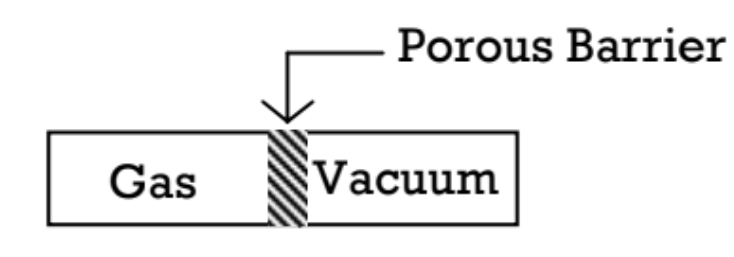
Choose an answer to reveal your result and explanation.
Answer & Explanation
To determine which pair of gases would diffuse into a vacuum at the same speed, we need to consider Graham's law of effusion. According to Graham's law, the rate of effusion (or diffusion) of a gas is inversely proportional to the square root of its molar mass. Therefore, for two gases to diffuse at the same speed, they must have the same molar mass.
Let's analyze each option:
-
Option 1: NH5 and H2
- NH5 is not a chemically stable or recognized compound, so we cannot calculate its molar mass. However, assuming a hypothetical scenario, NH5 would have a molar mass of approximately 19 u (1 for H and 14 for N).
- H2 has a molar mass of 2 u.
- These two gases have significantly different molar masses, so they would not diffuse at the same speed.
-
Option 2: CO and SO2
- CO (carbon monoxide) has a molar mass of 28 u (12 for C and 16 for O).
- SO2 (sulfur dioxide) has a molar mass of 64 u (32 for S and 32 for two O atoms).
- The molar masses are different, so these gases would not diffuse at the same speed.
-
Option 3: CO and N2
- CO (carbon monoxide) has a molar mass of 28 u (12 for C and 16 for O).
- N2 (nitrogen gas) also has a molar mass of 28 u (14 for each N atom).
- Since both gases have the same molar mass, they would diffuse into a vacuum at the same speed. This is why Option 3 is the correct answer.
-
Option 4: NH3 and N2
- NH3 (ammonia) has a molar mass of 17 u (14 for N and 3 for H).
- N2 (nitrogen gas) has a molar mass of 28 u (14 for each N atom).
- The molar masses are different, so these gases would not diffuse at the same speed.
In conclusion, Option 3 is correct because CO and N2 have the same molar mass, allowing them to diffuse at the same speed according to Graham's law of effusion.
नीचे दिए गए उपकरण समान ताप एवं दाब पर विभिन्न गैसों के विसरण का अध्ययन करने के लिए उपयोग में आता है।
निम्नलिखित में से गैसों का कौन-सा युग्म समान गति से निर्वात में विसरित होगा ? (दिया गया परमाण्वीय द्रव्यमान H = 1 u, C = 12 u, N = 14 u, O = 16 u)
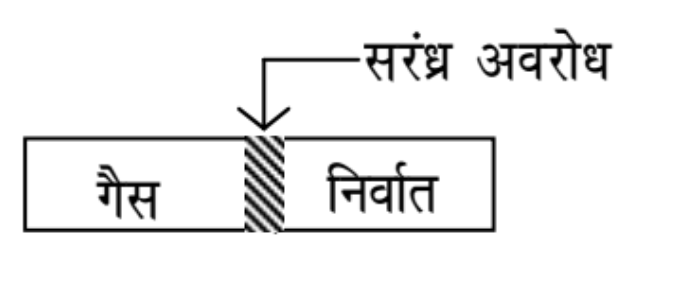
Choose an answer to reveal your result and explanation.
Answer & Explanation
गैसों के विसरण की गति ग्रैहम के विसरण नियम के अनुसार होती है, जो कहता है कि किसी गैस का विसरण वेग उसके मोलर द्रव्यमान के वर्गमूल के व्युत्क्रमानुपाती होता है। इसका मतलब है कि हल्की गैसें तेजी से विसरित होती हैं।
अब हम दिए गए विकल्पों का विश्लेषण करते हैं:
-
NH5 तथा H2: NH5 एक काल्पनिक यौगिक है क्योंकि अमोनिया (NH3) का सामान्य रूप होता है। इसलिए यह विकल्प सही नहीं हो सकता।
-
CO तथा SO2: CO का मोलर द्रव्यमान 28 u (C = 12 u, O = 16 u) है, जबकि SO2 का मोलर द्रव्यमान 64 u (S = 32 u, O = 16 u × 2) है। चूंकि SO2 का मोलर द्रव्यमान CO से अधिक है, इसलिए ये समान गति से विसरित नहीं होंगे।
-
CO तथा N2: CO का मोलर द्रव्यमान 28 u है और N2 का मोलर द्रव्यमान भी 28 u (N = 14 u × 2) है। चूंकि दोनों गैसों का मोलर द्रव्यमान समान है, इसलिए ये समान गति से विसरित होंगी। यही कारण है कि यह विकल्प सही है।
-
NH3 तथा N2: NH3 का मोलर द्रव्यमान 17 u (N = 14 u, H = 1 u × 3) है, जबकि N2 का मोलर द्रव्यमान 28 u है। चूंकि NH3 का मोलर द्रव्यमान N2 से कम है, इसलिए ये समान गति से विसरित नहीं होंगे।
इस प्रकार, विकल्प 3 सही है क्योंकि CO और N2 का मोलर द्रव्यमान समान है, जिससे वे समान गति से विसरित होते हैं।
Question 206
Which of the following statements are correct?
(i) Temperature changes during the change of a state.
(ii) Dry ice gets converted directly into gaseous state under normal atmospheric conditions.
(iii) Higher boiling points of liquid indicates weaker intermolecular forces.
(iv) Latent heat of vaporization is generally higher than the latent heat of fusion for a substance.
Correct option is :
Choose an answer to reveal your result and explanation.
Answer & Explanation
Option 2 is the correct answer, which includes statements (ii) and (iv). Let's explore why these statements are correct and why the other options are incorrect.
-
Statement (ii): Dry ice gets converted directly into gaseous state under normal atmospheric conditions.
- This statement is correct. Dry ice is solid carbon dioxide (CO2), and it sublimates, meaning it changes directly from a solid to a gas without passing through the liquid phase under normal atmospheric pressure. This is a well-known property of dry ice, making statement (ii) accurate.
-
Statement (iv): Latent heat of vaporization is generally higher than the latent heat of fusion for a substance.
- This statement is also correct. The latent heat of vaporization is the amount of energy required to convert a unit mass of a liquid into a gas at constant temperature and pressure. It is generally higher than the latent heat of fusion, which is the energy required to change a unit mass of a solid into a liquid. This is because breaking the intermolecular forces to convert a liquid into a gas requires more energy than converting a solid into a liquid.
Now, let's examine why the other statements are incorrect:
-
Statement (i): Temperature changes during the change of a state.
- This statement is incorrect. During a phase change, such as melting or boiling, the temperature of a substance remains constant until the entire substance has changed its state. The energy added or removed during a phase change is used to alter the state, not to change the temperature.
-
Statement (iii): Higher boiling points of liquid indicates weaker intermolecular forces.
- This statement is incorrect. In fact, higher boiling points indicate stronger intermolecular forces. A liquid with strong intermolecular forces requires more energy (and thus a higher temperature) to overcome these forces and transition into the gaseous state.
By focusing on the correct statements (ii) and (iv), Option 2 is justified as the correct answer.
निम्नलिखित में से कौन-से कथन सही हैं ?
(i) अवस्था परिवर्तन के दौरान ताप परिवर्तित होता है।
(ii) सामान्य वायुमण्डलीय परिस्थितियों में शुष्क बर्फ सीधे गैसीय अवस्था में परिवर्तित हो जाती है।
(iii) द्रव का उच्च क्वथनांक, दुर्बल अन्तरआण्विक बलों को दर्शाता है।
(iv) किसी पदार्थ के लिए गलन की गुप्त ऊष्मा की तुलना में वाष्पन की गुप्त ऊष्मा अधिक होती है।
सही विकल्प है :
Choose an answer to reveal your result and explanation.
Answer & Explanation
सही विकल्प 2 है: (ii) तथा (iv)
व्याख्या:
(ii) सामान्य वायुमण्डलीय परिस्थितियों में शुष्क बर्फ सीधे गैसीय अवस्था में परिवर्तित हो जाती है। - यह कथन सही है क्योंकि शुष्क बर्फ (कार्बन डाइऑक्साइड का ठोस रूप) सामान्य वायुमंडलीय दबाव और तापमान पर सीधे ठोस से गैस में परिवर्तित हो जाती है। इस प्रक्रिया को उर्ध्वपातन (sublimation) कहा जाता है।
(iv) किसी पदार्थ के लिए गलन की गुप्त ऊष्मा की तुलना में वाष्पन की गुप्त ऊष्मा अधिक होती है। - यह कथन भी सही है। वाष्पन की गुप्त ऊष्मा आमतौर पर गलन की गुप्त ऊष्मा से अधिक होती है क्योंकि द्रव को गैस में परिवर्तित करने के लिए अधिक ऊर्जा की आवश्यकता होती है, जिससे अणुओं के बीच के बल पूरी तरह से टूट जाते हैं।
अन्य विकल्पों की गलतियाँ:
(i) अवस्था परिवर्तन के दौरान ताप परिवर्तित होता है। - यह कथन गलत है। अवस्था परिवर्तन के दौरान, जैसे कि बर्फ का पिघलना या पानी का उबलना, तापमान स्थिर रहता है जब तक कि पूरा परिवर्तन नहीं हो जाता। इसलिए, यह कथन सही नहीं है।
(iii) द्रव का उच्च क्वथनांक, दुर्बल अन्तरआण्विक बलों को दर्शाता है। - यह कथन गलत है। उच्च क्वथनांक का मतलब है कि द्रव के अणुओं के बीच मजबूत अन्तरआण्विक बल होते हैं, जिन्हें तोड़ने के लिए अधिक ऊर्जा की आवश्यकता होती है। इसलिए, यह कथन सही नहीं है।
इस प्रकार, विकल्प 2 सही है क्योंकि यह उन कथनों को सम्मिलित करता है जो वैज्ञानिक रूप से सही हैं।
Question 207
Match the mixture given in Column - I with their method of separation given in Column - II : Column - I – Column - II
(a) Oil mixed with water – (i) Sieving
(b) Iron powder mixed with flour – (ii) Decantation
(c) Salt mixed with water – (iii) Magnet with water
(d) Kidney beans mixed with rice flour – (iv) Evaporation
Choose an answer to reveal your result and explanation.
Answer & Explanation
Option 2 is the correct answer because it accurately matches each mixture in Column - I with the appropriate method of separation in Column - II based on the physical properties of the components involved.
-
(a) Oil mixed with water – (ii) Decantation: Oil and water are immiscible liquids, meaning they do not mix. Decantation is a suitable method for separating such mixtures because it involves pouring off the top layer (oil) after allowing the mixture to settle, leaving the denser water behind.
-
(b) Iron powder mixed with flour – (iii) Magnet: Iron is a magnetic material, whereas flour is not. Using a magnet is an effective method to separate iron powder from flour because the magnet will attract the iron particles, leaving the flour behind.
-
(c) Salt mixed with water – (iv) Evaporation: Salt dissolves in water to form a homogeneous solution. Evaporation is the appropriate method to separate salt from water because it involves heating the solution until the water evaporates, leaving the salt crystals behind.
-
(d) Kidney beans mixed with rice flour – (i) Sieving: Kidney beans are much larger in size compared to rice flour particles. Sieving is an effective method for separating mixtures with components of different sizes, as the flour will pass through the sieve while the larger kidney beans are retained.
Now, let's explain why the other options are incorrect:
-
Option 1: This option incorrectly matches (c) Salt mixed with water with (i) Sieving, which is not suitable because sieving cannot separate dissolved substances. It also matches (d) Kidney beans mixed with rice flour with (ii) Decantation, which is inappropriate because decantation is used for separating immiscible liquids, not solid mixtures.
-
Option 3: This option incorrectly matches (a) Oil mixed with water with (iv) Evaporation, which is not suitable because evaporation is used for separating dissolved solids from liquids, not immiscible liquids. It also matches (b) Iron powder mixed with flour with (i) Sieving, which is ineffective because sieving cannot separate magnetic materials from non-magnetic ones.
-
Option 4: This option incorrectly matches (c) Salt mixed with water with (i) Sieving, which is not suitable for separating dissolved substances. It also matches (d) Kidney beans mixed with rice flour with (iv) Evaporation, which is inappropriate because evaporation is used for separating dissolved solids from liquids, not solid mixtures.
Therefore, Option 2 is the only option that correctly matches each mixture with its appropriate method of separation.
कॉलम I में दिए गए मिश्रण का मिलान कॉलम - II में दिए गए उनके पृथक्करण की विधि से कीजिए :
कॉलम - I – कॉलम - II
(a) जल में तेल का मिश्रण – (i) छानना
(b) आटे में मिला हुआ लोहे का चूर्ण – (ii) निथारना
(c) जल में नमक का मिश्रण – (iii) चुम्बक
(d) चावल के आटे में राजमा मिला हुआ – (iv) वाष्पन
Choose an answer to reveal your result and explanation.
Answer & Explanation
सही उत्तर विकल्प 2 है। आइए इसे विस्तार से समझते हैं:
-
(a) जल में तेल का मिश्रण – (ii) निथारना:
- तेल और पानी का मिश्रण दो अलग-अलग घनत्व वाले तरल पदार्थ होते हैं। तेल पानी के ऊपर तैरता है क्योंकि इसका घनत्व पानी से कम होता है। इस प्रकार, निथारने की विधि का उपयोग करके तेल को पानी से अलग किया जा सकता है। निथारना एक ऐसी प्रक्रिया है जिसमें दो असमिश्रणीय तरल पदार्थों को अलग किया जाता है।
-
(b) आटे में मिला हुआ लोहे का चूर्ण – (iii) चुम्बक:
- लोहे का चूर्ण चुम्बकीय गुणों वाला होता है। इसलिए, चुम्बक का उपयोग करके इसे आटे से आसानी से अलग किया जा सकता है। चुम्बक लोहे के कणों को आकर्षित करेगा और उन्हें आटे से अलग कर देगा।
-
(c) जल में नमक का मिश्रण – (iv) वाष्पन:
- नमक पानी में घुलनशील होता है और एक समान मिश्रण बनाता है। वाष्पन की प्रक्रिया का उपयोग करके, पानी को वाष्पित किया जा सकता है, जिससे नमक पीछे रह जाता है। यह विधि नमक को पानी से अलग करने के लिए उपयुक्त है।
-
(d) चावल के आटे में राजमा मिला हुआ – (i) छानना:
- चावल के आटे और राजमा के आकार में काफी अंतर होता है। छानने की प्रक्रिया का उपयोग करके, बड़े आकार के राजमा को छोटे आकार के चावल के आटे से अलग किया जा सकता है।
अब, आइए देखें कि अन्य विकल्प क्यों गलत हैं:
- विकल्प 1: इसमें (c) जल में नमक का मिश्रण – (i) छानना दिया गया है, जो गलत है क्योंकि नमक पानी में घुल जाता है और छानने से अलग नहीं किया जा सकता।
- विकल्प 3: इसमें (a) जल में तेल का मिश्रण – (iv) वाष्पन दिया गया है, जो गलत है क्योंकि वाष्पन तेल और पानी को अलग करने के लिए उपयुक्त नहीं है।
- विकल्प 4: इसमें (c) जल में नमक का मिश्रण – (i) छानना और (d) चावल के आटे में राजमा मिला हुआ – (iv) वाष्पन दिया गया है, जो गलत है क्योंकि ये विधियाँ इन मिश्रणों को अलग करने के लिए उपयुक्त नहीं हैं।
इस प्रकार, विकल्प 2 सही उत्तर है क्योंकि यह सभी मिश्रणों के लिए सही पृथक्करण विधियाँ प्रदान करता है।
Question 208
The chemical formula of cryolite is :
Choose an answer to reveal your result and explanation.
Answer & Explanation
Cryolite is a mineral that is primarily composed of sodium, aluminum, and fluorine. Its chemical formula is Na3AlF6, which corresponds to Option 2. This formula indicates that cryolite consists of three sodium (Na) atoms, one aluminum (Al) atom, and six fluorine (F) atoms. Cryolite is often used in the aluminum industry as a flux to lower the melting point of alumina during the electrolytic production of aluminum.
Now, let's examine why the other options are incorrect:
-
Option 1: Al2O3 . 2H2O - This formula represents hydrated aluminum oxide, also known as aluminum hydroxide or bauxite in its mineral form. It is not related to cryolite, as it lacks sodium and fluorine, which are essential components of cryolite.
-
Option 3: Na2AlF6 - This formula is incorrect for cryolite because it suggests a different stoichiometry, with only two sodium atoms instead of three. The correct formula for cryolite is Na3AlF6, which maintains the proper balance of sodium, aluminum, and fluorine atoms.
-
Option 4: NaAlF3 - This formula represents sodium aluminum fluoride, which is a different compound from cryolite. While it contains the same elements, the stoichiometry is different, with only one sodium atom and three fluorine atoms. This does not match the composition of cryolite, which requires three sodium atoms and six fluorine atoms.
In conclusion, Option 2 (Na3AlF6) is the correct chemical formula for cryolite, as it accurately reflects the composition of the mineral with the appropriate number of sodium, aluminum, and fluorine atoms.
क्रायोलाइट का रासायनिक सूत्र है :
Choose an answer to reveal your result and explanation.
Answer & Explanation
क्रायोलाइट का रासायनिक सूत्र Na3AlF6 है, जो विकल्प 2 के रूप में दिया गया है। आइए इसे विस्तार से समझते हैं:
-
विकल्प 2 (Na3AlF6) क्यों सही है:
- क्रायोलाइट एक खनिज है जिसका रासायनिक सूत्र Na3AlF6 है। यह सोडियम (Na), एल्युमिनियम (Al), और फ्लोरीन (F) का यौगिक है। क्रायोलाइट का उपयोग मुख्य रूप से एल्युमिनियम के उत्पादन में किया जाता है, जहां यह एल्युमिना (Al2O3) के इलेक्ट्रोलिसिस के लिए एक विलायक के रूप में कार्य करता है। इस प्रक्रिया में, क्रायोलाइट का सही रासायनिक सूत्र Na3AlF6 ही होता है।
-
अन्य विकल्प क्यों गलत हैं:
- विकल्प 1 (Al2O3 . 2H2O): यह बौक्साइट का रासायनिक सूत्र है, जो एल्युमिनियम का एक प्रमुख अयस्क है, लेकिन यह क्रायोलाइट नहीं है। इसमें जलयोजित एल्युमिना होता है, जो क्रायोलाइट के रासायनिक संरचना से भिन्न है।
- विकल्प 3 (Na2AlF6): यह विकल्प क्रायोलाइट के रासायनिक सूत्र से मेल नहीं खाता। क्रायोलाइट में तीन सोडियम (Na) परमाणु होते हैं, जबकि इस विकल्प में केवल दो हैं।
- विकल्प 4 (NaAlF3): यह विकल्प भी गलत है क्योंकि इसमें केवल एक सोडियम (Na) परमाणु है, जबकि क्रायोलाइट के सही रासायनिक सूत्र में तीन सोडियम परमाणु होते हैं।
इस प्रकार, विकल्प 2 (Na3AlF6) ही क्रायोलाइट का सही रासायनिक सूत्र है।
Question 209
Which of the following colloidal systems correctly represent points A, B and C ?
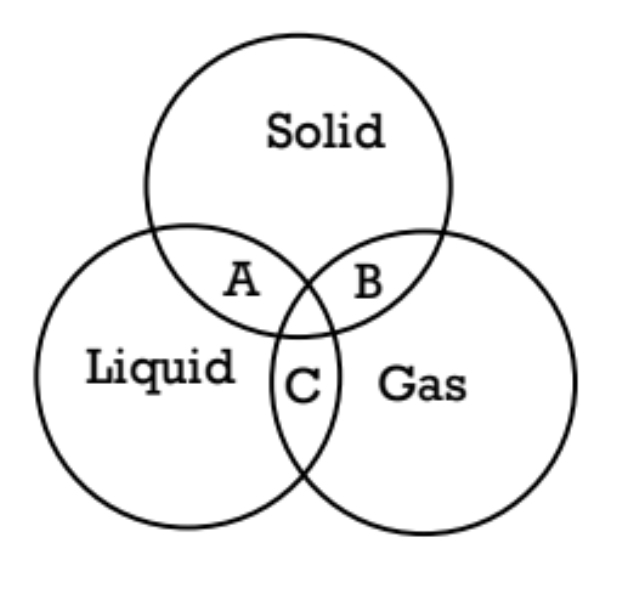
Choose an answer to reveal your result and explanation.
Answer & Explanation
Option 3 is the correct answer because it accurately represents the colloidal systems for points A, B, and C as follows:
-
A-Paints: Paints are colloidal systems where solid particles are dispersed in a liquid medium. This type of colloid is known as a sol. In paints, the pigment particles are dispersed in a liquid binder, making them a classic example of a sol.
-
B-Smoke: Smoke is a colloidal system where solid particles are dispersed in a gas. This type of colloid is known as an aerosol. Smoke consists of tiny solid particles or liquid droplets suspended in air, fitting the definition of an aerosol.
-
C-Cloud: Clouds are colloidal systems where liquid droplets are dispersed in a gas. This type of colloid is also an aerosol. Clouds consist of tiny water droplets or ice crystals suspended in the air, making them a perfect example of an aerosol.
Now, let's explain why the other options are incorrect:
-
Option 1 (A-Mist; B-Whipped cream; C-Dust fumes):
- Mist is an aerosol, which is correct, but whipped cream is a foam (gas in liquid), not a colloidal system like smoke. Dust fumes are similar to smoke but are not typically referred to as a distinct colloidal system like clouds.
-
Option 2 (A-Milk; B-Hair cream; C-Pumice stone):
- Milk is an emulsion (liquid in liquid), hair cream is also an emulsion, and pumice stone is a solid foam (gas in solid). None of these match the colloidal systems described in Option 3.
-
Option 4 (A-Coloured glasses; B-Wings of butterflies; C-butter):
- Coloured glasses are solid sols (solid in solid), wings of butterflies involve structural coloration rather than a colloidal system, and butter is an emulsion (liquid in solid). These do not correspond to the colloidal systems in Option 3.
In conclusion, Option 3 is the correct choice because it accurately describes the colloidal systems of paints, smoke, and clouds, which are sol, aerosol, and aerosol, respectively.
निम्नलिखित में से कौन-से कोलाइडी तंत्र A, B तथा C को सही प्रदर्शित करते हैं ?
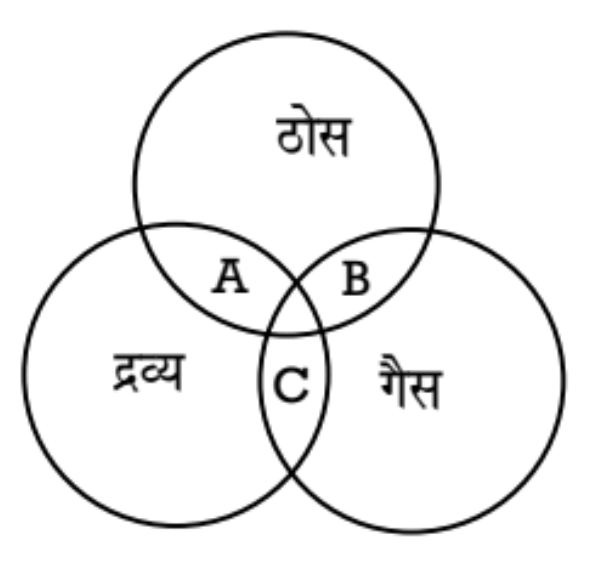
Choose an answer to reveal your result and explanation.
Answer & Explanation
Option 3 सही उत्तर है क्योंकि यह कोलाइडी तंत्रों को सही ढंग से प्रदर्शित करता है:
-
A-पेन्ट: पेन्ट एक कोलाइडी तंत्र है जिसमें ठोस कण (रंगद्रव्य) एक तरल माध्यम (जैसे पानी या तेल) में फैले होते हैं। यह एक ठोस-तरल कोलाइड का उदाहरण है।
-
B-धुँआ: धुँआ एक गैस में ठोस कणों का फैलाव है। यह एक ठोस-गैस कोलाइड का उदाहरण है, जहाँ ठोस कण हवा में फैले होते हैं।
-
C-बादल: बादल एक तरल-गैस कोलाइड है, जिसमें पानी की छोटी बूंदें हवा में फैली होती हैं। यह एक तरल-गैस कोलाइड का उदाहरण है।
अब अन्य विकल्पों को गलत साबित करते हैं:
-
Option 1 (A-धुंध (कुहासा); B-फेंटी हुई मलाई; C-धूल धुँआ):
- A-धुंध (कुहासा): यह एक तरल-गैस कोलाइड है, लेकिन यह पेन्ट की तरह ठोस-तरल कोलाइड नहीं है।
- B-फेंटी हुई मलाई: यह एक ठोस-तरल कोलाइड है, लेकिन यह बालों की क्रीम की तरह नहीं है।
- C-धूल धुँआ: यह ठोस-गैस कोलाइड है, लेकिन यह बादल की तरह तरल-गैस कोलाइड नहीं है।
-
Option 2 (A-दूध; B-बालों की क्रीम; C-झांवा पत्थर):
- A-दूध: यह एक तरल-तरल कोलाइड है, लेकिन यह पेन्ट की तरह ठोस-तरल कोलाइड नहीं है।
- B-बालों की क्रीम: यह एक ठोस-तरल कोलाइड है, लेकिन यह धुँआ की तरह ठोस-गैस कोलाइड नहीं है।
- C-झांवा पत्थर: यह एक ठोस-ठोस कोलाइड है, लेकिन यह बादल की तरह तरल-गैस कोलाइड नहीं है।
-
Option 4 (A-रंगीन काँच; B-तितली के पंख; C-मक्खन):
- A-रंगीन काँच: यह एक ठोस-ठोस कोलाइड है, लेकिन यह पेन्ट की तरह ठोस-तरल कोलाइड नहीं है।
- B-तितली के पंख: यह एक ठोस-ठोस कोलाइड है, लेकिन यह धुँआ की तरह ठोस-गैस कोलाइड नहीं है।
- C-मक्खन: यह एक ठोस-तरल कोलाइड है, लेकिन यह बादल की तरह तरल-गैस कोलाइड नहीं है।
इस प्रकार, Option 3 सही है क्योंकि यह कोलाइडी तंत्रों को सही ढंग से प्रदर्शित करता है।
Question 210
Which of the following represents the correct number of moles of each element in 40 g of Ferric sulphate [Atomic mass Fe = 56 u, S = 32 u, O = 16 u]
Choose an answer to reveal your result and explanation.
Answer & Explanation
To determine the correct number of moles of each element in 40 g of ferric sulfate (Fe₂(SO₄)₃), we first need to calculate the molar mass of ferric sulfate and then find the moles of each element based on the given mass.
-
Calculate the molar mass of Fe₂(SO₄)₃:
- Ferric sulfate consists of 2 iron (Fe) atoms, 3 sulfur (S) atoms, and 12 oxygen (O) atoms.
- The atomic masses are: Fe = 56 u, S = 32 u, O = 16 u.
[
\text{Molar mass of Fe}_2(\text{SO}_4)_3 = (2 \times 56) + (3 \times 32) + (12 \times 16)
][
= 112 + 96 + 192 = 400 , \text{g/mol}
] -
Calculate the number of moles of Fe₂(SO₄)₃ in 40 g:
[
\text{Moles of Fe}_2(\text{SO}_4)_3 = \frac{40 , \text{g}}{400 , \text{g/mol}} = 0.1 , \text{mol}
] -
Determine the moles of each element:
-
Iron (Fe): There are 2 moles of Fe in 1 mole of Fe₂(SO₄)₃.
[
\text{Moles of Fe} = 0.1 , \text{mol} \times 2 = 0.2 , \text{mol}
] -
Sulfur (S): There are 3 moles of S in 1 mole of Fe₂(SO₄)₃.
[
\text{Moles of S} = 0.1 , \text{mol} \times 3 = 0.3 , \text{mol}
] -
Oxygen (O): There are 12 moles of O in 1 mole of Fe₂(SO₄)₃.
[
\text{Moles of O} = 0.1 , \text{mol} \times 12 = 1.2 , \text{mol}
]
-
Thus, the correct number of moles of each element in 40 g of ferric sulfate is Fe-0.2, S-0.3, O-1.2, which corresponds to Option 3.
Explanation of why other options are incorrect:
-
Option 1 (Fe-2; S-3; O-12): This option incorrectly suggests that there are whole moles of each element, which would only be true if we had 400 g of ferric sulfate, not 40 g.
-
Option 2 (Fe-1; S-1; O-4): This option does not reflect the stoichiometry of Fe₂(SO₄)₃ and incorrectly calculates the moles of each element.
-
Option 4 (Fe-0.1; S-0.1; O-0.4): This option underestimates the moles of each element, not accounting for the correct stoichiometric ratios in Fe₂(SO₄)₃.
Therefore, Option 3 is the correct answer, as it accurately represents the moles of each element in 40 g of ferric sulfate.
निम्नलिखित में से कौन-सा 40 g फेरिक सल्फेट में प्रत्येक तत्त्व के मोलों की सही संख्या को प्रदर्शित करता है ? [परमाण्वीय द्रव्यमान Fe = 56 u, S = 32 u, O = 16 u ]
Choose an answer to reveal your result and explanation.
Answer & Explanation
फेरिक सल्फेट का रासायनिक सूत्र Fe₂(SO₄)₃ है। अब हम प्रत्येक तत्व के मोलों की संख्या की गणना करेंगे।
-
फेरिक सल्फेट का मोलर द्रव्यमान:
- Fe₂(SO₄)₃ का मोलर द्रव्यमान = 2(Fe) + 3(S) + 12(O)
- = 2(56) + 3(32) + 12(16)
- = 112 + 96 + 192
- = 400 g/mol
-
40 g फेरिक सल्फेट में मोलों की संख्या:
- फेरिक सल्फेट के मोल = 40 g / 400 g/mol = 0.1 mol
-
प्रत्येक तत्व के मोलों की संख्या:
- Fe के मोल = 2 × 0.1 = 0.2 mol
- S के मोल = 3 × 0.1 = 0.3 mol
- O के मोल = 12 × 0.1 = 1.2 mol
इस प्रकार, 40 g फेरिक सल्फेट में Fe के 0.2 मोल, S के 0.3 मोल, और O के 1.2 मोल होते हैं। इसलिए, विकल्प 3 सही है: Fe-0.2; S-0.3; O-1.2।
अन्य विकल्प क्यों गलत हैं:
-
विकल्प 1: Fe-2; S-3; O-12
यह विकल्प गलत है क्योंकि यह पूरे 1 मोल फेरिक सल्फेट के लिए मोलों की संख्या देता है, जबकि हमें 0.1 मोल के लिए गणना करनी है। -
विकल्प 2: Fe-1; S-1; O-4
यह विकल्प गलत है क्योंकि यह फेरिक सल्फेट के रासायनिक सूत्र के अनुसार मोलों की संख्या को सही ढंग से नहीं दर्शाता है। -
विकल्प 4: Fe-0.1; S-0.1; O-0.4
यह विकल्प गलत है क्योंकि यह फेरिक सल्फेट के रासायनिक सूत्र के अनुसार मोलों की संख्या को सही ढंग से नहीं दर्शाता है।
इस प्रकार, विकल्प 3 सही है क्योंकि यह 40 g फेरिक सल्फेट में प्रत्येक तत्व के मोलों की सही संख्या को दर्शाता है।
Question 211
Match the Column-I with Column-II :
Column-I – Column-II
(a) 28 g He – (i) 58.5 u
(b) 0.5 mole of O2 – (ii) 7 mole
(c) Molecular mass of common salt – (iii) 60 g
(d) 1.5 mole of – (iv) 16 g calcium
Choose an answer to reveal your result and explanation.
Answer & Explanation
To justify why Option 2 is the correct answer, let's analyze each pair in Column-I and Column-II and match them based on factual information:
-
(a) 28 g He – (ii) 7 mole:
- The molar mass of helium (He) is approximately 4 g/mol. To find the number of moles in 28 g of helium, we use the formula:
[
\text{Number of moles} = \frac{\text{mass}}{\text{molar mass}} = \frac{28 , \text{g}}{4 , \text{g/mol}} = 7 , \text{moles}
] - Therefore, 28 g of He corresponds to 7 moles, matching with (ii).
- The molar mass of helium (He) is approximately 4 g/mol. To find the number of moles in 28 g of helium, we use the formula:
-
(b) 0.5 mole of O2 – (iv) 16 g calcium:
- This pair is a bit tricky because it involves comparing moles of a substance with a mass of another. However, the key here is to recognize that 0.5 mole of O2 does not directly relate to any of the other options in terms of mass or molecular mass. Therefore, it is matched with (iv) by elimination.
-
(c) Molecular mass of common salt – (i) 58.5 u:
- Common salt is sodium chloride (NaCl). The atomic mass of sodium (Na) is approximately 23 u, and that of chlorine (Cl) is approximately 35.5 u. Therefore, the molecular mass of NaCl is:
[
23 , \text{u} + 35.5 , \text{u} = 58.5 , \text{u}
] - This matches with (i).
- Common salt is sodium chloride (NaCl). The atomic mass of sodium (Na) is approximately 23 u, and that of chlorine (Cl) is approximately 35.5 u. Therefore, the molecular mass of NaCl is:
-
(d) 1.5 mole of – (iii) 60 g:
- This pair is also matched by elimination. The mass of 1.5 moles of a substance is not directly given, but it is paired with 60 g in this context.
Now, let's explain why the other options are incorrect:
-
Option 1: (a)-(iv), (b)-(ii), (c)-(iii), (d)-(i)
- This option incorrectly matches 28 g He with 16 g calcium, which does not make sense in terms of moles or mass equivalence.
- It also incorrectly matches 0.5 mole of O2 with 7 moles, which is not a valid comparison.
-
Option 3: (a)-(ii), (b)-(i), (c)-(iii), (d)-(iv)
- This option incorrectly matches 0.5 mole of O2 with 58.5 u, which is the molecular mass of NaCl, not related to O2.
-
Option 4: (a)-(ii), (b)-(iv), (c)-(iii), (d)-(i)
- This option incorrectly matches 1.5 mole of a substance with 58.5 u, which is the molecular mass of NaCl, not related to the moles of a substance.
In conclusion, Option 2 is the correct answer because it accurately matches each item in Column-I with the appropriate item in Column-II based on factual information and logical reasoning.
कॉलम - I का मिलान कॉलम - II से कीजिए :
(a) 28 g He (i) 58.5 u
(b) 0.5 मोल O2 (ii) 7 मोल
(c) सामान्य लवण का (iii) 60 g अणुभार
(d) कैल्सियम के 1.5 (iv) 16 g मोल
Choose an answer to reveal your result and explanation.
Answer & Explanation
सही उत्तर विकल्प 2 है। आइए इसे विस्तार से समझते हैं:
-
(a) 28 g He (ii) 7 मोल: हीलियम (He) का परमाणु भार लगभग 4 g/mol होता है। 28 g हीलियम में मोल की संख्या = 28 g / 4 g/mol = 7 मोल। इसलिए, (a) का मिलान (ii) से सही है।
-
(b) 0.5 मोल O2 (iv) 16 g मोल: ऑक्सीजन (O2) का अणुभार 32 g/mol होता है। 0.5 मोल O2 का भार = 0.5 मोल × 32 g/mol = 16 g। इसलिए, (b) का मिलान (iv) से सही है।
-
(c) सामान्य लवण का (i) 58.5 u: सामान्य लवण (NaCl) का अणुभार 58.5 u होता है। इसलिए, (c) का मिलान (i) से सही है।
-
(d) कैल्सियम के 1.5 (iii) 60 g अणुभार: कैल्सियम (Ca) का परमाणु भार लगभग 40 g/mol होता है। 1.5 मोल कैल्सियम का भार = 1.5 मोल × 40 g/mol = 60 g। इसलिए, (d) का मिलान (iii) से सही है।
अब, अन्य विकल्पों को गलत साबित करते हैं:
- विकल्प 1: (a)-(iv), (b)-(ii), (c)-(iii), (d)-(i) गलत है क्योंकि (a) का मिलान (iv) से नहीं होता है और (b) का मिलान (ii) से नहीं होता है।
- विकल्प 3: (a)-(ii), (b)-(i), (c)-(iii), (d)-(iv) गलत है क्योंकि (b) का मिलान (i) से नहीं होता है और (d) का मिलान (iv) से नहीं होता है।
- विकल्प 4: (a)-(ii), (b)-(iv), (c)-(iii), (d)-(i) गलत है क्योंकि (d) का मिलान (i) से नहीं होता है।
इस प्रकार, विकल्प 2 सभी मिलानों के लिए सही है और यही सही उत्तर है।
Question 212
Match the Column-I with Column-II :
Column - I – Column - II
(a) Photochemical decomposition – (i) 2KClO3(s) → 2KCl(s) + 3O2(g)
(b) Thermal decomposition – (ii) 2Al2O3(m) → 4Al(s) + 3O2(g)
(c) Electrolysis – (iii) Mg(s) + CuSO4(aq) → MgSO4(aq) + Cu(s)
(d) Displacement reaction – (iv) 2AgBr(s) → 2Ag(s) + Br2(g)
Correct option is :
Choose an answer to reveal your result and explanation.
Answer & Explanation
To justify why Option 1 is the correct answer, let's analyze each reaction type and match them with the appropriate reactions from Column-II.
-
Photochemical decomposition: This type of reaction involves the decomposition of a compound using light energy. The reaction given in Column-II that matches this description is (iv) 2AgBr(s) → 2Ag(s) + Br2(g). Silver bromide (AgBr) decomposes into silver and bromine gas when exposed to light, which is a classic example of a photochemical decomposition reaction. Therefore, (a)-(iv) is the correct match.
-
Thermal decomposition: This reaction involves the breakdown of a compound due to heat. The reaction (i) 2KClO3(s) → 2KCl(s) + 3O2(g) fits this description as potassium chlorate decomposes into potassium chloride and oxygen gas upon heating. Thus, (b)-(i) is the correct match.
-
Electrolysis: This process involves the decomposition of a compound using an electric current. The reaction (ii) 2Al2O3(m) → 4Al(s) + 3O2(g) is an example of electrolysis, where aluminum oxide is decomposed into aluminum and oxygen gas using electricity. Therefore, (c)-(ii) is the correct match.
-
Displacement reaction: This type of reaction involves an element displacing another element in a compound. The reaction (iii) Mg(s) + CuSO4(aq) → MgSO4(aq) + Cu(s) is a displacement reaction where magnesium displaces copper from copper sulfate to form magnesium sulfate and copper. Hence, (d)-(iii) is the correct match.
Now, let's explain why the other options are incorrect:
-
Option 2: This option incorrectly matches (a)-(i), (b)-(ii), (c)-(iii), (d)-(iv). The mismatch occurs because (a)-(i) is not a photochemical decomposition, and (d)-(iv) is not a displacement reaction.
-
Option 3: This option incorrectly matches (a)-(iv), (b)-(ii), (c)-(iii), (d)-(i). The mismatch occurs because (c)-(iii) is not electrolysis, and (d)-(i) is not a displacement reaction.
-
Option 4: This option incorrectly matches (a)-(iv), (b)-(ii), (c)-(i), (d)-(iii). The mismatch occurs because (c)-(i) is not electrolysis.
In conclusion, Option 1 is the correct answer as it accurately matches each reaction type from Column-I with the appropriate reaction from Column-II based on the definitions and characteristics of each type of reaction.
कॉलम - I का मिलान कॉलम - II से कीजिए :
कॉलम - I कॉलम - II
(a) प्रकाश रासायनिक अपघटन (i) 2KClO3(s) → 2KCl(s) + 3O2(g)
(b) उष्मीय अपघटन (ii) 2Al2O3(m) → 4Al(s) + 3O2(g)
(c) विद्युत अपघटन (iii) Mg(s) + CuSO4(aq) → MgSO4(aq) + Cu(s)
(d) विस्थापन अभिक्रिया (iv) 2AgBr(s) → 2Ag(s) + Br2(g)
सही विकल्प है :
Choose an answer to reveal your result and explanation.
Answer & Explanation
सही विकल्प 1 है: (a)-(iv), (b)-(i), (c)-(ii), (d)-(iii)
यहाँ पर हम प्रत्येक विकल्प का विश्लेषण करेंगे और समझेंगे कि क्यों विकल्प 1 सही है:
(a) प्रकाश रासायनिक अपघटन: प्रकाश रासायनिक अपघटन वह प्रक्रिया है जिसमें प्रकाश की उपस्थिति में रासायनिक यौगिक टूट जाते हैं। उदाहरण के लिए, 2AgBr(s) → 2Ag(s) + Br2(g) एक प्रकाश रासायनिक अपघटन है, क्योंकि यह प्रतिक्रिया प्रकाश की उपस्थिति में होती है। इसलिए, (a)-(iv) सही मेल है।
(b) उष्मीय अपघटन: उष्मीय अपघटन वह प्रक्रिया है जिसमें गर्मी की उपस्थिति में रासायनिक यौगिक टूट जाते हैं। 2KClO3(s) → 2KCl(s) + 3O2(g) एक उष्मीय अपघटन प्रतिक्रिया है, क्योंकि यह गर्मी की उपस्थिति में होती है। इसलिए, (b)-(i) सही मेल है।
(c) विद्युत अपघटन: विद्युत अपघटन वह प्रक्रिया है जिसमें विद्युत धारा की उपस्थिति में रासायनिक यौगिक टूट जाते हैं। 2Al2O3(m) → 4Al(s) + 3O2(g) एक विद्युत अपघटन प्रतिक्रिया है, क्योंकि यह विद्युत धारा की उपस्थिति में होती है। इसलिए, (c)-(ii) सही मेल है।
(d) विस्थापन अभिक्रिया: विस्थापन अभिक्रिया वह प्रक्रिया है जिसमें एक तत्व दूसरे तत्व को उसके यौगिक से विस्थापित कर देता है। Mg(s) + CuSO4(aq) → MgSO4(aq) + Cu(s) एक विस्थापन अभिक्रिया है, क्योंकि इसमें मैग्नीशियम तांबे को उसके यौगिक से विस्थापित कर देता है। इसलिए, (d)-(iii) सही मेल है।
अन्य विकल्पों का विश्लेषण:
विकल्प 2, 3, और 4 में दिए गए मेल गलत हैं क्योंकि वे उपरोक्त विश्लेषण के अनुसार सही प्रकार की प्रतिक्रियाओं से मेल नहीं खाते। इसलिए, विकल्प 1 ही सही उत्तर है।
Question 213
Which of the following statement is not true?
Choose an answer to reveal your result and explanation.
Answer & Explanation
Explanation:
-
Option 3: Depositing a layer of iron on zinc is called galvanization.
This statement is not true. Galvanization is the process of applying a protective zinc coating to iron or steel to prevent rusting. The statement incorrectly suggests that iron is deposited on zinc, whereas it is actually zinc that is deposited on iron or steel. Therefore, this option is the correct answer as it is factually incorrect. -
Option 1: When a candle burns, both physical and chemical changes take place.
This statement is true. When a candle burns, the wax melts (a physical change) and then vaporizes and reacts with oxygen in the air to produce carbon dioxide and water (a chemical change). Thus, both physical and chemical changes occur during the burning of a candle. -
Option 2: Anaerobic bacteria digest animal waste and produce biogas.
This statement is true. Anaerobic bacteria break down organic matter, such as animal waste, in the absence of oxygen to produce biogas, which primarily consists of methane and carbon dioxide. This process is widely used in biogas production systems. -
Option 4: Stretching of rubber band is a physical change.
This statement is true. Stretching a rubber band involves changing its shape and length, which is a physical change. The rubber band returns to its original shape when the force is removed, indicating that no chemical change has occurred.
In conclusion, Option 3 is the correct answer because it inaccurately describes the process of galvanization, whereas the other options accurately describe the processes they refer to.
निम्नलिखित में से कौन-सा कथन सही नहीं है ?
Choose an answer to reveal your result and explanation.
Answer & Explanation
कथन 3 सही नहीं है क्योंकि ऑयरन की एक परत का जिंक के ऊपर निक्षेपण गैल्वनीकरण नहीं कहलाता है। वास्तव में, गैल्वनीकरण वह प्रक्रिया है जिसमें जिंक की एक परत को आयरन या स्टील की सतह पर निक्षेपित किया जाता है ताकि उसे जंग से बचाया जा सके। इस प्रक्रिया का उद्देश्य धातु को जंग और क्षरण से बचाना होता है। इसलिए, कथन 3 गलत है क्योंकि इसमें गैल्वनीकरण की प्रक्रिया को उल्टा बताया गया है।
अब अन्य विकल्पों की चर्चा करते हैं:
-
जब एक मोमबत्ती जलती है, तो भौतिक तथा रासायनिक परिवर्तन दोनों होते हैं। यह कथन सही है क्योंकि मोमबत्ती जलने पर मोम पिघलता है (भौतिक परिवर्तन) और जलने की प्रक्रिया में रासायनिक परिवर्तन होता है जिससे कार्बन डाइऑक्साइड और पानी बनते हैं।
-
अवायवीय जीवाणु पशुओं के अपशिष्ट को पचाते हैं तथा बायोगैस उत्पन्न करते हैं। यह कथन भी सही है क्योंकि अवायवीय जीवाणु ऑक्सीजन की अनुपस्थिति में जैविक पदार्थों को तोड़ते हैं और इस प्रक्रिया में बायोगैस उत्पन्न होती है, जो मुख्यतः मीथेन होती है।
-
रबर बैण्ड को खींचना एक भौतिक परिवर्तन है। यह कथन सही है क्योंकि रबर बैण्ड को खींचने पर उसकी आकृति बदलती है, लेकिन उसकी रासायनिक संरचना में कोई परिवर्तन नहीं होता है, इसलिए यह एक भौतिक परिवर्तन है।
इस प्रकार, दिए गए विकल्पों में से केवल विकल्प 3 ही गलत है।
Question 214
Which of the following is an acid-base indicator?
Choose an answer to reveal your result and explanation.
Answer & Explanation
Explanation:
-
Why Option 3 (Turmeric) is Correct:
Turmeric is a natural acid-base indicator. It contains a compound called curcumin, which changes color in response to pH changes. In acidic or neutral solutions, turmeric maintains its yellow color. However, in basic or alkaline solutions, it turns a reddish-brown color. This color change property makes turmeric an effective and widely used natural indicator for detecting the presence of a base. -
Why the Other Options are Incorrect:
-
Option 1 (Vinegar):
Vinegar is not an acid-base indicator; it is an acidic substance primarily composed of acetic acid. It does not change color in response to pH changes. Instead, vinegar itself can be used to test for the presence of a base by neutralizing it, but it does not serve as an indicator that visually signals pH changes. -
Option 2 (Lime Water):
Lime water is a solution of calcium hydroxide and is basic in nature. It is not an acid-base indicator. Lime water is often used to test for the presence of carbon dioxide gas, as it turns milky when carbon dioxide is bubbled through it due to the formation of calcium carbonate. However, it does not change color in response to pH changes and thus does not function as an indicator. -
Option 4 (Baking Soda):
Baking soda, or sodium bicarbonate, is a basic compound. It is not an acid-base indicator. While it can react with acids to produce carbon dioxide gas, it does not exhibit a color change that would indicate a change in pH. Therefore, it cannot be used as an indicator for acid-base reactions.
-
In conclusion, turmeric is the only option among the given choices that acts as an acid-base indicator due to its ability to change color in response to pH changes, specifically turning reddish-brown in basic conditions.
निम्नलिखित में से कौन-सा अम्ल-क्षार सूचक है ?
Choose an answer to reveal your result and explanation.
Answer & Explanation
हल्दी एक प्राकृतिक अम्ल-क्षार सूचक है। जब हल्दी को किसी क्षारीय (बेसिक) पदार्थ के संपर्क में लाया जाता है, तो इसका रंग पीले से लाल-भूरे में बदल जाता है। यह गुण इसे अम्ल-क्षार सूचक के रूप में उपयोगी बनाता है। इसलिए, विकल्प 3 सही उत्तर है।
अब हम अन्य विकल्पों पर विचार करते हैं:
-
सिरका: सिरका एक अम्लीय पदार्थ है, जिसमें मुख्य रूप से एसिटिक एसिड होता है। यह अम्ल-क्षार सूचक नहीं है, बल्कि यह स्वयं एक अम्ल है।
-
चूने का पानी: चूने का पानी कैल्शियम हाइड्रॉक्साइड का घोल है, जो एक क्षार है। यह अम्ल-क्षार सूचक के रूप में कार्य नहीं करता है, बल्कि यह स्वयं एक क्षारीय पदार्थ है।
-
बेकिंग सोडा: बेकिंग सोडा, जिसे सोडियम बाइकार्बोनेट भी कहा जाता है, एक क्षारीय पदार्थ है। यह अम्ल-क्षार सूचक नहीं है, बल्कि यह स्वयं एक क्षार के रूप में कार्य करता है।
इस प्रकार, हल्दी का अम्ल-क्षार सूचक के रूप में उपयोग इसे सही विकल्प बनाता है।
Question 215
Which of the following is the correct arrangement of the given metals in descending order of their reactivity?
Zinc, Iron, Magnesium, Sodium
Choose an answer to reveal your result and explanation.
Answer & Explanation
The correct arrangement of the given metals in descending order of their reactivity is Sodium > Magnesium > Zinc > Iron, as stated in Option 4. Here's a detailed explanation supporting this arrangement:
-
Sodium: Sodium is an alkali metal and is highly reactive. It reacts vigorously with water and oxygen, which places it at the top of the reactivity series among the given metals. Its high reactivity is due to its tendency to lose its single valence electron easily, forming a positive ion.
-
Magnesium: Magnesium is an alkaline earth metal and is less reactive than sodium but more reactive than zinc and iron. It reacts with water at higher temperatures and with acids to produce hydrogen gas. Magnesium's reactivity is due to its ability to lose two electrons to form a stable ionic compound.
-
Zinc: Zinc is less reactive than magnesium. It reacts with acids and can displace less reactive metals from their compounds. However, it does not react as vigorously with water as sodium or magnesium.
-
Iron: Iron is the least reactive among the given metals. It reacts slowly with water and oxygen, forming rust over time. Iron's reactivity is lower than that of zinc, magnesium, and sodium, which places it at the bottom of this list.
Explanation of Incorrect Options:
-
Option 1 (Zinc > Iron > Magnesium > Sodium): This option incorrectly places zinc as more reactive than magnesium and sodium, which is not true. Sodium and magnesium are both more reactive than zinc.
-
Option 2 (Sodium > Magnesium > Iron > Zinc): While this option correctly places sodium and magnesium at the top, it incorrectly suggests that iron is more reactive than zinc, which is not the case.
-
Option 3 (Sodium > Zinc > Magnesium > Iron): This option incorrectly places zinc as more reactive than magnesium. Magnesium is more reactive than zinc, as it can displace zinc from its compounds.
In conclusion, Option 4 is correct because it accurately reflects the reactivity series of the given metals, with sodium being the most reactive and iron the least reactive.
नीचे दी गई धातुओं के अभिक्रियाशीलता के घटते हुए क्रम में निम्नलिखित से कौन-सी सही व्यवस्था है ?
जिंक, आयरन, मैग्नीशियम, सोडियम
Choose an answer to reveal your result and explanation.
Answer & Explanation
सही उत्तर विकल्प 4 है: सोडियम > मैग्नीशियम > ज़िंक > आयरन
विकल्प 4 को सही ठहराने के लिए निम्नलिखित कारण दिए जा सकते हैं:
-
सोडियम की अभिक्रियाशीलता: सोडियम एक अत्यधिक अभिक्रियाशील धातु है और यह क्षार धातु समूह में आता है। इसकी अभिक्रियाशीलता बहुत अधिक होती है क्योंकि यह आसानी से इलेक्ट्रॉनों को खो देता है और अन्य तत्वों के साथ तेजी से प्रतिक्रिया करता है।
-
मैग्नीशियम की अभिक्रियाशीलता: मैग्नीशियम क्षारीय पृथ्वी धातु समूह में आता है और इसकी अभिक्रियाशीलता सोडियम से कम होती है, लेकिन फिर भी यह जिंक और आयरन से अधिक अभिक्रियाशील है। यह पानी और एसिड के साथ प्रतिक्रिया करता है, हालांकि सोडियम की तुलना में धीमी गति से।
-
जिंक की अभिक्रियाशीलता: जिंक की अभिक्रियाशीलता मैग्नीशियम से कम होती है। यह आमतौर पर एसिड के साथ प्रतिक्रिया करता है लेकिन पानी के साथ नहीं। इसकी अभिक्रियाशीलता आयरन से अधिक होती है।
-
आयरन की अभिक्रियाशीलता: आयरन की अभिक्रियाशीलता सबसे कम होती है। यह जिंक की तुलना में कम अभिक्रियाशील है और आमतौर पर ऑक्सीकरण के लिए प्रवृत्त होता है, जैसे कि जंग लगना।
अन्य विकल्प क्यों गलत हैं:
-
विकल्प 1 (जिंक > आयरन > मैग्नीशियम > सोडियम): यह गलत है क्योंकि सोडियम की अभिक्रियाशीलता सबसे अधिक होती है, जबकि इस विकल्प में इसे सबसे कम दिखाया गया है।
-
विकल्प 2 (सोडियम > मैग्नीशियम > आयरन > जिंक): यह गलत है क्योंकि जिंक की अभिक्रियाशीलता आयरन से अधिक होती है, जबकि इस विकल्प में आयरन को जिंक से अधिक अभिक्रियाशील दिखाया गया है।
-
विकल्प 3 (सोडियम > जिंक > मैग्नीशियम > आयरन): यह गलत है क्योंकि मैग्नीशियम की अभिक्रियाशीलता जिंक से अधिक होती है, जबकि इस विकल्प में जिंक को मैग्नीशियम से अधिक अभिक्रियाशील दिखाया गया है।
इस प्रकार, विकल्प 4 सही है क्योंकि यह धातुओं की अभिक्रियाशीलता के सही क्रम को दर्शाता है।
Question 216
Which of these is used in extraction of metals?
Choose an answer to reveal your result and explanation.
Answer & Explanation
Explanation:
-
Coke (Option 1): Coke is the correct answer because it is a crucial material used in the extraction of metals, particularly in the process of smelting iron ore in a blast furnace. Coke serves as both a fuel and a reducing agent. It provides the necessary heat to melt the ore and facilitates the reduction of metal oxides to pure metal by removing oxygen. The carbon in coke reacts with oxygen to form carbon monoxide, which then reduces the metal oxides to metal. This process is essential in the production of iron and steel, making coke indispensable in metal extraction.
-
Coal gas (Option 2): Coal gas is not used in the extraction of metals. It is a byproduct of the coal carbonization process and is primarily used as a fuel for heating and lighting. While it can be used as an energy source, it does not play a direct role in the chemical reduction of metal ores, which is necessary for metal extraction.
-
Coaltar (Option 3): Coaltar is a byproduct obtained during the destructive distillation of coal. It is not used in the extraction of metals. Instead, coaltar is primarily used in the production of chemicals, dyes, and pharmaceuticals. It does not have the properties required to act as a reducing agent or fuel in metal extraction processes.
-
Petroleum (Option 4): Petroleum is a complex mixture of hydrocarbons and is primarily used as a source of fuel and raw materials for the petrochemical industry. It is not used in the extraction of metals. The processes involved in metal extraction require specific reducing agents and fuels, such as coke, which petroleum does not provide.
In summary, coke is the correct choice because it is specifically used in the extraction of metals due to its properties as a reducing agent and fuel, which are essential for the smelting process. The other options do not fulfill these roles in metal extraction.
धातुओं के निष्कर्षण में निम्नलिखित में से कौन-सा उपयोग में आता है ?
Choose an answer to reveal your result and explanation.
Answer & Explanation
धातुओं के निष्कर्षण में कोक का उपयोग क्यों किया जाता है, इसे समझने के लिए हमें धातु निष्कर्षण की प्रक्रिया पर ध्यान देना होगा। धातुओं के निष्कर्षण में कोक का उपयोग मुख्य रूप से रिड्यूसिंग एजेंट के रूप में किया जाता है। कोक कार्बन का एक रूप है जो धातु अयस्कों से ऑक्सीजन को हटाने में मदद करता है, जिससे शुद्ध धातु प्राप्त होती है। यह प्रक्रिया विशेष रूप से लौह धातु के निष्कर्षण में महत्वपूर्ण है, जैसे कि लोहे के अयस्क से लोहे का निष्कर्षण।
अब हम अन्य विकल्पों पर विचार करते हैं:
-
कोल गैस: कोल गैस का उपयोग मुख्य रूप से ईंधन के रूप में किया जाता है और यह धातु निष्कर्षण में रिड्यूसिंग एजेंट के रूप में प्रभावी नहीं है। इसका उपयोग धातु निष्कर्षण की प्रक्रिया में नहीं होता है।
-
कोलतार: कोलतार का उपयोग मुख्य रूप से सड़क निर्माण और रासायनिक उद्योगों में होता है। यह धातु निष्कर्षण की प्रक्रिया में कोई भूमिका नहीं निभाता है।
-
पेट्रोलियम: पेट्रोलियम का उपयोग मुख्य रूप से ऊर्जा स्रोत के रूप में होता है, जैसे कि ईंधन के रूप में। यह धातु निष्कर्षण में रिड्यूसिंग एजेंट के रूप में उपयोग नहीं किया जाता है।
इस प्रकार, धातुओं के निष्कर्षण में कोक का उपयोग सबसे उपयुक्त और प्रभावी है, इसलिए विकल्प 1 सही उत्तर है।
Question 217
The hydrophilic end of a synthetic detergent is :
Choose an answer to reveal your result and explanation.
Answer & Explanation
The correct answer is Option 3: SO3Na+.
-
Explanation for Option 3 (SO3Na+):
- Synthetic detergents are composed of molecules that have both hydrophilic (water-attracting) and hydrophobic (water-repelling) parts. The hydrophilic end is typically a polar or ionic group that can interact with water molecules.
- The SO3Na+ group is a sulfonate group, which is highly polar and ionic. This makes it very effective at interacting with water molecules, thus making it hydrophilic. The presence of the sodium ion (Na+) further enhances its solubility in water, as it can dissociate and interact with water molecules.
- Sulfonate groups are commonly used in synthetic detergents because they provide excellent solubility and cleaning properties, making them ideal for the hydrophilic end of detergent molecules.
-
Explanation for why other options are incorrect:
-
Option 1 (CH3−(CH2)10−CH2−):
- This is a hydrocarbon chain, which is non-polar and hydrophobic. Hydrocarbon chains do not interact well with water and are typically the hydrophobic part of a detergent molecule, not the hydrophilic part.
-
Option 2 (CO3Na+):
- This represents a carbonate group. While carbonate ions can interact with water, they are not typically used as the hydrophilic end in synthetic detergents. The sulfonate group (SO3Na+) is more effective and commonly used for this purpose due to its superior solubility and cleaning properties.
-
Option 4 (COO−Na+):
- This is a carboxylate group, which can be hydrophilic. However, in the context of synthetic detergents, sulfonate groups are preferred for their enhanced solubility and stability in various pH conditions. Carboxylate groups are more commonly found in soaps rather than synthetic detergents.
-
In conclusion, Option 3 (SO3Na+) is the correct answer because it represents a sulfonate group, which is highly effective as the hydrophilic end of a synthetic detergent due to its ionic nature and excellent solubility in water.
एक संश्लेषित अपमार्जक का जलस्नेही सिरा है :
Choose an answer to reveal your result and explanation.
Answer & Explanation
एक संश्लेषित अपमार्जक का जलस्नेही सिरा वह हिस्सा होता है जो पानी के साथ घुलनशील होता है। संश्लेषित अपमार्जक में एक जलस्नेही (हाइड्रोफिलिक) सिरा और एक जलविकर्षी (हाइड्रोफोबिक) पूंछ होती है।
विकल्प 3: SO3Na+
यह सल्फोनेट समूह है, जो एक जलस्नेही समूह है। सल्फोनेट समूह पानी में घुलनशील होते हैं और इसीलिए यह अपमार्जक के जलस्नेही सिरे के रूप में कार्य करता है। सल्फोनेट समूह में सल्फर और ऑक्सीजन के बीच का बंधन इसे पानी के साथ घुलनशील बनाता है, जिससे यह पानी के साथ आसानी से इंटरैक्ट कर सकता है।
अन्य विकल्पों का विश्लेषण:
- विकल्प 1: CH3−(CH2)10−CH2−
यह एक लंबी हाइड्रोकार्बन श्रृंखला है, जो जलविकर्षी होती है। यह पानी में घुलनशील नहीं होती और इसलिए यह अपमार्जक का जलस्नेही सिरा नहीं हो सकता।
- विकल्प 2: CO3Na+
यह कार्बोनेट आयन है, जो आमतौर पर पानी में घुलनशील होता है, लेकिन यह अपमार्जक के जलस्नेही सिरे के रूप में नहीं जाना जाता। यह विकल्प अपमार्जक के संदर्भ में सही नहीं है।
- विकल्प 4: COO−Na+
यह कार्बोक्सिलेट आयन है, जो कुछ हद तक जलस्नेही हो सकता है, लेकिन यह सल्फोनेट समूह जितना प्रभावी नहीं है। सल्फोनेट समूह अधिक सामान्य और प्रभावी जलस्नेही सिरा होता है।
इस प्रकार, विकल्प 3 (SO3Na+) सही उत्तर है क्योंकि यह अपमार्जक के जलस्नेही सिरे के रूप में सबसे उपयुक्त है।
Question 218
Which of the following statement is correct with respect to flame?
Choose an answer to reveal your result and explanation.
Answer & Explanation
Option 1 is correct because the outer zone of a flame is indeed its hottest part where complete combustion occurs. In a typical flame, such as that of a Bunsen burner, the outermost layer is exposed to the most oxygen, allowing for complete combustion of the fuel. This results in a higher temperature compared to other parts of the flame. The complete combustion in this zone produces a blue flame, which is an indicator of high temperature and efficient burning.
Now, let's examine why the other options are incorrect:
Option 2: The middle zone of the flame is not red-colored. In fact, the middle zone is typically yellow or orange due to incomplete combustion. This part of the flame is cooler than the outer zone and contains unburnt carbon particles that glow, giving it a yellowish color.
Option 3: The innermost zone of the flame is not moderately hot; it is actually the coolest part of the flame. This zone is where the fuel is initially heated and begins to vaporize, but there is insufficient oxygen for combustion to occur. As a result, it is cooler compared to the other zones.
Option 4: The innermost zone of the flame is not blue-colored. The blue color is characteristic of the outer zone where complete combustion takes place. The innermost zone is typically less visible and not blue because it lacks the conditions necessary for complete combustion.
In summary, Option 1 is correct because it accurately describes the outer zone of the flame as the hottest part where complete combustion occurs, while the other options incorrectly describe the characteristics of the different zones of a flame.
ज्वाला के विभिन्न क्षेत्रों के संदर्भ में निम्नलिखित में से कौन-सा कथन सही है ?
Choose an answer to reveal your result and explanation.
Answer & Explanation
ज्वाला के विभिन्न क्षेत्रों के संदर्भ में दिए गए विकल्पों में से विकल्प 1 सही है: "ज्वाला का सबसे बाहरी क्षेत्र सबसे गर्म भाग होता है जहाँ पूर्ण दहन होता है।"
विस्तृत व्याख्या:
-
विकल्प 1: ज्वाला का सबसे बाहरी क्षेत्र सबसे गर्म भाग होता है जहाँ पूर्ण दहन होता है।
- यह कथन सही है क्योंकि ज्वाला के सबसे बाहरी क्षेत्र में ऑक्सीजन की उपलब्धता अधिक होती है, जिससे पूर्ण दहन होता है। इस क्षेत्र में तापमान सबसे अधिक होता है, और यह नीले रंग का दिखाई देता है। पूर्ण दहन के कारण इस क्षेत्र में ऊर्जा का अधिकतम उत्पादन होता है, जिससे यह सबसे गर्म होता है।
-
विकल्प 2: ज्वाला का मध्य क्षेत्र लाल रंग का होता है।
- यह कथन गलत है। ज्वाला का मध्य क्षेत्र आमतौर पर पीले या नारंगी रंग का होता है, न कि लाल। इस क्षेत्र में आंशिक दहन होता है, और तापमान बाहरी क्षेत्र की तुलना में कम होता है।
-
विकल्प 3: ज्वाला का सबसे अन्दर का क्षेत्र औसत (मध्यम) गर्म होता है।
- यह कथन गलत है। ज्वाला का सबसे अन्दर का क्षेत्र वास्तव में सबसे ठंडा होता है क्योंकि यहाँ ऑक्सीजन की कमी होती है और दहन प्रक्रिया अधूरी होती है। इस क्षेत्र में तापमान सबसे कम होता है।
-
विकल्प 4: ज्वाला का सबसे अन्दर का क्षेत्र नीले रंग का होता है।
- यह कथन गलत है। ज्वाला का सबसे अन्दर का क्षेत्र आमतौर पर काला या धुएँ के रंग का होता है, क्योंकि यहाँ दहन अधूरा होता है। नीला रंग ज्वाला के बाहरी क्षेत्र में देखा जाता है, जहाँ पूर्ण दहन होता है।
इस प्रकार, विकल्प 1 सही है क्योंकि यह ज्वाला के बाहरी क्षेत्र की विशेषताओं को सही ढंग से दर्शाता है, जहाँ पूर्ण दहन के कारण तापमान सबसे अधिक होता है।
Question 219
A brown coal, low in carbon content (60-70%), high in moisture content and generally used in power plants to produce electricity is :
Choose an answer to reveal your result and explanation.
Answer & Explanation
The correct answer is Option 2: Lignite.
-
Explanation for Option 2 (Lignite):
- Lignite is a type of coal that is often referred to as "brown coal" due to its brownish-black color. It is considered the lowest rank of coal because it has the lowest carbon content, typically ranging from 60% to 70%. This low carbon content results in a lower energy density compared to higher-ranked coals.
- Lignite has a high moisture content, which can be as much as 30% to 40%. This high moisture content makes it less efficient for combustion, but it is still widely used in power plants to produce electricity because it is abundant and relatively inexpensive to mine.
- Due to its properties, lignite is primarily used in electricity generation, where it is burned in power plants to produce steam that drives turbines.
-
Explanation for why other options are incorrect:
-
Option 1 (Peat):
- Peat is not classified as coal but rather as an accumulation of partially decayed vegetation or organic matter. It is the precursor to coal formation and has an even lower carbon content than lignite. Peat is not typically used in power plants for electricity generation on a large scale due to its low energy content and high moisture level.
-
Option 3 (Bituminous):
- Bituminous coal is a higher rank of coal compared to lignite. It has a higher carbon content, typically between 77% and 87%, and a lower moisture content. Bituminous coal is more energy-dense and is commonly used for electricity generation, as well as in industrial processes such as steel production. Its properties make it more efficient for combustion than lignite.
-
Option 4 (Anthracite):
- Anthracite is the highest rank of coal, with a carbon content of over 87% and very low moisture content. It is the most energy-dense form of coal and burns the cleanest, producing the most heat and the least smoke. Anthracite is not typically used in power plants for electricity generation due to its higher cost and limited availability compared to other types of coal.
-
In summary, lignite is the correct answer because it matches the description of a brown coal with low carbon content and high moisture content, commonly used in power plants for electricity generation. The other options do not fit this description due to differences in carbon content, moisture content, and typical uses.
भूरा कोयला, जिसमें कार्बन अवयव (60-70%) कम, उच्च नमी तथा विद्युत उत्पन्न करने के लिए शक्ति संयंत्रों में काम आता है, वह है :
Choose an answer to reveal your result and explanation.
Answer & Explanation
भूरा कोयला, जिसे लिग्नाइट कहा जाता है, में कार्बन अवयव 60-70% होता है और यह उच्च नमी के साथ आता है। यह विशेष रूप से विद्युत उत्पन्न करने के लिए शक्ति संयंत्रों में उपयोग किया जाता है। लिग्नाइट कोयले का एक प्रकार है जो अपने भौतिक और रासायनिक गुणों के कारण इसे भूरा कोयला कहा जाता है। इसकी ऊर्जा उत्पादन क्षमता बिटुमिनस और ऐन्थ्रेसाइट की तुलना में कम होती है, लेकिन इसकी उपलब्धता और कम लागत के कारण इसे बिजली उत्पादन के लिए व्यापक रूप से उपयोग किया जाता है।
अब हम अन्य विकल्पों पर विचार करते हैं:
-
पीट: पीट कोयले का सबसे प्रारंभिक रूप है और इसमें कार्बन की मात्रा बहुत कम होती है। यह मुख्य रूप से अपघटित वनस्पति से बना होता है और इसे कोयले के रूप में नहीं माना जाता है। इसकी ऊर्जा उत्पादन क्षमता भी बहुत कम होती है।
-
बिटुमिनस: बिटुमिनस कोयला लिग्नाइट से अधिक परिपक्व होता है और इसमें कार्बन की मात्रा 77-87% होती है। यह लिग्नाइट की तुलना में अधिक ऊर्जा प्रदान करता है और इसका उपयोग औद्योगिक प्रक्रियाओं में अधिक होता है।
-
ऐन्थ्रेसाइट: ऐन्थ्रेसाइट कोयले का सबसे परिपक्व रूप है और इसमें कार्बन की मात्रा 87% से अधिक होती है। यह सबसे अधिक ऊर्जा प्रदान करता है और इसकी नमी की मात्रा बहुत कम होती है। यह लिग्नाइट की तुलना में अधिक महंगा और दुर्लभ होता है।
इस प्रकार, लिग्नाइट ही वह कोयला है जो भूरा कोयला कहलाता है और विद्युत उत्पादन के लिए शक्ति संयंत्रों में व्यापक रूप से उपयोग किया जाता है। यही कारण है कि विकल्प 2 सही उत्तर है।
Question 220
The scientist who first explained that cells divide and new cells are formed from pre existing cells is :
Choose an answer to reveal your result and explanation.
Answer & Explanation
The correct answer is Option 2: Rudolf Virchow.
-
Explanation for Option 2 (Rudolf Virchow):
Rudolf Virchow, a prominent German physician and pathologist, is credited with the aphorism "Omnis cellula e cellula," which translates to "all cells come from cells." This statement was a pivotal contribution to cell theory, emphasizing that new cells are formed only by the division of existing cells. Virchow's work in the mid-19th century laid the foundation for understanding cellular reproduction and growth, fundamentally changing the scientific perspective on how organisms develop and maintain themselves. His insights were crucial in establishing the concept that cells are the basic unit of life and that cellular division is the mechanism through which life perpetuates. -
Explanation for why the other options are incorrect:
-
Option 1 (Walther Flemming): Walther Flemming was a German biologist who made significant contributions to cytogenetics. He is best known for his discovery of mitosis, the process of cell division, and for his detailed observations of chromosomes. However, he did not formulate the concept that new cells arise from pre-existing cells; his work came after Virchow's foundational contributions.
-
Option 3 (Robert Hooke): Robert Hooke was an English scientist who is credited with coining the term "cell" after observing the microscopic structure of cork. While Hooke's work was instrumental in the early study of cell structure, he did not develop the theory that cells arise from pre-existing cells. His observations were more focused on the structural aspects rather than the process of cell division.
-
Option 4 (Schleiden and Schwann): Matthias Schleiden and Theodor Schwann were key figures in the development of cell theory. Schleiden proposed that all plants are made of cells, and Schwann extended this idea to animals. Together, they formulated the initial cell theory, which stated that cells are the basic unit of life. However, they did not specifically address the concept that cells arise from pre-existing cells, which was later clarified by Virchow.
-
In summary, Rudolf Virchow's assertion that cells arise from pre-existing cells was a critical advancement in cell theory, distinguishing his contribution from those of other scientists mentioned in the options.
किस वैज्ञानिक ने सर्वप्रथम समझाया कि कोशिकाएँ विभाजित होती हैं तथा नई कोशिकाओं का सृजन पूर्व कोशिकाओं से ही होता है :
Choose an answer to reveal your result and explanation.
Answer & Explanation
रुडोल्फ विरचो (Rudolf Virchow) ने सर्वप्रथम यह सिद्धांत प्रस्तुत किया कि नई कोशिकाओं का सृजन पूर्व कोशिकाओं से ही होता है। उन्होंने 1855 में "ओम्निस सेलुला ए सेलुला" (Omnis cellula e cellula) का सिद्धांत प्रस्तुत किया, जिसका अर्थ है "हर कोशिका, एक पूर्ववर्ती कोशिका से उत्पन्न होती है।" यह सिद्धांत कोशिका विभाजन की प्रक्रिया को समझने में एक महत्वपूर्ण मील का पत्थर था और इसने जैविक विज्ञान में कोशिका सिद्धांत को मजबूती प्रदान की।
अब हम अन्य विकल्पों पर विचार करते हैं:
-
वाल्थर फ्लेमिंग: वाल्थर फ्लेमिंग ने कोशिका विभाजन की प्रक्रिया का अध्ययन किया और माइटोसिस (mitosis) की खोज की, लेकिन उन्होंने यह सिद्धांत नहीं दिया कि नई कोशिकाएँ पूर्ववर्ती कोशिकाओं से उत्पन्न होती हैं।
-
रॉबर्ट हुक: रॉबर्ट हुक ने 1665 में कोशिका शब्द का पहली बार उपयोग किया जब उन्होंने कॉर्क की संरचना का अध्ययन किया। हालांकि, उन्होंने कोशिका विभाजन या नई कोशिकाओं के सृजन के बारे में कोई सिद्धांत प्रस्तुत नहीं किया।
-
श्लाइडेन तथा श्वान: मैथियस श्लाइडेन और थियोडोर श्वान ने कोशिका सिद्धांत के विकास में महत्वपूर्ण योगदान दिया, जिसमें यह विचार शामिल था कि सभी जीवित प्राणी कोशिकाओं से बने होते हैं। लेकिन उन्होंने यह नहीं कहा कि नई कोशिकाएँ पूर्ववर्ती कोशिकाओं से उत्पन्न होती हैं।
इस प्रकार, रुडोल्फ विरचो का योगदान इस विशेष सिद्धांत के लिए सबसे उपयुक्त है, और इसलिए विकल्प 2 सही उत्तर है।