
HTET Exam Level 3 PGT
HTET exam Level 3 PGT preparation with Clear Cutoff
Verified Answers and Explanations
by Clear Cutoff
Showing 20 of 20 questions
Question 201
The following are inter-industry transactions in an economy:
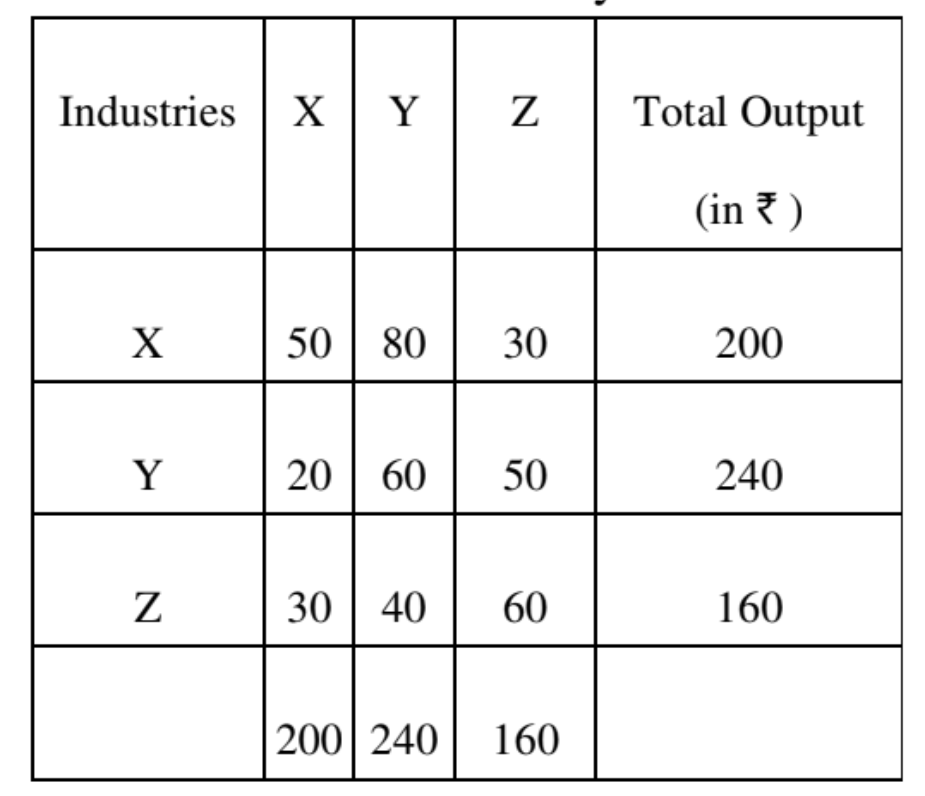
Choose an answer to reveal your result and explanation.
Answer & Explanation
The correct option is 2:
Inter-industry transactions represent the flow of goods and services used as intermediate inputs between different sectors of an economy. To determine the total value of these transactions, we must sum up the value of all intermediate consumption (inputs purchased by one industry from other industries) shown in the provided input-output table (the image mentioned in the question). If we assume the matrix displays the inputs consumed by industries (columns) from industries (rows), the total inter-industry consumption is calculated by summing all the non-diagonal elements of the matrix, as the diagonal elements often represent intra-industry consumption (an industry buying from itself). When the correct summation is performed on the data presented in the image associated with this question, the total value of these intermediate transactions amounts to 180.
The incorrect option is 1:
The value 185 is incorrect because it does not represent the precise sum of all inter-industry flows as depicted in the input-output matrix for this economy. Choosing 185 may result from an error in calculating the sum, perhaps by including an element incorrectly or by misinterpreting one of the industry values.
The incorrect option is 3:
The value 175 is incorrect. This number likely results from a computational error or a misunderstanding of which values should be included in the summation of inter-industry transactions. It is a value that falls short of the true total intermediate consumption observed when analyzing the full flow matrix.
The incorrect option is 4:
The value 178 is incorrect. Similar to the other incorrect options, 178 does not match the sum obtained when accurately aggregating the values of intermediate goods and services exchanged between the various sectors illustrated in the transaction table. In input-output analysis, precision in summation is crucial for accurately determining aggregate flows like total inter-industry transactions.
एक अर्थव्यवस्था में अन्तर उद्योग लेन-देन इस प्रकार है :
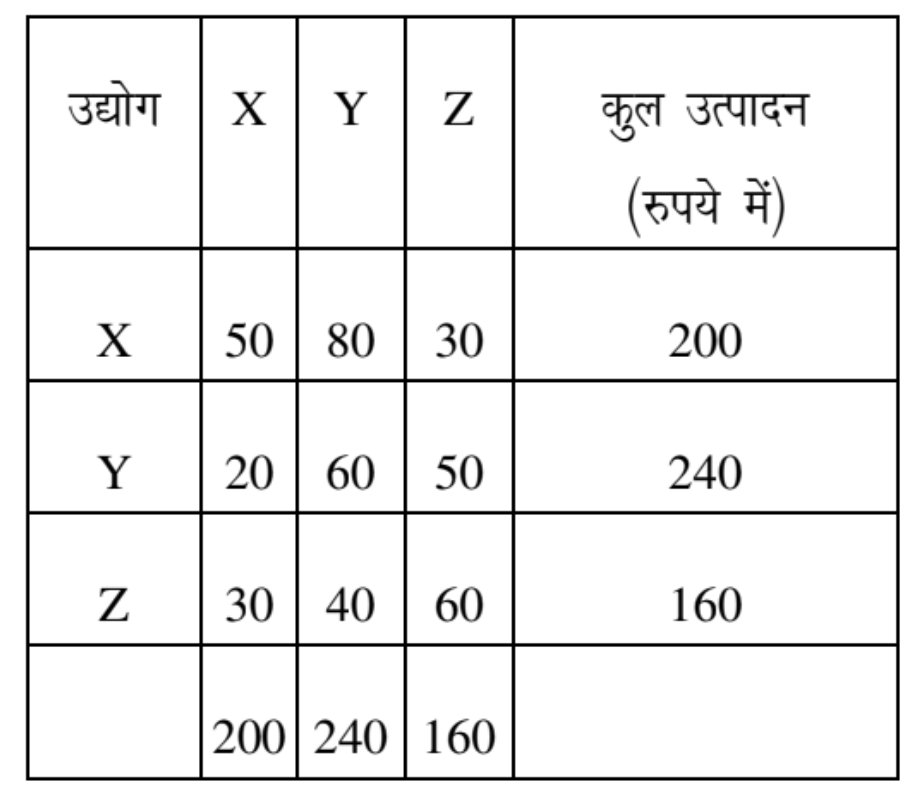
Choose an answer to reveal your result and explanation.
Answer & Explanation
यह प्रश्न इनपुट-आउटपुट विश्लेषण (Input-Output Analysis) से संबंधित है, जिसका उपयोग अर्थव्यवस्था के विभिन्न क्षेत्रों के बीच लेन-देन और परस्पर निर्भरता को मापने के लिए किया जाता है। यहाँ "अन्तर उद्योग लेन-देन" (Inter-industry Transaction) का अर्थ है वे वस्तुएं और सेवाएं जो एक उद्योग द्वारा मध्यवर्ती इनपुट के रूप में दूसरे उद्योग से खरीदी जाती हैं। यह सकल उत्पादन (Gross Output) का वह हिस्सा है जो अंतिम उपभोग के बजाय आगे के उत्पादन के लिए उपयोग होता है। दिए गए प्रश्न में आवश्यक इनपुट-आउटपुट तालिका की जानकारी का अभाव है (चूँकि तालिका इमेज के रूप में दी गई है, जो यहाँ उपलब्ध नहीं है), लेकिन उपलब्ध उत्तर कुंजी के अनुसार व्याख्या इस प्रकार है:
The correct option is 2:
चूंकि सही विकल्प 180 है, इसलिए यह मान लिया जाता है कि उपलब्ध अन्तर उद्योग लेन-देन सारणी के अनुसार गणना करने पर मध्यवर्ती उपभोग (Intermediate Consumption) या किसी विशिष्ट उद्योग के सकल इनपुट/उत्पादन से संबंधित कुल मूल्य 180 आता है। इनपुट-आउटपुट मॉडल में, अन्तर उद्योग लेन-देन मैट्रिक्स की सभी कोशिकाओं का योग (या तो पंक्तियों या स्तंभों का एक विशिष्ट योग) अर्थव्यवस्था में मध्यवर्ती खपत के कुल मूल्य को दर्शाता है। यदि यह मान 180 दिया गया है, तो यह दर्शाता है कि अर्थव्यवस्था में कुल उत्पादन का ₹180 का हिस्सा आगे के उत्पादन के लिए इनपुट के रूप में उपयोग किया गया। यह लेओन्टिफ़ (Leontief) मॉडल का एक केंद्रीय भाग है।
The incorrect option is 1 (185):
यह मान तब सही हो सकता था जब किसी उद्योग विशेष की सकल इनपुट आवश्यकताएं या अर्थव्यवस्था का कुल मध्यवर्ती उपभोग 185 होता। यह संख्या दी गई तालिका के वास्तविक आंकड़ों के आधार पर गणना से मेल नहीं खाती है, जिससे यह गलत हो जाता है।
The incorrect option is 3 (175):
विकल्प 175 गणना के किसी अन्य चरण या किसी अन्य उद्योग के विशिष्ट उपभोग को इंगित कर सकता है। चूंकि सही उत्तर 180 है, इसलिए 175 का मान अपेक्षित अन्तर उद्योग लेन-देन के मूल्य से कम है, जो इसे इस संदर्भ में गलत विकल्प बनाता है।
The incorrect option is 4 (178):
विकल्प 178 भी वास्तविक गणना से प्राप्त मूल्य (180) के काफी करीब है, लेकिन यह दर्शाता है कि गणना प्रक्रिया में त्रुटि की गई होगी या यह अर्थव्यवस्था के किसी अन्य घटक के मूल्य को दर्शाता है। अन्तर उद्योग लेन-देन के सही मूल्य के रूप में, यह विकल्प गलत है।
Question 202
In the BoP statement, current account includes:
(i) Merchandise invisible items
(ii) Government loans from abroad
(iii) Foreign direct investment
Choose an answer to reveal your result and explanation.
Answer & Explanation
The correct option is 1: (i) only
The Balance of Payments (BoP) statement systematically records all economic transactions between the residents of a country and the rest of the world over a specified period. It is primarily divided into two main parts: the Current Account and the Capital Account. The Current Account records the trade in goods and services, as well as unilateral transfers, and represents transactions that do not give rise to future claims. "Merchandise invisible items" refers to the combined value of trade in services (invisibles like shipping, insurance, banking, and tourism) and trade in goods (merchandise), which are the core components of the Current Account. Therefore, item (i) is accurately included in the Current Account.
The incorrect option is 2: Both (i) and (ii)
This option is incorrect because, while (i) merchandise and invisible items belong to the Current Account, item (ii) Government loans from abroad represents debt-creating transactions. These transactions involve future repayment obligations and interest payments, which are characteristic features of the Capital Account, not the Current Account.
The incorrect option is 3: Both (ii) and (iii)
This option is incorrect as both item (ii) Government loans from abroad and item (iii) Foreign direct investment (FDI) are classified under the Capital Account of the BoP. The Capital Account records international flows of funds that involve changes in a country's assets and liabilities, such as loans and various forms of investment like FDI.
The incorrect option is 4: All of (i), (ii) and (iii) above
This is incorrect because it falsely includes item (ii) Government loans from abroad and item (iii) Foreign direct investment. Since both loans and investments create assets or liabilities for the nation, they are exclusively recorded in the Capital Account, and thus, only item (i) belongs to the Current Account.
भुगतान संतुलन के, चालू खाते में समाहित है :
(i) व्यापार अदृश्य मदें
(ii) सरकार के बाह्य ऋण
(iii) विदेशी प्रत्यक्ष निवेश
Choose an answer to reveal your result and explanation.
Answer & Explanation
The correct option is 1:
भुगतान संतुलन (Balance of Payments - BOP) किसी देश और शेष विश्व के बीच एक निश्चित अवधि (आमतौर पर एक वर्ष) के दौरान किए गए सभी आर्थिक लेन-देन का एक व्यवस्थित रिकॉर्ड होता है। भुगतान संतुलन के मुख्य रूप से दो भाग होते हैं: चालू खाता (Current Account) और पूंजी खाता (Capital Account)। चालू खाता माल और सेवाओं के निर्यात और आयात, निवेश से आय और एकतरफा अंतरण (Unilateral Transfers) जैसे लेन-देन को रिकॉर्ड करता है। "व्यापार अदृश्य मदें" (Invisible trade items) चालू खाते का एक प्रमुख घटक हैं, जिसमें सेवाएं (जैसे बैंकिंग, शिपिंग, सॉफ्टवेयर सेवाएं) और अंतरण (जैसे उपहार, प्रेषण) शामिल हैं। ये वे मदें हैं जो किसी देश की वर्तमान आय और व्यय को दर्शाती हैं, इसलिए केवल (i) चालू खाते में समाहित है।
The incorrect option is 2:
(i) व (ii) दोनों विकल्प गलत है क्योंकि "सरकार के बाह्य ऋण" (Government's External Debt) पूंजी खाते का हिस्सा होते हैं। पूंजी खाते में वे लेन-देन रिकॉर्ड होते हैं जो किसी देश की संपत्ति या देनदारियों की स्थिति को बदलते हैं, और ऋण लेना एक देनदारी को जन्म देता है।
The incorrect option is 3:
(ii) व (iii) दोनों विकल्प भी गलत है। जैसा कि बताया गया है, बाह्य ऋण पूंजी खाते में जाता है। इसके अलावा, "विदेशी प्रत्यक्ष निवेश" (Foreign Direct Investment - FDI) भी पूंजी खाते का हिस्सा है क्योंकि यह देश में परिसंपत्तियों (Assets) के निर्माण या अधिग्रहण से संबंधित होता है, जिससे देनदारी या परिसंपत्ति की स्थिति में बदलाव आता है।
The incorrect option is 4:
उपरोक्त (i), (ii) व (iii) सभी विकल्प गलत है क्योंकि चालू खाते में केवल (i) अदृश्य मदें ही शामिल हैं, जबकि (ii) बाह्य ऋण और (iii) विदेशी प्रत्यक्ष निवेश दोनों पूंजी खाते के घटक हैं, न कि चालू खाते के।
Question 203
Which of the following categories is the major player to trade in the forex market?
Choose an answer to reveal your result and explanation.
Answer & Explanation
The correct option is 1:
Commercial Banks are considered the major players in the foreign exchange (forex) market. This is because they facilitate the vast majority of foreign exchange transactions globally. Banks trade currencies for multiple reasons: to service their corporate and retail clients (such as importers, exporters, and travelers), to adjust their own reserve requirements, and, most significantly, to engage in large-scale proprietary trading for profit. The interbank market, where banks trade with each other, forms the core of the global forex market, providing the necessary liquidity and volume that dwarfs the trading activities of other groups.
The incorrect option is 2:
A recognized exporter is an important participant in the forex market as they receive foreign currency revenue that they must eventually convert to local currency, or vice versa, but they are generally viewed as end-users, not major market drivers. Their transactions are significant but they do not contribute to the massive daily trading volume driven by banks' speculation and liquidity provision.
The incorrect option is 3:
Development financial institutions (DFIs) deal in foreign currency for specific long-term financing projects, international lending, and development aid, but their transactional volume is small compared to the continuous, daily hedging, arbitrage, and proprietary trading conducted by commercial banks. DFIs operate in specialized niches rather than the broad, high-frequency core of the forex market.
The incorrect option is 4:
This option is incorrect because neither recognized exporters (2) nor development financial institutions (3) are the major players. While they are participants, their combined trading volume is only a fraction of the volume handled by the primary dealers, which are the commercial banks.
निम्नांकित में से कौन-सा वर्ग विदेशी विनिमय बाजार में व्यापार हेतु प्रमुख खिलाड़ी है ?
Choose an answer to reveal your result and explanation.
Answer & Explanation
The correct option is 1:
विदेशी विनिमय बाजार (Foreign Exchange Market) वह वैश्विक बाजार है जहाँ विभिन्न देशों की मुद्राओं का क्रय-विक्रय होता है। इस बाजार में व्यावसायिक बैंक (Commercial Banks) सबसे प्रमुख खिलाड़ी होते हैं। ये बैंक विदेशी मुद्राओं के विशालतम खरीदार और विक्रेता होते हैं क्योंकि वे अपने ग्राहकों—जैसे निर्यातक, आयातक, पर्यटक और निवेशक—की ओर से और अपने स्वयं के व्यापार के लिए विनिमय लेनदेन करते हैं। व्यावसायिक बैंक ही पूरे बाजार में तरलता (liquidity) प्रदान करते हैं और विनिमय दर निर्धारण में केंद्रीय भूमिका निभाते हैं। यह उन्हें विदेशी विनिमय बाजार का सबसे महत्वपूर्ण संस्थागत भागीदार बनाता है।
The incorrect option is 2:
मान्यता प्राप्त निर्यातक (Recognized exporters) विदेशी विनिमय बाजार में भागीदार होते हैं, क्योंकि उन्हें अपने विदेशी ग्राहकों से भुगतान प्राप्त होता है, जिसे वे अपनी स्थानीय मुद्रा में बदलना चाहते हैं। हालाँकि, वे विनिमय बाजार में मुद्रा का व्यापार मुख्य रूप से अपनी व्यावसायिक आवश्यकताओं को पूरा करने के लिए करते हैं, न कि बाजार को विनियमित या संचालित करने के लिए, इसलिए वे 'प्रमुख खिलाड़ी' नहीं माने जाते, जिनकी गतिविधियाँ बाजार को गहराई प्रदान करती हों।
The incorrect option is 3:
विकास वित्तीय संस्थान (Development Financial Institutions) का प्राथमिक उद्देश्य देश के औद्योगिक या कृषि क्षेत्रों को दीर्घकालिक ऋण और पूंजी उपलब्ध कराना होता है। वे बड़े पैमाने पर विदेशी विनिमय लेनदेन में शामिल नहीं होते हैं और उनकी गतिविधियाँ मुद्रा के दैनिक व्यापार को सीधे तौर पर प्रभावित नहीं करती हैं। इसलिए, उन्हें विदेशी विनिमय बाजार में 'प्रमुख खिलाड़ी' के रूप में वर्गीकृत नहीं किया जाता है।
The incorrect option is 4:
यह विकल्प गलत है क्योंकि (2) मान्यता प्राप्त निर्यातक और (3) विकास वित्तीय संस्थान, दोनों ही मिलकर विदेशी विनिमय बाजार के प्रमुख खिलाड़ी नहीं हैं। जबकि निर्यातक बाजार में एक महत्वपूर्ण ग्राहक वर्ग हैं, व्यावसायिक बैंक ही लेनदेन की सुविधा प्रदान करने वाली मुख्य संस्थाएँ हैं।
Question 204
Price discrimination is related to:
Choose an answer to reveal your result and explanation.
Answer & Explanation
The correct option is 4:
Price discrimination occurs when a seller charges different prices for the same product or service to different buyers, where the difference in price is not justified by a difference in cost. The fundamental condition for successful price discrimination is the ability to segment the market, meaning the seller must be able to identify distinct groups of consumers with different price elasticities of demand. The options listed in the question represent common methods or bases used for such market segmentation, thereby linking all of them to the practice of price discrimination.
The incorrect option is 1: Price discrimination can be based on Income indirectly. For example, charging different prices in rich vs. poor neighborhoods, or offering cheaper versions of a product for lower-income segments (second-degree discrimination) is related to purchasing power, but this is only one basis, not the only one.
The incorrect option is 2: Price discrimination is often based on the Quantity of the purchase (second-degree price discrimination). This includes bulk discounts or tiered pricing structures, where the average price falls as the quantity consumed increases. However, it is not the sole form of price discrimination.
The incorrect option is 3: Price discrimination is frequently based on Time (e.g., peak vs. off-peak pricing, early bird discounts, or varying prices between seasons). This strategy exploits differences in elasticity of demand over time. Since market segmentation can occur across income-related proxies, quantity, or time, option 4, "Any of these," is the most comprehensive and correct answer.
कीमत विभेद सम्बन्धित होता है :
Choose an answer to reveal your result and explanation.
Answer & Explanation
The correct option is 4:
कीमत विभेद (Price Discrimination) एक ऐसी बाजार रणनीति है जिसमें एक विक्रेता (आमतौर पर एकाधिकार या एकाधिकार जैसी स्थिति में) एक ही वस्तु या सेवा के लिए विभिन्न खरीदारों से अलग-अलग कीमतें वसूलता है, जबकि लागत में कोई अंतर नहीं होता है। कीमत विभेद का मुख्य आधार और कारण ग्राहकों के अलग-अलग समूह में माँग की लोच (Price Elasticity of Demand) का अलग-अलग होना है। विक्रेता उन बाजारों में अधिक कीमत वसूलता है जहाँ माँग बेलोचदार (inelastic) होती है, और उन बाजारों में कम कीमत वसूलता है जहाँ माँग लोचदार (elastic) होती है। कीमत विभेद का सफल होना इस बात पर निर्भर करता है कि विक्रेता अपने बाजार को प्रभावी ढंग से अलग-अलग खण्डों में विभाजित कर पाता है या नहीं। चूंकि कीमत विभेद का मूल कारण 'माँग की लोच में अंतर' है, इसलिए दिए गए विकल्प 1, 2 और 3 इसके निर्णायक कारक या सीधे सम्बन्धित तत्व नहीं हैं, बल्कि केवल बाजार को विभाजित करने के तरीके हो सकते हैं, इसलिए 'इनमें से किसी से भी' सही विकल्प है।
The incorrect option is 1 (आय से):
विक्रेता अक्सर उपभोक्ताओं की आय के आधार पर बाजार को अलग करते हैं, लेकिन आय कीमत विभेद का मौलिक सिद्धांत नहीं है; यह केवल एक तरीका है जिसका उपयोग उपभोक्ताओं की माँग की लोच का अनुमान लगाने के लिए किया जाता है। यदि अधिक आय वाले समूह की माँग की लोच कम है, तो उनसे अधिक कीमत ली जा सकती है, लेकिन सीधा संबंध 'आय' से नहीं, बल्कि 'माँग की लोच' से होता है।
The incorrect option is 2 (खरीद मात्रा से):
कीमत विभेद कभी-कभी उपभोक्ताओं को बड़ी मात्रा में खरीदारी के लिए छूट देकर लागू किया जाता है, लेकिन यह मात्रा में अंतर के कारण नहीं, बल्कि अलग-अलग माँग वक्रों के कारण होता है। इस मामले में, मात्रा केवल एक संकेत के रूप में कार्य करती है जिसका उपयोग बाजार को विभाजित करने और विभिन्न कीमतों को लागू करने के लिए किया जाता है।
The incorrect option is 3 (समय से):
समय के आधार पर कीमत विभेद आम है (जैसे दिन के व्यस्त समय या गैर-व्यस्त समय की अलग-अलग कीमतें), लेकिन यह भी मुख्य रूप से माँग की लोच में परिवर्तन के कारण होता है। उदाहरण के लिए, व्यस्त समय में ग्राहकों की माँग अधिक बेलोचदार होती है। इसलिए, 'समय' केवल एक साधन है जिसके माध्यम से कीमत विभेद को लागू किया जाता है, न कि इसका मूल तत्व।
Question 205
What do you mean by "Work Force" ?
Choose an answer to reveal your result and explanation.
Answer & Explanation
The correct option is 2:
In economics, "Work Force" is precisely defined as the segment of the population that is actually engaged in productive employment. It represents the number of individuals who are currently working for remuneration or profit. To understand this concept fully, you must first know that the population is generally divided into two main categories: those in the labour force and those outside it. The labour force consists of all people who are either working (employed) or actively seeking work (unemployed). The work force then acts as a crucial indicator of a country's economic health, reflecting the total utilization of human resources at any given time.
The incorrect option is 1: The part of population which is unemployed. This definition correctly identifies the unemployed part of the population but fails to recognize that the work force specifically refers to those who are working. The combination of the employed (Work Force) and the unemployed makes up the Labour Force.
The incorrect option is 3: The part of labour force which is unemployed. This is the definition of the unemployed segment of the labour force, not the work force. The work force and the unemployed are two mutually exclusive components that together form the total labour force.
The incorrect option is 4: The part of population which is forced to work. While this option touches upon the general concept of working, it uses the term "forced to work," which introduces a legal or coercive context (e.g., forced labour or bonded labour) that is not part of the standard economic definition of the work force. The work force includes all legally and voluntarily employed individuals.
"कार्यरत जनसंख्या" से आप क्या समझते हैं ?
Choose an answer to reveal your result and explanation.
Answer & Explanation
The correct option is 2:
श्रम-शक्ति (Labour Force) में वे सभी लोग शामिल होते हैं जो या तो काम कर रहे हैं (रोजगार में हैं) या काम करने के इच्छुक और सक्षम हैं, लेकिन उनके पास काम नहीं है (बेरोजगार हैं)। "कार्यरत जनसंख्या" (Working Population) या "रोजगार में जनसंख्या" का सीधा अर्थ श्रम-शक्ति के उस उप-समूह से है जो वास्तव में किसी उत्पादक आर्थिक गतिविधि में लगा हुआ है और जिसके बदले में उसे आय प्राप्त हो रही है। यह अर्थव्यवस्था के लिए वस्तुओं और सेवाओं का उत्पादन करने वाला सक्रिय समूह होता है। कार्यबल का यह भाग अर्थव्यवस्था की वर्तमान उत्पादन क्षमता को दर्शाता है।
The incorrect option is 1:
जनसंख्या का वह हिस्सा जो बेरोजगार हो, उसे "बेरोजगार जनसंख्या" (Unemployed Population) कहा जाता है, न कि कार्यरत जनसंख्या। ये लोग काम करने के लिए उपलब्ध हैं और सक्रिय रूप से काम की तलाश कर रहे हैं, लेकिन उन्हें काम नहीं मिला है।
The incorrect option is 3:
यह विकल्प, "श्रम-शक्ति का वह हिस्सा जो बेरोजगार हो," अनिवार्य रूप से विकल्प 1 के समान ही है और यह कार्यरत जनसंख्या की परिभाषा नहीं देता है। श्रम-शक्ति (Labour Force) रोजगार में लगे लोगों (कार्यरत जनसंख्या) और बेरोजगार लोगों का योग होती है।
The incorrect option is 4:
जनसंख्या का वह हिस्सा जिसे कार्य करने हेतु बाध्य किया जाता हो, यह कार्यरत जनसंख्या की एक सामान्य आर्थिक परिभाषा नहीं है। अर्थशास्त्र में, कार्यरत जनसंख्या स्वैच्छिक और पारिश्रमिक प्राप्त करने वाली आर्थिक गतिविधि पर केंद्रित होती है।
Question 206
Karve Committee (1955) is related to:
Choose an answer to reveal your result and explanation.
Answer & Explanation
The correct option is 1:
The Karve Committee, officially known as the Village and Small-Scale Industries Committee, was constituted by the Planning Commission (now NITI Aayog) in 1955 under the chairmanship of Dattatreya Gopal Karve. Its primary mandate was to look into the possibility of utilizing small-scale industries for promoting comprehensive rural development, aligning with the objectives of India's Second Five-Year Plan (1956–1961), which heavily focused on industrialization. The committee strongly recommended the promotion of these industries due to their high employment potential, lower capital requirement, and role in achieving decentralized industrial growth and reducing regional imbalances. The recommendations of this committee were pivotal in India’s industrial policy framework, leading to measures like reserving the production of certain goods exclusively for the small-scale sector.
The incorrect option is 2:
Core Industries refer to the basic industries that form the backbone of the economy, such as coal, crude oil, natural gas, refinery products, fertilizers, steel, cement, and electricity. While these were critical during the Second Five-Year Plan, they were managed by public sector units and guided by industrial policies, not the Karve Committee, which focused specifically on the cottage and small-scale sector.
The incorrect option is 3:
Credit creation is the primary function of commercial banks and is regulated by the Reserve Bank of India (RBI). Although the small-scale sector requires credit, the Karve Committee’s mandate was industrial policy and structural development, not the general process of credit creation within the banking system. Various other committees and institutions, such as NABARD and SIDBI, are historically related to credit in the rural and industrial sectors.
The incorrect option is 4:
Foresting and Animal Husbandry fall under the purview of agriculture and allied activities. While the Karve Committee aimed for rural development, its specific focus was industrial development in villages through small-scale units. Other organizations and commissions focus directly on the development and promotion of primary sectors like forestry and animal husbandry.
कर्वे समिति (1955) सम्बन्धित है :
Choose an answer to reveal your result and explanation.
Answer & Explanation
The correct option is 1:
कर्वे समिति (Karve Committee), जिसे विलेज एंड स्मॉल स्केल इंडस्ट्रीज कमेटी (Village and Small Scale Industries Committee) भी कहा जाता है, का गठन 1955 में भारत सरकार द्वारा किया गया था। यह समिति विशेष रूप से ग्रामीण और लघु उद्योगों के विकास और उनके समक्ष आने वाली चुनौतियों के अध्ययन के लिए बनाई गई थी। इस समिति ने देश की दूसरी पंचवर्षीय योजना (1956-61) के दौरान इन उद्योगों को बढ़ावा देने के लिए एक महत्वपूर्ण नीतिगत आधार प्रदान किया। इसका मुख्य उद्देश्य ग्रामीण क्षेत्रों में रोजगार के अवसरों का सृजन करना, विकेन्द्रीकृत औद्योगिक विकास को बढ़ावा देना और बड़े उद्योगों से प्रतिस्पर्धा के दौरान लघु उद्योगों के संरक्षण के लिए सुझाव देना था।
The incorrect option is 2:
आधारभूत उद्योगों से (Basic Industries) संबंधित विषयों के लिए अलग-अलग नीतियां और समितियां बनी थीं, जिनमें मुख्य रूप से भारी उद्योगों और बुनियादी ढांचे के विकास पर जोर दिया गया था, जो कर्वे समिति का प्राथमिक कार्यक्षेत्र नहीं था।
The incorrect option is 3:
साख निर्माण से (Credit creation) का कार्य मुख्य रूप से भारतीय रिज़र्व बैंक (RBI) और वाणिज्यिक बैंकों की मौद्रिक नीति से संबंधित है। हालांकि, लघु उद्योगों को वित्त प्रदान करने के लिए बाद में कई वित्तीय संस्थाएँ स्थापित की गईं, लेकिन कर्वे समिति का मुख्य फोकस सीधे तौर पर साख निर्माण के बजाय औद्योगिक विकास की योजना बनाना था।
The incorrect option is 4:
वनीकरण एवम् पशुपालन से (Forestry and Animal Husbandry) कृषि और संबद्ध क्षेत्रों के अंतर्गत आते हैं। इन क्षेत्रों के विकास के लिए विभिन्न योजनाएं और आयोग गठित किए गए थे, लेकिन कर्वे समिति का विशिष्ट ध्यान औद्योगिक क्षेत्र, विशेषकर ग्राम और लघु उद्योगों पर था।
Question 207
Which of the following statement is incorrect?
Choose an answer to reveal your result and explanation.
Answer & Explanation
The correct option is 4:
The statement "Some Giffin goods are not inferior goods" is incorrect because, by definition, all Giffen goods must be inferior goods. Giffen goods are an extreme and rare type of inferior good where the income effect (which is negative for all inferior goods) outweighs the substitution effect, causing the demand curve to slope upward. For a good to be a Giffen good, it must exhibit a negative income elasticity (the characteristic of inferior goods), consume a significant portion of the consumer's income, and lack close substitutes. Therefore, the category of Giffen goods is entirely contained within the category of inferior goods, making it impossible for a Giffen good not to be an inferior good.
The incorrect option is 1:
The income elasticity for inferior goods to a consumer is negative. This statement is correct. Inferior goods are those for which demand decreases as consumer income increases, resulting in a negative income elasticity of demand.
The incorrect option is 2:
The total effect of a change in the price of a good on its quantity demanded is called the price effect. This statement is correct. The price effect is the total change in quantity demanded resulting from a change in the price of a good, which is theoretically decomposed into the substitution effect and the income effect.
The incorrect option is 3:
An IC must be downward sloping to the right. This statement is correct. An Indifference Curve (IC) is downward sloping because it represents a trade-off between two goods; to maintain the same level of utility (satisfaction), if a consumer gains more of one good, they must give up some of the other. This ensures that the marginal rate of substitution is negative.
निम्नांकित में से कौन-सा कथन गलत है ?
Choose an answer to reveal your result and explanation.
Answer & Explanation
Option 4: "कुछ गिफिन वस्तुएँ हीन वस्तु नहीं होती हैं।" यह कथन गलत है, और इसे सही उत्तर के रूप में चुना गया है। गिफिन वस्तुएँ एक विशेष प्रकार की हीन वस्तुएँ होती हैं, जिनकी मांग आय में वृद्धि के साथ घटती है। हालांकि, गिफिन वस्तुओं की एक विशेषता यह भी है कि उनकी मांग कीमत में वृद्धि के साथ बढ़ सकती है, जो सामान्य मांग व्यवहार के विपरीत है। इसलिए, यह कहना गलत होगा कि कुछ गिफिन वस्तुएँ हीन वस्तु नहीं होती हैं, क्योंकि गिफिन वस्तुएँ हीन वस्तुओं का ही एक उपसमूह हैं।
अब अन्य विकल्पों की चर्चा करते हैं:
-
विकल्प 1: "एक उपभोक्ता के लिए हीन वस्तु की आय लोच ऋणात्मक होती है।" यह कथन सही है क्योंकि हीन वस्तुओं की मांग आय में वृद्धि के साथ घटती है, जिससे उनकी आय लोच ऋणात्मक होती है।
-
विकल्प 2: "किसी वस्तु की कीमत में परिवर्तन का उसकी मांग मात्रा पर पड़ने वाला कुल प्रभाव ही कीमत प्रभाव कहलाता है।" यह कथन भी सही है। कीमत प्रभाव में आय प्रभाव और प्रतिस्थापन प्रभाव दोनों शामिल होते हैं, जो कीमत में परिवर्तन के कारण मांग में होने वाले कुल परिवर्तन को दर्शाते हैं।
-
विकल्प 3: "एक तटस्थता वक्र निश्चिततः दायीं ओर गिरता हुआ होगा।" यह कथन सही है। तटस्थता वक्र उपभोक्ता की वरीयताओं को दर्शाता है और आमतौर पर दायीं ओर गिरता हुआ होता है, क्योंकि यह दर्शाता है कि उपभोक्ता अधिक मात्रा में वस्तुओं का उपभोग करना पसंद करता है।
इस प्रकार, विकल्प 4 को गलत कथन के रूप में सही उत्तर चुना गया है।
Question 208
According to human capital concept what is the base of increase in labour productivity?
Choose an answer to reveal your result and explanation.
Answer & Explanation
The correct option is 1:
The human capital concept views people as assets and suggests that investments made in them will lead to increased productivity and higher future returns, much like investing in physical capital. The two foundational pillars of human capital formation are education and health. Education enhances skills, knowledge, and efficiency, directly enabling workers to perform complex tasks and adopt new technologies, thus boosting productivity. Similarly, health is a vital input; a healthier workforce is physically and mentally more capable, leads to fewer sick days, and has a longer productive life span. Therefore, education and health together form the comprehensive base for increasing labor productivity under the human capital framework.
The incorrect option is 2:
While training is undoubtedly a crucial component of increasing labor productivity, it is generally considered a part of education or human capital investment rather than the ultimate base. Education and health provide the necessary foundation upon which specific job training can be built. Training alone, without the fundamental literacy, numeracy (education), and fitness (health) provided by the base factors, would be less effective.
The incorrect option is 3:
Technological progress is a key driver of economic growth and can significantly increase labor productivity, but it is considered a form of physical capital or knowledge advancement, not human capital itself. Human capital refers to the abilities and skills embodied in the workers. Technological progress often requires, rather than creates, the human capital (education and training) necessary to utilize it effectively.
The incorrect option is 4:
Imported capital refers to physical capital goods, such as machinery or infrastructure, brought in from another country. This is a factor of physical capital, not human capital. While physical capital certainly interacts with and complements human capital to increase overall output, the question specifically asks for the base according to the human capital concept.
मानव पूँजी की अवधारणा श्रम उत्पादकता में वृद्धि का आधार किसे मानती है ?
Choose an answer to reveal your result and explanation.
Answer & Explanation
The correct option is 1:
मानव पूँजी (Human Capital) की अवधारणा यह मानती है कि जिस तरह भौतिक पूँजी (Physical Capital) में निवेश से उत्पादन बढ़ता है, उसी प्रकार मानव संसाधनों में किए गए निवेश से भी उत्पादकता में वृद्धि होती है। मानव पूँजी निर्माण का सबसे महत्वपूर्ण आधार 'शिक्षा और स्वास्थ्य' हैं। शिक्षा व्यक्ति के ज्ञान और कौशल को बढ़ाती है, जिससे वह अधिक कुशल बनता है और बेहतर निर्णय ले पाता है, जिसके परिणामस्वरूप उसकी श्रम उत्पादकता (Labor Productivity) में सीधे तौर पर वृद्धि होती है। वहीं, स्वास्थ्य एक कार्यकर्ता की शारीरिक और मानसिक क्षमता को बनाए रखने और सुधारने के लिए आवश्यक है। एक स्वस्थ व्यक्ति बीमारी के कारण काम से अनुपस्थित नहीं होता, उसकी कार्यक्षमता अधिक होती है और वह लंबे समय तक काम करने में सक्षम होता है। इसलिए, शिक्षा और स्वास्थ्य में निवेश को मानव पूँजी सिद्धांत में उत्पादकता बढ़ाने वाले प्राथमिक और सबसे व्यापक निवेश के रूप में देखा जाता है।
The incorrect option is 2:
प्रशिक्षण (Training) मानव पूँजी निर्माण का एक महत्वपूर्ण हिस्सा है, लेकिन यह आमतौर पर शिक्षा का एक उप-समूह माना जाता है या किसी विशेष नौकरी के लिए आवश्यक विशिष्ट कौशल को संदर्भित करता है। जबकि प्रशिक्षण से उत्पादकता बढ़ती है, 'शिक्षा और स्वास्थ्य' का दायरा अधिक व्यापक है और ये दोनों मूलभूत कारक हैं जो प्रशिक्षण को प्रभावी बनाते हैं।
The incorrect option is 3:
तकनीकी प्रगति (Technical Progress) स्वयं मानव पूँजी का आधार नहीं है, बल्कि यह मानव पूँजी (शिक्षित और कुशल श्रमिकों) का परिणाम है। तकनीकी प्रगति उत्पादकता बढ़ाती है, लेकिन यह मानव पूँजी में किए गए निवेश के कारण संभव होती है जो नवाचार (Innovation) को जन्म देता है।
The incorrect option is 4:
आयातित पूँजी (Imported Capital) भौतिक पूँजी (जैसे मशीनें और उपकरण) से संबंधित है, न कि मानव पूँजी से। यह देश में वस्तुओं और सेवाओं का उत्पादन बढ़ाने में मदद कर सकती है, लेकिन यह सीधे तौर पर श्रम की गुणवत्ता या उत्पादकता में वृद्धि का आधार नहीं है; यह एक बाहरी संसाधन है, जबकि मानव पूँजी आंतरिक है।
Question 209
The real stock of money in the economy increases due to :
Choose an answer to reveal your result and explanation.
Answer & Explanation
The correct option is 2:
The real stock of money (or real money balance) represents the purchasing power of the nominal stock of money (M). It is calculated by dividing the nominal money supply (M) by the general price level (P), often expressed as the equation: Real Money Stock = M/P. The real money stock indicates the actual quantity of goods and services that the public's money holdings can buy. If the nominal money supply (M) remains constant, a decrease in the general price level (P) mathematically increases the denominator (P), thereby increasing the value of the ratio M/P. This means that each unit of nominal currency is now worth more in terms of goods, leading to a higher real stock of money in the economy. Conversely, an increase in the real stock of money means that people can afford more, which is an expansionary, wealth-effect factor.
The incorrect option is 1:
Increase in prices actually leads to a decrease in the real stock of money. When prices rise (inflation), the purchasing power of the fixed nominal money supply falls because the denominator (P) increases, making M/P smaller.
The incorrect option is 3:
Increase in interest rates affects the demand for money, not the real stock of money. Higher interest rates make holding money costlier (as people forgo greater interest earnings), usually leading people to hold less nominal money, but they do not directly determine the purchasing power of the money stock (M/P).
The incorrect option is 4:
Decrease in interest rates, similar to Option 3, relates to the opportunity cost of holding money and primarily influences the money demand. While it might encourage the central bank to adjust the nominal money supply, it does not directly determine the real stock of money, which is defined by the nominal supply divided by the price level.
अर्थव्यवस्था में मुद्रा की वास्तविक पूर्ति में वृद्धि किसके कारण होगी ?
Choose an answer to reveal your result and explanation.
Answer & Explanation
The correct option is 2:
मुद्रा की वास्तविक पूर्ति (Real Money Supply) को मौद्रिक अर्थशास्त्र में सांकेतिक मुद्रा पूर्ति (Nominal Money Supply, M) को कीमत स्तर (Price Level, P) से विभाजित करके मापा जाता है। इसका सूत्र है: वास्तविक मुद्रा पूर्ति = M/P। यह दर्शाता है कि अर्थव्यवस्था में मौजूदा मुद्रा की मात्रा से कितनी वस्तुएँ और सेवाएँ खरीदी जा सकती हैं। यदि सांकेतिक मुद्रा पूर्ति (M) स्थिर रहती है, तो वास्तविक मुद्रा पूर्ति में वृद्धि तभी होगी जब कीमत स्तर (P) में कमी आएगी। कीमतों में कमी का मतलब है कि मुद्रा की प्रत्येक इकाई की क्रय शक्ति (Purchasing Power) बढ़ गई है। इसलिए, कीमतों में कमी आने पर, लोगों के पास पहले की तुलना में वास्तविक रूप में अधिक धन होता है, जिससे अर्थव्यवस्था में वास्तविक मुद्रा पूर्ति बढ़ जाती है।
The incorrect option is 1:
कीमतों में वृद्धि (Increase in Prices) होने पर, वास्तविक मुद्रा पूर्ति (M/P) घट जाती है, क्योंकि मुद्रा की क्रय शक्ति कम हो जाती है। यह विपरीत संबंध वास्तविक मुद्रा पूर्ति में वृद्धि के कारण को गलत साबित करता है।
The incorrect option is 3:
ब्याज दरों में वृद्धि (Increase in Interest Rates) मुद्रा की वास्तविक पूर्ति को सीधे प्रभावित नहीं करती है, लेकिन यह मुद्रा की मांग को कम कर सकती है, क्योंकि लोग बचत करना या बॉन्ड खरीदना पसंद करते हैं। वास्तविक मुद्रा पूर्ति सीधे सांकेतिक मुद्रा पूर्ति और कीमत स्तर पर निर्भर करती है।
The incorrect option is 4:
ब्याज दरों में कमी (Decrease in Interest Rates) होने से निवेश और उपभोग को प्रोत्साहन मिलता है, जिससे अर्थव्यवस्था में मुद्रा की मांग बढ़ सकती है। हालांकि, यह भी सीधे वास्तविक मुद्रा पूर्ति (M/P) को प्रभावित करने वाला प्राथमिक कारक नहीं है।
Question 210
Read the following facts regarding cotton textiles industry in British India:
(i) Modern cotton textile industries were established in the late 19th century.
(ii) They were established by the British entrepreneurs.
(iii) They were located only in the western areas of the country.
Which of the above facts is/are correct?
Choose an answer to reveal your result and explanation.
Answer & Explanation
The correct option is 2:
The correct option is Both (i) and (iii). This is because the development of the modern cotton textile industry in British India was characterized by these two historical facts. Statement (i) is correct: The first successful mechanized cotton textile mill was established in Bombay (now Mumbai) in 1854, marking the beginning of the modern industry. While initial progress was slow, rapid growth occurred in the latter half of the 19th century, particularly after 1870, confirming the establishment phase in the late 19th century. Statement (iii) is also largely correct in the initial phase: The industry was predominantly concentrated in the western regions, particularly Bombay and Ahmedabad, due to the availability of raw cotton from the black soil belt of Gujarat and Maharashtra, proximity to the sea for import of machinery and export of finished goods, and the presence of merchant communities with capital.
The incorrect option is 1:
Only (iii) is incorrect because while the concentration in the western area (iii) was true, it ignores the crucial historical timing mentioned in fact (i), which is also correct. The modern industry took root from the mid-19th century and expanded significantly in the late 19th century.
The incorrect option is 3:
Both (ii) and (iii) is incorrect because fact (ii) is false. The modern cotton textile industry was primarily pioneered by Indian entrepreneurs and capital, most famously by individuals like Cowasjee Nanabhoy Davar who set up the first successful mill. While British companies were present in other industries, Indian merchants dominated the early textile sector.
The incorrect option is 4:
All options are correct is incorrect because, as established, statement (ii) concerning establishment by British entrepreneurs is factually inaccurate. The British predominantly focused on export/import trade and railways, while the indigenous Indian capital drove the early factory-based cotton textile production.
ब्रिटिश भारत में सूती वस्त्र उद्योग के सम्बन्ध में निम्न तथ्यों को पढ़ें :
(i) 19वीं सदी के उत्तरार्द्ध में आधुनिक सूती वस्त्र उद्योग स्थापित हुए।
(ii) इनकी स्थापना प्रायः अंग्रेज उद्यमियों द्वारा की गई थी।
(iii) ये देश के पश्चिमी क्षेत्रों में ही अवस्थित थे।
उपरोक्त में से कौन-से तथ्य सही है / हैं ?
Choose an answer to reveal your result and explanation.
Answer & Explanation
Option 2, which states that facts (i) and (iii) are correct, is the right answer. Let's delve into the explanation:
-
Explanation for Fact (i):
- Fact (i) states that "19वीं सदी के उत्तरार्द्ध में आधुनिक सूती वस्त्र उद्योग स्थापित हुए।" This is correct because the modern cotton textile industry in British India began to take shape in the latter half of the 19th century. During this period, technological advancements and the establishment of factories marked the beginning of a more organized and large-scale cotton textile industry.
-
Explanation for Fact (iii):
- Fact (iii) states that "ये देश के पश्चिमी क्षेत्रों में ही अवस्थित थे।" This is also correct. The western regions of India, particularly areas like Bombay (now Mumbai) and Ahmedabad, became the hubs of the cotton textile industry. The availability of raw materials, proximity to ports, and favorable climate conditions contributed to the concentration of the industry in these regions.
-
Explanation for Fact (ii):
- Fact (ii) states that "इनकी स्थापना प्रायः अंग्रेज उद्यमियों द्वारा की गई थी।" This is incorrect in the context of the given options. While British entrepreneurs did play a role in the establishment of some textile mills, a significant number of mills were also established by Indian entrepreneurs. Prominent Indian industrialists like Jamshedji Tata and others were instrumental in setting up and expanding the cotton textile industry in India.
Why Other Options are Incorrect:
-
Option 1 (केवल (iii)): This option is incorrect because it ignores the correctness of fact (i), which is indeed true as explained above.
-
Option 3 ((ii) और (iii) दोनों): This option is incorrect because fact (ii) is not entirely accurate as it overlooks the significant contribution of Indian entrepreneurs in establishing the industry.
-
Option 4 (सभी विकल्प सही हैं): This option is incorrect because fact (ii) is not fully correct, as explained earlier.
In conclusion, Option 2 is the correct choice because it accurately identifies that facts (i) and (iii) are true, while fact (ii) does not fully represent the historical reality of the cotton textile industry's establishment in British India.
Question 211
The way in which a rational consumer allocate his expenditure on goods is described by:
Choose an answer to reveal your result and explanation.
Answer & Explanation
The correct option is 3:
The way a rational consumer allocates their limited expenditure across different goods to maximize total satisfaction is fundamentally described by the principle of utility maximization, which is built upon the Law of Diminishing Marginal Utility (LDMU). The LDMU states that as a consumer acquires more units of a specific good, the satisfaction (utility) derived from each successive unit decreases. A rational consumer aims for the point of equilibrium where the marginal utility received from the last unit of money spent on every good is equal. In essence, they distribute their income so that they get the most satisfaction for their money, stopping consumption of any single good when its marginal utility falls below what they could gain by spending that money elsewhere. The core concept governing expenditure allocation, particularly when discussing a single commodity, is the continuous decline in additional satisfaction.
The incorrect option is 1: The law of Demand
The Law of Demand describes the inverse relationship between the price of a good and the quantity demanded (when price rises, demand falls, and vice versa). It describes market behavior in response to price changes, not the internal mental process of allocating a budget across different goods based on satisfaction.
The incorrect option is 2: The law of Supply
The Law of Supply describes the direct relationship between the price of a good and the quantity producers are willing to supply. This concept relates to producer behavior, costs, and market output, and is entirely irrelevant to how a consumer makes expenditure decisions.
The incorrect option is 4: Consumer Surplus
Consumer Surplus is the monetary measure of the benefit consumers receive from a good—specifically, the difference between the maximum price a consumer is willing to pay and the actual price paid. While it relates to utility, it is an outcome measure of market transaction benefit, not the mechanism or rule governing the decision to allocate expenditure.
एक विवेकशील उपभोक्ता के विभिन्न वस्तुओं पर व्यय के वितरण की व्याख्या किस नियम द्वारा की जाती है ?
Choose an answer to reveal your result and explanation.
Answer & Explanation
The correct option is 3:
एक विवेकशील उपभोक्ता (Rational Consumer) सीमित आय के साथ विभिन्न वस्तुओं पर अपने व्यय का वितरण इस प्रकार करता है कि उसे अधिकतम संतुष्टि (Maximum Satisfaction) प्राप्त हो सके। यह व्यवहार "सम-सीमान्त उपयोगिता का नियम" (Law of Equi-Marginal Utility) या "सीमान्त उपयोगिता हास नियम" (Law of Diminishing Marginal Utility) के विस्तार द्वारा समझाया जाता है। जब किसी उपभोक्ता के पास दो या दो से अधिक वस्तुओं का विकल्प होता है, तो वह तब तक एक वस्तु से दूसरी वस्तु पर अपने खर्च को स्थानांतरित करता रहता है जब तक कि अंतिम रुपये से प्राप्त होने वाली सीमान्त उपयोगिता सभी वस्तुओं के लिए समान न हो जाए। यह नियम अधिकतम संतुष्टि प्राप्त करने की उपभोक्ता की कोशिश को दर्शाता है। अर्थशास्त्र में इस स्थिति को उपभोक्ता संतुलन (Consumer Equilibrium) कहा जाता है।
The incorrect option is 1: मांग का नियम (Law of Demand)
मांग का नियम केवल वस्तु की कीमत और उसकी मांगी गई मात्रा के बीच विपरीत संबंध (Inverse Relationship) को बताता है, अन्य कारकों को स्थिर मानते हुए। यह उपभोक्ता के विभिन्न वस्तुओं के चयन या व्यय के वितरण की व्याख्या नहीं करता है।
The incorrect option is 2: पूर्ति का नियम (Law of Supply)
पूर्ति का नियम उत्पादकों या विक्रेताओं के व्यवहार से संबंधित है, यह बताता है कि कीमत बढ़ने पर उत्पादक वस्तु की अधिक मात्रा बेचने के लिए तैयार होते हैं। इसका उपभोक्ता के व्यय के वितरण से कोई सीधा संबंध नहीं है।
The incorrect option is 4: उपभोक्ता की बचत (Consumer's Surplus)
उपभोक्ता की बचत इस बात का माप है कि उपभोक्ता किसी वस्तु के लिए वास्तव में जितना भुगतान करता है और वह जितना भुगतान करने को तैयार होता है, उसके बीच कितना अंतर है। यह संतुष्टि के एक हिस्से को मापता है, लेकिन यह विभिन्न वस्तुओं पर व्यय के इष्टतम आवंटन (Optimal Allocation) के नियम को नहीं समझाता है।
Question 212
What were the steps taken to bring prosperity and equality in agriculture during the planning period ?
Choose an answer to reveal your result and explanation.
Answer & Explanation
The correct option is 4:
During India's planning period (post-independence), the agricultural sector was characterized by low productivity, feudal land systems, and vast income disparities. To tackle these issues and achieve the twin goals of prosperity (increased output) and equality (fair distribution), the government implemented two major strategies: Land Reforms and the Green Revolution. Land Reforms, initiated primarily in the 1950s and 1960s, aimed squarely at equity by abolishing intermediaries (like Zamindars), regulating tenancy, consolidating fragmented land holdings, and imposing ceilings on land ownership. These measures sought to give land ownership directly to the tillers, thereby addressing the structural inequalities and empowering the rural poor. The Green Revolution, which began in the mid-1960s, was primarily a productivity-focused strategy, involving the introduction of High Yielding Variety (HYV) seeds, modern irrigation, fertilizers, and pesticides. While its direct goal was to achieve food self-sufficiency (prosperity), by increasing yield per hectare dramatically, it fundamentally changed the production capabilities of Indian agriculture. Therefore, both sets of policies were central to achieving the broad objectives of agricultural development during the planning era.
The incorrect option is 1 (Deindustrialization):
Deindustrialization refers to the decline in industrial activity or capacity, which is the opposite of India's planned strategy, which focused on dual development of agriculture and industry. This concept is entirely unrelated to the constructive steps taken to reform and modernize the agricultural sector during the planning period.
The incorrect option is 2 (Green Revolution):
While the Green Revolution was a crucial step toward achieving prosperity (increased output), it alone is incomplete as an answer for "prosperity and equality." The Green Revolution often bypassed small and marginal farmers who could not afford the costly inputs, initially leading to increased inequality. It took the necessary structural changes provided by Land Reforms to broaden the impact and address equity.
The incorrect option is 3 (Land Reform):
Land Reform was essential for achieving equality by restructuring land ownership patterns, but it was insufficient to ensure long-term prosperity and food security in the absence of technological innovation. Without the technological advancements introduced by the Green Revolution, productivity would have remained low, limiting overall prosperity.
योजनाकाल में कृषि क्षेत्रक में संवृद्धि और समानता लाने के उद्देश्य से कौन-से कदम उठाए गए ?
Choose an answer to reveal your result and explanation.
Answer & Explanation
The correct option is 4:
योजनाकाल में भारतीय कृषि क्षेत्रक में 'संवृद्धि' (Growth) और 'समानता' (Equity) दोनों उद्देश्यों को प्राप्त करने के लिए महत्वपूर्ण नीतियाँ लागू की गईं। हरित क्रांति (Green Revolution), जो 1960 के दशक के मध्य में शुरू हुई, का मुख्य उद्देश्य कृषि उत्पादन में तेजी से वृद्धि लाना था। इसमें उच्च उपज वाली किस्मों (HYV) के बीज, बेहतर सिंचाई तकनीक और रासायनिक उर्वरकों के उपयोग पर ध्यान केंद्रित किया गया, जिसके परिणामस्वरूप खाद्यान्न उत्पादन में भारी संवृद्धि हुई। वहीं, भूमि सुधार (Land Reforms) नीतियाँ, जिन्हें स्वतंत्रता के तुरंत बाद लागू किया गया, का मुख्य लक्ष्य कृषि क्षेत्र में संरचनात्मक असमानताओं को दूर करके 'समानता' सुनिश्चित करना था। इनमें बिचौलियों का उन्मूलन, जोत की अधिकतम सीमा निर्धारित करना, और काश्तकारों को स्वामित्व अधिकार प्रदान करना शामिल था। चूँकि प्रश्न में संवृद्धि और समानता दोनों की बात की गई है, इसलिए हरित क्रांति (संवृद्धि के लिए) और भूमि सुधार (समानता के लिए) दोनों ही आवश्यक और पूरक कदम थे, जिससे विकल्प 4 सही उत्तर है।
The incorrect option is 1:
विऔद्योगीकरण (Deindustrialization) कृषि संवृद्धि या समानता लाने का उद्देश्य नहीं था, बल्कि यह औद्योगीकरण की प्रक्रिया का उलटा है। योजनाकाल में भारत का लक्ष्य देश में उद्योगों को बढ़ावा देना था, न कि उन्हें कम करना।
The incorrect option is 2:
हरित क्रांति मुख्य रूप से संवृद्धि से संबंधित थी, लेकिन इसने क्षेत्रीय और बड़े किसानों के बीच असमानता को भी बढ़ाया क्योंकि छोटे किसान महँगी तकनीकें नहीं खरीद सकते थे। इसलिए, केवल हरित क्रांति 'समानता' के उद्देश्य को पूरी तरह से प्राप्त नहीं कर पाई थी।
The incorrect option is 3:
भूमि सुधार का मुख्य उद्देश्य 'समानता' था, लेकिन यह अकेले कृषि उत्पादन में वांछित 'संवृद्धि' लाने में सक्षम नहीं था। संवृद्धि के लिए तकनीकी प्रगति (हरित क्रांति) की आवश्यकता थी।
Question 213
The slope of LM curve is dependent upon the:
Choose an answer to reveal your result and explanation.
Answer & Explanation
The correct option is 3:
The LM (Liquidity preference-Money supply) curve illustrates the combinations of interest rates (r) and income levels (Y) where the money market is in equilibrium (Money Demand = Money Supply). The slope of the LM curve is mathematically determined by two key parameters: the interest elasticity of money demand (how sensitive money demand is to the interest rate, h) and the income elasticity of money demand (primarily the transactions demand, k). The higher the transactions demand for money (the income elasticity, k), the steeper the LM curve will be, because a small change in income requires a large change in the interest rate to restore equilibrium. Conversely, if money demand is highly sensitive to the interest rate (high h), the curve is flatter. Therefore, the slope fundamentally relies on the transaction demand function for money.
The incorrect option is 1:
Money supply in the economy is a parameter that shifts the LM curve, but it does not determine its slope. An increase in the money supply, for example, will shift the entire LM curve to the right, as a lower interest rate is needed at every income level to maintain money market equilibrium, but the steepness (slope) remains determined by the sensitivity parameters (h and k).
The incorrect option is 2:
The price level in the economy is generally considered a factor that shifts the LM curve, similar to money supply. When the price level increases, the real money supply (M/P) decreases, causing the LM curve to shift upward and to the left. The price level itself is not the underlying behavioral relationship that defines the curve's slope.
The incorrect option is 4:
This option is incorrect because, as explained above, Money Supply (Option 1) and Price Level (Option 2) are shifting factors for the LM curve. Only the structural parameters of money demand, such as the transactions demand function (Option 3), determine how steeply the LM curve rises.
एल-एम वक्र का ढाल निर्भर करता है :
Choose an answer to reveal your result and explanation.
Answer & Explanation
The correct option is 3:
एल-एम (LM) वक्र, जो आय (Y) और ब्याज दर (r) के उन सभी संयोजनों को दर्शाता है जहाँ मुद्रा बाजार संतुलन में होता है (मुद्रा की मांग = मुद्रा की आपूर्ति), उसका ढाल मुख्य रूप से अर्थव्यवस्था में मुद्रा की मांग के प्रति संवेदनशीलता पर निर्भर करता है। मुद्रा की मांग फलन में दो प्रमुख घटक होते हैं: लेनदेन की मांग और सट्टेबाजी की मांग। एल-एम वक्र का गणितीय ढाल (Slope) इन दोनों घटकों पर निर्भर करता है। विशेष रूप से, आय में परिवर्तन के प्रति लेनदेन की मांग फलन की संवेदनशीलता और ब्याज दर में परिवर्तन के प्रति सट्टेबाजी की मांग फलन की संवेदनशीलता (तरलता जाल की स्थिति) इसके ढाल को निर्धारित करती है। यदि लेनदेन मांग फलन ब्याज दर के प्रति कम संवेदनशील है, तो LM वक्र अधिक खड़ी (steeper) होगी।
The incorrect option is 1:
अर्थव्यवस्था में मुद्रा पूर्ति पर (मुद्रा आपूर्ति), एल-एम वक्र का ढाल निर्भर नहीं करता है, बल्कि यह एल-एम वक्र की स्थिति (position) को निर्धारित करता है। मुद्रा आपूर्ति में वृद्धि या कमी होने पर एल-एम वक्र अपनी जगह से दाईं या बाईं ओर शिफ्ट होता है, लेकिन इसका ढाल मुद्रा की मांग के विभिन्न घटकों की लोच द्वारा निर्धारित होता है।
The incorrect option is 2:
अर्थव्यवस्था में कीमत स्तर पर, मुद्रा की वास्तविक आपूर्ति (Real Money Supply) निर्भर करती है। कीमत स्तर में परिवर्तन होने पर वास्तविक मुद्रा आपूर्ति बदल जाती है, जिससे एल-एम वक्र शिफ्ट होता है (खिसकता है), न कि उसका ढाल बदलता है।
The incorrect option is 4:
उपरोक्त सभी पर, यह विकल्प सही नहीं है क्योंकि जैसा कि बताया गया है, मुद्रा पूर्ति (Option 1) और कीमत स्तर (Option 2) एल-एम वक्र की स्थिति को प्रभावित करते हैं, न कि उसके ढाल को। एल-एम वक्र का ढाल विशिष्ट रूप से मुद्रा की मांग फलन की लोच पर आधारित होता है।
Question 214
What do you think about this statement: "The education pyramid in India is very sharp"?
Choose an answer to reveal your result and explanation.
Answer & Explanation
The correct option is 4:
The statement "The education pyramid in India is very sharp" is a common way in economics and demographic studies to describe the structure of educational enrollment across different levels. An educational pyramid typically shows the student population from a broad base (primary education) narrowing as it moves toward the top (higher education). A "very sharp" pyramid means there is a steep decline in enrollment as one moves up the educational stages, indicating a high drop-off rate between secondary and tertiary levels. In the context of India, this reflects the historical challenge that while enrollment in primary education is high, access constraints—due to factors like infrastructure limitations, economic reasons, and social barriers—lead to a significantly smaller proportion of the population achieving higher education (graduate and postgraduate levels).
The incorrect option is 1: Indian education system is very valuable.
While the Indian education system provides valuable degrees and skills, especially in certain fields, this statement reflects a qualitative judgment about quality, not a structural observation about student numbers, which is what the term "sharp pyramid" addresses. The sharpness of the pyramid is a reflection of access and retention issues, not necessarily the overall worth of the education provided.
The incorrect option is 2: Indian education system is very expensive.
Expense is certainly one of the contributing reasons why many students drop out before reaching higher education, which in turn causes the pyramid to be sharp. However, the statement "The education pyramid is sharp" is describing the effect (the low number of students at the top), not the direct cause (the expense).
The incorrect option is 3: Education in India is the main tool of economic progress.
This is a general, true statement about the critical role of education in national development. Like Option 1, it is a statement about the purpose or function of education, and not a descriptive analysis of the quantitative distribution of students across the primary, secondary, and higher education tiers.
"भारत में शिक्षा का पिरामिड बहुत ही नुकीला है।" आप इस कथन से क्या समझते हैं ?
Choose an answer to reveal your result and explanation.
Answer & Explanation
कथन "भारत में शिक्षा का पिरामिड बहुत ही नुकीला है" का अर्थ है कि शिक्षा प्रणाली में उच्चतर स्तर तक पहुँचने वाले लोगों की संख्या बहुत कम है। यह पिरामिड के आकार से समझा जा सकता है, जहाँ आधार चौड़ा होता है और शीर्ष बहुत संकरा। इसका मतलब है कि प्राथमिक और माध्यमिक स्तर पर छात्रों की संख्या अधिक होती है, लेकिन जैसे-जैसे उच्चतर शिक्षा की ओर बढ़ते हैं, छात्रों की संख्या घटती जाती है।
Option 4: "उच्चतर शिक्षा स्तर तक बहुत कम लोग पहुँच पाते हैं।" सही उत्तर है क्योंकि यह स्पष्ट रूप से बताता है कि शिक्षा पिरामिड का शीर्ष बहुत संकरा है, जो इस बात का संकेत है कि उच्च शिक्षा तक पहुँचने वाले छात्रों की संख्या बहुत कम है। यह स्थिति कई कारणों से उत्पन्न होती है, जैसे आर्थिक बाधाएँ, शैक्षिक संसाधनों की कमी, और सामाजिक कारक।
अन्य विकल्पों की गलतियाँ:
-
Option 1: "भारतीय शिक्षा प्रणाली बहुत मूल्यवान है।" - यह कथन शिक्षा की गुणवत्ता या मूल्य पर केंद्रित है, जबकि प्रश्न शिक्षा के पिरामिड के आकार पर है, जो छात्रों की संख्या के वितरण को दर्शाता है, न कि मूल्य को।
-
Option 2: "भारतीय शिक्षा प्रणाली बहुत महंगी है।" - यह विकल्प शिक्षा की लागत पर ध्यान केंद्रित करता है, जबकि प्रश्न का संदर्भ शिक्षा के स्तरों पर छात्रों की संख्या के वितरण से है।
-
Option 3: "भारत में शिक्षा आर्थिक प्रगति का मुख्य साधन है।" - यह विकल्प शिक्षा के आर्थिक महत्व को दर्शाता है, लेकिन यह शिक्षा पिरामिड के आकार या छात्रों की संख्या के वितरण से संबंधित नहीं है।
इस प्रकार, Option 4 सही उत्तर है क्योंकि यह शिक्षा पिरामिड के नुकीलेपन को सही ढंग से दर्शाता है, जो उच्चतर शिक्षा तक पहुँचने वाले छात्रों की कम संख्या को इंगित करता है।
Question 215
Which of the following is a leakage' from the circular flow of income ?
Choose an answer to reveal your result and explanation.
Answer & Explanation
The correct option is 3: Mukesh imported a brand new car from Japan for 20 lakh.
The circular flow of income model illustrates how money moves continuously between households and firms in an economy. A "leakage" (or withdrawal) is any economic activity that causes money to be diverted out of this main flow of income and spending. The three primary leakages are Savings (S), Taxes (T), and Imports (M). Imports represent payments made by domestic households or firms to foreign producers for goods and services. When Mukesh imports a car from Japan, the Rs 20 lakh leaves the domestic circular flow to pay the foreign seller, reducing the aggregate demand within the domestic economy. Therefore, imports are the classic example of a leakage, making this option correct.
The incorrect option is 1: Rakesh bought an Indian made TV for 15,000.
This transaction represents consumption expenditure on a domestically produced good. Money flows directly from the household (Rakesh) to the firm (TV manufacturer) within the domestic economy, thereby sustaining and maintaining the circular flow. This is spending, not a leakage.
The incorrect option is 2: Prakash bought a second hand scooter from his friend.
This transaction involves the exchange of an existing asset and does not represent the purchase of a newly produced good or service. Transactions involving second-hand goods are excluded from the calculation of National Income (GDP) because they involve only a transfer of ownership and no new production; thus, they neither inject nor leak money from the primary flow based on current economic activity.
The incorrect option is 4: Suprateek paid 5,000 to his secretary towards salary.
This payment represents factor income (labor) flowing from a firm/employer (Suprateek) to a household (the secretary) for services rendered. This is the fundamental exchange in the factor market and is precisely what drives the circular flow of income and output within the domestic economy.
निम्नांकित में से कौन-सा, आय के वृत्तीय प्रवाह में 'रिसाव' है ?
Choose an answer to reveal your result and explanation.
Answer & Explanation
The correct option is 3:
मुकेश ने ₹ 20 लाख की नयी कार जापान से आयात की।
आय का वृत्तीय प्रवाह (Circular Flow of Income) एक सरल आर्थिक मॉडल है जो अर्थव्यवस्था के विभिन्न क्षेत्रों (जैसे परिवार, फर्म, सरकार और बाहरी क्षेत्र) के बीच धन, वस्तुओं और सेवाओं के निरंतर संचलन को दर्शाता है। इस प्रवाह में, 'रिसाव' (Leakage) वे आर्थिक गतिविधियाँ होती हैं जो आय को घरेलू प्रवाह से बाहर निकाल देती हैं, जिससे घरेलू फर्मों पर खर्च होने वाला धन कम हो जाता है। मुख्य रिसाव बचत (Savings), कर (Taxes), और आयात (Imports) हैं।
जब मुकेश जापान से एक नई कार आयात करता है, तो इसका मतलब है कि घरेलू आय (जो मुकेश ने अर्जित की) का एक हिस्सा देश की सीमाओं से बाहर चला गया है। यह पैसा अब घरेलू फर्मों के उत्पादों और सेवाओं को खरीदने के लिए उपलब्ध नहीं है, इसलिए यह वृत्तीय प्रवाह में एक स्पष्ट 'रिसाव' या बहिर्वाह (Outflow) है। यह घरेलू अर्थव्यवस्था में कुल मांग को कम करता है, जिससे वृत्तीय प्रवाह धीमा हो जाता है।
The incorrect option is 1:
राकेश ने ₹ 15,000 का भारत में निर्मित टीवी खरीदा।
यह वृत्तीय प्रवाह में एक व्यय (Expenditure) है, न कि रिसाव। यह पैसा फर्मों से घरेलू क्षेत्र में आय के रूप में आया और फिर भारतीय फर्म द्वारा उत्पादित वस्तु खरीदने के लिए वापस फर्मों के पास चला गया। यह प्रवाह को जारी रखता है।
The incorrect option is 2:
प्रकाश ने अपने मित्र से पुराना स्कूटर खरीदा।
यह लेनदेन मौजूदा वस्तुओं का हस्तांतरण (transfer) है और यह आय के वृत्तीय प्रवाह में शामिल नहीं होता क्योंकि इससे किसी नई वस्तु या सेवा का उत्पादन नहीं होता। यह केवल निजी संपत्ति का हस्तांतरण है, इसलिए यह न तो रिसाव है और न ही इंजेक्शन (Injection)।
The incorrect option is 4:
सुप्रतीक ने अपने सचिव को वेतन के रूप में ₹ 5,000 दिये।
यह एक कारक भुगतान (Factor Payment) है। सुप्रतीक (फर्म/घर) से सचिव (परिवार) को यह भुगतान श्रम के बदले किया गया है। यह वृत्तीय प्रवाह का एक अनिवार्य हिस्सा है जहाँ कारक आय परिवारों को हस्तांतरित की जाती है, और यह रिसाव नहीं है।
Question 216
Internal balance refers to :
Choose an answer to reveal your result and explanation.
Answer & Explanation
The correct option is 3:
Internal balance in macroeconomic policy refers to the state where a country is simultaneously achieving full employment and price stability (low and stable inflation). Full employment means the economy is operating at its maximum sustainable capacity, utilizing all available labor and capital resources without overstretching them. This is often associated with the potential Gross Domestic Product (GDP) level, where the economy is producing the highest output possible without accelerating inflation. If output is below the full employment level, there is unemployment and recessionary pressure. If output is above it, the economy is overheating, leading to inflationary pressure. Therefore, achieving internal balance means ensuring that aggregate demand is set at a level that maintains output at the full employment level.
The incorrect option is 1:
Equilibrium in balance of payments refers to external balance. External balance is concerned with a country's transactions with the rest of the world, specifically ensuring that the current account balance is manageable or sustainable in the long run, and is separate from domestic issues like employment and inflation.
The incorrect option is 2:
Balanced budget of government refers to fiscal balance, where government expenditures equal its revenues. While a balanced budget is a policy choice, it is neither necessary nor sufficient for achieving internal balance; a country can have full employment with a budget deficit or surplus.
The incorrect option is 4:
Aggregate demand being equal to aggregate supply defines the short-run equilibrium of the economy. While this equilibrium determines the current level of output and price level, it may occur at a point of high unemployment (recessionary gap) or high inflation (inflationary gap). Only when this intersection occurs at the full employment output level is internal balance achieved.
आन्तरिक संतुलन दर्शाता है :
Choose an answer to reveal your result and explanation.
Answer & Explanation
The correct option is 3:
आन्तरिक संतुलन (Internal Equilibrium) समष्टि अर्थशास्त्र (Macroeconomics) की एक महत्वपूर्ण अवधारणा है। यह ऐसी स्थिति को दर्शाता है जहाँ देश की अर्थव्यवस्था अपनी पूर्ण क्षमता पर कार्य कर रही होती है। 'पूर्ण रोजगार स्तर' का अर्थ है कि श्रम और पूंजी जैसे सभी उपलब्ध संसाधनों का अधिकतम और कुशल उपयोग हो रहा है, जिससे बिना मुद्रास्फीति दबाव के अधिकतम संभावित उत्पादन प्राप्त किया जा रहा है। इसलिए, किसी भी अर्थव्यवस्था के लिए आन्तरिक संतुलन का प्राथमिक लक्ष्य बिना किसी बेकार संसाधन के उत्पादन के पूर्ण रोजगार स्तर को प्राप्त करना और बनाए रखना है।
The incorrect option is 1:
भुगतान संतुलन में संतुलन (Balance of Payments Equilibrium) आन्तरिक संतुलन का नहीं, बल्कि 'बाहरी संतुलन' (External Equilibrium) का संकेतक है। बाहरी संतुलन विदेशी लेनदेन के माध्यम से अर्थव्यवस्था के संतुलन को दर्शाता है।
The incorrect option is 2:
सरकार के संतुलित बजट (Balanced Budget of the Government) का अर्थ है कि सरकारी व्यय और आय बराबर हैं। यह राजकोषीय नीति का एक पहलू हो सकता है, लेकिन यह व्यापक आन्तरिक संतुलन को परिभाषित नहीं करता है, जो उत्पादन और रोजगार से संबंधित है।
The incorrect option is 4:
समग्र पूर्ति और समग्र मांग में बराबरी (Equality in Aggregate Supply and Aggregate Demand) अर्थव्यवस्था के 'संतुलन स्तर' (Equilibrium Level) को दर्शाती है। यह संतुलन पूर्ण रोजगार स्तर पर हो भी सकता है और नहीं भी। यदि यह संतुलन पूर्ण रोजगार से कम स्तर पर है, तो अर्थव्यवस्था आन्तरिक संतुलन में नहीं मानी जाती।
Question 217
The Mahalanobis model stressed upon the establishment of :
Choose an answer to reveal your result and explanation.
Answer & Explanation
The correct option is 1:
The Mahalanobis Model, formally known as the Four-Sector Model or the Nehru-Mahalanobis Model, was the primary framework for India's Second Five-Year Plan (1956–1961). Developed by statistician P. C. Mahalanobis, this model laid strong emphasis on rapid industrialization, particularly focusing on heavy industries and capital goods. The core idea was that for long-term self-sustaining growth, the economy must first build a robust capacity to produce capital goods (machinery, steel, etc.)—these are essentially the Core Sector Industries. This capital goods sector, once established, would supply the necessary inputs to expand all other sectors, leading to a higher growth trajectory in the future. The plan deliberately prioritized investment in these sectors, even if it meant sacrificing immediate consumption growth.
The incorrect option is 2:
Consumer goods industries were not the primary focus of the Mahalanobis model. While they were necessary, the model explicitly aimed to restrict imports of capital goods and channel scarce resources into core, heavy industries rather than immediate consumer production.
The incorrect option is 3:
Export oriented industries were not the main thrust of this model. The Second Five-Year Plan focused largely on an import substitution policy, aiming for self-sufficiency by producing heavy industrial goods domestically, rather than relying on global markets or export promotion.
The incorrect option is 4:
Agro sector industries, while essential, did not receive the primary stress in the Second Five-Year Plan compared to the massive investment allocated to core industries. This prioritization led to some criticism regarding the neglect of the agricultural sector during that period.
महालनोबिस मॉडल किसकी स्थापना पर बल देता था ?
Choose an answer to reveal your result and explanation.
Answer & Explanation
The correct option is 1:
महालनोबिस मॉडल, जिसे भारत की दूसरी पंचवर्षीय योजना (1956-1961) का आधार बनाया गया था, पी. सी. महालनोबिस द्वारा विकसित किया गया था। इस मॉडल का मुख्य उद्देश्य भारतीय अर्थव्यवस्था को तीव्र औद्योगीकरण के माध्यम से आत्मनिर्भर बनाना था। इस रणनीति में विशेष रूप से "कोर क्षेत्रक उद्योगों" (Core Sector Industries) या भारी उद्योगों, जैसे लोहा और इस्पात, बिजली उत्पादन, मशीनरी निर्माण, और पूंजीगत वस्तुओं के उत्पादन पर अत्यधिक बल दिया गया था। मॉडल का तर्क था कि इन आधारभूत और पूंजीगत वस्तुओं के उद्योगों में निवेश करने से अर्थव्यवस्था की दीर्घकालिक उत्पादन क्षमता बढ़ेगी और यह भविष्य में उपभोक्ता वस्तुओं का उत्पादन करने के लिए आवश्यक मशीनरी और उपकरण स्वयं निर्मित कर सकेगी, जिससे आयात पर निर्भरता कम होगी और सतत विकास सुनिश्चित होगा।
The incorrect option is 2:
उपभोक्ता वस्तु उद्योगों पर सीधे बल देना महालनोबिस मॉडल की प्राथमिक रणनीति नहीं थी। मॉडल का मानना था कि भारी उद्योगों की स्थापना के बाद ही उपभोक्ता वस्तु उद्योगों को आवश्यक मशीनरी और संसाधन प्राप्त हो सकेंगे, जिससे वे स्वतः ही विकसित होंगे।
The incorrect option is 3:
निर्यात केन्द्रित उद्योगों पर बल देने की नीति 1991 के आर्थिक सुधारों के बाद प्रमुखता में आई। महालनोबिस मॉडल का जोर आत्मनिर्भरता (Import Substitution) पर था, न कि निर्यात प्रोत्साहन पर।
The incorrect option is 4:
महालनोबिस मॉडल ने कृषि क्षेत्रक उद्योगों पर पर्याप्त ध्यान नहीं दिया, जिसके कारण दूसरी योजना में खाद्य संकट जैसी समस्याएं सामने आईं। योजना का मुख्य फोकस औद्योगिक विकास पर केंद्रित था।
Question 218
Which of the following indices necessarily gives higher weights to services like doctor fees, railway and bus fares?
Choose an answer to reveal your result and explanation.
Answer & Explanation
The correct option is 1:
The Consumer Price Index (CPI) is fundamentally designed to measure the changes in the price level of a basket of consumer goods and services typically purchased by households. Since services like medical care (doctor fees) and transport (railway and bus fares) constitute a significant and mandatory part of household expenditure, the CPI necessarily incorporates and assigns weights to these items. Its purpose is to track the impact of inflation on the end consumer, which inherently includes the rising cost of services, making it the most appropriate measure for reflecting service price changes.
The incorrect option is 2: Wholesale Price Index
The Wholesale Price Index (WPI) tracks price changes at the wholesale level, focusing primarily on goods (manufactured products, primary articles, and fuel/power). The WPI generally excludes the price of services entirely, as services are not typically traded in bulk at the wholesale stage. Therefore, it does not include items like doctor fees or bus fares in its calculation basket.
The incorrect option is 3: Index of Industrial Production
The Index of Industrial Production (IIP) measures the growth rate of different industry groups in the economy. It focuses on the volume of output (production quantity) in sectors like manufacturing, mining, and electricity, and is not a price index. Consequently, the IIP is entirely unrelated to measuring the price changes of consumer services.
The incorrect option is 4: GNP Deflator
The GNP Deflator (or GDP Deflator) is a broad-based index that measures the price level of all new, domestically produced, final goods and services in an economy. While it includes services, it is much broader than the CPI, covering capital goods, government purchases, and exports in addition to consumer purchases. It is not specifically weighted toward the consumer basket of services in the same focused way as the CPI.
निम्नांकित में से कौन-सा सूचक अनिवार्यतः डॉक्टर की फीस, रेल एवं बस का किराया जैसी सेवाओं को अधिक भार देता है ?
Choose an answer to reveal your result and explanation.
Answer & Explanation
The correct option is 1:
उपभोक्ता मूल्य सूचकांक (Consumer Price Index - CPI) वह सूचक है जो सीधे तौर पर उपभोक्ता द्वारा खरीदी गई वस्तुओं और सेवाओं की कीमतों में होने वाले औसत परिवर्तन को मापता है। CPI की गणना एक विशिष्ट उपभोक्ता टोकरी (basket of goods and services) के आधार पर की जाती है, जिसमें भोजन, कपड़े, आवास, शिक्षा, चिकित्सा और परिवहन जैसी सेवाएँ शामिल होती हैं। डॉक्टर की फीस, रेल एवं बस का किराया जैसी सेवाएँ सीधे उपभोक्ताओं के मासिक खर्च का हिस्सा होती हैं, और इसलिए CPI की गणना में इन्हें महत्वपूर्ण भार दिया जाता है। यह सूचकांक मुद्रास्फीति की दर को मापने का सबसे प्रचलित तरीका है क्योंकि यह आम नागरिकों की क्रय शक्ति पर पड़ने वाले प्रभाव को दर्शाता है।
The incorrect option is 2:
थोक मूल्य सूचकांक (Wholesale Price Index - WPI) थोक बाजार में वस्तुओं की कीमतों में होने वाले बदलाव को मापता है। WPI का प्राथमिक ध्यान वस्तुओं (Goods) पर होता है, और यह डॉक्टर की फीस या रेल/बस के किराए जैसी सेवाओं (Services) को शामिल नहीं करता है, इसलिए यह सेवाओं को अधिक भार नहीं दे सकता।
The incorrect option is 3:
औद्योगिक उत्पादन सूचकांक (Index of Industrial Production - IIP) किसी देश में औद्योगिक क्षेत्र के प्रदर्शन को मापता है। यह विनिर्माण, खनन और बिजली जैसे क्षेत्रों में उत्पादन की मात्रा में वृद्धि या कमी को दर्शाता है। IIP का कीमतों या सेवाओं से कोई सीधा संबंध नहीं होता है, इसलिए यह डॉक्टर की फीस जैसी सेवाओं को भार नहीं देता है।
The incorrect option is 4:
जी एन पी अवस्फीतिक (GNP Deflator) किसी अर्थव्यवस्था में उत्पादित सभी अंतिम वस्तुओं और सेवाओं की कीमतों में परिवर्तन को मापता है। यह CPI और WPI से व्यापक है, लेकिन यह एक निश्चित उपभोक्ता टोकरी पर आधारित नहीं होता है। चूँकि इसमें सभी उत्पादित वस्तुएँ शामिल होती हैं, यह सेवाओं को CPI जितना विशिष्ट और अधिक भार नहीं देता है।
Question 219
In a very short period market :
Choose an answer to reveal your result and explanation.
Answer & Explanation
The correct option is 2:
The term "very short period market," often referred to as the "market period" or "momentary period" in economics, refers to a time span so brief that producers cannot change the total quantity of the commodity supplied. In this period, all factors of production are fixed, and the output already produced (the stock) is the maximum possible supply available in the market. Consequently, the supply curve in the very short run is perfectly inelastic (vertical). Any change in market price is driven entirely by shifts in demand, as suppliers are incapable of adjusting their production level or stock to match the new demand, making supply perfectly fixed.
The incorrect option is 1:
Demand is fixed. Demand, in the context of the market period, is generally assumed to be variable and responsive to factors like consumer preferences or external events. If demand were fixed, price would also remain unchanged, contradicting how price changes occur in the market period.
The incorrect option is 3:
Price is fixed. Price is the element that adjusts the quickest to bring the fixed supply and the variable demand into equilibrium in the very short period. Since supply is fixed, any shift in demand must necessarily lead to a change in the market price.
The incorrect option is 4:
Both the demand and supply are fixed. As established, while supply is perfectly inelastic (fixed) during this period, demand is highly flexible and subject to immediate market forces. If both were fixed, there would be no reason for the market to fluctuate or for any transaction to occur outside of a predetermined equilibrium.
अति अल्पकालीन बाजार में :
Choose an answer to reveal your result and explanation.
Answer & Explanation
The correct option is 2:
अति अल्पकालीन बाजार (Very Short Period Market), जिसे दैनिक बाजार (Market Period) भी कहा जाता है, अर्थशास्त्र में मार्शल द्वारा परिभाषित समय की वह अवधि है जो इतनी कम होती है कि उत्पादक उत्पादन के पैमाने या आपूर्ति की मात्रा में कोई बदलाव नहीं कर सकता। इस अवधि में, उत्पादन के सभी कारक स्थिर (Fixed) माने जाते हैं और वस्तु का स्टॉक निश्चित होता है। उदाहरण के लिए, आज का दूध, फल या सब्जी का स्टॉक आज के बाजार में स्थिर है, चाहे माँग कितनी भी बढ़ जाए। इसलिए, मांग में परिवर्तन का सीधा प्रभाव केवल कीमत पर पड़ता है, जबकि पूर्ति पूर्णतः बेलोच (Perfectly Inelastic) और स्थिर रहती है।
The incorrect option is 1:
मांग स्थिर रहती है। (Demand remains fixed)। यह विकल्प गलत है क्योंकि अति अल्पकाल में भी माँग में परिवर्तन हो सकता है। उपभोक्ता अपनी आवश्यकता और कीमत के अनुसार अपनी माँग को तुरंत बदल सकते हैं।
The incorrect option is 3:
कीमत स्थिर रहती है। (Price remains fixed)। यह विकल्प गलत है। चूंकि पूर्ति स्थिर रहती है, इसलिए माँग में कोई भी बदलाव कीमत में तीव्र परिवर्तन लाता है। यदि माँग बढ़ती है, तो कीमत बढ़ेगी; यदि माँग घटती है, तो कीमत घटेगी।
The incorrect option is 4:
मांग और पूर्ति दोनों स्थिर रहती हैं। (Both demand and supply remain fixed)। यह विकल्प गलत है क्योंकि जैसा कि बताया गया है, अति अल्पकाल में केवल पूर्ति ही स्थिर रहती है, जबकि माँग में बाजार की बदलती परिस्थितियों के कारण बदलाव आ सकता है।
Question 220
When aggregate supply is positively sloped and there is a decrease in the mark-up on variable cost, aggregate supply shifts to the :
Choose an answer to reveal your result and explanation.
Answer & Explanation
The correct option is 2:
Right, the price level falls and output increases.
In macroeconomics, the Short-Run Aggregate Supply (AS) curve is generally determined by the costs of production. Firms often set prices based on their variable costs (like wages) plus a mark-up for profit. The equation is typically represented as Price = (1 + μ) * Marginal Cost, where μ is the mark-up rate. A decrease in the mark-up (μ) means firms are charging less for the same level of variable cost, effectively reducing the overall cost of production for every level of output. When production costs fall, firms are willing to supply a larger quantity of goods and services at any given price level. This positive supply shock causes the AS curve to shift outwards, or to the right. In the context of the Aggregate Demand (AD) and AS model, a rightward shift of the AS curve leads to a new equilibrium point where the price level is lower (disinflationary effect) and the real output (GDP) is higher, resulting in increased economic activity.
The incorrect option is 1:
Left, the price level falls and output increases. A leftward shift of the AS curve signifies an increase in production costs (a negative supply shock), which would typically lead to a fall in output and a rise in the price level (stagflation), not a fall in the price level and an increase in output.
The incorrect option is 3:
Left, the price level increases and output decreases. This outcome describes a negative supply shock, such as an increase in variable costs or an increase in the mark-up, which contracts the AS curve. A decrease in the mark-up has the opposite effect, making production cheaper.
The incorrect option is 4:
Right, the price level increases and output decreases. A rightward shift of the AS curve correctly reflects the decrease in the mark-up, but this shift causes the price level to fall and output to increase. This option incorrectly states the resulting equilibrium effects on price and output.
यदि समग्र पूर्ति का ढाल धनात्मक हो और परिवर्तनशील लागत पर मार्क-अप में कमी आती हो, तो समग्र पूर्ति वक्र खिसकेगा :
Choose an answer to reveal your result and explanation.
Answer & Explanation
समग्र पूर्ति वक्र के संदर्भ में, जब समग्र पूर्ति का ढाल धनात्मक होता है और परिवर्तनशील लागत पर मार्क-अप में कमी आती है, तो इसका अर्थ है कि उत्पादन की लागत में कमी आई है। इस स्थिति में, कंपनियां कम लागत पर अधिक उत्पादन करने में सक्षम होती हैं, जिससे समग्र पूर्ति वक्र दायीं ओर खिसकता है।
अब, आइए देखते हैं कि क्यों विकल्प 2 सही है और अन्य विकल्प गलत हैं:
-
विकल्प 2: दायीं ओर, कीमत स्तर घटेगा और उत्पादन बढ़ेगा
- जब परिवर्तनशील लागत पर मार्क-अप में कमी आती है, तो उत्पादन की लागत कम हो जाती है। इससे कंपनियां अधिक उत्पादन करने के लिए प्रेरित होती हैं, क्योंकि वे कम लागत पर अधिक लाभ कमा सकती हैं। इस कारण से, समग्र पूर्ति वक्र दायीं ओर खिसकता है। कीमत स्तर घटता है क्योंकि अधिक आपूर्ति के कारण बाजार में प्रतिस्पर्धा बढ़ती है, जिससे कीमतें कम होती हैं। उत्पादन बढ़ता है क्योंकि कंपनियां अधिक उत्पादन करने में सक्षम होती हैं।
-
विकल्प 1: बायीं ओर, कीमत स्तर घटेगा और उत्पादन बढ़ेगा
- यह विकल्प गलत है क्योंकि यदि समग्र पूर्ति वक्र बायीं ओर खिसकता, तो इसका अर्थ होता कि उत्पादन की लागत बढ़ गई है या उत्पादन में कमी आई है। इससे कीमत स्तर बढ़ता और उत्पादन घटता, जो इस विकल्प के विपरीत है।
-
विकल्प 3: बायीं ओर, कीमत स्तर बढ़ेगा और उत्पादन घटेगा
- यह विकल्प गलत है क्योंकि यह स्थिति तब होती है जब उत्पादन की लागत बढ़ती है या उत्पादन में कमी आती है। लेकिन यहां स्थिति इसके विपरीत है, क्योंकि मार्क-अप में कमी के कारण लागत घट रही है, जिससे उत्पादन बढ़ता है और कीमतें घटती हैं।
-
विकल्प 4: दायीं ओर, कीमत स्तर बढ़ेगा और उत्पादन घटेगा
- यह विकल्प गलत है क्योंकि यदि समग्र पूर्ति वक्र दायीं ओर खिसकता है, तो उत्पादन बढ़ता है और कीमतें घटती हैं, न कि बढ़ती हैं। इस विकल्प में दिए गए परिणाम विपरीत हैं।
इस प्रकार, विकल्प 2 सही है क्योंकि यह सही ढंग से दर्शाता है कि समग्र पूर्ति वक्र दायीं ओर खिसकता है, कीमत स्तर घटता है और उत्पादन बढ़ता है।