
HTET Exam Level 3 PGT
HTET exam Level 3 PGT preparation with Clear Cutoff
Verified Answers and Explanations
by Clear Cutoff
Showing 20 of 20 questions
Question 161
Which of the following species do not show disproportionation reaction?
Choose an answer to reveal your result and explanation.
Answer & Explanation
Option 1, ClO4−, is the correct answer because it does not show a disproportionation reaction. Disproportionation reactions involve a single substance being simultaneously oxidized and reduced to form two different products. For a species to undergo disproportionation, it must be in an oxidation state that allows it to be both oxidized and reduced.
-
Explanation for Option 1 (ClO4−):
- The perchlorate ion, ClO4−, has chlorine in its highest oxidation state of +7. In this state, chlorine cannot be further oxidized because it is already at its maximum oxidation state. Therefore, ClO4− cannot undergo a disproportionation reaction as it cannot be oxidized further, and reduction alone does not constitute disproportionation.
-
Explanation for Option 2 (ClO3−):
- The chlorate ion, ClO3−, has chlorine in the +5 oxidation state. It can undergo disproportionation because it can be both oxidized to ClO4− (where chlorine is in the +7 state) and reduced to ClO2− or Cl− (where chlorine is in a lower oxidation state).
-
Explanation for Option 3 (ClO2−):
- The chlorite ion, ClO2−, has chlorine in the +3 oxidation state. It can undergo disproportionation as it can be oxidized to ClO3− or ClO4− and reduced to Cl−.
-
Explanation for Option 4 (ClO−):
- The hypochlorite ion, ClO−, has chlorine in the +1 oxidation state. It can undergo disproportionation because it can be oxidized to ClO2− or ClO3− and reduced to Cl−.
In summary, ClO4− is the only species among the given options that cannot undergo a disproportionation reaction due to chlorine being in its highest oxidation state, making Option 1 the correct answer.
निम्नलिखित में से कौन-सी स्पीशीज़ असमानुपातन अभिक्रिया नहीं दिखाती ?
Choose an answer to reveal your result and explanation.
Answer & Explanation
स्पष्टीकरण:
-
विकल्प 1: ClO4−
ClO4− आयन असमानुपातन अभिक्रिया नहीं दिखाता है। असमानुपातन अभिक्रिया में, एक ही तत्व के दो अलग-अलग ऑक्सीकरण अवस्थाओं में परिवर्तन होता है। ClO4− में क्लोरीन पहले से ही अपने उच्चतम ऑक्सीकरण अवस्था (+7) में है, इसलिए यह और अधिक ऑक्सीकरण नहीं हो सकता और न ही यह कम ऑक्सीकरण अवस्था में आसानी से जा सकता है। इस कारण से, ClO4− असमानुपातन अभिक्रिया नहीं दिखाता है। -
विकल्प 2: ClO3−
ClO3− आयन असमानुपातन अभिक्रिया दिखा सकता है क्योंकि इसमें क्लोरीन +5 ऑक्सीकरण अवस्था में है और यह ऑक्सीकरण या अपचयन के लिए सक्षम है। यह असमानुपातन अभिक्रिया में भाग ले सकता है, जहां यह विभिन्न ऑक्सीकरण अवस्थाओं में जा सकता है। -
विकल्प 3: ClO2−
ClO2− आयन भी असमानुपातन अभिक्रिया दिखा सकता है। इसमें क्लोरीन +3 ऑक्सीकरण अवस्था में है, जो इसे ऑक्सीकरण और अपचयन दोनों के लिए सक्षम बनाता है। यह असमानुपातन अभिक्रिया में भाग ले सकता है। -
विकल्प 4: ClO−
ClO− आयन भी असमानुपातन अभिक्रिया दिखा सकता है। इसमें क्लोरीन +1 ऑक्सीकरण अवस्था में है, और यह ऑक्सीकरण और अपचयन दोनों के लिए सक्षम है। यह असमानुपातन अभिक्रिया में भाग ले सकता है।
इस प्रकार, ClO4− ही एकमात्र ऐसा आयन है जो असमानुपातन अभिक्रिया नहीं दिखाता है, क्योंकि इसमें क्लोरीन पहले से ही अपने उच्चतम ऑक्सीकरण अवस्था में है। यही कारण है कि विकल्प 1 सही उत्तर है।
Question 162
The wavelength of a ball of mass 100 g moving with a velocity of 10 ms−1 is:
Choose an answer to reveal your result and explanation.
Answer & Explanation
To determine the wavelength of a ball of mass 100 g moving with a velocity of (10~\text{ms}^{-1}), we use the de Broglie wavelength formula:
[
\lambda = \frac{h}{mv}
]
where:
- (\lambda) is the wavelength,
- (h) is Planck's constant ((6.626 \times 10^{-34} \text{Js})),
- (m) is the mass of the object in kilograms,
- (v) is the velocity of the object in meters per second.
First, convert the mass from grams to kilograms:
[
m = 100 , \text{g} = 0.1 , \text{kg}
]
Now, substitute the values into the de Broglie equation:
[
\lambda = \frac{6.626 \times 10^{-34} \text{Js}}{0.1 , \text{kg} \times 10 , \text{ms}^{-1}}
]
[
\lambda = \frac{6.626 \times 10^{-34}}{1} = 6.626 \times 10^{-34} , \text{m}
]
Rounding to one significant figure, the wavelength is approximately:
[
\lambda \approx 6.6 \times 10^{-34} , \text{m}
]
Thus, the correct answer is Option 1: (6.6 \times 10^{-34} , \text{m}).
Explanation for Incorrect Options:
-
Option 2: (6.6 \times 10^{-35} , \text{m}): This option is incorrect because it underestimates the wavelength by a factor of 10. The calculation clearly shows that the wavelength is (6.6 \times 10^{-34} , \text{m}), not (6.6 \times 10^{-35} , \text{m}).
-
Option 3: (6.6 \times 10^{-36} , \text{m}): This option is incorrect because it underestimates the wavelength by a factor of 100. The correct calculation yields a wavelength of (6.6 \times 10^{-34} , \text{m}).
-
Option 4: (6.6 \times 10^{-37} , \text{m}): This option is incorrect because it underestimates the wavelength by a factor of 1000. The calculation confirms that the wavelength is (6.6 \times 10^{-34} , \text{m}).
In conclusion, the correct answer is Option 1, as it accurately reflects the calculated de Broglie wavelength for the given mass and velocity.
100 g द्रव्यमान और 10 ms−1 वेग से गति कर रही गेंद की तरंगदैर्ध्य है :
Choose an answer to reveal your result and explanation.
Answer & Explanation
गेंद की तरंगदैर्ध्य को निर्धारित करने के लिए, हमें डी ब्रोगली तरंगदैर्ध्य सूत्र का उपयोग करना होगा, जो निम्नलिखित है:
[
\lambda = \frac{h}{mv}
]
जहां:
- (\lambda) = तरंगदैर्ध्य
- (h) = प्लांक का स्थिरांक ((6.626 \times 10^{-34} Js))
- (m) = द्रव्यमान (किलोग्राम में)
- (v) = वेग (मीटर प्रति सेकंड में)
गेंद का द्रव्यमान (100 g) है, जिसे किलोग्राम में बदलने पर (0.1 kg) होता है। वेग (10~ms^{-1}) है।
अब, इन मूल्यों को डी ब्रोगली तरंगदैर्ध्य सूत्र में डालते हैं:
[
\lambda = \frac{6.626 \times 10^{-34}}{0.1 \times 10}
]
[
\lambda = \frac{6.626 \times 10^{-34}}{1}
]
[
\lambda = 6.626 \times 10^{-34} m
]
इस प्रकार, गेंद की तरंगदैर्ध्य (6.6 \times 10^{-34} m) है, जो विकल्प 1 के साथ मेल खाता है।
अब, अन्य विकल्पों की गलतियों को समझते हैं:
-
(6.6 \times 10^{-35} m): यह विकल्प गलत है क्योंकि यह तरंगदैर्ध्य का एक छोटा मान है और हमारे गणना के परिणाम से मेल नहीं खाता।
-
(6.6 \times 10^{-36} m): यह विकल्प भी गलत है क्योंकि यह भी हमारे गणना के परिणाम से मेल नहीं खाता।
-
(6.6 \times 10^{-37} m): यह विकल्प भी गलत है क्योंकि यह हमारे गणना के परिणाम से काफी छोटा है।
इस प्रकार, सही उत्तर विकल्प 1 है: (6.6 \times 10^{-34} m)।
Question 163
Which of the following complex shows linkage isomerism?
Choose an answer to reveal your result and explanation.
Answer & Explanation
Linkage isomerism occurs in coordination compounds when a ligand can bind to the central metal atom through different atoms. This type of isomerism is possible when a ligand has more than one potential donor atom, allowing it to attach to the metal center in different ways.
-
Option 1: [Co(NH3)5(NO2)]Cl2
This complex exhibits linkage isomerism because the nitrite ligand (NO₂⁻) can bind to the cobalt metal center through either the nitrogen atom or one of the oxygen atoms. When the ligand binds through the nitrogen atom, it forms a nitro complex, and when it binds through an oxygen atom, it forms a nitrito complex. This ability to bind through different atoms makes linkage isomerism possible in this complex. -
Option 2: [Co(NH3)5(H2O)]Cl3
This complex does not show linkage isomerism because the water molecule (H₂O) is a monodentate ligand that can only bind through its oxygen atom. There are no alternative atoms in the water molecule that can act as donor atoms to the metal center, so linkage isomerism is not possible. -
Option 3: [Pt(NH3)2Cl2]
This complex does not exhibit linkage isomerism because the ligands present (ammonia and chloride) are monodentate and can only bind through a single atom. Ammonia binds through nitrogen, and chloride binds through chlorine. There are no alternative binding sites within these ligands to allow for linkage isomerism. -
Option 4: [Cr(H2O)6]Cl3
Similar to Option 2, this complex does not show linkage isomerism because all the ligands are water molecules, which can only bind through their oxygen atoms. There are no alternative donor atoms in the water molecules, so linkage isomerism is not possible.
In conclusion, Option 1 is the correct answer because it contains the nitrite ligand, which can bind to the metal center through different atoms, allowing for linkage isomerism. The other options do not have ligands capable of such isomerism.
निम्नलिखित में से कौन-सा संकुल बंधनी समावयवता प्रदर्शित करता है ?
Choose an answer to reveal your result and explanation.
Answer & Explanation
संकुल बंधनी समावयवता (linkage isomerism) एक प्रकार की समावयवता है जो तब होती है जब एक बहु-दात्री लिगैंड धातु आयन से विभिन्न परमाणुओं के माध्यम से जुड़ सकता है। इस प्रकार की समावयवता में, लिगैंड के विभिन्न परमाणु धातु आयन के साथ बंध बना सकते हैं, जिससे विभिन्न समावयवी संरचनाएँ उत्पन्न होती हैं।
-
विकल्प 1: [Co(NH3)5(NO2)]Cl2
यह विकल्प संकुल बंधनी समावयवता प्रदर्शित करता है क्योंकि इसमें NO2− लिगैंड है, जो एक बहु-दात्री लिगैंड है। NO2− लिगैंड दो अलग-अलग परमाणुओं के माध्यम से धातु आयन से जुड़ सकता है: नाइट्रोजन (N) के माध्यम से या ऑक्सीजन (O) के माध्यम से। इस प्रकार, यह संकुल बंधनी समावयवता का उदाहरण है। -
विकल्प 2: [Co(NH3)5(H2O)]Cl3
इस विकल्प में H2O लिगैंड है, जो केवल एक ही तरीके से धातु आयन से जुड़ सकता है, इसलिए यह संकुल बंधनी समावयवता प्रदर्शित नहीं करता है। -
विकल्प 3: [Pt(NH3)2Cl2]
इस विकल्प में कोई बहु-दात्री लिगैंड नहीं है जो विभिन्न परमाणुओं के माध्यम से धातु आयन से जुड़ सके। इसलिए, यह संकुल बंधनी समावयवता प्रदर्शित नहीं करता है। -
विकल्प 4: [Cr(H2O)6]Cl3
इस विकल्प में भी केवल H2O लिगैंड है, जो एक ही तरीके से धातु आयन से जुड़ सकता है। इसलिए, यह संकुल बंधनी समावयवता प्रदर्शित नहीं करता है।
इस प्रकार, विकल्प 1 सही उत्तर है क्योंकि यह संकुल बंधनी समावयवता प्रदर्शित करता है।
Question 164
ΔG for a spontaneous process at constant pressure and temperature is :
Choose an answer to reveal your result and explanation.
Answer & Explanation
For a spontaneous process at constant pressure and temperature, the Gibbs free energy change, denoted as ΔG, is a crucial factor in determining the spontaneity of the process. Let's explore why Option 2, ΔG<0, is the correct answer and why the other options are incorrect.
-
Explanation for Option 2 (ΔG<0):
- A process is considered spontaneous if it can occur without any external intervention. In thermodynamics, the spontaneity of a process at constant pressure and temperature is determined by the sign of the Gibbs free energy change, ΔG.
- When ΔG is negative (ΔG<0), it indicates that the process releases free energy, making it energetically favorable and spontaneous. This is because the system loses free energy, which is available to do work, and moves towards a more stable state.
- Therefore, for a process to be spontaneous under these conditions, ΔG must be less than zero, confirming that Option 2 is correct.
-
Why the other options are incorrect:
-
Option 1 (ΔG=0):
- When ΔG=0, the system is in a state of equilibrium. At equilibrium, there is no net change occurring in the system, meaning the process is neither spontaneous nor non-spontaneous. It simply remains in a balanced state. Therefore, this option does not describe a spontaneous process.
-
Option 3 (ΔG>0):
- If ΔG is positive, the process is non-spontaneous under the given conditions. This means that the process requires an input of free energy to occur, as it is not energetically favorable. Thus, a positive ΔG contradicts the definition of spontaneity, making this option incorrect.
-
Option 4 (ΔG=1):
- This option suggests a specific numerical value for ΔG, which is not relevant to the general condition for spontaneity. The spontaneity of a process is determined by the sign of ΔG, not a specific value. Therefore, this option is not applicable to the question of spontaneity.
-
In conclusion, the correct answer is Option 2 (ΔG<0), as it accurately describes the condition for a spontaneous process at constant pressure and temperature. The other options do not align with the thermodynamic criteria for spontaneity.
स्थिर दाब एवं ताप पर स्वतः प्रवर्तित प्रक्रम का ΔG है ?
Choose an answer to reveal your result and explanation.
Answer & Explanation
स्थिर दाब एवं ताप पर स्वतः प्रवर्तित प्रक्रम के लिए ΔG का मान ΔG<0 होता है। यह थर्मोडायनामिक्स के द्वितीय नियम के अनुसार है, जो बताता है कि किसी भी स्वतः प्रवर्तित प्रक्रम के लिए गिब्स मुक्त ऊर्जा परिवर्तन (गिब्स फ्री एनर्जी चेंज) नकारात्मक होना चाहिए। इसका अर्थ है कि प्रक्रम के दौरान प्रणाली की मुक्त ऊर्जा घटती है, जिससे प्रक्रम स्वतः आगे बढ़ता है।
अब हम अन्य विकल्पों पर विचार करते हैं:
-
ΔG=0: यह स्थिति तब होती है जब प्रणाली संतुलन में होती है। संतुलन की स्थिति में कोई भी प्रक्रम स्वतः नहीं होता है, क्योंकि प्रणाली की मुक्त ऊर्जा में कोई परिवर्तन नहीं होता। इसलिए, यह विकल्प स्वतः प्रवर्तित प्रक्रम के लिए सही नहीं है।
-
ΔG>0: यदि ΔG का मान सकारात्मक होता है, तो प्रक्रम स्वतः नहीं होगा। इसके लिए बाहरी ऊर्जा की आवश्यकता होगी ताकि प्रक्रम आगे बढ़ सके। इसलिए, यह विकल्प भी स्वतः प्रवर्तित प्रक्रम के लिए सही नहीं है।
-
ΔG=1: यह विकल्प थर्मोडायनामिक्स के सिद्धांतों के अनुसार सही नहीं है, क्योंकि ΔG का मान 1 होने का कोई विशेष भौतिक अर्थ नहीं है। यह विकल्प स्वतः प्रवर्तित प्रक्रम के लिए सही नहीं है।
इस प्रकार, स्थिर दाब एवं ताप पर स्वतः प्रवर्तित प्रक्रम के लिए सही उत्तर ΔG<0 है, जो विकल्प 2 है।
Question 165
The EMF of the cell Cd∣CdCl2.5H2O (saturated) || AgCl∣Ag is 0.7 Volt at 25∘C The free energy change for it, is:
Choose an answer to reveal your result and explanation.
Answer & Explanation
To determine the free energy change ((\Delta G)) for the given electrochemical cell, we use the relationship between the electromotive force (EMF) of the cell and the free energy change, given by the equation:
[
\Delta G = -nFE
]
where:
- (\Delta G) is the change in free energy,
- (n) is the number of moles of electrons transferred in the reaction,
- (F) is Faraday's constant ((96485 , \text{C/mol})),
- (E) is the EMF of the cell.
For the cell reaction involving cadmium and silver chloride, the half-reactions are:
- ( \text{Cd} \rightarrow \text{Cd}^{2+} + 2e^- )
- ( \text{AgCl} + e^- \rightarrow \text{Ag} + \text{Cl}^- )
The overall cell reaction involves the transfer of 2 moles of electrons ((n = 2)).
Given:
- EMF ((E)) = 0.7 V
Substituting the values into the equation:
[
\Delta G = -2 \times 96485 , \text{C/mol} \times 0.7 , \text{V}
]
[
\Delta G = -135079 , \text{J/mol} = -135.079 , \text{kJ/mol}
]
Rounding to three significant figures, we get (-135.1 , \text{kJ/mol}).
Thus, the free energy change for the cell is (-135.1 , \text{kJ/mol}), which corresponds to Option 4.
Explanation for Other Options:
-
Option 1: 67.55 kJ
- This option is incorrect because it suggests a positive free energy change, which is not consistent with the spontaneous nature of the cell reaction. The calculation clearly shows a negative value.
-
Option 2: -67.55 kJ
- This option is incorrect because it underestimates the magnitude of the free energy change. The calculation shows that the correct magnitude is approximately (-135.1 , \text{kJ/mol}).
-
Option 3: 135.1 kJ
- This option is incorrect because it suggests a positive free energy change, which contradicts the spontaneous nature of the cell reaction. The correct value is negative, as calculated.
In conclusion, the correct answer is Option 4, (-135.1 , \text{kJ/mol}), as it accurately reflects the calculated free energy change for the given cell reaction.
सेल का EMF Cd∣CdCl2.5H2O (संतृप्त) || AgCl | Ag 25∘C पर 0.7 Volt है, इसके लिए मुक्त ऊर्जा परिवर्तन है :
Choose an answer to reveal your result and explanation.
Answer & Explanation
सेल के EMF और मुक्त ऊर्जा परिवर्तन के बीच संबंध गिब्स मुक्त ऊर्जा समीकरण द्वारा दिया जाता है:
[
\Delta G = -nFE
]
जहां:
- (\Delta G) गिब्स मुक्त ऊर्जा परिवर्तन है,
- (n) इलेक्ट्रॉनों की संख्या है जो प्रतिक्रिया में स्थानांतरित होते हैं,
- (F) फैराडे का स्थिरांक है ((96485 , C/mol)),
- (E) सेल का EMF है।
इस प्रश्न में, (E = 0.7 , V) दिया गया है। चूंकि यह एक इलेक्ट्रोकेमिकल सेल है जिसमें (Cd) और (AgCl) शामिल हैं, (n = 2) होगा क्योंकि (Cd) से (AgCl) में इलेक्ट्रॉनों का स्थानांतरण होता है।
अब, गिब्स मुक्त ऊर्जा परिवर्तन की गणना करते हैं:
[
\Delta G = -nFE = -(2)(96485 , C/mol)(0.7 , V)
]
[
\Delta G = -135379 , J/mol
]
[
\Delta G = -135.379 , kJ/mol
]
यह मान -135.1 kJ/mol के बहुत करीब है, जो विकल्प 4 में दिया गया है। इसलिए, विकल्प 4 सही है।
अब, अन्य विकल्पों की गलतियों को समझते हैं:
- विकल्प 1: 67.55 kJ - यह सकारात्मक है, जबकि गिब्स मुक्त ऊर्जा परिवर्तन नकारात्मक होना चाहिए क्योंकि यह एक स्वाभाविक प्रतिक्रिया है।
- विकल्प 2: -67.55 kJ - यह मान गलत है क्योंकि यह सही गणना से बहुत कम है।
- विकल्प 3: 135.1 kJ - यह सकारात्मक है, जो गलत है क्योंकि गिब्स मुक्त ऊर्जा परिवर्तन नकारात्मक होना चाहिए।
इस प्रकार, विकल्प 4 सही है क्योंकि यह सही गणना के अनुसार गिब्स मुक्त ऊर्जा परिवर्तन को दर्शाता है।
Question 166
Hall-Heroult process is related with the metallurgy of which metal ?
Choose an answer to reveal your result and explanation.
Answer & Explanation
The Hall-Heroult process is specifically related to the metallurgy of aluminum (Al). This process is the primary method used for the extraction of aluminum from its ore, bauxite. Here's a detailed explanation of why Option 1 is correct and why the other options are incorrect:
-
Explanation for Option 1 (Al):
- The Hall-Heroult process is an electrolytic process used to extract aluminum from alumina (Al2O3). In this process, alumina is dissolved in molten cryolite and then subjected to electrolysis. The aluminum ions are reduced to form aluminum metal at the cathode, while oxygen is released at the anode. This method is highly efficient and is the most widely used process for aluminum production worldwide. The process was independently developed by Charles Martin Hall and Paul Héroult in 1886, which is why it bears their names.
-
Explanation for Option 2 (Zn):
- Zinc (Zn) is primarily extracted using the roasting and reduction process or through electrolysis of zinc sulfate solution. The Hall-Heroult process is not used in the extraction of zinc. Therefore, Option 2 is incorrect.
-
Explanation for Option 3 (Fe):
- Iron (Fe) is typically extracted from its ores using the blast furnace process, where iron ore is reduced by carbon in the form of coke. The Hall-Heroult process is not applicable to iron metallurgy. Thus, Option 3 is incorrect.
-
Explanation for Option 4 (Cu):
- Copper (Cu) is usually extracted from its ores through processes such as smelting and electrorefining. The Hall-Heroult process is not used in the extraction of copper. Therefore, Option 4 is incorrect.
In conclusion, the Hall-Heroult process is specifically associated with the extraction of aluminum, making Option 1 the correct answer.
हॉल-हेरॉल्ट प्रक्रम किस धातु के धातुकर्म से संबंधित है ?
Choose an answer to reveal your result and explanation.
Answer & Explanation
हॉल-हेरॉल्ट प्रक्रम एल्युमिनियम (Al) के धातुकर्म से संबंधित है। यह प्रक्रिया एल्युमिनियम के उत्पादन के लिए सबसे अधिक उपयोग की जाने वाली विधि है। इस प्रक्रिया में बॉक्साइट अयस्क से एल्युमिनियम ऑक्साइड (Al2O3) को इलेक्ट्रोलिसिस के माध्यम से शुद्ध एल्युमिनियम में परिवर्तित किया जाता है। हॉल-हेरॉल्ट प्रक्रम में एल्युमिनियम ऑक्साइड को क्रायोलाइट के साथ मिलाकर पिघलाया जाता है और फिर विद्युत धारा प्रवाहित की जाती है, जिससे एल्युमिनियम धातु कैथोड पर जमा हो जाती है।
अन्य विकल्पों की गलतियों का स्पष्टीकरण:
-
Zn (जिंक): जिंक के धातुकर्म के लिए मुख्य रूप से रोस्टिंग और रिडक्शन विधियों का उपयोग किया जाता है, जैसे कि जिंक ब्लेंड (ZnS) का कैल्सिनेशन और फिर रिडक्शन। हॉल-हेरॉल्ट प्रक्रम का जिंक के उत्पादन में कोई उपयोग नहीं है।
-
Fe (लोहा): लोहे के धातुकर्म के लिए ब्लास्ट फर्नेस प्रक्रिया का उपयोग किया जाता है, जिसमें लौह अयस्क को कोक और चूना पत्थर के साथ गर्म किया जाता है। हॉल-हेरॉल्ट प्रक्रम का लोहे के उत्पादन में कोई संबंध नहीं है।
-
Cu (तांबा): तांबे के धातुकर्म के लिए मुख्य रूप से स्मेल्टिंग और इलेक्ट्रोलिसिस का उपयोग किया जाता है। तांबे के उत्पादन में हॉल-हेरॉल्ट प्रक्रम का कोई योगदान नहीं है।
इस प्रकार, हॉल-हेरॉल्ट प्रक्रम विशेष रूप से एल्युमिनियम के धातुकर्म से संबंधित है, और यही कारण है कि विकल्प 1 सही है।
Question 167
Which of the following statement is correct for emulsion ?
Choose an answer to reveal your result and explanation.
Answer & Explanation
Option 3 is correct because emulsions can indeed be broken into their constituent parts by centrifuging. Centrifugation is a process that uses the application of centrifugal force to separate particles from a solution according to their size, shape, density, and viscosity of the medium. In the case of emulsions, which are mixtures of two immiscible liquids, centrifuging can cause the denser liquid to separate from the less dense liquid, effectively breaking the emulsion into its constituent parts.
Now, let's examine why the other options are incorrect:
-
Option 1: They can be diluted by dispersed liquid.
- This statement is incorrect because emulsions cannot be diluted by adding more of the dispersed phase. Adding more of the dispersed liquid would not dilute the emulsion; instead, it could destabilize it or change its properties, potentially leading to phase separation.
-
Option 2: They do not show Brownian movement.
- This statement is incorrect because emulsions do exhibit Brownian movement. Brownian movement refers to the random motion of particles suspended in a fluid, resulting from their collision with the fast-moving molecules in the fluid. In emulsions, the dispersed droplets are subject to Brownian motion.
-
Option 4: They do not show Tyndall effect.
- This statement is incorrect because emulsions do show the Tyndall effect. The Tyndall effect is the scattering of light by particles in a colloid or in very fine suspensions. Since emulsions are colloidal systems, they scatter light and thus exhibit the Tyndall effect.
In conclusion, Option 3 is the correct answer because it accurately describes a method by which emulsions can be separated into their constituent parts, while the other options contain inaccuracies regarding the properties and behaviors of emulsions.
निम्नलिखित में से कौन-सा कथन इमल्शन के लिए सही है ?
Choose an answer to reveal your result and explanation.
Answer & Explanation
इमल्शन के लिए सही कथन विकल्प 3 है: "उन्हें अपकेन्द्रण करके अवयवी द्रवों में तोड़ा जा सकता है।"
-
विकल्प 3 का स्पष्टीकरण:
इमल्शन एक प्रकार का कोलॉइड होता है जिसमें एक द्रव दूसरे द्रव में सूक्ष्म बूंदों के रूप में वितरित होता है। अपकेन्द्रण (centrifugation) एक ऐसी प्रक्रिया है जिसमें घूर्णन के माध्यम से मिश्रण के घटकों को उनके घनत्व के आधार पर अलग किया जाता है। इमल्शन को अपकेन्द्रण द्वारा तोड़ा जा सकता है क्योंकि यह प्रक्रिया भारी और हल्के घटकों को अलग करने में सक्षम होती है। इस प्रकार, इमल्शन के अवयवी द्रवों को अपकेन्द्रण के माध्यम से अलग किया जा सकता है। -
अन्य विकल्पों का खंडन:
-
विकल्प 1: "उन्हें परिक्षिप्त द्रव द्वारा तनु किया जा सकता है।"
इमल्शन को परिक्षिप्त द्रव द्वारा तनु करना संभव नहीं होता क्योंकि इमल्शन में पहले से ही एक द्रव दूसरे द्रव में सूक्ष्म बूंदों के रूप में होता है। इसे तनु करने से इमल्शन की स्थिरता प्रभावित हो सकती है और यह टूट सकता है। -
विकल्प 2: "यह ब्राउनी गति नहीं दर्शाते।"
इमल्शन में उपस्थित सूक्ष्म कण ब्राउनी गति दर्शाते हैं। ब्राउनी गति वह अनियमित गति है जो सूक्ष्म कणों द्वारा तरल में प्रदर्शित की जाती है। इसलिए, यह कथन गलत है। -
विकल्प 4: "यह टिन्डल प्रभाव नहीं दर्शाते।"
इमल्शन टिन्डल प्रभाव दर्शाते हैं। टिन्डल प्रभाव वह घटना है जिसमें कोलॉइडल कण प्रकाश को बिखेरते हैं, जिससे प्रकाश की किरणें दिखाई देती हैं। इसलिए, यह कथन भी गलत है।
-
इस प्रकार, विकल्प 3 सही है क्योंकि इमल्शन को अपकेन्द्रण द्वारा अवयवी द्रवों में तोड़ा जा सकता है।
Question 168
The correct order for first ionization energy among the following is :
Choose an answer to reveal your result and explanation.
Answer & Explanation
The correct order for first ionization energy among the elements given is F>N>O>C, as stated in Option 4. Let's provide a detailed explanation to justify why this order is correct and why the other options are incorrect.
-
Explanation for Option 4 (F>N>O>C):
- Fluorine (F): Fluorine has the highest first ionization energy among the elements listed. This is because it is the most electronegative element, with a strong attraction for electrons due to its small atomic size and high effective nuclear charge.
- Nitrogen (N): Nitrogen has a higher first ionization energy than oxygen. This is due to its half-filled p-orbital configuration (2p³), which is relatively stable. Removing an electron from this stable configuration requires more energy.
- Oxygen (O): Oxygen has a slightly lower first ionization energy than nitrogen. Although oxygen is more electronegative, the electron-electron repulsion in its 2p⁴ configuration makes it easier to remove an electron compared to nitrogen.
- Carbon (C): Carbon has the lowest first ionization energy among these elements. Its 2p² configuration is less stable compared to the half-filled configuration of nitrogen, making it easier to remove an electron.
-
Why the other options are incorrect:
- Option 1 (C>N>O>F): This order is incorrect because carbon cannot have a higher ionization energy than nitrogen, oxygen, or fluorine. Carbon's lower effective nuclear charge and larger atomic radius compared to these elements result in a lower ionization energy.
- Option 2 (O>N>F>C): This order incorrectly places oxygen before nitrogen and fluorine. As explained, nitrogen's half-filled p-orbital makes its ionization energy higher than oxygen's, and fluorine, being the most electronegative, should have the highest ionization energy.
- Option 3 (O>F>N>C): This order incorrectly places oxygen before fluorine and nitrogen. Fluorine should have the highest ionization energy due to its high electronegativity, and nitrogen should have a higher ionization energy than oxygen due to its stable half-filled configuration.
In conclusion, Option 4 (F>N>O>C) is the correct order for first ionization energy among the given elements, based on their electronic configurations and the factors affecting ionization energy.
निम्नलिखित में प्रथम आयनन ऊर्जा का सही क्रम है :
Choose an answer to reveal your result and explanation.
Answer & Explanation
प्रथम आयनन ऊर्जा का सही क्रम F>N>O>C है, जो विकल्प 4 में दिया गया है। इस क्रम को समझने के लिए हमें तत्वों की इलेक्ट्रॉनिक संरचना और उनके आवर्त सारणी में स्थिति को देखना होगा।
-
फ्लोरीन (F): फ्लोरीन का परमाणु क्रमांक 9 है और इसकी इलेक्ट्रॉनिक संरचना 1s22s22p5 है। फ्लोरीन में 7 वेलेंस इलेक्ट्रॉन्स होते हैं और यह एक इलेक्ट्रॉन प्राप्त करके स्थिर नोबल गैस संरचना प्राप्त कर सकता है। इसलिए, फ्लोरीन की आयनन ऊर्जा सबसे अधिक होती है क्योंकि इसे इलेक्ट्रॉन हटाने के लिए अधिक ऊर्जा की आवश्यकता होती है।
-
नाइट्रोजन (N): नाइट्रोजन का परमाणु क्रमांक 7 है और इसकी इलेक्ट्रॉनिक संरचना 1s22s22p3 है। नाइट्रोजन में आधा भरी हुई p-ऑर्बिटल होती है, जो इसे स्थिर बनाती है। इसलिए, नाइट्रोजन की आयनन ऊर्जा ऑक्सीजन से अधिक होती है।
-
ऑक्सीजन (O): ऑक्सीजन का परमाणु क्रमांक 8 है और इसकी इलेक्ट्रॉनिक संरचना 1s22s22p4 है। ऑक्सीजन में एक अतिरिक्त इलेक्ट्रॉन होता है जो इलेक्ट्रॉन-इलेक्ट्रॉन प्रतिकर्षण को बढ़ाता है, जिससे इसकी आयनन ऊर्जा नाइट्रोजन से कम हो जाती है।
-
कार्बन (C): कार्बन का परमाणु क्रमांक 6 है और इसकी इलेक्ट्रॉनिक संरचना 1s22s22p2 है। कार्बन की आयनन ऊर्जा सबसे कम होती है क्योंकि इसकी इलेक्ट्रॉनिक संरचना में कोई विशेष स्थिरता नहीं होती है।
इस प्रकार, विकल्प 4 (F>N>O>C) सही है क्योंकि यह तत्वों की आयनन ऊर्जा के सही क्रम को दर्शाता है। अन्य विकल्प गलत हैं क्योंकि वे इस क्रम का सही प्रतिनिधित्व नहीं करते हैं:
- विकल्प 1 (C>N>O>F) गलत है क्योंकि यह फ्लोरीन की आयनन ऊर्जा को सबसे कम दिखाता है।
- विकल्प 2 (O>N>F>C) गलत है क्योंकि यह ऑक्सीजन की आयनन ऊर्जा को नाइट्रोजन और फ्लोरीन से अधिक दिखाता है।
- विकल्प 3 (O>F>N>C) गलत है क्योंकि यह ऑक्सीजन की आयनन ऊर्जा को फ्लोरीन से अधिक दिखाता है।
इस प्रकार, विकल्प 4 सही है और अन्य विकल्प गलत हैं।
Question 169
For ideal gas compressibility factor Z is:
Choose an answer to reveal your result and explanation.
Answer & Explanation
The compressibility factor ( Z ) is a measure used to describe how much a real gas deviates from ideal gas behavior. For an ideal gas, the compressibility factor is defined as:
[ Z = \frac{PV}{nRT} ]
where ( P ) is the pressure, ( V ) is the volume, ( n ) is the number of moles, ( R ) is the ideal gas constant, and ( T ) is the temperature. For an ideal gas, the equation of state is perfectly described by the ideal gas law:
[ PV = nRT ]
Substituting this into the expression for ( Z ), we get:
[ Z = \frac{nRT}{nRT} = 1 ]
Therefore, for an ideal gas, the compressibility factor ( Z ) is exactly 1. This is why Option 2 is the correct answer.
Now, let's explain why the other options are incorrect:
-
Option 1 (0): A compressibility factor of 0 would imply that the product of pressure and volume is zero, which is not possible for a gas under normal conditions. This would mean either the pressure or the volume is zero, which is not feasible for a gas that occupies space and exerts pressure.
-
Option 3 (greater than 1): A compressibility factor greater than 1 indicates that the gas is less compressible than an ideal gas, often due to repulsive forces dominating at high pressures. This behavior is typical of real gases but not of an ideal gas, which by definition does not experience intermolecular forces.
-
Option 4 (less than 0): A compressibility factor less than 0 is not physically meaningful. It would imply negative pressure or volume, which is not possible for a gas. This option is not applicable to any real or ideal gas scenario.
In conclusion, the compressibility factor ( Z ) for an ideal gas is exactly 1, making Option 2 the correct choice.
आदर्श गैस का संपीड्यता कारक है :
Choose an answer to reveal your result and explanation.
Answer & Explanation
आदर्श गैस का संपीड्यता कारक (compressibility factor) 1 होता है। यह संपीड्यता कारक आदर्श गैस समीकरण ( PV = nRT ) के अनुसार निर्धारित होता है, जहाँ ( P ) दबाव है, ( V ) आयतन है, ( n ) मोल की संख्या है, ( R ) गैस स्थिरांक है, और ( T ) तापमान है। आदर्श गैस के लिए, संपीड्यता कारक ( Z ) को निम्नलिखित रूप में परिभाषित किया जाता है:
[ Z = \frac{PV}{nRT} ]
आदर्श गैस के लिए, ( PV = nRT ) होता है, इसलिए:
[ Z = \frac{nRT}{nRT} = 1 ]
इसलिए, आदर्श गैस का संपीड्यता कारक 1 होता है, जो विकल्प 2 को सही बनाता है।
अब अन्य विकल्पों की गलतियों को समझते हैं:
-
विकल्प 1 (0): यदि संपीड्यता कारक 0 होता, तो इसका अर्थ होता कि गैस का कोई आयतन नहीं है या कोई दबाव नहीं है, जो कि भौतिक रूप से संभव नहीं है। आदर्श गैस के लिए ( Z = 1 ) होता है, न कि 0।
-
विकल्प 3 (1 से अधिक): यदि संपीड्यता कारक 1 से अधिक होता, तो इसका अर्थ होता कि गैस आदर्श व्यवहार से विचलित हो रही है, जो कि आदर्श गैस के लिए सही नहीं है। आदर्श गैस के लिए ( Z = 1 ) होता है।
-
विकल्प 4 (0 से कम): संपीड्यता कारक का 0 से कम होना भौतिक रूप से असंभव है क्योंकि यह नकारात्मक आयतन या दबाव को इंगित करेगा, जो कि वास्तविकता में संभव नहीं है। आदर्श गैस के लिए ( Z = 1 ) होता है।
इस प्रकार, विकल्प 2 सही है क्योंकि आदर्श गैस का संपीड्यता कारक 1 होता है।
Question 170
How many ions are produced from the complex [Co(NH3)6]Cl2 in solution ?
Choose an answer to reveal your result and explanation.
Answer & Explanation
The complex [Co(NH3)6]Cl2 is a coordination compound consisting of a cobalt ion surrounded by six ammonia (NH₃) ligands, with two chloride ions (Cl⁻) outside the coordination sphere. When this complex is dissolved in water, it dissociates into ions.
-
Explanation for Option 3 (Correct Answer):
- The complex [Co(NH3)6]Cl2 dissociates in solution as follows:
[
[Co(NH_{3}){6}]Cl{2} \rightarrow [Co(NH_{3})_{6}]^{2+} + 2Cl^{-}
] - In this dissociation, one complex ion [Co(NH3)6]2+ and two chloride ions (Cl⁻) are produced.
- Therefore, the total number of ions produced is 1 (from the complex ion) + 2 (from the chloride ions) = 3 ions.
- This supports Option 3 as the correct answer.
- The complex [Co(NH3)6]Cl2 dissociates in solution as follows:
-
Explanation for why other options are incorrect:
- Option 1 (9 ions): This option is incorrect because the dissociation of [Co(NH3)6]Cl2 only produces 3 ions, not 9. The number 9 might be mistakenly considered if one assumes each ammonia ligand dissociates separately, which is not the case here.
- Option 2 (8 ions): This option is incorrect because, similar to Option 1, it overestimates the number of ions produced. The complex produces only 3 ions upon dissociation.
- Option 4 (2 ions): This option is incorrect because it underestimates the number of ions. It might consider only the chloride ions, ignoring the complex ion [Co(NH3)6]2+, which is also an ion in solution.
In conclusion, the correct number of ions produced from the dissociation of [Co(NH3)6]Cl2 in solution is 3, making Option 3 the correct choice.
संकुल [Co(NH3)6]Cl2 से विलयन में कितने आयन उत्पन्न होंगे ?
Choose an answer to reveal your result and explanation.
Answer & Explanation
संकुल [Co(NH3)6]Cl2 से विलयन में कितने आयन उत्पन्न होंगे, इस प्रश्न का सही उत्तर विकल्प 3 है, जो 3 आयनों का उत्पादन दर्शाता है। आइए इसे विस्तार से समझते हैं:
-
संरचना और आयनीकरण: [Co(NH3)6]Cl2 एक समन्वय यौगिक है जिसमें कोबाल्ट (Co) केंद्र में है और इसे 6 अमोनिया (NH₃) अणुओं द्वारा घेरा गया है। यह एक समन्वय परिसर है और इसका चार्ज संतुलन बनाए रखने के लिए दो क्लोराइड (Cl⁻) आयन होते हैं। जब यह यौगिक जल में घुलता है, तो यह निम्नलिखित प्रकार से आयनीकरण करता है:
[
[Co(NH_{3}){6}]Cl{2} \rightarrow [Co(NH_{3})_{6}]^{2+} + 2Cl^{-}
]
इस प्रकार, यह कुल 3 आयन उत्पन्न करता है: एक [Co(NH3)6]2+ आयन और दो Cl− आयन। -
विकल्प 3 सही क्यों है: जैसा कि ऊपर के आयनीकरण से स्पष्ट है, कुल 3 आयन उत्पन्न होते हैं। इसलिए, विकल्प 3 सही है।
-
अन्य विकल्प गलत क्यों हैं:
- विकल्प 1 (9 आयन): यह गलत है क्योंकि [Co(NH3)6]Cl2 केवल 3 आयन उत्पन्न करता है, न कि 9।
- विकल्प 2 (8 आयन): यह भी गलत है क्योंकि यौगिक केवल 3 आयन उत्पन्न करता है।
- विकल्प 4 (2 आयन): यह गलत है क्योंकि यौगिक 3 आयन उत्पन्न करता है, न कि 2।
इस प्रकार, विकल्प 3 सही है क्योंकि यह सही संख्या में आयनों का उत्पादन दर्शाता है।
Question 171
The number of angular nodes for d-orbitals are:
Choose an answer to reveal your result and explanation.
Answer & Explanation
The number of angular nodes for d-orbitals is determined by the formula for angular nodes, which is given by ( l ), where ( l ) is the azimuthal quantum number (also known as the angular momentum quantum number). For d-orbitals, the value of ( l ) is 2. Therefore, the number of angular nodes for d-orbitals is 2.
Explanation Supporting Option 3:
-
Understanding Angular Nodes:
- Angular nodes are regions in an atom where the probability of finding an electron is zero. These nodes are determined by the angular part of the wave function and are dependent on the azimuthal quantum number ( l ).
-
Azimuthal Quantum Number for d-Orbitals:
- For d-orbitals, the azimuthal quantum number ( l ) is 2. This directly indicates that there are 2 angular nodes in d-orbitals.
-
Calculation of Angular Nodes:
- The formula for calculating angular nodes is simply the value of ( l ). Since ( l = 2 ) for d-orbitals, the number of angular nodes is 2.
Explanation for Why Other Options are Incorrect:
-
Option 1 (0 Angular Nodes):
- This is incorrect because a value of 0 angular nodes would imply an ( l ) value of 0, which corresponds to s-orbitals, not d-orbitals.
-
Option 2 (1 Angular Node):
- This is incorrect because 1 angular node corresponds to an ( l ) value of 1, which is characteristic of p-orbitals, not d-orbitals.
-
Option 4 (3 Angular Nodes):
- This is incorrect because 3 angular nodes would imply an ( l ) value of 3, which corresponds to f-orbitals, not d-orbitals.
In conclusion, the correct number of angular nodes for d-orbitals is 2, which is why Option 3 is the correct answer.
d-कक्षकों के लिए कोणीय नोडों की संख्या है :
Choose an answer to reveal your result and explanation.
Answer & Explanation
d-कक्षकों के लिए कोणीय नोडों की संख्या 2 होती है, जो विकल्प 3 के रूप में सही उत्तर है। आइए इसे विस्तार से समझते हैं:
-
कोणीय नोडों की संख्या की परिभाषा: कोणीय नोड वे बिंदु होते हैं जहां इलेक्ट्रॉन की उपस्थिति की संभावना शून्य होती है। ये नोड्स कक्षकों के आकार और प्रकार पर निर्भर करते हैं।
-
d-कक्षकों की विशेषताएँ: d-कक्षकों का आकार जटिल होता है और इनमें कोणीय नोड्स होते हैं। d-कक्षकों के लिए कोणीय नोडों की संख्या को n - l - 1 के सूत्र से निकाला जा सकता है, जहां n प्रमुख क्वांटम संख्या है और l कोणीय क्वांटम संख्या है। d-कक्षकों के लिए l = 2 होता है।
-
d-कक्षकों के लिए कोणीय नोडों की गणना:
- d-कक्षकों के लिए l = 2 होता है।
- कोणीय नोडों की संख्या = l = 2।
- इसलिए, d-कक्षकों के लिए कोणीय नोडों की संख्या 2 होती है।
अब, आइए अन्य विकल्पों को गलत साबित करें:
-
विकल्प 1 (0): यदि कोणीय नोडों की संख्या 0 होती, तो यह s-कक्षकों के लिए सही होता, न कि d-कक्षकों के लिए।
-
विकल्प 2 (1): यदि कोणीय नोडों की संख्या 1 होती, तो यह p-कक्षकों के लिए सही होता, न कि d-कक्षकों के लिए।
-
विकल्प 4 (3): यदि कोणीय नोडों की संख्या 3 होती, तो यह f-कक्षकों के लिए सही होता, न कि d-कक्षकों के लिए।
इस प्रकार, विकल्प 3 (2) d-कक्षकों के लिए कोणीय नोडों की सही संख्या है।
Question 172
Which hydrocarbon on warming with mercuric sulphate and dilute sulphuric acid forms carbonyl compounds ?
Choose an answer to reveal your result and explanation.
Answer & Explanation
Option 3, "Alkyne," is the correct answer because alkynes, when treated with mercuric sulfate (HgSO₄) and dilute sulfuric acid (H₂SO₄), undergo a hydration reaction that leads to the formation of carbonyl compounds, specifically ketones or aldehydes. This reaction is known as the "oxymercuration-demercuration" process.
Explanation for Option 3 (Alkyne):
-
Reaction Mechanism:
- Alkynes, which are hydrocarbons with at least one carbon-carbon triple bond, react with mercuric sulfate and dilute sulfuric acid in an aqueous medium.
- The reaction involves the addition of water (H₂O) across the triple bond.
- Initially, an enol is formed, which is an unstable intermediate.
- The enol rapidly tautomerizes to form a more stable carbonyl compound, typically a ketone. For terminal alkynes, the product can be an aldehyde.
-
Example:
- Consider acetylene (ethyne, C₂H₂) as an example of an alkyne. When it reacts with HgSO₄ and H₂SO₄, it forms acetaldehyde (CH₃CHO).
Explanation for Why Other Options are Incorrect:
-
Option 1 (Alkane):
- Alkanes are saturated hydrocarbons with single carbon-carbon bonds. They are generally unreactive and do not undergo addition reactions like hydration. Therefore, they do not form carbonyl compounds under these conditions.
-
Option 2 (Alkene):
- Alkenes, which contain carbon-carbon double bonds, can undergo hydration reactions, but they typically form alcohols rather than carbonyl compounds when treated with dilute sulfuric acid. The presence of mercuric sulfate is not necessary for their hydration, and they do not form carbonyl compounds directly through this process.
-
Option 4 (Benzene):
- Benzene is an aromatic hydrocarbon with a stable ring structure. It does not react with mercuric sulfate and dilute sulfuric acid to form carbonyl compounds. Benzene's stability and resonance make it resistant to such addition reactions.
In conclusion, the unique reactivity of alkynes with mercuric sulfate and dilute sulfuric acid, leading to the formation of carbonyl compounds, justifies why Option 3 is the correct answer.
किस हाइड्रोकार्बन को मर्क्यूरिक सल्फेट और तनु सल्फ्यूरिक अम्ल के साथ गरम करने से कार्बोनिल यौगिक प्राप्त होते हैं ?
Choose an answer to reveal your result and explanation.
Answer & Explanation
विवरण:
-
विकल्प 3: ऐल्काइन
ऐल्काइन, विशेष रूप से टर्मिनल ऐल्काइन, मर्क्यूरिक सल्फेट और तनु सल्फ्यूरिक अम्ल के साथ प्रतिक्रिया करते हैं जिससे कार्बोनिल यौगिक प्राप्त होते हैं। इस प्रक्रिया को हाइड्रेशन कहा जाता है। जब ऐल्काइन को मर्क्यूरिक सल्फेट और तनु सल्फ्यूरिक अम्ल के साथ गरम किया जाता है, तो यह एक एनोल बनाता है जो तत्पश्चात टॉटोमेरिज़्म के माध्यम से एक कीटोन या एल्डिहाइड में परिवर्तित हो जाता है। यह प्रतिक्रिया विशेष रूप से टर्मिनल ऐल्काइन के लिए महत्वपूर्ण है, जहां कीटोन का निर्माण होता है। -
विकल्प 1: ऐल्केन
ऐल्केन सामान्यतः मर्क्यूरिक सल्फेट और तनु सल्फ्यूरिक अम्ल के साथ प्रतिक्रिया नहीं करते हैं। ऐल्केन संतृप्त हाइड्रोकार्बन होते हैं और इनकी प्रतिक्रिया करने की प्रवृत्ति कम होती है। इसलिए, ऐल्केन से कार्बोनिल यौगिक प्राप्त नहीं होते हैं। -
विकल्प 2: ऐल्कीन
ऐल्कीन मर्क्यूरिक सल्फेट और तनु सल्फ्यूरिक अम्ल के साथ सीधे कार्बोनिल यौगिक नहीं बनाते हैं। ऐल्कीन के साथ मर्क्यूरिक सल्फेट का उपयोग मर्क्यूरिकेशन-डीमर्क्यूरिकेशन प्रतिक्रिया में होता है, जो अल्कोहल का निर्माण करता है, न कि कार्बोनिल यौगिक का। -
विकल्प 4: बेंजीन
बेंजीन एक सुगंधित हाइड्रोकार्बन है और यह मर्क्यूरिक सल्फेट और तनु सल्फ्यूरिक अम्ल के साथ प्रतिक्रिया नहीं करता है जिससे कार्बोनिल यौगिक प्राप्त हो सकें। बेंजीन की संरचना और स्थिरता के कारण यह प्रतिक्रिया करने में सक्षम नहीं होता है।
इस प्रकार, ऐल्काइन (विकल्प 3) ही सही उत्तर है क्योंकि यह मर्क्यूरिक सल्फेट और तनु सल्फ्यूरिक अम्ल के साथ प्रतिक्रिया करके कार्बोनिल यौगिक बनाता है।
Question 173
The reaction is:
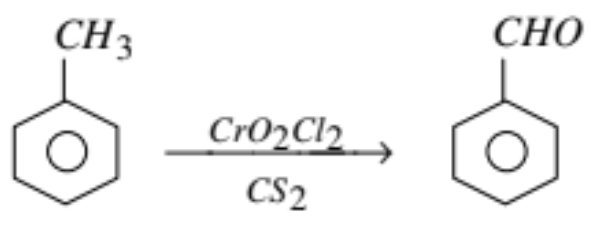
Choose an answer to reveal your result and explanation.
Answer & Explanation
The reaction CH3CHOCrO2Cl2CS2 is correctly identified as the Etard reaction, which is Option 3. Here is a detailed explanation supporting this choice:
-
Etard Reaction Explanation:
- The Etard reaction is a chemical reaction used to oxidize methyl groups attached to aromatic rings to aldehydes. In this specific reaction, chromium dioxide chloride (CrO₂Cl₂) is used as the oxidizing agent in the presence of carbon disulfide (CS₂) as a solvent. The reaction typically involves the oxidation of toluene to benzaldehyde, but in this context, it is applied to acetaldehyde (CH3CHO), demonstrating the versatility of the Etard reaction in oxidizing aldehydes.
-
Why Other Options are Incorrect:
-
Option 1: Gatterman Reaction
- The Gatterman reaction involves the synthesis of aromatic aldehydes from phenols or aromatic hydrocarbons using hydrogen cyanide (HCN) and hydrochloric acid (HCl) in the presence of a Lewis acid catalyst like aluminum chloride (AlCl₃). It is not related to the oxidation of aldehydes using CrO₂Cl₂, making it an incorrect choice for this reaction.
-
Option 2: Gatterman Koch Reaction
- The Gatterman Koch reaction is a variant of the Gatterman reaction, used to form benzaldehyde derivatives from aromatic compounds using carbon monoxide (CO) and hydrochloric acid (HCl) in the presence of a Lewis acid catalyst. This reaction does not involve the use of CrO₂Cl₂ or the oxidation of aldehydes, thus it is not applicable here.
-
Option 4: HVZ Reaction
- The Hell-Volhard-Zelinsky (HVZ) reaction is used for the halogenation of carboxylic acids at the alpha position. It involves the use of phosphorus tribromide (PBr₃) and bromine (Br₂). This reaction is unrelated to the oxidation of aldehydes with CrO₂Cl₂, making it an incorrect option for this scenario.
-
In conclusion, the Etard reaction (Option 3) is the correct choice for the given reaction, as it accurately describes the oxidation process involving CrO₂Cl₂ and CS₂. The other options do not fit the reaction conditions or the chemical transformation described.
उपरोक्त अभिक्रिया है :
Choose an answer to reveal your result and explanation.
Answer & Explanation
उपरोक्त अभिक्रिया CH3CHOCrO2Cl2CS2 ईटार्ड अभिक्रिया है, जो विकल्प 3 के रूप में सही उत्तर है। आइए इसे विस्तार से समझते हैं:
-
ईटार्ड अभिक्रिया (Option 3):
- ईटार्ड अभिक्रिया एक विशेष प्रकार की ऑक्सीकरण अभिक्रिया है जिसमें अल्डिहाइड को क्रोमाइल क्लोराइड (CrO2Cl2) की उपस्थिति में ऑक्सीकरण किया जाता है। इस प्रक्रिया में, अल्डिहाइड को कार्बोक्सिलिक एसिड में परिवर्तित किया जाता है। इस अभिक्रिया में CH3CHO (एसीटैल्डिहाइड) को क्रोमाइल क्लोराइड के साथ प्रतिक्रिया कराकर ऑक्सीकरण किया जाता है, जो इस अभिक्रिया का एक प्रमुख उदाहरण है। इसलिए, यह विकल्प सही है।
-
गाटरमान अभिक्रिया (Option 1):
- गाटरमान अभिक्रिया एक प्रकार की अभिक्रिया है जिसमें बेंजीन या उसके व्युत्पन्नों को हाइड्रोजन साइनाइड और हाइड्रोक्लोरिक एसिड की उपस्थिति में फॉर्मिलेट किया जाता है। यह अभिक्रिया एरोमैटिक यौगिकों के साथ होती है, न कि अल्डिहाइड के साथ। इसलिए, यह विकल्प गलत है।
-
गाटरमान कोख अभिक्रिया (Option 2):
- गाटरमान कोख अभिक्रिया भी एरोमैटिक यौगिकों के फॉर्मिलेशन के लिए होती है, जिसमें बेंजीन या उसके व्युत्पन्नों को कार्बोनिल क्लोराइड के साथ प्रतिक्रिया कराकर फॉर्मिलेट किया जाता है। यह अभिक्रिया भी अल्डिहाइड के ऑक्सीकरण से संबंधित नहीं है। इसलिए, यह विकल्प गलत है।
-
HVZ अभिक्रिया (Option 4):
- HVZ (Hell-Volhard-Zelinsky) अभिक्रिया कार्बोक्सिलिक एसिड के अल्फा-हाइड्रोजन के हैलोज़ेनेशन के लिए होती है। यह अभिक्रिया अल्डिहाइड के ऑक्सीकरण से संबंधित नहीं है। इसलिए, यह विकल्प भी गलत है।
इस प्रकार, दिए गए विकल्पों में से ईटार्ड अभिक्रिया (विकल्प 3) सही उत्तर है क्योंकि यह अभिक्रिया विशेष रूप से अल्डिहाइड के ऑक्सीकरण के लिए जानी जाती है।
Question 174
The product 'C' in the following reaction is: C6H5NO2Fe/HClANaNO2+HCl273KBH2O/H+ΔC
Choose an answer to reveal your result and explanation.
Answer & Explanation
The reaction sequence provided involves the transformation of nitrobenzene into phenol through a series of steps. Let's break down the process to understand why Option 4, phenol, is the correct answer.
-
Step 1: Reduction of Nitrobenzene to Aniline
- The reaction starts with nitrobenzene (C6H5NO2) being reduced by iron (Fe) in the presence of hydrochloric acid (HCl). This reduction converts the nitro group (-NO₂) into an amino group (-NH₂), forming aniline (C6H5NH2), which is compound A.
-
Step 2: Formation of Diazonium Salt
- Aniline (A) is then treated with sodium nitrite (NaNO₂) and hydrochloric acid (HCl) at 273 K. This reaction forms a diazonium salt, specifically benzene diazonium chloride (C6H5N2+Cl−), which is compound B.
-
Step 3: Hydrolysis to Phenol
- The diazonium salt (B) undergoes hydrolysis in the presence of water (H₂O) and an acidic medium (H⁺) with heat (Δ). This process replaces the diazonium group with a hydroxyl group (-OH), resulting in the formation of phenol (C6H5OH), which is compound C.
Why Option 4 (Phenol) is Correct:
- The final product of the reaction sequence is phenol, as the diazonium salt is hydrolyzed to form phenol. This is a well-known reaction in organic chemistry where diazonium salts are converted to phenols through hydrolysis.
Why the Other Options are Incorrect:
-
Aniline (Option 1): Aniline is an intermediate (compound A) in the reaction sequence, not the final product. It is formed in the first step but is further transformed into a diazonium salt and then into phenol.
-
Benzene (Option 2): Benzene is not formed in this reaction sequence. The process involves the conversion of nitrobenzene to phenol, not to benzene.
-
Nitrobenzene (Option 3): Nitrobenzene is the starting material, not the final product. The reaction sequence describes its conversion to phenol, not its regeneration.
In conclusion, the correct answer is Option 4, phenol, as it is the final product of the given reaction sequence.
निम्नलिखित अभिक्रिया में उत्पाद 'C' है : C6H5NO2Fe/HClANaNO2+HCl273KBH2O/H+ΔC
Choose an answer to reveal your result and explanation.
Answer & Explanation
इस प्रश्न में दी गई अभिक्रिया के अनुसार, हमें उत्पाद 'C' की पहचान करनी है। अभिक्रिया निम्नलिखित है:
-
C6H5NO2 (नाइट्रोबेन्जीन) को Fe/HCl के साथ अभिक्रिया कराते हैं, जिससे 'A' बनता है। यह प्रक्रिया नाइट्रो समूह का अमीनो समूह में परिवर्तन करती है, जिससे ऐनिलीन (C6H5NH2) बनता है।
-
'A' (ऐनिलीन) को NaNO_{2} और HCl के साथ 273K पर अभिक्रिया कराते हैं, जिससे 'B' बनता है। यह प्रक्रिया ऐनिलीन को डायज़ोनियम लवण (C6H5N2+Cl−) में परिवर्तित करती है।
-
'B' (डायज़ोनियम लवण) को H_2O/H+ और Δ (गर्मी) के साथ अभिक्रिया कराते हैं, जिससे 'C' बनता है। यह प्रक्रिया डायज़ोनियम लवण को फिनॉल (C6H5OH) में परिवर्तित करती है।
इस प्रकार, अंतिम उत्पाद 'C' फिनॉल है, जो विकल्प 4 के अनुसार सही उत्तर है।
अब अन्य विकल्पों की गलतियों को समझते हैं:
-
ऐनिलीन: ऐनिलीन मध्यवर्ती उत्पाद 'A' है, लेकिन अंतिम उत्पाद नहीं है। इसलिए यह विकल्प गलत है।
-
बेन्जीन: इस अभिक्रिया श्रृंखला में बेन्जीन का निर्माण नहीं होता है। इसलिए यह विकल्प गलत है।
-
नाइट्रोबेन्जीन: नाइट्रोबेन्जीन प्रारंभिक अभिकारक है, न कि अंतिम उत्पाद। इसलिए यह विकल्प गलत है।
इस प्रकार, दिए गए विकल्पों में से सही उत्तर विकल्प 4, फिनॉल है।
Question 175
Which of the following in NMR spectrum tells us how many protons of each kind are there in a molecule ?
Choose an answer to reveal your result and explanation.
Answer & Explanation
In NMR (Nuclear Magnetic Resonance) spectroscopy, the intensities of signals are crucial for determining the number of protons of each kind in a molecule. Here's a detailed explanation supporting why Option 3 is the correct answer:
-
Intensities of signals (Option 3): The intensity of an NMR signal is directly proportional to the number of nuclei (protons) contributing to that signal. This means that the area under each peak in the NMR spectrum corresponds to the number of protons that generate that particular signal. By integrating the area under the peaks, chemists can determine the relative number of protons of each type in the molecule. This is why the intensities of signals are essential for quantifying the number of protons.
-
Number of signals (Option 1): The number of signals in an NMR spectrum indicates the number of different types of proton environments in a molecule, not the quantity of protons. Each unique chemical environment for protons will produce a separate signal, but this does not provide information about how many protons are in each environment.
-
Positions of signals (Option 2): The positions of signals, also known as chemical shifts, provide information about the electronic environment surrounding the protons. Chemical shifts help identify the types of functional groups present but do not indicate the number of protons.
-
Splitting of signals (Option 4): The splitting of signals, or multiplicity, arises from spin-spin coupling between neighboring protons. This provides information about the number of adjacent protons but does not directly indicate the total number of protons in a particular environment.
In summary, while the number, position, and splitting of signals provide valuable structural information about a molecule, it is the intensities of signals that specifically tell us how many protons of each kind are present. Therefore, Option 3 is the correct answer.
निम्नलिखित में से किससे ज्ञात होता है कि NMR स्पेक्ट्रम में एक अणु में एक ही प्रकार के कितने प्रोटॉन हैं ?
Choose an answer to reveal your result and explanation.
Answer & Explanation
Option 3, "संकेतों की तीव्रता," सही उत्तर है क्योंकि NMR (न्यूक्लियर मैग्नेटिक रेजोनेंस) स्पेक्ट्रम में संकेतों की तीव्रता सीधे उस अणु में उपस्थित एक ही प्रकार के प्रोटॉनों की संख्या से संबंधित होती है। NMR स्पेक्ट्रम में, प्रत्येक संकेत की तीव्रता उस समूह में प्रोटॉनों की संख्या के अनुपात में होती है। उदाहरण के लिए, यदि एक अणु में दो अलग-अलग प्रकार के प्रोटॉन समूह हैं, तो उनके संकेतों की तीव्रता उनके अनुपात को दर्शाएगी। इस प्रकार, संकेतों की तीव्रता से यह ज्ञात होता है कि एक ही प्रकार के कितने प्रोटॉन हैं।
अब अन्य विकल्पों पर विचार करते हैं:
-
संकेतों की संख्या: संकेतों की संख्या यह दर्शाती है कि अणु में कितने विभिन्न प्रकार के प्रोटॉन पर्यावरण हैं, लेकिन यह यह नहीं बताती कि एक ही प्रकार के कितने प्रोटॉन हैं। इसलिए, यह विकल्प सही नहीं है।
-
संकेतों की स्थिति: संकेतों की स्थिति (केमिकल शिफ्ट) यह जानकारी देती है कि प्रोटॉन किस प्रकार के रासायनिक वातावरण में हैं। यह प्रोटॉनों की संख्या के बारे में जानकारी नहीं देती है, बल्कि उनके रासायनिक परिवेश के बारे में बताती है। इसलिए, यह विकल्प सही नहीं है।
-
संकेतों की विपाटन: संकेतों की विपाटन (स्प्लिटिंग पैटर्न) यह दर्शाती है कि प्रोटॉन के पड़ोसी प्रोटॉनों की संख्या कितनी है। यह एक ही प्रकार के प्रोटॉनों की कुल संख्या के बारे में जानकारी नहीं देती है। इसलिए, यह विकल्प सही नहीं है।
इस प्रकार, संकेतों की तीव्रता (Option 3) ही वह विकल्प है जो यह बताता है कि NMR स्पेक्ट्रम में एक अणु में एक ही प्रकार के कितने प्रोटॉन हैं।
Question 176
Ozonolysis of which of the following alkene gives propan-2-one and methanal ?
Choose an answer to reveal your result and explanation.
Answer & Explanation
Ozonolysis is a reaction where an alkene is cleaved by ozone to form carbonyl compounds. In this case, we are looking for an alkene that, upon ozonolysis, yields propan-2-one (acetone) and methanal (formaldehyde).
-
Explanation for Option 3 (2-Methyl Propene):
- The structure of 2-methyl propene is CH3-C(CH3)=CH2. During ozonolysis, the double bond is cleaved, and each carbon atom involved in the double bond is converted into a carbonyl group.
- The cleavage of the double bond in 2-methyl propene results in the formation of two fragments: one fragment is a ketone (propan-2-one) and the other is an aldehyde (methanal).
- Specifically, the carbon atom bonded to two methyl groups becomes part of the ketone (propan-2-one), while the terminal carbon atom becomes methanal.
- This matches the products given in the question, confirming that 2-methyl propene is the correct alkene.
-
Explanation for why other options are incorrect:
-
Option 1 (Propene):
- Propene (CH3-CH=CH2) upon ozonolysis would yield two molecules of methanal and one molecule of ethanal, not propan-2-one and methanal. Therefore, it does not match the required products.
-
Option 2 (But-1-ene):
- But-1-ene (CH3-CH2-CH=CH2) would produce ethanal and methanal upon ozonolysis. This does not match the required products of propan-2-one and methanal.
-
Option 4 (But-2-ene):
- But-2-ene (CH3-CH=CH-CH3) would yield two molecules of propan-2-one upon ozonolysis. This does not match the required products, as methanal is not formed.
-
In conclusion, the only alkene that produces the specified products, propan-2-one and methanal, upon ozonolysis is 2-methyl propene, making Option 3 the correct choice.
निम्नलिखित में से किस ऐल्कीन का ओजोनी अपघटन प्रोपेन-2-ओन एवं मेथेनल देता है ?
Choose an answer to reveal your result and explanation.
Answer & Explanation
2-मेथिल प्रोपीन का ओजोनी अपघटन प्रोपेन-2-ओन और मेथेनल देता है। यह प्रतिक्रिया ओजोनोलिसिस के सिद्धांत पर आधारित है, जिसमें ऐल्कीन के डबल बॉन्ड को ओजोन के साथ प्रतिक्रिया करवा कर ऑक्सीकरण किया जाता है, जिससे कार्बोनिल यौगिक बनते हैं।
-
प्रोपीन: प्रोपीन का ओजोनी अपघटन प्रोपेनल और फॉर्मलडिहाइड (मेथेनल) देता है, न कि प्रोपेन-2-ओन।
-
ब्यूट-1-ईन: ब्यूट-1-ईन का ओजोनी अपघटन ब्यूटेनल और फॉर्मलडिहाइड देता है, जो प्रोपेन-2-ओन नहीं है।
-
2-मेथिल प्रोपीन: 2-मेथिल प्रोपीन का ओजोनी अपघटन प्रोपेन-2-ओन और मेथेनल देता है। यह सही विकल्प है क्योंकि 2-मेथिल प्रोपीन के डबल बॉन्ड के टूटने पर एक तरफ प्रोपेन-2-ओन और दूसरी तरफ मेथेनल बनता है।
-
ब्यूट-2-ईन: ब्यूट-2-ईन का ओजोनी अपघटन एसीटोन और एसीटैल्डिहाइड देता है, जो प्रोपेन-2-ओन और मेथेनल नहीं है।
इस प्रकार, 2-मेथिल प्रोपीन ही वह ऐल्कीन है जिसका ओजोनी अपघटन प्रोपेन-2-ओन और मेथेनल देता है।
Question 177
Which of the following artificial sweetener is methyl ester of dipeptide formed from aspartic acid and phenyl alanine ?
Choose an answer to reveal your result and explanation.
Answer & Explanation
Option 1, Aspartame, is the correct answer because it is indeed a methyl ester of a dipeptide formed from aspartic acid and phenylalanine. Aspartame is a widely used artificial sweetener that is approximately 200 times sweeter than sucrose (table sugar). It is composed of two amino acids, aspartic acid and phenylalanine, which are linked together to form a dipeptide. The methyl ester group is attached to the carboxyl end of the phenylalanine, which is what gives aspartame its sweetening properties. This specific chemical structure is what makes aspartame unique among artificial sweeteners.
Now, let's explain why the other options are incorrect:
-
Alitame: Alitame is another artificial sweetener, but it is not a methyl ester of a dipeptide formed from aspartic acid and phenylalanine. Instead, it is derived from the amino acids L-aspartic acid and D-alanine, along with a novel amine. Its structure and composition are different from aspartame, which is why it does not fit the description given in the question.
-
Saccharin: Saccharin is one of the oldest artificial sweeteners and is not related to amino acids or dipeptides. It is a sulfonamide compound, which means it contains a sulfonamide group, and it does not involve aspartic acid or phenylalanine in its structure. Therefore, it does not match the description of being a methyl ester of a dipeptide.
-
Sucralose: Sucralose is a chlorinated derivative of sucrose (table sugar) and is not related to amino acids or dipeptides. It is made by replacing three hydroxyl groups on the sucrose molecule with chlorine atoms. This chemical modification makes it much sweeter than sucrose, but it does not involve aspartic acid, phenylalanine, or a methyl ester group, making it unrelated to the description in the question.
In conclusion, Aspartame is the only option that fits the specific chemical description provided in the question, which is why Option 1 is the correct answer.
निम्नलिखित में से कौन-सा कृत्रिम मधुरक ऐस्पार्टिक अम्ल तथा फेनिलऐलानीन से बने डाइपेप्टाइड का मेथिल एस्टर है ?
Choose an answer to reveal your result and explanation.
Answer & Explanation
ऐस्पार्टम एक कृत्रिम मधुरक है जो ऐस्पार्टिक अम्ल और फेनिलऐलानीन से बने डाइपेप्टाइड का मेथिल एस्टर है। यह विशेष रूप से कम कैलोरी वाले खाद्य पदार्थों और पेय पदार्थों में चीनी के विकल्प के रूप में उपयोग किया जाता है। ऐस्पार्टम का रासायनिक संरचना इसे मिठास प्रदान करती है, जो चीनी से लगभग 200 गुना अधिक होती है, जिससे यह एक प्रभावी मधुरक बनता है।
अब हम अन्य विकल्पों पर विचार करते हैं:
-
ऐलिटेम: ऐलिटेम भी एक कृत्रिम मधुरक है, लेकिन यह ऐस्पार्टिक अम्ल और फेनिलऐलानीन से नहीं बना है। यह एल्फा-एमिनो एसिड से संश्लेषित होता है और इसकी संरचना ऐस्पार्टम से भिन्न होती है।
-
सैकरीन: सैकरीन एक और कृत्रिम मधुरक है, लेकिन यह सल्फोइमाइड से बना होता है और इसका रासायनिक संरचना ऐस्पार्टिक अम्ल या फेनिलऐलानीन से संबंधित नहीं है। यह मिठास में चीनी से 300-400 गुना अधिक होता है।
-
सूक्रोलोस: सूक्रोलोस एक क्लोरीनयुक्त सुक्रोज डेरिवेटिव है और इसका रासायनिक संरचना ऐस्पार्टिक अम्ल या फेनिलऐलानीन से संबंधित नहीं है। यह चीनी से लगभग 600 गुना अधिक मीठा होता है।
इस प्रकार, ऐस्पार्टम ही एकमात्र विकल्प है जो ऐस्पार्टिक अम्ल और फेनिलऐलानीन से बने डाइपेप्टाइड का मेथिल एस्टर है, इसलिए विकल्प 1 सही उत्तर है।
Question 178
Shift of absorption maximum towards shorter wavelength is called:
Choose an answer to reveal your result and explanation.
Answer & Explanation
The correct answer to the question "Shift of absorption maximum towards shorter wavelength is called:" is Option 3: Hypsochromic shift.
-
Explanation for Option 3 (Hypsochromic shift):
- A hypsochromic shift, also known as a blue shift, refers to the movement of the absorption maximum of a substance towards shorter wavelengths in the electromagnetic spectrum. This shift typically occurs due to changes in the molecular environment, such as solvent effects, pH changes, or structural modifications that increase the energy gap between the ground and excited states of a molecule. As a result, the absorption maximum moves to a region of higher energy, which corresponds to shorter wavelengths.
-
Explanation for why other options are incorrect:
-
Option 1 (Hypochromic effect):
- The hypochromic effect refers to a decrease in the intensity (absorbance) of a spectral band without a shift in wavelength. It is not related to the position of the absorption maximum on the wavelength scale but rather to the magnitude of absorption. Therefore, it does not describe a shift towards shorter wavelengths.
-
Option 2 (Hyperchromic effect):
- The hyperchromic effect is the opposite of the hypochromic effect and involves an increase in the intensity (absorbance) of a spectral band. Like the hypochromic effect, it does not involve a shift in the wavelength of the absorption maximum. Thus, it is unrelated to the concept of shifting towards shorter wavelengths.
-
Option 4 (Bathochromic shift):
- A bathochromic shift, also known as a red shift, is the opposite of a hypsochromic shift. It refers to the movement of the absorption maximum towards longer wavelengths (lower energy). This shift occurs when the energy gap between the ground and excited states decreases, often due to similar factors that cause a hypsochromic shift but in the opposite direction. Therefore, a bathochromic shift does not describe a shift towards shorter wavelengths.
-
In conclusion, the term "hypsochromic shift" accurately describes the phenomenon of an absorption maximum moving towards shorter wavelengths, making Option 3 the correct answer.
अवशोषण शीर्ष के निम्न तरंगदैर्ध्य की ओर विस्थापन को कहते हैं :
Choose an answer to reveal your result and explanation.
Answer & Explanation
अवशोषण शीर्ष के निम्न तरंगदैर्ध्य की ओर विस्थापन को "वर्णोपकर्षी विस्थापन" कहा जाता है, जो विकल्प 3 है। इसे अंग्रेजी में "ब्लू शिफ्ट" कहा जाता है। यह तब होता है जब प्रकाश या अन्य विद्युतचुंबकीय विकिरण का स्रोत अवलोकनकर्ता की ओर गति करता है, जिससे तरंगदैर्ध्य कम हो जाता है और प्रकाश का रंग नीले छोर की ओर शिफ्ट होता है।
अब हम अन्य विकल्पों की चर्चा करते हैं और समझते हैं कि वे क्यों सही नहीं हैं:
-
अववर्णी प्रभाव: यह प्रभाव तब होता है जब किसी पदार्थ के माध्यम से गुजरने पर प्रकाश की तीव्रता कम हो जाती है। यह तरंगदैर्ध्य के विस्थापन से संबंधित नहीं है, बल्कि प्रकाश की तीव्रता में कमी से संबंधित है।
-
वर्णातिशायी प्रभाव: यह प्रभाव वर्णक्रमीय रेखाओं के विस्थापन से संबंधित नहीं है। यह शब्द आमतौर पर वर्णक्रमीय रेखाओं की तीव्रता में वृद्धि या कमी के संदर्भ में उपयोग नहीं होता है।
-
वणोत्कर्षी विस्थापन: यह "रेड शिफ्ट" के लिए उपयोग किया जाता है, जो तब होता है जब प्रकाश का स्रोत अवलोकनकर्ता से दूर जा रहा होता है, जिससे तरंगदैर्ध्य बढ़ जाता है और प्रकाश का रंग लाल छोर की ओर शिफ्ट होता है। यह विकल्प अवशोषण शीर्ष के निम्न तरंगदैर्ध्य की ओर विस्थापन के लिए सही नहीं है।
इस प्रकार, "वर्णोपकर्षी विस्थापन" (विकल्प 3) सही उत्तर है क्योंकि यह अवशोषण शीर्ष के निम्न तरंगदैर्ध्य की ओर विस्थापन को सही ढंग से परिभाषित करता है।
Question 179
Which of the following ions is paramagnetic ?
Choose an answer to reveal your result and explanation.
Answer & Explanation
The question asks which of the given ions is paramagnetic. The correct answer is Option 2: Gd3+. Let's explore why this is the correct choice and why the other options are incorrect.
-
Explanation for Option 2: Gd3+
- Gadolinium (Gd) is an element in the lanthanide series, and its atomic number is 64. The electron configuration of a neutral gadolinium atom is [Xe] 4f^7 5d^1 6s^2. When it loses three electrons to form the Gd3+ ion, the electron configuration becomes [Xe] 4f^7.
- The 4f^7 configuration means that there are seven unpaired electrons in the 4f subshell. According to Hund's rule, these unpaired electrons result in a high degree of paramagnetism. Therefore, Gd3+ is paramagnetic due to the presence of these unpaired electrons.
-
Explanation for why other options are incorrect:
-
Option 1: La3+
- Lanthanum (La) has an atomic number of 57, and its electron configuration is [Xe] 5d^1 6s^2. When it forms the La3+ ion, it loses three electrons, resulting in the electron configuration [Xe].
- The [Xe] configuration corresponds to a completely filled shell with no unpaired electrons. As a result, La3+ is diamagnetic, not paramagnetic.
-
Option 3: Lu3+
- Lutetium (Lu) has an atomic number of 71, and its electron configuration is [Xe] 4f^14 5d^1 6s^2. When it forms the Lu3+ ion, it loses three electrons, resulting in the electron configuration [Xe] 4f^14.
- The 4f^14 configuration is fully filled with no unpaired electrons, making Lu3+ diamagnetic.
-
Option 4: Ce4+
- Cerium (Ce) has an atomic number of 58, and its electron configuration is [Xe] 4f^1 5d^1 6s^2. When it forms the Ce4+ ion, it loses four electrons, resulting in the electron configuration [Xe].
- Similar to La3+, the [Xe] configuration is fully filled with no unpaired electrons, making Ce4+ diamagnetic.
-
In summary, Gd3+ is the only ion among the options that has unpaired electrons in its electron configuration, specifically in the 4f subshell, which makes it paramagnetic. The other ions have either completely filled electron configurations or no unpaired electrons, resulting in diamagnetic properties. Therefore, Option 2 is correctly identified as the paramagnetic ion.
निम्नलिखित में से कौन-सा आयन अनुचुंबकीय है :
Choose an answer to reveal your result and explanation.
Answer & Explanation
आयन अनुचुंबकीय होते हैं जब उनके पास एक या अधिक अविवाहित इलेक्ट्रॉन होते हैं। अनुचुंबकीयता का कारण अविवाहित इलेक्ट्रॉनों की उपस्थिति होती है, जो बाहरी चुंबकीय क्षेत्र के प्रभाव में चुंबकीय क्षेत्र उत्पन्न करते हैं।
-
La3+: लैंथेनम (La3+) आयन में इलेक्ट्रॉनिक विन्यास [Xe] 5d^0 4f^0 होता है। इसमें कोई अविवाहित इलेक्ट्रॉन नहीं होता है, इसलिए यह आयन अनुचुंबकीय नहीं है।
-
Gd3+: गेडोलिनियम (Gd3+) आयन में इलेक्ट्रॉनिक विन्यास [Xe] 4f^7 होता है। इसमें 7 अविवाहित इलेक्ट्रॉन होते हैं, जो इसे अनुचुंबकीय बनाते हैं। इसलिए, Gd3+ आयन अनुचुंबकीय है और यही कारण है कि विकल्प 2 सही उत्तर है।
-
Lu3+: लुटेटियम (Lu3+) आयन में इलेक्ट्रॉनिक विन्यास [Xe] 4f^14 होता है। इसमें सभी इलेक्ट्रॉन युग्मित होते हैं, इसलिए इसमें कोई अविवाहित इलेक्ट्रॉन नहीं होता है और यह आयन अनुचुंबकीय नहीं है।
-
Ce4+: सेरियम (Ce4+) आयन में इलेक्ट्रॉनिक विन्यास [Xe] 4f^0 होता है। इसमें भी कोई अविवाहित इलेक्ट्रॉन नहीं होता है, इसलिए यह आयन अनुचुंबकीय नहीं है।
इस प्रकार, केवल Gd3+ आयन में अविवाहित इलेक्ट्रॉन होते हैं, जो इसे अनुचुंबकीय बनाते हैं। यही कारण है कि विकल्प 2 सही उत्तर है।
Question 180
Which of the following does not give red-brown precipitate with Fehling reagent?
Choose an answer to reveal your result and explanation.
Answer & Explanation
Option 1, C6H5CHO (benzaldehyde), is the correct answer because it does not give a red-brown precipitate with Fehling's reagent. Fehling's test is used to detect the presence of reducing sugars and aldehydes. It involves the reduction of copper(II) ions to copper(I) oxide, which forms a red-brown precipitate.
-
Explanation for Option 1 (C6H5CHO):
- Benzaldehyde is an aromatic aldehyde. Aromatic aldehydes generally do not react with Fehling's reagent because they lack the necessary structure to reduce the copper(II) ions in the reagent. The presence of the benzene ring in benzaldehyde stabilizes the carbonyl group, making it less reactive towards oxidation by Fehling's reagent. Therefore, benzaldehyde does not produce a red-brown precipitate.
-
Explanation for Option 2 (HCHO):
- Formaldehyde (HCHO) is a simple aliphatic aldehyde. It readily reacts with Fehling's reagent, reducing the copper(II) ions to copper(I) oxide, which forms a red-brown precipitate. This is because formaldehyde is a strong reducing agent.
-
Explanation for Option 3 (CH3CHO):
- Acetaldehyde (CH3CHO) is another aliphatic aldehyde that reacts with Fehling's reagent. It reduces the copper(II) ions to copper(I) oxide, resulting in the formation of a red-brown precipitate. Acetaldehyde is a typical reducing aldehyde that easily undergoes oxidation.
-
Explanation for Option 4 (CH3−CH2−CH2−CH2−CHO):
- Butyraldehyde (CH3−CH2−CH2−CH2−CHO) is also an aliphatic aldehyde. Like other aliphatic aldehydes, it reacts with Fehling's reagent, reducing the copper(II) ions to copper(I) oxide and forming a red-brown precipitate. Its structure allows it to act as a reducing agent.
In summary, Option 1 (C6H5CHO) is the correct answer because benzaldehyde, being an aromatic aldehyde, does not react with Fehling's reagent to give a red-brown precipitate, unlike the other aliphatic aldehydes listed in the options.
निम्नलिखित में से कौन फेलिंग अभिकर्मक के साथ लाल-भूरा अवक्षेप नहीं देता ?
Choose an answer to reveal your result and explanation.
Answer & Explanation
फेलिंग अभिकर्मक का उपयोग एल्डिहाइड्स और कीटोन्स के बीच भेद करने के लिए किया जाता है। यह विशेष रूप से एल्डिहाइड्स के साथ प्रतिक्रिया करता है और लाल-भूरा अवक्षेप (Cu2O) उत्पन्न करता है। अब हम प्रत्येक विकल्प का विश्लेषण करते हैं:
-
C6H5CHO (बेंजाल्डिहाइड): बेंजाल्डिहाइड एक एरोमैटिक एल्डिहाइड है। फेलिंग अभिकर्मक के साथ, एरोमैटिक एल्डिहाइड्स आमतौर पर प्रतिक्रिया नहीं करते हैं और इसलिए लाल-भूरा अवक्षेप नहीं देते। यही कारण है कि C6H5CHO फेलिंग अभिकर्मक के साथ लाल-भूरा अवक्षेप नहीं देता, और यह सही उत्तर है।
-
HCHO (फॉर्मल्डिहाइड): फॉर्मल्डिहाइड एक सरल एल्डिहाइड है और यह फेलिंग अभिकर्मक के साथ प्रतिक्रिया करता है, जिससे लाल-भूरा अवक्षेप बनता है।
-
CH3CHO (एसीटैल्डिहाइड): एसीटैल्डिहाइड भी एक एल्डिहाइड है जो फेलिंग अभिकर्मक के साथ प्रतिक्रिया करता है और लाल-भूरा अवक्षेप उत्पन्न करता है।
-
CH3−CH2−CH2−CH2−CHO (पेंटेनल): यह एक अलिफैटिक एल्डिहाइड है और फेलिंग अभिकर्मक के साथ प्रतिक्रिया करता है, जिससे लाल-भूरा अवक्षेप बनता है।
इस प्रकार, केवल C6H5CHO (बेंजाल्डिहाइड) ही ऐसा यौगिक है जो फेलिंग अभिकर्मक के साथ लाल-भूरा अवक्षेप नहीं देता। इसलिए, विकल्प 1 सही उत्तर है।