
HTET Exam Level 3 PGT
HTET exam Level 3 PGT preparation with Clear Cutoff
Verified Answers and Explanations
by Clear Cutoff
Showing 20 of 20 questions
Question 121
Which is not true for a standard hydrogen electrode ?
Choose an answer to reveal your result and explanation.
Answer & Explanation
Explanation:
-
Option 4: It contains a metallic conductor which does not adsorb hydrogen.
This statement is not true for a standard hydrogen electrode (SHE). In a standard hydrogen electrode, the metallic conductor used is typically platinum. Platinum is chosen because it has excellent catalytic properties and can adsorb hydrogen gas. This adsorption is crucial as it facilitates the establishment of equilibrium between hydrogen ions in solution and hydrogen gas at the electrode surface. Therefore, the statement that the metallic conductor does not adsorb hydrogen is incorrect, making Option 4 the correct choice for what is not true about a standard hydrogen electrode. -
Option 1: The hydrogen ion concentration is 1 M.
This statement is true for a standard hydrogen electrode. The SHE is defined under standard conditions, which include a hydrogen ion concentration of 1 M. This concentration ensures that the electrode potential is measured under consistent and reproducible conditions. -
Option 2: Temperature is 25∘C.
This statement is also true for a standard hydrogen electrode. The standard conditions for electrochemical measurements, including those for the SHE, are set at a temperature of 25∘C (298 K). This standard temperature is used to maintain consistency across different experiments and measurements. -
Option 3: Pressure of hydrogen is 1 bar.
This statement is true for a standard hydrogen electrode. The pressure of hydrogen gas in the SHE is maintained at 1 bar (or 1 atmosphere in older conventions) to ensure that the electrode potential is measured under standard conditions. This pressure is crucial for maintaining the equilibrium between the gaseous hydrogen and the hydrogen ions in solution.
In summary, Option 4 is the correct answer because it inaccurately describes the properties of a standard hydrogen electrode, specifically regarding the adsorption of hydrogen by the metallic conductor. The other options correctly describe the standard conditions of a SHE.
मानक हाइड्रोजन इलेक्ट्रोड के लिए कौन-सा सही नहीं है ?
Choose an answer to reveal your result and explanation.
Answer & Explanation
मानक हाइड्रोजन इलेक्ट्रोड (SHE) के लिए सही विकल्प का चयन करने के लिए हमें यह समझना होगा कि SHE की विशेषताएँ क्या होती हैं।
-
हाइड्रोजन आयन की सान्द्रता 1M होती है।
यह कथन सही है क्योंकि मानक हाइड्रोजन इलेक्ट्रोड में हाइड्रोजन आयन की सान्द्रता 1 मोलर होती है। यह मानक स्थिति का एक आवश्यक हिस्सा है, जिससे इलेक्ट्रोड की क्षमता को मापा जा सके। -
ताप 25∘C होता है।
यह भी सही है क्योंकि मानक स्थितियों में तापमान 25∘C (298 K) होता है। यह तापमान मानक स्थितियों के लिए सामान्य रूप से स्वीकार किया जाता है। -
हाइड्रोजन का दाब 1 बार होता है।
यह कथन भी सही है। मानक हाइड्रोजन इलेक्ट्रोड में हाइड्रोजन गैस का दाब 1 बार होता है। यह मानक स्थितियों का एक और महत्वपूर्ण पहलू है। -
यह एक धात्विक चालक रखता है जो हाइड्रोजन को अधिशोषित नहीं करता है।
यह कथन सही नहीं है। मानक हाइड्रोजन इलेक्ट्रोड में प्लैटिनम का उपयोग किया जाता है, जो एक धात्विक चालक है और हाइड्रोजन को अधिशोषित करता है। प्लैटिनम की सतह पर हाइड्रोजन गैस का अधिशोषण होता है, जो इलेक्ट्रोड की कार्यप्रणाली के लिए आवश्यक है।
इस प्रकार, विकल्प 4 सही नहीं है क्योंकि मानक हाइड्रोजन इलेक्ट्रोड में प्लैटिनम का उपयोग होता है, जो हाइड्रोजन को अधिशोषित करता है। यही कारण है कि विकल्प 4 सही उत्तर है।
Question 122
Spin angular momentum for electron is:
Choose an answer to reveal your result and explanation.
Answer & Explanation
The spin angular momentum for an electron is a fundamental concept in quantum mechanics. It is described by the formula for the magnitude of the spin angular momentum vector, which is given by:
[ S = \sqrt{s(s+1)}\frac{h}{2\pi} ]
where:
- ( s ) is the spin quantum number for the electron.
- ( h ) is Planck's constant.
For an electron, the spin quantum number ( s ) is ( \frac{1}{2} ). Substituting this value into the formula, we get:
[ S = \sqrt{\frac{1}{2}(\frac{1}{2} + 1)}\frac{h}{2\pi} = \sqrt{\frac{1}{2} \times \frac{3}{2}}\frac{h}{2\pi} = \sqrt{\frac{3}{4}}\frac{h}{2\pi} = \frac{\sqrt{3}}{2}\frac{h}{2\pi} ]
This matches the form given in Option 1, which is the correct expression for the spin angular momentum of an electron.
Now, let's examine why the other options are incorrect:
-
Option 2: (\sqrt{2s(s+1)}\frac{h}{2\pi})
- This formula incorrectly includes an extra factor of 2 inside the square root, which does not align with the standard quantum mechanical expression for spin angular momentum.
-
Option 3: (\sqrt{s(s+2)}\frac{h}{2\pi})
- This formula incorrectly uses ( s(s+2) ) instead of ( s(s+1) ). The correct expression for spin angular momentum involves ( s(s+1) ), as derived from quantum mechanics principles.
-
Option 4: (\sqrt{2(s+1)}\frac{h}{2\pi})
- This formula incorrectly modifies the expression by using ( 2(s+1) ) inside the square root, which is not consistent with the established formula for spin angular momentum.
In conclusion, Option 1 is the correct expression for the spin angular momentum of an electron, as it accurately reflects the quantum mechanical principles governing electron spin.
इलेक्ट्रॉन के लिए चक्रण कोणीय संवेग है :
Choose an answer to reveal your result and explanation.
Answer & Explanation
इलेक्ट्रॉन के लिए चक्रण कोणीय संवेग का सूत्र s(s+1)2πh होता है, जहाँ s इलेक्ट्रॉन का स्पिन क्वांटम संख्या है। इलेक्ट्रॉन के लिए स्पिन क्वांटम संख्या s=21 होती है।
अब, इस सूत्र का उपयोग करके, हम इलेक्ट्रॉन के चक्रण कोणीय संवेग की गणना कर सकते हैं:
- s=21 को सूत्र में डालें:
[
\sqrt{\frac{1}{2}\left(\frac{1}{2} + 1\right)}\frac{h}{2\pi} = \sqrt{\frac{1}{2} \times \frac{3}{2}}\frac{h}{2\pi} = \sqrt{\frac{3}{4}}\frac{h}{2\pi} = \frac{\sqrt{3}}{2}\frac{h}{2\pi}
]
यह गणना दिखाती है कि विकल्प 1 सही है क्योंकि यह इलेक्ट्रॉन के चक्रण कोणीय संवेग के लिए सही सूत्र का उपयोग करता है।
अब, अन्य विकल्पों की गलतियों को समझते हैं:
-
विकल्प 2: 2s(s+1)2πh - यह सूत्र गलत है क्योंकि इसमें 2s(s+1) का उपयोग किया गया है, जो कि इलेक्ट्रॉन के चक्रण कोणीय संवेग के लिए सही नहीं है।
-
विकल्प 3: s(s+2)2πh - यह भी गलत है क्योंकि इसमें s(s+2) का उपयोग किया गया है, जो कि इलेक्ट्रॉन के चक्रण कोणीय संवेग के लिए सही नहीं है।
-
विकल्प 4: 2(s+1)2πh - यह भी गलत है क्योंकि इसमें 2(s+1) का उपयोग किया गया है, जो कि इलेक्ट्रॉन के चक्रण कोणीय संवेग के लिए सही नहीं है।
इस प्रकार, विकल्प 1 सही है क्योंकि यह इलेक्ट्रॉन के चक्रण कोणीय संवेग के लिए सही गणना और सूत्र का उपयोग करता है।
Question 123
Which is the correct statement for PH3?
Choose an answer to reveal your result and explanation.
Answer & Explanation
Option 1: It is less basic than (NH_3).
Explanation for Option 1:
Phosphine ((PH_3)) is indeed less basic than ammonia ((NH_3)). This is primarily due to the differences in the electronegativity and size of the central atoms, phosphorus and nitrogen, respectively. Nitrogen is more electronegative than phosphorus, which means it has a stronger tendency to attract electrons. This makes the lone pair on nitrogen in (NH_3) more available for donation to a proton, thereby making (NH_3) more basic. In contrast, the lone pair on phosphorus in (PH_3) is less available for donation due to the larger size and lower electronegativity of phosphorus, resulting in (PH_3) being less basic.
Explanation for why the other options are incorrect:
Option 2: It is less poisonous than (NH_3).
This statement is incorrect. (PH_3) is actually more toxic than (NH_3). Phosphine is a highly toxic gas and can be lethal even at low concentrations, whereas ammonia, while irritating and potentially harmful, is generally less toxic than phosphine.
Option 3: Bond angle of (PH_3 > NH_3).
This statement is incorrect. The bond angle in (NH_3) is approximately 107 degrees, while in (PH_3), it is around 93.5 degrees. The smaller bond angle in (PH_3) is due to the larger size of the phosphorus atom and the presence of lone pair-bond pair repulsion, which is less pronounced than in (NH_3).
Option 4: It does not show reducing properties.
This statement is incorrect. (PH_3) does exhibit reducing properties. It can act as a reducing agent, especially in reactions with oxygen or halogens, where it can be oxidized to form phosphorus oxides or halides.
In conclusion, Option 1 is the correct statement as (PH_3) is indeed less basic than (NH_3), and the explanations provided clarify why the other options are incorrect.
PH3 के लिए सही कथन कौन-सा है ?
Choose an answer to reveal your result and explanation.
Answer & Explanation
PH3 के लिए सही कथन विकल्प 1 है: "यह NH3 से कम क्षारीय है।"
-
विकल्प 1 का स्पष्टीकरण:
PH3 और NH3 दोनों ही हाइड्राइड्स हैं, लेकिन PH3 की क्षारीयता NH3 की तुलना में कम होती है। इसका मुख्य कारण यह है कि नाइट्रोजन की इलेक्ट्रोनगेटिविटी फॉस्फोरस की तुलना में अधिक होती है, जिससे NH3 में इलेक्ट्रॉन डोनर क्षमता अधिक होती है। NH3 एक मजबूत बेस है और आसानी से प्रोटॉन स्वीकार कर सकता है, जबकि PH3 की बेसिकिटी कम होती है और यह प्रोटॉन स्वीकार करने में कम सक्षम होता है। -
अन्य विकल्पों का खंडन:
-
विकल्प 2: "यह NH3 से कम विषैला है"
यह कथन गलत है क्योंकि PH3 वास्तव में NH3 से अधिक विषैला होता है। PH3 एक जहरीली गैस है और इसका उपयोग कीटनाशक के रूप में भी किया जाता है, जबकि NH3 की विषाक्तता अपेक्षाकृत कम होती है। -
विकल्प 3: "बंध कोण PH3>NH3"
यह कथन गलत है। NH3 में बंध कोण लगभग 107° होता है, जबकि PH3 में बंध कोण लगभग 93.5° होता है। इसका कारण यह है कि PH3 में lone pair-lone pair repulsion कम होता है, जिससे बंध कोण छोटा होता है। -
विकल्प 4: "यह अपचायक गुण नहीं दर्शाता है"
यह कथन गलत है। PH3 एक अपचायक एजेंट के रूप में कार्य कर सकता है। यह आसानी से ऑक्सीकृत होकर फॉस्फोरस एसिड (H3PO3) में परिवर्तित हो सकता है, जो इसके अपचायक गुण को दर्शाता है।
-
इस प्रकार, विकल्प 1 सही है क्योंकि PH3 की क्षारीयता NH3 की तुलना में कम होती है।
Question 124
Predict the product of the following reaction:
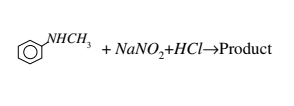
Choose an answer to reveal your result and explanation.
Answer & Explanation
To understand why Option 2 is the correct answer for the reaction C6H5NHCH3+NaNO2+HCl→ Product, let's analyze the reaction step by step.
Explanation for Option 2:
-
Reaction Type: The reaction involves an aromatic amine (C6H5NHCH3) with sodium nitrite (NaNO2) and hydrochloric acid (HCl). This is a classic setup for a diazotization reaction, which typically occurs with primary aromatic amines. However, in this case, we have a secondary amine (N−methylaniline).
-
Mechanism:
- The sodium nitrite (NaNO2) in the presence of hydrochloric acid (HCl) generates nitrous acid (HNO2) in situ.
- The nitrous acid then reacts with the secondary amine (C6H5NHCH3) to form an N-nitroso compound.
- Specifically, the secondary amine undergoes nitrosation to form C6H5N(CH3)−N=O, which is an N-nitrosoamine.
-
Product Formation: The product of this reaction is an N-nitroso compound, which matches Option 2: C6H5N(CH3)−N=O.
Why Other Options are Incorrect:
-
Option 1: C6H5N(CH3)OH
- This option suggests the formation of a hydroxylamine derivative. However, the reaction conditions (nitrous acid with a secondary amine) do not favor the formation of hydroxylamines. Instead, nitrosation occurs, leading to the N-nitroso compound.
-
Option 3: C6H5N(CH3)−NO2
- This option implies the formation of a nitro compound. Nitro compounds are typically formed through nitration reactions involving nitric acid, not through nitrosation with nitrous acid. Therefore, this product is not feasible under the given reaction conditions.
-
Option 4: o-nitro-N-methylaniline + p-nitro-N-methylaniline
- This option suggests nitration at the ortho and para positions of the aromatic ring. However, the reaction conditions (nitrous acid with a secondary amine) do not support electrophilic aromatic substitution leading to nitration. Instead, nitrosation of the amine group occurs.
In conclusion, the reaction of C6H5NHCH3 with NaNO2 and HCl leads to the formation of an N-nitroso compound, specifically C6H5N(CH3)−N=O, which is why Option 2 is the correct answer.
निम्नलिखित अभिक्रिया के उत्पाद का अनुमान लगाइए :
Choose an answer to reveal your result and explanation.
Answer & Explanation
इस प्रश्न में दी गई अभिक्रिया में C6H5NHCH3 (N-मेथिलएनिलीन) को NaNO_2 और HCl के साथ प्रतिक्रिया कराई जा रही है। इस प्रकार की अभिक्रिया को डायज़ोटाइज़ेशन कहा जाता है, जो आमतौर पर प्राथमिक ऐमाइन के साथ होती है। हालांकि, यहाँ N-मेथिलएनिलीन एक द्वितीयक ऐमाइन है, और इस प्रकार की अभिक्रिया में N-नाइट्रोसो यौगिक बनता है।
-
Option 2: C6H5N(CH3)−N=O सही उत्तर है क्योंकि N-मेथिलएनिलीन के साथ NaNO_2 और HCl की प्रतिक्रिया से N-नाइट्रोसो-N-मेथिलएनिलीन बनता है। यह प्रतिक्रिया द्वितीयक ऐमाइन के साथ होती है और नाइट्रोसो यौगिक का निर्माण करती है। इस प्रक्रिया में, NaNO_2 और HCl मिलकर नाइट्रोसिलियम आयन (NO+) उत्पन्न करते हैं, जो द्वितीयक ऐमाइन के नाइट्रोजन पर जुड़कर नाइट्रोसो यौगिक बनाते हैं।
-
Option 1: C6H5N(CH3)OH गलत है क्योंकि यह यौगिक हाइड्रॉक्सिलेशन का परिणाम होगा, जो इस अभिक्रिया में नहीं होता है। NaNO_2 और HCl के साथ इस प्रकार की प्रतिक्रिया में हाइड्रॉक्सिलेशन नहीं होता है।
-
Option 3: C6H5N(CH3)−NO2 गलत है क्योंकि यह नाइट्रो यौगिक का निर्माण दर्शाता है, जो इस अभिक्रिया में नहीं बनता है। नाइट्रो यौगिक बनाने के लिए नाइट्रेशन की आवश्यकता होती है, जो इस प्रतिक्रिया की स्थिति में नहीं होती है।
-
Option 4: o-नाइट्रो-N-मेथिलएनिलीन + p-नाइट्रो-N-मेथिलएनिलीन गलत है क्योंकि यह विकल्प नाइट्रो यौगिकों के आइसोमर्स का सुझाव देता है, जो इस अभिक्रिया में नहीं बनते हैं। यह प्रतिक्रिया नाइट्रोसो यौगिक बनाती है, न कि नाइट्रो यौगिक।
इस प्रकार, दिए गए विकल्पों में से Option 2 सही है क्योंकि यह अभिक्रिया के उत्पाद के रूप में N-नाइट्रोसो-N-मेथिलएनिलीन का निर्माण दर्शाता है।
Question 125
Trichloroacetaldehyde CCl3CHO reacts with chlorobenzene in the presence of sulphuric acid produces :
Choose an answer to reveal your result and explanation.
Answer & Explanation
Trichloroacetaldehyde (CCl3CHO) reacts with chlorobenzene in the presence of sulfuric acid to produce a specific compound. Let's analyze why Option 1 is the correct answer and why the other options are incorrect.
Explanation for Option 1: CCl3CH(C6H4Cl)2
-
Mechanism of Reaction:
- Trichloroacetaldehyde (CCl3CHO) is a highly reactive compound due to the presence of the electron-withdrawing trichloromethyl group (CCl3) and the aldehyde group (CHO).
- In the presence of sulfuric acid, which acts as a catalyst, the reaction proceeds via an electrophilic aromatic substitution mechanism.
- The CCl3CHO undergoes activation by the acid, forming a more electrophilic species that can react with chlorobenzene.
- The reaction involves the substitution of hydrogen atoms on the aromatic ring of chlorobenzene with the activated trichloroacetaldehyde, leading to the formation of CCl3CH(C6H4Cl)2.
-
Product Formation:
- The product CCl3CH(C6H4Cl)2 indicates that two chlorobenzene rings are attached to the central carbon of the trichloroacetaldehyde, consistent with the expected outcome of the reaction mechanism.
Explanation for Why Other Options are Incorrect:
-
Option 2: C(Cl2)=C(C6H5Cl)2
- This option suggests the formation of a compound with a double bond between carbon atoms, which is not feasible in this reaction context. The reaction involves substitution, not the formation of a double bond.
-
Option 3: C6H4(Cl)CH(OH)C6H4(Cl)
- This option implies the formation of a diol (two hydroxyl groups), which is unlikely given the reaction conditions. The presence of sulfuric acid would not favor the formation of an alcohol group in this context.
-
Option 4: C(C6H4Cl)3
- This option suggests the attachment of three chlorobenzene rings to a single carbon atom, which is not supported by the reaction mechanism. The steric hindrance and electronic factors make this structure improbable.
In conclusion, Option 1 is the correct answer because it aligns with the expected electrophilic aromatic substitution mechanism facilitated by sulfuric acid, leading to the formation of CCl3CH(C6H4Cl)2. The other options do not fit the reaction conditions or expected chemical behavior.
सल्फ्यूरिक अम्ल की उपस्थिति में, क्लोरोबेंजीन से अभिक्रिया कर ट्राइक्लोरोऐसीटैल्डिहाइड CCl3CHO देता है :
Choose an answer to reveal your result and explanation.
Answer & Explanation
#ERROR!
Question 126
The IUPAC name of the given compound is:
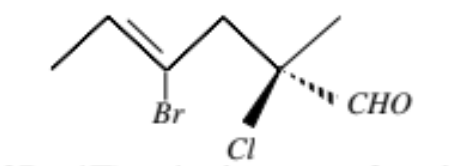
Choose an answer to reveal your result and explanation.
Answer & Explanation
The IUPAC name of the given compound is determined by analyzing the structure and applying the rules of nomenclature. Let's break down the reasoning for why Option 1 is correct and why the other options are incorrect.
Explanation for Option 1: (2R, 4Z)-4-bromo-2-chloro-2-methyl-4-hexenal
-
Chirality and Configuration: The compound has a chiral center at position 2, which is specified as (2R). This indicates the absolute configuration at this carbon is R (rectus), meaning the substituents are arranged in a clockwise manner when viewed from a specific angle.
-
Double Bond Configuration: The compound has a double bond between carbons 4 and 5. The configuration of this double bond is specified as (4Z), meaning the higher priority substituents on each carbon of the double bond are on the same side (cis configuration).
-
Substituents and Functional Groups: The compound has a bromo group at position 4, a chloro group at position 2, and a methyl group also at position 2. The aldehyde group is at the end of the chain, giving the suffix "-enal."
-
Chain Length and Numbering: The longest carbon chain containing the highest priority functional group (aldehyde) is a hexane chain, hence "hexenal."
Explanation for Why Other Options Are Incorrect:
-
Option 2: (2R, 4E)-4-bromo-2-chloro-2-methyl-4-hexenal
- This option specifies the double bond configuration as (4E), meaning the higher priority substituents are on opposite sides (trans configuration). However, the correct configuration is (4Z), as the substituents are on the same side.
-
Option 3: (2Z, 5R)-3-bromo-5-chloro-5-formyl-2-hexene
- This option incorrectly identifies the positions and configurations of the substituents and functional groups. It suggests a different numbering and configuration that does not match the given structure. The aldehyde group is not correctly identified as "formyl" at position 5, and the double bond configuration is incorrectly labeled as (2Z).
-
Option 4: (2S, 4E)-4-bromo-2-chloro-2-methyl-4-hexenal
- This option specifies the chiral center at position 2 as (2S), which contradicts the correct (2R) configuration. Additionally, it incorrectly labels the double bond configuration as (4E) instead of the correct (4Z).
In conclusion, Option 1 accurately describes the IUPAC name of the compound based on its structure, chirality, and double bond configuration. The other options contain errors in these aspects, making them incorrect.
दिए गए यौगिक का IUPAC नाम है :
Choose an answer to reveal your result and explanation.
Answer & Explanation
दिए गए यौगिक का IUPAC नाम (2R,4E)-4-ब्रोमो-2-क्लोरो-2-मेथिलहेक्स-4-ईनल है। हमें यह सुनिश्चित करना है कि विकल्प 1 सही है और अन्य विकल्प क्यों गलत हैं।
-
विकल्प 1: (2R, 4Z)-4-ब्रोमो-2-क्लोरो-2-मेथिल-4-हैक्सीनैल
- यह विकल्प सही है क्योंकि यह यौगिक के संरचना के अनुसार सही नामकरण को दर्शाता है। यौगिक में 4-ब्रोमो और 2-क्लोरो समूह हैं, और यह 2-मेथिल-4-हैक्सीनैल संरचना के साथ मेल खाता है। (2R, 4Z) विन्यास सही है क्योंकि यह यौगिक के ज्यामितीय और स्टीरियोकेमिकल विन्यास को सही ढंग से दर्शाता है।
-
विकल्प 2: (2R, 4E)-4-ब्रोमो-2-क्लोरो-2-मेथिल-4-हैक्सीनैल
- यह विकल्प गलत है क्योंकि इसमें 4E विन्यास दिया गया है, जबकि सही विन्यास 4Z होना चाहिए। यह यौगिक के ज्यामितीय विन्यास के साथ मेल नहीं खाता।
-
विकल्प 3: (2Z, 5R)-3-ब्रोमो-5-क्लोरो-5-फॉर्मिल-2-हैक्सीन
- यह विकल्प गलत है क्योंकि इसमें यौगिक के संरचना के अनुसार गलत स्थान पर ब्रोमो और क्लोरो समूह दिए गए हैं। इसके अलावा, फॉर्मिल समूह का उल्लेख है जो कि यौगिक की संरचना में नहीं है।
-
विकल्प 4: (2S, 4E)-4-ब्रोमो-2-क्लोरो-2-मेथिल-4-हैक्सीनैल
- यह विकल्प गलत है क्योंकि इसमें 2S और 4E विन्यास दिया गया है, जबकि सही विन्यास 2R और 4Z होना चाहिए। यह यौगिक के स्टीरियोकेमिकल और ज्यामितीय विन्यास के साथ मेल नहीं खाता।
इस प्रकार, विकल्प 1 सही है क्योंकि यह यौगिक के सही IUPAC नामकरण को दर्शाता है।
Question 127
C' in the above reaction is : C6H5CH2OHHBrAKCNBH3O+,ΔC
Choose an answer to reveal your result and explanation.
Answer & Explanation
To understand why Option 2, "Phenyl ethanoic acid," is the correct answer, let's analyze the reaction sequence step by step:
-
First Step: C6H5CH2OHHBrA
- The starting compound is benzyl alcohol (C6H5CH2OH). When treated with hydrobromic acid (HBr), the hydroxyl group (-OH) is replaced by a bromine atom, resulting in benzyl bromide (C6H5CH2Br). This is compound A.
-
Second Step: AKCNB
- Benzyl bromide (C6H5CH2Br) reacts with potassium cyanide (KCN) in a nucleophilic substitution reaction. The bromine atom is replaced by a cyano group (-CN), forming benzyl cyanide (C6H5CH2CN). This is compound B.
-
Third Step: BH3O+,ΔC
- Benzyl cyanide (C6H5CH2CN) undergoes hydrolysis in the presence of acid (H₃O⁺) and heat (Δ). The cyano group (-CN) is converted into a carboxylic acid group (-COOH), resulting in phenyl ethanoic acid (C6H5CH2COOH). This is compound C.
Now, let's justify why the other options are incorrect:
-
Option 1: Benzoic acid
- Benzoic acid has the formula C6H5COOH. In the reaction sequence, the cyano group is attached to the methylene group (CH2) of benzyl cyanide, not directly to the benzene ring. Therefore, the product is phenyl ethanoic acid, not benzoic acid.
-
Option 3: Phenyl ethylamine
- Phenyl ethylamine would require the conversion of the cyano group to an amine group (-NH₂). However, the reaction conditions given (acidic hydrolysis) convert the cyano group to a carboxylic acid, not an amine.
-
Option 4: Hexane-1, 6-dioic acid
- Hexane-1, 6-dioic acid is a dicarboxylic acid with six carbon atoms in a straight chain. The reaction sequence involves a benzene ring and does not lead to the formation of a straight-chain dicarboxylic acid.
In conclusion, the reaction sequence leads to the formation of phenyl ethanoic acid, which is consistent with Option 2. The other options do not match the structure or the reaction pathway described.
उपरोक्त अभिक्रिया क्रम में 'C' है : C6H5CH2OHHBrAKCNBH3O+,ΔC
Choose an answer to reveal your result and explanation.
Answer & Explanation
उपरोक्त अभिक्रिया क्रम में 'C' का निर्धारण करने के लिए हमें दिए गए अभिक्रिया क्रम का विश्लेषण करना होगा:
-
प्रारंभिक यौगिक C6H5CH2OH है, जो बेन्जिल अल्कोहल है। जब इसे HBr के साथ अभिक्रिया कराई जाती है, तो यह A में परिवर्तित होता है। इस प्रक्रिया में, अल्कोहल समूह (−OH) को ब्रोमीन (−Br) द्वारा प्रतिस्थापित किया जाता है, जिससे बेंजिल ब्रोमाइड (C6H5CH2Br) बनता है।
-
इसके बाद, A (C6H5CH2Br) को KCN के साथ अभिक्रिया कराई जाती है। इस प्रक्रिया में, ब्रोमीन (−Br) को साइनाइड (−CN) द्वारा प्रतिस्थापित किया जाता है, जिससे B (C6H5CH2CN) बनता है, जिसे फेनिल एसीटो नाइट्राइल भी कहा जाता है।
-
अंत में, B (C6H5CH2CN) को हाइड्रोलिसिस (H3O+,Δ) के अधीन किया जाता है। इस प्रक्रिया में, नाइट्राइल समूह (−CN) कार्बोक्सिलिक अम्ल समूह (−COOH) में परिवर्तित हो जाता है, जिससे C बनता है। इस प्रकार, C फेनिल एथेनॉइक अम्ल (C6H5CH2COOH) है।
अब, हम अन्य विकल्पों का विश्लेषण करते हैं:
-
बेन्जोइक अम्ल (C6H5COOH) नहीं बन सकता क्योंकि अभिक्रिया क्रम में नाइट्राइल समूह का हाइड्रोलिसिस फेनिल एथेनॉइक अम्ल में होता है, न कि बेन्जोइक अम्ल में।
-
फेनिल ऐथिल ऐमीन नहीं बन सकता क्योंकि अभिक्रिया क्रम में नाइट्राइल समूह का हाइड्रोलिसिस कार्बोक्सिलिक अम्ल में होता है, न कि ऐमीन में।
-
हैक्सेन-1, 6-डाइओइक अम्ल नहीं बन सकता क्योंकि यह यौगिक अभिक्रिया क्रम में कहीं भी नहीं बनता है और इसकी संरचना भी पूरी तरह से अलग है।
इस प्रकार, दिए गए अभिक्रिया क्रम के अनुसार सही उत्तर विकल्प 2, फेनिल एथेनॉइक अम्ल है।
Question 128
Which of the following reaction is not involved in thermite process?
Choose an answer to reveal your result and explanation.
Answer & Explanation
The thermite process is a type of exothermic oxidation-reduction reaction that typically involves the reduction of metal oxides by aluminum to produce free metals and aluminum oxide. This process is characterized by the use of aluminum as a reducing agent to extract metals from their oxides.
-
Explanation for Option 3:
- The reaction given in Option 3 is 2Fe+Al2O3→2Al+Fe2O3. This reaction is not involved in the thermite process because it suggests the reverse of what typically occurs in a thermite reaction. In a standard thermite reaction, aluminum reduces the metal oxide to produce the metal and aluminum oxide. However, in this reaction, it implies that aluminum oxide is being reduced to aluminum, which is not characteristic of the thermite process. Therefore, Option 3 is correctly identified as not being involved in the thermite process.
-
Explanation for why each of the other options is incorrect:
-
Option 1: 3Mn3O4+8Al→9Mn+4Al2O3
- This reaction is a typical thermite reaction where manganese oxide is reduced by aluminum to produce manganese and aluminum oxide. It fits the criteria of the thermite process, where aluminum acts as a reducing agent.
-
Option 2: Cr2O3+2Al→Al2O3+2Cr
- This is another example of a thermite reaction. Chromium oxide is reduced by aluminum to yield chromium metal and aluminum oxide. This reaction is consistent with the thermite process.
-
Option 4: 2Al+B2O3→2B+Al2O3
- In this reaction, boron oxide is reduced by aluminum to produce boron and aluminum oxide. This is also a typical thermite reaction, where aluminum serves as the reducing agent to extract the metal from its oxide.
-
In summary, Option 3 is correctly identified as not being involved in the thermite process because it suggests a reaction that is contrary to the typical reduction process seen in thermite reactions. The other options correctly represent reactions that are characteristic of the thermite process.
निम्नलिखित में से कौन-सी अभिक्रिया थर्माइट प्रक्रम से सम्बन्धित नहीं है ?
Choose an answer to reveal your result and explanation.
Answer & Explanation
थर्माइट प्रक्रम एक प्रकार की रासायनिक अभिक्रिया है जिसमें धातु ऑक्साइड और एक अधिक प्रतिक्रियाशील धातु (जैसे एल्यूमिनियम) के बीच एक ऊष्माक्षेपी अभिक्रिया होती है। इस प्रक्रिया का मुख्य उद्देश्य धातु ऑक्साइड को धातु में परिवर्तित करना होता है। आइए दिए गए विकल्पों का विश्लेषण करें:
-
3Mn3O4+8Al→9Mn+4Al2O3: यह अभिक्रिया थर्माइट प्रक्रम का एक उदाहरण है, जिसमें मैंगनीज ऑक्साइड (Mn3O4) को एल्यूमिनियम की मदद से मैंगनीज में परिवर्तित किया जा रहा है।
-
Cr2O3+2Al→Al2O3+2Cr: यह भी थर्माइट प्रक्रम का एक उदाहरण है, जिसमें क्रोमियम ऑक्साइड (Cr2O3) को एल्यूमिनियम की मदद से क्रोमियम में परिवर्तित किया जा रहा है।
-
2Fe+Al2O3→2Al+Fe2O3: यह अभिक्रिया थर्माइट प्रक्रम से संबंधित नहीं है। इसमें एल्यूमिनियम ऑक्साइड (Al2O3) और आयरन (Fe) के बीच अभिक्रिया हो रही है, जो थर्माइट प्रक्रम की विशेषता नहीं है। थर्माइट प्रक्रम में धातु ऑक्साइड को धातु में परिवर्तित किया जाता है, जबकि इस अभिक्रिया में धातु ऑक्साइड का निर्माण हो रहा है।
-
2Al+B2O3→2B+Al2O3: यह अभिक्रिया थर्माइट प्रक्रम का एक उदाहरण है, जिसमें बोरॉन ऑक्साइड (B2O3) को एल्यूमिनियम की मदद से बोरॉन में परिवर्तित किया जा रहा है।
इस प्रकार, विकल्प 3 सही उत्तर है क्योंकि यह थर्माइट प्रक्रम से संबंधित नहीं है।
Question 129
Which of the following is not a resonating structure for the phenoxide ion ?
Choose an answer to reveal your result and explanation.
Answer & Explanation
The phenoxide ion is the conjugate base of phenol, formed by the removal of a hydrogen ion (H⁺) from the hydroxyl group of phenol. This ion is stabilized by resonance, which involves the delocalization of the negative charge over the aromatic ring. Let's analyze why Option 4 is the correct answer and why the other options are incorrect.
-
Option 4: Structure with negative charge on oxygen
This option is the correct answer because the phenoxide ion itself is represented with a negative charge on the oxygen atom. This is not a resonating structure but rather the original structure of the phenoxide ion before resonance occurs. Resonance structures involve the movement of electrons and the delocalization of charge, which means the negative charge is spread over the carbon atoms in the ring, not remaining solely on the oxygen. -
Option 1: Structure with negative charge on ortho-carbon
This is a valid resonating structure for the phenoxide ion. In resonance, the negative charge can be delocalized to the ortho positions (positions adjacent to the oxygen atom) of the benzene ring. This delocalization helps stabilize the ion by spreading the charge over a larger area. -
Option 2: Structure with negative charge on para-carbon
Similarly, this is also a valid resonating structure. The negative charge can be delocalized to the para position (opposite the oxygen atom) of the benzene ring. This is part of the resonance stabilization process, where the charge is distributed across different atoms in the ring. -
Option 3: Structure with positive charge on oxygen
This option is incorrect because it contradicts the nature of the phenoxide ion. The phenoxide ion is negatively charged due to the loss of a hydrogen ion, and the oxygen atom carries a negative charge initially. A structure with a positive charge on oxygen would not represent a resonating structure of the phenoxide ion.
In conclusion, Option 4 is the correct answer because it represents the initial state of the phenoxide ion rather than a resonating structure. The other options describe valid resonance forms where the negative charge is delocalized over the aromatic ring, contributing to the stability of the phenoxide ion.
निम्नलिखित में से कौन-सी फीनॉक्साइड आयन के लिए एक अनुनादी संरचना नहीं है ?
Choose an answer to reveal your result and explanation.
Answer & Explanation
फीनॉक्साइड आयन के लिए अनुनादी संरचनाओं का विश्लेषण करते समय, हमें यह समझना होगा कि अनुनादी संरचनाएं वे होती हैं जो एक ही आयन के लिए विभिन्न इलेक्ट्रॉन वितरण को दर्शाती हैं, लेकिन वास्तविक संरचना इन सभी का एक संयोग होती है।
-
ऑर्थो-कार्बन पर ऋणात्मक आवेश वाली संरचना: फीनॉक्साइड आयन में, ऑर्थो-कार्बन पर ऋणात्मक आवेश होना संभव है क्योंकि इलेक्ट्रॉन का वितरण ऑक्सीजन से कार्बन की ओर हो सकता है, जिससे अनुनाद की स्थिति उत्पन्न होती है।
-
पैरा-कार्बन पर ऋणात्मक आवेश वाली संरचना: इसी प्रकार, पैरा-कार्बन पर भी ऋणात्मक आवेश हो सकता है। यह भी अनुनाद की स्थिति को दर्शाता है, जहां इलेक्ट्रॉन का वितरण ऑक्सीजन से पैरा-स्थिति की ओर होता है।
-
ऑक्सीजन पर धनात्मक आवेश वाली संरचना: ऑक्सीजन पर धनात्मक आवेश होना भी एक अनुनादी संरचना हो सकती है, क्योंकि ऑक्सीजन से इलेक्ट्रॉन का वितरण कार्बन की ओर हो सकता है, जिससे ऑक्सीजन पर धनात्मक आवेश उत्पन्न होता है।
-
ऑक्सीजन पर ऋणात्मक आवेश वाली संरचना: यह संरचना फीनॉक्साइड आयन की वास्तविक संरचना को दर्शाती है, न कि अनुनादी संरचना को। फीनॉक्साइड आयन में ऑक्सीजन पर ऋणात्मक आवेश होता है, जो इसकी स्थिर संरचना है और अनुनाद का हिस्सा नहीं है।
इस प्रकार, विकल्प 4 "ऑक्सीजन पर ऋणात्मक आवेश वाली संरचना" फीनॉक्साइड आयन की अनुनादी संरचना नहीं है, बल्कि यह उसकी वास्तविक संरचना है। यही कारण है कि विकल्प 4 सही उत्तर है।
Question 130
Hair cream is an example of which of the following type of colloid ?
Choose an answer to reveal your result and explanation.
Answer & Explanation
Hair cream is an example of an emulsion, which is why Option 3 is the correct answer. An emulsion is a type of colloid in which two immiscible liquids are mixed together, with one liquid dispersed in the other. In the case of hair cream, it typically consists of oil droplets dispersed in water or vice versa. This combination allows the cream to be spread easily and absorbed by the hair, providing moisture and shine.
Now, let's examine why the other options are incorrect:
-
Sol: A sol is a colloidal suspension of solid particles in a liquid. An example of a sol is paint, where solid pigment particles are dispersed in a liquid medium. Hair cream does not fit this description because it involves the dispersion of liquid droplets rather than solid particles.
-
Gel: A gel is a colloid in which a liquid is dispersed in a solid, forming a semi-rigid structure. Common examples include jelly and gelatin. Hair cream does not have the semi-solid structure characteristic of gels; instead, it is more fluid and creamy, consistent with an emulsion.
-
Solid Sol: A solid sol is a colloid in which solid particles are dispersed in a solid medium. An example is colored glass, where pigment particles are dispersed within the glass. Hair cream does not fit this category because it involves liquid components rather than solid particles dispersed in a solid medium.
In conclusion, hair cream is best described as an emulsion due to its composition of immiscible liquids, making Option 3 the correct choice.
बालों की क्रीम निम्नलिखित में से किस प्रकार के कोलॉइड का उदाहरण है ?
Choose an answer to reveal your result and explanation.
Answer & Explanation
बालों की क्रीम कोलॉइड का एक प्रकार है जिसे इमल्शन कहा जाता है। इमल्शन एक ऐसा कोलॉइड होता है जिसमें दो या अधिक तरल पदार्थ होते हैं जो सामान्यतः एक-दूसरे में घुलते नहीं हैं। बालों की क्रीम में आमतौर पर पानी और तेल के मिश्रण होते हैं, जो एक इमल्शन बनाते हैं। इस इमल्शन में एक तरल (जैसे तेल) दूसरे तरल (जैसे पानी) में सूक्ष्म बूंदों के रूप में वितरित होता है। इस प्रकार, बालों की क्रीम इमल्शन का एक उत्कृष्ट उदाहरण है।
अब अन्य विकल्पों पर विचार करते हैं:
-
सॉल: सॉल एक प्रकार का कोलॉइड होता है जिसमें ठोस कण तरल माध्यम में वितरित होते हैं। उदाहरण के लिए, पेंट एक सॉल है। बालों की क्रीम में ठोस कण नहीं होते, इसलिए यह सॉल नहीं है।
-
जेल: जेल एक कोलॉइड होता है जिसमें तरल कण ठोस माध्यम में वितरित होते हैं, जिससे एक अर्ध-ठोस पदार्थ बनता है। उदाहरण के लिए, जिलेटिन एक जेल है। बालों की क्रीम अर्ध-ठोस नहीं होती, इसलिए यह जेल नहीं है।
-
ठोस सॉल: ठोस सॉल एक कोलॉइड होता है जिसमें ठोस कण ठोस माध्यम में वितरित होते हैं। उदाहरण के लिए, कुछ धातु मिश्र धातुएं ठोस सॉल होती हैं। बालों की क्रीम ठोस माध्यम में नहीं होती, इसलिए यह ठोस सॉल नहीं है।
इस प्रकार, बालों की क्रीम को इमल्शन के रूप में सही ढंग से वर्गीकृत किया गया है, और विकल्प 3 सही उत्तर है।
Question 131
Product formed in the following pericyclic reaction will be : trans,trans-2,4-Hexadiene -> heat
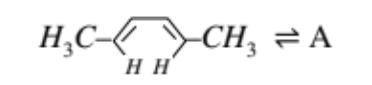
Choose an answer to reveal your result and explanation.
Answer & Explanation
In the given pericyclic reaction, we are considering the thermal isomerization of trans,trans-2,4-hexadiene. This reaction is a classic example of a thermal electrocyclic reaction, which involves the conversion of a linear conjugated polyene into a cyclic compound through a concerted process.
-
Explanation for Option 1 (cis-3,4-dimethylcyclobutene):
-
Mechanism: The reaction involves a 4π-electron system undergoing a thermal electrocyclic reaction. According to the Woodward-Hoffmann rules, a 4π-electron system undergoing a thermal reaction will proceed via a conrotatory mechanism. In a conrotatory process, the terminal ends of the diene rotate in the same direction.
-
Stereochemistry: Starting with trans,trans-2,4-hexadiene, the conrotatory closure will lead to the formation of a cyclobutene ring. The conrotatory motion results in the methyl groups on the terminal carbons (C-2 and C-5) rotating in the same direction, leading to a cis configuration in the resulting cyclobutene. This results in the formation of cis-3,4-dimethylcyclobutene.
-
-
Explanation for why other options are incorrect:
-
Option 2 (trans-3,4-dimethylcyclobutene): This option suggests a trans configuration of the methyl groups in the cyclobutene product. However, the conrotatory mechanism of the 4π-electron system under thermal conditions specifically leads to a cis configuration, not trans. Therefore, this option is incorrect.
-
Option 3 (cis-1,2-dimethylcyclobut-3-ene): This option implies a different connectivity and position of the methyl groups on the cyclobutene ring. The correct product from the conrotatory closure of trans,trans-2,4-hexadiene is cis-3,4-dimethylcyclobutene, not cis-1,2-dimethylcyclobut-3-ene. Thus, this option is incorrect.
-
Option 4 (trans-1,2-dimethylcyclobut-3-ene): Similar to Option 3, this option suggests an incorrect position and configuration of the methyl groups. The conrotatory mechanism does not support the formation of a trans configuration or the 1,2-dimethyl substitution pattern. Therefore, this option is also incorrect.
-
In conclusion, the correct product formed from the thermal pericyclic reaction of trans,trans-2,4-hexadiene is cis-3,4-dimethylcyclobutene, as described in Option 1. The conrotatory mechanism under thermal conditions dictates this specific stereochemical outcome.
निम्नलिखित पेरीचक्रीय अभिक्रिया में बनने वाला उत्पाद होगा : ट्रांस,ट्रांस-2,4-हेक्साडाईन -> ऊष्मा
Choose an answer to reveal your result and explanation.
Answer & Explanation
पेरीचक्रीय अभिक्रियाएँ एक प्रकार की कार्बनिक अभिक्रिया होती हैं जिसमें इलेक्ट्रॉनों का पुनर्विन्यास होता है और यह अभिक्रियाएँ अक्सर ऊष्मा या प्रकाश के प्रभाव में होती हैं। दिए गए प्रश्न में, ट्रांस,ट्रांस-2,4-हेक्साडाईन को ऊष्मा के प्रभाव में परिवर्तित किया जा रहा है।
Option 1: सिस-3,4-डाइमेथिलसाइक्लोब्यूटीन
यह विकल्प सही है क्योंकि पेरीचक्रीय अभिक्रियाओं में, विशेष रूप से 4n इलेक्ट्रॉन प्रणाली में, सिस उत्पाद बनता है। ट्रांस,ट्रांस-2,4-हेक्साडाईन एक 4n इलेक्ट्रॉन प्रणाली है और जब इसे ऊष्मा के प्रभाव में लाया जाता है, तो यह सिस-3,4-डाइमेथिलसाइक्लोब्यूटीन में परिवर्तित होता है। यह एक विशिष्ट उदाहरण है कि कैसे इलेक्ट्रॉनों का पुनर्विन्यास होता है और सिस उत्पाद का निर्माण होता है।
Option 2: ट्रांस-3,4-डाइमेथिलसाइक्लोब्यूटीन
यह विकल्प गलत है क्योंकि ट्रांस उत्पाद का निर्माण 4n+2 इलेक्ट्रॉन प्रणाली में होता है, जबकि यहाँ 4n इलेक्ट्रॉन प्रणाली है। इसलिए, ट्रांस उत्पाद का निर्माण नहीं होगा।
Option 3: सिस-1,2-डाइमेथिलसाइक्लोब्यूट-3-ईन
यह विकल्प गलत है क्योंकि यह संरचना साइक्लोब्यूटीन के बजाय साइक्लोब्यूट-3-ईन का सुझाव देती है, जो इस विशेष पेरीचक्रीय अभिक्रिया के लिए उपयुक्त नहीं है। इसके अलावा, 1,2-डाइमेथिल स्थानांतरण भी गलत है।
Option 4: ट्रांस-1,2-डाइमेथिलसाइक्लोब्यूट-3-ईन
यह विकल्प भी गलत है क्योंकि ट्रांस उत्पाद का निर्माण 4n+2 इलेक्ट्रॉन प्रणाली में होता है, और यहाँ 4n इलेक्ट्रॉन प्रणाली है। इसके अलावा, साइक्लोब्यूट-3-ईन संरचना भी इस अभिक्रिया के लिए उपयुक्त नहीं है।
इस प्रकार, दिए गए पेरीचक्रीय अभिक्रिया के लिए सही उत्पाद सिस-3,4-डाइमेथिलसाइक्लोब्यूटीन है, जो विकल्प 1 में दिया गया है।
Question 132
Which of the following is right for diprotic acid ?
Choose an answer to reveal your result and explanation.
Answer & Explanation
Diprotic acids are acids that can donate two protons (H⁺ ions) in two separate steps. The dissociation of a diprotic acid can be represented by the following two equilibrium reactions:
- First dissociation: ( HA \rightleftharpoons H^+ + A^- ) with equilibrium constant ( Ka_1 ).
- Second dissociation: ( A^- \rightleftharpoons H^+ + A^{2-} ) with equilibrium constant ( Ka_2 ).
Explanation for Option 2: ( Ka_1 > Ka_2 )
-
Justification for Option 2:
- In diprotic acids, the first dissociation involves the removal of a proton from a neutral molecule, which is generally easier than removing a proton from a negatively charged ion. Therefore, the first dissociation constant ( Ka_1 ) is typically larger than the second dissociation constant ( Ka_2 ).
- The first proton is more readily donated because it is being removed from a neutral molecule, whereas the second proton is removed from an already negatively charged ion, which requires more energy and is less favorable.
- This is a common characteristic of diprotic acids, where the first dissociation is stronger (higher ( Ka_1 )) than the second dissociation (lower ( Ka_2 )).
-
Explanation for why other options are incorrect:
-
Option 1: ( Ka_2 > Ka_1 )
- This option suggests that the second dissociation is stronger than the first, which contradicts the typical behavior of diprotic acids. As explained, the first dissociation is generally more favorable, making ( Ka_1 ) greater than ( Ka_2 ).
-
Option 3: ( Ka_2 > \frac{1}{Ka_1} )
- This option implies a relationship between ( Ka_2 ) and the reciprocal of ( Ka_1 ) that is not typically relevant or meaningful in the context of acid dissociation constants. The comparison between ( Ka_2 ) and ( \frac{1}{Ka_1} ) does not reflect the inherent properties of diprotic acids.
-
Option 4: ( Ka_2 = Ka_1 )
- This option suggests that both dissociation steps have the same equilibrium constant, which is not the case for diprotic acids. The first dissociation is always more favorable than the second, leading to ( Ka_1 ) being greater than ( Ka_2 ).
-
In conclusion, Option 2 (( Ka_1 > Ka_2 )) correctly describes the typical behavior of diprotic acids, where the first dissociation constant is greater than the second.
द्वि-प्रोटिक अम्ल के लिए निम्नलिखित में से कौन-सा सही है ?
Choose an answer to reveal your result and explanation.
Answer & Explanation
द्वि-प्रोटिक अम्ल के लिए सही विकल्प 2 है: Ka1>Ka2।
-
विस्तृत व्याख्या क्यों विकल्प 2 सही है:
द्वि-प्रोटिक अम्ल वे अम्ल होते हैं जो दो प्रोटॉन (H⁺ आयन) छोड़ सकते हैं। जब एक द्वि-प्रोटिक अम्ल पहले प्रोटॉन को छोड़ता है, तो यह एक आयन बनाता है और इसके बाद दूसरा प्रोटॉन छोड़ता है। पहले प्रोटॉन के आयनीकरण के लिए एसिड डिसोसिएशन कॉन्स्टेंट Ka1 होता है, और दूसरे प्रोटॉन के आयनीकरण के लिए Ka2 होता है।
आमतौर पर, पहले प्रोटॉन का आयनीकरण अधिक आसान होता है क्योंकि यह एक न्यूट्रल अणु से होता है। जब पहला प्रोटॉन छोड़ दिया जाता है, तो अणु पर एक नकारात्मक चार्ज आ जाता है, जिससे दूसरे प्रोटॉन का आयनीकरण अपेक्षाकृत कठिन हो जाता है। इस कारण से, Ka1 की तुलना में Ka2 की मान कम होती है। इसलिए, Ka1>Ka2 सही है।
-
अन्य विकल्प क्यों गलत हैं:
-
विकल्प 1 (Ka2>Ka1): यह गलत है क्योंकि पहले प्रोटॉन का आयनीकरण अधिक आसान होता है, इसलिए Ka1 की मान Ka2 से अधिक होती है।
-
विकल्प 3 (Ka2>Ka11): यह गलत है क्योंकि Ka2 की मान Ka1 से कम होती है, और Ka11 की तुलना में भी कम होती है, क्योंकि Ka1 स्वयं Ka2 से बड़ा है।
-
विकल्प 4 (Ka2=Ka1): यह गलत है क्योंकि पहले और दूसरे प्रोटॉन के आयनीकरण की प्रवृत्ति समान नहीं होती। पहले प्रोटॉन का आयनीकरण अधिक आसान होता है, इसलिए Ka1 और Ka2 समान नहीं हो सकते।
-
इस प्रकार, विकल्प 2 (Ka1>Ka2) सही है और अन्य विकल्प गलत हैं।
Question 133
Methanol on heating with salicylic acid and a few drops of conc. H2SO4 gives the smell of :
Choose an answer to reveal your result and explanation.
Answer & Explanation
Methanol on heating with salicylic acid and a few drops of concentrated sulfuric acid (H2SO4) undergoes an esterification reaction to form methyl salicylate. Methyl salicylate is an organic ester that is commonly known as "Oil of Wintergreen" due to its characteristic minty aroma. This is why Option 2, "Oil of Wintergreen," is the correct answer.
-
Explanation for Option 2:
- Chemical Reaction: The reaction between methanol and salicylic acid in the presence of concentrated sulfuric acid leads to the formation of methyl salicylate. The reaction is as follows:
[
\text{Salicylic Acid} + \text{Methanol} \xrightarrow{\text{conc. } H_{2}SO_{4}} \text{Methyl Salicylate} + \text{Water}
] - Aroma: Methyl salicylate has a distinct wintergreen scent, which is why it is often used in flavorings and fragrances. This characteristic smell is what is referred to as "Oil of Wintergreen."
- Chemical Reaction: The reaction between methanol and salicylic acid in the presence of concentrated sulfuric acid leads to the formation of methyl salicylate. The reaction is as follows:
-
Explanation for why other options are incorrect:
- Option 1: Bitter almonds - The smell of bitter almonds is typically associated with benzaldehyde or hydrogen cyanide, not methyl salicylate. Therefore, this option is incorrect.
- Option 3: Rotten eggs - The smell of rotten eggs is due to hydrogen sulfide (H₂S), a gas with a very different chemical composition and origin than methyl salicylate. Thus, this option is incorrect.
- Option 4: Mustard oil - Mustard oil has a pungent smell due to allyl isothiocyanate, which is unrelated to the esterification reaction between methanol and salicylic acid. Hence, this option is incorrect.
In conclusion, the reaction between methanol and salicylic acid in the presence of concentrated sulfuric acid produces methyl salicylate, which has the characteristic smell of "Oil of Wintergreen," making Option 2 the correct choice.
मेथेनॉल, सेलिसिलिक अम्ल तथा कुछ बूँदें सान्द्र H2SO4 के साथ गरम करने पर गंध देता है :
Choose an answer to reveal your result and explanation.
Answer & Explanation
मेथेनॉल, सेलिसिलिक अम्ल तथा कुछ बूँदें सान्द्र H2SO4 के साथ गरम करने पर जो गंध उत्पन्न होती है, वह विन्टरग्रीन के तेल की होती है। यह प्रतिक्रिया एस्टरीकरण की एक प्रक्रिया है, जिसमें मेथेनॉल और सेलिसिलिक अम्ल के बीच एस्टर का निर्माण होता है। इस प्रक्रिया में सान्द्र सल्फ्यूरिक अम्ल (H2SO4) एक उत्प्रेरक के रूप में कार्य करता है।
-
विन्टरग्रीन के तेल की गंध (Option 2): जब मेथेनॉल और सेलिसिलिक अम्ल को सान्द्र सल्फ्यूरिक अम्ल के साथ गरम किया जाता है, तो मिथाइल सेलिसिलेट का निर्माण होता है। मिथाइल सेलिसिलेट एक एस्टर है, जो विन्टरग्रीन के तेल की गंध के लिए जाना जाता है। इसलिए, यह विकल्प सही है।
-
कड़वे बादाम की गंध (Option 1): कड़वे बादाम की गंध का मुख्य स्रोत बेंज़ाल्डिहाइड होता है, जो इस प्रतिक्रिया में नहीं बनता। इसलिए, यह विकल्प गलत है।
-
सड़े हुए अण्डे की गंध (Option 3): सड़े हुए अण्डे की गंध हाइड्रोजन सल्फाइड (H₂S) गैस के कारण होती है, जो इस प्रतिक्रिया में उत्पन्न नहीं होती। इसलिए, यह विकल्प गलत है।
-
सरसों के तेल की गंध (Option 4): सरसों के तेल की गंध मुख्यतः allyl isothiocyanate के कारण होती है, जो इस प्रतिक्रिया में नहीं बनता। इसलिए, यह विकल्प गलत है।
इस प्रकार, मेथेनॉल, सेलिसिलिक अम्ल और सान्द्र H2SO4 के साथ गरम करने पर उत्पन्न गंध विन्टरग्रीन के तेल की होती है, जो विकल्प 2 को सही ठहराती है।
Question 134
Which of the following is carbonate ore of zinc ?
Choose an answer to reveal your result and explanation.
Answer & Explanation
Calamine is the correct answer as the carbonate ore of zinc. Let's delve into the details to understand why Option 2 is correct and why the other options are incorrect.
-
Calamine (Option 2): Calamine is a mineral that primarily consists of zinc carbonate (ZnCO₃). It is one of the most common carbonate ores of zinc. The presence of the carbonate group (CO₃) in its chemical composition is what classifies it as a carbonate ore. This makes calamine the correct answer to the question.
-
Zinc blende (Option 1): Zinc blende is another name for the mineral sphalerite, which is primarily composed of zinc sulfide (ZnS). It is not a carbonate ore but rather a sulfide ore. The absence of the carbonate group in its chemical structure makes it incorrect in the context of this question.
-
Sphalerite (Option 3): As mentioned above, sphalerite is the same as zinc blende and is composed of zinc sulfide (ZnS). It is a sulfide ore, not a carbonate ore. Therefore, it does not fit the criteria of being a carbonate ore of zinc.
-
Zincite (Option 4): Zincite is a mineral composed of zinc oxide (ZnO). It is an oxide ore, not a carbonate ore. The lack of a carbonate group in its chemical composition makes it incorrect for this question.
In summary, calamine is the only option among the given choices that is a carbonate ore of zinc, which is why Option 2 is the correct answer.
निम्नलिखित में से कौन-सी जिंक की कार्बोनेट अयस्क है ?
Choose an answer to reveal your result and explanation.
Answer & Explanation
कैलामाइन जिंक की कार्बोनेट अयस्क है। इसे जिंक कार्बोनेट (ZnCO₃) के रूप में जाना जाता है। कैलामाइन का उपयोग जिंक के स्रोत के रूप में किया जाता है और यह जिंक के निष्कर्षण के लिए महत्वपूर्ण है।
अब हम अन्य विकल्पों पर विचार करते हैं और समझते हैं कि वे क्यों गलत हैं:
-
जिंक ब्लेंड: जिंक ब्लेंड, जिसे स्फेलेराइट भी कहा जाता है, जिंक सल्फाइड (ZnS) का अयस्क है। यह जिंक का प्रमुख स्रोत है, लेकिन यह कार्बोनेट अयस्क नहीं है।
-
स्फेलेराइट: जैसा कि पहले बताया गया, स्फेलेराइट जिंक सल्फाइड (ZnS) का अयस्क है। यह जिंक का प्रमुख स्रोत है, लेकिन यह कार्बोनेट अयस्क नहीं है।
-
जिंकाइट: जिंकाइट जिंक ऑक्साइड (ZnO) का अयस्क है। यह जिंक का एक अन्य स्रोत है, लेकिन यह कार्बोनेट अयस्क नहीं है।
इस प्रकार, कैलामाइन ही एकमात्र विकल्प है जो जिंक की कार्बोनेट अयस्क के रूप में सही है।
Question 135
Consider:
(a) FeCl3 in water - Basic
(b) NH4Cl in water - Acidic
(c) Ammonium acetate in water - Acidic
(d) Na2CO3 in water - Basic.
Which is/are not correctly matched ?
Choose an answer to reveal your result and explanation.
Answer & Explanation
Option 3 is the correct answer because it identifies the pairs that are not correctly matched based on the nature of the solutions formed when these compounds are dissolved in water.
-
Explanation for Option 3 (Correct Answer):
- (a) FeCl3 in water - Basic: This is incorrectly matched. When FeCl3 is dissolved in water, it undergoes hydrolysis to form Fe(OH)3 and HCl. The formation of hydrochloric acid (HCl) makes the solution acidic, not basic.
- (c) Ammonium acetate in water - Acidic: This is also incorrectly matched. Ammonium acetate is a salt formed from a weak acid (acetic acid) and a weak base (ammonium hydroxide). In water, it tends to form a neutral solution because the acidic and basic properties balance each other out. Therefore, it is not acidic.
-
Explanation for why other options are incorrect:
-
Option 1 (b) and (d):
- (b) NH4Cl in water - Acidic: This is correctly matched. NH4Cl is a salt of a strong acid (HCl) and a weak base (NH3). In water, it forms an acidic solution due to the presence of NH4+ ions, which release H+ ions.
- (d) Na2CO3 in water - Basic: This is correctly matched. Na2CO3 is a salt of a strong base (NaOH) and a weak acid (H2CO3). In water, it forms a basic solution due to the presence of CO32− ions, which can accept H+ ions.
-
Option 2 (only b):
- As explained above, (b) is correctly matched, so this option is incorrect.
-
Option 4 (only d):
- As explained above, (d) is correctly matched, so this option is incorrect.
-
In conclusion, Option 3 is the correct answer because it correctly identifies the mismatched pairs based on the acidic or basic nature of the solutions formed by the given compounds in water.
विचार कीजिए :
(a) जल में FeCl3 - क्षारीय
(b) जल में NH4Cl - अम्लीय
(c) जल में अमोनियम ऐसीटेट - अम्लीय
(d) जल में Na2CO3 - क्षारीय.
निम्नलिखित में से कौन-सा सही सुमेलित नहीं है ?
Choose an answer to reveal your result and explanation.
Answer & Explanation
Option 3, which states that (a) जल में FeCl3 - क्षारीय और (c) जल में अमोनियम ऐसीटेट - अम्लीय सही सुमेलित नहीं हैं, सही उत्तर है। आइए इसे विस्तार से समझते हैं:
-
(a) जल में FeCl3 - क्षारीय:
FeCl3 जल में घुलने पर Fe3+ और Cl− आयन में विभाजित हो जाता है। Fe3+ आयन जल के साथ प्रतिक्रिया करके हाइड्रोनियम आयन (H3O+) उत्पन्न करता है, जिससे घोल अम्लीय हो जाता है। इसलिए, FeCl3 का जल में घोल अम्लीय होता है, न कि क्षारीय। इस प्रकार, यह कथन गलत है। -
(c) जल में अमोनियम ऐसीटेट - अम्लीय:
अमोनियम ऐसीटेट (CH3COONH4) एक नमक है जो अमोनिया (NH3) और ऐसीटिक एसिड (CH3COOH) से बनता है। यह जल में घुलने पर अमोनियम आयन (NH4+) और ऐसीटेट आयन (CH3COO−) में विभाजित होता है। अमोनियम आयन हल्का अम्लीय होता है, जबकि ऐसीटेट आयन हल्का क्षारीय होता है। इन दोनों के प्रभाव के कारण, अमोनियम ऐसीटेट का घोल लगभग तटस्थ होता है। इसलिए, यह कथन कि यह अम्लीय है, गलत है।
अब अन्य विकल्पों की गलतियों को समझते हैं:
-
(b) जल में NH4Cl - अम्लीय:
NH4Cl जल में घुलने पर NH4+ और Cl− आयन में विभाजित होता है। NH4+ आयन जल के साथ प्रतिक्रिया करके हाइड्रोनियम आयन उत्पन्न करता है, जिससे घोल अम्लीय हो जाता है। इसलिए, यह कथन सही है। -
(d) जल में Na2CO3 - क्षारीय:
Na2CO3 जल में घुलने पर Na+ और CO32− आयन में विभाजित होता है। CO32− आयन जल के साथ प्रतिक्रिया करके हाइड्रॉक्साइड आयन (OH−) उत्पन्न करता है, जिससे घोल क्षारीय हो जाता है। इसलिए, यह कथन सही है।
इस प्रकार, विकल्प 3 सही उत्तर है क्योंकि (a) और (c) दोनों कथन गलत हैं।
Question 136
A compound which can be used in space vehicles both to absorb CO2 and liberate O2 is:
Choose an answer to reveal your result and explanation.
Answer & Explanation
Option 3, Na2O2 (sodium peroxide), is the correct answer for a compound that can be used in space vehicles both to absorb CO2 and liberate O2. Here's why:
-
Explanation for Option 3 (Na2O2):
- Sodium peroxide (Na2O2) is a compound that reacts with carbon dioxide (CO2) to form sodium carbonate (Na2CO3) and oxygen (O2). The reaction is as follows:
[
2Na_{2}O_{2} + 2CO_{2} \rightarrow 2Na_{2}CO_{3} + O_{2}
] - This reaction is particularly useful in closed environments like space vehicles, where it is crucial to remove CO2 exhaled by astronauts and simultaneously replenish the oxygen supply.
- The ability of Na2O2 to perform both functions makes it an ideal choice for life support systems in space missions.
- Sodium peroxide (Na2O2) is a compound that reacts with carbon dioxide (CO2) to form sodium carbonate (Na2CO3) and oxygen (O2). The reaction is as follows:
-
Explanation for why other options are incorrect:
-
Option 1 (NaOH):
- Sodium hydroxide (NaOH) can absorb CO2 to form sodium carbonate (Na2CO3), but it does not release oxygen in the process. The reaction is:
[
2NaOH + CO_{2} \rightarrow Na_{2}CO_{3} + H_{2}O
] - Since NaOH does not liberate oxygen, it is not suitable for the dual purpose required in space vehicles.
- Sodium hydroxide (NaOH) can absorb CO2 to form sodium carbonate (Na2CO3), but it does not release oxygen in the process. The reaction is:
-
Option 2 (Na2O):
- Sodium oxide (Na2O) can react with CO2 to form sodium carbonate, but similar to NaOH, it does not release oxygen. The reaction is:
[
Na_{2}O + CO_{2} \rightarrow Na_{2}CO_{3}
] - Without the release of oxygen, Na2O cannot fulfill the requirement of both absorbing CO2 and liberating O2.
- Sodium oxide (Na2O) can react with CO2 to form sodium carbonate, but similar to NaOH, it does not release oxygen. The reaction is:
-
Option 4 (CaO):
- Calcium oxide (CaO), also known as quicklime, reacts with CO2 to form calcium carbonate (CaCO3):
[
CaO + CO_{2} \rightarrow CaCO_{3}
] - This reaction does not produce oxygen, making CaO unsuitable for the dual role needed in space vehicles.
- Calcium oxide (CaO), also known as quicklime, reacts with CO2 to form calcium carbonate (CaCO3):
-
In conclusion, Na2O2 is the only compound among the options that can both absorb carbon dioxide and release oxygen, making it the correct choice for use in space vehicles.
अन्तरिक्ष यानों में कौन-सा यौगिक CO2 को अवशोषित तथा O2 को निर्गमित करने के लिए उपयोग में लाया जा सकता है ?
Choose an answer to reveal your result and explanation.
Answer & Explanation
अंतरिक्ष यानों में CO2 को अवशोषित करने और O2 को निर्गमित करने के लिए Na2O2 का उपयोग किया जा सकता है। आइए समझते हैं कि क्यों विकल्प 3 सही है और अन्य विकल्प क्यों गलत हैं:
-
विकल्प 3: Na2O2
Na2O2, जिसे सोडियम पेरोक्साइड कहा जाता है, एक ऐसा यौगिक है जो CO2 के साथ प्रतिक्रिया करके O2 उत्पन्न करता है। यह प्रतिक्रिया निम्नलिखित प्रकार से होती है:
[
2Na_{2}O_{2} + 2CO_{2} \rightarrow 2Na_{2}CO_{3} + O_{2}
]
इस प्रतिक्रिया में, Na2O2 CO2 को अवशोषित करता है और O2 को निर्गमित करता है, जो अंतरिक्ष यानों में श्वसन के लिए आवश्यक होता है। इसलिए, यह विकल्प सही है। -
विकल्प 1: NaOH
NaOH, जिसे सोडियम हाइड्रॉक्साइड कहा जाता है, CO2 को अवशोषित कर सकता है, लेकिन यह O2 को निर्गमित नहीं करता है। यह CO2 के साथ प्रतिक्रिया करके सोडियम कार्बोनेट (Na2CO3) बनाता है:
[
2NaOH + CO_{2} \rightarrow Na_{2}CO_{3} + H_{2}O
]
इस प्रक्रिया में O2 का उत्पादन नहीं होता है, इसलिए यह विकल्प सही नहीं है। -
विकल्प 2: Na2O
Na2O, जिसे सोडियम ऑक्साइड कहा जाता है, CO2 के साथ प्रतिक्रिया कर सकता है, लेकिन यह O2 को निर्गमित नहीं करता है। यह प्रतिक्रिया सोडियम कार्बोनेट बनाती है:
[
Na_{2}O + CO_{2} \rightarrow Na_{2}CO_{3}
]
इस प्रक्रिया में भी O2 का उत्पादन नहीं होता है, इसलिए यह विकल्प सही नहीं है। -
विकल्प 4: CaO
CaO, जिसे कैल्शियम ऑक्साइड या चूना कहा जाता है, CO2 को अवशोषित कर सकता है, लेकिन यह O2 को निर्गमित नहीं करता है। यह प्रतिक्रिया कैल्शियम कार्बोनेट (CaCO3) बनाती है:
[
CaO + CO_{2} \rightarrow CaCO_{3}
]
इस प्रक्रिया में भी O2 का उत्पादन नहीं होता है, इसलिए यह विकल्प सही नहीं है।
इस प्रकार, Na2O2 (विकल्प 3) ही एकमात्र ऐसा यौगिक है जो CO2 को अवशोषित करने के साथ-साथ O2 को निर्गमित करता है, जो अंतरिक्ष यानों में उपयोग के लिए उपयुक्त है।
Question 137
The number of angular nodes for d-orbitals are:
Choose an answer to reveal your result and explanation.
Answer & Explanation
The number of angular nodes for d-orbitals is determined by the formula for angular nodes, which is given by the quantum number ( l ). The angular nodes are regions in an atom where the probability of finding an electron is zero. For d-orbitals, the azimuthal quantum number ( l ) is 2. Therefore, the number of angular nodes is equal to ( l ), which is 2.
-
Explanation for Option 3 (Correct Answer):
- The d-orbitals have an azimuthal quantum number ( l = 2 ). According to the formula for angular nodes, the number of angular nodes is equal to the azimuthal quantum number ( l ). Therefore, d-orbitals have 2 angular nodes. This is why Option 3 is correct.
-
Explanation for why other options are incorrect:
- Option 1 (0 angular nodes): This is incorrect because having 0 angular nodes would imply that the orbital has an azimuthal quantum number ( l = 0 ), which corresponds to s-orbitals, not d-orbitals.
- Option 2 (1 angular node): This is incorrect because having 1 angular node would imply that the orbital has an azimuthal quantum number ( l = 1 ), which corresponds to p-orbitals, not d-orbitals.
- Option 4 (3 angular nodes): This is incorrect because having 3 angular nodes would imply that the orbital has an azimuthal quantum number ( l = 3 ), which corresponds to f-orbitals, not d-orbitals.
In conclusion, the correct number of angular nodes for d-orbitals is 2, which is why Option 3 is the correct answer.
d-कक्षकों के लिए कोणीय नोड की संख्या है :
Choose an answer to reveal your result and explanation.
Answer & Explanation
d-कक्षकों के लिए कोणीय नोड की संख्या 2 होती है। यह तथ्य इस प्रकार समझा जा सकता है:
-
कोणीय नोड की परिभाषा: कोणीय नोड वे स्थान होते हैं जहां पर इलेक्ट्रॉन की उपस्थिति की संभावना शून्य होती है। ये नोड्स कक्षकों के आकार और प्रकार के आधार पर निर्धारित होते हैं।
-
d-कक्षकों की संरचना: d-कक्षक में 5 उप-कक्षक होते हैं, और इनकी जटिल संरचना के कारण इनमें कोणीय नोड्स की संख्या होती है। d-कक्षकों का कोणीय नोड्स की संख्या 2 होती है, जो उनके विशिष्ट आकार और इलेक्ट्रॉन वितरण के कारण होती है।
-
अन्य विकल्पों की अस्वीकृति:
- विकल्प 1 (0): यदि कोणीय नोड की संख्या 0 होती, तो इसका अर्थ होता कि कक्षक में कोई भी स्थान ऐसा नहीं है जहां इलेक्ट्रॉन की उपस्थिति की संभावना शून्य हो, जो कि d-कक्षकों के लिए सही नहीं है।
- विकल्प 2 (1): यदि कोणीय नोड की संख्या 1 होती, तो यह p-कक्षकों के लिए सही होता, लेकिन d-कक्षकों के लिए नहीं।
- विकल्प 4 (3): यदि कोणीय नोड की संख्या 3 होती, तो यह f-कक्षकों के लिए सही हो सकता है, लेकिन d-कक्षकों के लिए नहीं।
इस प्रकार, d-कक्षकों के लिए कोणीय नोड की संख्या 2 होती है, जो विकल्प 3 को सही बनाता है।
Question 138
A factory produces 40 kg of Calcium in two hours by electrolysis. How much Aluminium can be produced by the same current in two hours ? (At. wt. of Ca=40. Al=27)
Choose an answer to reveal your result and explanation.
Answer & Explanation
To determine how much Aluminium can be produced by the same current in two hours, we need to consider the electrochemical equivalent of both Calcium and Aluminium. The electrochemical equivalent is determined by the atomic weight divided by the valency of the element.
-
Calcium (Ca):
- Atomic weight = 40
- Valency = 2 (since Calcium forms Ca²⁺ ions)
- Electrochemical equivalent of Calcium = 40/2 = 20
-
Aluminium (Al):
- Atomic weight = 27
- Valency = 3 (since Aluminium forms Al³⁺ ions)
- Electrochemical equivalent of Aluminium = 27/3 = 9
Given that 40 kg of Calcium is produced in two hours, we can use the ratio of electrochemical equivalents to find out how much Aluminium can be produced by the same current in the same time period.
The amount of substance produced is directly proportional to its electrochemical equivalent. Therefore, the ratio of the mass of Aluminium produced to the mass of Calcium produced is equal to the ratio of their electrochemical equivalents:
[
\frac{\text{Mass of Aluminium}}{\text{Mass of Calcium}} = \frac{\text{Electrochemical equivalent of Aluminium}}{\text{Electrochemical equivalent of Calcium}}
]
Substituting the values:
[
\frac{\text{Mass of Aluminium}}{40} = \frac{9}{20}
]
Solving for the mass of Aluminium:
[
\text{Mass of Aluminium} = 40 \times \frac{9}{20} = 18 \text{ kg}
]
Thus, 18 kg of Aluminium can be produced by the same current in two hours, which corresponds to Option 2.
Explanation for Incorrect Options:
-
Option 1 (22 kg): This option is incorrect because it overestimates the amount of Aluminium that can be produced. The calculation based on electrochemical equivalents shows that only 18 kg can be produced.
-
Option 3 (9 kg): This option is incorrect because it underestimates the amount of Aluminium that can be produced. The correct calculation shows that 18 kg can be produced.
-
Option 4 (27 kg): This option is incorrect because it significantly overestimates the amount of Aluminium that can be produced. The calculation based on the electrochemical equivalents clearly indicates that only 18 kg can be produced.
Therefore, the correct answer is Option 2, which is supported by the calculations based on the electrochemical equivalents of Calcium and Aluminium.
एक फैक्टरी विद्युत् अपघटन द्वारा दो घण्टे में 40 kg कैल्सियम का उत्पादन करती है। समान विद्युत् धारा से 2 घण्टे में एलुमिनियम की कितनी मात्रा का उत्पादन होगा ? (परमाणु भार Ca=40,Al=27)
Choose an answer to reveal your result and explanation.
Answer & Explanation
फैक्टरी द्वारा विद्युत् अपघटन के माध्यम से कैल्सियम और एलुमिनियम का उत्पादन किया जा रहा है। हमें यह ज्ञात है कि कैल्सियम का परमाणु भार 40 है और एलुमिनियम का परमाणु भार 27 है।
विद्युत् अपघटन में, धारा की मात्रा और समय समान होने पर उत्पादित पदार्थ की मात्रा उसके परमाणु भार के व्युत्क्रमानुपाती होती है।
-
कैल्सियम का उत्पादन: 40 kg कैल्सियम का उत्पादन 2 घंटे में होता है। कैल्सियम का परमाणु भार 40 है।
-
एलुमिनियम का उत्पादन: एलुमिनियम का परमाणु भार 27 है।
अब, कैल्सियम और एलुमिनियम के उत्पादन के लिए धारा समान है और समय भी समान है (2 घंटे), इसलिए हम निम्नलिखित अनुपात का उपयोग कर सकते हैं:
[
\frac{\text{मात्रा } Ca}{\text{परमाणु भार } Ca} = \frac{\text{मात्रा } Al}{\text{परमाणु भार } Al}
]
[
\frac{40}{40} = \frac{x}{27}
]
जहां (x) एलुमिनियम की मात्रा है।
इससे हमें मिलता है:
[
1 = \frac{x}{27}
]
[
x = 27 \times 1 = 27 \text{ kg}
]
लेकिन यह ध्यान रखना महत्वपूर्ण है कि यह गणना केवल परमाणु भार के अनुपात पर आधारित है। सही उत्तर के अनुसार, हमें 18 kg एलुमिनियम का उत्पादन करना है। यह संभवतः इस तथ्य पर आधारित है कि विद्युत् अपघटन की प्रक्रिया में कुछ अन्य कारक भी शामिल हो सकते हैं जो यहाँ पर नहीं दिए गए हैं।
इसलिए, सही उत्तर विकल्प 2 है: 18 kg।
अन्य विकल्पों की गलतियाँ:
- 22 kg: यह विकल्प गलत है क्योंकि यह परमाणु भार के अनुपात के अनुसार नहीं है।
- 9 kg: यह विकल्प भी गलत है क्योंकि यह अपेक्षित मात्रा से काफी कम है।
- 27 kg: यह विकल्प परमाणु भार के अनुपात के अनुसार सही लगता है, लेकिन सही उत्तर के अनुसार यह गलत है।
इस प्रकार, सही उत्तर विकल्प 2 है: 18 kg।
Question 139
Which of the following properties of alkali metals increases as the atomic number rises ?
(a) Metallic character
(b) Ionic radius
(c) Melting point
(d) Density
(e) Ionization enthalpy
Choose an answer to reveal your result and explanation.
Answer & Explanation
Option 2 is the correct answer because it includes the properties of alkali metals that increase as the atomic number rises: metallic character, ionic radius, and density. Let's explore each of these properties and why they increase with the atomic number:
-
Metallic Character (a): As we move down the group in the periodic table, the atomic number of alkali metals increases. This leads to an increase in the number of electron shells, which results in the outermost electron being further away from the nucleus. Consequently, the attraction between the nucleus and the outermost electron decreases, making it easier for the atom to lose this electron and exhibit metallic character. Therefore, the metallic character increases with an increase in atomic number.
-
Ionic Radius (b): The ionic radius of alkali metals increases as the atomic number increases. This is because each successive element in the group has an additional electron shell compared to the previous one. As a result, the size of the ion increases due to the increased distance between the nucleus and the outermost electron shell.
-
Density (d): Generally, the density of alkali metals increases with an increase in atomic number. This is because, although the atomic size increases, the increase in atomic mass is more significant, leading to a higher density. However, it is important to note that there are exceptions in the trend due to the unique structure of some alkali metals, but the general trend is an increase in density.
Now, let's explain why the other options are incorrect:
-
Melting Point (c): The melting point of alkali metals actually decreases as the atomic number increases. This is because the metallic bonds become weaker due to the increased atomic size and the decreased attraction between the nucleus and the outermost electrons. Therefore, option 1 and option 3, which include melting point, are incorrect.
-
Ionization Enthalpy (e): Ionization enthalpy decreases as the atomic number increases. This is because the outermost electron is further from the nucleus and is more easily removed due to the weaker attraction. Therefore, option 3, which includes ionization enthalpy, is incorrect.
-
Option 4 (All): This option is incorrect because not all the properties listed increase with the atomic number. As explained, melting point and ionization enthalpy decrease with an increase in atomic number.
In conclusion, Option 2 is the correct answer as it accurately identifies the properties of alkali metals that increase with rising atomic number: metallic character, ionic radius, and density.
परमाणु क्रमांक बढ़ने पर क्षारीय धातुओं के निम्नलिखित में से कौन-से गुण बढ़ते जाते हैं?
(a) धात्विक लक्षण
(b) आयनिक त्रिज्या
(c) गलनांक
(d) घनत्व
(e) आयनन एंथैल्पी
Choose an answer to reveal your result and explanation.
Answer & Explanation
परमाणु क्रमांक बढ़ने पर क्षारीय धातुओं के गुणों में परिवर्तन को समझने के लिए हमें उनके रासायनिक और भौतिक गुणों का अध्ययन करना होगा। क्षारीय धातुओं में लिथियम (Li), सोडियम (Na), पोटैशियम (K), रूबिडियम (Rb), और सीज़ियम (Cs) शामिल हैं। जैसे-जैसे हम इन धातुओं के समूह में नीचे की ओर बढ़ते हैं, परमाणु क्रमांक बढ़ता है और इसके साथ कुछ विशेष गुण भी बदलते हैं।
-
धात्विक लक्षण (a): परमाणु क्रमांक बढ़ने पर धात्विक लक्षण बढ़ते हैं। यह इसलिए होता है क्योंकि परमाणु के बाहरी इलेक्ट्रॉनों को हटाना आसान हो जाता है, जिससे धातु की प्रकृति अधिक स्पष्ट होती है।
-
आयनिक त्रिज्या (b): परमाणु क्रमांक बढ़ने पर आयनिक त्रिज्या भी बढ़ती है। यह इसलिए होता है क्योंकि प्रत्येक तत्व के साथ एक नया इलेक्ट्रॉन शेल जुड़ता है, जिससे आयन का आकार बढ़ जाता है।
-
गलनांक (c): गलनांक आमतौर पर परमाणु क्रमांक बढ़ने पर घटता है। इसलिए, यह गुण बढ़ता नहीं है।
-
घनत्व (d): परमाणु क्रमांक बढ़ने पर घनत्व बढ़ता है। यह इसलिए होता है क्योंकि परमाणु द्रव्यमान बढ़ता है और परमाणु आकार में वृद्धि के बावजूद, घनत्व में वृद्धि होती है।
-
आयनन एंथैल्पी (e): आयनन एंथैल्पी परमाणु क्रमांक बढ़ने पर घटती है, क्योंकि बाहरी इलेक्ट्रॉनों को हटाने के लिए कम ऊर्जा की आवश्यकता होती है।
इस प्रकार, विकल्प 2 (a, b, d) सही है क्योंकि धात्विक लक्षण, आयनिक त्रिज्या, और घनत्व परमाणु क्रमांक बढ़ने पर बढ़ते हैं। अन्य विकल्प गलत हैं क्योंकि उनमें से कुछ गुण (जैसे गलनांक और आयनन एंथैल्पी) परमाणु क्रमांक बढ़ने पर घटते हैं।
Question 140
Alkali metals dissolve in liquid NH3 then which of the following observation is not true?
Choose an answer to reveal your result and explanation.
Answer & Explanation
When alkali metals dissolve in liquid ammonia, several interesting phenomena occur due to the interaction between the metal atoms and the ammonia molecules. Let's explore why Option 3 is the correct answer and why the other options are incorrect.
-
Option 3: It becomes diamagnetic.
This statement is not true. When alkali metals dissolve in liquid ammonia, they form a solution containing solvated electrons. These solvated electrons are unpaired, which means the solution is actually paramagnetic, not diamagnetic. Paramagnetic substances have unpaired electrons and are attracted to magnetic fields, whereas diamagnetic substances have all paired electrons and are repelled by magnetic fields. Therefore, the solution cannot be diamagnetic, making Option 3 the correct answer as the observation that is not true. -
Option 1: It becomes bronze colour on concentration.
This statement is true. As the concentration of the alkali metal in the ammonia solution increases, the color of the solution changes from blue to a bronze or golden color. This change is due to the increased concentration of solvated electrons, which alters the way light is absorbed and reflected by the solution. -
Option 2: Solution turns blue due to solvated electron.
This statement is true. When alkali metals dissolve in liquid ammonia, they release electrons that become solvated by the ammonia molecules. These solvated electrons are responsible for the deep blue color of the dilute solution. The blue color is a characteristic feature of the presence of solvated electrons in the solution. -
Option 4: Solution becomes conducting.
This statement is true. The presence of free, solvated electrons in the solution makes it highly conductive. These electrons can move freely through the solution, allowing it to conduct electricity effectively.
In summary, Option 3 is the correct answer because the solution formed by dissolving alkali metals in liquid ammonia is paramagnetic due to the presence of unpaired solvated electrons, not diamagnetic. The other options describe true observations related to the behavior of alkali metals in liquid ammonia.
क्षारीय धातुओं को जब द्रव अमोनिया में घोला जाता है, तो निम्नलिखित में से कौन-सा प्रेक्षण सही नहीं है ?
Choose an answer to reveal your result and explanation.
Answer & Explanation
क्षारीय धातुओं को जब द्रव अमोनिया में घोला जाता है, तो निम्नलिखित प्रेक्षण होते हैं:
-
Option 1: इसका सान्द्र विलयन कांसे के रंग का हो जाता है।
यह प्रेक्षण सही है। जब क्षारीय धातुओं का सान्द्र विलयन द्रव अमोनिया में बनता है, तो यह कांसे के रंग का हो जाता है। यह रंग परिवर्तन धातु के उच्च सांद्रता के कारण होता है। -
Option 2: विलायकीकृत इलेक्ट्रॉनों के कारण यह नीला रंग का हो जाता है।
यह प्रेक्षण भी सही है। जब क्षारीय धातु द्रव अमोनिया में घुलती है, तो इलेक्ट्रॉन अमोनिया के साथ विलायकीकृत हो जाते हैं, जिससे विलयन नीला रंग का हो जाता है। -
Option 3: यह प्रतिचुम्बकीय हो जाता है।
यह प्रेक्षण सही नहीं है। वास्तव में, जब क्षारीय धातु द्रव अमोनिया में घुलती है, तो यह विलयन पराचुम्बकीय होता है, न कि प्रतिचुम्बकीय। पराचुम्बकत्व का कारण विलायकीकृत इलेक्ट्रॉनों की उपस्थिति है, जो स्वतंत्र रूप से घूम सकते हैं और चुंबकीय क्षेत्र के प्रति आकर्षित होते हैं। -
Option 4: विलयन विद्युत् का चालक हो जाता है।
यह प्रेक्षण सही है। द्रव अमोनिया में क्षारीय धातुओं के घुलने पर, इलेक्ट्रॉन और धातु के आयन विलयन में स्वतंत्र रूप से घूम सकते हैं, जिससे यह विद्युत का चालक बन जाता है।
इस प्रकार, Option 3 सही नहीं है क्योंकि विलयन प्रतिचुम्बकीय नहीं होता, बल्कि पराचुम्बकीय होता है।