
HTET Exam Level 3 PGT
HTET exam Level 3 PGT preparation with Clear Cutoff
Verified Answers and Explanations
by Clear Cutoff
Showing 20 of 20 questions
Question 121
The self condensation of aromatic aldehydes with no α-hydrogen in presence of cyanide ion as catalyst to α-hydroxy ketone is called :
Choose an answer to reveal your result and explanation.
Answer & Explanation
The self-condensation of aromatic aldehydes with no α-hydrogen in the presence of a cyanide ion as a catalyst to form α-hydroxy ketone is known as Benzoin condensation. Let's explore why Option 2 is the correct answer and why the other options are incorrect.
-
Benzoin Condensation (Option 2):
- Benzoin condensation is a reaction that involves the coupling of two molecules of an aromatic aldehyde, such as benzaldehyde, in the presence of a cyanide ion catalyst. This reaction results in the formation of an α-hydroxy ketone, specifically benzoin. The cyanide ion acts as a nucleophile, attacking the carbonyl carbon of the aldehyde, which leads to the formation of a cyanohydrin intermediate. This intermediate then undergoes further reaction to yield the final α-hydroxy ketone product. This process is characteristic of benzoin condensation, making Option 2 the correct choice.
-
Canizzaro's Reaction (Option 1):
- Canizzaro's reaction involves the disproportionation of non-enolizable aldehydes (aldehydes without α-hydrogens) in the presence of a strong base, typically yielding an alcohol and a carboxylic acid salt. This reaction does not involve the formation of α-hydroxy ketones, and it does not use cyanide ions as a catalyst. Therefore, Option 1 is incorrect in the context of the given reaction.
-
Perkin Condensation (Option 3):
- Perkin condensation is a reaction used to synthesize cinnamic acids by the condensation of an aromatic aldehyde with an anhydride in the presence of a base. This reaction is not related to the formation of α-hydroxy ketones and does not involve cyanide ions. Thus, Option 3 is not applicable to the described reaction.
-
Stobbe Condensation (Option 4):
- Stobbe condensation involves the reaction of an aldehyde or ketone with a diester of succinic acid to form a substituted succinic acid derivative. This reaction is distinct from benzoin condensation and does not involve the formation of α-hydroxy ketones or the use of cyanide ions. Therefore, Option 4 is incorrect for the given reaction.
In conclusion, the correct answer is Option 2, Benzoin condensation, as it specifically describes the self-condensation of aromatic aldehydes with no α-hydrogen in the presence of a cyanide ion catalyst to form α-hydroxy ketones.
α-हाइड्रोजन रहित ऐरोमैटिक ऐल्डिहाइडों का सायनाइड आयन उत्प्रेरक से स्वतः संघनन द्वारा α-हाइड्रॉक्सी कीटोन बनने को कहते हैं:
Choose an answer to reveal your result and explanation.
Answer & Explanation
α-हाइड्रोजन रहित ऐरोमैटिक ऐल्डिहाइडों का सायनाइड आयन उत्प्रेरक से स्वतः संघनन द्वारा α-हाइड्रॉक्सी कीटोन बनने की प्रक्रिया को बेन्जोइन संघनन कहा जाता है। यह प्रतिक्रिया विशेष रूप से ऐरोमैटिक ऐल्डिहाइडों के लिए होती है, जहाँ सायनाइड आयन एक उत्प्रेरक के रूप में कार्य करता है और ऐल्डिहाइड के कार्बोनिल कार्बन पर न्यूक्लियोफिलिक हमले की शुरुआत करता है। इसके परिणामस्वरूप एक α-हाइड्रॉक्सी कीटोन का निर्माण होता है, जिसे बेन्जोइन कहा जाता है। इस प्रक्रिया का नामकरण इसी उत्पाद के नाम पर किया गया है।
अब अन्य विकल्पों पर विचार करते हैं:
-
कैनिजारो अभिक्रिया: यह प्रतिक्रिया उन ऐल्डिहाइडों के लिए होती है जिनमें α-हाइड्रोजन नहीं होता है। इसमें ऐल्डिहाइड का एक अणु ऑक्सीकृत होकर कार्बोक्सिलिक एसिड बनता है और दूसरा अणु अवकृत होकर अल्कोहल बनता है। यह प्रतिक्रिया α-हाइड्रॉक्सी कीटोन नहीं बनाती है, इसलिए यह विकल्प गलत है।
-
पर्किन संघनन: यह प्रतिक्रिया ऐरोमैटिक ऐल्डिहाइड और ऐनहाइड्राइड के बीच होती है, जिसमें एक α,β-असंतृप्त एसिड का निर्माण होता है। यह प्रक्रिया α-हाइड्रॉक्सी कीटोन नहीं बनाती है, इसलिए यह विकल्प भी गलत है।
-
स्टॉबे संघनन: यह प्रतिक्रिया एक विशेष प्रकार की संघनन प्रतिक्रिया है जो β-हाइड्रॉक्सी कीटोन का निर्माण करती है, लेकिन यह प्रक्रिया बेन्जोइन संघनन के समान नहीं है और α-हाइड्रॉक्सी कीटोन नहीं बनाती है। इसलिए यह विकल्प भी गलत है।
इस प्रकार, दिए गए विकल्पों में से बेन्जोइन संघनन (विकल्प 2) ही सही उत्तर है, क्योंकि यह α-हाइड्रोजन रहित ऐरोमैटिक ऐल्डिहाइडों के सायनाइड आयन उत्प्रेरक से स्वतः संघनन द्वारा α-हाइड्रॉक्सी कीटोन बनाने की प्रक्रिया को सही रूप से वर्णित करता है।
Question 122
Which of the following group directs the incoming electrophile at meta position in benzene ring ?
Choose an answer to reveal your result and explanation.
Answer & Explanation
In the context of electrophilic aromatic substitution reactions, the directing effects of substituents on a benzene ring are crucial in determining the position where the incoming electrophile will attach. Substituents can be classified as either ortho/para-directing or meta-directing based on their electronic effects.
-
Option 4: -COR (Correct Answer)
- The -COR group is a carbonyl-containing substituent, which is an electron-withdrawing group due to the presence of the electronegative oxygen atom. This group withdraws electron density from the benzene ring through resonance and inductive effects. As a result, the electron density on the ortho and para positions is reduced, making them less favorable for electrophilic attack. Consequently, the meta position becomes relatively more electron-rich compared to the ortho and para positions, directing the incoming electrophile to the meta position. This is why -COR is considered a meta-directing group.
-
Option 1: -C₂H₅
- The -C₂H₅ (ethyl) group is an alkyl group, which is electron-donating through hyperconjugation and inductive effects. Alkyl groups increase the electron density on the benzene ring, particularly at the ortho and para positions, making them more reactive towards electrophiles. Therefore, -C₂H₅ is an ortho/para-directing group, not a meta-directing group.
-
Option 2: -NHCOCH₃
- The -NHCOCH₃ group is an acylated amine, which can donate electron density to the benzene ring through resonance. The lone pair on the nitrogen can participate in resonance, increasing electron density at the ortho and para positions. This makes -NHCOCH₃ an ortho/para-directing group, not a meta-directing group.
-
Option 3: -OCH₃
- The -OCH₃ (methoxy) group is an electron-donating group due to the lone pairs on the oxygen atom, which can participate in resonance with the benzene ring. This increases electron density at the ortho and para positions, making them more favorable for electrophilic attack. Thus, -OCH₃ is an ortho/para-directing group, not a meta-directing group.
In summary, the -COR group is the only option among the given choices that directs the incoming electrophile to the meta position due to its electron-withdrawing nature, which decreases electron density at the ortho and para positions, making the meta position relatively more favorable for electrophilic substitution.
निम्नलिखित में से कौन-सा समूह आने वाले इलेक्ट्रॉन स्नेही को बेंजीन वलय की मेटा स्थिति पर निर्देशित करता है ?
Choose an answer to reveal your result and explanation.
Answer & Explanation
समूह जो इलेक्ट्रॉन स्नेही (electrophile) को बेंजीन वलय की मेटा स्थिति पर निर्देशित करता है, वह समूह होता है जो इलेक्ट्रॉन खींचने वाला (electron-withdrawing) होता है।
-
Option 4: -COR
-COR समूह एक इलेक्ट्रॉन खींचने वाला समूह है। यह समूह कार्बोनिल (carbonyl) समूह के कारण इलेक्ट्रॉन घनत्व को बेंजीन वलय से खींचता है। इस वजह से, यह समूह इलेक्ट्रोफाइल को मेटा स्थिति पर निर्देशित करता है। इलेक्ट्रॉन खींचने वाले समूह आमतौर पर मेटा निर्देशित होते हैं क्योंकि वे ऑर्थो और पारा स्थितियों पर इलेक्ट्रॉन घनत्व को कम करते हैं, जिससे मेटा स्थिति पर इलेक्ट्रोफाइल के हमले की संभावना बढ़ जाती है। -
Option 1: −C2H5
−C2H5 एक इलेक्ट्रॉन दाता समूह है। यह इलेक्ट्रॉन घनत्व को बेंजीन वलय में बढ़ाता है और इलेक्ट्रोफाइल को ऑर्थो और पारा स्थिति पर निर्देशित करता है, न कि मेटा स्थिति पर। इसलिए, यह विकल्प गलत है। -
Option 2: −NHCOCH3
−NHCOCH3 समूह भी एक इलेक्ट्रॉन दाता समूह है, जो इलेक्ट्रॉन घनत्व को बेंजीन वलय में बढ़ाता है। यह समूह भी इलेक्ट्रोफाइल को ऑर्थो और पारा स्थिति पर निर्देशित करता है। इसलिए, यह विकल्प भी गलत है। -
Option 3: −OCH3
−OCH3 समूह एक इलेक्ट्रॉन दाता समूह है। यह इलेक्ट्रॉन घनत्व को बेंजीन वलय में बढ़ाता है और इलेक्ट्रोफाइल को ऑर्थो और पारा स्थिति पर निर्देशित करता है। इसलिए, यह विकल्प भी गलत है।
इस प्रकार, केवल -COR समूह ही ऐसा समूह है जो इलेक्ट्रॉन खींचने वाला है और इलेक्ट्रोफाइल को मेटा स्थिति पर निर्देशित करता है। इसलिए, सही उत्तर विकल्प 4 है।
Question 123
[Co(NH3)5SO4]Br and [Co(NH3)5Br]SO4 shows which type of isomerism?
Choose an answer to reveal your result and explanation.
Answer & Explanation
The compounds [Co(NH3)5SO4]Br and [Co(NH3)5Br]SO4 exhibit ionization isomerism. This type of isomerism occurs when the counter ion in a complex salt is capable of exchanging places with a ligand within the coordination sphere. In these two compounds, the sulfate ion (SO₄²⁻) and the bromide ion (Br⁻) are interchanged between the coordination sphere and the counter ion position.
-
Explanation for Option 1 (Ionization isomerism):
- In [Co(NH3)5SO4]Br, the sulfate ion is coordinated to the cobalt center, and the bromide ion is the counter ion. In [Co(NH3)5Br]SO4, the bromide ion is coordinated to the cobalt center, and the sulfate ion is the counter ion. This exchange of positions between the ligand and the counter ion is characteristic of ionization isomerism. Therefore, Option 1 is correct.
-
Explanation for why other options are incorrect:
-
Option 2 (Coordination isomerism): Coordination isomerism occurs in compounds where both cationic and anionic parts are complex ions, and there is an exchange of ligands between these complex ions. In the given compounds, there is no such exchange between complex ions, as there is only one complex ion in each compound. Thus, this option is incorrect.
-
Option 3 (Linkage isomerism): Linkage isomerism occurs when a ligand can coordinate to the metal center through different atoms. For example, NO₂⁻ can bind through nitrogen or oxygen. In the given compounds, there is no such ligand capable of binding through different atoms. Therefore, this option is incorrect.
-
Option 4 (Optical isomerism): Optical isomerism occurs when a compound can exist in two forms that are non-superimposable mirror images of each other, typically due to chirality. The given compounds do not exhibit chirality or optical activity, as they do not have the necessary structural features for optical isomerism. Hence, this option is incorrect.
-
In conclusion, the correct type of isomerism exhibited by the compounds [Co(NH3)5SO4]Br and [Co(NH3)5Br]SO4 is ionization isomerism, making Option 1 the correct choice.
[Co(NH3)5SO4]Br और [Co(NH3)5Br]SO4 किस प्रकार की समावयवता प्रदर्शित करते हैं ?
Choose an answer to reveal your result and explanation.
Answer & Explanation
[Co(NH3)5SO4]Br और [Co(NH3)5Br]SO4 आयनन समावयवता प्रदर्शित करते हैं। आयनन समावयवता (Ionization isomerism) एक प्रकार की समावयवता है जिसमें समावयवी यौगिकों के आयनों का विन्यास भिन्न होता है, लेकिन उनके समग्र रासायनिक सूत्र समान होते हैं। इस प्रकार के समावयवता में, एक यौगिक में एक आयन जटिल के भीतर होता है जबकि दूसरा आयन जटिल के बाहर होता है, और ये आयन एक-दूसरे के स्थान पर आ सकते हैं।
-
आयनन समावयवता (Option 1):
- [Co(NH3)5SO4]Br में, सल्फेट आयन (SO42−) जटिल के भीतर है और ब्रोमाइड आयन (Br−) बाहर है।
- [Co(NH3)5Br]SO4 में, ब्रोमाइड आयन जटिल के भीतर है और सल्फेट आयन बाहर है।
- इस प्रकार, ये यौगिक आयनन समावयवता प्रदर्शित करते हैं क्योंकि आयनों का विन्यास बदलता है।
-
उपसहसंयोजन समावयवता (Option 2):
- उपसहसंयोजन समावयवता तब होती है जब जटिल के भीतर लिगैंड्स का संयोजन भिन्न होता है। यहाँ लिगैंड्स का संयोजन समान है, केवल आयनों का विन्यास भिन्न है, इसलिए यह विकल्प गलत है।
-
बंधनी समावयवता (Option 3):
- बंधनी समावयवता तब होती है जब एक ही लिगैंड विभिन्न परमाणुओं के माध्यम से धातु से जुड़ सकता है। यहाँ ऐसा कोई परिवर्तन नहीं है, इसलिए यह विकल्प गलत है।
-
ध्रुवण समावयवता (Option 4):
- ध्रुवण समावयवता तब होती है जब जटिल के भीतर ध्रुवण के कारण भिन्नता होती है। यहाँ ध्रुवण के कारण कोई भिन्नता नहीं है, इसलिए यह विकल्प गलत है।
इस प्रकार, [Co(NH3)5SO4]Br और [Co(NH3)5Br]SO4 आयनन समावयवता प्रदर्शित करते हैं, और सही उत्तर विकल्प 1 है।
Question 124
Which of the following elements is a member of Chalcogens ?
Choose an answer to reveal your result and explanation.
Answer & Explanation
Option 1, Se (Selenium), is the correct answer because it is a member of the chalcogen group in the periodic table. The chalcogens are the elements found in Group 16, which includes Oxygen (O), Sulfur (S), Selenium (Se), Tellurium (Te), and Polonium (Po). These elements are known for their similar properties, such as forming compounds with hydrogen to create hydrides and with metals to form oxides and sulfides. Selenium, being part of this group, shares these characteristics and is thus classified as a chalcogen.
Now, let's explain why the other options are incorrect:
-
Br (Bromine): Bromine is not a chalcogen; it belongs to the halogen group, which is Group 17 of the periodic table. Halogens are known for their high reactivity and their ability to form salts when combined with metals. Bromine, as a halogen, does not share the same group characteristics as the chalcogens.
-
As (Arsenic): Arsenic is part of Group 15, known as the pnictogens. This group includes elements like Nitrogen (N), Phosphorus (P), and Antimony (Sb). Pnictogens have different chemical properties compared to chalcogens, such as forming different types of compounds and having different oxidation states.
-
Ge (Germanium): Germanium is a member of Group 14, which is the carbon group. This group includes elements like Carbon (C), Silicon (Si), and Tin (Sn). The carbon group elements are known for their ability to form covalent bonds and their use in semiconductors, which is distinct from the properties of chalcogens.
In summary, Selenium (Se) is the only element among the given options that belongs to the chalcogen group, making Option 1 the correct answer.
निम्नलिखित में से कौन-सा तत्त्व चाल्कोजेन का सदस्य है ?
Choose an answer to reveal your result and explanation.
Answer & Explanation
चाल्कोजेन समूह आवर्त सारणी के 16वें समूह के तत्वों को संदर्भित करता है, जिसमें ऑक्सीजन (O), सल्फर (S), सेलेनियम (Se), टेल्यूरियम (Te), और पोलोनियम (Po) शामिल हैं। इन तत्वों को चाल्कोजेन कहा जाता है क्योंकि वे धातुओं के साथ मिलकर अयस्क (ore) बनाते हैं।
अब, दिए गए विकल्पों का विश्लेषण करते हैं:
-
Se (सेलेनियम): सेलेनियम चाल्कोजेन समूह का सदस्य है। यह आवर्त सारणी के 16वें समूह में आता है और इस समूह के अन्य तत्वों की तरह, यह भी धातुओं के साथ मिलकर अयस्क बनाता है। इसलिए, विकल्प 1 सही है।
-
Br (ब्रोमीन): ब्रोमीन आवर्त सारणी के 17वें समूह का सदस्य है, जिसे हैलोजन समूह कहा जाता है। यह चाल्कोजेन समूह का हिस्सा नहीं है, इसलिए यह विकल्प गलत है।
-
As (आर्सेनिक): आर्सेनिक आवर्त सारणी के 15वें समूह का सदस्य है, जिसे नाइट्रोजन समूह कहा जाता है। यह चाल्कोजेन समूह का हिस्सा नहीं है, इसलिए यह विकल्प गलत है।
-
Ge (जर्मेनियम): जर्मेनियम आवर्त सारणी के 14वें समूह का सदस्य है, जिसे कार्बन समूह कहा जाता है। यह चाल्कोजेन समूह का हिस्सा नहीं है, इसलिए यह विकल्प गलत है।
इस प्रकार, सेलेनियम (Se) चाल्कोजेन समूह का सदस्य है और इसलिए विकल्प 1 सही उत्तर है।
Question 125
Which of the following gases forms carboxyhaemoglobin ?
Choose an answer to reveal your result and explanation.
Answer & Explanation
Carboxyhaemoglobin is a compound formed when carbon monoxide (CO) binds with hemoglobin in the blood. Here is a detailed explanation of why Option 1 is correct and why the other options are incorrect:
-
Option 1: CO (Carbon Monoxide)
- Carbon monoxide is a colorless, odorless gas that can bind with hemoglobin to form carboxyhaemoglobin. This binding is much stronger than the binding of oxygen to hemoglobin, which means that even small amounts of carbon monoxide can significantly reduce the blood's ability to carry oxygen. This is why carbon monoxide is so dangerous and can lead to carbon monoxide poisoning. The formation of carboxyhaemoglobin is a key reason why exposure to carbon monoxide is hazardous to health.
-
Option 2: CO2 (Carbon Dioxide)
- Carbon dioxide does not form carboxyhaemoglobin. Instead, it is transported in the blood in three main forms: dissolved in plasma, chemically bound to hemoglobin as carbaminohemoglobin, and as bicarbonate ions. While carbon dioxide does interact with hemoglobin, it does not form carboxyhaemoglobin.
-
Option 3: CH4 (Methane)
- Methane is a simple hydrocarbon and does not interact with hemoglobin to form any compound similar to carboxyhaemoglobin. Methane is primarily a greenhouse gas and does not have a direct effect on hemoglobin in the blood.
-
Option 4: O2 (Oxygen)
- Oxygen binds to hemoglobin to form oxyhemoglobin, not carboxyhaemoglobin. The binding of oxygen to hemoglobin is essential for the transport of oxygen from the lungs to the tissues. Oxygen does not form carboxyhaemoglobin; instead, it competes with carbon monoxide for binding sites on hemoglobin.
In conclusion, Option 1 (CO) is the correct answer because carbon monoxide is the specific gas that forms carboxyhaemoglobin by binding with hemoglobin, thereby reducing the blood's oxygen-carrying capacity. The other options do not form carboxyhaemoglobin and are therefore incorrect in this context.
निम्नलिखित में से कौन-सी गैस कार्बोक्सी हीमोग्लोबिन बनाती है ?
Choose an answer to reveal your result and explanation.
Answer & Explanation
कार्बोक्सी हीमोग्लोबिन का निर्माण कार्बन मोनोऑक्साइड (CO) गैस के साथ होता है। जब कार्बन मोनोऑक्साइड साँस के माध्यम से शरीर में प्रवेश करती है, तो यह हीमोग्लोबिन के साथ मिलकर कार्बोक्सी हीमोग्लोबिन बनाती है। यह प्रक्रिया इसलिए होती है क्योंकि कार्बन मोनोऑक्साइड का हीमोग्लोबिन के साथ संबंध ऑक्सीजन की तुलना में लगभग 200 गुना अधिक मजबूत होता है। इस कारण से, कार्बन मोनोऑक्साइड हीमोग्लोबिन के ऑक्सीजन को बाँधने की क्षमता को बाधित करती है, जिससे शरीर में ऑक्सीजन की कमी हो सकती है और यह स्थिति विषाक्त हो सकती है।
अब हम अन्य विकल्पों पर विचार करते हैं:
-
CO2 (कार्बन डाइऑक्साइड): यह गैस कार्बोक्सी हीमोग्लोबिन नहीं बनाती है। कार्बन डाइऑक्साइड शरीर में हीमोग्लोबिन के साथ मिलकर कार्बामिनो हीमोग्लोबिन बनाती है, लेकिन यह प्रक्रिया ऑक्सीजन के परिवहन को बाधित नहीं करती है जैसे कि कार्बन मोनोऑक्साइड करती है।
-
CH4 (मीथेन): मीथेन एक साधारण हाइड्रोकार्बन गैस है और यह हीमोग्लोबिन के साथ कोई विशेष यौगिक नहीं बनाती है। इसका कार्बोक्सी हीमोग्लोबिन के निर्माण में कोई योगदान नहीं है।
-
O2 (ऑक्सीजन): ऑक्सीजन हीमोग्लोबिन के साथ मिलकर ऑक्सीहीमोग्लोबिन बनाती है, जो शरीर के विभिन्न हिस्सों में ऑक्सीजन के परिवहन के लिए आवश्यक है। यह कार्बोक्सी हीमोग्लोबिन नहीं बनाती है।
इस प्रकार, कार्बोक्सी हीमोग्लोबिन के निर्माण के लिए सही उत्तर विकल्प 1, CO (कार्बन मोनोऑक्साइड) है।
Question 126
Predict the entropy in the following change :
H2(g)→2H(g)
Choose an answer to reveal your result and explanation.
Answer & Explanation
In the given chemical change, H2(g)→2H(g), we are observing the dissociation of a diatomic hydrogen molecule into two individual hydrogen atoms. Let's analyze why the entropy increases in this process, supporting Option 3 as the correct answer.
Explanation for Option 3: Increases
-
Entropy and Molecular Disorder: Entropy is a measure of the disorder or randomness in a system. When a diatomic molecule like H2 dissociates into two separate atoms, the number of particles in the system increases. This increase in the number of particles leads to a greater number of possible microstates or configurations that the system can adopt, thereby increasing the disorder.
-
Freedom of Movement: In the initial state, the two hydrogen atoms are bound together in a single molecule, which restricts their movement relative to each other. Upon dissociation, each hydrogen atom can move independently, increasing the degrees of freedom and thus the entropy of the system.
-
Statistical Mechanics Perspective: From a statistical mechanics viewpoint, the entropy is related to the number of ways the particles can be arranged. The dissociation of H2 into two separate H atoms increases the number of possible arrangements, leading to an increase in entropy.
Explanation for Why Other Options are Incorrect
-
Option 1: 0: This option suggests that there is no change in entropy. However, as explained, the dissociation process increases the number of particles and possible configurations, which inherently increases entropy. Therefore, the entropy change cannot be zero.
-
Option 2: Remains same: This option implies that the entropy before and after the reaction is identical. Given the increase in the number of particles and the associated increase in disorder, the entropy cannot remain the same. The system becomes more disordered, leading to an increase in entropy.
-
Option 4: Decreases: This option suggests a decrease in entropy, which contradicts the fundamental principle that breaking a molecule into more particles increases disorder. The dissociation process increases the number of independent particles, thus increasing the entropy, not decreasing it.
In conclusion, the dissociation of H2(g) into 2H(g) results in an increase in entropy due to the increase in the number of particles and the associated increase in disorder and possible configurations. Therefore, Option 3 is the correct answer.
निम्नलिखित परिवर्तन में एंट्रोपी बताइए :
H2(g)→2H(g)
Choose an answer to reveal your result and explanation.
Answer & Explanation
एंट्रोपी एक थर्मोडायनामिक गुण है जो किसी प्रणाली में अव्यवस्था या अनिश्चितता के माप के रूप में कार्य करता है। दिए गए परिवर्तन में, H2(g)→2H(g), एक हाइड्रोजन गैस के अणु को दो स्वतंत्र हाइड्रोजन परमाणुओं में तोड़ा जा रहा है।
-
एंट्रोपी बढ़ती है (Option 3): जब H2(g) को 2H(g) में तोड़ा जाता है, तो एक अणु से दो स्वतंत्र परमाणु बनते हैं। यह प्रक्रिया प्रणाली की अव्यवस्था को बढ़ाती है क्योंकि स्वतंत्र परमाणुओं की स्थिति और गति की संभावनाएं अधिक होती हैं। इस प्रकार, एंट्रोपी बढ़ती है। इसलिए, Option 3 सही है।
-
0 (Option 1): एंट्रोपी में परिवर्तन 0 तभी होता है जब प्रणाली में कोई अव्यवस्था या अनिश्चितता का परिवर्तन नहीं होता। लेकिन इस प्रक्रिया में, एक अणु को दो स्वतंत्र परमाणुओं में तोड़ा जा रहा है, जिससे अव्यवस्था बढ़ती है। इसलिए, यह विकल्प गलत है।
-
समान रहती है (Option 2): यदि एंट्रोपी समान रहती, तो इसका मतलब होता कि प्रणाली की अव्यवस्था में कोई परिवर्तन नहीं हुआ है। लेकिन यहां अव्यवस्था बढ़ रही है क्योंकि एक अणु से दो स्वतंत्र परमाणु बन रहे हैं। इसलिए, यह विकल्प भी गलत है।
-
घटती है (Option 4): एंट्रोपी का घटना तब होता है जब प्रणाली की अव्यवस्था कम होती है। लेकिन इस प्रक्रिया में, अव्यवस्था बढ़ रही है क्योंकि स्वतंत्र परमाणुओं की संख्या बढ़ रही है। इसलिए, यह विकल्प भी गलत है।
इस प्रकार, दिए गए परिवर्तन में एंट्रोपी बढ़ती है, और Option 3 सही उत्तर है।
Question 127
Which of the following oxoacids of sulphur has peroxide linkage ?
Choose an answer to reveal your result and explanation.
Answer & Explanation
The correct answer is Option 3: H2S2O8, which is known as peroxodisulfuric acid. This oxoacid of sulfur is characterized by the presence of a peroxide linkage. Let's delve into the details to understand why this is the case and why the other options do not have a peroxide linkage.
-
Explanation for Option 3 (H2S2O8):
- Peroxodisulfuric acid, H2S2O8, contains a peroxide linkage, which is an -O-O- bond. This is a distinctive feature of this acid, setting it apart from other sulfur oxoacids. The structure of H2S2O8 includes two sulfur atoms, each bonded to four oxygen atoms, with one of the oxygen atoms forming a bridge between the two sulfur atoms through a peroxide linkage. This peroxide linkage is what qualifies H2S2O8 as the correct answer.
-
Explanation for why other options are incorrect:
-
Option 1 (H2SO3):
- H2SO3 is known as sulfurous acid. It does not contain a peroxide linkage. Instead, it consists of a sulfur atom bonded to three oxygen atoms, with one of the oxygen atoms forming a double bond with sulfur and the other two forming single bonds. There is no -O-O- bond present in this structure.
-
Option 2 (H2SO4):
- H2SO4 is sulfuric acid. Similar to sulfurous acid, it does not have a peroxide linkage. The structure of sulfuric acid includes a sulfur atom bonded to four oxygen atoms, with two of them forming double bonds and the other two forming single bonds with hydrogen atoms. Again, there is no -O-O- bond in this structure.
-
Option 4 (H2S2O7):
- H2S2O7 is known as pyrosulfuric acid or oleum. This acid consists of two sulfur atoms, each bonded to four oxygen atoms, with one oxygen atom forming a bridge between the two sulfur atoms. However, this bridging oxygen does not form a peroxide linkage; it is a simple oxygen bridge without the -O-O- bond characteristic of a peroxide linkage.
-
In conclusion, H2S2O8 is the only oxoacid among the given options that contains a peroxide linkage, making Option 3 the correct answer.
सल्फर के निम्नलिखित किस ऑक्सो अम्ल में परऑक्साइड लिंकेज है ?
Choose an answer to reveal your result and explanation.
Answer & Explanation
सल्फर के ऑक्सो अम्लों में परऑक्साइड लिंकेज की उपस्थिति को समझने के लिए, हमें उनके रासायनिक संरचनाओं का विश्लेषण करना होगा।
-
H2SO3 (सल्फ्यूरस एसिड): यह सल्फर का ऑक्सो अम्ल है जिसमें सल्फर की ऑक्सीकरण अवस्था +4 होती है। इसकी संरचना में परऑक्साइड लिंकेज नहीं होता है। यह मुख्य रूप से सल्फर और ऑक्सीजन के बीच साधारण डबल बॉन्ड और हाइड्रोजन के साथ सिंगल बॉन्ड के रूप में मौजूद होता है।
-
H2SO4 (सल्फ्यूरिक एसिड): यह सल्फर का एक और ऑक्सो अम्ल है जिसमें सल्फर की ऑक्सीकरण अवस्था +6 होती है। इसकी संरचना में भी परऑक्साइड लिंकेज नहीं होता है। यह सल्फर और ऑक्सीजन के बीच साधारण डबल बॉन्ड और हाइड्रोजन के साथ सिंगल बॉन्ड के रूप में मौजूद होता है।
-
H2S2O8 (पेरोक्सोडिसल्फ्यूरिक एसिड या मार्शल्स एसिड): यह सल्फर का ऑक्सो अम्ल है जिसमें परऑक्साइड लिंकेज मौजूद होता है। इसकी संरचना में दो सल्फर परमाणु होते हैं जो एक परऑक्साइड (O-O) लिंकेज के माध्यम से जुड़े होते हैं। यह विशेषता इसे अन्य सल्फर ऑक्सो अम्लों से अलग बनाती है और यही कारण है कि इस विकल्प को सही उत्तर के रूप में चुना गया है।
-
H2S2O7 (पायरोसल्फ्यूरिक एसिड): यह सल्फर का ऑक्सो अम्ल है जिसमें सल्फर की ऑक्सीकरण अवस्था +6 होती है। इसकी संरचना में परऑक्साइड लिंकेज नहीं होता है। यह दो सल्फ्यूरिक एसिड इकाइयों के संघनन से बनता है और इसमें साधारण ऑक्सीजन ब्रिज होता है।
इस प्रकार, H2S2O8 (पेरोक्सोडिसल्फ्यूरिक एसिड) ही एकमात्र ऐसा ऑक्सो अम्ल है जिसमें परऑक्साइड लिंकेज मौजूद होता है, इसलिए विकल्प 3 सही उत्तर है।
Question 128
Bactericidal antibiotic is:
Choose an answer to reveal your result and explanation.
Answer & Explanation
Ofloxacin is the correct answer as a bactericidal antibiotic. Bactericidal antibiotics are those that kill bacteria directly, as opposed to bacteriostatic antibiotics, which only inhibit the growth and reproduction of bacteria.
-
Why Ofloxacin (Option 2) is Correct:
- Ofloxacin is a fluoroquinolone antibiotic that works by inhibiting bacterial DNA gyrase and topoisomerase IV. These enzymes are crucial for bacterial DNA replication, transcription, repair, and recombination. By inhibiting these enzymes, Ofloxacin causes bacterial cell death, making it a bactericidal antibiotic. This mechanism of action is effective against a broad range of Gram-positive and Gram-negative bacteria.
-
Why the Other Options are Incorrect:
-
Erythromycin (Option 1): Erythromycin is a macrolide antibiotic that is primarily bacteriostatic. It works by binding to the 50S ribosomal subunit of bacteria, inhibiting protein synthesis. This action prevents bacteria from growing and reproducing but does not directly kill them, which is why it is not considered bactericidal.
-
Tetracycline (Option 3): Tetracycline is a bacteriostatic antibiotic that inhibits bacterial protein synthesis by binding to the 30S ribosomal subunit. This prevents the addition of amino acids to the growing peptide chain, thereby inhibiting bacterial growth and reproduction rather than killing the bacteria outright.
-
Chloramphenicol (Option 4): Chloramphenicol is also primarily bacteriostatic. It inhibits bacterial protein synthesis by binding to the 50S ribosomal subunit, preventing peptide bond formation. While it can be bactericidal against certain organisms in high concentrations or specific conditions, it is generally not classified as a bactericidal antibiotic.
-
In summary, Ofloxacin is the correct choice as a bactericidal antibiotic due to its mechanism of action that directly leads to bacterial cell death, distinguishing it from the other options, which are primarily bacteriostatic.
जीवाणुनाशी प्रति जीवाणु है :
Choose an answer to reveal your result and explanation.
Answer & Explanation
ओफ्लॉक्सासिन एक फ्लोरोक्विनोलोन एंटीबायोटिक है जो जीवाणुनाशी (बैक्टीरियोसाइडल) के रूप में कार्य करता है। इसका मतलब है कि यह बैक्टीरिया को मारता है, जिससे संक्रमण का इलाज होता है। ओफ्लॉक्सासिन डीएनए गाइरेज़ और टोपोइसोमेरेज़ IV एंजाइमों को अवरुद्ध करके बैक्टीरिया के डीएनए प्रतिकृति को रोकता है, जिससे बैक्टीरिया की वृद्धि और प्रजनन रुक जाती है और अंततः उनकी मृत्यु हो जाती है।
अन्य विकल्पों की बात करें तो:
-
एरिथ्रोमाइसिन: यह एक मैक्रोलाइड एंटीबायोटिक है और यह जीवाणु के प्रोटीन संश्लेषण को रोकता है। यह जीवाणुनाशी नहीं बल्कि जीवाणुस्थैतिक (बैक्टीरियोस्टेटिक) होता है, जिसका मतलब है कि यह बैक्टीरिया की वृद्धि को रोकता है लेकिन उन्हें मारता नहीं है।
-
टेट्रासाइक्लीन: यह भी एक जीवाणुस्थैतिक एंटीबायोटिक है जो प्रोटीन संश्लेषण को रोकता है। यह बैक्टीरिया की वृद्धि को रोकता है लेकिन उन्हें सीधे नहीं मारता।
-
क्लोरैम्फेनिकॉल: यह एक और जीवाणुस्थैतिक एंटीबायोटिक है जो प्रोटीन संश्लेषण को रोकता है। यह बैक्टीरिया की वृद्धि को रोकता है लेकिन उन्हें मारता नहीं है।
इस प्रकार, ओफ्लॉक्सासिन (विकल्प 2) सही उत्तर है क्योंकि यह जीवाणुनाशी है, जबकि अन्य विकल्प जीवाणुस्थैतिक हैं।
Question 129
The number of NMR signals produced by 1, 2- Dichloropropane are:
Choose an answer to reveal your result and explanation.
Answer & Explanation
1, 2-Dichloropropane is a molecule with the chemical formula C3H6Cl2. To determine the number of NMR signals produced by this compound, we need to consider the number of unique hydrogen environments in the molecule.
-
Explanation for Option 3 (Correct Answer):
- In 1, 2-Dichloropropane, the structure can be represented as CH3-CHCl-CH2Cl.
- The molecule has three types of hydrogen environments:
- The methyl group (CH3) at one end of the molecule has three equivalent hydrogen atoms.
- The methine group (CH) in the middle, which is attached to a chlorine atom, has one unique hydrogen atom.
- The methylene group (CH2) at the other end, which is also attached to a chlorine atom, has two equivalent hydrogen atoms.
- Each of these environments is unique due to the different chemical surroundings, leading to three distinct NMR signals.
- Therefore, the correct number of NMR signals for 1, 2-Dichloropropane is 3, which corresponds to Option 3.
-
Explanation for why other options are incorrect:
- Option 1 (6 signals): This option is incorrect because there are not six unique hydrogen environments in 1, 2-Dichloropropane. The molecule only has three distinct types of hydrogen environments, as explained above.
- Option 2 (5 signals): This option is incorrect because there are not five unique hydrogen environments. The structure of 1, 2-Dichloropropane does not support the presence of five distinct hydrogen signals.
- Option 4 (4 signals): This option is incorrect because there are not four unique hydrogen environments. The analysis of the molecule shows only three distinct environments, leading to three NMR signals.
In conclusion, the correct number of NMR signals for 1, 2-Dichloropropane is 3, which is why Option 3 is the correct answer.
1, 2-डाइक्लोरोप्रोपेन द्वारा प्राप्त होने वाले NMR सिग्नलों की संख्या है :
Choose an answer to reveal your result and explanation.
Answer & Explanation
1, 2-डाइक्लोरोप्रोपेन के NMR सिग्नलों की संख्या को समझने के लिए हमें इसके संरचनात्मक विश्लेषण की आवश्यकता है। 1, 2-डाइक्लोरोप्रोपेन का रासायनिक सूत्र C3H4Cl2 है। इसकी संरचना में तीन कार्बन परमाणु होते हैं, जिनमें से पहले और दूसरे कार्बन पर क्लोरीन परमाणु जुड़े होते हैं।
-
संरचना और समरूपता:
- पहले कार्बन (C1) पर एक क्लोरीन और दो हाइड्रोजन होते हैं।
- दूसरे कार्बन (C2) पर एक क्लोरीन और एक हाइड्रोजन होता है।
- तीसरे कार्बन (C3) पर दो हाइड्रोजन होते हैं।
-
NMR सिग्नल्स की संख्या:
- C1 और C3 पर हाइड्रोजन परमाणु रासायनिक रूप से असमान होते हैं, क्योंकि C1 पर क्लोरीन का प्रभाव अधिक होता है।
- C2 पर हाइड्रोजन भी रासायनिक रूप से असमान होता है क्योंकि यह दो क्लोरीन के बीच स्थित है।
- इस प्रकार, तीन अलग-अलग प्रकार के हाइड्रोजन होते हैं, जो तीन अलग-अलग NMR सिग्नल्स उत्पन्न करेंगे।
-
अन्य विकल्पों का विश्लेषण:
- विकल्प 1 (6 सिग्नल्स) और विकल्प 2 (5 सिग्नल्स) गलत हैं क्योंकि 1, 2-डाइक्लोरोप्रोपेन में केवल तीन प्रकार के हाइड्रोजन होते हैं।
- विकल्प 4 (3 सिग्नल्स) सही है क्योंकि तीन प्रकार के हाइड्रोजन तीन अलग-अलग NMR सिग्नल्स उत्पन्न करेंगे।
इस प्रकार, 1, 2-डाइक्लोरोप्रोपेन के NMR सिग्नलों की संख्या 3 है, जो विकल्प 3 को सही ठहराता है।
Question 130
Which of the following compounds of Xe is square pyramidal ?
Choose an answer to reveal your result and explanation.
Answer & Explanation
The question asks which of the given compounds of xenon (Xe) has a square pyramidal molecular geometry. The correct answer is Option 2: XeOF4. Let's provide a detailed explanation to justify why this is the correct answer and why the other options are incorrect.
-
Explanation for Option 2: XeOF4
- XeOF4 is a compound where xenon is the central atom bonded to one oxygen atom and four fluorine atoms. The molecular geometry of XeOF4 can be understood by considering the electron pair geometry around the xenon atom.
- Xenon has eight valence electrons. In XeOF4, it forms five bonds (one with oxygen and four with fluorine), using five of its valence electrons. This leaves one lone pair of electrons on the xenon atom.
- The presence of five bonding pairs and one lone pair results in a total of six electron pairs, which corresponds to an octahedral electron pair geometry. However, due to the presence of the lone pair, the molecular geometry is distorted to a square pyramidal shape.
- Therefore, XeOF4 has a square pyramidal geometry, making Option 2 the correct answer.
-
Explanation for why the other options are incorrect:
-
Option 1: XeO3
- XeO3 consists of xenon bonded to three oxygen atoms. Xenon has eight valence electrons, and in XeO3, it forms three double bonds with oxygen, using six electrons. This leaves two lone pairs on the xenon atom.
- The molecular geometry of XeO3 is trigonal pyramidal, not square pyramidal, due to the presence of three bonding pairs and one lone pair.
- Therefore, XeO3 does not have a square pyramidal geometry.
-
Option 3: XeF4
- In XeF4, xenon is bonded to four fluorine atoms. Xenon uses four of its valence electrons to form bonds with fluorine, leaving two lone pairs.
- The electron pair geometry is octahedral, and the molecular geometry is square planar due to the arrangement of four bonding pairs and two lone pairs.
- Thus, XeF4 has a square planar geometry, not square pyramidal.
-
Option 4: XeF2
- XeF2 consists of xenon bonded to two fluorine atoms. Xenon uses two of its valence electrons for bonding, leaving three lone pairs.
- The electron pair geometry is trigonal bipyramidal, and the molecular geometry is linear due to the arrangement of two bonding pairs and three lone pairs.
- Therefore, XeF2 has a linear geometry, not square pyramidal.
-
In conclusion, XeOF4 is the only compound among the options that exhibits a square pyramidal geometry, confirming that Option 2 is the correct answer.
निम्नलिखित Xe का कौन-सा यौगिक वर्ग पिरैमिडी है ?
Choose an answer to reveal your result and explanation.
Answer & Explanation
Option 2, XeOF4, is the correct answer because it forms a square pyramidal structure. Let's analyze why this is the case and why the other options are incorrect:
-
XeOF4 (Option 2):
- Structure: XeOF4 has a square pyramidal geometry. Xenon (Xe) is the central atom bonded to one oxygen (O) atom and four fluorine (F) atoms. The presence of one lone pair on xenon leads to a square pyramidal shape.
- Explanation: The molecular geometry is determined by the VSEPR (Valence Shell Electron Pair Repulsion) theory, which states that electron pairs around a central atom will arrange themselves to minimize repulsion. In XeOF4, the lone pair occupies one position, and the four fluorine atoms form a square base with the oxygen atom at the apex, resulting in a square pyramidal shape.
-
XeO3 (Option 1):
- Structure: XeO3 has a trigonal pyramidal geometry. Xenon is bonded to three oxygen atoms with one lone pair.
- Explanation: The presence of one lone pair and three bonding pairs leads to a trigonal pyramidal shape, not a square pyramidal one.
-
XeF4 (Option 3):
- Structure: XeF4 has a square planar geometry. Xenon is bonded to four fluorine atoms with two lone pairs.
- Explanation: The two lone pairs are positioned opposite each other, resulting in a square planar shape, which is different from a square pyramidal shape.
-
XeF2 (Option 4):
- Structure: XeF2 has a linear geometry. Xenon is bonded to two fluorine atoms with three lone pairs.
- Explanation: The three lone pairs occupy equatorial positions in a trigonal bipyramidal arrangement, leading to a linear shape for the molecule.
In conclusion, XeOF4 is the only compound among the given options that exhibits a square pyramidal geometry, making Option 2 the correct answer.
Question 131
Presence of S2− ion gives violet colour with which of the following?
Choose an answer to reveal your result and explanation.
Answer & Explanation
Presence of S2− ion gives violet color with Na2[Fe(CN)5NO], which is Option 4. Here's why this is the correct answer:
-
Explanation for Option 4 (Na2[Fe(CN)5NO]):
- The compound Na2[Fe(CN)5NO] is known as sodium nitroprusside. When S2− ions are present, they react with sodium nitroprusside to form a complex that exhibits a violet color. This reaction is specific and is used as a qualitative test for the presence of sulfide ions (S2−). The formation of this violet-colored complex is due to the interaction between the sulfide ions and the nitroprusside ion, which leads to a change in the electronic structure and results in the observed color change.
-
Explanation for why other options are incorrect:
-
Option 1 (K2Cr2O7):
- Potassium dichromate (K2Cr2O7) is an oxidizing agent and does not specifically react with S2− ions to produce a violet color. Instead, it may oxidize sulfide ions to sulfur or sulfate, but this reaction does not result in a violet color. Therefore, it is not the correct choice for detecting S2− ions through a color change.
-
Option 2 (KMnO4):
- Potassium permanganate (KMnO4) is another strong oxidizing agent. It can oxidize S2− ions, but the reaction typically results in the formation of manganese dioxide (MnO2) and sulfate ions, which do not produce a violet color. The color change associated with KMnO4 is usually due to its own reduction, not the formation of a violet complex with S2− ions.
-
Option 3 (Pb(CH3COO)2):
- Lead acetate (Pb(CH3COO)2) reacts with S2− ions to form lead sulfide (PbS), which is a black precipitate. This reaction is used to detect sulfide ions, but it does not produce a violet color. The formation of a black precipitate is distinct from the violet color observed with sodium nitroprusside.
-
In conclusion, Option 4 (Na2[Fe(CN)5NO]) is the correct answer because it specifically reacts with S2− ions to produce a violet color, which is a characteristic and well-known test for the presence of sulfide ions. The other options do not produce this specific color change with S2− ions.
S2− आयन की उपस्थिति, निम्नलिखित में से किसके साथ बैंगनी रंग देता है ?
Choose an answer to reveal your result and explanation.
Answer & Explanation
S2− आयन की उपस्थिति में बैंगनी रंग का निर्माण Na2[Fe(CN)5NO] के साथ होता है। यह प्रतिक्रिया एक विशेष प्रकार की रासायनिक प्रतिक्रिया है जिसमें S2− आयन और Na2[Fe(CN)5NO] के बीच एक जटिल यौगिक का निर्माण होता है, जो बैंगनी रंग का होता है। इस प्रतिक्रिया के दौरान, S2− आयन Na2[Fe(CN)5NO] के साथ मिलकर एक नया यौगिक बनाता है, जो बैंगनी रंग का होता है।
अब, अन्य विकल्पों की चर्चा करते हैं:
-
K2Cr2O7: यह एक ऑक्सीडाइजिंग एजेंट है और S2− आयन के साथ बैंगनी रंग नहीं देता है। यह आमतौर पर ऑक्सीडेशन प्रतिक्रियाओं में प्रयोग होता है।
-
KMnO4: यह भी एक शक्तिशाली ऑक्सीडाइजिंग एजेंट है और S2− आयन के साथ बैंगनी रंग नहीं देता है। यह अक्सर ऑक्सीडेशन के लिए प्रयोग किया जाता है और इसका रंग स्वयं बैंगनी होता है, लेकिन यह S2− के साथ प्रतिक्रिया करके बैंगनी रंग नहीं बनाता।
-
Pb(CH3COO)2: यह लेड(II) एसीटेट है और S2− आयन के साथ बैंगनी रंग नहीं देता है। यह आमतौर पर सल्फाइड आयनों के साथ सफेद या काले रंग का लेड सल्फाइड बनाता है।
इस प्रकार, Na2[Fe(CN)5NO] के साथ S2− आयन की प्रतिक्रिया ही बैंगनी रंग का निर्माण करती है, जो इसे सही विकल्प बनाता है।
Question 132
Excess of which ion in drinking water causes methemoglobinemia ?
Choose an answer to reveal your result and explanation.
Answer & Explanation
Methemoglobinemia, also known as "blue baby syndrome," is a condition where an abnormal amount of methemoglobin is produced in the blood. Methemoglobin is a form of hemoglobin that contains ferric [Fe3+] iron and has a decreased ability to bind oxygen, leading to reduced oxygen delivery to tissues.
-
Explanation for Option 3 (NO3−):
- Nitrate ions (NO3−) in drinking water are known to cause methemoglobinemia, particularly in infants. When ingested, nitrates can be converted into nitrites (NO2−) in the body. Nitrites can oxidize the iron in hemoglobin from the ferrous (Fe2+) to the ferric (Fe3+) state, forming methemoglobin. This form of hemoglobin cannot effectively release oxygen to body tissues, leading to symptoms of oxygen deprivation.
- Infants are particularly susceptible to this condition because their digestive systems are more likely to convert nitrates to nitrites, and their hemoglobin is more easily oxidized. This is why high levels of nitrates in drinking water are a significant health concern and are regulated by health authorities.
-
Explanation for why other options are incorrect:
- Option 1 (F−): Fluoride ions are not associated with methemoglobinemia. While excessive fluoride can lead to dental and skeletal fluorosis, it does not affect hemoglobin or oxygen transport in the blood.
- Option 2 (SO42−): Sulfate ions are not linked to methemoglobinemia. High levels of sulfate in drinking water can cause a laxative effect and gastrointestinal discomfort, but they do not interfere with hemoglobin function.
- Option 4 (Cl−): Chloride ions are a normal component of body fluids and are not associated with methemoglobinemia. Chloride is essential for maintaining fluid balance and acid-base balance in the body, and it does not affect the oxygen-carrying capacity of hemoglobin.
In conclusion, the presence of excess nitrate ions (NO3−) in drinking water is the specific cause of methemoglobinemia, making Option 3 the correct answer.
पीने के पानी में किस आयन के आधिक्य से मेथेमोग्लोबीनेमिया होता है ?
Choose an answer to reveal your result and explanation.
Answer & Explanation
मेथेमोग्लोबीनेमिया एक स्वास्थ्य स्थिति है जिसमें रक्त में मेथेमोग्लोबिन का स्तर बढ़ जाता है, जिससे ऑक्सीजन का परिवहन प्रभावित होता है। यह स्थिति विशेष रूप से शिशुओं में गंभीर हो सकती है और इसे "ब्लू बेबी सिंड्रोम" के रूप में भी जाना जाता है।
अब हम प्रत्येक विकल्प का विश्लेषण करते हैं:
-
F− (फ्लोराइड आयन): फ्लोराइड का मुख्य रूप से दांतों के स्वास्थ्य से संबंध होता है। फ्लोराइड की अधिकता से फ्लोरोसिस हो सकता है, लेकिन यह मेथेमोग्लोबीनेमिया का कारण नहीं बनता है।
-
SO42− (सल्फेट आयन): सल्फेट आयन का अधिकता से मुख्य रूप से पेट की समस्याएं हो सकती हैं, जैसे कि दस्त, लेकिन यह मेथेमोग्लोबीनेमिया का कारण नहीं बनता है।
-
NO3− (नाइट्रेट आयन): नाइट्रेट आयन का अधिकता पीने के पानी में मेथेमोग्लोबीनेमिया का मुख्य कारण है। जब नाइट्रेट शरीर में प्रवेश करता है, तो यह नाइट्राइट में परिवर्तित हो सकता है, जो हीमोग्लोबिन को मेथेमोग्लोबिन में बदल देता है। मेथेमोग्लोबिन ऑक्सीजन को प्रभावी रूप से बांध नहीं सकता, जिससे ऑक्सीजन की कमी हो सकती है। इसलिए, नाइट्रेट आयन का अधिकता मेथेमोग्लोबीनेमिया का कारण बनता है।
-
Cl− (क्लोराइड आयन): क्लोराइड आयन का मुख्य रूप से शरीर में इलेक्ट्रोलाइट संतुलन बनाए रखने में भूमिका होती है। इसका मेथेमोग्लोबीनेमिया से कोई सीधा संबंध नहीं है।
इस प्रकार, पीने के पानी में नाइट्रेट आयन (NO3−) की अधिकता मेथेमोग्लोबीनेमिया का कारण बनती है, इसलिए विकल्प 3 सही है।
Question 133
Match the List I of cubic lattice and List II giving relation between spacing (d) and cell edge (a):
List - I (Lattice) – List - II (Relation between d and a)
(I) bcc – (a) d=2a2
(II) fcc – (b) d=2a3
(III) simple cube – (c) d=2a
Choose an answer to reveal your result and explanation.
Answer & Explanation
घनीय जालक की सूची I को सूची II में दिए गए अंतरण (d) और कोष्ठिका धार (a) के मध्य संबंध से सुमेलित कीजिए :
सूची-I (जालक) – सूची-II (d और a के मध्य सम्बन्ध)
(I) bcc (a) – d=2a2
(II) fcc (b) – d=2a3
(III) सरल घन – (c) d=2a
Choose an answer to reveal your result and explanation.
Answer & Explanation
Question 134
Which of the following is an intensive property ?
Choose an answer to reveal your result and explanation.
Answer & Explanation
In the context of thermodynamics and physical chemistry, properties of substances are categorized into two types: intensive and extensive properties. An intensive property is one that does not depend on the amount of substance or the size of the system. In contrast, an extensive property is dependent on the system's size or the amount of material present.
-
Temperature (Option 1):
Temperature is an intensive property. This means that it remains constant regardless of the quantity of the substance or the size of the system. For example, if you have a glass of water at 25°C and you pour half of it into another glass, both glasses of water will still be at 25°C. The temperature does not change with the division of the system, demonstrating its intensive nature. This is why Option 1 is the correct answer. -
Internal Energy (Option 2):
Internal energy is an extensive property. It depends on the total amount of substance present in the system. If you divide a system into two equal parts, the internal energy of each part will be half of the original system's internal energy. This dependency on the quantity of matter makes internal energy an extensive property, not an intensive one. -
Mass (Option 3):
Mass is a classic example of an extensive property. It directly depends on the amount of substance present. If you take a system and divide it into two equal parts, the mass of each part will be half of the original system's mass. This characteristic clearly shows that mass is not an intensive property. -
Volume (Option 4):
Volume, like mass, is an extensive property. It is dependent on the size of the system or the amount of substance present. If you split a system into two equal parts, each part will have half the volume of the original system. This dependency on the system's size confirms that volume is not an intensive property.
In conclusion, temperature is the only option among the given choices that qualifies as an intensive property, as it remains unchanged regardless of the system's size or the amount of substance present.
निम्नलिखित में से कौन-सा गहन गुण है ?
Choose an answer to reveal your result and explanation.
Answer & Explanation
गहन गुण वे गुण होते हैं जो पदार्थ की मात्रा पर निर्भर नहीं करते हैं। निम्नलिखित में से कौन-सा गहन गुण है, इस प्रश्न के लिए सही उत्तर विकल्प 1, "तापमान" है। आइए इसे विस्तार से समझते हैं:
-
तापमान (Option 1): तापमान एक गहन गुण है क्योंकि यह पदार्थ की मात्रा पर निर्भर नहीं करता है। उदाहरण के लिए, यदि आपके पास एक गिलास पानी है और आप इसे दो भागों में विभाजित करते हैं, तो दोनों भागों का तापमान वही रहेगा। तापमान केवल पदार्थ के औसत गतिज ऊर्जा का माप है और यह पदार्थ की मात्रा से प्रभावित नहीं होता।
-
आन्तरिक ऊर्जा (Option 2): आन्तरिक ऊर्जा एक व्यापक गुण है क्योंकि यह पदार्थ की कुल ऊर्जा का माप है, जिसमें उसके सभी अणुओं की गतिज और स्थितिज ऊर्जा शामिल होती है। यह पदार्थ की मात्रा पर निर्भर करता है; अधिक मात्रा में पदार्थ होने पर आन्तरिक ऊर्जा भी अधिक होगी।
-
द्रव्यमान (Option 3): द्रव्यमान भी एक व्यापक गुण है क्योंकि यह सीधे तौर पर पदार्थ की मात्रा पर निर्भर करता है। अधिक मात्रा में पदार्थ होने पर द्रव्यमान भी बढ़ता है।
-
आयतन (Option 4): आयतन भी एक व्यापक गुण है क्योंकि यह पदार्थ की मात्रा पर निर्भर करता है। यदि आप किसी पदार्थ को दो भागों में विभाजित करते हैं, तो प्रत्येक भाग का आयतन मूल आयतन का आधा होगा।
इस प्रकार, तापमान एकमात्र गहन गुण है जो पदार्थ की मात्रा पर निर्भर नहीं करता है, और इसलिए विकल्प 1 सही उत्तर है।
Question 135
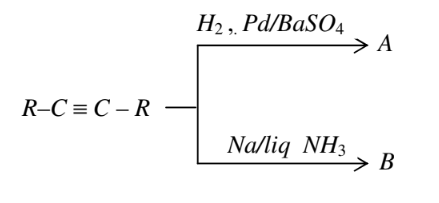
In the reaction, A and B are respectively:
Choose an answer to reveal your result and explanation.
Answer & Explanation
In the given reactions, we are dealing with the hydrogenation of alkynes to alkenes using different reagents, which lead to different stereochemical outcomes.
-
Reaction with H2,Pd/BaSO4 (Lindlar's Catalyst):
- This reaction involves the partial hydrogenation of an alkyne to an alkene using Lindlar's catalyst, which is a poisoned palladium catalyst. The key characteristic of this catalyst is that it selectively hydrogenates alkynes to alkenes without further reducing the alkene to an alkane.
- Importantly, Lindlar's catalyst facilitates the formation of a cis-alkene. This is because the hydrogenation occurs on the surface of the catalyst, and both hydrogen atoms add to the same side of the alkyne, resulting in a syn addition. Therefore, the product A is a cis-alkene.
-
Reaction with Na/liq NH3:
- This reaction is known as the Birch reduction, which involves the reduction of an alkyne to an alkene using sodium in liquid ammonia. This method is distinct from the Lindlar's catalyst reaction in that it produces a trans-alkene.
- The mechanism involves the formation of a radical anion intermediate, which leads to the anti addition of hydrogen atoms across the triple bond. As a result, the product B is a trans-alkene.
Given these explanations, Option 3 is correct because:
- Product A, formed using Lindlar's catalyst, is a cis-alkene.
- Product B, formed using sodium in liquid ammonia, is a trans-alkene.
Why the other options are incorrect:
-
Option 1 (cis-alkene and cis-alkene):
- This option is incorrect because the reaction with Na/liq NH3 does not produce a cis-alkene; it produces a trans-alkene.
-
Option 2 (trans-alkene and trans-alkene):
- This option is incorrect because the reaction with H2,Pd/BaSO4 (Lindlar's catalyst) does not produce a trans-alkene; it produces a cis-alkene.
-
Option 4 (trans-alkene and cis-alkene):
- This option is incorrect because the stereochemistry of the products is reversed. The reaction with Lindlar's catalyst produces a cis-alkene, and the reaction with Na/liq NH3 produces a trans-alkene, not the other way around.
Thus, the correct answer is Option 3: cis-alkene and trans-alkene.
उपरोक्त अभिक्रिया में A और B क्रमशः हैं :
Choose an answer to reveal your result and explanation.
Answer & Explanation
सम्पूर्ण प्रश्न के अनुसार, हमें यह समझना है कि दिए गए अभिक्रियाओं में A और B के रूप में कौन से यौगिक बनते हैं।
-
समपक्ष ऐल्कीन और विपक्ष ऐल्कीन (Option 3):
-
पहली अभिक्रिया: R−C≡C−RH2,Pd/BaSO4A
- यह अभिक्रिया लिंड्लर के उत्प्रेरक का उपयोग करती है, जो एक आंशिक हाइड्रोजनीकरण उत्प्रेरक है। यह उत्प्रेरक अल्काइन को आंशिक रूप से हाइड्रोजनीकरण करके समपक्ष ऐल्कीन में परिवर्तित करता है। इसलिए, A समपक्ष ऐल्कीन होगा।
-
दूसरी अभिक्रिया: R−C≡C−RNa/liq NH3B
- यह अभिक्रिया बिर्च कमी के रूप में जानी जाती है, जो अल्काइन को विपक्ष ऐल्कीन में परिवर्तित करती है। इसलिए, B विपक्ष ऐल्कीन होगा।
-
इस प्रकार, Option 3 सही है क्योंकि यह बताता है कि A समपक्ष ऐल्कीन है और B विपक्ष ऐल्कीन है।
-
अन्य विकल्पों की गलतियाँ:
-
Option 1: समपक्ष ऐल्कीन और समपक्ष ऐल्कीन:
- यह गलत है क्योंकि दूसरी अभिक्रिया (Na/liq NH3) विपक्ष ऐल्कीन बनाती है, न कि समपक्ष ऐल्कीन।
-
Option 2: विपक्ष ऐल्कीन और विपक्ष ऐल्कीन:
- यह गलत है क्योंकि पहली अभिक्रिया (H2, Pd/BaSO4) समपक्ष ऐल्कीन बनाती है, न कि विपक्ष ऐल्कीन।
-
Option 4: विपक्ष ऐल्कीन और समपक्ष ऐल्कीन:
- यह गलत है क्योंकि दूसरी अभिक्रिया (Na/liq NH3) विपक्ष ऐल्कीन बनाती है, न कि समपक्ष ऐल्कीन।
-
इस प्रकार, Option 3 सही है और अन्य विकल्प गलत हैं।
Question 136
At constant volume, pressure of a fixed amount of a gas varies directly with the temperature. It is the statement of which of the following laws ?
Choose an answer to reveal your result and explanation.
Answer & Explanation
The correct answer to the question is Option 3: Gay-Lussac's law. Let's delve into the reasoning behind this choice and why the other options are incorrect.
-
Explanation for Option 3 (Gay-Lussac's Law):
- Gay-Lussac's law states that the pressure of a given mass of gas varies directly with the absolute temperature when the volume is kept constant. Mathematically, this can be expressed as ( P \propto T ) or ( \frac{P}{T} = \text{constant} ), where ( P ) is the pressure and ( T ) is the temperature in Kelvin. This law is applicable when the volume of the gas does not change, and it clearly aligns with the statement in the question that at constant volume, the pressure of a fixed amount of gas varies directly with the temperature.
-
Why Option 1 (Boyle's Law) is Incorrect:
- Boyle's law describes the relationship between pressure and volume at constant temperature. It states that the pressure of a gas is inversely proportional to its volume when the temperature is held constant, expressed as ( PV = \text{constant} ). This law does not involve temperature as a variable affecting pressure, so it does not match the scenario described in the question.
-
Why Option 2 (Charles's Law) is Incorrect:
- Charles's law focuses on the relationship between volume and temperature at constant pressure. It states that the volume of a gas is directly proportional to its absolute temperature when the pressure remains constant, expressed as ( V \propto T ). Since the question specifies a constant volume and a relationship between pressure and temperature, Charles's law is not applicable here.
-
Why Option 4 (Avogadro's Law) is Incorrect:
- Avogadro's law deals with the relationship between the volume of a gas and the number of moles at constant temperature and pressure. It states that equal volumes of gases, at the same temperature and pressure, contain an equal number of molecules. This law does not address the relationship between pressure and temperature, making it irrelevant to the question.
In conclusion, Gay-Lussac's law is the correct choice because it directly addresses the relationship between pressure and temperature at constant volume, which is precisely what the question describes.
स्थिर आयतन पर किसी निश्चित मात्रा वाली गैस का दाब उसके तापमान के समानुपाती होता है यह कथन निम्नलिखित में से किस नियम का है ?
Choose an answer to reveal your result and explanation.
Answer & Explanation
गै-लुसैक नियम के अनुसार, स्थिर आयतन पर किसी निश्चित मात्रा वाली गैस का दाब उसके तापमान के समानुपाती होता है। इसका अर्थ यह है कि जब गैस का आयतन स्थिर रहता है, तो उसके तापमान में वृद्धि होने पर दाब भी बढ़ता है और तापमान में कमी होने पर दाब भी घटता है। यह नियम गैसों के व्यवहार को समझने में महत्वपूर्ण है और इसे गैसों के तापमान-दाब संबंध के रूप में जाना जाता है।
अब हम अन्य विकल्पों पर विचार करते हैं और समझते हैं कि वे क्यों सही नहीं हैं:
-
बॉयल का नियम: यह नियम दाब और आयतन के बीच संबंध को बताता है, जिसमें कहा गया है कि स्थिर तापमान पर किसी गैस का दाब उसके आयतन के व्युत्क्रमानुपाती होता है। यह नियम तापमान के बजाय आयतन पर केंद्रित है, इसलिए यह विकल्प सही नहीं है।
-
चार्ल्स का नियम: यह नियम आयतन और तापमान के बीच संबंध को बताता है, जिसमें कहा गया है कि स्थिर दाब पर किसी गैस का आयतन उसके तापमान के समानुपाती होता है। यह नियम दाब के बजाय आयतन पर केंद्रित है, इसलिए यह विकल्प सही नहीं है।
-
आवोगाद्रो नियम: यह नियम बताता है कि समान तापमान और दाब पर समान आयतन वाली गैसों में अणुओं की संख्या समान होती है। यह नियम दाब और तापमान के संबंध से संबंधित नहीं है, इसलिए यह विकल्प सही नहीं है।
इस प्रकार, गै-लुसैक नियम (विकल्प 3) ही सही उत्तर है क्योंकि यह स्थिर आयतन पर दाब और तापमान के संबंध को स्पष्ट रूप से परिभाषित करता है।
Question 137
Match the geometry of following from List - I with List - II:
List - I – List - II
(A) NH3 – (i) See-saw
(B) CIF3 – (ii) Trigonal pyramidal
(C) SO2 – (iii) T- shape
(D) SF4 – (iv) Bent (V-Shaped)
Choose an answer to reveal your result and explanation.
Answer & Explanation
To justify why Option 4 is the correct answer, let's analyze the molecular geometry of each compound listed in List - I and match it with the appropriate geometry from List - II.
(A) NH3 – Trigonal pyramidal (ii):
- Ammonia (NH3) has a central nitrogen atom bonded to three hydrogen atoms with one lone pair of electrons. The presence of the lone pair results in a trigonal pyramidal shape due to the repulsion between the lone pair and the bonding pairs, which pushes the hydrogen atoms downwards. This matches with (ii) Trigonal pyramidal.
(B) CIF3 – T-shape (iii):
- Chlorine trifluoride (CIF3) has a central chlorine atom bonded to three fluorine atoms and has two lone pairs of electrons. The lone pairs occupy equatorial positions in a trigonal bipyramidal arrangement, leading to a T-shaped molecular geometry. This matches with (iii) T-shape.
(C) SO2 – Bent (V-Shaped) (iv):
- Sulfur dioxide (SO2) has a central sulfur atom double-bonded to two oxygen atoms and has one lone pair of electrons. The lone pair causes a repulsion that results in a bent or V-shaped geometry. This matches with (iv) Bent (V-Shaped).
(D) SF4 – See-saw (i):
- Sulfur tetrafluoride (SF4) has a central sulfur atom bonded to four fluorine atoms with one lone pair of electrons. The lone pair occupies an equatorial position in a trigonal bipyramidal arrangement, resulting in a see-saw shape. This matches with (i) See-saw.
Now, let's explain why the other options are incorrect:
Option 1: (A)-(i), (B)-(ii), (C)-(iii), (D)-(iv)
- This option incorrectly matches NH3 with See-saw (i), CIF3 with Trigonal pyramidal (ii), SO2 with T-shape (iii), and SF4 with Bent (V-Shaped) (iv). None of these match the actual geometries of the molecules.
Option 2: (A)-(iv), (B)-(iii), (C)-(ii), (D)-(i)
- This option incorrectly matches NH3 with Bent (V-Shaped) (iv), CIF3 with T-shape (iii) (which is correct), SO2 with Trigonal pyramidal (ii), and SF4 with See-saw (i) (which is correct). Only two matches are correct, making this option incorrect.
Option 3: (A)-(iii), (B)-(i), (C)-(iv), (D)-(ii)
- This option incorrectly matches NH3 with T-shape (iii), CIF3 with See-saw (i), SO2 with Bent (V-Shaped) (iv) (which is correct), and SF4 with Trigonal pyramidal (ii). Only one match is correct, making this option incorrect.
Therefore, Option 4 is the only option that correctly matches each compound with its respective geometry, making it the correct answer.
सूची I की ज्यामिति को सूची II से सुमेलित कीजिए :
सूची-I – सूची-II
(A) NH3 – (i) ढेंकुली
(B) CIF3 – (ii) त्रिकोणीय पिरामिडल
(C) SO2 – (iii) T- आकृति
(D) SF4 – (iv) मुड़ी हुई
Choose an answer to reveal your result and explanation.
Answer & Explanation
Explanation:
To determine the correct geometries for the given molecules, we need to consider the molecular shapes based on VSEPR (Valence Shell Electron Pair Repulsion) theory. Let's analyze each molecule:
(A) NH3: Ammonia (NH3) has a central nitrogen atom with three hydrogen atoms bonded to it and one lone pair of electrons. According to VSEPR theory, the presence of the lone pair results in a trigonal pyramidal shape. Therefore, NH3 corresponds to (ii) त्रिकोणीय पिरामिडल.
(B) CIF3: Chlorine trifluoride (CIF3) has a central chlorine atom with three fluorine atoms bonded to it and two lone pairs of electrons. The molecular geometry is T-shaped due to the repulsion between the lone pairs and the bonded pairs. Thus, CIF3 corresponds to (iii) T- आकृति.
(C) SO2: Sulfur dioxide (SO2) has a central sulfur atom with two oxygen atoms bonded to it and one lone pair of electrons. This results in a bent or V-shaped molecular geometry. Therefore, SO2 corresponds to (iv) मुड़ी हुई.
(D) SF4: Sulfur tetrafluoride (SF4) has a central sulfur atom with four fluorine atoms bonded to it and one lone pair of electrons. The molecular geometry is seesaw-shaped due to the lone pair's influence. However, the closest match in the given options is (i) ढेंकुली, which is often used to describe a seesaw-like shape in some contexts.
Correct Answer: Option 4
- (A)-(ii) NH3 – त्रिकोणीय पिरामिडल
- (B)-(iii) CIF3 – T- आकृति
- (C)-(iv) SO2 – मुड़ी हुई
- (D)-(i) SF4 – ढेंकुली
Why Other Options are Incorrect:
-
Option 1: (A)-(i), (B)-(ii), (C)-(iii), (D)-(iv)
- This option incorrectly matches NH3 with ढेंकुली and CIF3 with त्रिकोणीय पिरामिडल, which do not align with their actual geometries.
-
Option 2: (A)-(iv), (B)-(iii), (C)-(ii), (D)-(i)
- This option incorrectly matches NH3 with मुड़ी हुई and SO2 with त्रिकोणीय पिरामिडल, which are incorrect based on their molecular shapes.
-
Option 3: (A)-(iii), (B)-(i), (C)-(iv), (D)-(ii)
- This option incorrectly matches NH3 with T- आकृति and SF4 with त्रिकोणीय पिरामिडल, which do not correspond to their actual geometries.
By analyzing the molecular geometries and matching them correctly, Option 4 is confirmed as the correct answer.
Question 138
The monomers of glyptal are:
Choose an answer to reveal your result and explanation.
Answer & Explanation
Glyptal is a type of polyester resin, and its monomers are ethylene glycol and phthalic acid. Here's a detailed explanation of why Option 3 is correct and why the other options are incorrect:
-
Explanation for Option 3 (Correct Answer):
- Ethylene Glycol and Phthalic Acid: Glyptal is synthesized through a polycondensation reaction between ethylene glycol and phthalic acid (or its anhydride form, phthalic anhydride). Ethylene glycol is a diol, and phthalic acid is a dicarboxylic acid. When these two compounds react, they form ester linkages, resulting in the formation of a polyester resin. Glyptal is commonly used in paints, coatings, and as an insulating material due to its excellent adhesive and protective properties.
-
Explanation for why other options are incorrect:
-
Option 1: Phenol and Formaldehyde
- Phenol and formaldehyde are the monomers for phenolic resins, such as Bakelite, not glyptal. These resins are formed through a condensation reaction between phenol and formaldehyde, resulting in a thermosetting polymer. This is distinctly different from the polyester structure of glyptal.
-
Option 2: Styrene
- Styrene is a monomer used to produce polystyrene, a different type of polymer. Polystyrene is a thermoplastic polymer, whereas glyptal is a thermosetting polyester resin. Styrene does not react with phthalic acid or ethylene glycol to form glyptal.
-
Option 4: Ethylene Glycol and Terephthalic Acid
- Ethylene glycol and terephthalic acid are the monomers for polyethylene terephthalate (PET), not glyptal. PET is another type of polyester, commonly used in fibers for clothing and containers for liquids and foods. While both PET and glyptal are polyesters, they are made from different dicarboxylic acids (terephthalic acid for PET and phthalic acid for glyptal).
-
In conclusion, Option 3 is the correct answer because glyptal is specifically synthesized from ethylene glycol and phthalic acid, forming a polyester resin with unique properties suitable for its applications.
ग्लिप्टल के एकलक हैं :
Choose an answer to reveal your result and explanation.
Answer & Explanation
ग्लिप्टल के एकलक एथिलीन ग्लाइकॉल और थैलिक अम्ल होते हैं, जो विकल्प 3 में दिए गए हैं। ग्लिप्टल एक प्रकार का अल्काइड रेजिन है, जो मुख्य रूप से पेंट और कोटिंग्स में उपयोग किया जाता है। इसे बनाने के लिए एथिलीन ग्लाइकॉल और थैलिक अम्ल का पॉलीमराइजेशन किया जाता है। यह पॉलीमराइजेशन प्रक्रिया ग्लिप्टल रेजिन की संरचना और गुणों को निर्धारित करती है, जिससे यह विभिन्न औद्योगिक अनुप्रयोगों के लिए उपयुक्त बनता है।
अब, अन्य विकल्पों की चर्चा करते हैं:
-
फीनॉल और फॉर्मेल्डिहाइड: ये एकलक बैकेलाइट के निर्माण में उपयोग होते हैं, जो एक प्रकार का थर्मोसेटिंग प्लास्टिक है। यह ग्लिप्टल के निर्माण में उपयोग नहीं होते।
-
स्टाइरीन: स्टाइरीन का उपयोग मुख्य रूप से पॉलीस्टाइरीन और अन्य कोपॉलिमर के निर्माण में होता है। यह ग्लिप्टल के निर्माण में शामिल नहीं होता।
-
एथिलीन ग्लाइकॉल और टेरेफ्थैलिक अम्ल: ये एकलक पॉलीएस्टर, विशेष रूप से पॉलीएथिलीन टेरेफ्थालेट (PET) के निर्माण में उपयोग होते हैं। यह ग्लिप्टल के निर्माण में उपयोग नहीं होते।
इस प्रकार, एथिलीन ग्लाइकॉल और थैलिक अम्ल (विकल्प 3) ही सही उत्तर हैं क्योंकि ये ग्लिप्टल के निर्माण के लिए आवश्यक एकलक हैं।
Question 139
For the equilibrium 2NO(g)+Cl2(g)⇌2NOCl(g) Kp is related to Kc by the relation :
Choose an answer to reveal your result and explanation.
Answer & Explanation
To understand why Option 3 is the correct answer, we need to examine the relationship between the equilibrium constants ( K_p ) and ( K_c ) for the given reaction:
[ 2NO(g) + Cl_2(g) \rightleftharpoons 2NOCl(g) ]
Explanation of the Relationship
The relationship between ( K_p ) and ( K_c ) is given by the equation:
[ K_p = K_c (RT)^{\Delta n} ]
where:
- ( R ) is the universal gas constant.
- ( T ) is the temperature in Kelvin.
- ( \Delta n ) is the change in the number of moles of gas, calculated as the moles of gaseous products minus the moles of gaseous reactants.
For the given reaction:
- Moles of gaseous products = 2 (from ( 2NOCl(g) ))
- Moles of gaseous reactants = 2 (from ( 2NO(g) + Cl_2(g) ))
Thus, ( \Delta n = 2 - 3 = -1 ).
Substituting (\Delta n = -1) into the equation, we get:
[ K_p = K_c (RT)^{-1} ]
This simplifies to:
[ K_p = \frac{K_c}{RT} ]
This matches Option 3, which states:
[ K_p = \frac{K_c}{RT} ]
Explanation of Why Other Options are Incorrect
-
Option 1: ( K_p = K_c (RT) )
- This option assumes (\Delta n = 1), which is incorrect for this reaction. The correct (\Delta n) is -1, not 1.
-
Option 2: ( K_p = K_c (RT)^2 )
- This option assumes (\Delta n = 2), which is incorrect. The correct (\Delta n) is -1, not 2.
-
Option 4: ( K_p = \frac{K_c}{(RT)^2} )
- This option assumes (\Delta n = -2), which is incorrect. The correct (\Delta n) is -1, not -2.
Conclusion
The correct relationship between ( K_p ) and ( K_c ) for the given reaction, considering the change in moles of gas, is ( K_p = \frac{K_c}{RT} ). Therefore, Option 3 is the correct answer.
2NO(g)+Cl2(g)⇌2NOCl(g) के साम्य में Kp का Kc के साथ संबंध होगा :
Choose an answer to reveal your result and explanation.
Answer & Explanation
साम्य प्रतिक्रिया 2NO(g)+Cl2(g)⇌2NOCl(g) के लिए, Kp और Kc के बीच संबंध को समझने के लिए, हमें गैसीय प्रतिक्रियाओं के लिए थर्मोडायनामिक संबंध का उपयोग करना होगा। यह संबंध है:
[ K_{p} = K_{c}(RT)^{\Delta n} ]
जहां Δn गैसीय उत्पादों और गैसीय अभिकारकों के मोल की संख्या के बीच का अंतर है। इस प्रतिक्रिया के लिए:
- गैसीय उत्पादों के मोल = 2 (NOCl)
- गैसीय अभिकारकों के मोल = 2 (NO) + 1 (Cl₂) = 3
इसलिए, Δn=2−3=−1।
अब, इस मान को थर्मोडायनामिक संबंध में डालते हैं:
[ K_{p} = K_{c}(RT)^{-1} ]
जिसे पुनः व्यवस्थित करने पर हमें मिलता है:
[ K_{p} = \frac{K_{c}}{RT} ]
इसलिए, सही विकल्प है विकल्प 3: Kp=RTKc।
अब, अन्य विकल्पों की गलतियों को समझते हैं:
-
विकल्प 1: Kp=Kc(RT) - यह सही नहीं है क्योंकि यह Δn=1 के लिए सही होता, जबकि हमारे मामले में Δn=−1 है।
-
विकल्प 2: Kp=Kc(RT)2 - यह सही नहीं है क्योंकि यह Δn=2 के लिए सही होता, जबकि हमारे मामले में Δn=−1 है।
-
विकल्प 4: Kp=(RT)2Kc - यह सही नहीं है क्योंकि यह Δn=−2 के लिए सही होता, जबकि हमारे मामले में Δn=−1 है।
इस प्रकार, दिए गए सही उत्तर विकल्प 3 को समर्थन मिलता है।
Question 140
No two electrons in an atom can have the same set of four quantum numbers. This statement is which of the following principle/rule ?
Choose an answer to reveal your result and explanation.
Answer & Explanation
The statement "No two electrons in an atom can have the same set of four quantum numbers" is correctly identified as the Pauli Exclusion Principle. Here is a detailed explanation supporting why Option 1 is correct and why the other options are incorrect:
-
Pauli Exclusion Principle (Option 1):
- The Pauli Exclusion Principle, formulated by Wolfgang Pauli in 1925, states that no two electrons in a single atom can have identical sets of quantum numbers. Quantum numbers describe the properties of atomic orbitals and the properties of electrons in those orbitals. There are four quantum numbers: the principal quantum number (n), the azimuthal quantum number (l), the magnetic quantum number (m), and the spin quantum number (s). The Pauli Exclusion Principle is fundamental to the structure of atoms and the behavior of electrons in atoms, ensuring that each electron in an atom has a unique set of quantum numbers. This principle explains the arrangement of electrons in different atomic orbitals and is crucial for understanding the electronic configuration of elements.
-
Afbau Principle (Option 2):
- The Afbau Principle is a rule used to determine the electron configuration of an atom. It states that electrons fill atomic orbitals of the lowest available energy levels before occupying higher levels. This principle helps predict the order in which orbitals are filled but does not address the uniqueness of quantum numbers for electrons. Therefore, it does not relate to the statement about electrons having unique sets of quantum numbers.
-
Hund's Rule of Maximum Multiplicity (Option 3):
- Hund's Rule states that electrons will fill degenerate orbitals (orbitals with the same energy) singly before pairing up. This rule is concerned with the distribution of electrons among orbitals of the same energy level to maximize the total spin, which leads to greater stability. It does not address the uniqueness of the set of quantum numbers for electrons, making it unrelated to the statement in question.
-
(n+l) Rule (Option 4):
- The (n+l) rule, also known as the Madelung rule, is used to predict the order in which atomic orbitals are filled based on the sum of the principal quantum number (n) and the azimuthal quantum number (l). Orbitals with lower (n+l) values are filled first. This rule helps determine the sequence of orbital filling but does not pertain to the uniqueness of quantum numbers for electrons.
In conclusion, the Pauli Exclusion Principle is the only principle that directly addresses the statement that no two electrons in an atom can have the same set of four quantum numbers, making Option 1 the correct answer.
किसी परमाणु में उपस्थित दो इलेक्ट्रॉनों की चारों क्वांटम संख्याएँ एक समान नहीं हो सकती हैं, यह कथन निम्नलिखित में से किस सिद्धान्त/नियम का है ?
Choose an answer to reveal your result and explanation.
Answer & Explanation
किसी परमाणु में उपस्थित दो इलेक्ट्रॉनों की चारों क्वांटम संख्याएँ एक समान नहीं हो सकती हैं, यह पाउली अपवर्जन सिद्धांत (Pauli Exclusion Principle) का कथन है। आइए इसे विस्तार से समझते हैं:
-
पाउली अपवर्जन सिद्धांत (Option 1): यह सिद्धांत कहता है कि किसी भी परमाणु में दो इलेक्ट्रॉनों की चारों क्वांटम संख्याएँ (मुख्य, कोणीय, चुम्बकीय, और स्पिन क्वांटम संख्या) एक समान नहीं हो सकती हैं। इसका अर्थ है कि एक ही परमाणु में दो इलेक्ट्रॉन एक ही क्वांटम स्थिति में नहीं हो सकते। यह सिद्धांत इलेक्ट्रॉनिक संरचना और परमाणु के रासायनिक गुणों को समझने में महत्वपूर्ण भूमिका निभाता है।
-
ऑफबाऊ नियम (Option 2): यह नियम इलेक्ट्रॉनों के ऊर्जा स्तरों में भरने के क्रम को बताता है। यह कहता है कि इलेक्ट्रॉन सबसे कम ऊर्जा वाले ऑर्बिटल में पहले भरते हैं। यह नियम पाउली अपवर्जन सिद्धांत से अलग है क्योंकि यह क्वांटम संख्याओं की समानता पर नहीं बल्कि ऊर्जा स्तरों के भरने के क्रम पर केंद्रित है।
-
हुंड का अधिकतम बहुकता का नियम (Option 3): यह नियम कहता है कि एक ही ऊर्जा स्तर के ऑर्बिटल्स में इलेक्ट्रॉनों का वितरण इस प्रकार होता है कि अधिकतम समानांतर स्पिन वाले इलेक्ट्रॉन हों। यह नियम इलेक्ट्रॉनों के स्पिन के वितरण पर केंद्रित है, न कि क्वांटम संख्याओं की समानता पर।
-
(n + 1) नियम (Option 4): यह नियम ऊर्जा स्तरों के क्रम को निर्धारित करने के लिए उपयोग होता है, जिसमें n मुख्य क्वांटम संख्या और l कोणीय क्वांटम संख्या होती है। यह नियम भी पाउली अपवर्जन सिद्धांत से अलग है क्योंकि यह ऊर्जा स्तरों के क्रम पर ध्यान केंद्रित करता है।
इस प्रकार, पाउली अपवर्जन सिद्धांत (Option 1) सही उत्तर है क्योंकि यह विशेष रूप से क्वांटम संख्याओं की समानता को रोकता है, जो अन्य विकल्पों में नहीं किया जाता।