
HTET Exam Level 3 PGT
HTET exam Level 3 PGT preparation with Clear Cutoff
Verified Answers and Explanations
by Clear Cutoff
Showing 20 of 20 questions
Question 161
Tris (ethane-1,2-diammine) cobalt (III) sulphate is :
Choose an answer to reveal your result and explanation.
Answer & Explanation
Tris (ethane-1,2-diammine) cobalt (III) sulphate is a coordination compound where cobalt is coordinated with three ethane-1,2-diamine (en) ligands, and the compound is associated with sulphate ions. Let's analyze why Option 4 is the correct representation of this compound:
-
Option 4: [Co(en)3]2(SO4)3
- This option correctly represents the compound as a complex ion with cobalt (III) coordinated to three ethane-1,2-diamine ligands. The notation [Co(en)3] indicates that each cobalt ion is surrounded by three bidentate ethane-1,2-diamine ligands, forming a stable octahedral complex.
- The compound is a sulphate salt, and the formula [Co(en)3]2(SO4)3 indicates that there are two such cobalt complexes for every three sulphate ions. This stoichiometry is consistent with the charge balance, as each cobalt (III) complex carries a +3 charge, and each sulphate ion carries a -2 charge. Therefore, two cobalt complexes (+6 total charge) balance with three sulphate ions (-6 total charge), making the compound electrically neutral.
-
Option 1: [Co(en)3]SO4
- This option suggests a 1:1 ratio between the cobalt complex and the sulphate ion. However, this does not satisfy the charge balance. The cobalt complex [Co(en)3]3+ would require three sulphate ions to balance the charge, not one.
-
Option 2: [Co(en)3]3(SO4)2
- This option implies a 3:2 ratio between the cobalt complexes and sulphate ions. The total positive charge from three cobalt complexes would be +9, while the total negative charge from two sulphate ions would be -4. This does not achieve charge neutrality.
-
Option 3: [Co(H2N−CH2−CH2−NH2)3]2(SO4)2
- Although this option correctly represents the ethane-1,2-diamine ligands in their full chemical form, it suggests a 2:2 ratio between the cobalt complexes and sulphate ions. This would result in a total positive charge of +6 from the cobalt complexes and a total negative charge of -4 from the sulphate ions, which does not balance.
In conclusion, Option 4 is the correct representation of tris (ethane-1,2-diammine) cobalt (III) sulphate because it accurately reflects the stoichiometry and charge balance required for the compound to be electrically neutral.
ट्रिस (एथेन-1,2-डाइएमीन) कोबाल्ट (III) सल्फेट है :
Choose an answer to reveal your result and explanation.
Answer & Explanation
ट्रिस (एथेन-1,2-डाइएमीन) कोबाल्ट (III) सल्फेट के लिए सही विकल्प 4 है: [Co(en)3]2(SO4)3।
-
विकल्प 4 की सही व्याख्या:
- ट्रिस (एथेन-1,2-डाइएमीन) कोबाल्ट (III) सल्फेट का मतलब है कि कोबाल्ट (III) आयन के साथ तीन एथेन-1,2-डाइएमीन (en) लिगैंड्स जुड़े हुए हैं। यह एक जटिल आयन बनाता है, जिसे [Co(en)3]3+ के रूप में दर्शाया जा सकता है।
- सल्फेट आयन का चार्ज SO42− होता है। चूंकि जटिल आयन का चार्ज +3 है, इसे संतुलित करने के लिए दो जटिल आयन और तीन सल्फेट आयन की आवश्यकता होती है। इस प्रकार, यौगिक का समग्र सूत्र [Co(en)3]2(SO4)3 होगा, जो विकल्प 4 में दिया गया है।
-
अन्य विकल्पों की गलत व्याख्या:
-
विकल्प 1: [Co(en)3]SO4
यह विकल्प गलत है क्योंकि यह केवल एक सल्फेट आयन के साथ एक जटिल आयन को दर्शाता है, जो चार्ज संतुलन के लिए पर्याप्त नहीं है। जटिल आयन का चार्ज +3 है, जबकि सल्फेट का चार्ज -2 है, जिससे चार्ज संतुलन नहीं होता। -
विकल्प 2: Co(en)3]3(SO4)2
यह विकल्प गलत है क्योंकि यह तीन जटिल आयन और दो सल्फेट आयन को दर्शाता है। चार्ज संतुलन के लिए तीन जटिल आयन (+9) और दो सल्फेट आयन (-4) के बीच चार्ज संतुलन नहीं होता। -
विकल्प 3: [Co(H2N−CH2−CH2−NH2)3]2(SO4)2
यह विकल्प गलत है क्योंकि यह दो जटिल आयन और दो सल्फेट आयन को दर्शाता है। चार्ज संतुलन के लिए दो जटिल आयन (+6) और दो सल्फेट आयन (-4) के बीच चार्ज संतुलन नहीं होता।
-
इस प्रकार, विकल्प 4 सही है क्योंकि यह चार्ज संतुलन को सही ढंग से दर्शाता है और ट्रिस (एथेन-1,2-डाइएमीन) कोबाल्ट (III) सल्फेट के लिए सही संरचना प्रदान करता है।
Question 162
If the equilibrium constant for the reaction H2(g)+I2(g)⇌2HI(g) is Kc, then at same temperature, what will be the equilibrium constant for the reaction 2H2(g)+2I2(g)⇌4HI(g) ?
Choose an answer to reveal your result and explanation.
Answer & Explanation
To determine the equilibrium constant for the reaction 2H2(g)+2I2(g)⇌4HI(g), given that the equilibrium constant for the reaction H2(g)+I2(g)⇌2HI(g) is Kc, we need to understand how equilibrium constants change with the stoichiometry of the reaction.
-
Explanation for Option 3 (Kc2):
The original reaction is:
[
H_{2}(g) + I_{2}(g) \rightleftharpoons 2HI(g)
]
with an equilibrium constant Kc.The new reaction is:
[
2H_{2}(g) + 2I_{2}(g) \rightleftharpoons 4HI(g)
]This new reaction is essentially the original reaction multiplied by 2. When a chemical equation is multiplied by a factor, the equilibrium constant for the new reaction is the original equilibrium constant raised to the power of that factor. In this case, the factor is 2. Therefore, the equilibrium constant for the new reaction is:
[
(K_{c})^{2}
]Thus, the correct answer is Option 3, Kc2.
-
Explanation for why the other options are incorrect:
-
Option 1 (Kc): This option would be correct if the stoichiometry of the reaction remained unchanged. However, since the reaction is multiplied by 2, the equilibrium constant must be squared, not remain the same.
-
Option 2 (Kc): This option would be applicable if the reaction was divided by 2, meaning the stoichiometry was halved. In such a case, the equilibrium constant would be the square root of the original. However, since the reaction is multiplied by 2, this option is incorrect.
-
Option 4 (2Kc): This option suggests a linear relationship between the stoichiometry change and the equilibrium constant, which is incorrect. The equilibrium constant is not simply multiplied by the factor; it is raised to the power of the factor. Therefore, this option is incorrect.
-
In conclusion, the correct equilibrium constant for the reaction 2H2(g)+2I2(g)⇌4HI(g) is Kc2, making Option 3 the correct choice.
यदि अभिक्रिया H2(g)+I2(g)⇌2HI(g) का साम्यावस्था स्थिरांक Kc है, तब उसी ताप पर अभिक्रिया 2H2(g)+2I2(g)⇌4HI(g) का साम्यावस्था स्थिरांक क्या होगा ?
Choose an answer to reveal your result and explanation.
Answer & Explanation
साम्यावस्था स्थिरांक (Kc) का निर्धारण रासायनिक अभिक्रिया के संतुलन में भाग लेने वाले पदार्थों की सांद्रता के अनुपात से होता है। दिए गए प्रश्न में, हमें दो अभिक्रियाओं के साम्यावस्था स्थिरांक के बीच संबंध ज्ञात करना है।
पहली अभिक्रिया है:
[ H_{2}(g) + I_{2}(g) \rightleftharpoons 2HI(g) ]
इस अभिक्रिया के लिए साम्यावस्था स्थिरांक Kc है, जिसे निम्नलिखित रूप में व्यक्त किया जा सकता है:
[ K_c = \frac{[HI]^2}{[H_2][I_2]} ]
दूसरी अभिक्रिया है:
[ 2H_{2}(g) + 2I_{2}(g) \rightleftharpoons 4HI(g) ]
यह अभिक्रिया पहली अभिक्रिया का गुणांक 2 से गुणा किया गया रूप है। जब किसी अभिक्रिया के सभी गुणांक n से गुणा किए जाते हैं, तो नए साम्यावस्था स्थिरांक Kc′ को मूल साम्यावस्था स्थिरांक Kc की शक्ति n के रूप में व्यक्त किया जाता है। यहाँ n=2 है, इसलिए:
[ K'_c = (K_c)^2 ]
इस प्रकार, दूसरी अभिक्रिया का साम्यावस्था स्थिरांक Kc2 होगा।
अब, अन्य विकल्पों को गलत साबित करते हैं:
- विकल्प 1 (Kc): यह गलत है क्योंकि जब अभिक्रिया के गुणांक को 2 से गुणा किया जाता है, तो साम्यावस्था स्थिरांक Kc नहीं रहता, बल्कि Kc2 हो जाता है।
- विकल्प 2 (Kc): यह गलत है क्योंकि गुणांक को 2 से गुणा करने पर साम्यावस्था स्थिरांक की जड़ नहीं ली जाती, बल्कि उसे वर्ग किया जाता है।
- विकल्प 4 (2Kc): यह गलत है क्योंकि गुणांक को 2 से गुणा करने पर साम्यावस्था स्थिरांक को 2 से गुणा नहीं किया जाता, बल्कि उसे वर्ग किया जाता है।
इस प्रकार, सही उत्तर विकल्प 3 (Kc2) है।
Question 163
For ideal gas compressibility factor Z is:
Choose an answer to reveal your result and explanation.
Answer & Explanation
For an ideal gas, the compressibility factor ( Z ) is defined as the ratio of the molar volume of the gas to the molar volume of an ideal gas at the same temperature and pressure. Mathematically, it is expressed as:
[ Z = \frac{PV}{nRT} ]
where ( P ) is the pressure, ( V ) is the volume, ( n ) is the number of moles, ( R ) is the universal gas constant, and ( T ) is the temperature.
-
Explanation for Option 2 (Correct Answer):
- For an ideal gas, the behavior is perfectly described by the ideal gas law, ( PV = nRT ). When we substitute this into the expression for ( Z ), we get:
[ Z = \frac{PV}{nRT} = \frac{nRT}{nRT} = 1 ] - Therefore, for an ideal gas, the compressibility factor ( Z ) is exactly 1. This indicates that the gas behaves exactly as predicted by the ideal gas law without any deviations.
- For an ideal gas, the behavior is perfectly described by the ideal gas law, ( PV = nRT ). When we substitute this into the expression for ( Z ), we get:
-
Explanation for why other options are incorrect:
- Option 1 (0): A compressibility factor of 0 would imply that the gas occupies no volume or exerts no pressure, which is physically impossible for any real or ideal gas.
- Option 3 (greater than 1): A compressibility factor greater than 1 indicates that the gas is less compressible than predicted by the ideal gas law, which is typical for real gases at high pressures. However, this does not apply to an ideal gas, which by definition does not deviate from the ideal gas law.
- Option 4 (less than 0): A negative compressibility factor is not physically meaningful, as it would imply negative pressure or volume, which is not possible for any gas.
In conclusion, for an ideal gas, the compressibility factor ( Z ) is exactly 1, making Option 2 the correct answer. This reflects the fact that ideal gases perfectly follow the ideal gas law without any deviations.
आदर्श गैस के लिए संपीड्यता कारक Z है:
Choose an answer to reveal your result and explanation.
Answer & Explanation
आदर्श गैस के लिए संपीड्यता कारक Z की सही व्याख्या निम्नलिखित है:
-
आदर्श गैस के लिए संपीड्यता कारक Z का अर्थ: संपीड्यता कारक Z एक माप है जो यह दर्शाता है कि एक वास्तविक गैस कितनी आदर्श गैस के व्यवहार से विचलित होती है। आदर्श गैस के लिए, Z का मान 1 होता है। इसका अर्थ है कि आदर्श गैस का व्यवहार पूरी तरह से आदर्श गैस समीकरण PV = nRT का पालन करता है।
-
विकल्प 2 (Z = 1) क्यों सही है: आदर्श गैस के लिए, संपीड्यता कारक Z का मान 1 होता है क्योंकि यह गैस आदर्श गैस समीकरण का पालन करती है। आदर्श गैसें अणुओं के बीच कोई पारस्परिक आकर्षण या विकर्षण नहीं मानती हैं और अणुओं का स्वयं का कोई आयतन नहीं होता। इसलिए, आदर्श गैस के लिए Z = 1 सही है।
-
अन्य विकल्प क्यों गलत हैं:
- विकल्प 1 (Z = 0): यदि Z = 0 होता, तो इसका अर्थ होता कि गैस का व्यवहार पूरी तरह से आदर्श गैस समीकरण से विचलित है, जो कि आदर्श गैस के लिए संभव नहीं है।
- विकल्प 3 (Z = 1 से अधिक): Z का मान 1 से अधिक तब होता है जब गैस का व्यवहार आदर्श गैस से अधिक विचलित होता है, जैसे कि उच्च दाब पर जहां अणुओं के बीच विकर्षण बल प्रमुख होते हैं। यह आदर्श गैस के लिए लागू नहीं होता।
- विकल्प 4 (Z = 0 से कम): Z का मान 0 से कम नहीं हो सकता क्योंकि यह भौतिक रूप से असंभव है और इसका कोई भौतिक अर्थ नहीं है।
इस प्रकार, आदर्श गैस के लिए संपीड्यता कारक Z का मान 1 होता है, जो विकल्प 2 को सही ठहराता है।
Question 164
Which of the following species do not show disproportionation reaction?
Choose an answer to reveal your result and explanation.
Answer & Explanation
To determine which species do not show disproportionation reactions, we need to understand the concept of disproportionation. Disproportionation is a type of redox reaction in which a single substance is simultaneously oxidized and reduced, forming two different products.
Let's analyze each option:
-
ClO− (Hypochlorite ion):
The hypochlorite ion can undergo disproportionation. In a typical disproportionation reaction, ClO− can be converted into Cl− and ClO3−, where chlorine is both reduced to Cl− and oxidized to ClO3−. -
ClO2− (Chlorite ion):
The chlorite ion is also capable of undergoing disproportionation. It can disproportionate to form ClO3− and Cl−, where chlorine is again both reduced and oxidized. -
ClO3− (Chlorate ion):
The chlorate ion can undergo disproportionation as well. It can disproportionate to form ClO4− and Cl−, where chlorine is both reduced and oxidized. -
ClO4− (Perchlorate ion):
The perchlorate ion is the most oxidized form of chlorine in these oxyanions and does not undergo disproportionation. This is because there is no higher oxidation state for chlorine than +7 in ClO4−, so it cannot be further oxidized. Additionally, it is a very stable ion and does not readily reduce to a lower oxidation state under normal conditions.
Therefore, the correct answer is Option 4: ClO4−, as it does not show disproportionation due to its stability and the fact that it is already in the highest oxidation state possible for chlorine.
निम्नलिखित में से कौन-सी स्पीशीज़ असमानुपातन अभिक्रिया नहीं दिखाती है ?
Choose an answer to reveal your result and explanation.
Answer & Explanation
स्पष्टीकरण:
असमानुपातन अभिक्रिया (disproportionation reaction) वह अभिक्रिया होती है जिसमें एक ही तत्व के ऑक्सीकरण अवस्था में वृद्धि और कमी दोनों होती है। इस प्रश्न में हमें यह निर्धारित करना है कि कौन-सी स्पीशीज़ असमानुपातन अभिक्रिया नहीं दिखाती है।
-
ClO−: यह स्पीशीज़ असमानुपातन अभिक्रिया दिखा सकती है। ClO− आयन में क्लोरीन की ऑक्सीकरण अवस्था +1 होती है, और यह +5 (जैसे ClO3−) और -1 (जैसे Cl−) ऑक्सीकरण अवस्थाओं में असमानुपातन कर सकता है।
-
ClO2−: यह स्पीशीज़ भी असमानुपातन अभिक्रिया दिखा सकती है। ClO2− आयन में क्लोरीन की ऑक्सीकरण अवस्था +3 होती है, और यह +5 (जैसे ClO3−) और +1 (जैसे ClO−) ऑक्सीकरण अवस्थाओं में असमानुपातन कर सकता है।
-
ClO3−: यह स्पीशीज़ भी असमानुपातन अभिक्रिया दिखा सकती है। ClO3− आयन में क्लोरीन की ऑक्सीकरण अवस्था +5 होती है, और यह +7 (जैसे ClO4−) और +3 (जैसे ClO2−) ऑक्सीकरण अवस्थाओं में असमानुपातन कर सकता है।
-
ClO4−: यह स्पीशीज़ असमानुपातन अभिक्रिया नहीं दिखाती है। ClO4− आयन में क्लोरीन की ऑक्सीकरण अवस्था +7 होती है, जो कि क्लोरीन की उच्चतम ऑक्सीकरण अवस्था है। इस अवस्था से क्लोरीन का और ऑक्सीकरण संभव नहीं है, और यह अवस्था इतनी स्थिर होती है कि यह असमानुपातन अभिक्रिया में भाग नहीं लेती।
इस प्रकार, ClO4− स्पीशीज़ असमानुपातन अभिक्रिया नहीं दिखाती है, इसलिए विकल्प 4 सही उत्तर है।
Question 165
For the process to occur under adiabatic conditions, the correct condition is :
Choose an answer to reveal your result and explanation.
Answer & Explanation
In an adiabatic process, the key characteristic is that there is no heat exchange between the system and its surroundings. This is precisely why Option 3, q=0, is the correct answer. Let's delve into the explanation:
-
Explanation for Option 3 (q=0):
- An adiabatic process is defined by the absence of heat transfer. This means that the heat exchanged, denoted by q, is zero. In thermodynamics, this is a fundamental condition for a process to be considered adiabatic. The system is perfectly insulated, preventing any heat from entering or leaving. This condition is crucial for processes like adiabatic expansion or compression, where changes in temperature and pressure occur without heat exchange.
-
Why Option 1 (ΔT=0) is incorrect:
- Option 1 suggests that the temperature change, ΔT, is zero. However, in an adiabatic process, the temperature can indeed change. For example, during adiabatic compression, the temperature of a gas increases, while during adiabatic expansion, the temperature decreases. Therefore, ΔT=0 is not a condition for an adiabatic process.
-
Why Option 2 (Δp=0) is incorrect:
- Option 2 implies that the pressure change, Δp, is zero. In reality, pressure can change significantly during an adiabatic process. For instance, when a gas is compressed adiabatically, its pressure increases, and when it expands adiabatically, its pressure decreases. Thus, Δp=0 does not define an adiabatic process.
-
Why Option 4 (w=0) is incorrect:
- Option 4 states that the work done, w, is zero. In an adiabatic process, work is often done on or by the system. For example, when a gas expands adiabatically, it does work on its surroundings, and when it is compressed adiabatically, work is done on the gas. Therefore, w=0 is not a condition for an adiabatic process.
In summary, the defining feature of an adiabatic process is the absence of heat exchange, which is accurately captured by Option 3, q=0. This distinguishes it from other thermodynamic processes where heat transfer may occur.
एक प्रक्रम के रुद्धोष्म परिस्थितियों में होने के लिए सही स्थिति है :
Choose an answer to reveal your result and explanation.
Answer & Explanation
रुद्धोष्म (adiabatic) प्रक्रम वह होता है जिसमें प्रणाली और उसके परिवेश के बीच कोई ऊष्मा का आदान-प्रदान नहीं होता है। इस प्रकार के प्रक्रम में ऊष्मा का प्रवाह शून्य होता है। इसलिए, सही स्थिति है:
- q=0
अब हम अन्य विकल्पों पर विचार करते हैं और समझते हैं कि वे क्यों गलत हैं:
-
ΔT=0: यह स्थिति समतापीय (isothermal) प्रक्रम के लिए सही होती है, जहां तापमान में कोई परिवर्तन नहीं होता है। रुद्धोष्म प्रक्रम में तापमान बदल सकता है, क्योंकि ऊष्मा का आदान-प्रदान नहीं होता है, लेकिन कार्य के कारण तापमान में परिवर्तन हो सकता है।
-
Δp=0: यह स्थिति समदाब (isobaric) प्रक्रम के लिए सही होती है, जहां दाब में कोई परिवर्तन नहीं होता है। रुद्धोष्म प्रक्रम में दाब बदल सकता है, क्योंकि ऊष्मा का आदान-प्रदान नहीं होता है, लेकिन कार्य के कारण दाब में परिवर्तन हो सकता है।
-
w=0: यह स्थिति तब सही होती है जब कोई कार्य नहीं किया जाता है। रुद्धोष्म प्रक्रम में कार्य किया जा सकता है या प्रणाली द्वारा किया जा सकता है, लेकिन ऊष्मा का आदान-प्रदान नहीं होता है।
इस प्रकार, रुद्धोष्म प्रक्रम के लिए सही स्थिति है कि ऊष्मा का प्रवाह शून्य हो, अर्थात् q=0।
Question 166
Which of the following is not an example of first order reaction?
Choose an answer to reveal your result and explanation.
Answer & Explanation
Option 4 is the correct answer because it represents a reaction that is not a first-order reaction. Let's analyze each option to understand why Option 4 is the correct choice:
-
Option 1: C2H4(g)+H2(g)→C2H6(g)
This reaction is a bimolecular reaction involving two reactants, ethylene (C2H4) and hydrogen (H2). The rate of this reaction depends on the concentration of both reactants, making it a second-order reaction overall. Therefore, it is not a first-order reaction.
-
Option 2: 88226Ra→24He+86222Rn
This is a radioactive decay process, which is a classic example of a first-order reaction. The rate of radioactive decay depends only on the concentration of the radioactive isotope (88226Ra) and is independent of any other substances. Thus, this is a first-order reaction.
-
Option 3: N2O5(g)→N2O4(g)+21O2(g)
The decomposition of N2O5 is a first-order reaction. The rate of this reaction depends solely on the concentration of N2O5, making it a first-order reaction.
-
Option 4: 2NH3(g)1130KPt CatalystN2(g)+3H2(g)
This reaction is the decomposition of ammonia (NH3) in the presence of a platinum catalyst at high temperature. It is a catalytic reaction that involves the breaking of bonds in NH3 and the formation of N2 and H2. The rate of this reaction is not solely dependent on the concentration of a single reactant, as it involves multiple steps and the presence of a catalyst. Therefore, it is not a first-order reaction.
In conclusion, Option 4 is the correct answer because it represents a reaction that does not follow first-order kinetics, unlike the other options which are examples of first-order reactions.
निम्नलिखित में से कौन-सी प्रथम कोटि की अभिक्रिया का उदाहरण नहीं है ?
Choose an answer to reveal your result and explanation.
Answer & Explanation
प्रथम कोटि की अभिक्रिया वह होती है जिसमें अभिक्रिया की दर केवल एक अभिकारक की सांद्रता पर निर्भर करती है। अब हम दिए गए विकल्पों का विश्लेषण करते हैं:
-
C2H4(g)+H2(g)→C2H6(g): यह एक द्वितीय कोटि की अभिक्रिया है क्योंकि इसमें दो अभिकारक शामिल हैं और दर दोनों की सांद्रता पर निर्भर करती है।
-
88226Ra→24He+86222Rn: यह एक रेडियोधर्मी विघटन अभिक्रिया है, जो प्रथम कोटि की होती है क्योंकि इसकी दर केवल Ra की सांद्रता पर निर्भर करती है।
-
N2O5(g)→N2O4(g)+21O2(g): यह भी प्रथम कोटि की अभिक्रिया है क्योंकि इसकी दर केवल N2O5 की सांद्रता पर निर्भर करती है।
-
2NH3(g)1130KPt CatalystN2(g)+3H2(g): यह एक द्वितीय कोटि की अभिक्रिया है क्योंकि इसमें दो मोल NH3 शामिल हैं और दर NH3 की सांद्रता के वर्ग पर निर्भर करती है।
इस प्रकार, विकल्प 4 प्रथम कोटि की अभिक्रिया का उदाहरण नहीं है, इसलिए यह सही उत्तर है।
Question 167
Basicity of which of the following hydride is maximum ?
Choose an answer to reveal your result and explanation.
Answer & Explanation
The question asks about the basicity of different hydrides, and the correct answer is Option 3: NH3 (ammonia). Let's explore why NH3 is the most basic among the given options and why the others are less basic.
Explanation for Option 3: NH3
-
Lone Pair Availability: Ammonia (NH3) has a lone pair of electrons on the nitrogen atom, which is readily available for donation. This makes it a strong Lewis base.
-
Electronegativity: Nitrogen is more electronegative than phosphorus, arsenic, and antimony. This higher electronegativity means that nitrogen holds its lone pair less tightly, making it more available for bonding with protons (H+ ions).
-
Size and Bonding: The smaller size of the nitrogen atom compared to phosphorus, arsenic, and antimony allows for a more concentrated electron cloud, enhancing its ability to donate the lone pair.
-
Hydrogen Bonding: Ammonia can form hydrogen bonds due to its high electronegativity and the presence of hydrogen atoms. This property increases its solubility in water and enhances its basicity in aqueous solutions.
Explanation for Other Options:
-
Option 1: PH3 (Phosphine)
- Lone Pair Availability: Phosphorus also has a lone pair, but it is less available for donation compared to nitrogen due to its larger atomic size.
- Electronegativity: Phosphorus is less electronegative than nitrogen, which means it holds its lone pair more tightly, reducing its basicity.
- Bonding: The larger size of phosphorus leads to a more diffuse electron cloud, making the lone pair less concentrated and less available for bonding.
-
Option 2: AsH3 (Arsine)
- Lone Pair Availability: Arsenic's lone pair is even less available than phosphorus due to its larger size.
- Electronegativity: Arsenic is less electronegative than both nitrogen and phosphorus, further reducing its ability to donate the lone pair.
- Bonding: The electron cloud is more diffuse, and the lone pair is less concentrated, making AsH3 a weaker base.
-
Option 4: SbH3 (Stibine)
- Lone Pair Availability: Antimony has the least available lone pair among the given options due to its large atomic size.
- Electronegativity: Antimony is the least electronegative, meaning it holds its lone pair very tightly, making it the weakest base.
- Bonding: The electron cloud is very diffuse, and the lone pair is not readily available for donation, resulting in very low basicity.
In conclusion, NH3 is the most basic hydride among the options due to its high electronegativity, small atomic size, and the availability of its lone pair for donation. The other hydrides have larger atomic sizes, lower electronegativities, and less available lone pairs, making them less basic.
निम्नलिखित किस हाइड्राइड की क्षारकता उच्चतम है ?
Choose an answer to reveal your result and explanation.
Answer & Explanation
निम्नलिखित प्रश्न में हमें यह निर्धारित करना है कि किस हाइड्राइड की क्षारकता (basicity) उच्चतम है। सही उत्तर विकल्प 3, NH3 (अमोनिया) है। आइए इसे विस्तार से समझते हैं:
-
NH3 (अमोनिया):
- अमोनिया की क्षारकता सबसे अधिक होती है क्योंकि इसमें नाइट्रोजन पर एक अकेला इलेक्ट्रॉन जोड़ा होता है जो आसानी से प्रोटॉन (H⁺) को स्वीकार कर सकता है। यह इसे एक अच्छा लुईस बेस बनाता है। इसके अलावा, नाइट्रोजन की उच्च इलेक्ट्रोनगेटिविटी और छोटे आकार के कारण, यह इलेक्ट्रॉन जोड़े को अधिक प्रभावी ढंग से साझा कर सकता है, जिससे इसकी क्षारकता बढ़ जाती है।
-
PH3 (फॉस्फीन):
- फॉस्फीन की क्षारकता अमोनिया की तुलना में कम होती है। फॉस्फोरस का आकार नाइट्रोजन से बड़ा होता है, जिससे इलेक्ट्रॉन जोड़े की उपलब्धता कम हो जाती है। इसके अलावा, फॉस्फोरस की इलेक्ट्रोनगेटिविटी भी नाइट्रोजन से कम होती है, जिससे इसकी क्षारकता घट जाती है।
-
AsH3 (आर्सीन):
- आर्सीन की क्षारकता फॉस्फीन से भी कम होती है। आर्सेनिक का आकार फॉस्फोरस से बड़ा होता है, जिससे इलेक्ट्रॉन जोड़े की उपलब्धता और भी कम हो जाती है। इसकी इलेक्ट्रोनगेटिविटी भी कम होती है, जिससे इसकी क्षारकता और घट जाती है।
-
SbH3 (स्टिबाइन):
- स्टिबाइन की क्षारकता सबसे कम होती है। एंटीमनी का आकार सबसे बड़ा होता है और इसकी इलेक्ट्रोनगेटिविटी सबसे कम होती है, जिससे इसकी क्षारकता न्यूनतम हो जाती है।
इस प्रकार, नाइट्रोजन के छोटे आकार और उच्च इलेक्ट्रोनगेटिविटी के कारण, NH3 की क्षारकता सबसे अधिक होती है। यही कारण है कि विकल्प 3 सही उत्तर है।
Question 168
The number of angular nodes for d-orbitals are:
Choose an answer to reveal your result and explanation.
Answer & Explanation
The number of angular nodes for d-orbitals is determined by the azimuthal quantum number, denoted as ( l ). For d-orbitals, the azimuthal quantum number ( l ) is equal to 2. The formula to calculate the number of angular nodes is given by the azimuthal quantum number itself, which means the number of angular nodes is equal to ( l ).
-
Explanation for Option 3 (Correct Answer):
- Since the azimuthal quantum number ( l ) for d-orbitals is 2, the number of angular nodes is also 2. Angular nodes are regions in an atom where the probability of finding an electron is zero, and they are determined by the shape of the orbital. For d-orbitals, which have complex shapes, there are exactly 2 angular nodes. Therefore, Option 3 is correct.
-
Explanation for why other options are incorrect:
- Option 1 (0 angular nodes): This is incorrect because having 0 angular nodes would imply that the orbital has no angular dependence, which is not the case for d-orbitals. D-orbitals have a specific shape that results in 2 angular nodes.
- Option 2 (1 angular node): This is incorrect because 1 angular node corresponds to p-orbitals, where the azimuthal quantum number ( l ) is 1. D-orbitals, with ( l = 2 ), have 2 angular nodes.
- Option 4 (3 angular nodes): This is incorrect because 3 angular nodes would correspond to f-orbitals, where the azimuthal quantum number ( l ) is 3. D-orbitals have only 2 angular nodes, as determined by their azimuthal quantum number.
In conclusion, the correct number of angular nodes for d-orbitals is 2, which aligns with Option 3.
d-कक्षकों के लिए कोणीय नोड की संख्या है :
Choose an answer to reveal your result and explanation.
Answer & Explanation
d-कक्षकों के लिए कोणीय नोड की संख्या 2 होती है। यह तथ्य क्वांटम यांत्रिकी के सिद्धांतों पर आधारित है, जो परमाणु कक्षकों की संरचना और उनके गुणों को समझने में मदद करते हैं।
-
विकल्प 1 (0) क्यों गलत है:
कोणीय नोड की संख्या 0 तब होती है जब हम s-कक्षकों की बात करते हैं। d-कक्षकों के लिए, कोणीय नोड की संख्या 0 नहीं होती है। -
विकल्प 2 (1) क्यों गलत है:
कोणीय नोड की संख्या 1 तब होती है जब हम p-कक्षकों की बात करते हैं। d-कक्षकों के लिए, यह संख्या 1 नहीं होती है। -
विकल्प 3 (2) क्यों सही है:
d-कक्षकों के लिए कोणीय नोड की संख्या 2 होती है। कोणीय नोड की संख्या को n - l - 1 से निर्धारित किया जाता है, जहां n मुख्य क्वांटम संख्या है और l कोणीय क्वांटम संख्या है। d-कक्षकों के लिए l = 2 होता है, इसलिए कोणीय नोड की संख्या 2 होती है। -
विकल्प 4 (3) क्यों गलत है:
कोणीय नोड की संख्या 3 तब होती है जब हम f-कक्षकों की बात करते हैं। d-कक्षकों के लिए, यह संख्या 3 नहीं होती है।
इस प्रकार, विकल्प 3 सही है क्योंकि यह d-कक्षकों के लिए कोणीय नोड की सही संख्या को दर्शाता है।
Question 169
Which of the following complex does not show geometric isomerism?
Choose an answer to reveal your result and explanation.
Answer & Explanation
Option 4, [Ni(CO)4], is the correct answer because it does not show geometric isomerism. Here's the detailed explanation:
-
Explanation for Option 4: [Ni(CO)4]
- [Ni(CO)4] is a tetrahedral complex. In tetrahedral complexes, all four positions around the central metal atom are equivalent. Therefore, there is no possibility of geometric isomerism because there are no different spatial arrangements of ligands that can lead to distinct isomers. All ligands are symmetrically arranged around the central metal, resulting in only one possible structure.
-
Explanation for why other options show geometric isomerism:
-
Option 1: [Pt(NH3)2Cl2]
- This is a square planar complex. In square planar complexes, geometric isomerism is possible because the ligands can be arranged differently around the central metal. For [Pt(NH3)2Cl2], there are two possible arrangements: the cis isomer, where the two chloride ions are adjacent to each other, and the trans isomer, where the chloride ions are opposite each other.
-
Option 2: [Co(NH3)3(NO2)3]
- This is an octahedral complex. Octahedral complexes can exhibit geometric isomerism when there are different types of ligands. In this case, the three NO2 groups can be arranged in different positions relative to the NH3 groups, leading to the possibility of facial (fac) and meridional (mer) isomers.
-
Option 3: [CoCl2(en)2]
- This is also an octahedral complex. The presence of bidentate ethylenediamine (en) ligands allows for geometric isomerism. The two chloride ions can be positioned either adjacent to each other (cis) or opposite each other (trans), resulting in different geometric isomers.
-
In summary, [Ni(CO)4] does not show geometric isomerism due to its tetrahedral geometry, where all ligand positions are equivalent. In contrast, the other complexes have geometries that allow for different spatial arrangements of ligands, leading to geometric isomerism.
निम्नलिखित में से कौन-सा संकुल ज्यामितीय समावयवता प्रदर्शित नहीं करता है ?
Choose an answer to reveal your result and explanation.
Answer & Explanation
सवाल: निम्नलिखित में से कौन-सा संकुल ज्यामितीय समावयवता प्रदर्शित नहीं करता है ?
सही उत्तर: विकल्प 4
विस्तृत व्याख्या:
-
विकल्प 1: [Pt(NH3)2Cl2]
यह संकुल प्लैटिनम (Pt) के साथ एक चतुर्भुजाकार (square planar) ज्यामिति बनाता है। इस प्रकार की संरचना में, [Pt(NH3)2Cl2] में ज्यामितीय समावयवता होती है, क्योंकि NH3 और Cl के स्थान बदलने से विभिन्न समावयव बन सकते हैं। -
विकल्प 2: [Co(NH3)3(NO2)3]
यह संकुल कोबाल्ट (Co) के साथ एक ऑक्टाहेड्रल ज्यामिति बनाता है। इस संरचना में, NH3 और NO2 के विभिन्न संयोजनों के कारण ज्यामितीय समावयवता संभव है। -
विकल्प 3: [CoCl2(en)2]
यह संकुल भी कोबाल्ट (Co) के साथ ऑक्टाहेड्रल ज्यामिति बनाता है। en (एथिलीनडायमाइन) एक द्विदंतक (bidentate) लिगैंड है, और Cl के स्थान बदलने से ज्यामितीय समावयवता उत्पन्न होती है। -
विकल्प 4: [Ni(CO)4]
यह संकुल निकेल (Ni) के साथ एक टेट्राहेड्रल ज्यामिति बनाता है। CO एक मोनोडेंटेट लिगैंड है और सभी CO लिगैंड समान होते हैं। इस कारण से, [Ni(CO)4] में कोई ज्यामितीय समावयवता नहीं होती है क्योंकि सभी लिगैंड समान होते हैं और उनके स्थान बदलने से कोई नया समावयव नहीं बनता।
इस प्रकार, विकल्प 4 सही उत्तर है क्योंकि [Ni(CO)4] ज्यामितीय समावयवता प्रदर्शित नहीं करता है।
Question 170
Which of the following has the highest magnetic moment?
Choose an answer to reveal your result and explanation.
Answer & Explanation
The question asks which of the given complexes has the highest magnetic moment. The correct answer is Option 3: [FeF6]3−. Let's provide a detailed explanation to justify why this is the correct choice and why the other options are incorrect.
-
Explanation for Option 3: [FeF6]3−
- The magnetic moment of a complex is determined by the number of unpaired electrons present in the metal ion. In [FeF6]3−, the central metal ion is Fe(III), which has an electronic configuration of 3d5. Fluoride (F-) is a weak field ligand, which means it does not cause significant splitting of the d-orbitals. As a result, all five d-electrons remain unpaired. The magnetic moment can be calculated using the formula μ=n(n+2), where n is the number of unpaired electrons. For [FeF6]3−, n = 5, so the magnetic moment is μ=5(5+2)=35, which is relatively high.
-
Explanation for Option 1: [Mn(CN)6]3−
- In [Mn(CN)6]3−, the central metal ion is Mn(III), which has an electronic configuration of 3d4. Cyanide (CN-) is a strong field ligand, which causes significant splitting of the d-orbitals and leads to pairing of electrons. As a result, the number of unpaired electrons is reduced, typically resulting in a lower magnetic moment compared to complexes with weak field ligands.
-
Explanation for Option 2: [Fe(CN)6]3−
- In [Fe(CN)6]3−, the central metal ion is Fe(III), with an electronic configuration of 3d5. Cyanide (CN-) is a strong field ligand, causing significant splitting and pairing of electrons. This results in fewer unpaired electrons compared to [FeF6]3−, leading to a lower magnetic moment.
-
Explanation for Option 4: [CoF6]3−
- In [CoF6]3−, the central metal ion is Co(III), which has an electronic configuration of 3d6. Fluoride (F-) is a weak field ligand, but with six d-electrons, some pairing occurs even with weak field ligands. This results in fewer unpaired electrons compared to [FeF6]3−, leading to a lower magnetic moment.
In conclusion, [FeF6]3− has the highest magnetic moment due to the presence of five unpaired electrons, which is more than any of the other complexes listed. This is why Option 3 is the correct answer.
निम्नलिखित में किसका चुंबकीय आघूर्ण उच्चतम है ?
Choose an answer to reveal your result and explanation.
Answer & Explanation
चुंबकीय आघूर्ण का निर्धारण मुख्य रूप से यौगिक में उपस्थित इलेक्ट्रॉनों की संख्या और उनके स्पिन पर निर्भर करता है। उच्च चुंबकीय आघूर्ण का मतलब है कि यौगिक में अधिक संख्या में असंयोजित इलेक्ट्रॉन होते हैं।
अब हम दिए गए विकल्पों का विश्लेषण करते हैं:
-
[Mn(CN)6]3−: मैंगनीज (Mn) का ऑक्सीडेशन स्टेट +3 है। Mn3+ में 3d^4 इलेक्ट्रॉन संरचना होती है। CN^- एक मजबूत क्षेत्र वाला लिगैंड है, जो इलेक्ट्रॉनों को जोड़ी बनाने के लिए प्रेरित करता है। इस कारण से, [Mn(CN)6]3− में कम असंयोजित इलेक्ट्रॉन होते हैं और इसलिए इसका चुंबकीय आघूर्ण कम होता है।
-
[Fe(CN)6]3−: आयरन (Fe) का ऑक्सीडेशन स्टेट +3 है। Fe3+ में 3d^5 इलेक्ट्रॉन संरचना होती है। CN^- एक मजबूत क्षेत्र वाला लिगैंड है, जो इलेक्ट्रॉनों को जोड़ी बनाने के लिए प्रेरित करता है। इस कारण से, [Fe(CN)6]3− में भी कम असंयोजित इलेक्ट्रॉन होते हैं और इसका चुंबकीय आघूर्ण कम होता है।
-
[FeF6]3−: आयरन (Fe) का ऑक्सीडेशन स्टेट +3 है। Fe3+ में 3d^5 इलेक्ट्रॉन संरचना होती है। F^- एक कमजोर क्षेत्र वाला लिगैंड है, जो इलेक्ट्रॉनों को जोड़ी बनाने के लिए प्रेरित नहीं करता है। इस कारण से, [FeF6]3− में अधिक असंयोजित इलेक्ट्रॉन होते हैं और इसका चुंबकीय आघूर्ण उच्च होता है।
-
[CoF6]3−: कोबाल्ट (Co) का ऑक्सीडेशन स्टेट +3 है। Co3+ में 3d^6 इलेक्ट्रॉन संरचना होती है। F^- एक कमजोर क्षेत्र वाला लिगैंड है, लेकिन Co3+ में इलेक्ट्रॉनों की जोड़ी बनने की प्रवृत्ति होती है। इस कारण से, [CoF6]3− में अपेक्षाकृत कम असंयोजित इलेक्ट्रॉन होते हैं और इसका चुंबकीय आघूर्ण कम होता है।
इस प्रकार, [FeF6]3− में सबसे अधिक असंयोजित इलेक्ट्रॉन होते हैं, जिससे इसका चुंबकीय आघूर्ण उच्चतम होता है। इसलिए, विकल्प 3 सही उत्तर है।
Question 171
Which of the following has sp3d hybridization ?
Choose an answer to reveal your result and explanation.
Answer & Explanation
Option 2, SF4, is the correct answer because it exhibits sp3d hybridization. Here's a detailed explanation:
-
Explanation for SF4:
- Sulfur in SF4 has six valence electrons. When it forms SF4, it uses four of these electrons to form bonds with four fluorine atoms, resulting in four sigma bonds.
- The remaining two electrons form a lone pair on the sulfur atom.
- To accommodate these bonds and the lone pair, sulfur undergoes sp3d hybridization, which involves the mixing of one s orbital, three p orbitals, and one d orbital.
- This hybridization results in a trigonal bipyramidal electron geometry. However, due to the presence of the lone pair, the molecular shape is a "see-saw" configuration.
-
Explanation for why other options are incorrect:
-
Option 1: NH4+
- The ammonium ion, NH4+, involves nitrogen forming four sigma bonds with hydrogen atoms.
- Nitrogen undergoes sp3 hybridization, not sp3d, as it uses one s orbital and three p orbitals to form these bonds.
- There are no d orbitals involved because nitrogen does not have available d orbitals in its valence shell.
-
Option 3: XeF4
- Xenon in XeF4 forms four bonds with fluorine atoms and has two lone pairs.
- The hybridization of xenon in this molecule is sp3d2, which involves one s orbital, three p orbitals, and two d orbitals.
- This results in a square planar molecular geometry, not sp3d hybridization.
-
Option 4: XeOF4
- In XeOF4, xenon forms bonds with one oxygen and four fluorine atoms, and it has one lone pair.
- The hybridization here is sp3d2, similar to XeF4, involving one s orbital, three p orbitals, and two d orbitals.
- This results in a square pyramidal molecular geometry, not sp3d hybridization.
-
In conclusion, SF4 is the only molecule among the options that exhibits sp3d hybridization, which justifies why Option 2 is the correct answer.
निम्नलिखित में से किसका sp3d संकरण है :
Choose an answer to reveal your result and explanation.
Answer & Explanation
SF4 का sp3d संकरण है। आइए इसे विस्तार से समझते हैं:
-
SF4 का संकरण (sp3d):
- SF4 में सल्फर (S) केंद्रीय परमाणु है। सल्फर के पास 6 वैलेंस इलेक्ट्रॉन होते हैं। चार फ्लोरीन (F) परमाणु सल्फर के साथ बंध बनाते हैं, जिससे 4 इलेक्ट्रॉन उपयोग होते हैं। शेष 2 इलेक्ट्रॉन एक अकेली इलेक्ट्रॉन जोड़ी के रूप में रहते हैं।
- इस प्रकार, SF4 में कुल 5 इलेक्ट्रॉन जोड़े होते हैं (4 बंधन जोड़े और 1 अकेली जोड़ी), जो sp3d संकरण को दर्शाते हैं। यह संकरण त्रिकोणीय द्विपिरामिडीय ज्यामिति को दर्शाता है, लेकिन अकेली जोड़ी के कारण वास्तविक संरचना विकृत त्रिकोणीय द्विपिरामिडीय होती है।
-
अन्य विकल्पों का विश्लेषण:
-
NH4+:
- NH4+ में नाइट्रोजन (N) केंद्रीय परमाणु है और यह चार हाइड्रोजन (H) परमाणुओं के साथ बंध बनाता है। इसमें कोई अकेली इलेक्ट्रॉन जोड़ी नहीं होती है। इसका संकरण sp3 है, जो टेट्राहेड्रल ज्यामिति को दर्शाता है।
-
XeF4:
- XeF4 में जीनॉन (Xe) केंद्रीय परमाणु है। इसमें 4 फ्लोरीन परमाणु बंध बनाते हैं और 2 अकेली इलेक्ट्रॉन जोड़ियाँ होती हैं। इसका संकरण sp3d2 है, जो वर्गाकार समतल (square planar) ज्यामिति को दर्शाता है।
-
XeOF4:
- XeOF4 में जीनॉन (Xe) केंद्रीय परमाणु है। इसमें 1 ऑक्सीजन और 4 फ्लोरीन परमाणु बंध बनाते हैं और 1 अकेली इलेक्ट्रॉन जोड़ी होती है। इसका संकरण sp3d2 है, जो विकृत ऑक्टाहेड्रल ज्यामिति को दर्शाता है।
-
इस प्रकार, SF4 का संकरण sp3d है, जो इसे सही विकल्प बनाता है।
Question 172
Wilson's disease causes accumulation of which metal in the liver, kidney and brain?
Choose an answer to reveal your result and explanation.
Answer & Explanation
Wilson's disease is a rare genetic disorder that leads to excessive accumulation of copper (Cu) in the body, particularly in the liver, brain, and kidneys. This condition is caused by a mutation in the ATP7B gene, which is responsible for regulating copper transport and excretion. When this gene is defective, copper is not properly eliminated from the body, resulting in its toxic buildup.
-
Explanation for Option 1 (Cu):
- Copper is an essential trace element necessary for various bodily functions, including the formation of red blood cells and the maintenance of nerve cells and the immune system. However, in Wilson's disease, the body's inability to excrete excess copper leads to its accumulation, causing damage to organs such as the liver, brain, and kidneys. This accumulation can result in liver disease, neurological symptoms, and psychiatric disturbances. The treatment for Wilson's disease often involves medications that help remove excess copper from the body or prevent its absorption.
-
Explanation for why other options are incorrect:
- Option 2 (Fe - Iron): Iron accumulation in the body is associated with a different condition known as hemochromatosis, not Wilson's disease. Hemochromatosis leads to excessive iron storage in organs, which can cause damage over time. Therefore, iron is not the metal involved in Wilson's disease.
- Option 3 (Ca - Calcium): Calcium is a vital mineral for bone health and various metabolic processes. Disorders related to calcium imbalance include conditions like hypercalcemia or hypocalcemia, but these are not related to Wilson's disease. Calcium does not accumulate in the liver, brain, or kidneys in Wilson's disease.
- Option 4 (Mg - Magnesium): Magnesium is another essential mineral involved in numerous biochemical reactions in the body. While magnesium imbalances can lead to health issues, they are not related to Wilson's disease. Magnesium does not accumulate in the organs affected by Wilson's disease.
In conclusion, Wilson's disease is specifically characterized by the accumulation of copper (Cu) in the liver, brain, and kidneys, making Option 1 the correct answer.
विल्सन रोग के कारण किस धातु का संचय यकृत, गुर्दे और मस्तिष्क में होता है ?
Choose an answer to reveal your result and explanation.
Answer & Explanation
विल्सन रोग एक आनुवंशिक विकार है जो शरीर में तांबे (Cu) के असामान्य संचय के कारण होता है। यह रोग मुख्य रूप से यकृत, गुर्दे और मस्तिष्क में तांबे के अत्यधिक जमाव के कारण होता है। सामान्यतः, शरीर में तांबे का संतुलन बनाए रखने के लिए यकृत तांबे को पित्त के माध्यम से बाहर निकालता है। लेकिन विल्सन रोग में, यह प्रक्रिया बाधित हो जाती है, जिससे तांबे का संचय होता है और यह अंगों को नुकसान पहुंचा सकता है।
अब, आइए अन्य विकल्पों पर विचार करें:
-
Fe (लोहा): लोहा शरीर में हीमोग्लोबिन के निर्माण के लिए आवश्यक है, लेकिन विल्सन रोग में लोहा का संचय नहीं होता। लोहा के असामान्य संचय से संबंधित विकार हेमोक्रोमैटोसिस कहलाता है, जो विल्सन रोग से भिन्न है।
-
Ca (कैल्शियम): कैल्शियम का संचय हड्डियों और दांतों के स्वास्थ्य के लिए महत्वपूर्ण है, लेकिन यह विल्सन रोग से संबंधित नहीं है। कैल्शियम के असामान्य संचय से संबंधित विकार हड्डियों से जुड़े होते हैं, जैसे कि हड्डियों का घनत्व बढ़ना।
-
Mg (मैग्नीशियम): मैग्नीशियम शरीर में विभिन्न जैव रासायनिक प्रतिक्रियाओं के लिए आवश्यक है, लेकिन इसका संचय विल्सन रोग से संबंधित नहीं है। मैग्नीशियम की कमी या अधिकता से संबंधित विकार अन्य प्रकार के होते हैं।
इस प्रकार, विल्सन रोग के संदर्भ में तांबे (Cu) का संचय ही सही उत्तर है, और यही कारण है कि विकल्प 1 सही है।
Question 173
Reaction with which of the following reagents give benzaldehyde from toluene ?
Choose an answer to reveal your result and explanation.
Answer & Explanation
To convert toluene to benzaldehyde, the reagent CrO2Cl2, also known as chromyl chloride, is used. This reaction is known as the Etard reaction. Here's a detailed explanation of why Option 1 is correct and why the other options are not suitable for this transformation:
-
Option 1: CrO2Cl2 (Chromyl Chloride)
- Chromyl chloride is specifically used in the Etard reaction to oxidize the methyl group of toluene to form benzaldehyde. The reaction involves the formation of a complex between chromyl chloride and toluene, which upon hydrolysis yields benzaldehyde. This method is selective for the oxidation of the methyl group to the aldehyde without further oxidation to the carboxylic acid, making it the correct choice for this transformation.
-
Option 2: K2Cr2O7 (Potassium Dichromate)
- Potassium dichromate is a strong oxidizing agent that typically oxidizes primary alcohols to carboxylic acids and secondary alcohols to ketones. In the case of toluene, K2Cr2O7 would likely oxidize the methyl group all the way to benzoic acid rather than stopping at the aldehyde stage. Therefore, it is not suitable for selectively producing benzaldehyde from toluene.
-
Option 3: DIBAL-H (Diisobutylaluminium Hydride)
- DIBAL-H is a reducing agent, not an oxidizing agent. It is commonly used to reduce esters, nitriles, and other functional groups to aldehydes or alcohols. Since the task is to oxidize toluene to benzaldehyde, DIBAL-H is not applicable for this transformation.
-
Option 4: CH3COCl/ anhydrous AlCl3 (Friedel-Crafts Acylation)
- This combination is used for Friedel-Crafts acylation reactions, which involve the introduction of an acyl group into an aromatic ring. This reaction would not convert toluene to benzaldehyde; instead, it would introduce an acyl group onto the aromatic ring, resulting in an acetophenone derivative rather than benzaldehyde.
In conclusion, the use of chromyl chloride (CrO2Cl2) in the Etard reaction is the correct method for selectively oxidizing toluene to benzaldehyde, making Option 1 the correct answer.
निम्नलिखित किस अभिकर्मक द्वारा टालुईन से बेन्जैल्डिहाइड प्राप्त होता है ?
Choose an answer to reveal your result and explanation.
Answer & Explanation
टालुईन से बेन्जैल्डिहाइड प्राप्त करने के लिए सही अभिकर्मक CrO2Cl2 है, जिसे क्रोइलाइट के रूप में भी जाना जाता है। यह अभिकर्मक विशेष रूप से टालुईन के बेंजाइल समूह को ऑक्सीडाइज करके बेन्जैल्डिहाइड में परिवर्तित करता है। इस प्रक्रिया को एटार्ड प्रतिक्रिया के रूप में जाना जाता है, जिसमें CrO2Cl2 का उपयोग किया जाता है। यह एक प्रभावी और विशिष्ट विधि है जो टालुईन को सीधे बेन्जैल्डिहाइड में बदलने के लिए जानी जाती है।
अब अन्य विकल्पों पर विचार करते हैं:
-
K2Cr2O7: यह एक सामान्य ऑक्सीडाइजिंग एजेंट है, लेकिन यह टालुईन को बेन्जैल्डिहाइड में बदलने के बजाय इसे अधिक ऑक्सीडाइज करके बेन्जोइक एसिड में परिवर्तित कर सकता है। इसलिए, यह विकल्प सही नहीं है।
-
DIBAL-H: यह एक रिड्यूसिंग एजेंट है और इसका उपयोग एल्डिहाइड्स और कीटोन्स को अल्कोहल में रिड्यूस करने के लिए किया जाता है। यह टालुईन को बेन्जैल्डिहाइड में ऑक्सीडाइज नहीं कर सकता, इसलिए यह विकल्प सही नहीं है।
-
CH3COCl/ निर्जल AlCl3: यह एक फ्राइडेल-क्राफ्ट्स एसिलेशन प्रतिक्रिया के लिए उपयोग किया जाता है, जो टालुईन के साथ प्रतिक्रिया करके एसीटोफेनोन का निर्माण करता है, न कि बेन्जैल्डिहाइड का। इसलिए, यह विकल्प भी सही नहीं है।
इस प्रकार, टालुईन से बेन्जैल्डिहाइड प्राप्त करने के लिए CrO2Cl2 (Option 1) ही सही अभिकर्मक है।
Question 174
What will be the Ecell∘ from following half cell reactions ? Fe3+(aq)+e−→Fe2+(aq), E∘=+0.77 V and Zn2+(aq)+2e−→Zn(s), E∘=−0.76 V
Choose an answer to reveal your result and explanation.
Answer & Explanation
To determine the standard cell potential (Ecell∘) for the given electrochemical cell, we need to consider the two half-cell reactions and their standard electrode potentials (E∘).
The given half-cell reactions are:
- ( Fe^{3+}(aq) + e^{-} \rightarrow Fe^{2+}(aq) ), with ( E^{\circ} = +0.77 , \text{V} )
- ( Zn^{2+}(aq) + 2e^{-} \rightarrow Zn(s) ), with ( E^{\circ} = -0.76 , \text{V} )
To find the overall cell potential, we need to identify which half-reaction will act as the anode (oxidation) and which will act as the cathode (reduction).
-
Cathode Reaction (Reduction): The reaction with the more positive electrode potential will occur as the reduction at the cathode. Here, ( Fe^{3+}(aq) + e^{-} \rightarrow Fe^{2+}(aq) ) with ( E^{\circ} = +0.77 , \text{V} ) is the reduction reaction.
-
Anode Reaction (Oxidation): The reaction with the less positive (or more negative) electrode potential will occur as the oxidation at the anode. Here, the reverse of ( Zn^{2+}(aq) + 2e^{-} \rightarrow Zn(s) ) is ( Zn(s) \rightarrow Zn^{2+}(aq) + 2e^{-} ) with ( E^{\circ} = +0.76 , \text{V} ) (since oxidation is the reverse of reduction, we change the sign).
The standard cell potential is calculated using the formula:
[ E_{cell}^{\circ} = E_{cathode}^{\circ} - E_{anode}^{\circ} ]
Substituting the values:
[ E_{cell}^{\circ} = (+0.77 , \text{V}) - (-0.76 , \text{V}) ]
[ E_{cell}^{\circ} = 0.77 , \text{V} + 0.76 , \text{V} ]
[ E_{cell}^{\circ} = 1.53 , \text{V} ]
Therefore, the correct answer is Option 2: 1.53 V.
Explanation for Incorrect Options:
-
Option 1 (0.01 V): This value is incorrect because it does not account for the correct addition of the electrode potentials. The calculation clearly shows that the sum of the potentials is 1.53 V, not 0.01 V.
-
Option 3 (-1.53 V): This option is incorrect because the cell potential cannot be negative when calculated as the difference between a positive and a negative potential, as shown in the calculation.
-
Option 4 (2.30 V): This value is incorrect because it overestimates the cell potential. The correct calculation based on the given electrode potentials results in 1.53 V, not 2.30 V.
In conclusion, the correct standard cell potential for the given reactions is 1.53 V, which supports Option 2 as the correct answer.
निम्नलिखित अर्ध सेल अभिक्रियाओं से Ecell∘ क्या होगा ? Fe3+(aq)+e−→Fe2+(aq), E∘=+0.77 V and Zn2+(aq)+2e−→Zn(s), E∘=−0.76 V
Choose an answer to reveal your result and explanation.
Answer & Explanation
Ecell∘ की गणना करने के लिए, हमें दो अर्ध-सेल अभिक्रियाओं के मानक इलेक्ट्रोड संभावनाओं को जोड़ना होगा।
दी गई अर्ध-सेल अभिक्रियाएं हैं:
- Fe3+(aq)+e−→Fe2+(aq), E∘=+0.77 V
- Zn2+(aq)+2e−→Zn(s), E∘=−0.76 V
Ecell∘ की गणना के लिए, हमें यह ध्यान रखना होगा कि जिंक की अर्ध-सेल अभिक्रिया को उल्टा करना होगा क्योंकि यह ऑक्सीकरण अभिक्रिया होगी। जब हम इसे उल्टा करते हैं, तो इसका इलेक्ट्रोड संभावन +0.76 V हो जाएगा।
अब, Ecell∘ की गणना:
[ E_{cell}^{\circ} = E_{cathode}^{\circ} - E_{anode}^{\circ} ]
यहां, कैथोड पर Fe3+/Fe2+ युग्म है और एनोड पर Zn/Zn2+ युग्म है।
[ E_{cell}^{\circ} = (+0.77~V) - (-0.76~V) ]
[ E_{cell}^{\circ} = +0.77~V + 0.76~V ]
[ E_{cell}^{\circ} = 1.53~V ]
इस प्रकार, Ecell∘ का मान 1.53 V है, जो विकल्प 2 के अनुसार सही है।
अब, अन्य विकल्पों की गलतियों को समझते हैं:
-
0.01 V: यह विकल्प गलत है क्योंकि यह Ecell∘ की सही गणना नहीं दर्शाता है। सही गणना से 1.53 V प्राप्त होता है, न कि 0.01 V।
-
-1.53 V: यह विकल्प गलत है क्योंकि Ecell∘ का मान सकारात्मक होता है जब कैथोड का इलेक्ट्रोड संभावन एनोड के इलेक्ट्रोड संभावन से अधिक होता है। यहाँ, सही मान 1.53 V है, न कि -1.53 V।
-
2.30 V: यह विकल्प गलत है क्योंकि यह Ecell∘ की सही गणना से मेल नहीं खाता। सही गणना से 1.53 V प्राप्त होता है, न कि 2.30 V।
इस प्रकार, विकल्प 2 सही है क्योंकि यह सही गणना और तर्क के अनुसार Ecell∘ का सही मान दर्शाता है।
Question 175
Deficiency of which of the following Vitamins causes increased blood clotting time?
Choose an answer to reveal your result and explanation.
Answer & Explanation
Deficiency of Vitamin K causes increased blood clotting time. Here is a detailed explanation supporting why Option 1 is correct and why the other options are incorrect:
-
Vitamin K (Correct Answer):
- Vitamin K is essential for the synthesis of certain proteins required for blood coagulation. These proteins include prothrombin and other clotting factors (such as factors VII, IX, and X) that are crucial for the blood clotting process. Without adequate Vitamin K, the body cannot produce these proteins effectively, leading to increased blood clotting time. This is why a deficiency in Vitamin K is directly linked to problems with blood coagulation and can result in excessive bleeding.
-
Vitamin E (Incorrect Option):
- Vitamin E is a fat-soluble antioxidant that helps protect cells from damage caused by free radicals. While it plays a role in immune function and skin health, it is not directly involved in the blood clotting process. In fact, excessive intake of Vitamin E can actually interfere with Vitamin K activity and potentially increase bleeding risk, but a deficiency in Vitamin E does not cause increased blood clotting time.
-
Vitamin B12 (Incorrect Option):
- Vitamin B12 is crucial for nerve function and the production of DNA and red blood cells. A deficiency in Vitamin B12 can lead to anemia and neurological issues, but it does not directly affect blood clotting time. Therefore, it is not related to the synthesis of clotting factors like Vitamin K is.
-
Vitamin B6 (Incorrect Option):
- Vitamin B6 is involved in amino acid metabolism, neurotransmitter synthesis, and hemoglobin production. While it is important for overall health, it does not play a direct role in the blood clotting process. A deficiency in Vitamin B6 can lead to anemia and other health issues, but it does not cause increased blood clotting time.
In conclusion, Vitamin K is the only vitamin among the options provided that is directly involved in the synthesis of clotting factors necessary for proper blood coagulation. Therefore, a deficiency in Vitamin K leads to increased blood clotting time, making Option 1 the correct answer.
निम्नलिखित किस विटामिन की कमी से रक्त के थक्का जमने के समय में वृद्धि होती है ?
Choose an answer to reveal your result and explanation.
Answer & Explanation
विटामिन K की कमी से रक्त के थक्का जमने के समय में वृद्धि होती है क्योंकि विटामिन K रक्त के थक्का जमने की प्रक्रिया में महत्वपूर्ण भूमिका निभाता है। यह विटामिन कुछ प्रोटीनों के संश्लेषण के लिए आवश्यक होता है जो रक्त के थक्के जमने में मदद करते हैं। जब शरीर में विटामिन K की कमी होती है, तो ये प्रोटीन सही तरीके से कार्य नहीं कर पाते, जिससे रक्त के थक्का जमने की प्रक्रिया धीमी हो जाती है और रक्तस्राव का खतरा बढ़ जाता है।
अब अन्य विकल्पों पर विचार करते हैं:
-
विटामिन E: यह एक एंटीऑक्सीडेंट है और इसका मुख्य कार्य शरीर में मुक्त कणों से रक्षा करना है। इसका रक्त के थक्का जमने की प्रक्रिया में सीधा संबंध नहीं होता है।
-
विटामिन B12: यह विटामिन लाल रक्त कोशिकाओं के निर्माण और तंत्रिका तंत्र के कार्य में महत्वपूर्ण होता है। इसकी कमी से एनीमिया हो सकता है, लेकिन इसका रक्त के थक्का जमने की प्रक्रिया पर सीधा प्रभाव नहीं होता है।
-
विटामिन B6: यह विटामिन प्रोटीन और ग्लूकोज के मेटाबॉलिज्म में महत्वपूर्ण भूमिका निभाता है। इसकी कमी से तंत्रिका तंत्र और त्वचा संबंधी समस्याएं हो सकती हैं, लेकिन इसका रक्त के थक्का जमने की प्रक्रिया पर सीधा प्रभाव नहीं होता है।
इस प्रकार, विटामिन K की कमी ही रक्त के थक्का जमने के समय में वृद्धि का कारण बनती है, इसलिए विकल्प 1 सही उत्तर है।
Question 176
A in above reaction is : CH3−C≡CH+H2OHg2+/H+333KA
Choose an answer to reveal your result and explanation.
Answer & Explanation
In the given reaction, we are starting with propyne (CH3−C≡CH) and reacting it with water in the presence of mercuric ion (Hg2+) and an acidic medium (H+) at 333K. This is a classic example of the hydration of an alkyne, which follows the Markovnikov's rule and involves the formation of an enol intermediate that tautomerizes to a ketone.
-
Explanation for Option 3 (CH3−C(=O)−CH3):
- The reaction involves the addition of water across the triple bond of propyne. The mercuric ion acts as a catalyst to facilitate the addition of water.
- According to Markovnikov's rule, the hydroxyl group (OH) from water will add to the more substituted carbon atom, which in this case is the middle carbon of the propyne.
- This results in the formation of an enol intermediate (CH3−C(OH)=CH2), which is unstable and undergoes tautomerization.
- Tautomerization is the process where the enol form rearranges to a more stable keto form. In this case, the enol tautomerizes to acetone (CH3−C(=O)−CH3), which is a ketone.
- Therefore, the correct product of the reaction is acetone, which corresponds to Option 3.
-
Explanation for why the other options are incorrect:
- Option 1 (CH3−CH2−CH2OH): This structure represents an alcohol with the hydroxyl group on the terminal carbon. This product would result from the anti-Markovnikov addition of water, which is not favored in the presence of Hg2+ and an acidic medium.
- Option 2 (CH3−CH2−CHO): This structure is an aldehyde, which would not be formed from the hydration of propyne. The reaction conditions favor the formation of a ketone rather than an aldehyde.
- Option 4 (CH3−CH(OH)−CH3): This structure is a secondary alcohol, which would result from the direct addition of water to the double bond without tautomerization. However, the reaction conditions specifically lead to the formation of a ketone through tautomerization, not an alcohol.
In conclusion, the correct product of the reaction is acetone (CH3−C(=O)−CH3), which is Option 3. The reaction mechanism and conditions support the formation of a ketone via enol-keto tautomerization, making Option 3 the correct answer.
उपरोक्त अभिक्रिया में A है : CH3−C≡CH+H2OHg2+/H+333KA
Choose an answer to reveal your result and explanation.
Answer & Explanation
उपरोक्त अभिक्रिया में CH3−C≡CH (प्रोपाइन) का जलयोजन होता है। इस प्रक्रिया में, प्रोपाइन को पारे के द्वितीयक आयन (Hg2+) और अम्लीय माध्यम (H+) की उपस्थिति में जल के साथ अभिक्रिया कराई जाती है। यह प्रक्रिया 333K तापमान पर होती है। इस अभिक्रिया के परिणामस्वरूप एक एनोलीक यौगिक बनता है, जो तत्पश्चात टॉटोमेराइजेशन के माध्यम से एक कीटोन में परिवर्तित हो जाता है।
अब, आइए देखें कि क्यों विकल्प 3 सही है:
- विकल्प 3: CH3−C(=O)−CH3 (एसीटोन)
प्रोपाइन के जलयोजन के बाद बनने वाला एनोलीक यौगिक टॉटोमेराइजेशन के माध्यम से एसीटोन में परिवर्तित होता है। यह प्रक्रिया एनोलीक यौगिक के ऑक्सीजन पर हाइड्रोजन के स्थानांतरण और डबल बॉन्ड के स्थानांतरण के माध्यम से होती है, जिससे कीटोन बनता है। इसलिए, विकल्प 3 सही है।
अब, अन्य विकल्पों की गलतियों को समझते हैं:
-
विकल्प 1: CH3−CH2−CH2OH (प्रोपानॉल)
यह यौगिक एक अल्कोहल है, जो प्रोपाइन के जलयोजन से नहीं बनता। प्रोपाइन के जलयोजन से कीटोन बनता है, न कि अल्कोहल। -
विकल्प 2: CH3−CH2−CHO (प्रोपेनल्डिहाइड)
यह यौगिक एक एल्डिहाइड है। प्रोपाइन के जलयोजन से एल्डिहाइड नहीं बनता, बल्कि कीटोन बनता है। -
विकल्प 4: CH3−CH(OH)−CH3 (आइसोप्रोपानॉल)
यह यौगिक भी एक अल्कोहल है। प्रोपाइन के जलयोजन से आइसोप्रोपानॉल नहीं बनता, बल्कि कीटोन बनता है।
इस प्रकार, दिए गए विकल्पों में से केवल विकल्प 3 ही सही है, क्योंकि यह प्रोपाइन के जलयोजन के बाद बनने वाले उत्पाद का सही प्रतिनिधित्व करता है।
Question 177
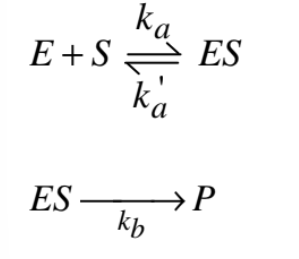
What is the concentration of enzyme- substrate complex by applying steady state approximation ?
Choose an answer to reveal your result and explanation.
Answer & Explanation
To determine the concentration of the enzyme-substrate complex ([ES]) using the steady-state approximation, we need to analyze the given reaction mechanism:
- (E + S \xrightleftharpoons[k_{a}']{k_{a}} ES)
- (ES \xrightarrow{k_{b}} P)
The steady-state approximation assumes that the concentration of the enzyme-substrate complex ([ES]) remains constant over time. This implies that the rate of formation of ([ES]) is equal to the rate of its breakdown.
Step-by-step Explanation:
-
Formation of ([ES]):
The rate of formation of ([ES]) is given by the forward reaction:
[
\text{Rate of formation} = k_{a}[E][S]
] -
Breakdown of ([ES]):
The breakdown of ([ES]) occurs via two pathways:- The reverse reaction to form (E + S): (k_{a}'[ES])
- The conversion to product (P): (k_{b}[ES])
Therefore, the total rate of breakdown of ([ES]) is:
[
\text{Rate of breakdown} = k_{a}'[ES] + k_{b}[ES]
] -
Steady-State Approximation:
According to the steady-state approximation, the rate of formation equals the rate of breakdown:
[
k_{a}[E][S] = k_{a}'[ES] + k_{b}[ES]
]Simplifying, we get:
[
k_{a}[E][S] = (k_{a}' + k_{b})[ES]
]Solving for ([ES]), we find:
[
[ES] = \frac{k_{a}[E][S]}{k_{a}' + k_{b}}
]
This derivation matches Option 2: ((\frac{k_{a}}{k_{a}' + k_{b}})[E][S]).
Explanation of Incorrect Options:
-
Option 1: ((\frac{k_{b}}{k_{a}' + k_{a}})[E][S])
- This option incorrectly uses (k_{b}) in the numerator, which represents the rate constant for the conversion of ([ES]) to product (P). The numerator should represent the formation of ([ES]), which is governed by (k_{a}).
-
Option 3: ((\frac{k_{a}}{k_{a}'k_{b}})[E][S])
- This option incorrectly uses the product (k_{a}'k_{b}) in the denominator. The denominator should be the sum (k_{a}' + k_{b}), representing the total breakdown rate of ([ES]).
-
Option 4: ((\frac{k_{a}'}{k_{a} + k_{b}})[E][S])
- This option incorrectly places (k_{a}') in the numerator, which represents the reverse reaction rate constant. The numerator should be (k_{a}), representing the forward reaction rate constant for the formation of ([ES]).
In conclusion, Option 2 is the correct answer as it accurately represents the concentration of the enzyme-substrate complex ([ES]) under the steady-state approximation.
स्थायी अवस्था सन्निकटन लगाने पर एन्जाइम- आश्रय संकुल की सान्द्रता क्या होगी ?
Choose an answer to reveal your result and explanation.
Answer & Explanation
स्थायी अवस्था सन्निकटन (steady-state approximation) का उपयोग एन्जाइम-आश्रय संकुल (enzyme-substrate complex) की सान्द्रता को निर्धारित करने के लिए किया जाता है। इस प्रक्रिया में, हम मानते हैं कि एन्जाइम-आश्रय संकुल की सान्द्रता समय के साथ स्थिर रहती है, अर्थात् इसकी दर से बनने और टूटने की दरें बराबर होती हैं।
दिए गए रासायनिक समीकरण हैं:
[ E + S \xrightleftharpoons[k_{a}']{k_{a}} ES ]
[ ES \xrightarrow{k_{b}} P ]
स्थायी अवस्था सन्निकटन के अनुसार, (ES) की सान्द्रता के लिए दर समीकरण होगा:
[ \frac{d[ES]}{dt} = k_{a}[E][S] - k_{a}'[ES] - k_{b}[ES] = 0 ]
इस समीकरण को हल करने पर हमें मिलता है:
[ k_{a}[E][S] = (k_{a}' + k_{b})[ES] ]
इससे (ES) की सान्द्रता के लिए समीकरण प्राप्त होता है:
[ [ES] = \frac{k_{a}[E][S]}{k_{a}' + k_{b}} ]
यह समीकरण विकल्प 2 के समान है:
[ (\frac{k_{a}}{k_{a}'+k_{b}})[E][S] ]
अब, अन्य विकल्पों को गलत साबित करने के लिए:
-
विकल्प 1: ((\frac{k_{b}}{k_{a}'+k_{a}})[E][S]) - यह विकल्प गलत है क्योंकि यह (k_{b}) को शीर्ष में रखता है, जबकि स्थायी अवस्था समीकरण में (k_{a}) शीर्ष में होना चाहिए।
-
विकल्प 3: ((\frac{k_{a}}{k_{a}'k_{b}})[E][S]) - यह विकल्प गलत है क्योंकि यह (k_{a}'k_{b}) को हर में रखता है, जबकि सही समीकरण में (k_{a}' + k_{b}) होना चाहिए।
-
विकल्प 4: ((\frac{k_{a}'}{k_{a}+k_{b}})[E][S]) - यह विकल्प गलत है क्योंकि यह (k_{a}') को शीर्ष में रखता है, जबकि सही समीकरण में (k_{a}) शीर्ष में होना चाहिए।
इस प्रकार, विकल्प 2 सही है क्योंकि यह स्थायी अवस्था सन्निकटन के अनुसार सही समीकरण को दर्शाता है।
Question 178
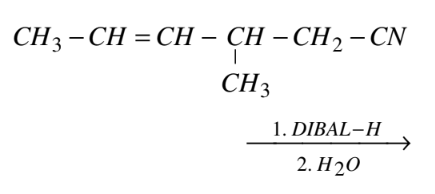
The product of the above reaction is : CH3−CH=CH−CH(CH3)−CH2−CN1.DIBAL−H,2.H2O
Choose an answer to reveal your result and explanation.
Answer & Explanation
To understand why Option 2 is the correct answer, let's analyze the reaction step by step.
Reaction Analysis:
-
Reagents Used:
- DIBAL-H (Diisobutylaluminum hydride): This is a selective reducing agent commonly used to reduce nitriles to aldehydes at low temperatures.
- H₂O (Water): Used to quench the reaction and hydrolyze any aluminum complexes formed during the reduction.
-
Substrate:
- The starting compound is CH3−CH=CH−CH(CH3)−CH2−CN, which contains a nitrile group (-CN) at the end of the carbon chain.
-
Reaction Mechanism:
- Step 1: DIBAL-H selectively reduces the nitrile group (-CN) to an aldehyde (-CHO) without affecting the double bond present in the molecule. This is because DIBAL-H is a mild reducing agent and, under controlled conditions, it can stop the reduction at the aldehyde stage.
- Step 2: The addition of water (H₂O) helps to hydrolyze any intermediate aluminum complexes, resulting in the formation of the aldehyde.
Justification for Option 2:
- Product Formation: The nitrile group (-CN) in the starting material is reduced to an aldehyde (-CHO), resulting in the product CH3−CH=CH−CH(CH3)−CH2−CHO. The double bond and the rest of the carbon skeleton remain unchanged.
- Option 2: CH3−CH=CH−CH(CH3)−CH2−CHO correctly represents the product formed after the reduction of the nitrile group to an aldehyde.
Explanation for Incorrect Options:
-
Option 1: CH3−CH2−CH2−CH(CH3)−CH2−CN
- This option suggests a complete reduction of the double bond and no change to the nitrile group, which is incorrect. DIBAL-H does not reduce alkenes under these conditions.
-
Option 3: CH3−CH2−CH2−CH(CH3)−CH2−CH2−CN
- This option implies a complete reduction of the double bond and an extension of the carbon chain, which is not possible with DIBAL-H. The nitrile group remains unchanged, which is incorrect.
-
Option 4: CH3−CH=CH−CH(CH3)−CH2−COOH
- This option suggests the formation of a carboxylic acid, which would require a stronger oxidizing agent or hydrolysis under acidic conditions, not DIBAL-H. DIBAL-H specifically reduces nitriles to aldehydes, not carboxylic acids.
In conclusion, Option 2 is the correct answer because it accurately reflects the transformation of the nitrile group to an aldehyde while preserving the rest of the molecular structure, consistent with the action of DIBAL-H.
उपरोक्त अभिक्रिया का उत्पाद है : CH3−CH=CH−CH(CH3)−CH2−CN1.DIBAL−H,2.H2O
Choose an answer to reveal your result and explanation.
Answer & Explanation
Explanation:
-
Correct Answer: Option 2 - CH3−CH=CH−CH(CH3)−CH2−CHO
The reaction involves the use of DIBAL-H (Diisobutylaluminium hydride) followed by hydrolysis with water. DIBAL-H is a selective reducing agent commonly used to reduce nitriles to aldehydes. In this reaction, the nitrile group (−CN) in the compound CH3−CH=CH−CH(CH3)−CH2−CN is reduced to an aldehyde group (−CHO) by DIBAL-H. The presence of the double bond (CH=CH) and the rest of the carbon chain remains unchanged during this reduction process. Therefore, the product of this reaction is CH3−CH=CH−CH(CH3)−CH2−CHO, which corresponds to Option 2.
-
Explanation for Incorrect Options:
-
Option 1: CH3−CH2−CH2−CH(CH3)−CH2−CN
This option suggests a reduction of the double bond (CH=CH) to a single bond (CH2−CH2), which is not the action of DIBAL-H. DIBAL-H specifically reduces nitriles to aldehydes without affecting double bonds. Therefore, this option is incorrect.
-
Option 3: CH3−CH2−CH2−CH(CH3)−CH2−CH2−CN
Similar to Option 1, this option implies a reduction of the double bond and an extension of the carbon chain, which is not the expected outcome of the reaction with DIBAL-H. The reagent does not add additional carbon atoms or reduce double bonds, making this option incorrect.
-
Option 4: CH3−CH=CH−CH(CH3)−CH2−COOH
This option suggests the conversion of the nitrile group to a carboxylic acid (−COOH). While nitriles can be hydrolyzed to carboxylic acids, this requires different conditions, typically involving strong acids or bases, not DIBAL-H. DIBAL-H specifically reduces nitriles to aldehydes, not carboxylic acids, making this option incorrect.
-
In conclusion, Option 2 is the correct answer because it accurately reflects the selective reduction of the nitrile group to an aldehyde by DIBAL-H, while the other options do not align with the chemical behavior of DIBAL-H in this context.
Question 179
Which among the following compounds has highest order of reactivity in nucleophilic addition reaction?
Choose an answer to reveal your result and explanation.
Answer & Explanation
Option 3, p-nitrobenzaldehyde, is the correct answer for having the highest order of reactivity in nucleophilic addition reactions. Here's why:
-
Explanation for Option 3 (p-nitrobenzaldehyde):
- p-Nitrobenzaldehyde contains a nitro group (-NO2) attached to the benzene ring. The nitro group is a strong electron-withdrawing group due to its resonance and inductive effects. This electron-withdrawing nature increases the positive character of the carbonyl carbon in the aldehyde group, making it more susceptible to attack by nucleophiles. The increased electrophilicity of the carbonyl carbon enhances the reactivity of p-nitrobenzaldehyde in nucleophilic addition reactions.
-
Explanation for why other options are incorrect:
-
Option 1 (Benzaldehyde):
- Benzaldehyde lacks any additional electron-withdrawing groups that could enhance the electrophilicity of the carbonyl carbon. While it is reactive in nucleophilic addition reactions, it is less reactive compared to p-nitrobenzaldehyde because it does not have the additional electron-withdrawing effect provided by a nitro group.
-
Option 2 (p-tolualdehyde):
- p-Tolualdehyde has a methyl group (-CH3) attached to the benzene ring, which is an electron-donating group. This group decreases the electrophilicity of the carbonyl carbon by donating electron density through hyperconjugation and inductive effects. As a result, p-tolualdehyde is less reactive in nucleophilic addition reactions compared to p-nitrobenzaldehyde.
-
Option 4 (Acetophenone):
- Acetophenone is a ketone, and ketones are generally less reactive in nucleophilic addition reactions compared to aldehydes due to steric hindrance and the electron-donating effect of the alkyl group attached to the carbonyl carbon. Additionally, acetophenone does not have an electron-withdrawing group like the nitro group in p-nitrobenzaldehyde, making it less reactive.
-
In conclusion, the presence of the strong electron-withdrawing nitro group in p-nitrobenzaldehyde significantly enhances its reactivity in nucleophilic addition reactions, making it the most reactive compound among the given options.
निम्नलिखित यौगिकों में से किसकी अभिक्रियाशीलता नाभिकस्नेही योगात्मक अभिक्रिया के लिए उच्चतम है ?
Choose an answer to reveal your result and explanation.
Answer & Explanation
नाभिकस्नेही योगात्मक अभिक्रिया में, यौगिक की अभिक्रियाशीलता मुख्य रूप से इलेक्ट्रॉन खींचने वाले समूहों की उपस्थिति पर निर्भर करती है, जो कार्बोनिल कार्बन को अधिक इलेक्ट्रोफिलिक बनाते हैं।
विकल्प 3: p-नाइट्रोबेन्जैल्डिहाइड में नाइट्रो समूह होता है, जो एक शक्तिशाली इलेक्ट्रॉन खींचने वाला समूह है। यह समूह कार्बोनिल कार्बन पर इलेक्ट्रॉन घनत्व को कम करता है, जिससे यह अधिक इलेक्ट्रोफिलिक बन जाता है और नाभिकस्नेही अभिक्रिया के लिए अधिक प्रतिक्रियाशील होता है। इस कारण से, p-नाइट्रोबेन्जैल्डिहाइड की अभिक्रियाशीलता नाभिकस्नेही योगात्मक अभिक्रिया के लिए उच्चतम होती है।
अन्य विकल्पों का विश्लेषण:
-
बेन्जैल्डिहाइड: इसमें कोई अतिरिक्त इलेक्ट्रॉन खींचने वाला या धकेलने वाला समूह नहीं होता है, जिससे इसकी अभिक्रियाशीलता p-नाइट्रोबेन्जैल्डिहाइड की तुलना में कम होती है।
-
p-टॉलूऐल्डिहाइड: इसमें टॉलूइल समूह होता है, जो एक इलेक्ट्रॉन धकेलने वाला समूह है। यह कार्बोनिल कार्बन पर इलेक्ट्रॉन घनत्व को बढ़ाता है, जिससे इसकी अभिक्रियाशीलता कम हो जाती है।
-
ऐसीटोफीनोन: इसमें फिनाइल समूह होता है, जो इलेक्ट्रॉन खींचने की तुलना में धकेलने की प्रवृत्ति रखता है। यह कार्बोनिल कार्बन को कम इलेक्ट्रोफिलिक बनाता है, जिससे इसकी अभिक्रियाशीलता कम होती है।
इस प्रकार, p-नाइट्रोबेन्जैल्डिहाइड (विकल्प 3) नाभिकस्नेही योगात्मक अभिक्रिया के लिए सबसे अधिक अभिक्रियाशील है।
Question 180
Which of the following gives entropy change of an ideal gas for isobaric process ?
Choose an answer to reveal your result and explanation.
Answer & Explanation
The correct answer for the entropy change of an ideal gas during an isobaric process is given by Option 2: (C_{p} \ln\left(\frac{T_{2}}{T_{1}}\right)). Let's explore why this is the correct choice and why the other options are incorrect.
Explanation for Option 2:
-
Isobaric Process: An isobaric process is one in which the pressure remains constant. For an ideal gas undergoing an isobaric process, the change in entropy ((\Delta S)) can be calculated using the formula:
[
\Delta S = C_{p} \ln\left(\frac{T_{2}}{T_{1}}\right)
]
where (C_{p}) is the specific heat capacity at constant pressure, (T_{1}) is the initial temperature, and (T_{2}) is the final temperature. -
Justification: This formula arises because, in an isobaric process, the heat added to the system is related to the change in temperature at constant pressure. The specific heat capacity at constant pressure, (C_{p}), is used because the process is isobaric. The natural logarithm of the ratio of the final to initial temperatures reflects the proportional change in entropy due to temperature change.
Explanation for Incorrect Options:
-
Option 1: (R \ln\left(\frac{P_{1}}{P_{2}}\right)):
- This formula is not applicable for an isobaric process because it involves a change in pressure ((P_{1}) and (P_{2})). In an isobaric process, the pressure remains constant, so this expression does not describe the entropy change correctly.
-
Option 3: (C_{V} \ln\left(\frac{T_{2}}{T_{1}}\right)):
- This formula is used for calculating the entropy change in an isochoric process (constant volume), not an isobaric process. In an isobaric process, the volume changes, and the specific heat capacity at constant volume, (C_{V}), is not applicable.
-
Option 4: (R \ln\left(\frac{V_{2}}{V_{1}}\right)):
- This expression is related to the entropy change in an isothermal process (constant temperature) for an ideal gas, where the volume changes. It does not apply to an isobaric process where the temperature changes and pressure remains constant.
In conclusion, Option 2 is the correct choice because it accurately describes the entropy change for an ideal gas during an isobaric process, using the specific heat capacity at constant pressure and the change in temperature. The other options do not correctly apply to the conditions of an isobaric process.
निम्नलिखित में से कौन-सा आदर्श गैस के लिए समदाबी प्रक्रम में एंट्रापी परिवर्तन देता है ?
Choose an answer to reveal your result and explanation.
Answer & Explanation
समदाबी प्रक्रम (isobaric process) में आदर्श गैस के लिए एंट्रापी परिवर्तन का सही सूत्र Cpln(T1T2) है, जो विकल्प 2 में दिया गया है। आइए इसे विस्तार से समझते हैं:
-
विकल्प 2: Cpln(T1T2)
समदाबी प्रक्रम में, दबाव स्थिर रहता है और तापमान में परिवर्तन होता है। इस स्थिति में एंट्रापी परिवर्तन का सूत्र Cpln(T1T2) होता है, जहाँ Cp स्थिर दबाव पर विशिष्ट ऊष्मा है। यह सूत्र इस तथ्य पर आधारित है कि एंट्रापी परिवर्तन तापमान के अनुपात के प्राकृतिक लघुगणक के साथ सीधे संबंधित होता है जब दबाव स्थिर रहता है। इसलिए, यह विकल्प सही है। -
विकल्प 1: R ln(P2P1)
यह सूत्र समद्रवीय प्रक्रम (isothermal process) में एंट्रापी परिवर्तन के लिए सही होता है, जहाँ तापमान स्थिर रहता है और दबाव में परिवर्तन होता है। समदाबी प्रक्रम में, दबाव स्थिर रहता है, इसलिए यह विकल्प गलत है। -
विकल्प 3: Cvln(T1T2)
यह सूत्र समवायवीय प्रक्रम (isochoric process) के लिए सही होता है, जहाँ आयतन स्थिर रहता है। समदाबी प्रक्रम में, आयतन में परिवर्तन होता है जबकि दबाव स्थिर रहता है, इसलिए यह विकल्प गलत है। -
विकल्प 4: R ln(V1V2)
यह सूत्र भी समद्रवीय प्रक्रम के लिए सही होता है, जहाँ तापमान स्थिर रहता है और आयतन में परिवर्तन होता है। समदाबी प्रक्रम में, दबाव स्थिर रहता है, इसलिए यह विकल्प गलत है।
इस प्रकार, समदाबी प्रक्रम में आदर्श गैस के लिए एंट्रापी परिवर्तन का सही सूत्र विकल्प 2 है: Cpln(T1T2)।