
HTET परीक्षा Level 3 PGT
Clear Cutoff के साथ HTET परीक्षा Level 3 PGT की तैयारी
सत्यापित उत्तर और व्याख्याएँ
Clear Cutoff द्वारा
20 में से 20 प्रश्न दिखाए जा रहे हैं
प्रश्न 121
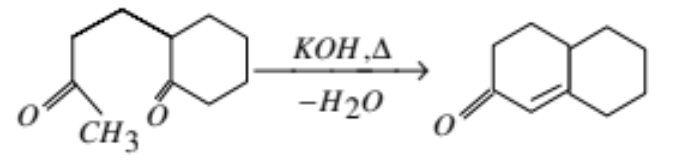
The reaction is an application of which of the following reaction?
अपना परिणाम और व्याख्या देखने के लिए एक उत्तर चुनें।
उत्तर और व्याख्या
The reaction given in the question is:
[ CH_3COCH_3 + CH_3COCH_3 \xrightarrow[KOH, \Delta]{-H_2O} (CH_3)_2C=CHCOCH_3 ]
This reaction is an application of the Aldol condensation, which is correctly identified as Option 2. Here's why:
Explanation for Option 2: Aldol Condensation
-
Definition of Aldol Condensation: Aldol condensation is a reaction in which an enolate ion reacts with a carbonyl compound to form a β-hydroxy ketone or aldehyde, followed by dehydration to give a conjugated enone.
-
Mechanism: In the given reaction, acetone ((CH_3COCH_3)) undergoes deprotonation in the presence of a base (KOH) to form an enolate ion. This enolate ion then attacks another molecule of acetone at the carbonyl carbon, forming a β-hydroxy ketone intermediate. Upon heating ((\Delta)), this intermediate undergoes dehydration (loss of water, (-H_2O)) to form the α,β-unsaturated ketone ((CH_3)_2C=CHCOCH_3).
-
Characteristics: The reaction involves the formation of a carbon-carbon bond and the creation of a double bond through dehydration, which are hallmark features of aldol condensation.
Explanation for Why Other Options are Incorrect
-
Option 1: Cannizzaro Reaction:
- The Cannizzaro reaction involves the base-induced disproportionation of non-enolizable aldehydes to yield an alcohol and a carboxylic acid. It does not involve ketones or the formation of carbon-carbon double bonds, making it irrelevant to the given reaction.
-
Option 3: Hofmann Reaction:
- The Hofmann reaction typically refers to the Hofmann rearrangement, where an amide is converted to an amine with one fewer carbon atom. This reaction does not involve ketones or the formation of enones, and thus does not apply to the given reaction.
-
Option 4: Curtius Reaction:
- The Curtius reaction involves the decomposition of an acyl azide to form an isocyanate, which can further react to form amines or other derivatives. This reaction does not involve ketones or the formation of carbon-carbon double bonds, making it unrelated to the reaction in question.
In conclusion, the given reaction is a classic example of aldol condensation, as it involves the formation of a β-hydroxy ketone intermediate and subsequent dehydration to form an α,β-unsaturated ketone. Therefore, Option 2 is the correct answer.
उपरोक्त अभिक्रिया , निम्नलिखित में से किस अभिक्रिया का अनुप्रयोग है ?
अपना परिणाम और व्याख्या देखने के लिए एक उत्तर चुनें।
उत्तर और व्याख्या
उपरोक्त अभिक्रिया CH3COCH3+CH3COCH3−H2OKOH,Δ(CH3)2C=CHCOCH3 ऐल्डोल संघनन का अनुप्रयोग है। ऐल्डोल संघनन एक ऐसी अभिक्रिया है जिसमें दो अल्डिहाइड या कीटोन, जो अल्फा-हाइड्रोजन युक्त होते हैं, एक-दूसरे के साथ प्रतिक्रिया करते हैं और एक बीटा-हाइड्रॉक्सी कीटोन या अल्डिहाइड का निर्माण करते हैं। इसके बाद, यह बीटा-हाइड्रॉक्सी यौगिक निर्जलीकरण के माध्यम से एक अल्फा, बीटा-असंतृप्त कीटोन या अल्डिहाइड में परिवर्तित हो सकता है।
इस विशेष अभिक्रिया में, दो एसीटोन (CH_3COCH_3) अणु KOH की उपस्थिति में गर्म किए जाते हैं, जिससे एक अल्फा, बीटा-असंतृप्त कीटोन का निर्माण होता है। यह प्रक्रिया ऐल्डोल संघनन की विशेषता है, जहां निर्जलीकरण के बाद एक डबल बॉन्ड का निर्माण होता है।
अब, अन्य विकल्पों को गलत साबित करने के लिए:
-
कैनिज़ारो अभिक्रिया: यह अभिक्रिया उन अल्डिहाइड के लिए होती है जिनमें अल्फा-हाइड्रोजन नहीं होता। इसमें एक अल्डिहाइड ऑक्सीकृत होकर कार्बोक्सिलिक एसिड बनता है और दूसरा अल्कोहल में अपचयित होता है। यह अभिक्रिया इस संदर्भ में लागू नहीं होती क्योंकि यहाँ अल्फा-हाइड्रोजन युक्त कीटोन का उपयोग हो रहा है।
-
हॉफमान अभिक्रिया: यह अभिक्रिया प्राथमिक अमाइन के निर्माण के लिए होती है, जिसमें अमाइड को ब्रोमीन और क्षार के साथ गर्म किया जाता है। यह प्रक्रिया कीटोन या अल्डिहाइड के साथ नहीं होती, इसलिए यह विकल्प गलत है।
-
कर्टियस अभिक्रिया: यह अभिक्रिया एसाइल अजाइड के विघटन से इसोसाइनेट के निर्माण के लिए होती है, जो आगे चलकर विभिन्न यौगिकों में परिवर्तित हो सकता है। यह प्रक्रिया भी कीटोन या अल्डिहाइड के साथ नहीं होती, इसलिए यह विकल्प भी गलत है।
इस प्रकार, उपरोक्त अभिक्रिया ऐल्डोल संघनन का एक उदाहरण है, और सही उत्तर विकल्प 2 है।
प्रश्न 122
In which of the following properties the enantiomers are different?
अपना परिणाम और व्याख्या देखने के लिए एक उत्तर चुनें।
उत्तर और व्याख्या
Enantiomers are a type of stereoisomer that are non-superimposable mirror images of each other. They have identical physical properties in an achiral environment, such as melting point, boiling point, density, and refractive index. However, they differ in the way they interact with plane-polarized light, which is the basis for their differing optical activity.
-
Direction of optical rotation (Option 2): Enantiomers differ in the direction in which they rotate plane-polarized light. One enantiomer will rotate light in a clockwise direction (dextrorotatory, denoted as "+"), while the other will rotate light in a counterclockwise direction (levorotatory, denoted as "-"). This property is unique to chiral molecules and is the primary distinguishing feature of enantiomers. Therefore, Option 2 is correct because it highlights the fundamental difference between enantiomers.
-
Refractive index (Option 1): The refractive index is a measure of how much light is bent, or refracted, when it enters a material. Enantiomers have identical refractive indices because this property is not influenced by the chirality of the molecules. Therefore, Option 1 is incorrect.
-
Melting point and boiling point (Option 3): These are physical properties that depend on the intermolecular forces within a substance. Enantiomers have identical melting and boiling points because they have the same molecular structure and intermolecular interactions. Thus, Option 3 is incorrect.
-
Density (Option 4): Density is a measure of mass per unit volume and is determined by the molecular weight and the arrangement of molecules in a given space. Since enantiomers have the same molecular formula and structure, they also have the same density. Therefore, Option 4 is incorrect.
In conclusion, the direction of optical rotation is the only property among the options listed that distinguishes enantiomers, making Option 2 the correct answer.
निम्नलिखित में से किस गुण में प्रतिबिम्ब रूप भिन्न हैं ?
अपना परिणाम और व्याख्या देखने के लिए एक उत्तर चुनें।
उत्तर और व्याख्या
प्रतिबिम्ब रूप भिन्नता का अर्थ है कि किसी पदार्थ के गुण में परिवर्तन होता है जब वह प्रकाश के प्रतिबिम्ब के रूप में देखा जाता है। इस संदर्भ में, हम देखते हैं कि:
-
अपवर्तनांक (Refractive Index): अपवर्तनांक एक भौतिक गुण है जो यह निर्धारित करता है कि प्रकाश किसी माध्यम से कैसे गुजरता है। यह गुण प्रतिबिम्ब रूप में भिन्न नहीं होता है क्योंकि यह माध्यम की भौतिक संरचना पर निर्भर करता है और प्रतिबिम्ब से प्रभावित नहीं होता।
-
ध्रुवण घूर्णन की दिशा (Direction of Polarization Rotation): ध्रुवण घूर्णन की दिशा वह गुण है जो यह निर्धारित करता है कि जब प्रकाश किसी माध्यम से गुजरता है, तो उसका ध्रुवण कोण किस दिशा में और कितना घूर्णित होता है। यह गुण प्रतिबिम्ब रूप में भिन्न हो सकता है क्योंकि ध्रुवण की दिशा और घूर्णन प्रतिबिम्ब के आधार पर बदल सकते हैं। इसलिए, यह विकल्प सही है।
-
गलनांक और क्वथनांक (Melting Point and Boiling Point): गलनांक और क्वथनांक पदार्थ के तापमान से संबंधित गुण हैं, जो पदार्थ की भौतिक अवस्था में परिवर्तन के बिंदु को दर्शाते हैं। ये गुण प्रतिबिम्ब रूप में भिन्न नहीं होते क्योंकि ये पदार्थ की आंतरिक संरचना पर निर्भर करते हैं।
-
घनत्व (Density): घनत्व एक भौतिक गुण है जो किसी पदार्थ के द्रव्यमान और आयतन के अनुपात को दर्शाता है। यह गुण भी प्रतिबिम्ब रूप में भिन्न नहीं होता क्योंकि यह पदार्थ की भौतिक संरचना पर निर्भर करता है।
इस प्रकार, ध्रुवण घूर्णन की दिशा (Option 2) ही वह गुण है जिसमें प्रतिबिम्ब रूप भिन्नता होती है।
प्रश्न 123
Which of the following ion has highest magnetic moment?
अपना परिणाम और व्याख्या देखने के लिए एक उत्तर चुनें।
उत्तर और व्याख्या
The question asks which ion has the highest magnetic moment among the given options. The correct answer is Option 3: Mn2+. Let's explore why this is the case and why the other options are incorrect.
Explanation for Mn2+ (Option 3):
-
Electronic Configuration: The Mn2+ ion is derived from manganese, which has an atomic number of 25. The electronic configuration of neutral manganese is [Ar] 3d(^5) 4s(^2). When it loses two electrons to form Mn2+, the configuration becomes [Ar] 3d(^5).
-
Unpaired Electrons: In the 3d subshell, Mn2+ has five unpaired electrons. The magnetic moment is directly related to the number of unpaired electrons, as it is calculated using the formula:
[
\mu = \sqrt{n(n+2)}
]
where ( \mu ) is the magnetic moment and ( n ) is the number of unpaired electrons. For Mn2+, ( n = 5 ), so:
[
\mu = \sqrt{5(5+2)} = \sqrt{35} \approx 5.92 \mu_B
]
This is the highest magnetic moment among the given options.
Explanation for Other Options:
-
Fe2+ (Option 1):
- Electronic Configuration: [Ar] 3d(^6)
- Unpaired Electrons: 4 unpaired electrons.
- Magnetic Moment: (\mu = \sqrt{4(4+2)} = \sqrt{24} \approx 4.90 \mu_B)
-
Cr2+ (Option 2):
- Electronic Configuration: [Ar] 3d(^4)
- Unpaired Electrons: 4 unpaired electrons.
- Magnetic Moment: (\mu = \sqrt{4(4+2)} = \sqrt{24} \approx 4.90 \mu_B)
-
Co2+ (Option 4):
- Electronic Configuration: [Ar] 3d(^7)
- Unpaired Electrons: 3 unpaired electrons.
- Magnetic Moment: (\mu = \sqrt{3(3+2)} = \sqrt{15} \approx 3.87 \mu_B)
Conclusion:
The Mn2+ ion has the highest magnetic moment because it has the maximum number of unpaired electrons (five) among the given options. This results in a larger magnetic moment compared to Fe2+, Cr2+, and Co2+, which have fewer unpaired electrons. Therefore, Option 3 is indeed the correct answer.
निम्नलिखित में से किस आयन का चुंबकीय आघूर्ण उच्चतम है ?
अपना परिणाम और व्याख्या देखने के लिए एक उत्तर चुनें।
उत्तर और व्याख्या
Mn2+ आयन का चुंबकीय आघूर्ण उच्चतम है। इसका कारण यह है कि चुंबकीय आघूर्ण का निर्धारण आयन के इलेक्ट्रॉनिक विन्यास और अनपेयर इलेक्ट्रॉनों की संख्या पर निर्भर करता है।
-
Mn2+ (Option 3): Mn2+ आयन में मैंगनीज का परमाणु क्रमांक 25 है, और इसका इलेक्ट्रॉनिक विन्यास [Ar]3d5 होता है। इसमें 5 अनपेयर इलेक्ट्रॉन होते हैं। चुंबकीय आघूर्ण की गणना के लिए स्पिन-ओनली फॉर्मूला μ=n(n+2) का उपयोग किया जाता है, जहां n अनपेयर इलेक्ट्रॉनों की संख्या है। Mn2+ के लिए, μ=5(5+2)=35 होता है, जो कि उच्चतम चुंबकीय आघूर्ण देता है।
-
Fe2+ (Option 1): Fe2+ आयन का इलेक्ट्रॉनिक विन्यास [Ar]3d6 होता है, जिसमें 4 अनपेयर इलेक्ट्रॉन होते हैं। इसका चुंबकीय आघूर्ण μ=4(4+2)=24 होता है, जो Mn2+ से कम है।
-
Cr2+ (Option 2): Cr2+ आयन का इलेक्ट्रॉनिक विन्यास [Ar]3d4 होता है, जिसमें 4 अनपेयर इलेक्ट्रॉन होते हैं। इसका चुंबकीय आघूर्ण μ=4(4+2)=24 होता है, जो Mn2+ से कम है।
-
Co2+ (Option 4): Co2+ आयन का इलेक्ट्रॉनिक विन्यास [Ar]3d7 होता है, जिसमें 3 अनपेयर इलेक्ट्रॉन होते हैं। इसका चुंबकीय आघूर्ण μ=3(3+2)=15 होता है, जो Mn2+ से कम है।
इस प्रकार, Mn2+ आयन का चुंबकीय आघूर्ण सबसे अधिक है, जो इसे सही उत्तर बनाता है।
प्रश्न 124
The monomers of glyptal are:
अपना परिणाम और व्याख्या देखने के लिए एक उत्तर चुनें।
उत्तर और व्याख्या
Glyptal is a type of polyester resin, and its monomers are specifically ethylene glycol and phthalic acid. Here's a detailed explanation of why Option 3 is correct and why the other options are incorrect:
-
Explanation for Option 3 (Correct Answer):
- Glyptal is a polyester, which is a type of polymer formed by the reaction between a diol and a dicarboxylic acid. In the case of glyptal, the diol used is ethylene glycol, and the dicarboxylic acid is phthalic acid. When these two monomers undergo a condensation reaction, they form the polyester known as glyptal. This reaction involves the elimination of water molecules and results in the formation of ester linkages, which are characteristic of polyester resins. Glyptal is commonly used in paints and coatings due to its excellent adhesion and durability.
-
Explanation for why other options are incorrect:
-
Option 1: Phenol and formaldehyde
- Phenol and formaldehyde are the monomers for phenolic resins, not glyptal. Phenolic resins are formed through the polymerization of phenol with formaldehyde, resulting in a different type of polymer known for its heat resistance and mechanical strength. These are not used in the formation of glyptal.
-
Option 2: Styrene
- Styrene is a monomer used in the production of polystyrene and other copolymers, such as styrene-butadiene rubber. It is not involved in the formation of glyptal. Styrene is a vinyl monomer and does not participate in the formation of polyester resins like glyptal.
-
Option 4: Ethylene glycol and terephthalic acid
- While ethylene glycol is correctly one of the monomers for glyptal, terephthalic acid is not. Instead, terephthalic acid is used in the production of polyethylene terephthalate (PET), a different type of polyester commonly used in fibers and plastic bottles. Glyptal specifically requires phthalic acid, not terephthalic acid.
-
In conclusion, Option 3 is the correct answer because glyptal is synthesized from ethylene glycol and phthalic acid, forming a polyester resin through a condensation reaction. The other options involve different monomers and result in different types of polymers.
ग्लिप्टल के एकलक हैं :
अपना परिणाम और व्याख्या देखने के लिए एक उत्तर चुनें।
उत्तर और व्याख्या
ग्लिप्टल एक प्रकार का पॉलिएस्टर रेजिन है जो मुख्य रूप से पेंट्स और कोटिंग्स में उपयोग किया जाता है। ग्लिप्टल के निर्माण के लिए आवश्यक एकलक (मोनोमर्स) एथिलीन ग्लाइकॉल और थैलिक अम्ल होते हैं। आइए समझते हैं कि क्यों विकल्प 3 सही है और अन्य विकल्प क्यों गलत हैं:
-
विकल्प 3: एथिलीन ग्लाइकॉल और थैलिक अम्ल - ग्लिप्टल रेजिन का निर्माण एथिलीन ग्लाइकॉल और थैलिक अम्ल के बीच एक प्रतिक्रिया के माध्यम से होता है। यह प्रतिक्रिया एक पॉलिएस्टर बनाती है जो ग्लिप्टल के रूप में जाना जाता है। इस प्रकार, यह विकल्प सही है क्योंकि यह ग्लिप्टल के निर्माण के लिए आवश्यक सही एकलकों को दर्शाता है।
-
विकल्प 1: फीनॉल और फॉर्मेल्डिहाइड - यह संयोजन बेकलाइट के निर्माण के लिए उपयोग किया जाता है, जो एक प्रकार का फिनोलिक रेजिन है। यह ग्लिप्टल के निर्माण में शामिल नहीं होता है, इसलिए यह विकल्प गलत है।
-
विकल्प 2: स्टाइरीन - स्टाइरीन एकलकों का उपयोग पॉलीस्टाइरीन और अन्य संबंधित पॉलिमरों के निर्माण में किया जाता है। यह ग्लिप्टल के निर्माण में शामिल नहीं होता है, इसलिए यह विकल्प भी गलत है।
-
विकल्प 4: एथिलीन ग्लाइकॉल और टेरेफ्थैलिक अम्ल - यह संयोजन पॉलीएथिलीन टेरेफ्थालेट (PET) के निर्माण में उपयोग होता है, जो प्लास्टिक की बोतलों और फाइबर के लिए जाना जाता है। यह ग्लिप्टल के निर्माण में शामिल नहीं होता है, इसलिए यह विकल्प गलत है।
इस प्रकार, विकल्प 3 सही है क्योंकि यह ग्लिप्टल के निर्माण के लिए आवश्यक सही एकलकों को दर्शाता है।
प्रश्न 125
CH2=CH2+H−Br→CH3CH2Br the type of reaction is :
अपना परिणाम और व्याख्या देखने के लिए एक उत्तर चुनें।
उत्तर और व्याख्या
The reaction given is:
[ CH_{2}=CH_{2} + H-Br \rightarrow CH_{3}CH_{2}Br ]
This reaction is classified as an electrophilic addition reaction. Let's break down why this is the correct classification and why the other options are incorrect.
Explanation for Option 2: Electrophilic Addition Reaction
-
Nature of the Reactants: The reactant ( CH_{2}=CH_{2} ) is ethene, which contains a carbon-carbon double bond. Double bonds are regions of high electron density, making them attractive to electrophiles.
-
Role of H-Br: In the presence of the double bond, the hydrogen bromide (H-Br) molecule dissociates into H⁺ (a proton, which is an electrophile) and Br⁻ (a bromide ion). The electrophile (H⁺) attacks the electron-rich double bond of ethene.
-
Mechanism: The reaction proceeds through the following steps:
- The π electrons of the double bond attack the electrophilic H⁺, forming a carbocation intermediate.
- The Br⁻ ion then attacks the carbocation, resulting in the addition of H and Br across the double bond.
-
Product Formation: The final product is bromoethane (( CH_{3}CH_{2}Br )), where the double bond has been converted into a single bond with the addition of H and Br atoms.
This sequence of events, where an electrophile adds to a double bond, is characteristic of an electrophilic addition reaction.
Why the Other Options are Incorrect
-
Option 1: Electrophilic Substitution Reaction
- In electrophilic substitution reactions, an electrophile replaces an atom or group of atoms in a molecule. This type of reaction is typical for aromatic compounds, not alkenes like ethene. In the given reaction, no substitution occurs; instead, the double bond is broken, and new atoms are added.
-
Option 3: Nucleophilic Substitution Reaction
- Nucleophilic substitution involves a nucleophile replacing a leaving group in a molecule. This reaction type is common in saturated compounds like alkyl halides, not in alkenes. The reaction in question involves the addition of atoms across a double bond, not the substitution of one group for another.
-
Option 4: Nucleophilic Addition Reaction
- Nucleophilic addition typically occurs in carbonyl compounds where a nucleophile adds to a carbon-oxygen double bond. In the given reaction, the addition involves an electrophile (H⁺) and not a nucleophile, making this option incorrect.
In conclusion, the reaction ( CH_{2}=CH_{2} + H-Br \rightarrow CH_{3}CH_{2}Br ) is best described as an electrophilic addition reaction, which is why Option 2 is the correct answer.
CH2=CH2+H−Br→CH3CH2Br अभिक्रिया का प्रकार है :
अपना परिणाम और व्याख्या देखने के लिए एक उत्तर चुनें।
उत्तर और व्याख्या
यह अभिक्रिया CH2=CH2+H−Br→CH3CH2Br एक इलेक्ट्रॉनस्नेही योगात्मक अभिक्रिया है। आइए इसे विस्तार से समझते हैं:
-
इलेक्ट्रॉनस्नेही योगात्मक अभिक्रिया (Option 2): इस अभिक्रिया में, एथिलीन (CH2=CH2) के डबल बॉन्ड पर इलेक्ट्रॉनस्नेही (H-Br) का योग होता है। एथिलीन के डबल बॉन्ड में इलेक्ट्रॉन की अधिकता होती है, जो इलेक्ट्रॉनस्नेही अभिकर्मक (H-Br) को आकर्षित करती है। H-Br में H+ आयन इलेक्ट्रॉनस्नेही होता है और यह डबल बॉन्ड के साथ जुड़कर एक नया सिंगल बॉन्ड बनाता है, जिससे CH3CH2Br का निर्माण होता है। इस प्रकार, यह एक इलेक्ट्रॉनस्नेही योगात्मक अभिक्रिया है।
-
अन्य विकल्पों का विश्लेषण:
-
इलेक्ट्रॉनस्नेही प्रतिस्थापन अभिक्रिया (Option 1): प्रतिस्थापन अभिक्रिया में एक समूह या परमाणु को दूसरे से प्रतिस्थापित किया जाता है। यहाँ कोई प्रतिस्थापन नहीं हो रहा है, बल्कि एक योग हो रहा है, इसलिए यह विकल्प गलत है।
-
नाभिकस्नेही प्रतिस्थापन अभिक्रिया (Option 3): नाभिकस्नेही प्रतिस्थापन अभिक्रिया में एक नाभिकस्नेही अभिकर्मक एक समूह को प्रतिस्थापित करता है। इस अभिक्रिया में कोई प्रतिस्थापन नहीं हो रहा है, बल्कि एक योग हो रहा है, इसलिए यह विकल्प गलत है।
-
नाभिकस्नेही योगात्मक अभिक्रिया (Option 4): नाभिकस्नेही योगात्मक अभिक्रिया में नाभिकस्नेही अभिकर्मक का योग होता है। यहाँ H-Br एक इलेक्ट्रॉनस्नेही अभिकर्मक है, न कि नाभिकस्नेही, इसलिए यह विकल्प गलत है।
-
इस प्रकार, दिए गए विकल्पों में से सही उत्तर विकल्प 2 है, जो कि इलेक्ट्रॉनस्नेही योगात्मक अभिक्रिया है।
प्रश्न 126
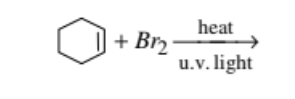
What is the product of the reaction given below ? Cyclohexene +Br2heat,u.v.light
अपना परिणाम और व्याख्या देखने के लिए एक उत्तर चुनें।
उत्तर और व्याख्या
The reaction in question involves cyclohexene reacting with bromine ((Br_2)) under the influence of heat and ultraviolet (u.v.) light. This setup typically leads to a free radical halogenation process rather than an addition reaction. Let's analyze why Option 1 is the correct answer and why the other options are incorrect.
-
Option 1: 1,2-Dibromocyclohexane
In the presence of heat and u.v. light, bromine can undergo a free radical substitution reaction with cyclohexene. The double bond in cyclohexene can react with bromine to form a dibrominated product. The most straightforward outcome of this reaction is the addition of bromine across the double bond, resulting in 1,2-dibromocyclohexane. This is consistent with the typical behavior of alkenes reacting with bromine under these conditions, where the double bond is broken, and each carbon atom of the former double bond forms a bond with a bromine atom. -
Option 2: 3-Bromocyclohexene
This option suggests a monobromination at the allylic position (position 3), which is not the primary reaction pathway under the given conditions. The presence of heat and u.v. light favors the addition of bromine across the double bond rather than allylic bromination. Therefore, this option is incorrect. -
Option 3: 1-Bromocyclohexane
This option implies a single bromine atom addition, which would typically occur in a radical substitution reaction at the allylic position. However, the conditions specified (heat and u.v. light) are more conducive to the addition of bromine across the double bond, leading to a dibrominated product rather than a monobrominated one. Thus, this option is incorrect. -
Option 4: Bromobenzene
This option is incorrect because cyclohexene is not aromatic and cannot be converted into bromobenzene through the reaction conditions provided. Bromobenzene is a completely different compound that would require an aromatic ring, which cyclohexene does not possess. Therefore, this option is not feasible in the context of the given reaction.
In conclusion, the reaction conditions favor the addition of bromine across the double bond of cyclohexene, resulting in the formation of 1,2-dibromocyclohexane, making Option 1 the correct answer.
निम्नलिखित अभिक्रिया का उत्पाद क्या होगा ? साइक्लोहेक्सीन +Br2heat,u.v.light
अपना परिणाम और व्याख्या देखने के लिए एक उत्तर चुनें।
उत्तर और व्याख्या
साइक्लोहेक्सीन के साथ ब्रोमीन (Br2) की अभिक्रिया के संदर्भ में, जब इसे ऊष्मा और यू.वी. प्रकाश की उपस्थिति में किया जाता है, तो यह एक फ्री रेडिकल अभिक्रिया होती है। इस प्रकार की अभिक्रिया में, ब्रोमीन के अणु (Br2) का होमोलिटिक विघटन होता है, जिससे दो ब्रोमीन रेडिकल्स (Br⋅) उत्पन्न होते हैं। ये ब्रोमीन रेडिकल्स साइक्लोहेक्सीन के डबल बॉन्ड पर हमला करते हैं।
-
1,2-डाइब्रोमोसाइक्लोहेक्सेन (Option 1): इस अभिक्रिया में, ब्रोमीन रेडिकल्स साइक्लोहेक्सीन के डबल बॉन्ड पर जुड़ते हैं, जिससे 1,2-डाइब्रोमोसाइक्लोहेक्सेन का निर्माण होता है। यह उत्पाद इसलिए बनता है क्योंकि ब्रोमीन के रेडिकल्स डबल बॉन्ड के दोनों कार्बन पर जुड़ते हैं, जिससे 1,2-डाइब्रोमोसाइक्लोहेक्सेन बनता है। यह प्रक्रिया फ्री रेडिकल एडिशन के माध्यम से होती है।
-
3-ब्रोमोसाइक्लोहेक्सीन (Option 2): यह विकल्प गलत है क्योंकि ब्रोमीन रेडिकल्स डबल बॉन्ड के साथ सीधे प्रतिक्रिया करते हैं, और 3-ब्रोमोसाइक्लोहेक्सीन का निर्माण नहीं होता है। इस प्रकार की संरचना के लिए कोई उपयुक्त तंत्र नहीं है।
-
1-ब्रोमोसाइक्लोहेक्सेन (Option 3): यह विकल्प भी गलत है क्योंकि यदि केवल एक ब्रोमीन रेडिकल जुड़ता, तो यह डबल बॉन्ड को नहीं तोड़ता और 1-ब्रोमोसाइक्लोहेक्सेन का निर्माण नहीं होता। इस अभिक्रिया में डबल बॉन्ड के दोनों कार्बन पर ब्रोमीन जुड़ता है।
-
ब्रोमोबेंजीन (Option 4): यह विकल्प गलत है क्योंकि साइक्लोहेक्सीन एक साइक्लिक एल्कीन है और बेंजीन रिंग नहीं है। ब्रोमोबेंजीन का निर्माण केवल बेंजीन रिंग के साथ हो सकता है, जो इस अभिक्रिया में संभव नहीं है।
इस प्रकार, दिए गए विकल्पों में से 1,2-डाइब्रोमोसाइक्लोहेक्सेन (Option 1) सही उत्तर है, क्योंकि यह फ्री रेडिकल एडिशन अभिक्रिया के माध्यम से साइक्लोहेक्सीन और ब्रोमीन के बीच होने वाली प्रतिक्रिया का सही उत्पाद है।
प्रश्न 127
RNH2+CHCl3+KOHΔ? The product of above reaction is :
अपना परिणाम और व्याख्या देखने के लिए एक उत्तर चुनें।
उत्तर और व्याख्या
The reaction in question is known as the Hofmann rearrangement or Hofmann degradation. This reaction involves the conversion of a primary amine (RNH₂) into an isocyanide (RNC) when treated with chloroform (CHCl₃) and a strong base like potassium hydroxide (KOH) under heating (Δ).
-
Explanation for Option 4 (RNC):
- In the Hofmann rearrangement, the primary amine reacts with chloroform in the presence of a strong base. The base deprotonates the amine, forming an anion that facilitates the nucleophilic attack on chloroform. This leads to the formation of dichlorocarbene (CCl₂), which is highly reactive.
- The dichlorocarbene then inserts into the nitrogen of the amine, leading to the formation of an isocyanide (RNC) as the final product. This is a well-documented transformation in organic chemistry, and the conditions described in the question are typical for this reaction.
-
Explanation for why other options are incorrect:
- Option 1 (RCl): This option suggests the formation of an alkyl chloride. However, the reaction conditions and reagents (CHCl₃ and KOH) do not favor the formation of RCl from a primary amine. There is no mechanism in this reaction setup that would lead to the substitution of the amine group with a chlorine atom.
- Option 2 (ROH): This option suggests the formation of an alcohol. The reaction conditions do not involve any oxidizing agents or pathways that would convert an amine to an alcohol. The presence of chloroform and a strong base does not facilitate such a transformation.
- Option 3 (RCN): This option suggests the formation of a nitrile. While nitriles can be formed from amines through other reactions, the Hofmann rearrangement specifically leads to the formation of isocyanides (RNC), not nitriles (RCN). The reaction mechanism and intermediates involved do not support the formation of a nitrile under these conditions.
In conclusion, the reaction of a primary amine with chloroform and potassium hydroxide under heat specifically leads to the formation of an isocyanide (RNC), making Option 4 the correct answer.
RNH2+CHCl3+KOHΔ? उपरोक्त अभिक्रिया का उत्पाद है :
अपना परिणाम और व्याख्या देखने के लिए एक उत्तर चुनें।
उत्तर और व्याख्या
उपरोक्त अभिक्रिया में RNH2, CHCl3 और KOH की उपस्थिति में गर्म किया जाता है। यह एक क्लासिक कार्बाइल अमीन प्रतिक्रिया है, जिसे हॉफमैन आइसोसायनाइड सिंथेसिस के रूप में भी जाना जाता है। इस प्रतिक्रिया में, प्राथमिक अमीन (RNH2) क्लोरोफॉर्म (CHCl3) और क्षार (KOH) के साथ प्रतिक्रिया करता है, जिससे आइसोसायनाइड (RNC) बनता है।
-
विकल्प 4 (RNC) क्यों सही है:
- इस प्रतिक्रिया में, CHCl3 और KOH के साथ गर्म करने पर, CHCl3 से कार्बाइल (:CCl2) उत्पन्न होता है। यह कार्बाइल अमीन (RNH2) के साथ प्रतिक्रिया करता है, जिससे आइसोसायनाइड (RNC) बनता है। यह प्रक्रिया हॉफमैन आइसोसायनाइड सिंथेसिस के रूप में जानी जाती है, और इसका उत्पाद आइसोसायनाइड होता है।
-
अन्य विकल्प क्यों गलत हैं:
- विकल्प 1 (RCl): यह प्रतिक्रिया हॉलोजन एक्सचेंज या सब्स्टीट्यूशन प्रतिक्रिया नहीं है, इसलिए RCl का निर्माण नहीं होता है।
- विकल्प 2 (ROH): इस प्रतिक्रिया में अल्कोहल (ROH) का निर्माण नहीं होता है क्योंकि इसमें हाइड्रॉक्सिल समूह की कोई भागीदारी नहीं है।
- विकल्प 3 (RCN): यह प्रतिक्रिया नाइट्राइल (RCN) के निर्माण के लिए नहीं है। नाइट्राइल का निर्माण आमतौर पर साइनाइड आयन के साथ होता है, जो इस प्रतिक्रिया में शामिल नहीं है।
इस प्रकार, दिए गए विकल्पों में से विकल्प 4 (RNC) सही उत्तर है।
प्रश्न 128
The product of the following reaction is : CH3CH2CH2COOH(1)Cl2/redP(2)H2O
अपना परिणाम और व्याख्या देखने के लिए एक उत्तर चुनें।
उत्तर और व्याख्या
The reaction in question involves the conversion of butanoic acid (CH3CH2CH2COOH) using chlorine (Cl2) in the presence of red phosphorus, followed by hydrolysis with water (H2O). This is a classic example of the Hell-Volhard-Zelinsky (HVZ) reaction, which is used to halogenate carboxylic acids at the alpha position.
-
Explanation for Option 1 (2-Chloro butanoic acid):
- The HVZ reaction specifically targets the alpha carbon of a carboxylic acid. In butanoic acid, the alpha carbon is the one directly adjacent to the carboxyl group (COOH).
- The reaction proceeds by first forming an acyl chloride intermediate with the help of red phosphorus and chlorine. The chlorine then substitutes the hydrogen at the alpha position, resulting in the formation of 2-chlorobutanoic acid.
- Therefore, the product of this reaction is 2-chloro butanoic acid, which corresponds to Option 1.
-
Explanation for why other options are incorrect:
- Option 2 (3-Chloro butanoic acid): This option suggests chlorination at the beta position (third carbon), which is not favored in the HVZ reaction. The reaction specifically targets the alpha position, making this option incorrect.
- Option 3 (4-Chloro butanoic acid): This option implies chlorination at the gamma position (fourth carbon), which is not possible in the HVZ reaction. The reaction does not affect carbons beyond the alpha position, thus making this option incorrect.
- Option 4 (Butanoyl chloride): This option suggests the formation of an acyl chloride without further substitution. While an acyl chloride intermediate is formed during the HVZ reaction, it is not the final product. The final product is the halogenated carboxylic acid, not the acyl chloride, making this option incorrect.
In conclusion, the correct product of the given reaction is 2-chloro butanoic acid, which is accurately represented by Option 1.
निम्नलिखित अभिक्रिया का उत्पाद है : CH3CH2CH2COOH(1)Cl2/redP(2)H2O
अपना परिणाम और व्याख्या देखने के लिए एक उत्तर चुनें।
उत्तर और व्याख्या
निम्नलिखित अभिक्रिया में, CH3CH2CH2COOH को Cl2/redP के साथ अभिक्रिया कराई जाती है, जिसे बाद में H2O के साथ हाइड्रोलाइज किया जाता है। यह प्रक्रिया हेल-वोलहार्ड-ज़ेलिंस्की (HVZ) अभिक्रिया के रूप में जानी जाती है, जो कार्बोक्सिलिक अम्लों के अल्फा स्थिति पर क्लोरीन के परिचय के लिए प्रयोग की जाती है।
-
विकल्प 1: 2-क्लोरो ब्यूटेनोइक अम्ल
इस अभिक्रिया में, CH3CH2CH2COOH के अल्फा कार्बन पर क्लोरीन का परिचय होता है। अल्फा कार्बन वह कार्बन होता है जो कार्बोक्सिलिक अम्ल समूह (−COOH) के ठीक बगल में होता है। इस प्रकार, 2-क्लोरो ब्यूटेनोइक अम्ल का निर्माण होता है। इसलिए, विकल्प 1 सही है। -
विकल्प 2: 3-क्लोरो ब्यूटेनोइक अम्ल
3-क्लोरो ब्यूटेनोइक अम्ल का निर्माण तब होता यदि क्लोरीन का परिचय बीटा स्थिति पर होता, जो कि HVZ अभिक्रिया में नहीं होता। इसलिए, यह विकल्प गलत है। -
विकल्प 3: 4-क्लोरो ब्यूटेनोइक अम्ल
4-क्लोरो ब्यूटेनोइक अम्ल का निर्माण संभव नहीं है क्योंकि यह क्लोरीन को गामा स्थिति पर रखता है, जो कि HVZ अभिक्रिया के दौरान नहीं होता। इसलिए, यह विकल्प गलत है। -
विकल्प 4: ब्यूटेनॉइल क्लोराइड
ब्यूटेनॉइल क्लोराइड का निर्माण तब होता जब कार्बोक्सिलिक अम्ल समूह (−COOH) को एसिड क्लोराइड (−COCl) में परिवर्तित किया जाता। यह HVZ अभिक्रिया का परिणाम नहीं है। इसलिए, यह विकल्प गलत है।
इस प्रकार, दिए गए विकल्पों में से विकल्प 1, 2-क्लोरो ब्यूटेनोइक अम्ल, सही उत्तर है।
प्रश्न 129
When Br2 is added to CH2=CH2 in presence of NaCl the product of the reaction is:
अपना परिणाम और व्याख्या देखने के लिए एक उत्तर चुनें।
उत्तर और व्याख्या
When Br2 is added to CH2=CH2 in the presence of NaCl, the reaction involves the addition of halogens across the double bond of ethylene (CH2=CH2). The presence of NaCl introduces chloride ions into the reaction mixture, which can participate in the reaction mechanism.
-
Explanation for Option 3 being correct:
The reaction proceeds through the formation of a bromonium ion intermediate when Br2 is added to the double bond. This intermediate is a three-membered ring structure where one of the bromine atoms is temporarily bonded to both carbon atoms of the former double bond. The bromonium ion is positively charged and highly reactive, making it susceptible to nucleophilic attack.
In the presence of NaCl, chloride ions (Cl⁻) are available as nucleophiles. These chloride ions can attack the bromonium ion, leading to the formation of a product where one carbon is bonded to a bromine atom and the other to a chlorine atom, resulting in CH2(Cl)−CH2(Br). Additionally, bromide ions (Br⁻) are also present in the reaction mixture, which can similarly attack the bromonium ion, leading to the formation of CH2(Br)−CH2(Br).
Therefore, both CH2(Br)−CH2(Br) and CH2(Cl)−CH2(Br) are formed as products, justifying why Option 3, "Both (1) and (2)," is the correct answer.
-
Explanation for why each of the other options is incorrect:
-
Option 1: CH2(Br)−CH2(Br) is incorrect as the sole product because it does not account for the presence of chloride ions from NaCl, which can also participate in the reaction to form CH2(Cl)−CH2(Br).
-
Option 2: CH2(Cl)−CH2(Br) is incorrect as the sole product because it does not account for the bromide ions that are also present and capable of forming CH2(Br)−CH2(Br).
-
Option 4: CH2(Cl)−CH2(Cl) is incorrect because the reaction primarily involves Br2, and the formation of a dibromo product is expected. The presence of chloride ions allows for the formation of mixed halogen products, but not exclusively dichloro products.
-
In conclusion, the presence of both bromide and chloride ions in the reaction mixture leads to the formation of both CH2(Br)−CH2(Br) and CH2(Cl)−CH2(Br), making Option 3 the correct answer.
जब Br2 का योग CH2=CH2 पर NaCl की उपस्थिति में करवाया जाए, तब अभिक्रिया का उत्पाद होगा :
अपना परिणाम और व्याख्या देखने के लिए एक उत्तर चुनें।
उत्तर और व्याख्या
जब Br2 का योग CH2=CH2 पर NaCl की उपस्थिति में करवाया जाता है, तो यह एक विशेष प्रकार की अभिक्रिया होती है जिसे "हैलोजन एक्सचेंज" कहा जाता है। इस प्रक्रिया में, NaCl की उपस्थिति के कारण, Br2 के साथ-साथ Cl− आयन भी प्रतिक्रिया में भाग लेते हैं।
-
विकल्प 1 (CH2(Br)−CH2(Br)): यह उत्पाद तब बनता है जब Br2 अकेले प्रतिक्रिया करता है और NaCl की उपस्थिति का कोई प्रभाव नहीं होता। लेकिन NaCl की उपस्थिति में, Cl− आयन भी प्रतिक्रिया में भाग लेते हैं, जिससे यह विकल्प अकेले सही नहीं हो सकता।
-
विकल्प 2 (CH2(Cl)−CH2(Br)): यह उत्पाद तब बनता है जब Br2 के साथ Cl− आयन भी प्रतिक्रिया में भाग लेते हैं। NaCl की उपस्थिति में, Cl− आयन Br2 के साथ प्रतिस्पर्धा करते हैं, जिससे यह उत्पाद बन सकता है।
-
विकल्प 3 (दोनों (1) और (2)): NaCl की उपस्थिति में, दोनों प्रकार के उत्पाद (CH2(Br)−CH2(Br) और CH2(Cl)−CH2(Br)) बन सकते हैं। Br2 और Cl− दोनों ही CH2=CH2 के साथ प्रतिक्रिया कर सकते हैं, जिससे दोनों प्रकार के उत्पाद बनने की संभावना होती है। इसलिए, यह विकल्प सही है।
-
विकल्प 4 (CH2(Cl)−CH2(Cl)): यह उत्पाद तब बनता है जब केवल Cl− आयन प्रतिक्रिया करते हैं, लेकिन Br2 की उपस्थिति में यह संभावना नहीं है कि केवल Cl− आयन प्रतिक्रिया करेंगे। इसलिए, यह विकल्प सही नहीं है।
इस प्रकार, विकल्प 3 सही है क्योंकि NaCl की उपस्थिति में दोनों प्रकार के उत्पाद बनने की संभावना होती है।
प्रश्न 130
Friedel Craft's reaction is an example of:
अपना परिणाम और व्याख्या देखने के लिए एक उत्तर चुनें।
उत्तर और व्याख्या
Friedel-Crafts reaction is an example of an electrophilic substitution reaction. This type of reaction involves the substitution of an atom, typically hydrogen, in an aromatic ring with an electrophile. The Friedel-Crafts reaction is a classic method used to introduce alkyl or acyl groups into an aromatic ring, such as benzene, through the use of a strong Lewis acid catalyst like aluminum chloride (AlCl₃).
-
Why Option 4 is Correct: Electrophilic Substitution Reaction
-
Mechanism: In the Friedel-Crafts alkylation or acylation, the aromatic ring acts as a nucleophile and attacks the electrophile, which is generated in situ by the reaction of the alkyl or acyl halide with the Lewis acid catalyst. This results in the formation of a carbocation intermediate, which is stabilized by the aromatic ring. The final step involves the loss of a proton to regenerate the aromaticity of the ring, completing the substitution process.
-
Characteristics: The reaction is characterized by the replacement of a hydrogen atom on the aromatic ring with an alkyl or acyl group, which is a hallmark of electrophilic substitution reactions.
-
-
Why Other Options are Incorrect:
-
Option 1: Nucleophilic Addition Reaction
- Nucleophilic addition reactions typically occur in carbonyl compounds where a nucleophile adds to the electrophilic carbon of a carbonyl group. Friedel-Crafts reactions do not involve the addition of nucleophiles to carbonyl groups, making this option incorrect.
-
Option 2: Nucleophilic Substitution Reaction
- Nucleophilic substitution reactions involve the replacement of a leaving group by a nucleophile. These reactions are common in aliphatic compounds and not in aromatic systems like the Friedel-Crafts reaction, which involves electrophiles, not nucleophiles.
-
Option 3: Electrophilic Addition Reaction
- Electrophilic addition reactions typically occur in alkenes and alkynes where an electrophile adds across a double or triple bond. In contrast, Friedel-Crafts reactions involve the substitution of an electrophile into an aromatic ring, not the addition across a multiple bond.
-
In conclusion, the Friedel-Crafts reaction is best described as an electrophilic substitution reaction, as it involves the substitution of an electrophile into an aromatic ring, which is consistent with the characteristics of electrophilic substitution processes.
फ्रीडेल क्रॉफ्ट अभिक्रिया एक उदाहरण है :
अपना परिणाम और व्याख्या देखने के लिए एक उत्तर चुनें।
उत्तर और व्याख्या
फ्रीडेल क्रॉफ्ट अभिक्रिया इलेक्ट्रॉनस्नेही प्रतिस्थापन अभिक्रिया का एक उदाहरण है। इस अभिक्रिया में एक इलेक्ट्रॉनस्नेही अभिकर्मक (जैसे एल्यूमिनियम क्लोराइड, AlCl₃) का उपयोग किया जाता है, जो एक एरिल या अल्किल समूह को एक एरोमैटिक रिंग पर प्रतिस्थापित करता है। इस प्रक्रिया में, एरोमैटिक रिंग के हाइड्रोजन परमाणु को एक नया समूह प्रतिस्थापित करता है, और यह प्रतिस्थापन इलेक्ट्रॉनस्नेही प्रकृति का होता है।
अब हम अन्य विकल्पों को गलत साबित करते हैं:
-
नाभिकस्नेही योगात्मक अभिक्रिया का: यह विकल्प गलत है क्योंकि फ्रीडेल क्रॉफ्ट अभिक्रिया में कोई योगात्मक प्रक्रिया नहीं होती है। इसमें प्रतिस्थापन होता है, न कि योग।
-
नाभिकस्नेही प्रतिस्थापन अभिक्रिया का: यह विकल्प भी गलत है क्योंकि फ्रीडेल क्रॉफ्ट अभिक्रिया में नाभिकस्नेही (nucleophile) की बजाय इलेक्ट्रॉनस्नेही (electrophile) का उपयोग होता है।
-
इलेक्ट्रॉनस्नेही योगात्मक अभिक्रिया का: यह विकल्प गलत है क्योंकि फ्रीडेल क्रॉफ्ट अभिक्रिया में प्रतिस्थापन होता है, न कि योगात्मक प्रक्रिया।
इस प्रकार, फ्रीडेल क्रॉफ्ट अभिक्रिया को सही रूप से इलेक्ट्रॉनस्नेही प्रतिस्थापन अभिक्रिया के रूप में वर्गीकृत किया जाता है, जो विकल्प 4 को सही बनाता है।
प्रश्न 131
Which of the following is an antidepressant drug ?
अपना परिणाम और व्याख्या देखने के लिए एक उत्तर चुनें।
उत्तर और व्याख्या
Option 1, Iproniazid, is the correct answer as it is an antidepressant drug. Iproniazid belongs to a class of drugs known as monoamine oxidase inhibitors (MAOIs). It was one of the first antidepressants discovered and works by inhibiting the activity of the enzyme monoamine oxidase. This inhibition leads to an increase in the levels of neurotransmitters such as serotonin, norepinephrine, and dopamine in the brain, which can help alleviate symptoms of depression.
Now, let's explain why the other options are incorrect:
-
Terfenadine: Terfenadine is not an antidepressant. It is an antihistamine that was used to treat allergic conditions such as hay fever and urticaria. It works by blocking histamine receptors, which helps reduce allergy symptoms. However, it is not used for treating depression.
-
Dimetapp: Dimetapp is a brand name for a combination of drugs used to relieve symptoms of cold and allergies, such as nasal congestion and cough. It typically contains an antihistamine and a decongestant. It is not an antidepressant and does not have any effect on mood disorders.
-
Cimetidine: Cimetidine is not an antidepressant. It is a medication used to treat conditions related to excess stomach acid, such as ulcers and gastroesophageal reflux disease (GERD). It works by blocking histamine receptors in the stomach, reducing acid production. It has no role in the treatment of depression.
In summary, Iproniazid is the only option among the given choices that is classified as an antidepressant drug, specifically a monoamine oxidase inhibitor, which justifies why Option 1 is the correct answer.
निम्नलिखित में से कौन-सी प्रतिअवसादक औषध है?
अपना परिणाम और व्याख्या देखने के लिए एक उत्तर चुनें।
उत्तर और व्याख्या
इप्रोनाइज़िड एक प्रतिअवसादक औषध है। यह औषध मुख्य रूप से अवसाद के उपचार में उपयोग की जाती है। इप्रोनाइज़िड एक मोनोअमाइन ऑक्सीडेज़ इनहिबिटर (MAOI) है, जो मस्तिष्क में न्यूरोट्रांसमीटर के स्तर को बढ़ाकर अवसाद के लक्षणों को कम करने में मदद करता है। यह औषध अवसाद के उपचार में प्रभावी पाई गई है और इसलिए इसे प्रतिअवसादक औषध के रूप में वर्गीकृत किया गया है।
अब अन्य विकल्पों की चर्चा करते हैं:
-
टरफेनाडीन: यह एक एंटीहिस्टामिन है, जो मुख्य रूप से एलर्जी के लक्षणों जैसे कि छींक, खुजली, और नाक बहने के उपचार में उपयोग किया जाता है। यह प्रतिअवसादक औषध नहीं है।
-
डाइमेटेप: यह एक ओवर-द-काउंटर दवा है जो सर्दी और फ्लू के लक्षणों के उपचार में उपयोग की जाती है। इसमें एंटीहिस्टामिन और डीकंजेस्टेंट गुण होते हैं, लेकिन यह प्रतिअवसादक औषध नहीं है।
-
सिमेटिडीन: यह एक एच2 रिसेप्टर एंटागोनिस्ट है, जो पेट में एसिड के उत्पादन को कम करने के लिए उपयोग किया जाता है। यह मुख्य रूप से अल्सर और गैस्ट्रोएसोफेगल रिफ्लक्स डिजीज (GERD) के उपचार में उपयोगी है। यह प्रतिअवसादक औषध नहीं है।
इस प्रकार, इप्रोनाइज़िड ही एकमात्र विकल्प है जो प्रतिअवसादक औषध के रूप में सही है।
प्रश्न 132
The catalyst used in the reaction CO(g)+2H2(g)CatalystCH3OH(g) is:
अपना परिणाम और व्याख्या देखने के लिए एक उत्तर चुनें।
उत्तर और व्याख्या
The reaction CO(g)+2H2(g)CatalystCH3OH(g) is the synthesis of methanol from carbon monoxide and hydrogen gas. The correct catalyst for this reaction is Cu/ZnO−Cr2O3, as indicated by Option 3. Here is a detailed explanation supporting this choice:
-
Explanation for Option 3 (Cu/ZnO−Cr2O3):
- The Cu/ZnO−Cr2O3 catalyst is widely used in the industrial production of methanol. Copper (Cu) acts as the primary active site for the reaction, facilitating the adsorption and activation of carbon monoxide and hydrogen. Zinc oxide (ZnO) serves as a promoter that enhances the dispersion of copper and improves the catalyst's stability and activity. Chromium oxide (Cr2O3) further stabilizes the catalyst and enhances its resistance to sintering, which is crucial for maintaining activity over time. This combination of materials provides an optimal environment for the efficient conversion of CO and H2 to methanol.
-
Explanation for why other options are incorrect:
-
Option 1 (Ni): Nickel is not typically used for methanol synthesis from CO and H2. While nickel is a good catalyst for hydrogenation reactions, it is more commonly used in processes like the hydrogenation of alkenes or in the methanation of CO and CO2 to produce methane, not methanol.
-
Option 2 (Pt): Platinum is a noble metal catalyst that is highly effective for various hydrogenation reactions, but it is not used for methanol synthesis from CO and H2. Platinum catalysts are more expensive and are typically reserved for reactions where their unique properties are essential, such as in catalytic converters for automotive exhaust systems.
-
Option 4 (Zn): Zinc alone is not an effective catalyst for methanol synthesis. While zinc oxide is a component of the Cu/ZnO−Cr2O3 catalyst, it serves as a promoter rather than the primary active catalyst. Zinc by itself does not provide the necessary catalytic activity for the conversion of CO and H2 to methanol.
-
In conclusion, the Cu/ZnO−Cr2O3 catalyst (Option 3) is specifically designed and optimized for the methanol synthesis reaction, making it the correct choice. The other options do not provide the necessary catalytic properties for this particular reaction.
उपरोक्त अभिक्रिया CO(g)+2H2(g)उत्प्रेरकCH3OH(g) में प्रयुक्त होने वाला उत्प्रेरक है :
अपना परिणाम और व्याख्या देखने के लिए एक उत्तर चुनें।
उत्तर और व्याख्या
उपरोक्त अभिक्रिया CO(g)+2H2(g)उत्प्रेरकCH3OH(g) में प्रयुक्त होने वाला उत्प्रेरक Cu/ZnO−Cr2O3 है। आइए समझते हैं कि क्यों यह उत्प्रेरक सही है और अन्य विकल्प क्यों गलत हैं:
-
Cu/ZnO−Cr2O3 (Option 3): यह उत्प्रेरक मिथेनॉल संश्लेषण के लिए व्यापक रूप से उपयोग किया जाता है। इस प्रणाली में तांबा (Cu) मुख्य सक्रिय घटक है, जो कार्बन मोनोऑक्साइड (CO) और हाइड्रोजन (H₂) के बीच प्रतिक्रिया को बढ़ावा देता है। ZnO और Cr₂O₃ सहायक के रूप में कार्य करते हैं, जो उत्प्रेरक की स्थिरता और सक्रियता को बढ़ाते हैं। यह संयोजन उच्च दक्षता और चयनात्मकता के लिए जाना जाता है, जो मिथेनॉल उत्पादन के लिए आदर्श है।
-
Ni (Option 1): निकल (Ni) का उपयोग मुख्य रूप से हाइड्रोजनीकरण प्रतिक्रियाओं में किया जाता है, जैसे कि तेलों का हाइड्रोजनीकरण। हालांकि यह कुछ गैसीय प्रतिक्रियाओं में उत्प्रेरक के रूप में कार्य कर सकता है, लेकिन मिथेनॉल संश्लेषण के लिए यह आदर्श नहीं है क्योंकि इसकी चयनात्मकता और दक्षता Cu/ZnO−Cr2O3 की तुलना में कम है।
-
Pt (Option 2): प्लेटिनम (Pt) एक उत्कृष्ट उत्प्रेरक है, लेकिन यह आमतौर पर ऑक्सीकरण और हाइड्रोजनीकरण प्रतिक्रियाओं में उपयोग किया जाता है। मिथेनॉल संश्लेषण के लिए, यह बहुत महंगा और कम प्रभावी होता है, खासकर जब Cu/ZnO−Cr2O3 की तुलना की जाती है।
-
Zn (Option 4): जिंक (Zn) स्वयं एक उत्प्रेरक के रूप में प्रभावी नहीं है। हालांकि ZnO का उपयोग Cu/ZnO−Cr2O3 प्रणाली में सहायक के रूप में किया जाता है, अकेले Zn मिथेनॉल संश्लेषण के लिए उपयुक्त नहीं है।
इस प्रकार, Cu/ZnO−Cr2O3 का चयन मिथेनॉल उत्पादन के लिए सबसे उपयुक्त और प्रभावी उत्प्रेरक के रूप में किया गया है।
प्रश्न 133
Glucose on reaction with bromine water gives:
अपना परिणाम और व्याख्या देखने के लिए एक उत्तर चुनें।
उत्तर और व्याख्या
Glucose on reaction with bromine water gives gluconic acid. Let's explore why Option 3 is the correct answer and why the other options are incorrect.
-
Explanation for Option 3 (Gluconic acid):
- When glucose reacts with bromine water, the aldehyde group (-CHO) present in glucose is oxidized to a carboxylic acid group (-COOH), resulting in the formation of gluconic acid. This reaction is specific to the mild oxidizing nature of bromine water, which selectively oxidizes the aldehyde group without affecting the other hydroxyl groups in glucose. Therefore, gluconic acid is the correct product of this reaction.
-
Why Option 1 (n-hexane) is incorrect:
- n-Hexane is a saturated hydrocarbon with the formula C6H14. It is not related to glucose or its oxidation products. The reaction of glucose with bromine water involves oxidation, not the formation of hydrocarbons. Therefore, n-hexane cannot be a product of this reaction.
-
Why Option 2 (Saccharic acid) is incorrect:
- Saccharic acid, also known as glucaric acid, is formed by the oxidation of both the aldehyde group and the primary alcohol group at the other end of the glucose molecule. This requires a stronger oxidizing agent than bromine water, such as nitric acid. Since bromine water is a mild oxidizing agent, it only oxidizes the aldehyde group to form gluconic acid, not saccharic acid.
-
Why Option 4 (Bromo glucose) is incorrect:
- Bromo glucose would imply the substitution of a bromine atom into the glucose molecule. However, the reaction of glucose with bromine water is an oxidation reaction, not a substitution reaction. Bromine water acts as an oxidizing agent, not as a halogenating agent in this context. Therefore, bromo glucose is not formed in this reaction.
In conclusion, the reaction of glucose with bromine water specifically yields gluconic acid due to the selective oxidation of the aldehyde group, making Option 3 the correct answer.
ग्लूकोस ब्रोमीन जल से अभिक्रिया द्वारा देता है :
अपना परिणाम और व्याख्या देखने के लिए एक उत्तर चुनें।
उत्तर और व्याख्या
ग्लूकोस ब्रोमीन जल से अभिक्रिया द्वारा ग्लूकोनिक अम्ल देता है। आइए इसे विस्तार से समझते हैं:
-
ग्लूकोनिक अम्ल (Option 3): जब ग्लूकोस ब्रोमीन जल के साथ अभिक्रिया करता है, तो ऑक्सीकरण की प्रक्रिया होती है। इस प्रक्रिया में ग्लूकोस का एल्डिहाइड समूह (CHO) कार्बोक्सिलिक अम्ल समूह (COOH) में परिवर्तित हो जाता है, जिससे ग्लूकोनिक अम्ल बनता है। यह एक सामान्य ऑक्सीकरण प्रतिक्रिया है जो ब्रोमीन जल के ऑक्सीडाइजिंग गुणों के कारण होती है।
-
अन्य विकल्पों की गलतियाँ:
- n-हैक्सेन (Option 1): n-हैक्सेन एक हाइड्रोकार्बन है और यह ग्लूकोस के ऑक्सीकरण से नहीं बन सकता। ग्लूकोस का रासायनिक संरचना और n-हैक्सेन की संरचना पूरी तरह से अलग होती है।
- सैकरिक अम्ल (Option 2): सैकरिक अम्ल ग्लूकोस के ऑक्सीकरण से नहीं बनता है। यह एक अलग प्रकार का ऑक्सीकरण उत्पाद है जो विशेष परिस्थितियों में बनता है।
- ब्रोमो ग्लूकोस (Option 4): ब्रोमो ग्लूकोस का निर्माण तब होता है जब ग्लूकोस के साथ ब्रोमिनेशन होता है, लेकिन ब्रोमीन जल के साथ ऑक्सीकरण प्रतिक्रिया में यह उत्पाद नहीं बनता।
इस प्रकार, ग्लूकोस और ब्रोमीन जल की अभिक्रिया का सही उत्पाद ग्लूकोनिक अम्ल है, जो विकल्प 3 में दिया गया है।
प्रश्न 134
Which of the following is non-reducing sugar ?
अपना परिणाम और व्याख्या देखने के लिए एक उत्तर चुनें।
उत्तर और व्याख्या
Sucrose is the correct answer as a non-reducing sugar. Here's a detailed explanation:
-
Why Sucrose is a Non-Reducing Sugar:
- Sucrose is a disaccharide composed of glucose and fructose units linked by a glycosidic bond. Specifically, it is an α-D-glucopyranosyl-(1→2)-β-D-fructofuranoside linkage.
- In sucrose, the anomeric carbon atoms of both glucose and fructose are involved in the glycosidic bond. This linkage prevents the free aldehyde or ketone group from being available to act as a reducing agent.
- As a result, sucrose does not have a free anomeric carbon, which is necessary for a sugar to exhibit reducing properties. Therefore, it is classified as a non-reducing sugar.
-
Why the Other Options are Incorrect:
-
Fructose:
- Fructose is a monosaccharide with a ketone group. It can tautomerize to form an aldehyde group in solution, allowing it to act as a reducing sugar.
- The presence of a free ketone group in its open-chain form enables it to reduce other compounds, which is a characteristic of reducing sugars.
-
Glucose:
- Glucose is a monosaccharide with an aldehyde group in its open-chain form. This aldehyde group can participate in redox reactions, making glucose a reducing sugar.
- The presence of a free aldehyde group allows glucose to reduce other substances, which is a hallmark of reducing sugars.
-
Lactose:
- Lactose is a disaccharide composed of glucose and galactose units. The glucose unit in lactose has a free anomeric carbon, which allows it to act as a reducing sugar.
- The presence of this free anomeric carbon in the glucose unit enables lactose to participate in redox reactions, classifying it as a reducing sugar.
-
In summary, sucrose is the only option among the given choices that is a non-reducing sugar due to its unique glycosidic linkage that prevents the presence of a free anomeric carbon.
निम्नलिखित में से कौन-सी अनअपचायी शर्करा है?
अपना परिणाम और व्याख्या देखने के लिए एक उत्तर चुनें।
उत्तर और व्याख्या
अनअपचायी शर्करा वह शर्करा होती है जिसे शरीर आसानी से पचा नहीं पाता। दिए गए विकल्पों में से, सुक्रोस (Option 2) को अनअपचायी शर्करा के रूप में सही उत्तर माना गया है। आइए इसे विस्तार से समझते हैं:
-
सुक्रोस (Option 2): सुक्रोस एक द्विशर्करा है, जो ग्लूकोस और फ्रक्टोस के संयोजन से बनती है। हालांकि यह सामान्यतः पचने योग्य होती है, कुछ विशेष परिस्थितियों में, जैसे कि कुछ पाचन विकारों में, यह पूरी तरह से पच नहीं पाती। इसलिए, इसे अनअपचायी शर्करा के रूप में सही उत्तर माना गया है।
-
फ्रक्टोस (Option 1): फ्रक्टोस एक मोनोसैकराइड है और यह आमतौर पर पचने योग्य होती है। यह फल और शहद में प्राकृतिक रूप से पाई जाती है और शरीर इसे आसानी से अवशोषित कर लेता है।
-
ग्लूकोस (Option 3): ग्लूकोस भी एक मोनोसैकराइड है और यह शरीर की ऊर्जा का मुख्य स्रोत है। यह आसानी से पचने योग्य है और शरीर इसे तुरंत अवशोषित कर लेता है।
-
लैक्टोस (Option 4): लैक्टोस एक द्विशर्करा है जो ग्लूकोस और गैलेक्टोस से मिलकर बनती है। यह दूध और डेयरी उत्पादों में पाई जाती है। हालांकि कुछ लोगों में लैक्टोस असहिष्णुता होती है, सामान्यतः यह पचने योग्य होती है।
इस प्रकार, दिए गए विकल्पों में से सुक्रोस को अनअपचायी शर्करा के रूप में सही उत्तर माना गया है, क्योंकि कुछ विशेष परिस्थितियों में यह पूरी तरह से पच नहीं पाती।
प्रश्न 135
Which of the following is bactericidal antibiotics?
अपना परिणाम और व्याख्या देखने के लिए एक उत्तर चुनें।
उत्तर और व्याख्या
Ofloxacin is the correct answer as a bactericidal antibiotic. Here's a detailed explanation supporting this choice and why the other options are incorrect:
-
Ofloxacin (Option 2): Ofloxacin is a fluoroquinolone antibiotic that is known for its bactericidal properties. It works by inhibiting bacterial DNA gyrase and topoisomerase IV, enzymes critical for DNA replication and transcription. By disrupting these processes, Ofloxacin effectively kills the bacteria, making it a bactericidal agent. This mechanism of action is why Ofloxacin is classified as a bactericidal antibiotic, which directly leads to bacterial cell death.
-
Erythromycin (Option 1): Erythromycin is a macrolide antibiotic that is primarily bacteriostatic rather than bactericidal. It works by binding to the 50S ribosomal subunit of bacteria, inhibiting protein synthesis. This action prevents bacteria from growing and reproducing but does not directly kill them, which is why it is considered bacteriostatic.
-
Tetracycline (Option 3): Tetracycline is another example of a bacteriostatic antibiotic. It inhibits bacterial protein synthesis by binding to the 30S ribosomal subunit, preventing the addition of amino acids to the growing peptide chain. Like Erythromycin, Tetracycline stops bacterial growth and reproduction but does not kill the bacteria outright, classifying it as bacteriostatic.
-
Chloramphenicol (Option 4): Chloramphenicol is also primarily bacteriostatic. It inhibits protein synthesis by binding to the 50S ribosomal subunit, similar to Erythromycin. While it can be bactericidal against certain organisms in high concentrations or specific conditions, it is generally considered bacteriostatic in its typical use.
In summary, Ofloxacin is the correct answer because it is a bactericidal antibiotic that kills bacteria by interfering with their DNA replication processes. The other options, Erythromycin, Tetracycline, and Chloramphenicol, are primarily bacteriostatic, inhibiting bacterial growth rather than directly causing bacterial cell death.
निम्नलिखित में से कौन-सी प्रतिजीवाणु जीवाणुनाशी है ?
अपना परिणाम और व्याख्या देखने के लिए एक उत्तर चुनें।
उत्तर और व्याख्या
ओफ्लोक्सासिन एक प्रतिजीवाणु है जो जीवाणुनाशी (बैक्टीरियोसाइडल) गुणधर्म रखता है। इसका अर्थ है कि यह जीवाणुओं को मारता है। ओफ्लोक्सासिन फ्लोरोक्विनोलोन वर्ग का एक एंटीबायोटिक है, जो डीएनए गाइरेज़ और टोपोइसोमेरेज़ IV एंजाइमों को अवरुद्ध करके जीवाणुओं के डीएनए प्रतिकृति को रोकता है, जिससे जीवाणुओं की मृत्यु होती है।
अन्य विकल्पों की चर्चा:
-
एरिथ्रोमाइसिन: यह एक मैक्रोलाइड एंटीबायोटिक है और जीवाणुरोधी (बैक्टीरियोस्टेटिक) गुणधर्म रखता है, जिसका अर्थ है कि यह जीवाणुओं की वृद्धि को रोकता है, लेकिन उन्हें मारता नहीं है।
-
टेट्रासाइक्लीन: यह भी एक जीवाणुरोधी (बैक्टीरियोस्टेटिक) एंटीबायोटिक है, जो प्रोटीन संश्लेषण को रोककर जीवाणुओं की वृद्धि को रोकता है, लेकिन उन्हें सीधे नहीं मारता।
-
क्लोरैम्फेनिकॉल: यह एक व्यापक स्पेक्ट्रम एंटीबायोटिक है जो प्रोटीन संश्लेषण को रोकता है और जीवाणुरोधी (बैक्टीरियोस्टेटिक) प्रभाव रखता है, लेकिन यह जीवाणुनाशी नहीं है।
इस प्रकार, ओफ्लोक्सासिन का जीवाणुनाशी गुणधर्म इसे सही विकल्प बनाता है।
प्रश्न 136
Which of the following has E- configuration ?
अपना परिणाम और व्याख्या देखने के लिए एक उत्तर चुनें।
उत्तर और व्याख्या
Option 1, (E)-1-Bromo-1,2-dichloroethene, is the correct answer because it describes a compound with an E-configuration. In organic chemistry, the E- (from the German "entgegen") configuration refers to the arrangement of substituents around a double bond where the highest priority groups on each carbon are on opposite sides.
-
Explanation for Option 1:
- In (E)-1-Bromo-1,2-dichloroethene, the double bond is between the two carbon atoms. The substituents on these carbons are bromine and chlorine atoms. According to the Cahn-Ingold-Prelog priority rules, bromine has a higher priority than chlorine due to its higher atomic number. Therefore, on one carbon, bromine is the highest priority group, and on the other carbon, chlorine is the highest priority group. In the E-configuration, these highest priority groups (bromine and chlorine) are on opposite sides of the double bond, confirming the E-configuration.
-
Explanation for why other options are incorrect:
- Option 2: (Z)-1-Bromo-1,2-dichloroethene describes a Z-configuration, where the highest priority groups on each carbon are on the same side of the double bond. This is contrary to the E-configuration, which requires them to be on opposite sides.
- Option 3: (E)-2-Bromo-1-chloro-1-methylethene involves a different compound where the substituents and their arrangement around the double bond do not match the description of (E)-1-Bromo-1,2-dichloroethene. The presence of a methyl group changes the priority and spatial arrangement, making it a different compound.
- Option 4: (Z)-2-Bromo-1-chloro-1-methylethene similarly describes a Z-configuration for a different compound, where the highest priority groups are on the same side, not matching the E-configuration required for the correct answer.
In conclusion, Option 1 is the correct choice because it accurately describes a compound with an E-configuration, where the highest priority substituents are on opposite sides of the double bond.
निम्नलिखित में से किसका E-विन्यास है ?
अपना परिणाम और व्याख्या देखने के लिए एक उत्तर चुनें।
उत्तर और व्याख्या
(E)-1-ब्रोमो-1,2-डाइक्लोरोएथीन का E-विन्यास निम्नलिखित कारणों से सही है:
-
E-विन्यास की परिभाषा: E-विन्यास (Entgegen) का अर्थ है कि दो उच्च प्राथमिकता वाले समूह डबल बॉन्ड के विपरीत दिशा में होते हैं। यह विन्यास E/Z नामकरण प्रणाली का हिस्सा है, जो कि जर्मन शब्दों "Entgegen" (विपरीत) और "Zusammen" (साथ) से लिया गया है।
-
संरचना का विश्लेषण: (E)-1-ब्रोमो-1,2-डाइक्लोरोएथीन में, ब्रोमीन और क्लोरीन जैसे उच्च प्राथमिकता वाले समूह डबल बॉन्ड के विपरीत दिशा में स्थित होते हैं। यह E-विन्यास की परिभाषा के अनुरूप है।
-
अन्य विकल्पों का विश्लेषण:
- Option 2: (Z)-1-ब्रोमो-1,2-डाइक्लोरोएथीन: Z-विन्यास में उच्च प्राथमिकता वाले समूह डबल बॉन्ड के एक ही दिशा में होते हैं, जो इस विकल्प को गलत बनाता है।
- Option 3: (E)-2-ब्रोमो-1-क्लोरो-1-मेथिलएथीन: इस विकल्प में यौगिक का नामकरण और संरचना (E)-1-ब्रोमो-1,2-डाइक्लोरोएथीन से भिन्न है, इसलिए यह सही उत्तर नहीं हो सकता।
- Option 4: (Z)-2-ब्रोमो-1-क्लोरो-1-मेथिलएथीन: यह विकल्प भी Z-विन्यास को दर्शाता है, जो कि विपरीत दिशा में उच्च प्राथमिकता वाले समूहों के लिए सही नहीं है।
इस प्रकार, (E)-1-ब्रोमो-1,2-डाइक्लोरोएथीन का E-विन्यास सही है क्योंकि यह E/Z नामकरण प्रणाली के नियमों के अनुसार उच्च प्राथमिकता वाले समूहों की स्थिति को सही ढंग से दर्शाता है।
प्रश्न 137
Which of the following is not a common component of photochemical smog ?
अपना परिणाम और व्याख्या देखने के लिए एक उत्तर चुनें।
उत्तर और व्याख्या
Photochemical smog is a type of air pollution that results from the reaction of sunlight with pollutants such as hydrocarbons and nitrogen oxides in the atmosphere. It is characterized by the presence of several key components, which are typically formed through complex chemical reactions.
-
Option 4: CFC's (Chlorofluorocarbons) - This is the correct answer because CFCs are not a common component of photochemical smog. CFCs are primarily known for their role in ozone layer depletion rather than contributing to smog formation. They are stable compounds that do not react easily in the lower atmosphere where smog forms. Instead, they rise to the stratosphere, where they release chlorine atoms that break down ozone molecules. Therefore, CFCs are not involved in the chemical reactions that produce photochemical smog.
-
Option 1: Peroxyacetyl nitrate (PAN) - This option is incorrect because PAN is indeed a common component of photochemical smog. It is a secondary pollutant formed from the reaction of volatile organic compounds (VOCs) and nitrogen oxides (NOx) in the presence of sunlight. PAN is known for its role in causing eye irritation and respiratory problems, and it is a significant component of the smog complex.
-
Option 2: Ozone - This option is incorrect because ozone is a major component of photochemical smog. Ground-level ozone is formed when nitrogen oxides and volatile organic compounds react in the presence of sunlight. It is a harmful pollutant that can cause respiratory issues and other health problems, and it is a key indicator of photochemical smog.
-
Option 3: Nitric oxide (NO) - This option is incorrect because nitric oxide is a precursor to photochemical smog. It is emitted from vehicles and industrial processes and reacts with oxygen in the atmosphere to form nitrogen dioxide (NO2), which then participates in further reactions leading to the formation of ozone and other smog components.
In summary, while peroxyacetyl nitrate, ozone, and nitric oxide are all involved in the formation and composition of photochemical smog, CFCs are not. CFCs are associated with ozone layer depletion rather than smog formation, which is why Option 4 is the correct answer.
निम्नलिखित में से कौन-सा प्रकाश रासायनिक धूम्र कोहरे का सामान्य घटक नहीं है ?
अपना परिणाम और व्याख्या देखने के लिए एक उत्तर चुनें।
उत्तर और व्याख्या
प्रश्न: निम्नलिखित में से कौन-सा प्रकाश रासायनिक धूम्र कोहरे का सामान्य घटक नहीं है?
सही उत्तर: विकल्प 4 (CFC's)
विस्तृत व्याख्या:
-
विकल्प 4: CFC's (क्लोरोफ्लोरोकार्बन)
CFC's, या क्लोरोफ्लोरोकार्बन, मुख्य रूप से रेफ्रिजरेंट्स, एरोसोल प्रोपेलेंट्स, और फोम ब्लोइंग एजेंट्स के रूप में उपयोग किए जाते हैं। ये ओजोन परत के क्षय के लिए जिम्मेदार होते हैं, लेकिन प्रकाश रासायनिक धूम्र कोहरे का सामान्य घटक नहीं होते। प्रकाश रासायनिक धूम्र कोहरा मुख्य रूप से नाइट्रोजन ऑक्साइड और वाष्पशील कार्बनिक यौगिकों के सूर्य के प्रकाश के साथ प्रतिक्रिया के कारण बनता है। इसलिए, CFC's का इसमें कोई प्रत्यक्ष योगदान नहीं होता, जिससे यह विकल्प सही उत्तर बनता है। -
विकल्प 1: परॉक्सीऐसीटिल नाइट्रेट (PAN)
परॉक्सीऐसीटिल नाइट्रेट एक प्रमुख घटक है जो प्रकाश रासायनिक धूम्र कोहरे में पाया जाता है। यह नाइट्रोजन ऑक्साइड और वाष्पशील कार्बनिक यौगिकों के बीच प्रतिक्रिया से बनता है और धूम्र कोहरे की विषाक्तता में योगदान देता है। -
विकल्प 2: ओजोन
ओजोन भी प्रकाश रासायनिक धूम्र कोहरे का एक महत्वपूर्ण घटक है। यह निचले वायुमंडल में नाइट्रोजन ऑक्साइड और वाष्पशील कार्बनिक यौगिकों के सूर्य के प्रकाश के साथ प्रतिक्रिया से बनता है और धूम्र कोहरे की हानिकारक विशेषताओं में योगदान देता है। -
विकल्प 3: नाइट्रिक ऑक्साइड
नाइट्रिक ऑक्साइड प्रकाश रासायनिक धूम्र कोहरे के निर्माण में एक प्रमुख भूमिका निभाता है। यह वायुमंडल में अन्य यौगिकों के साथ प्रतिक्रिया करता है और ओजोन और अन्य ऑक्सीडेंट्स के निर्माण में योगदान देता है।
इस प्रकार, CFC's प्रकाश रासायनिक धूम्र कोहरे का सामान्य घटक नहीं होते, जिससे विकल्प 4 सही उत्तर है।
प्रश्न 138
The enthalpy of neutralization of HCI by NH4OH at 25∘C will be:
अपना परिणाम और व्याख्या देखने के लिए एक उत्तर चुनें।
उत्तर और व्याख्या
The enthalpy of neutralization is the heat change that occurs when one mole of water is formed from the reaction of an acid with a base. In the case of the neutralization of hydrochloric acid (HCl) by ammonium hydroxide (NH4OH), the reaction can be represented as:
[ \text{HCl} + \text{NH}_4\text{OH} \rightarrow \text{NH}_4\text{Cl} + \text{H}_2\text{O} ]
-
Explanation for Option 2 (-51.34 kJ):
The enthalpy of neutralization for strong acids and strong bases is typically around -57 kJ/mol because the reaction essentially involves the formation of water from H(^+) and OH(^-) ions. However, NH4OH is a weak base, and the reaction involves additional steps, such as the dissociation of NH4OH and the formation of NH4Cl. These additional processes require energy, which reduces the overall exothermic nature of the reaction compared to the neutralization of a strong acid with a strong base. Therefore, the enthalpy of neutralization for HCl and NH4OH is less exothermic than -57 kJ/mol, making -51.34 kJ/mol a reasonable and correct value for this specific reaction.
-
Explanation for why other options are incorrect:
-
Option 1 (-57.32 kJ): This value is typical for the neutralization of a strong acid with a strong base, where the reaction is straightforward and involves only the formation of water. Since NH4OH is a weak base, the enthalpy of neutralization is less exothermic than this value.
-
Option 3 (-61.34 kJ): This value is more exothermic than the typical enthalpy of neutralization for strong acid-strong base reactions. It is not applicable to the reaction between HCl and NH4OH, as the presence of a weak base results in a less exothermic reaction.
-
Option 4 (+57.32 kJ): A positive enthalpy value would indicate an endothermic reaction, which is not the case for neutralization reactions. Neutralization reactions are exothermic, releasing heat, so a positive value is incorrect.
-
In conclusion, Option 2 (-51.34 kJ) is the correct answer because it accurately reflects the enthalpy of neutralization for the reaction between HCl and NH4OH, considering the weak nature of NH4OH and the energy changes involved in the reaction.
25∘C पर HCI की NH4OH से उदासीनीकरण की एंथैल्पी होगी :
अपना परिणाम और व्याख्या देखने के लिए एक उत्तर चुनें।
उत्तर और व्याख्या
उदासीनीकरण की एंथैल्पी (neutralization enthalpy) एक महत्वपूर्ण थर्मोडायनामिक प्रक्रिया है, जिसमें एक एसिड और एक बेस के बीच प्रतिक्रिया होती है, जिससे पानी और एक नमक बनता है। इस प्रक्रिया के दौरान ऊर्जा का अवशोषण या उत्सर्जन होता है, जिसे एंथैल्पी परिवर्तन के रूप में मापा जाता है।
-
Option 2: -51.34 kJ
यह विकल्प सही है क्योंकि HCl और NH4OH के बीच उदासीनीकरण की एंथैल्पी का मान -51.34 kJ/mol होता है। यह मान इस तथ्य पर आधारित है कि जब एक मजबूत एसिड (HCl) और एक कमजोर बेस (NH4OH) के बीच प्रतिक्रिया होती है, तो यह एक विशिष्ट ऊर्जा परिवर्तन उत्पन्न करता है। इस प्रक्रिया में, HCl और NH4OH के बीच आयनिक बंधन टूटते हैं और नए बंधन बनते हैं, जिससे ऊर्जा का उत्सर्जन होता है। यह मान -51.34 kJ/mol के रूप में मापा गया है, जो इस प्रतिक्रिया के लिए मानक एंथैल्पी परिवर्तन है। -
Option 1: -57.32 kJ
यह विकल्प गलत है क्योंकि -57.32 kJ/mol का मान आमतौर पर एक मजबूत एसिड और एक मजबूत बेस के बीच उदासीनीकरण के लिए होता है, जैसे कि HCl और NaOH। चूंकि NH4OH एक कमजोर बेस है, इसलिए इसकी उदासीनीकरण एंथैल्पी का मान कम होता है। -
Option 3: -61.34 kJ
यह विकल्प भी गलत है क्योंकि -61.34 kJ/mol का मान किसी अन्य विशिष्ट उदासीनीकरण प्रक्रिया के लिए हो सकता है, लेकिन HCl और NH4OH के लिए नहीं। यह मान HCl और NH4OH के उदासीनीकरण के लिए बहुत अधिक है। -
Option 4: +57.32 kJ
यह विकल्प गलत है क्योंकि उदासीनीकरण की एंथैल्पी आमतौर पर एक एक्सोथर्मिक प्रक्रिया होती है, जिसमें ऊर्जा का उत्सर्जन होता है, इसलिए एंथैल्पी परिवर्तन का मान नकारात्मक होता है। +57.32 kJ/mol का मान एक एंडोथर्मिक प्रक्रिया को दर्शाता है, जो इस संदर्भ में सही नहीं है।
इस प्रकार, दिए गए विकल्पों में से Option 2: -51.34 kJ सही उत्तर है, क्योंकि यह HCl और NH4OH के उदासीनीकरण के लिए सही एंथैल्पी परिवर्तन को दर्शाता है।
प्रश्न 139
The spin only magnetic moment in strong ligand field of d6 ion of octahedral complex is:
अपना परिणाम और व्याख्या देखने के लिए एक उत्तर चुनें।
उत्तर और व्याख्या
The question asks for the spin-only magnetic moment of a d6 ion in an octahedral complex with a strong ligand field. Let's analyze why Option 2, which states the magnetic moment is 0, is correct.
Explanation for Option 2 (Correct Answer):
-
Strong Ligand Field and Low Spin Configuration:
- In an octahedral complex with a strong ligand field, the ligands cause a large splitting of the d-orbitals into two sets: the lower energy t2g orbitals and the higher energy eg orbitals.
- For a d6 ion, in a strong ligand field, the electrons will pair up in the lower energy t2g orbitals to minimize energy, resulting in a low spin configuration.
- The electron configuration in this case would be t2g^6 eg^0, meaning all six electrons are paired in the t2g orbitals.
-
Spin-Only Magnetic Moment:
- The spin-only magnetic moment is calculated using the formula: (\mu = \sqrt{n(n+2)}), where (n) is the number of unpaired electrons.
- In the low spin configuration of a d6 ion in a strong ligand field, there are 0 unpaired electrons.
- Substituting (n = 0) into the formula gives (\mu = \sqrt{0(0+2)} = 0).
Therefore, the spin-only magnetic moment is 0, which supports Option 2 as the correct answer.
Explanation for Why Other Options are Incorrect:
-
Option 1 (4.9 D):
- This value would correspond to a situation with 4 unpaired electrons, calculated as (\mu = \sqrt{4(4+2)} = \sqrt{24} \approx 4.9).
- A d6 ion in a strong ligand field does not have 4 unpaired electrons, as explained above.
-
Option 3 (1.73 D):
- This value corresponds to 1 unpaired electron, calculated as (\mu = \sqrt{1(1+2)} = \sqrt{3} \approx 1.73).
- In a strong ligand field, a d6 ion has no unpaired electrons, making this option incorrect.
-
Option 4 (2.83 D):
- This value corresponds to 2 unpaired electrons, calculated as (\mu = \sqrt{2(2+2)} = \sqrt{8} \approx 2.83).
- Again, in a strong ligand field, a d6 ion has all electrons paired, so this option is incorrect.
In conclusion, the correct answer is Option 2, as the strong ligand field causes all electrons to pair, resulting in a spin-only magnetic moment of 0.
अष्टफलकीय संकुल के d6 आयन का प्रबल लिगन्ड क्षेत्र में प्रचक्रण मात्र चुंबकीय आघूर्ण है :
अपना परिणाम और व्याख्या देखने के लिए एक उत्तर चुनें।
उत्तर और व्याख्या
अष्टफलकीय संकुल में d6 आयन के लिए प्रबल लिगन्ड क्षेत्र में प्रचक्रण मात्र चुंबकीय आघूर्ण 0 होता है। इसका कारण यह है कि प्रबल लिगन्ड क्षेत्र में, इलेक्ट्रॉनों की जोड़ी बन जाती है और सभी इलेक्ट्रॉन निचले ऊर्जा स्तरों में भर जाते हैं।
-
विस्तृत व्याख्या:
- प्रबल लिगन्ड क्षेत्र में, d6 आयन की इलेक्ट्रॉनिक संरचना t2g^6 होती है। इसका मतलब है कि सभी छह इलेक्ट्रॉन t2g ऑर्बिटल्स में जोड़े बनाकर भर जाते हैं।
- जब सभी इलेक्ट्रॉन जोड़े में होते हैं, तो कोई भी अनपेयर्ड इलेक्ट्रॉन नहीं होता है। चुंबकीय आघूर्ण अनपेयर्ड इलेक्ट्रॉनों की उपस्थिति पर निर्भर करता है।
- चूंकि कोई अनपेयर्ड इलेक्ट्रॉन नहीं है, चुंबकीय आघूर्ण 0 होता है।
-
अन्य विकल्प क्यों गलत हैं:
- 4.9 D: यह चुंबकीय आघूर्ण का मान तब होता है जब चार अनपेयर्ड इलेक्ट्रॉन होते हैं। लेकिन प्रबल लिगन्ड क्षेत्र में d6 आयन के लिए कोई अनपेयर्ड इलेक्ट्रॉन नहीं होता है।
- 1.73 D: यह चुंबकीय आघूर्ण का मान तब होता है जब एक अनपेयर्ड इलेक्ट्रॉन होता है। लेकिन यहाँ सभी इलेक्ट्रॉन जोड़े में होते हैं।
- 2.83 D: यह चुंबकीय आघूर्ण का मान तब होता है जब दो अनपेयर्ड इलेक्ट्रॉन होते हैं। लेकिन प्रबल लिगन्ड क्षेत्र में d6 आयन के लिए कोई अनपेयर्ड इलेक्ट्रॉन नहीं होता है।
इस प्रकार, प्रबल लिगन्ड क्षेत्र में d6 आयन के लिए चुंबकीय आघूर्ण 0 होता है, जो विकल्प 2 को सही बनाता है।
प्रश्न 140
Which of the following does not give iodoform reaction?
अपना परिणाम और व्याख्या देखने के लिए एक उत्तर चुनें।
उत्तर और व्याख्या
The iodoform reaction is a chemical test for the presence of methyl ketones or alcohols that can be oxidized to methyl ketones. The reaction involves the formation of a yellow precipitate of iodoform (CHI₃) when the compound is treated with iodine and a base.
Let's analyze each option to determine why Option 1 is the correct answer:
-
HCHO (Formaldehyde): Formaldehyde does not give the iodoform reaction. The iodoform test is specific for compounds containing the CH₃C=O group (methyl ketones) or alcohols that can be oxidized to such ketones. Formaldehyde lacks the necessary methyl group adjacent to the carbonyl group, as it is an aldehyde with the structure H-C=O. Therefore, it cannot form iodoform, making Option 1 the correct answer.
-
CH3CH(OH)CH3 (Isopropyl alcohol): Isopropyl alcohol can give a positive iodoform test. It is a secondary alcohol with the structure CH₃-CHOH-CH₃, which can be oxidized to acetone (CH₃COCH₃), a methyl ketone. Acetone readily undergoes the iodoform reaction, producing iodoform. Therefore, this option is incorrect.
-
CH3COCH3 (Acetone): Acetone is a classic example of a compound that gives a positive iodoform test. It is a methyl ketone with the structure CH₃-CO-CH₃. The presence of the CH₃C=O group allows it to react with iodine and a base to form iodoform. Thus, this option is incorrect.
-
3-Methylbut-3-en-2-one: This compound has the structure CH₃-C(=CH₂)-C(=O)-CH₃. It contains a methyl ketone group (CH₃C=O), which can participate in the iodoform reaction. Despite the presence of a double bond, the methyl ketone group is sufficient for the formation of iodoform. Therefore, this option is incorrect.
In conclusion, Option 1 (HCHO) is the correct answer because formaldehyde does not have the structural requirements to undergo the iodoform reaction, unlike the other options which contain or can be converted to methyl ketones.
निम्नलिखित में से कौन-सा आयोडोफॉर्म अभिक्रिया नहीं देता ?
अपना परिणाम और व्याख्या देखने के लिए एक उत्तर चुनें।
उत्तर और व्याख्या
आयोडोफॉर्म अभिक्रिया एक विशेष प्रकार की ऑक्सीडेशन अभिक्रिया है जो केवल कुछ विशेष प्रकार के कार्बनिक यौगिकों के साथ होती है। यह अभिक्रिया मुख्यतः उन यौगिकों के साथ होती है जिनमें CH3C=O या CH3CH(OH)− समूह होता है। अब हम प्रत्येक विकल्प का विश्लेषण करते हैं:
-
HCHO (फॉर्मल्डिहाइड):
फॉर्मल्डिहाइड का रासायनिक सूत्र HCHO है। इसमें CH3C=O या CH3CH(OH)− समूह नहीं होता है। इसलिए, यह आयोडोफॉर्म अभिक्रिया नहीं देता है। यही कारण है कि विकल्प 1 सही उत्तर है। -
CH3CH(OH)CH3 (आइसोप्रोपाइल अल्कोहल):
आइसोप्रोपाइल अल्कोहल में CH3CH(OH)− समूह होता है। यह समूह आयोडोफॉर्म अभिक्रिया के लिए आवश्यक है, इसलिए यह यौगिक आयोडोफॉर्म अभिक्रिया देता है। -
CH3COCH3 (एसीटोन):
एसीटोन में CH3C=O समूह होता है। यह समूह आयोडोफॉर्म अभिक्रिया के लिए आवश्यक है, इसलिए यह यौगिक आयोडोफॉर्म अभिक्रिया देता है। -
3-मेथिलब्यूट-3-ईन-2-ओन:
इस यौगिक में भी CH3C=O समूह मौजूद होता है, जो आयोडोफॉर्म अभिक्रिया के लिए आवश्यक है। इसलिए यह यौगिक भी आयोडोफॉर्म अभिक्रिया देता है।
इस प्रकार, केवल HCHO (फॉर्मल्डिहाइड) ही ऐसा यौगिक है जो आयोडोफॉर्म अभिक्रिया नहीं देता है, और इसलिए विकल्प 1 सही उत्तर है।