
HTET परीक्षा Level 3 PGT
Clear Cutoff के साथ HTET परीक्षा Level 3 PGT की तैयारी
सत्यापित उत्तर और व्याख्याएँ
Clear Cutoff द्वारा
20 में से 20 प्रश्न दिखाए जा रहे हैं
प्रश्न 141
Arrange the following alkyl halides in decreasing order of the rate of ẞ-elimination reaction with alcoholic KOH:
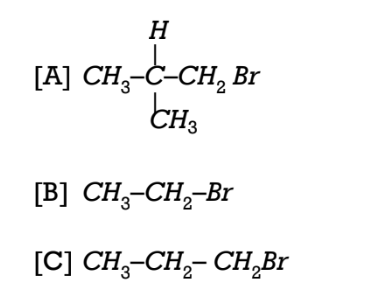
अपना परिणाम और व्याख्या देखने के लिए एक उत्तर चुनें।
उत्तर और व्याख्या
To determine the correct order of the rate of ẞ-elimination reaction with alcoholic KOH for the given alkyl halides, we need to consider the factors that influence the rate of ẞ-elimination. These factors include the structure of the alkyl halide, the stability of the resulting alkene, and the nature of the leaving group.
-
Structure of the Alkyl Halide:
- ẞ-elimination reactions are generally favored in more substituted alkyl halides because they lead to more stable alkenes. This is due to the fact that more substituted alkenes are more stable due to hyperconjugation and the inductive effect.
- In the given options:
- [A] CH3−C(H)(CH3)−CH2Br is a secondary alkyl halide.
- [B] CH3−CH2−Br is a primary alkyl halide.
- [C] CH3−CH2−CH2Br is also a primary alkyl halide.
-
Stability of the Resulting Alkene:
- The more substituted the alkene, the more stable it is. This stability increases the rate of ẞ-elimination.
- From [A], the resulting alkene is more substituted compared to those from [B] and [C].
-
Nature of the Leaving Group:
- All the given compounds have bromine as the leaving group, which is a good leaving group. Therefore, the leaving group factor is constant across all options.
Based on these considerations, the order of reactivity for ẞ-elimination with alcoholic KOH is determined by the degree of substitution of the alkyl halide and the stability of the resulting alkene. Therefore, the correct order is:
- [A] > [C] > [B]
This order is consistent with Option 4: A>C>B.
Explanation for Incorrect Options:
-
Option 1 (A>B>C): This option incorrectly suggests that [B] is more reactive than [C]. However, both [B] and [C] are primary alkyl halides, and the resulting alkene from [C] is more substituted than that from [B], making [C] more reactive than [B].
-
Option 2 (C>B>A): This option incorrectly places [A] as the least reactive. [A] is a secondary alkyl halide and forms a more substituted alkene, making it more reactive than both [B] and [C].
-
Option 3 (B>C>A): This option incorrectly suggests that [B] is the most reactive. As a primary alkyl halide, [B] is less reactive than [A], which is secondary and forms a more stable alkene.
Thus, the correct order of reactivity, supporting Option 4, is A>C>B.
ऐल्कोहॉली KOH के साथ ẞ-विलोपन की दर के घटते क्रम में निम्नलिखित ऐल्किल हैलाइडों को व्यवस्थित कीजिए :
अपना परिणाम और व्याख्या देखने के लिए एक उत्तर चुनें।
उत्तर और व्याख्या
ऐल्कोहॉली KOH के साथ ẞ-विलोपन (β-elimination) की दर मुख्य रूप से कार्बोकैटायन की स्थिरता पर निर्भर करती है जो कि विलोपन के दौरान बनता है। अधिक स्थिर कार्बोकैटायन तेजी से बनता है और इस प्रकार विलोपन की दर अधिक होती है।
आइए दिए गए ऐल्किल हैलाइडों का विश्लेषण करें:
[A] CH3−C(H)(CH3)−CH2Br: यह एक द्वितीयक ऐल्किल हैलाइड है। द्वितीयक कार्बोकैटायन अपेक्षाकृत स्थिर होता है क्योंकि इसमें हाइपरकंजुगेशन और इंडक्टिव प्रभाव के माध्यम से स्थिरीकरण होता है।
[B] CH3−CH2−Br: यह एक प्राथमिक ऐल्किल हैलाइड है। प्राथमिक कार्बोकैटायन कम स्थिर होता है क्योंकि इसमें हाइपरकंजुगेशन और इंडक्टिव प्रभाव का अभाव होता है।
[C] CH3−CH2−CH2Br: यह भी एक प्राथमिक ऐल्किल हैलाइड है और इसका कार्बोकैटायन भी कम स्थिर होता है।
अब, विलोपन की दर के घटते क्रम में इन्हें व्यवस्थित करते हैं:
- [A] द्वितीयक ऐल्किल हैलाइड होने के कारण सबसे अधिक स्थिर कार्बोकैटायन बनाता है, इसलिए इसकी विलोपन दर सबसे अधिक होगी।
- [C] और [B] दोनों प्राथमिक ऐल्किल हैलाइड हैं, लेकिन [C] में एक अतिरिक्त कार्बन होता है जो थोड़ी अधिक स्थिरता प्रदान कर सकता है, हालांकि यह प्रभाव नगण्य हो सकता है। फिर भी, [A] की तुलना में इनकी दर कम होगी।
इस प्रकार, सही क्रम होगा: A>C>B
इसलिए, विकल्प 4 (A>C>B) सही है।
अन्य विकल्प क्यों गलत हैं:
- A>B>C: यह गलत है क्योंकि [B] और [C] दोनों प्राथमिक हैं और [A] द्वितीयक है, इसलिए [A] की दर सबसे अधिक होगी।
- C>B>A: यह गलत है क्योंकि [A] की दर सबसे अधिक होनी चाहिए, न कि सबसे कम।
- B>C>A: यह गलत है क्योंकि [A] की दर सबसे अधिक होनी चाहिए, और [B] और [C] की दर [A] से कम होनी चाहिए।
इस प्रकार, विकल्प 4 सही है।
प्रश्न 142
The half life period of 3685Kr is 10 years. How long will it take for 99% of the 3685Kr to disintegrate?
अपना परिणाम और व्याख्या देखने के लिए एक उत्तर चुनें।
उत्तर और व्याख्या
To determine how long it will take for 99% of 3685Kr to disintegrate, we need to use the concept of half-life and the formula for radioactive decay.
Explanation for Option 2:
-
Understanding Half-Life:
- The half-life of a radioactive substance is the time required for half of the radioactive atoms present to decay.
- For 3685Kr, the half-life is given as 10 years.
-
Decay Formula:
- The formula for radioactive decay is:
[
N = N_0 \left(\frac{1}{2}\right)^{\frac{t}{t_{1/2}}}
]
Where:- ( N ) is the remaining quantity of the substance.
- ( N_0 ) is the initial quantity of the substance.
- ( t ) is the time elapsed.
- ( t_{1/2} ) is the half-life of the substance.
- The formula for radioactive decay is:
-
Calculating Time for 99% Disintegration:
- If 99% of the substance has disintegrated, 1% remains. Therefore, ( N = 0.01N_0 ).
- Plugging into the decay formula:
[
0.01N_0 = N_0 \left(\frac{1}{2}\right)^{\frac{t}{10}}
] - Simplifying, we get:
[
0.01 = \left(\frac{1}{2}\right)^{\frac{t}{10}}
] - Taking the logarithm of both sides:
[
\log(0.01) = \frac{t}{10} \log\left(\frac{1}{2}\right)
] - Solving for ( t ):
[
t = 10 \times \frac{\log(0.01)}{\log(0.5)}
] - Calculating the values:
[
\log(0.01) = -2 \quad \text{and} \quad \log(0.5) \approx -0.3010
]
[
t = 10 \times \frac{-2}{-0.3010} \approx 66.4 \text{ years}
]
Thus, it will take approximately 66.4 years for 99% of 3685Kr to disintegrate, which corresponds to Option 2.
Explanation for Why Other Options are Incorrect:
-
Option 1 (33.2 years):
- This option suggests a much shorter time than calculated. Given the half-life of 10 years, 33.2 years would not be sufficient for 99% disintegration, as shown by the decay formula.
-
Option 3 (99.6 years):
- This option suggests a longer time than necessary. The calculation shows that 66.4 years is sufficient for 99% disintegration, making 99.6 years an overestimate.
-
Option 4 (132.8 years):
- This option is even longer than Option 3 and is clearly an overestimate. The calculation confirms that 66.4 years is adequate for 99% disintegration, so 132.8 years is unnecessarily long.
In conclusion, Option 2 is the correct answer as it accurately reflects the time required for 99% of 3685Kr to disintegrate based on the half-life and decay formula.
3685Kr की अर्धायु अवधि 10 वर्ष है 3685Kr के 99% को विघटित होने में कितना समय लगेगा ?
अपना परिणाम और व्याख्या देखने के लिए एक उत्तर चुनें।
उत्तर और व्याख्या
3685Kr की अर्धायु अवधि 10 वर्ष है, जिसका अर्थ है कि हर 10 वर्षों में इसकी आधी मात्रा विघटित हो जाती है। हमें यह पता करना है कि 3685Kr के 99% को विघटित होने में कितना समय लगेगा।
-
अर्धायु अवधारणा: अर्धायु (half-life) वह समय है जिसमें किसी रेडियोधर्मी पदार्थ की आधी मात्रा विघटित हो जाती है। 3685Kr की अर्धायु 10 वर्ष है।
-
99% विघटन: यदि 99% विघटित हो चुका है, तो केवल 1% शेष है। इसका अर्थ है कि मूल मात्रा का 1% बचा है।
-
गणना:
- अर्धायु सूत्र का उपयोग करते हुए:
[
N = N_0 \times \left(\frac{1}{2}\right)^{\frac{t}{T_{1/2}}}
]
यहाँ, (N) शेष मात्रा है, (N_0) प्रारंभिक मात्रा है, (t) समय है, और (T_{1/2}) अर्धायु है। - हमें (N = 0.01N_0) के लिए (t) खोजना है।
- [
0.01 = \left(\frac{1}{2}\right)^{\frac{t}{10}}
] - [
\log_{10}(0.01) = \frac{t}{10} \times \log_{10}\left(\frac{1}{2}\right)
] - [
-2 = \frac{t}{10} \times (-0.3010)
] - [
t = \frac{2 \times 10}{0.3010} \approx 66.4 \text{ वर्ष}
]
- अर्धायु सूत्र का उपयोग करते हुए:
इस प्रकार, 3685Kr के 99% को विघटित होने में 66.4 वर्ष लगेंगे, जो कि विकल्प 2 के अनुसार सही उत्तर है।
अन्य विकल्पों का विश्लेषण:
-
विकल्प 1 (33.2 वर्ष): यह समय 99% विघटन के लिए बहुत कम है। यह समय केवल कुछ अर्धायु अवधियों के लिए उपयुक्त हो सकता है, लेकिन 99% के लिए नहीं।
-
विकल्प 3 (99.6 वर्ष): यह समय 99% विघटन के लिए अधिक है। यह समय 99% से अधिक विघटन के लिए उपयुक्त हो सकता है।
-
विकल्प 4 (132.8 वर्ष): यह समय भी 99% विघटन के लिए बहुत अधिक है और यह 99% से भी अधिक विघटन को दर्शाता है।
इस प्रकार, विकल्प 2 (66.4 वर्ष) सही उत्तर है क्योंकि यह गणना के अनुसार सही समय अवधि को दर्शाता है।
प्रश्न 143
The most stable carbanion among the following is:
अपना परिणाम और व्याख्या देखने के लिए एक उत्तर चुनें।
उत्तर और व्याख्या
The most stable carbanion among the given options is the 4-nitro benzyl carbanion (Option 3). Let's explore why this is the case and why the other options are less stable.
-
4-nitro benzyl carbanion (Option 3):
- The stability of a carbanion is greatly influenced by the ability of the substituents to delocalize the negative charge. In the case of the 4-nitro benzyl carbanion, the nitro group is an electron-withdrawing group due to its strong -I (inductive) and -M (mesomeric) effects. This group can stabilize the negative charge on the carbanion through resonance, effectively delocalizing the charge over the aromatic ring and the nitro group. This delocalization significantly enhances the stability of the carbanion.
-
Benzyl carbanion (Option 1):
- The benzyl carbanion is stabilized by resonance with the aromatic ring, which allows the negative charge to be delocalized over the ring. However, it lacks any additional electron-withdrawing groups that could further stabilize the negative charge. Therefore, it is less stable compared to the 4-nitro benzyl carbanion.
-
4-methoxy benzyl carbanion (Option 2):
- The methoxy group is an electron-donating group due to its +M (mesomeric) effect. While it can participate in resonance, it actually destabilizes the carbanion by increasing electron density on the already negatively charged carbanion. This makes the 4-methoxy benzyl carbanion less stable than the 4-nitro benzyl carbanion.
-
4-methyl carbanion (Option 4):
- The methyl group is an electron-donating group through its +I (inductive) effect. Similar to the methoxy group, it increases electron density on the carbanion, which destabilizes it. Additionally, the methyl group does not participate in resonance stabilization. Therefore, the 4-methyl carbanion is less stable compared to the 4-nitro benzyl carbanion.
In conclusion, the 4-nitro benzyl carbanion is the most stable due to the strong electron-withdrawing effects of the nitro group, which effectively stabilizes the negative charge through resonance. This makes Option 3 the correct answer.
निम्नलिखित में से अधिकतम स्थायी कार्बेनियन है :
अपना परिणाम और व्याख्या देखने के लिए एक उत्तर चुनें।
उत्तर और व्याख्या
Option 3, 4-नाइट्रो बेन्जिल कार्बेनियन, अधिकतम स्थायी कार्बेनियन है। इसका कारण यह है कि नाइट्रो समूह एक शक्तिशाली इलेक्ट्रॉन-विचलन समूह है। यह समूह कार्बेनियन पर उपस्थित नकारात्मक चार्ज को स्थिर करता है। नाइट्रो समूह के इलेक्ट्रॉन-विचलन प्रभाव के कारण, यह कार्बेनियन के नकारात्मक चार्ज को फैलाने में मदद करता है, जिससे इसकी स्थिरता बढ़ जाती है।
अब अन्य विकल्पों पर विचार करते हैं:
-
बेन्जिल कार्बेनियन: इसमें कोई अतिरिक्त इलेक्ट्रॉन-विचलन या इलेक्ट्रॉन-आकर्षण समूह नहीं होता है, जो कार्बेनियन की स्थिरता को बढ़ा सके। इसलिए, यह 4-नाइट्रो बेन्जिल कार्बेनियन की तुलना में कम स्थिर होता है।
-
4-मेथॉक्सी बेन्जिल कार्बेनियन: मेथॉक्सी समूह एक इलेक्ट्रॉन-आकर्षण समूह है, जो कार्बेनियन के नकारात्मक चार्ज को स्थिर करने के बजाय उसे अस्थिर करता है। यह समूह इलेक्ट्रॉन-घनत्व को बढ़ाता है, जिससे कार्बेनियन की स्थिरता कम हो जाती है।
-
4-मेथिल कार्बेनियन: मेथिल समूह का कोई विशेष इलेक्ट्रॉन-विचलन प्रभाव नहीं होता है, जो कार्बेनियन की स्थिरता को बढ़ा सके। यह समूह कार्बेनियन की स्थिरता पर कोई महत्वपूर्ण प्रभाव नहीं डालता है।
इस प्रकार, 4-नाइट्रो बेन्जिल कार्बेनियन का नकारात्मक चार्ज नाइट्रो समूह द्वारा सबसे अधिक स्थिर होता है, जिससे यह अधिकतम स्थायी कार्बेनियन बनता है।
प्रश्न 144
A compound contains 4.07% hydrogen, 24.27% carbon and 71.65% chlorine. Its molar mass is 99 g, then its molecular formula is :
अपना परिणाम और व्याख्या देखने के लिए एक उत्तर चुनें।
उत्तर और व्याख्या
To determine the molecular formula of the compound, we need to use the given percentage composition and the molar mass of the compound. Let's break down the process step by step:
-
Determine the Empirical Formula:
-
Percentage to Mass: Assume we have 100 grams of the compound. This means we have:
- 4.07 grams of hydrogen
- 24.27 grams of carbon
- 71.65 grams of chlorine
-
Convert Mass to Moles:
- Moles of hydrogen = 4.07 g / 1.01 g/mol = 4.03 mol
- Moles of carbon = 24.27 g / 12.01 g/mol = 2.02 mol
- Moles of chlorine = 71.65 g / 35.45 g/mol = 2.02 mol
-
Determine the Simplest Ratio:
- The simplest whole number ratio of moles is approximately 2:2:2, which simplifies to 1:1:1.
-
Empirical Formula: The empirical formula based on the simplest ratio is CHCl.
-
-
Determine the Molecular Formula:
-
Calculate the Empirical Formula Mass:
- Empirical formula mass of CHCl = 12.01 (C) + 1.01 (H) + 35.45 (Cl) = 48.47 g/mol
-
Determine the Molecular Formula:
- The molar mass of the compound is given as 99 g/mol.
- Divide the molar mass by the empirical formula mass: 99 g/mol / 48.47 g/mol ≈ 2.04
-
Multiply the Empirical Formula by this Factor:
- Since the factor is approximately 2, the molecular formula is (CHCl)₂, which is C₂H₂Cl₂.
-
-
Justification for Option 2:
- The molecular formula C₂H₄Cl₂ corresponds to the empirical formula multiplied by 2, which matches the calculated factor.
- The molar mass of C₂H₄Cl₂ is 98.96 g/mol, which is very close to the given molar mass of 99 g/mol, confirming the correctness of this option.
-
Explanation of Incorrect Options:
-
Option 1: CH2Cl
- This formula does not match the calculated molecular formula, as it does not account for the correct molar mass of 99 g/mol.
-
Option 3: C2HCl2
- This formula does not match the calculated molecular formula, as it does not provide the correct ratio of hydrogen to carbon and chlorine.
-
Option 4: C2H2Cl2
- Although this formula seems similar, it does not match the correct ratio of hydrogen to carbon and chlorine as determined by the empirical formula calculation.
-
In conclusion, Option 2 (C2H4Cl2) is the correct molecular formula for the compound based on the given percentage composition and molar mass.
एक यौगिक में 4.07% हाइड्रोजन, 24.27% कार्बन और 71.65% क्लोरीन है। इसका मोलर द्रव्यमान 99 g है, तब इसका आण्विक सूत्र है :
अपना परिणाम और व्याख्या देखने के लिए एक उत्तर चुनें।
उत्तर और व्याख्या
इस प्रश्न में हमें एक यौगिक के प्रतिशत संरचना और मोलर द्रव्यमान के आधार पर उसका आण्विक सूत्र ज्ञात करना है। दिए गए यौगिक में 4.07% हाइड्रोजन, 24.27% कार्बन और 71.65% क्लोरीन है, और इसका मोलर द्रव्यमान 99 g है। सही उत्तर विकल्प 2 है: C2H4Cl2।
विकल्प 2 (C2H4Cl2) क्यों सही है:
-
प्रतिशत संरचना से मोल की गणना:
- कार्बन (C): 24.27% / 12.01 g/mol = 2.02 mol
- हाइड्रोजन (H): 4.07% / 1.008 g/mol = 4.04 mol
- क्लोरीन (Cl): 71.65% / 35.45 g/mol = 2.02 mol
इन मोलों के अनुपात को सरलतम पूर्णांक अनुपात में बदलने पर हमें C2H4Cl2 मिलता है।
-
मोलर द्रव्यमान की पुष्टि:
- C2H4Cl2 का मोलर द्रव्यमान = (2 × 12.01) + (4 × 1.008) + (2 × 35.45) = 24.02 + 4.032 + 70.90 = 98.952 g/mol, जो 99 g/mol के बहुत करीब है।
अन्य विकल्प क्यों गलत हैं:
-
विकल्प 1 (CH2Cl):
- इसका मोलर द्रव्यमान = 12.01 + (2 × 1.008) + 35.45 = 49.476 g/mol, जो 99 g/mol से बहुत कम है।
-
विकल्प 3 (C2HCl2):
- इसका मोलर द्रव्यमान = (2 × 12.01) + 1.008 + (2 × 35.45) = 24.02 + 1.008 + 70.90 = 95.928 g/mol, जो 99 g/mol से थोड़ा कम है और हाइड्रोजन की मात्रा भी मेल नहीं खाती।
-
विकल्प 4 (C2H2Cl2):
- इसका मोलर द्रव्यमान = (2 × 12.01) + (2 × 1.008) + (2 × 35.45) = 24.02 + 2.016 + 70.90 = 96.936 g/mol, जो 99 g/mol से कम है और हाइड्रोजन की मात्रा भी मेल नहीं खाती।
इस प्रकार, सभी तथ्यों और गणनाओं के आधार पर, विकल्प 2 (C2H4Cl2) सही उत्तर है।
प्रश्न 145
The t1/2 of a reaction is doubled as the initial concentration of the reactant is doubled, what is the order of the reaction?
अपना परिणाम और व्याख्या देखने के लिए एक उत्तर चुनें।
उत्तर और व्याख्या
To determine the order of a reaction based on how the half-life (t1/2) changes with the initial concentration of the reactant, we need to understand the relationship between these variables for different reaction orders.
-
Explanation for Option 4 (Zero Order Reaction):
- In a zero-order reaction, the rate of reaction is independent of the concentration of the reactant. The half-life for a zero-order reaction is given by the formula:
[
t_{1/2} = \frac{[A]_0}{2k}
]
where ([A]_0) is the initial concentration and (k) is the rate constant. - From this formula, it is clear that the half-life is directly proportional to the initial concentration ([A]_0). Therefore, if the initial concentration is doubled, the half-life will also double.
- This matches the condition given in the question, where the half-life doubles as the initial concentration is doubled, confirming that the reaction is zero-order.
- In a zero-order reaction, the rate of reaction is independent of the concentration of the reactant. The half-life for a zero-order reaction is given by the formula:
-
Why Other Options are Incorrect:
-
Option 1 (Third Order Reaction):
- For a third-order reaction, the half-life is inversely proportional to the square of the initial concentration. The formula is:
[
t_{1/2} = \frac{1}{k[A]_0^2}
] - If the initial concentration is doubled, the half-life would decrease by a factor of four, not double. Therefore, this does not match the condition given in the question.
- For a third-order reaction, the half-life is inversely proportional to the square of the initial concentration. The formula is:
-
Option 2 (Second Order Reaction):
- For a second-order reaction, the half-life is inversely proportional to the initial concentration. The formula is:
[
t_{1/2} = \frac{1}{k[A]_0}
] - If the initial concentration is doubled, the half-life would be halved, not doubled. This contradicts the condition given in the question.
- For a second-order reaction, the half-life is inversely proportional to the initial concentration. The formula is:
-
Option 3 (First Order Reaction):
- For a first-order reaction, the half-life is independent of the initial concentration. The formula is:
[
t_{1/2} = \frac{0.693}{k}
] - Doubling the initial concentration would have no effect on the half-life, which remains constant. This does not satisfy the condition that the half-life doubles with the doubling of the initial concentration.
- For a first-order reaction, the half-life is independent of the initial concentration. The formula is:
-
In conclusion, the only scenario where the half-life doubles as the initial concentration is doubled is in a zero-order reaction, which is why Option 4 is the correct answer.
किसी अभिक्रिया में क्रियाकारक की प्रारम्भिक सांद्रता को दुगना करने पर अभिक्रिया का t1/2 दुगना हो जाता है, अभिक्रिया की कोटि क्या होगी ?
अपना परिणाम और व्याख्या देखने के लिए एक उत्तर चुनें।
उत्तर और व्याख्या
किसी अभिक्रिया में क्रियाकारक की प्रारम्भिक सांद्रता को दुगना करने पर अभिक्रिया का t1/2 दुगना हो जाता है, इसका अर्थ है कि अभिक्रिया शून्य कोटि (zero order) की है। आइए इसे विस्तार से समझते हैं:
-
शून्य कोटि अभिक्रिया (Option 4): शून्य कोटि की अभिक्रिया में, अभिक्रिया की दर क्रियाकारक की सांद्रता पर निर्भर नहीं करती है। शून्य कोटि की अभिक्रिया के लिए, अर्ध-आयु (t1/2) सीधे प्रारम्भिक सांद्रता के साथ आनुपातिक होती है। इसलिए, जब प्रारम्भिक सांद्रता को दुगना किया जाता है, तो t1/2 भी दुगना हो जाता है। यही कारण है कि Option 4 सही है।
-
अन्य विकल्पों की गलतियाँ:
-
तीसरी कोटि (Option 1): तीसरी कोटि की अभिक्रिया में, t1/2 प्रारम्भिक सांद्रता के वर्ग के व्युत्क्रमानुपाती होता है। यदि प्रारम्भिक सांद्रता को दुगना किया जाता है, तो t1/2 चार गुना कम हो जाएगा, जो कि प्रश्न में दिए गए परिदृश्य से मेल नहीं खाता।
-
दूसरी कोटि (Option 2): दूसरी कोटि की अभिक्रिया में, t1/2 प्रारम्भिक सांद्रता के व्युत्क्रमानुपाती होता है। यदि प्रारम्भिक सांद्रता को दुगना किया जाता है, तो t1/2 आधा हो जाएगा, जो कि प्रश्न में दिए गए परिदृश्य से मेल नहीं खाता।
-
प्रथम कोटि (Option 3): प्रथम कोटि की अभिक्रिया में, t1/2 प्रारम्भिक सांद्रता पर निर्भर नहीं करता है। इसलिए, प्रारम्भिक सांद्रता को दुगना करने पर t1/2 अपरिवर्तित रहेगा, जो कि प्रश्न में दिए गए परिदृश्य से मेल नहीं खाता।
-
इस प्रकार, दिए गए परिदृश्य के अनुसार, शून्य कोटि (Option 4) ही सही उत्तर है।
प्रश्न 146
For the strong electrolytes NaCl, HCI and NaAc the molar conductivities at infinite dilution are 126.4, 425.9 and 91.0 S cm2mol−1 respectively. λm∘ for HAc in S cm2mol−1:
अपना परिणाम और व्याख्या देखने के लिए एक उत्तर चुनें।
उत्तर और व्याख्या
To determine the molar conductivity at infinite dilution for acetic acid (HAc), we can use the principle of Kohlrausch's Law of Independent Migration of Ions. According to this law, the molar conductivity at infinite dilution for a weak electrolyte can be calculated by summing the molar conductivities of its constituent ions, which are derived from strong electrolytes.
Given:
- Molar conductivity of NaCl at infinite dilution, (\lambda_{m}^{\circ}(\text{NaCl}) = 126.4~S~cm^{2}mol^{-1})
- Molar conductivity of HCl at infinite dilution, (\lambda_{m}^{\circ}(\text{HCl}) = 425.9~S~cm^{2}mol^{-1})
- Molar conductivity of NaAc at infinite dilution, (\lambda_{m}^{\circ}(\text{NaAc}) = 91.0~S~cm^{2}mol^{-1})
We need to find (\lambda_{m}^{\circ}(\text{HAc})).
Using Kohlrausch's Law, we can express the molar conductivity of HAc as:
[
\lambda_{m}^{\circ}(\text{HAc}) = \lambda_{m}^{\circ}(\text{HCl}) + \lambda_{m}^{\circ}(\text{NaAc}) - \lambda_{m}^{\circ}(\text{NaCl})
]
Substituting the given values:
[
\lambda_{m}^{\circ}(\text{HAc}) = 425.9 + 91.0 - 126.4
]
Calculating the above expression:
[
\lambda_{m}^{\circ}(\text{HAc}) = 425.9 + 91.0 - 126.4 = 390.5~S~cm^{2}mol^{-1}
]
Thus, the molar conductivity at infinite dilution for acetic acid (HAc) is (390.5~S~cm^{2}mol^{-1}), which corresponds to Option 3.
Explanation for Incorrect Options:
-
Option 1 (643.3): This value is significantly higher than the calculated value. It does not align with the principle of adding and subtracting the molar conductivities of the given strong electrolytes.
-
Option 2 (461.3): This value is also incorrect as it exceeds the calculated value of 390.5. It suggests an overestimation of the molar conductivity of HAc.
-
Option 4 (208.5): This value is much lower than the calculated value. It underestimates the molar conductivity of HAc and does not fit the logical calculation based on the given data.
Therefore, based on the calculations and logical reasoning using Kohlrausch's Law, Option 3 is the correct answer.
प्रबल वैद्युत अपघट्य NaCl, HCl और NaAc की सीमांत मोलर चालकताएँ क्रमशः 126.4, 425.9 और 91.0 S cm2mol−1 है, तब HAc का λm∘, S cm2mol−1 में है :
अपना परिणाम और व्याख्या देखने के लिए एक उत्तर चुनें।
उत्तर और व्याख्या
प्रश्न में दिए गए प्रबल वैद्युत अपघट्य NaCl, HCl और NaAc की सीमांत मोलर चालकताएँ क्रमशः 126.4, 425.9 और 91.0 S cm2mol−1 हैं। हमें HAc की सीमांत मोलर चालकता (λm∘) ज्ञात करनी है।
HAc की सीमांत मोलर चालकता ज्ञात करने के लिए, हम कोलराश के नियम का उपयोग कर सकते हैं, जो कहता है कि किसी भी इलेक्ट्रोलाइट की सीमांत मोलर चालकता उसके घटक आयनों की सीमांत मोलर चालकताओं के योग के बराबर होती है।
HAc के लिए:
[
\lambda_{m}^{\circ}(\text{HAc}) = \lambda_{m}^{\circ}(\text{HCl}) + \lambda_{m}^{\circ}(\text{NaAc}) - \lambda_{m}^{\circ}(\text{NaCl})
]
दिए गए मानों को समीकरण में डालते हैं:
[
\lambda_{m}^{\circ}(\text{HAc}) = 425.9 + 91.0 - 126.4
]
इसकी गणना करने पर:
[
\lambda_{m}^{\circ}(\text{HAc}) = 390.5~S~cm^{2}mol^{-1}
]
इस प्रकार, HAc की सीमांत मोलर चालकता 390.5 S cm2mol−1 है, जो विकल्प 3 के अनुसार है।
अब, अन्य विकल्पों की गलतियों को समझते हैं:
-
विकल्प 1 (643.3): यह मान बहुत अधिक है और यह कोलराश के नियम के अनुसार प्राप्त गणना से मेल नहीं खाता।
-
विकल्प 2 (461.3): यह मान भी गलत है क्योंकि यह गणना के अनुसार प्राप्त सही मान से अधिक है।
-
विकल्प 4 (208.5): यह मान बहुत कम है और यह भी कोलराश के नियम के अनुसार सही नहीं है।
इस प्रकार, विकल्प 3 (390.5 S cm2mol−1) सही उत्तर है।
प्रश्न 147
Arrange the following compounds in order of their decreasing reactivity with an electrophile:
methoxy-benzene (I)
chloro-benzene (II)
nitro-benzene (III)
अपना परिणाम और व्याख्या देखने के लिए एक उत्तर चुनें।
उत्तर और व्याख्या
To determine the order of reactivity of the given compounds with an electrophile, we need to consider the electronic effects of the substituents on the benzene ring. The reactivity of benzene derivatives towards electrophilic aromatic substitution is influenced by the nature of the substituents attached to the benzene ring.
-
Methoxy-benzene (I): The methoxy group (-OCH₃) is an electron-donating group due to its +R (resonance) effect. It donates electron density into the benzene ring, making it more electron-rich and thus more reactive towards electrophiles. The increased electron density enhances the ability of the benzene ring to stabilize the positive charge of the intermediate carbocation formed during the electrophilic attack.
-
Chloro-benzene (II): The chloro group (-Cl) is slightly electron-withdrawing due to its -I (inductive) effect, but it also has a +R effect due to the lone pairs on chlorine that can participate in resonance. However, the overall effect is less activating compared to the methoxy group. Therefore, chloro-benzene is less reactive than methoxy-benzene but more reactive than nitro-benzene.
-
Nitro-benzene (III): The nitro group (-NO₂) is a strong electron-withdrawing group due to both its -I and -R effects. It pulls electron density away from the benzene ring, making it electron-deficient and less reactive towards electrophiles. The electron-withdrawing nature of the nitro group significantly deactivates the benzene ring, making it the least reactive among the three compounds.
Based on the above analysis, the order of reactivity with an electrophile is: methoxy-benzene (I) > chloro-benzene (II) > nitro-benzene (III). Therefore, Option 1 (I>II>III) is correct.
Explanation of why other options are incorrect:
-
Option 2 (III>II>I): This option suggests that nitro-benzene is more reactive than chloro-benzene and methoxy-benzene, which is incorrect. Nitro-benzene is the least reactive due to the strong electron-withdrawing nature of the nitro group.
-
Option 3 (II>III>I): This option suggests that chloro-benzene is more reactive than methoxy-benzene, which is incorrect. The methoxy group is a stronger electron-donating group than the chloro group, making methoxy-benzene more reactive.
-
Option 4 (I>III>II): This option suggests that nitro-benzene is more reactive than chloro-benzene, which is incorrect. Nitro-benzene is the least reactive due to the electron-withdrawing nature of the nitro group.
In conclusion, Option 1 (I>II>III) correctly represents the order of decreasing reactivity with an electrophile based on the electronic effects of the substituents.
इलेक्ट्रॉनस्नेही के साथ उनकी घटती अभिक्रियाशीलता के क्रम में निम्नलिखित यौगिकों को व्यवस्थित कीजिए :
मेथॉक्सी-बेन्जीन (I)
क्लोरो-बेन्जीन (II)
नाइट्रो-बेन्जीन (III)
अपना परिणाम और व्याख्या देखने के लिए एक उत्तर चुनें।
उत्तर और व्याख्या
इलेक्ट्रॉनस्नेही के साथ यौगिकों की अभिक्रियाशीलता को समझने के लिए, हमें इन यौगिकों के इलेक्ट्रॉन वितरण और उनके प्रभाव को देखना होगा।
-
मेथॉक्सी-बेन्जीन (I): मेथॉक्सी समूह (-OCH₃) एक इलेक्ट्रॉन-प्रदाता समूह है। यह बेन्जीन रिंग में इलेक्ट्रॉनों को जोड़ता है, जिससे रिंग की इलेक्ट्रॉन घनत्व बढ़ जाती है। इस कारण से, मेथॉक्सी-बेन्जीन इलेक्ट्रॉनस्नेही अभिक्रियाओं के प्रति अधिक प्रतिक्रियाशील होता है।
-
क्लोरो-बेन्जीन (II): क्लोरीन एक हल्का इलेक्ट्रॉन-आकर्षक समूह है, लेकिन इसमें +M (मेसोमेरिक) प्रभाव भी होता है, जो इलेक्ट्रॉनों को रिंग की ओर धकेलता है। हालांकि, इसका -I (इंडक्टिव) प्रभाव अधिक प्रभावी होता है, जिससे रिंग की इलेक्ट्रॉन घनत्व कम हो जाती है, लेकिन यह मेथॉक्सी-बेन्जीन की तुलना में कम प्रतिक्रियाशील होता है।
-
नाइट्रो-बेन्जीन (III): नाइट्रो समूह (-NO₂) एक शक्तिशाली इलेक्ट्रॉन-आकर्षक समूह है। यह रिंग से इलेक्ट्रॉनों को खींचता है, जिससे रिंग की इलेक्ट्रॉन घनत्व काफी कम हो जाती है। इस कारण से, नाइट्रो-बेन्जीन इलेक्ट्रॉनस्नेही अभिक्रियाओं के प्रति सबसे कम प्रतिक्रियाशील होता है।
इस प्रकार, इलेक्ट्रॉनस्नेही के साथ उनकी घटती अभिक्रियाशीलता के क्रम में यौगिकों की व्यवस्था होगी: मेथॉक्सी-बेन्जीन (I) > क्लोरो-बेन्जीन (II) > नाइट्रो-बेन्जीन (III)। इसलिए, विकल्प 1 (I>II>III) सही है।
अन्य विकल्पों की अस्वीकृति:
-
विकल्प 2 (III>II>I): यह गलत है क्योंकि नाइट्रो-बेन्जीन सबसे कम प्रतिक्रियाशील है, जबकि मेथॉक्सी-बेन्जीन सबसे अधिक।
-
विकल्प 3 (II>III>I): यह गलत है क्योंकि क्लोरो-बेन्जीन की प्रतिक्रियाशीलता मेथॉक्सी-बेन्जीन से कम है।
-
विकल्प 4 (I>III>II): यह गलत है क्योंकि क्लोरो-बेन्जीन की प्रतिक्रियाशीलता नाइट्रो-बेन्जीन से अधिक है।
इस प्रकार, विकल्प 1 सही है और अन्य विकल्प गलत हैं।
प्रश्न 148
The electophile involved in Reimer-Tiemann reaction is :
अपना परिणाम और व्याख्या देखने के लिए एक उत्तर चुनें।
उत्तर और व्याख्या
The Reimer-Tiemann reaction is a chemical reaction used to convert phenols into ortho-formyl phenols using chloroform and a strong base, typically sodium hydroxide. The key to understanding this reaction lies in identifying the electrophile that facilitates the transformation.
-
Explanation for Option 2 (:CCl₂) as the Correct Answer:
In the Reimer-Tiemann reaction, the electrophile involved is dichlorocarbene (:CCl₂). This electrophile is generated in situ from chloroform (CHCl₃) in the presence of a strong base like NaOH. The base deprotonates chloroform, leading to the formation of the trichloromethide anion (CCl₃⁻), which then loses a chloride ion to form the neutral, highly reactive dichlorocarbene (:CCl₂). This carbene acts as the electrophile that attacks the phenol, leading to the formation of the ortho-formylated product. Thus, Option 2 is correct because :CCl₂ is the electrophile responsible for the reaction.
-
Explanation for Why the Other Options are Incorrect:
-
Option 1 (CH3+): The methyl cation (CH3+) is a carbocation and not involved in the Reimer-Tiemann reaction. This reaction specifically requires the formation of a carbene, not a carbocation, to proceed. Therefore, CH3+ is not the electrophile in this context.
-
Option 3 (Cl−): The chloride ion (Cl−) is a nucleophile, not an electrophile. In the Reimer-Tiemann reaction, the role of the electrophile is crucial, and Cl− does not fulfill this role. Instead, it is involved in the generation of the dichlorocarbene but does not act as the electrophile itself.
-
Option 4 (OH−): The hydroxide ion (OH−) is a strong base and acts as a nucleophile in many reactions. In the Reimer-Tiemann reaction, it is used to deprotonate chloroform to generate the dichlorocarbene, but it is not the electrophile. Its role is to facilitate the formation of the actual electrophile, :CCl₂.
-
In conclusion, the correct electrophile in the Reimer-Tiemann reaction is :CCl₂, making Option 2 the correct choice. The other options do not fit the role of the electrophile in this specific reaction mechanism.
राइमर-टीमान अभिक्रिया में निहित इलेक्ट्रॉनस्नेही है :
अपना परिणाम और व्याख्या देखने के लिए एक उत्तर चुनें।
उत्तर और व्याख्या
राइमर-टीमान अभिक्रिया में निहित इलेक्ट्रॉनस्नेही :CCl2 है। आइए समझते हैं कि क्यों :CCl2 सही विकल्प है और अन्य विकल्प क्यों गलत हैं।
-
: CCl2 (Option 2): राइमर-टीमान अभिक्रिया में, :CCl2 एक इलेक्ट्रॉनस्नेही (electrophile) के रूप में कार्य करता है। यह एक डाइक्लोरोकार्बीन है, जो कि एक इलेक्ट्रॉन-घाटे वाला यौगिक है। इसकी संरचना में कार्बन के पास केवल छह इलेक्ट्रॉन होते हैं, जिससे यह इलेक्ट्रॉन की कमी को पूरा करने के लिए इलेक्ट्रॉन-धनी यौगिकों के साथ प्रतिक्रिया करने की प्रवृत्ति रखता है। इस कारण से, :CCl2 राइमर-टीमान अभिक्रिया में इलेक्ट्रॉनस्नेही के रूप में कार्य करता है।
-
CH3+ (Option 1): CH3+ एक कार्बोकैटायन है और यह भी एक इलेक्ट्रॉनस्नेही हो सकता है, लेकिन यह राइमर-टीमान अभिक्रिया में शामिल नहीं होता है। इस अभिक्रिया में विशेष रूप से :CCl2 का उपयोग होता है, न कि CH3+ का।
-
Cl− (Option 3): Cl− एक इलेक्ट्रॉन-धनी आयन है, जिसे न्यूक्लियोफाइल के रूप में वर्गीकृत किया जाता है, न कि इलेक्ट्रॉनस्नेही के रूप में। यह इलेक्ट्रॉनों को दान करने की प्रवृत्ति रखता है, जबकि राइमर-टीमान अभिक्रिया में इलेक्ट्रॉनस्नेही की आवश्यकता होती है।
-
OH− (Option 4): OH− भी एक न्यूक्लियोफाइल है, जो इलेक्ट्रॉनों को दान करता है। यह इलेक्ट्रॉनस्नेही नहीं है और इसलिए राइमर-टीमान अभिक्रिया में इसकी भूमिका नहीं होती है।
इस प्रकार, राइमर-टीमान अभिक्रिया में :CCl2 का इलेक्ट्रॉनस्नेही के रूप में उपयोग होता है, और यही कारण है कि विकल्प 2 सही है।
प्रश्न 149
Which of the following does not exist?
अपना परिणाम और व्याख्या देखने के लिए एक उत्तर चुनें।
उत्तर और व्याख्या
Option 2, NeF2, is the correct answer because it does not exist. Here's a detailed explanation:
-
Why Option 2 (NeF2) is Correct:
- Neon (Ne) is a noble gas with a complete octet in its outer electron shell, making it extremely stable and chemically inert. Due to this stability, neon does not readily form compounds with other elements, including fluorine (F). There are no known stable compounds of neon, such as NeF2, because neon lacks the tendency to share, gain, or lose electrons to form chemical bonds.
-
Why the Other Options are Incorrect:
- Option 1 (XeOF4): Xenon (Xe) is another noble gas, but unlike neon, xenon can form compounds under certain conditions due to its larger atomic size and the availability of d-orbitals. XeOF4 is a known compound where xenon is bonded to oxygen and fluorine atoms.
- Option 3 (XeF2): This is a well-known compound of xenon. XeF2 is a stable compound where xenon is bonded to two fluorine atoms. It is used in various chemical reactions and applications.
- Option 4 (XeF6): XeF6 is another established compound of xenon. It is formed when xenon is bonded to six fluorine atoms. This compound is known and studied in the field of chemistry.
In summary, the correct answer is Option 2 (NeF2) because neon does not form compounds like NeF2 due to its chemical inertness, while the other options are known compounds of xenon.
निम्नलिखित में से कौन-सा अस्तित्व में नहीं है?
अपना परिणाम और व्याख्या देखने के लिए एक उत्तर चुनें।
उत्तर और व्याख्या
Option 2, NeF2, सही उत्तर है क्योंकि यह यौगिक अस्तित्व में नहीं है। इसका कारण यह है कि नीयॉन (Ne) एक निष्क्रिय गैस है और इसकी बाहरी इलेक्ट्रॉनिक परत पूरी तरह से भरी हुई होती है। इस वजह से, नीयॉन रासायनिक रूप से निष्क्रिय होता है और आमतौर पर अन्य तत्वों के साथ यौगिक नहीं बनाता है। इसलिए, NeF2 का अस्तित्व नहीं है।
अब अन्य विकल्पों की चर्चा करते हैं:
-
XeOF4: यह यौगिक अस्तित्व में है। जीनॉन (Xe) एक निष्क्रिय गैस होते हुए भी, यह फ्लोरीन (F) और ऑक्सीजन (O) के साथ यौगिक बना सकता है। XeOF4 एक ज्ञात यौगिक है जिसमें जीनॉन, फ्लोरीन और ऑक्सीजन के बीच रासायनिक बंधन होते हैं।
-
XeF2: यह यौगिक भी अस्तित्व में है। जीनॉन और फ्लोरीन के बीच रासायनिक बंधन बन सकते हैं, और XeF2 एक स्थिर यौगिक है जो जीनॉन और फ्लोरीन के बीच के बंधन को दर्शाता है।
-
XeF6: यह यौगिक भी अस्तित्व में है। जीनॉन फ्लोरीन के साथ कई यौगिक बना सकता है, और XeF6 उनमें से एक है। यह जीनॉन और फ्लोरीन के बीच एक स्थिर यौगिक है।
इस प्रकार, केवल NeF2 ही ऐसा यौगिक है जो अस्तित्व में नहीं है, और इसलिए विकल्प 2 सही उत्तर है।
प्रश्न 150
Which of the following reactions are disproportionation reactions?
a. 2Cu+→Cu2++Cu
b. 3MnO42−+4H+→2MnO4−+MnO2+2H2O
c. 2KMnO4→K2MnO4+MnO2+O2
d. 10I−+2MnO4−+16H+→2Mn2++8H2O+5I2
अपना परिणाम और व्याख्या देखने के लिए एक उत्तर चुनें।
उत्तर और व्याख्या
To determine which reactions are disproportionation reactions, we need to understand what a disproportionation reaction is. A disproportionation reaction is a specific type of redox reaction in which a single substance is simultaneously oxidized and reduced, forming two different products.
Let's analyze each reaction:
a. (2Cu^{+} \rightarrow Cu^{2+} + Cu)
In this reaction, the copper ion (Cu^{+}) is both oxidized and reduced. One (Cu^{+}) ion is oxidized to (Cu^{2+}), and another (Cu^{+}) ion is reduced to metallic copper (Cu). This is a classic example of a disproportionation reaction.
b. (3MnO_{4}^{2-} + 4H^{+} \rightarrow 2MnO_{4}^{-} + MnO_{2} + 2H_{2}O)
In this reaction, the manganese in (MnO_{4}^{2-}) is both oxidized and reduced. Some of the manganese is oxidized to (MnO_{4}^{-}), while some is reduced to (MnO_{2}). This fits the definition of a disproportionation reaction.
c. (2KMnO_{4} \rightarrow K_{2}MnO_{4} + MnO_{2} + O_{2})
In this reaction, (KMnO_{4}) is not undergoing a disproportionation reaction. Instead, it is decomposing into different products without a single species being both oxidized and reduced. Therefore, this is not a disproportionation reaction.
d. (10I^{-} + 2MnO_{4}^{-} + 16H^{+} \rightarrow 2Mn^{2+} + 8H_{2}O + 5I_{2})
In this reaction, the iodide ions (I^{-}) are oxidized to iodine (I_{2}), and the permanganate ions (MnO_{4}^{-}) are reduced to (Mn^{2+}). There is no single species undergoing both oxidation and reduction, so this is not a disproportionation reaction.
Based on the analysis above, reactions a and b are disproportionation reactions. Therefore, Option 4 (a, b) is the correct answer.
Explanation of why other options are incorrect:
- Option 1 (c, d): Neither reaction c nor d is a disproportionation reaction, as explained above.
- Option 2 (a, c): While reaction a is a disproportionation reaction, reaction c is not.
- Option 3 (b, c): Reaction b is a disproportionation reaction, but reaction c is not.
Thus, the correct answer is Option 4, which includes reactions a and b as disproportionation reactions.
निम्नलिखित में से कौन-सी अभिक्रियाएँ असमानुपातन अभिक्रियाएँ हैं ?
a. 2Cu+→Cu2++Cu
b. 3MnO42−+4H+→2MnO4−+MnO2+2H2O
c. 2KMnO4→K2MnO4+MnO2+O2
d. 10I−+2MnO4−+16H+→2Mn2++8H2O+5I2
अपना परिणाम और व्याख्या देखने के लिए एक उत्तर चुनें।
उत्तर और व्याख्या
असमानुपातन अभिक्रियाएँ वे अभिक्रियाएँ होती हैं जिनमें एक ही तत्व के परमाणु ऑक्सीकरण और अपचयन दोनों undergo करते हैं। आइए दिए गए विकल्पों का विश्लेषण करें:
-
विकल्प a: 2Cu+→Cu2++Cu
इस अभिक्रिया में, Cu+ आयन दो अलग-अलग अवस्थाओं में बदलता है: Cu2+ (जहां यह ऑक्सीकरण undergo करता है) और Cu (जहां यह अपचयन undergo करता है)। यह एक असमानुपातन अभिक्रिया का उदाहरण है क्योंकि एक ही तत्व के परमाणु ऑक्सीकरण और अपचयन दोनों undergo कर रहे हैं।
-
विकल्प b: 3MnO42−+4H+→2MnO4−+MnO2+2H2O
इस अभिक्रिया में, Mn तत्व दो अलग-अलग अवस्थाओं में बदलता है: MnO4− (जहां यह ऑक्सीकरण undergo करता है) और MnO2 (जहां यह अपचयन undergo करता है)। यह भी एक असमानुपातन अभिक्रिया का उदाहरण है।
-
विकल्प c: 2KMnO4→K2MnO4+MnO2+O2
इस अभिक्रिया में, Mn तत्व दो अलग-अलग अवस्थाओं में बदलता है: K2MnO4 और MnO2, लेकिन यह असमानुपातन अभिक्रिया नहीं है क्योंकि यह एक साधारण अपघटन अभिक्रिया है।
-
विकल्प d: 10I−+2MnO4−+16H+→2Mn2++8H2O+5I2
इस अभिक्रिया में, I− आयन I2 में बदलता है, जो एक साधारण ऑक्सीकरण अभिक्रिया है, और MnO4− Mn2+ में बदलता है, जो एक साधारण अपचयन अभिक्रिया है। यह असमानुपातन अभिक्रिया नहीं है।
इस प्रकार, विकल्प 4 (a, b) सही है क्योंकि ये दोनों अभिक्रियाएँ असमानुपातन अभिक्रियाएँ हैं। अन्य विकल्पों में दी गई अभिक्रियाएँ असमानुपातन अभिक्रियाएँ नहीं हैं।
प्रश्न 151
What right does a consumer have against unfair trade practices and exploitation ?
अपना परिणाम और व्याख्या देखने के लिए एक उत्तर चुनें।
उत्तर और व्याख्या
The correct option is 3: Right to Seek Redressal
The Right to Seek Redressal, also known as the Right to Redress, is the most accurate answer because it is the specific right that empowers a consumer to obtain a remedy against unfair trade practices, exploitation, or unsatisfactory service. This right provides an essential legal avenue for the consumer to be heard, receive compensation, and have their grievances resolved. Under consumer protection laws, if a consumer is exploited—for example, by receiving a defective product, being misled by false advertising, or being overcharged—they can file a complaint to seek various forms of redressal, such as a refund of the price paid, replacement of the defective goods, or compensation for any loss or injury suffered. This right ensures that businesses are held accountable and consumer interests are protected effectively after harm has been done.
The incorrect option is 1: Right to Information
The Right to Information is a core consumer right, but its primary function is preventive, not remedial. This right ensures that a consumer is informed about the quality, quantity, potency, purity, standard, and price of goods or services so they can make an intelligent and informed purchasing decision. While it helps prevent the consumer from being exploited initially, it is not the mechanism used to seek justice or compensation after an act of exploitation has already taken place. The consumer uses the Right to Information before buying, but the Right to Seek Redressal after suffering harm.
The incorrect option is 2: Right to Equality
The Right to Equality is a fundamental right guaranteed to all citizens under a country’s constitution, ensuring equal treatment before the law and prohibiting discrimination. While this right is a prerequisite for fair legal proceedings, it is not listed among the specific, targeted rights established under consumer protection legislation to combat marketplace exploitation. The consumer rights framework deals with the relationship between the consumer and the seller/manufacturer, focusing on market fairness, not general civic equality.
The incorrect option is 4: None of these
This option is incorrect because Right to Seek Redressal is definitively the correct and relevant right established under consumer protection laws to address and remedy the effects of unfair trade practices and exploitation.
उपभोक्ता संरक्षण अधिनियम के अनुसार निम्नलिखित में से कौन-सा कथन गलत है ?
अपना परिणाम और व्याख्या देखने के लिए एक उत्तर चुनें।
उत्तर और व्याख्या
सही विकल्प 3 है:
"जिला फोरम में चार सदस्य होंगे" यह कथन उपभोक्ता संरक्षण अधिनियम के प्रावधानों के तहत तथ्यात्मक रूप से गलत है, इसलिए गलत कथन पूछने वाले प्रश्न के लिए यह सही उत्तर है। उपभोक्ता निवारण तंत्र (consumer redressal machinery) के लिए कानूनी ढांचा न्यायिक दक्षता और स्थिरता बनाए रखने के लिए इसके सदस्यों की संरचना को सटीक रूप से बताता है। जिला आयोग (जो पहले जिला फोरम कहलाता था) में एक अध्यक्ष और कम से कम दो अन्य सदस्य होने चाहिए, जिनमें से एक महिला होनी अनिवार्य है, जिसके परिणामस्वरूप कुल सदस्यों की न्यूनतम संख्या तीन होती है। इसलिए, सदस्यों की संख्या चार बताना सीधे तौर पर कानून में बताई गई मानक और न्यूनतम संरचनात्मक आवश्यकता के विपरीत है।
गलत विकल्प 1 है:
"जिला फोरम में एक महिला सामाजिक कार्यकर्ता शामिल होगी" यह कथन उपभोक्ता संरक्षण अधिनियम के अनुसार सही है, यही कारण है कि यह बहुविकल्पीय प्रश्न (MCQ) के लिए एक गलत चुनाव है। अधिनियम स्पष्ट रूप से यह अनिवार्य करता है कि जिला आयोग के सदस्यों में से एक महिला होगी, जो उपभोक्ता विवाद समाधान में लैंगिक प्रतिनिधित्व और एक सामाजिक दृष्टिकोण सुनिश्चित करती है। इस महिला सदस्य से अक्सर यह अपेक्षा की जाती है कि वह विभिन्न सामाजिक और आर्थिक क्षेत्रों में पर्याप्त ज्ञान या अनुभव वाली, क्षमता और ईमानदारी वाली व्यक्ति हो, इस प्रकार 'महिला सामाजिक कार्यकर्ता' का संदर्भ अधिनियम की भावना के संदर्भ में सैद्धांतिक रूप से सटीक है।
गलत विकल्प 2 है:
"राज्य आयोग में वह व्यक्ति शामिल होगा जो उच्च न्यायालय का न्यायाधीश है या रहा है" यह उपभोक्ता संरक्षण अधिनियम का एक सही प्रावधान है। राज्य आयोग के अध्यक्ष के लिए आवश्यक है कि उसके पास न्यायिक अनुभव का यह उच्च स्तर हो ताकि वह आयोग की व्यापक शक्तियों, जिसमें जिला आयोगों पर अपीलीय क्षेत्राधिकार शामिल है, का प्रबंधन कर सके। यह सख्त योग्यता सुनिश्चित करती है कि राज्य स्तर पर आवश्यक न्यायिक कौशल और निष्पक्षता के साथ जटिल कानूनी और तथ्यात्मक मामलों को संभाला जाए।
गलत विकल्प 4 है:
"राष्ट्रीय उपभोक्ता निवारण आयोग में एक व्यक्ति शामिल होगा जो सर्वोच्च न्यायालय का न्यायाधीश है या रहा है" यह भी अधिनियम के तहत एक सही कानूनी प्रावधान है। त्रिस्तरीय प्रणाली में सर्वोच्च निकाय होने के नाते, राष्ट्रीय आयोग के अध्यक्ष के पास उच्चतम न्यायिक योग्यता होनी आवश्यक है। सर्वोच्च न्यायालय के मौजूदा या सेवानिवृत्त न्यायाधीश की अध्यक्ष के रूप में नियुक्ति यह सुनिश्चित करती है कि आयोग राष्ट्रीय महत्व के मामलों को संभालने में सक्षम हो और उसके पास अपने से निचले आयोगों पर बाध्यकारी आदेश पारित करने का अधिकार हो।
प्रश्न 152
Tuples in Python are:
अपना परिणाम और व्याख्या देखने के लिए एक उत्तर चुनें।
उत्तर और व्याख्या
The correct option is (2):
The correct option is (2) because tuples in Python are fundamentally immutable data structures. Immutability means that once a tuple is created in memory, its contents—the sequence of elements it holds—cannot be changed, added to, or removed from. This property is a core design choice in Python, distinguishing tuples from mutable data types like lists. Being immutable provides several advantages, such as allowing tuples to be used as keys in a dictionary (since their hash value is guaranteed not to change) and ensuring data integrity for fixed collections of items. Any attempt to modify a tuple after its creation will result in a TypeError, which reinforces the strict, unchangeable nature of this data type.
The incorrect option is (1): mutable.
This is the defining characteristic of data types like Python lists, sets, and dictionaries, which can be altered after their creation. For example, a list allows elements to be appended, inserted, deleted, or modified in place using methods like append() or item assignment. If tuples were mutable, the memory location they point to would permit direct alteration of the sequence, but Python's architecture strictly prevents this for tuples. Therefore, 'mutable' is the exact opposite of a tuple's nature and accurately describes other primary collection types in the language.
The incorrect option is (3): modifiable.
In the context of programming data structures, 'modifiable' is simply another term used to describe a data type that is 'mutable' or changeable. Since we have established that Python tuples are fixed and unchangeable once defined, they cannot be considered modifiable in their current state. This option is semantically equivalent to option (1) and thus incorrectly states the tuple's core property. Data structures that are modifiable are preferred when the collection of items is expected to grow, shrink, or be rearranged frequently, a use case for which the list data type is much better suited.
The incorrect option is (4): convertible.
While it is true that a tuple can be converted to other types, such as a list using the list() function, and a list can be converted back into a tuple using the tuple() function, 'convertible' describes an operation or capability, not the intrinsic nature of the data structure. The core question asks for the fundamental property of the tuple itself. Being convertible is a feature of nearly all Python collections; however, it does not define the internal, fixed, and unchangeable characteristic of a tuple, which is its immutability.
गलत डिलिवरी से बचने के लिए हैडर में त्रुटियों का पता लगाने के लिए _______ का उपयोग किया जाता है।
अपना परिणाम और व्याख्या देखने के लिए एक उत्तर चुनें।
उत्तर और व्याख्या
The correct option is (1):
डेटा संचार और नेटवर्किंग में, खासकर IP (इंटरनेट प्रोटोकॉल) और TCP (ट्रांसमिशन कंट्रोल प्रोटोकॉल) जैसे प्रोटोकॉल के हेडर में डेटा की अखंडता (Integrity) सुनिश्चित करने के लिए चेकसम (Checksum) का उपयोग किया जाता है। चेकसम एक सरल त्रुटि-पहचान तकनीक है जिसमें प्रेषक (Sender) हेडर में मौजूद सभी डेटा बाइट्स पर एक गणितीय योग (Summation) गणना करता है और परिणामी योगफल को चेकसम फ़ील्ड में संग्रहीत करता है। जब पैकेट प्राप्तकर्ता (Receiver) के पास पहुँचता है, तो वह भी हेडर डेटा पर समान गणना करता है। यदि प्राप्तकर्ता द्वारा गणना किया गया चेकसम और हेडर में मौजूद चेकसम मेल नहीं खाते हैं, तो इसका स्पष्ट अर्थ है कि संचरण के दौरान हेडर में डेटा बदल गया है या उसमें त्रुटि आई है। इस विसंगति से, प्राप्तकर्ता पैकेट को अस्वीकार कर देता है, जिससे नेटवर्क परत पर गलत रूटिंग या डिलीवरी होने से बचा जा सकता है।
The incorrect option is (2):
फ़ॉल्ट (Fault) एक सामान्य तकनीकी शब्द है जो किसी सिस्टम या डिज़ाइन में एक अंतर्निहित दोष या कमी को दर्शाता है जो विफलता (Failure) का कारण बन सकता है। यह स्वयं कोई सक्रिय तंत्र या प्रक्रिया नहीं है जिसका उपयोग हेडर में त्रुटियों का पता लगाने के लिए किया जाता हो। फ़ॉल्ट एक कारण या स्थिति है, जबकि चेकसम उस स्थिति को पहचानने का एक साधन है। डेटा ट्रांसमिशन के संदर्भ में, फ़ॉल्ट की पहचान अक्सर चेकसम जैसे तंत्रों के परिणाम के रूप में की जाती है, न कि फ़ॉल्ट के उपयोग से।
The incorrect option is (3):
एरर (Error) या त्रुटि वह अनपेक्षित बदलाव या गलत मान होता है जो डेटा के संचरण के दौरान हो सकता है। यह 'त्रुटि का पता लगाने' (Error Detection) की प्रक्रिया का उद्देश्य है, न कि वह उपकरण जिसका उपयोग त्रुटियों का पता लगाने के लिए किया जाता है। दूसरे शब्दों में, चेकसम एक ऐसा टूल है जो आपको बताता है कि डेटा में एक एरर है या नहीं। यदि हेडर में चेकसम की गणना मेल नहीं खाती है, तो हम कहते हैं कि हेडर में एक एरर है। इसलिए, 'एरर' खुद एक प्रक्रिया नहीं है जिसका उपयोग त्रुटियों को रोकने के लिए किया जाता है।
The incorrect option is (4):
पैडिंग (Padding) डेटा में अतिरिक्त, निरर्थक बाइट्स जोड़ने की प्रक्रिया है ताकि डेटा को एक निश्चित आकार या ब्लॉक लंबाई तक लाया जा सके। यह नेटवर्क प्रोटोकॉल की आवश्यकताओं या एन्क्रिप्शन एल्गोरिदम की जरूरतों को पूरा करने के लिए किया जाता है। इसका प्राथमिक उद्देश्य डेटा संरेखण (Alignment) है, न कि त्रुटि पहचान। पैडिंग से हेडर की अखंडता की जाँच करने के लिए कोई गणितीय जाँच नहीं होती है, इस प्रकार यह गलत डिलीवरी से बचने के लिए त्रुटि का पता लगाने वाला कार्य नहीं कर सकता है।
प्रश्न 153
The transitional stages of sequential changes from one vegetation community to other vegetation community are called:
अपना परिणाम और व्याख्या देखने के लिए एक उत्तर चुनें।
उत्तर और व्याख्या
The transitional stages of sequential changes from one vegetation community to another are called Sere.
Here's why:
- Sere: A sere (also called a seral stage) is a series of ecological communities that succeed one another over time in a given area, eventually leading to a climax community. Each stage modifies the environment, making it more suitable for the next community. Therefore, "sere" accurately describes the transitional stages of vegetation change.
Here's why the other options are incorrect:
- Climax Vegetation: Climax vegetation refers to the final, stable community in a successional sequence. It's the end result, not the transitional stages themselves.
- Climax Community: Similar to climax vegetation, a climax community is the stable, mature ecological community that represents the final stage of ecological succession. It's the endpoint, not the process of change.
- Ecocline: An ecocline is a gradual change in environmental factors (like altitude, temperature, or salinity) and the associated change in species composition across a landscape. While it represents a gradient of change, it doesn't specifically refer to the sequential and temporal changes in vegetation communities that define succession. It's more about spatial variation than temporal progression.
एक वनस्पति समुदाय से दूसरे वनस्पति समुदाय में क्रमिक परिवर्तनों की संक्रमणकालीन अवस्था कहलाती है :
अपना परिणाम और व्याख्या देखने के लिए एक उत्तर चुनें।
उत्तर और व्याख्या
एक वनस्पति समुदाय से दूसरे वनस्पति समुदाय में क्रमिक परिवर्तनों की संक्रमणकालीन अवस्था सेरे कहलाती है, क्योंकि:
- सेरे (Sere): सेरे, पारिस्थितिक अनुक्रमण (ecological succession) के दौरान विभिन्न चरणों या समुदायों की एक श्रृंखला को संदर्भित करता है। यह एक विशेष क्षेत्र में वनस्पति और जीव जंतुओं के क्रमिक प्रतिस्थापन को दर्शाता है। एक सेरे में, एक समुदाय दूसरे समुदाय द्वारा प्रतिस्थापित होता है, जो अंततः एक चरम समुदाय (climax community) की ओर ले जाता है। इसलिए, यह एक वनस्पति समुदाय से दूसरे में क्रमिक परिवर्तनों की संक्रमणकालीन अवस्था को सटीक रूप से दर्शाता है।
अब, अन्य विकल्पों की व्याख्या:
-
चरम वनस्पति (Climax Vegetation): चरम वनस्पति अनुक्रमण की अंतिम, स्थिर अवस्था है, जहाँ वनस्पति समुदाय लंबे समय तक अपेक्षाकृत स्थिर रहता है। यह संक्रमणकालीन अवस्था नहीं है, बल्कि अनुक्रमण का अंतिम परिणाम है।
-
चरम समुदाय (Climax Community): चरम समुदाय भी अनुक्रमण की अंतिम अवस्था है, जो एक स्थिर और स्व-स्थायी पारिस्थितिकी तंत्र का प्रतिनिधित्व करता है। यह क्रमिक परिवर्तनों की संक्रमणकालीन अवस्था नहीं है।
-
इकोक्लाइन (Ecocline): इकोक्लाइन एक पारिस्थितिक तंत्र में पर्यावरणीय कारकों में क्रमिक परिवर्तन को दर्शाता है, जिसके परिणामस्वरूप प्रजातियों की संरचना और वितरण में परिवर्तन होता है। यह वनस्पति समुदायों के क्रमिक परिवर्तनों की संक्रमणकालीन अवस्था को सीधे तौर पर नहीं दर्शाता है, बल्कि पर्यावरणीय ढाल को दर्शाता है।
इसलिए, सेरे ही वह शब्द है जो एक वनस्पति समुदाय से दूसरे में क्रमिक परिवर्तनों की संक्रमणकालीन अवस्था को सबसे सटीक रूप से दर्शाता है।
प्रश्न 154
"रस कविता को अंग, भूषन हैं भूषन सकल।
गुन सरूप और रंग, दूषण करै कुरूपता।।"
किस कवि की उक्ति है ?
अपना परिणाम और व्याख्या देखने के लिए एक उत्तर चुनें।
उत्तर और व्याख्या
प्रश्न 155
सूची I को सूची II के साथ मिलान करते हुए सही उत्तर चुनें :
सूची - I : सूची - II
(A) वर्तनी संबंधी विकार : (ⅰ) ऑडीटरी प्रोसेसिंग डिसऑर्डर
(B) श्रवण संबंधी विकार : (ii) डिस्ऑर्थोग्राफिया
(C) पठन संबंधी विकार : (iii) डिस्लेक्सिया
(D) लेखन संबंधी विकार : (iv) डिस्प्राफिया
सही विकल्प का चुनाव करें :
अपना परिणाम और व्याख्या देखने के लिए एक उत्तर चुनें।
उत्तर और व्याख्या
प्रश्न 156
"शक्ति निपुणता लोकमत, वितपति अरु अभ्यास।
अरु प्रतिभा ते होत है, ताको ललित प्रकास।।"
उक्त काव्य-हेतु किसके द्वारा प्रदत्त है ?
अपना परिणाम और व्याख्या देखने के लिए एक उत्तर चुनें।
उत्तर और व्याख्या
प्रश्न 157
किस विकल्प में व्याकरण पाठ-योजना के सोपान हैं ?
अपना परिणाम और व्याख्या देखने के लिए एक उत्तर चुनें।
उत्तर और व्याख्या
प्रश्न 158
शब्द शक्ति के संदर्भ में कौन-सा विकल्प संगत नहीं है ?
अपना परिणाम और व्याख्या देखने के लिए एक उत्तर चुनें।
उत्तर और व्याख्या
प्रश्न 159
कृति एवं उसकी साहित्यिक विधा की दृष्टि से संगत विकल्प नहीं है ?
अपना परिणाम और व्याख्या देखने के लिए एक उत्तर चुनें।
उत्तर और व्याख्या
प्रश्न 160
भाषा संसर्ग प्रणाली का गुण नहीं है -
अपना परिणाम और व्याख्या देखने के लिए एक उत्तर चुनें।