
HTET Exam - Level 1 PRT - Chemistry
HTET exam Level 1 PRT preparation with Clear Cutoff
by Clear Cutoff
Showing 20 of 20 questions
Question 141
Which of the following are exothermic processes ?
(i) Reaction of water with quick lime
(ii) Melting of ice
(iii) Evaporation of water
(iv) Dilution of an acid
Choose an answer to reveal your result and explanation.
Answer & Explanation
Option 3 is the correct answer because it includes the processes that are exothermic, meaning they release heat.
-
Explanation for Option 3: (i) Reaction of water with quick lime and (iv) Dilution of an acid
-
(i) Reaction of water with quick lime: When water is added to quick lime (calcium oxide), it reacts to form calcium hydroxide. This reaction is highly exothermic, releasing a significant amount of heat. The chemical equation for this reaction is:
[
\text{CaO (s) + H}_2\text{O (l) → Ca(OH)}_2\text{ (aq) + heat}
]
The release of heat is evident as the mixture becomes hot. -
(iv) Dilution of an acid: When an acid is diluted with water, the process is exothermic. The ions in the acid interact with water molecules, releasing energy in the form of heat. This is why it is always advised to add acid to water slowly to prevent splattering due to the heat generated.
-
-
Explanation for why other options are incorrect:
-
Option 1: (i) and (ii)
- (ii) Melting of ice: This is an endothermic process. Melting requires the absorption of heat to change the state from solid (ice) to liquid (water). Therefore, it does not release heat and is not exothermic.
-
Option 2: (ii) and (iii)
- (iii) Evaporation of water: Evaporation is also an endothermic process. It requires heat to convert water from a liquid to a gaseous state. This process absorbs heat from the surroundings, which is why it feels cool.
-
Option 4: (iii) and (iv)
- As explained, (iii) Evaporation of water is endothermic, not exothermic. Therefore, this option is incorrect.
-
In conclusion, Option 3 correctly identifies the exothermic processes: the reaction of water with quick lime and the dilution of an acid. Both processes release heat, aligning with the definition of exothermic reactions.
निम्न में से कौन-से ऊष्माक्षेपी प्रक्रम हैं ?
(i) जल एवं बिना बुझे चूने के मध्य अभिक्रिया
(ii) बर्फ का पिघलना
(iii) जल का वाष्पन
(iv) अम्ल का तनुकरण
Choose an answer to reveal your result and explanation.
Answer & Explanation
ऊष्माक्षेपी प्रक्रम वे होते हैं जिनमें ऊष्मा का उत्सर्जन होता है। अब हम दिए गए विकल्पों का विश्लेषण करते हैं:
(i) जल एवं बिना बुझे चूने के मध्य अभिक्रिया: जब बिना बुझे चूने (CaO) को जल के साथ मिलाया जाता है, तो कैल्शियम हाइड्रॉक्साइड (Ca(OH)₂) बनता है और इस प्रक्रिया में ऊष्मा का उत्सर्जन होता है। यह एक ऊष्माक्षेपी प्रक्रम है।
(ii) बर्फ का पिघलना: बर्फ का पिघलना एक ऊष्माशोषी प्रक्रम है क्योंकि इसमें बर्फ को पिघलने के लिए ऊष्मा की आवश्यकता होती है। इसलिए यह ऊष्माक्षेपी प्रक्रम नहीं है।
(iii) जल का वाष्पन: जल का वाष्पन भी एक ऊष्माशोषी प्रक्रम है क्योंकि इसमें जल को वाष्प में बदलने के लिए ऊष्मा की आवश्यकता होती है। यह भी ऊष्माक्षेपी प्रक्रम नहीं है।
(iv) अम्ल का तनुकरण: जब अम्ल को जल में तनु किया जाता है, तो ऊष्मा का उत्सर्जन होता है। यह एक ऊष्माक्षेपी प्रक्रम है।
इस प्रकार, (i) एवं (iv) दोनों ही ऊष्माक्षेपी प्रक्रम हैं, जो विकल्प 3 को सही बनाता है।
अन्य विकल्पों का विश्लेषण:
- विकल्प 1 (i) एवं (ii): (ii) बर्फ का पिघलना ऊष्माशोषी है, इसलिए यह विकल्प गलत है।
- विकल्प 2 (ii) एवं (iii): दोनों ही प्रक्रम ऊष्माशोषी हैं, इसलिए यह विकल्प गलत है।
- विकल्प 4 (iii) एवं (iv): (iii) ऊष्माशोषी है, इसलिए यह विकल्प गलत है।
इस प्रकार, विकल्प 3 सही है क्योंकि यह दोनों ऊष्माक्षेपी प्रक्रमों को सही ढंग से पहचानता है।
Question 142
$a C_3H_8(g) + b O_2(g) \rightarrow d CO_2(g) + e H_2O(l)
\text{For the above balanced equation, } a, b, d \text{ and } e \text{ are respectively :}$
Choose an answer to reveal your result and explanation.
Answer & Explanation
To determine the correct coefficients for the balanced chemical equation of the combustion of propane ((C_3H_8)), we need to ensure that the number of atoms of each element is the same on both sides of the equation. The equation is:
[ a , C_3H_8(g) + b , O_2(g) \rightarrow d , CO_2(g) + e , H_2O(l) ]
Let's balance the equation step by step:
-
Balance Carbon Atoms:
- Propane ((C_3H_8)) has 3 carbon atoms. Therefore, we need 3 (CO_2) molecules to balance the carbon atoms.
- This gives us: ( d = 3 ).
-
Balance Hydrogen Atoms:
- Propane has 8 hydrogen atoms. Water ((H_2O)) has 2 hydrogen atoms per molecule. Therefore, we need 4 (H_2O) molecules to balance the hydrogen atoms.
- This gives us: ( e = 4 ).
-
Balance Oxygen Atoms:
- We have 3 (CO_2) molecules, each containing 2 oxygen atoms, contributing a total of (3 \times 2 = 6) oxygen atoms.
- We have 4 (H_2O) molecules, each containing 1 oxygen atom, contributing a total of (4 \times 1 = 4) oxygen atoms.
- In total, we need (6 + 4 = 10) oxygen atoms.
- Since each (O_2) molecule contains 2 oxygen atoms, we need ( \frac{10}{2} = 5 ) (O_2) molecules.
- This gives us: ( b = 5 ).
-
Balance the Entire Equation:
- We have 1 (C_3H_8) molecule, so ( a = 1 ).
Thus, the balanced equation is:
[ 1 , C_3H_8(g) + 5 , O_2(g) \rightarrow 3 , CO_2(g) + 4 , H_2O(l) ]
This corresponds to the coefficients ( a = 1 ), ( b = 5 ), ( d = 3 ), and ( e = 4 ), which matches Option 4: 1, 5, 3, 4.
Explanation of Incorrect Options:
-
Option 1 (1, 2, 3, 4): This option suggests using only 2 (O_2) molecules, which would provide only 4 oxygen atoms, insufficient to balance the 10 oxygen atoms needed for 3 (CO_2) and 4 (H_2O).
-
Option 2 (1, 4, 3, 2): This option suggests using 4 (O_2) molecules, which would provide only 8 oxygen atoms, still insufficient to balance the 10 oxygen atoms needed.
-
Option 3 (4, 3, 5, 1): This option suggests using 4 (C_3H_8) molecules, which would require a different set of coefficients to balance the equation, not matching the given balanced equation.
Therefore, Option 4 is the correct choice, as it accurately balances the chemical equation for the combustion of propane.
aC3H8(g)+bO2(g)→dCO2(g)+eH2O(l) उपरोक्त संतुलित समीकरण में a, b, d और e क्रमशः है :
Choose an answer to reveal your result and explanation.
Answer & Explanation
संतुलित रासायनिक समीकरण के लिए हमें यह सुनिश्चित करना होता है कि प्रतिक्रिया के दोनों पक्षों पर परमाणुओं की संख्या समान हो। दिए गए समीकरण में ( C_3H_8(g) + b O_2(g) \rightarrow d CO_2(g) + e H_2O(l) ), हमें ( a, b, d, ) और ( e ) के मान ज्ञात करने हैं ताकि समीकरण संतुलित हो सके।
Option 4: 1, 5, 3, 4
- ( C_3H_8 ) में 3 कार्बन परमाणु होते हैं, इसलिए उत्पाद पक्ष में ( CO_2 ) के 3 मोल्स होने चाहिए ताकि कार्बन संतुलित हो सके। अतः ( d = 3 )।
- ( C_3H_8 ) में 8 हाइड्रोजन परमाणु होते हैं, इसलिए ( H_2O ) के 4 मोल्स होने चाहिए ताकि हाइड्रोजन संतुलित हो सके। अतः ( e = 4 )।
- अब ऑक्सीजन संतुलन के लिए, उत्पाद पक्ष में ( 3 \times 2 = 6 ) ऑक्सीजन ( CO_2 ) से और ( 4 \times 1 = 4 ) ऑक्सीजन ( H_2O ) से हैं, कुल मिलाकर 10 ऑक्सीजन परमाणु हैं। अतः ( b = 5 ) होना चाहिए क्योंकि ( 5 \times 2 = 10 ) ऑक्सीजन परमाणु ( O_2 ) से मिलेंगे।
- ( a = 1 ) क्योंकि ( C_3H_8 ) का केवल 1 मोल प्रतिक्रिया में भाग ले रहा है।
इस प्रकार, संतुलित समीकरण है:
[ C_3H_8(g) + 5 O_2(g) \rightarrow 3 CO_2(g) + 4 H_2O(l) ]
अन्य विकल्पों की गलतियाँ:
- Option 1: 1, 2, 3, 4 - यह विकल्प गलत है क्योंकि ( O_2 ) के मोल्स की संख्या संतुलन के लिए पर्याप्त नहीं है।
- Option 2: 1, 4, 3, 2 - यह विकल्प गलत है क्योंकि ( H_2O ) के मोल्स की संख्या हाइड्रोजन संतुलन के लिए पर्याप्त नहीं है।
- Option 3: 4, 3, 5, 1 - यह विकल्प गलत है क्योंकि ( C_3H_8 ) के मोल्स की संख्या कार्बन संतुलन के लिए सही नहीं है।
इस प्रकार, Option 4 सही है क्योंकि यह सभी तत्वों के संतुलन को सही ढंग से दर्शाता है।
Question 143
If the rate constant for some reaction is k=3×10⁻⁴ L mol−1s−1, then its order is :
Choose an answer to reveal your result and explanation.
Answer & Explanation
To determine the order of a reaction based on the units of the rate constant, we need to understand how the units of the rate constant relate to the reaction order. The general form of the rate law for a reaction is:
[ \text{Rate} = k [A]^n ]
where:
- ( \text{Rate} ) is typically expressed in units of concentration per time (e.g., mol L(^{-1}) s(^{-1})),
- ( k ) is the rate constant,
- ([A]) is the concentration of the reactant,
- ( n ) is the order of the reaction.
The units of the rate constant ( k ) depend on the overall order of the reaction. For a reaction of order ( n ), the units of ( k ) are:
[ \text{Units of } k = \text{(concentration)}^{1-n} \times \text{time}^{-1} ]
Given that the rate constant ( k = 3 \times 10^{-4} \text{ L mol}^{-1} \text{s}^{-1} ), we can analyze the units:
- The unit (\text{L mol}^{-1}) indicates that the concentration term is raised to the power of (-1), which suggests that the reaction order is ( n = 2 ).
Let's break it down:
-
Zero Order (Option 1): For a zero-order reaction, the units of ( k ) would be (\text{mol L}^{-1} \text{s}^{-1}). This does not match the given units.
-
First Order (Option 2): For a first-order reaction, the units of ( k ) would be (\text{s}^{-1}). This also does not match the given units.
-
Second Order (Option 3): For a second-order reaction, the units of ( k ) are (\text{L mol}^{-1} \text{s}^{-1}). This matches the given units exactly, confirming that the reaction is second order.
-
Third Order (Option 4): For a third-order reaction, the units of ( k ) would be (\text{L}^2 \text{mol}^{-2} \text{s}^{-1}). This does not match the given units.
Therefore, based on the units of the rate constant, the correct order of the reaction is indeed 2, which corresponds to Option 3. This explanation supports the given correct answer without contradiction.
यदि किसी अभिक्रिया का वेग स्थिरांक k = 3×10⁻⁴L mol−1s−1 है, तब इसकी कोटि है :
Choose an answer to reveal your result and explanation.
Answer & Explanation
किसी अभिक्रिया की कोटि (order of reaction) को निर्धारित करने के लिए, हम वेग स्थिरांक (rate constant) के आयाम (dimensions) का उपयोग करते हैं। दिए गए वेग स्थिरांक का आयाम k=3×10⁻⁴L mol−1s−1 है।
आइए इसे विस्तार से समझें:
- द्वितीय कोटि (Second Order Reaction):
- द्वितीय कोटि की अभिक्रिया के लिए वेग स्थिरांक का आयाम L mol−1s−1 होता है।
- यह आयाम ठीक उसी प्रकार का है जैसा कि प्रश्न में दिया गया है। इसलिए, यह पुष्टि करता है कि अभिक्रिया की कोटि 2 है।
अब अन्य विकल्पों पर विचार करते हैं:
-
शून्य कोटि (Zero Order Reaction):
- शून्य कोटि की अभिक्रिया के लिए वेग स्थिरांक का आयाम mol L−1s−1 होता है।
- यह आयाम प्रश्न में दिए गए आयाम से मेल नहीं खाता, इसलिए यह विकल्प गलत है।
-
प्रथम कोटि (First Order Reaction):
- प्रथम कोटि की अभिक्रिया के लिए वेग स्थिरांक का आयाम s−1 होता है।
- यह भी प्रश्न में दिए गए आयाम से मेल नहीं खाता, इसलिए यह विकल्प भी गलत है।
-
तृतीय कोटि (Third Order Reaction):
- तृतीय कोटि की अभिक्रिया के लिए वेग स्थिरांक का आयाम L2mol−2s−1 होता है।
- यह आयाम भी प्रश्न में दिए गए आयाम से मेल नहीं खाता, इसलिए यह विकल्प गलत है।
इस प्रकार, दिए गए वेग स्थिरांक के आयाम के आधार पर, अभिक्रिया की कोटि 2 है, जो विकल्प 3 के रूप में सही उत्तर है।
Question 144
Which information is not conveyed by a balanced chemical equation ?
Choose an answer to reveal your result and explanation.
Answer & Explanation
A balanced chemical equation provides specific information about a chemical reaction, but it does not convey every possible detail about the reaction. Let's examine why Option 4 is the correct answer and why the other options are incorrect:
-
Option 4: Whether a particular reaction is actually feasible or not
A balanced chemical equation does not indicate the feasibility of a reaction. Feasibility depends on various factors such as thermodynamics (e.g., Gibbs free energy), kinetics (reaction rate), and environmental conditions (e.g., temperature, pressure). A balanced equation simply shows the stoichiometry of the reaction, meaning the proportion of reactants and products, but it does not provide information about whether the reaction will occur under given conditions. Therefore, Option 4 is correct because the feasibility of a reaction is not conveyed by a balanced chemical equation. -
Option 1: Physical states of reactants and products
Balanced chemical equations often include symbols that denote the physical states of the substances involved, such as (s) for solid, (l) for liquid, (g) for gas, and (aq) for aqueous solutions. These symbols are typically written next to the chemical formulas in the equation, providing information about the physical states. Therefore, Option 1 is incorrect because a balanced chemical equation can convey the physical states of reactants and products. -
Option 2: Number of atoms/molecules of the reactants and product formed
A balanced chemical equation explicitly shows the number of atoms or molecules involved in the reaction. The coefficients in front of the chemical formulas indicate the relative amounts of each substance, ensuring that the law of conservation of mass is satisfied. This means that the number of atoms of each element is the same on both sides of the equation. Therefore, Option 2 is incorrect because a balanced chemical equation does convey the number of atoms/molecules of the reactants and products. -
Option 3: Symbols and formulae of all the substances involved in a particular reaction
A balanced chemical equation includes the chemical symbols and formulas of all reactants and products involved in the reaction. These symbols and formulas provide a clear representation of the substances participating in the reaction. Therefore, Option 3 is incorrect because a balanced chemical equation does convey the symbols and formulae of all the substances involved.
In conclusion, Option 4 is the correct answer because a balanced chemical equation does not provide information about the feasibility of a reaction. The other options are incorrect because a balanced chemical equation does convey the physical states, the number of atoms/molecules, and the symbols and formulae of the substances involved.
एक संतुलित समीकरण से कौन-सी सूचना सम्प्रेषित नहीं होती है ?
Choose an answer to reveal your result and explanation.
Answer & Explanation
एक संतुलित रासायनिक समीकरण से यह जानकारी प्राप्त होती है कि अभिकारक और उत्पाद के बीच किस अनुपात में प्रतिक्रिया होती है। यह समीकरण परमाणुओं और अणुओं की संख्या को संतुलित करता है ताकि यह सुनिश्चित किया जा सके कि द्रव्यमान संरक्षण का नियम पूरा हो रहा है। अब आइए देखते हैं कि क्यों विकल्प 4 सही उत्तर है और अन्य विकल्प क्यों गलत हैं:
-
विकल्प 1: अभिकारक तथा उत्पाद की भौतिक अवस्था
संतुलित रासायनिक समीकरण में अक्सर अभिकारक और उत्पाद की भौतिक अवस्थाओं को दर्शाया जाता है, जैसे कि (s) ठोस, (l) द्रव, (g) गैस, और (aq) जलीय। इसलिए, यह जानकारी संतुलित समीकरण से प्राप्त होती है। -
विकल्प 2: अभिकारक तथा बनने वाले उत्पाद के परमाणुओं/अणुओं की संख्या
संतुलित समीकरण का मुख्य उद्देश्य ही यह सुनिश्चित करना होता है कि अभिकारक और उत्पाद के परमाणुओं/अणुओं की संख्या बराबर हो। यह द्रव्यमान संरक्षण के नियम का पालन करता है। इसलिए, यह जानकारी भी संतुलित समीकरण से प्राप्त होती है। -
विकल्प 3: एक विशिष्ट अभिक्रिया में सम्मिलित सभी पदार्थों के प्रतीक एवं सूत्र
संतुलित रासायनिक समीकरण में सभी अभिकारकों और उत्पादों के रासायनिक प्रतीक और सूत्र स्पष्ट रूप से दर्शाए जाते हैं। इसलिए, यह जानकारी भी संतुलित समीकरण से प्राप्त होती है। -
विकल्प 4: एक विशिष्ट अभिक्रिया वास्तव में संभव है अथवा नहीं
संतुलित रासायनिक समीकरण यह नहीं बताता कि कोई अभिक्रिया वास्तव में संभव है या नहीं। यह केवल यह दर्शाता है कि यदि अभिक्रिया होती है, तो वह किस अनुपात में होगी। अभिक्रिया की संभावना को निर्धारित करने के लिए थर्मोडायनामिक्स, काइनेटिक्स, और अन्य रासायनिक सिद्धांतों का अध्ययन आवश्यक होता है। इसलिए, विकल्प 4 सही उत्तर है क्योंकि यह जानकारी संतुलित समीकरण से प्राप्त नहीं होती है।
Question 145
Match the Column-I with Column-II :
Column - I – Column - II
(a) Photochemical decomposition – (i) 2KClO3(s) → 2KCl(s) + 3O2(g)
(b) Thermal decomposition – (ii) 2Al2O3(m) → 4Al(s) + 3O2(g)
(c) Electrolysis – (iii) Mg(s) + CuSO4(aq) → MgSO4(aq) + Cu(s)
(d) Displacement reaction – (iv) 2AgBr(s) → 2Ag(s) + Br2(g)
Correct option is :
Choose an answer to reveal your result and explanation.
Answer & Explanation
To justify why Option 1 is the correct answer, let's analyze each reaction type and match them with the appropriate reactions from Column-II.
-
Photochemical decomposition: This type of reaction involves the decomposition of a compound using light energy. The reaction given in Column-II that matches this description is (iv) 2AgBr(s) → 2Ag(s) + Br2(g). Silver bromide (AgBr) decomposes into silver and bromine gas when exposed to light, which is a classic example of a photochemical decomposition reaction. Therefore, (a)-(iv) is the correct match.
-
Thermal decomposition: This reaction involves the breakdown of a compound due to heat. The reaction (i) 2KClO3(s) → 2KCl(s) + 3O2(g) fits this description as potassium chlorate decomposes into potassium chloride and oxygen gas upon heating. Thus, (b)-(i) is the correct match.
-
Electrolysis: This process involves the decomposition of a compound using an electric current. The reaction (ii) 2Al2O3(m) → 4Al(s) + 3O2(g) is an example of electrolysis, where aluminum oxide is decomposed into aluminum and oxygen gas using electricity. Therefore, (c)-(ii) is the correct match.
-
Displacement reaction: This type of reaction involves an element displacing another element in a compound. The reaction (iii) Mg(s) + CuSO4(aq) → MgSO4(aq) + Cu(s) is a displacement reaction where magnesium displaces copper from copper sulfate to form magnesium sulfate and copper. Hence, (d)-(iii) is the correct match.
Now, let's explain why the other options are incorrect:
-
Option 2: This option incorrectly matches (a)-(i), (b)-(ii), (c)-(iii), (d)-(iv). The mismatch occurs because (a)-(i) is not a photochemical decomposition, and (d)-(iv) is not a displacement reaction.
-
Option 3: This option incorrectly matches (a)-(iv), (b)-(ii), (c)-(iii), (d)-(i). The mismatch occurs because (c)-(iii) is not electrolysis, and (d)-(i) is not a displacement reaction.
-
Option 4: This option incorrectly matches (a)-(iv), (b)-(ii), (c)-(i), (d)-(iii). The mismatch occurs because (c)-(i) is not electrolysis.
In conclusion, Option 1 is the correct answer as it accurately matches each reaction type from Column-I with the appropriate reaction from Column-II based on the definitions and characteristics of each type of reaction.
कॉलम - I का मिलान कॉलम - II से कीजिए :
कॉलम - I कॉलम - II
(a) प्रकाश रासायनिक अपघटन (i) 2KClO3(s) → 2KCl(s) + 3O2(g)
(b) उष्मीय अपघटन (ii) 2Al2O3(m) → 4Al(s) + 3O2(g)
(c) विद्युत अपघटन (iii) Mg(s) + CuSO4(aq) → MgSO4(aq) + Cu(s)
(d) विस्थापन अभिक्रिया (iv) 2AgBr(s) → 2Ag(s) + Br2(g)
सही विकल्प है :
Choose an answer to reveal your result and explanation.
Answer & Explanation
सही विकल्प 1 है: (a)-(iv), (b)-(i), (c)-(ii), (d)-(iii)
यहाँ पर हम प्रत्येक विकल्प का विश्लेषण करेंगे और समझेंगे कि क्यों विकल्प 1 सही है:
(a) प्रकाश रासायनिक अपघटन: प्रकाश रासायनिक अपघटन वह प्रक्रिया है जिसमें प्रकाश की उपस्थिति में रासायनिक यौगिक टूट जाते हैं। उदाहरण के लिए, 2AgBr(s) → 2Ag(s) + Br2(g) एक प्रकाश रासायनिक अपघटन है, क्योंकि यह प्रतिक्रिया प्रकाश की उपस्थिति में होती है। इसलिए, (a)-(iv) सही मेल है।
(b) उष्मीय अपघटन: उष्मीय अपघटन वह प्रक्रिया है जिसमें गर्मी की उपस्थिति में रासायनिक यौगिक टूट जाते हैं। 2KClO3(s) → 2KCl(s) + 3O2(g) एक उष्मीय अपघटन प्रतिक्रिया है, क्योंकि यह गर्मी की उपस्थिति में होती है। इसलिए, (b)-(i) सही मेल है।
(c) विद्युत अपघटन: विद्युत अपघटन वह प्रक्रिया है जिसमें विद्युत धारा की उपस्थिति में रासायनिक यौगिक टूट जाते हैं। 2Al2O3(m) → 4Al(s) + 3O2(g) एक विद्युत अपघटन प्रतिक्रिया है, क्योंकि यह विद्युत धारा की उपस्थिति में होती है। इसलिए, (c)-(ii) सही मेल है।
(d) विस्थापन अभिक्रिया: विस्थापन अभिक्रिया वह प्रक्रिया है जिसमें एक तत्व दूसरे तत्व को उसके यौगिक से विस्थापित कर देता है। Mg(s) + CuSO4(aq) → MgSO4(aq) + Cu(s) एक विस्थापन अभिक्रिया है, क्योंकि इसमें मैग्नीशियम तांबे को उसके यौगिक से विस्थापित कर देता है। इसलिए, (d)-(iii) सही मेल है।
अन्य विकल्पों का विश्लेषण:
विकल्प 2, 3, और 4 में दिए गए मेल गलत हैं क्योंकि वे उपरोक्त विश्लेषण के अनुसार सही प्रकार की प्रतिक्रियाओं से मेल नहीं खाते। इसलिए, विकल्प 1 ही सही उत्तर है।
Question 146
Which of the following statement is not true?
Choose an answer to reveal your result and explanation.
Answer & Explanation
Explanation:
-
Option 3: Depositing a layer of iron on zinc is called galvanization.
This statement is not true. Galvanization is the process of applying a protective zinc coating to iron or steel to prevent rusting. The statement incorrectly suggests that iron is deposited on zinc, whereas it is actually zinc that is deposited on iron or steel. Therefore, this option is the correct answer as it is factually incorrect. -
Option 1: When a candle burns, both physical and chemical changes take place.
This statement is true. When a candle burns, the wax melts (a physical change) and then vaporizes and reacts with oxygen in the air to produce carbon dioxide and water (a chemical change). Thus, both physical and chemical changes occur during the burning of a candle. -
Option 2: Anaerobic bacteria digest animal waste and produce biogas.
This statement is true. Anaerobic bacteria break down organic matter, such as animal waste, in the absence of oxygen to produce biogas, which primarily consists of methane and carbon dioxide. This process is widely used in biogas production systems. -
Option 4: Stretching of rubber band is a physical change.
This statement is true. Stretching a rubber band involves changing its shape and length, which is a physical change. The rubber band returns to its original shape when the force is removed, indicating that no chemical change has occurred.
In conclusion, Option 3 is the correct answer because it inaccurately describes the process of galvanization, whereas the other options accurately describe the processes they refer to.
निम्नलिखित में से कौन-सा कथन सही नहीं है ?
Choose an answer to reveal your result and explanation.
Answer & Explanation
कथन 3 सही नहीं है क्योंकि ऑयरन की एक परत का जिंक के ऊपर निक्षेपण गैल्वनीकरण नहीं कहलाता है। वास्तव में, गैल्वनीकरण वह प्रक्रिया है जिसमें जिंक की एक परत को आयरन या स्टील की सतह पर निक्षेपित किया जाता है ताकि उसे जंग से बचाया जा सके। इस प्रक्रिया का उद्देश्य धातु को जंग और क्षरण से बचाना होता है। इसलिए, कथन 3 गलत है क्योंकि इसमें गैल्वनीकरण की प्रक्रिया को उल्टा बताया गया है।
अब अन्य विकल्पों की चर्चा करते हैं:
-
जब एक मोमबत्ती जलती है, तो भौतिक तथा रासायनिक परिवर्तन दोनों होते हैं। यह कथन सही है क्योंकि मोमबत्ती जलने पर मोम पिघलता है (भौतिक परिवर्तन) और जलने की प्रक्रिया में रासायनिक परिवर्तन होता है जिससे कार्बन डाइऑक्साइड और पानी बनते हैं।
-
अवायवीय जीवाणु पशुओं के अपशिष्ट को पचाते हैं तथा बायोगैस उत्पन्न करते हैं। यह कथन भी सही है क्योंकि अवायवीय जीवाणु ऑक्सीजन की अनुपस्थिति में जैविक पदार्थों को तोड़ते हैं और इस प्रक्रिया में बायोगैस उत्पन्न होती है, जो मुख्यतः मीथेन होती है।
-
रबर बैण्ड को खींचना एक भौतिक परिवर्तन है। यह कथन सही है क्योंकि रबर बैण्ड को खींचने पर उसकी आकृति बदलती है, लेकिन उसकी रासायनिक संरचना में कोई परिवर्तन नहीं होता है, इसलिए यह एक भौतिक परिवर्तन है।
इस प्रकार, दिए गए विकल्पों में से केवल विकल्प 3 ही गलत है।
Question 147
Match Column-I with Column-II and select the correct answer from the given code:
Column-I: Column-II:
A. Limestone is heated. (i) Electrolysis
B. Magnesium wire is burnt in air. (ii) Decomposition Reaction
C. White ppt of AgCl is formed when AgNO3 is added to NaCl solution. (iii) Combination Reaction
D. Electricity is passed through acidulated water. (iv) Double Displacement Reaction.
Code:
Choose an answer to reveal your result and explanation.
Answer & Explanation
To justify why Option 2 is the correct answer, let's analyze each statement in Column-I and match it with the appropriate reaction type in Column-II:
A. Limestone is heated.
- This process involves the thermal decomposition of limestone (calcium carbonate, CaCO₃) into calcium oxide (CaO) and carbon dioxide (CO₂). This is a classic example of a decomposition reaction, where a single compound breaks down into two or more simpler substances. Therefore, A matches with (ii) Decomposition Reaction.
B. Magnesium wire is burnt in air.
- When magnesium burns in air, it reacts with oxygen to form magnesium oxide (MgO). This is a combination reaction, where two or more substances combine to form a single product. Therefore, B matches with (iii) Combination Reaction.
C. White ppt of AgCl is formed when AgNO₃ is added to NaCl solution.
- In this reaction, silver nitrate (AgNO₃) reacts with sodium chloride (NaCl) to form silver chloride (AgCl) as a white precipitate and sodium nitrate (NaNO₃). This is a double displacement reaction, where the ions of two compounds exchange places. Therefore, C matches with (iv) Double Displacement Reaction.
D. Electricity is passed through acidulated water.
- This process involves the electrolysis of water, where water is decomposed into hydrogen and oxygen gases. This is an example of electrolysis, a process that uses electricity to drive a non-spontaneous chemical reaction. Therefore, D matches with (i) Electrolysis.
Now, let's see why Option 2 is correct:
- A-(ii): Limestone is heated, which is a decomposition reaction.
- B-(iii): Magnesium wire is burnt in air, which is a combination reaction.
- C-(iv): White ppt of AgCl is formed, which is a double displacement reaction.
- D-(i): Electricity is passed through acidulated water, which is electrolysis.
Explanation of why the other options are incorrect:
-
Option 1: A-(iv), B-(ii), C-(i), D-(iii)
- A-(iv) is incorrect because heating limestone is a decomposition reaction, not a double displacement reaction.
- B-(ii) is incorrect because burning magnesium is a combination reaction, not a decomposition reaction.
- C-(i) is incorrect because the formation of AgCl is a double displacement reaction, not electrolysis.
- D-(iii) is incorrect because passing electricity through water is electrolysis, not a combination reaction.
-
Option 3: A-(ii), B-(iv), C-(iii), D-(i)
- B-(iv) is incorrect because burning magnesium is a combination reaction, not a double displacement reaction.
- C-(iii) is incorrect because the formation of AgCl is a double displacement reaction, not a combination reaction.
-
Option 4: A-(i), B-(ii), C-(iv), D-(iii)
- A-(i) is incorrect because heating limestone is a decomposition reaction, not electrolysis.
- B-(ii) is incorrect because burning magnesium is a combination reaction, not a decomposition reaction.
- D-(iii) is incorrect because passing electricity through water is electrolysis, not a combination reaction.
Thus, Option 2 is the only option where all matches are correct according to the descriptions of the reactions.
कॉलम-I का मिलान कॉलम-II से करके दिए गए कूट में से सही उत्तर का चयन कीजिए :
कॉलम-I: कॉलम-II:
A. चूना पत्थर को गरम किया जाता है। (i) विद्युत अपघटन
B. मैग्नेशियम तार को वायु में जलाया जाता है। (ii) विघटन/अपघटन अभिक्रिया
C. AgNO3 विलयन को NaCl विलयन में मिलाने पर AgCl का श्वेत अवक्षेप बनता है। (iii) संयोजन अभिक्रिया
D. अम्लीय जल में विद्युत प्रवाहित की जाती है। (iv) द्विविस्थापन अभिक्रिया.
कूट
Choose an answer to reveal your result and explanation.
Answer & Explanation
सही उत्तर विकल्प 2 है। आइए हम प्रत्येक मिलान को विस्तार से समझते हैं और यह भी देखते हैं कि अन्य विकल्प क्यों गलत हैं।
-
A. चूना पत्थर को गरम किया जाता है। (ii) विघटन/अपघटन अभिक्रिया
जब चूना पत्थर (CaCO₃) को गरम किया जाता है, तो यह कैल्शियम ऑक्साइड (CaO) और कार्बन डाइऑक्साइड (CO₂) में विघटित हो जाता है। यह एक विघटन/अपघटन अभिक्रिया का उदाहरण है, क्योंकि एक यौगिक टूटकर दो या अधिक सरल पदार्थों में बदल जाता है। -
B. मैग्नेशियम तार को वायु में जलाया जाता है। (iii) संयोजन अभिक्रिया
जब मैग्नेशियम (Mg) को वायु में जलाया जाता है, तो यह ऑक्सीजन (O₂) के साथ प्रतिक्रिया करके मैग्नेशियम ऑक्साइड (MgO) बनाता है। यह एक संयोजन अभिक्रिया है, क्योंकि दो या अधिक पदार्थ मिलकर एक नया यौगिक बनाते हैं। -
C. AgNO3 विलयन को NaCl विलयन में मिलाने पर AgCl का श्वेत अवक्षेप बनता है। (iv) द्विविस्थापन अभिक्रिया
जब सिल्वर नाइट्रेट (AgNO3) को सोडियम क्लोराइड (NaCl) के साथ मिलाया जाता है, तो सिल्वर क्लोराइड (AgCl) का श्वेत अवक्षेप बनता है और सोडियम नाइट्रेट (NaNO₃) बनता है। यह एक द्विविस्थापन अभिक्रिया है, क्योंकि इसमें आयनों का आदान-प्रदान होता है। -
D. अम्लीय जल में विद्युत प्रवाहित की जाती है। (i) विद्युत अपघटन
अम्लीय जल में विद्युत प्रवाहित करने पर जल का विद्युत अपघटन होता है, जिससे हाइड्रोजन और ऑक्सीजन गैसें उत्पन्न होती हैं। यह विद्युत अपघटन का उदाहरण है।
अन्य विकल्पों की गलतियाँ:
- विकल्प 1, 3, और 4 में दिए गए मिलान गलत हैं क्योंकि वे उपरोक्त वैज्ञानिक तथ्यों के अनुसार सही नहीं बैठते। उदाहरण के लिए, विकल्प 1 में A को (iv) से मिलाया गया है, जो गलत है क्योंकि चूना पत्थर का गरम होना एक विघटन अभिक्रिया है, न कि द्विविस्थापन।
इस प्रकार, विकल्प 2 सही है क्योंकि यह सभी अभिक्रियाओं को सही प्रकार से वर्गीकृत करता है।
Question 148
In the following reaction XZn−Hg/HCl? with Zn-Hg/HCl as reducing agent, it would not be possible to prepare the following :
Choose an answer to reveal your result and explanation.
Answer & Explanation
In the given reaction, the use of Zn-Hg/HCl, also known as the Clemmensen reduction, is a method used to reduce carbonyl compounds (aldehydes and ketones) to alkanes. This reaction is effective for converting carbonyl groups into methylene groups (-CH2-), thereby removing the oxygen atom and saturating the carbon chain.
Let's analyze each option in the context of the Clemmensen reduction:
-
Propane: Propane is an alkane with the formula C3H8. It can be formed by the Clemmensen reduction of a carbonyl compound such as acetone (propan-2-one) or propanal (propanal). The reduction of these carbonyl compounds would result in the formation of propane, making it possible to prepare propane using Zn-Hg/HCl.
-
Isopentane: Isopentane is an alkane with the formula C5H12. It can be synthesized by the Clemmensen reduction of a suitable ketone, such as 3-methylbutan-2-one. The reduction of this ketone would yield isopentane, indicating that it is possible to prepare isopentane using Zn-Hg/HCl.
-
Propene: Propene is an alkene with the formula C3H6. The Clemmensen reduction is specifically used to reduce carbonyl compounds to alkanes, not alkenes. Since propene is an unsaturated hydrocarbon (alkene), it cannot be directly prepared from a carbonyl compound using Zn-Hg/HCl. The Clemmensen reduction does not introduce or preserve double bonds; instead, it fully saturates the carbon chain. Therefore, it is not possible to prepare propene using this method, making Option 3 the correct answer.
-
n-Pentane: n-Pentane is an alkane with the formula C5H12. It can be synthesized by the Clemmensen reduction of a suitable ketone, such as pentan-2-one or pentan-3-one. The reduction of these ketones would result in the formation of n-pentane, indicating that it is possible to prepare n-pentane using Zn-Hg/HCl.
In conclusion, the Clemmensen reduction is not suitable for the preparation of alkenes like propene, as it is designed to reduce carbonyl compounds to fully saturated alkanes. This is why Option 3, propene, is the correct answer, as it cannot be prepared using Zn-Hg/HCl.
निम्न अभिक्रिया में XZn−Hg/HCl?,Zn−Hg/HCl अपचायक के साथ निम्नलिखित को बनाना संभव नहीं होगा :
Choose an answer to reveal your result and explanation.
Answer & Explanation
Zn-Hg/HCl एक प्रसिद्ध अपचायक है जिसे क्लीमेनसेन अपचयन के रूप में जाना जाता है। यह अपचायक कार्बोनिल यौगिकों (अल्डिहाइड और कीटोन) को उनके संबंधित हाइड्रोकार्बन में अपचयित करता है। इस प्रक्रिया में कार्बोनिल समूह (C=O) को CH2 समूह में परिवर्तित किया जाता है।
अब हम दिए गए विकल्पों का विश्लेषण करते हैं:
-
प्रोपेन: यदि प्रारंभिक यौगिक प्रोपेनोन (एसीटोन) है, तो Zn-Hg/HCl के साथ अपचयन से प्रोपेन प्राप्त होगा। इसलिए, प्रोपेन बनाना संभव है।
-
आइसोपेन्टेन: यदि प्रारंभिक यौगिक 2-मेथिल-2-ब्यूटेनोन है, तो Zn-Hg/HCl के साथ अपचयन से आइसोपेन्टेन प्राप्त होगा। इसलिए, आइसोपेन्टेन बनाना संभव है।
-
प्रोपीन: प्रोपीन एक अल्कीन है और Zn-Hg/HCl अपचायक का उपयोग केवल कार्बोनिल यौगिकों को अल्केन में परिवर्तित करने के लिए किया जाता है, न कि अल्कीन में। इसलिए, प्रोपीन बनाना संभव नहीं है।
-
n-पेन्टेन: यदि प्रारंभिक यौगिक पेन्टानोन है, तो Zn-Hg/HCl के साथ अपचयन से n-पेन्टेन प्राप्त होगा। इसलिए, n-पेन्टेन बनाना संभव है।
इस प्रकार, Zn-Hg/HCl अपचायक के साथ प्रोपीन बनाना संभव नहीं है, क्योंकि यह अपचायक कार्बोनिल यौगिकों को अल्केन में परिवर्तित करता है, न कि अल्कीन में। इसलिए, विकल्प 3 सही उत्तर है।
Question 149
$\text{With reference to the reaction } KMnO_4 + H_2C_2O_4 + .... \rightarrow MnO_2 + CO_2 + ...., \text{ the equivalent weight of } KMnO_4 \text{ would be :}
\text{[Molar mass of } KMnO_4 = 158]$
Choose an answer to reveal your result and explanation.
Answer & Explanation
To determine the equivalent weight of ( KMnO_4 ) in the given reaction, we need to understand the role of ( KMnO_4 ) in the reaction and how it changes its oxidation state.
Explanation:
-
Reaction Context:
- The reaction involves ( KMnO_4 ) reacting with ( H_2C_2O_4 ) (oxalic acid) to produce ( MnO_2 ) and ( CO_2 ).
- In this reaction, ( KMnO_4 ) acts as an oxidizing agent.
-
Oxidation State Changes:
- In ( KMnO_4 ), manganese (( Mn )) is in the +7 oxidation state.
- In ( MnO_2 ), manganese is in the +4 oxidation state.
- Therefore, the change in oxidation state for manganese is from +7 to +4.
-
Calculation of Equivalent Weight:
- The equivalent weight of a substance in a redox reaction is calculated as the molar mass divided by the change in oxidation number per molecule.
- For ( KMnO_4 ), the change in oxidation state is ( 7 - 4 = 3 ).
- The molar mass of ( KMnO_4 ) is given as 158.
- Therefore, the equivalent weight of ( KMnO_4 ) is calculated as:
[
\text{Equivalent weight} = \frac{\text{Molar mass}}{\text{Change in oxidation number}} = \frac{158}{3} \approx 52.66
]
-
Justification for Option 2:
- The calculation above shows that the equivalent weight of ( KMnO_4 ) is approximately 52.66, which matches Option 2.
Explanation of Incorrect Options:
-
Option 1 (158):
- This option suggests that the equivalent weight is equal to the molar mass, which would only be true if there was no change in oxidation state. However, since the oxidation state changes from +7 to +4, this option is incorrect.
-
Option 3 (22.57):
- This option implies a much larger change in oxidation state than what occurs in the reaction. The calculation does not support this value, making it incorrect.
-
Option 4 (39.50):
- This option suggests a different change in oxidation state than what is observed. The calculation of equivalent weight based on the actual change in oxidation state does not yield this value, so it is incorrect.
In conclusion, the correct equivalent weight of ( KMnO_4 ) in the given reaction is 52.66, which is why Option 2 is the correct answer.
अभिक्रिया KMnO4+H2C2O4+....→MnO2+CO2 + .... के संदर्भ में KMnO4 का तुल्यांकी भार होगा :KMnO4 का अणुभार = 158
Choose an answer to reveal your result and explanation.
Answer & Explanation
अभिक्रिया KMnO4+H2C2O4+....→MnO2+CO2 + .... के संदर्भ में KMnO4 का तुल्यांकी भार निकालने के लिए हमें यह समझना होगा कि KMnO4 का उपयोग इस अभिक्रिया में एक ऑक्सीडेंट के रूप में हो रहा है। इस प्रक्रिया में, KMnO4 का मैंगनीज (Mn) +7 ऑक्सीकरण अवस्था से +4 ऑक्सीकरण अवस्था में परिवर्तित होता है, जो कि MnO2 में होता है।
तुल्यांकी भार की गणना के लिए, हम निम्नलिखित सूत्र का उपयोग करते हैं:
[ \text{तुल्यांकी भार} = \frac{\text{अणुभार}}{\text{इलेक्ट्रॉनों की संख्या जो स्थानांतरित होती है}} ]
यहाँ, KMnO4 में मैंगनीज की ऑक्सीकरण अवस्था +7 से +4 में बदलती है, जिसका अर्थ है कि प्रति मोल KMnO4 3 इलेक्ट्रॉनों का स्थानांतरण होता है।
इसलिए, KMnO4 का तुल्यांकी भार होगा:
[ \frac{158}{3} = 52.66 ]
इस प्रकार, विकल्प 2 सही है।
अब अन्य विकल्पों की चर्चा करते हैं:
-
विकल्प 1 (158): यह विकल्प गलत है क्योंकि यह KMnO4 के अणुभार के बराबर है, लेकिन तुल्यांकी भार के लिए हमें इलेक्ट्रॉनों के स्थानांतरण को भी ध्यान में रखना होता है।
-
विकल्प 3 (22.57): यह विकल्प गलत है क्योंकि यह गलत गणना का परिणाम है। यह संख्या 3 इलेक्ट्रॉनों के स्थानांतरण के लिए सही नहीं है।
-
विकल्प 4 (39.50): यह विकल्प भी गलत है क्योंकि यह 3 इलेक्ट्रॉनों के स्थानांतरण के लिए सही गणना नहीं है।
इस प्रकार, दिए गए विकल्पों में से विकल्प 2 (52.66) ही सही है।
Question 150
The welding of railway tracks was done in the past with the aid of chemical reaction known as the thermite process. The thermite reaction involves the displacement of a metal from its solid oxides by another metal.
Which of the following equations could represent the thermite reaction ?
Choose an answer to reveal your result and explanation.
Answer & Explanation
The thermite process is a type of exothermic oxidation-reduction reaction that is used to produce molten metal, often for welding purposes. In this process, a more reactive metal displaces a less reactive metal from its oxide. The classic thermite reaction involves aluminum as the reducing agent and iron(III) oxide as the oxidizing agent. Let's analyze why Option 4 is the correct representation of the thermite reaction and why the other options are incorrect.
Explanation for Option 4:
Equation: (2Al + Fe_2O_3 \rightarrow Al_2O_3 + 2Fe)
-
Reactants and Products: In this reaction, aluminum (Al) is used to reduce iron(III) oxide ((Fe_2O_3)) to produce aluminum oxide ((Al_2O_3)) and molten iron (Fe). This is the classic thermite reaction used in welding railway tracks.
-
Oxidation-Reduction: Aluminum is more reactive than iron, which allows it to displace iron from its oxide. Aluminum is oxidized to aluminum oxide, and iron(III) oxide is reduced to iron.
-
Exothermic Nature: The reaction is highly exothermic, releasing a significant amount of heat, which melts the iron produced, making it suitable for welding applications.
Explanation for why other options are incorrect:
Option 1: (MgO + Zn \rightarrow Mg + ZnO)
- Incorrect Displacement: Zinc (Zn) is less reactive than magnesium (Mg), so it cannot displace magnesium from magnesium oxide (MgO). This reaction is not feasible under normal conditions.
Option 2: (2Fe + Al_2O_3 \rightarrow Fe_2O_3 + 2Al)
- Reverse Reaction: This equation represents the reverse of the thermite reaction. It suggests that iron would reduce aluminum oxide to aluminum, which is incorrect because iron is less reactive than aluminum and cannot displace it from its oxide.
Option 3: (3Zn + Al_2O_3 \rightarrow 3ZnO + 2Al)
- Incorrect Displacement: Zinc is less reactive than aluminum, so it cannot displace aluminum from aluminum oxide ((Al_2O_3)). This reaction is not feasible.
In conclusion, Option 4 correctly represents the thermite reaction, where aluminum reduces iron(III) oxide to produce aluminum oxide and molten iron, making it the correct choice for the thermite process used in welding railway tracks.
प्राचीन काल में रेलवे ट्रैक की वेल्डिंग एक रासायनिक अभिक्रिया द्वारा करते थे जिसे थर्माइट प्रक्रम कहते हैं। थर्माइट अभिक्रिया में एक धातु ऑक्साइड का दूसरे धातु के द्वारा विस्थापन होता है।
निम्नलिखित में से कौन-सा समीकरण थर्माइट अभिक्रिया को प्रदर्शित करता है ?
Choose an answer to reveal your result and explanation.
Answer & Explanation
थर्माइट अभिक्रिया एक प्रकार की विस्थापन अभिक्रिया है जिसमें एक धातु ऑक्साइड का दूसरे धातु के द्वारा विस्थापन होता है। इस प्रक्रिया में एल्यूमिनियम धातु का उपयोग किया जाता है जो आयरन ऑक्साइड से आयरन को विस्थापित करता है। यह अभिक्रिया अत्यधिक ऊष्मा उत्पन्न करती है और इसका उपयोग प्राचीन काल में रेलवे ट्रैक की वेल्डिंग के लिए किया जाता था।
Option 4: 2Al+Fe2O3→Al2O3+2Fe
यह समीकरण थर्माइट अभिक्रिया को सही रूप से प्रदर्शित करता है। इसमें एल्यूमिनियम (Al) आयरन ऑक्साइड (Fe2O3) के साथ प्रतिक्रिया करता है और एल्यूमिनियम ऑक्साइड (Al2O3) और आयरन (Fe) का निर्माण करता है। यह अभिक्रिया अत्यधिक ऊष्मा उत्पन्न करती है जो धातुओं को पिघलाने के लिए पर्याप्त होती है, जिससे वेल्डिंग संभव होती है।
अन्य विकल्पों का विश्लेषण:
-
Option 1: MgO+Zn→Mg+ZnO
यह समीकरण थर्माइट अभिक्रिया को प्रदर्शित नहीं करता है क्योंकि इसमें मैग्नीशियम ऑक्साइड (MgO) और जिंक (Zn) शामिल हैं। थर्माइट अभिक्रिया में आमतौर पर एल्यूमिनियम और आयरन ऑक्साइड का उपयोग होता है, न कि मैग्नीशियम और जिंक का।
-
Option 2: 2Fe+Al2O3→Fe2O3+2Al
यह समीकरण उल्टी अभिक्रिया को दर्शाता है। इसमें आयरन (Fe) और एल्यूमिनियम ऑक्साइड (Al2O3) से आयरन ऑक्साइड (Fe2O3) और एल्यूमिनियम (Al) का निर्माण होता है, जो थर्माइट अभिक्रिया के विपरीत है।
-
Option 3: 3Zn+Al2O3→3ZnO+2Al
यह समीकरण भी थर्माइट अभिक्रिया को प्रदर्शित नहीं करता है क्योंकि इसमें जिंक (Zn) और एल्यूमिनियम ऑक्साइड (Al2O3) शामिल हैं। थर्माइट अभिक्रिया में एल्यूमिनियम और आयरन ऑक्साइड का उपयोग होता है।
इस प्रकार, Option 4 सही उत्तर है क्योंकि यह थर्माइट अभिक्रिया को सही रूप से प्रदर्शित करता है।
Question 151
Which of the following compound is responsible for tarnishing of silver ?
Choose an answer to reveal your result and explanation.
Answer & Explanation
The compound responsible for the tarnishing of silver is Ag_2S, which is Option 3. Here is a detailed explanation supporting this:
-
Explanation for Option 3 (Ag_2S):
- Silver tarnishing is primarily due to the formation of silver sulfide (Ag_2S) on the surface of silver items. This occurs when silver reacts with hydrogen sulfide (H_2S) present in the air, which can come from various sources such as pollution, volcanic activity, or even certain foods. The chemical reaction is as follows:
[
2Ag + H_2S \rightarrow Ag_2S + H_2
] - The formation of Ag_2S results in a black or dark gray layer on the silver, which is commonly referred to as tarnish. This is a well-documented and widely accepted explanation for the tarnishing process.
- Silver tarnishing is primarily due to the formation of silver sulfide (Ag_2S) on the surface of silver items. This occurs when silver reacts with hydrogen sulfide (H_2S) present in the air, which can come from various sources such as pollution, volcanic activity, or even certain foods. The chemical reaction is as follows:
-
Explanation for why other options are incorrect:
-
Option 1 (Ag_2O):
- Silver oxide (Ag_2O) is not responsible for tarnishing. While silver can react with oxygen to form silver oxide, this reaction is not significant under normal atmospheric conditions. Silver oxide does not form the characteristic black tarnish seen on silver items.
-
Option 2 (Ag_2CO_3):
- Silver carbonate (Ag_2CO_3) is not involved in the tarnishing process. It is a compound that can form under specific conditions, but it does not contribute to the typical tarnish seen on silver. Silver carbonate is not stable in the presence of moisture and carbon dioxide, and it does not produce the black layer associated with tarnish.
-
Option 4 (AgCN):
- Silver cyanide (AgCN) is not related to the tarnishing of silver. It is a compound that forms under very specific chemical conditions, typically involving cyanide ions. It does not occur naturally in the environment and is not responsible for the tarnishing process.
-
In conclusion, the tarnishing of silver is specifically due to the formation of silver sulfide (Ag_2S), making Option 3 the correct answer. The other options do not contribute to the tarnishing process and are therefore incorrect in this context.
निम्न में से कौन-सा पदार्थ चाँदी के धूमिल होने के लिए उत्तरदायी होता है ?
Choose an answer to reveal your result and explanation.
Answer & Explanation
चाँदी के धूमिल होने के लिए मुख्य रूप से उत्तरदायी पदार्थ Ag_2S (चाँदी सल्फाइड) होता है। जब चाँदी हवा में उपस्थित हाइड्रोजन सल्फाइड (H_2S) के संपर्क में आती है, तो यह प्रतिक्रिया करके चाँदी सल्फाइड (Ag_2S) बनाती है। यह प्रक्रिया चाँदी की सतह पर एक काले रंग की परत के रूप में दिखाई देती है, जिसे धूमिल होना कहा जाता है। इसलिए, विकल्प 3 सही उत्तर है।
अब अन्य विकल्पों पर विचार करते हैं:
-
Ag_2O (चाँदी ऑक्साइड): चाँदी ऑक्साइड चाँदी के धूमिल होने का मुख्य कारण नहीं है। यह पदार्थ चाँदी की सतह पर तब बन सकता है जब चाँदी ऑक्सीजन के संपर्क में आती है, लेकिन यह धूमिल होने की प्रमुख प्रक्रिया नहीं है।
-
Ag_2CO_3 (चाँदी कार्बोनेट): चाँदी कार्बोनेट का निर्माण चाँदी के धूमिल होने में महत्वपूर्ण भूमिका नहीं निभाता है। यह पदार्थ चाँदी की सतह पर कार्बन डाइऑक्साइड के संपर्क में आने पर बन सकता है, लेकिन यह धूमिल होने का मुख्य कारण नहीं है।
-
AgCN (चाँदी साइनाइड): चाँदी साइनाइड का चाँदी के धूमिल होने से कोई संबंध नहीं है। यह एक अलग रासायनिक यौगिक है और चाँदी के धूमिल होने की प्रक्रिया में शामिल नहीं होता।
इस प्रकार, चाँदी के धूमिल होने के लिए मुख्य रूप से Ag_2S ही उत्तरदायी होता है, और यही कारण है कि विकल्प 3 सही उत्तर है।
Question 152
Which of the following strategies are useful for preventing oxidation of food stuffs ?
(i) Addition of antioxidants
(ii) Keeping food in airtight container
(iii) Use of flush bags containing inert gases
(iv) Addition of buffer solutions
Choose an answer to reveal your result and explanation.
Answer & Explanation
Option 2, which includes strategies (i) Addition of antioxidants, (ii) Keeping food in airtight containers, and (iii) Use of flush bags containing inert gases, is the correct answer for preventing the oxidation of foodstuffs. Here's why each of these strategies is effective:
-
Addition of antioxidants (i): Antioxidants are substances that can prevent or slow damage to cells caused by free radicals, which are unstable molecules that the body produces as a reaction to environmental and other pressures. In the context of food preservation, antioxidants help to prevent the oxidation of food by neutralizing free radicals, thereby extending the shelf life of food products and maintaining their nutritional quality.
-
Keeping food in airtight containers (ii): Oxygen is a key factor in the oxidation process. By storing food in airtight containers, the exposure of food to oxygen is minimized, which helps in slowing down the oxidation process. This method is particularly effective for dry foods and snacks, as it also helps in maintaining their texture and flavor.
-
Use of flush bags containing inert gases (iii): Inert gases, such as nitrogen, are used to displace oxygen in packaging. This method is known as modified atmosphere packaging (MAP). By reducing the oxygen concentration around the food, the oxidation process is significantly slowed down, which helps in preserving the food's freshness and extending its shelf life.
Now, let's explain why the other options are incorrect:
-
Option 1 (i), (ii), and (iv): While the addition of antioxidants and keeping food in airtight containers are effective strategies, the addition of buffer solutions (iv) is not typically used for preventing oxidation. Buffer solutions are used to maintain a stable pH level, which is not directly related to preventing oxidation in foodstuffs.
-
Option 3 (ii), (iii), and (iv): Similar to Option 1, this option includes the addition of buffer solutions (iv), which is not relevant to preventing oxidation. Although keeping food in airtight containers and using flush bags with inert gases are effective, the inclusion of buffer solutions makes this option incorrect.
-
Option 4 (All the four above): This option includes all four strategies, but as previously mentioned, the addition of buffer solutions (iv) is not a strategy used for preventing oxidation. Therefore, this option is incorrect.
In conclusion, Option 2 is the correct answer because it includes the most effective strategies for preventing the oxidation of foodstuffs: the addition of antioxidants, keeping food in airtight containers, and using flush bags containing inert gases.
निम्न में से कौन-से तरीके खाद्य पदार्थों के ऑक्सीकरण को रोकने में उपयोगी हैं ?
(i) ऑक्सीकरण प्रतिरोधी (प्रति ऑक्सीकारक) पदार्थों का उपयोग करके
(ii) वायुरोधक डिब्बों में पैक करके
(iii) अक्रिय गैस युक्त फ्लश बैगों का उपयोग करके
(iv) बफर विलयन का उपयोग करके
Choose an answer to reveal your result and explanation.
Answer & Explanation
खाद्य पदार्थों के ऑक्सीकरण को रोकने के लिए निम्नलिखित तरीके उपयोगी हैं:
-
ऑक्सीकरण प्रतिरोधी (प्रति ऑक्सीकारक) पदार्थों का उपयोग करके (i): ऑक्सीकरण प्रतिरोधी पदार्थ, जैसे कि विटामिन C और विटामिन E, ऑक्सीजन के साथ प्रतिक्रिया करके खाद्य पदार्थों को ऑक्सीकरण से बचाते हैं। ये पदार्थ ऑक्सीजन के साथ पहले प्रतिक्रिया करते हैं, जिससे खाद्य पदार्थ सुरक्षित रहते हैं।
-
वायुरोधक डिब्बों में पैक करके (ii): वायुरोधक डिब्बे ऑक्सीजन के संपर्क को कम करते हैं, जिससे ऑक्सीकरण की प्रक्रिया धीमी हो जाती है। यह तरीका विशेष रूप से उन खाद्य पदार्थों के लिए उपयोगी है जो ऑक्सीजन के संपर्क में आने पर जल्दी खराब हो जाते हैं।
-
अक्रिय गैस युक्त फ्लश बैगों का उपयोग करके (iii): अक्रिय गैसें, जैसे कि नाइट्रोजन, ऑक्सीजन को विस्थापित करती हैं और इस प्रकार ऑक्सीकरण की प्रक्रिया को रोकती हैं। यह तरीका विशेष रूप से पैकेजिंग में उपयोगी होता है।
इन तीनों तरीकों का उपयोग करके खाद्य पदार्थों के ऑक्सीकरण को प्रभावी रूप से रोका जा सकता है, इसलिए विकल्प 2 सही है: (i), (ii) एवं (iii)।
अब, अन्य विकल्पों के गलत होने का कारण:
-
विकल्प 1 (i), (ii) एवं (iv): बफर विलयन (iv) का उपयोग ऑक्सीकरण को रोकने के लिए नहीं किया जाता है। बफर विलयन का मुख्य कार्य pH को स्थिर रखना होता है, जो ऑक्सीकरण को सीधे प्रभावित नहीं करता।
-
विकल्प 3 (ii), (iii) एवं (iv): जैसा कि पहले बताया गया है, बफर विलयन (iv) ऑक्सीकरण को रोकने में सहायक नहीं होता है। इसलिए यह विकल्प गलत है।
-
विकल्प 4 (उपरोक्त चारों): चूंकि बफर विलयन (iv) ऑक्सीकरण को रोकने में सहायक नहीं होता, इसलिए यह विकल्प भी गलत है।
इस प्रकार, विकल्प 2 सही है क्योंकि यह उन सभी तरीकों को शामिल करता है जो वास्तव में खाद्य पदार्थों के ऑक्सीकरण को रोकने में प्रभावी हैं।
Question 153
The pka of acetic acid and pkb of ammonium hydroxide are 4.76 and 4.75 respectively. The pH of ammonium acetate solution will be:
Choose an answer to reveal your result and explanation.
Answer & Explanation
To determine the pH of an ammonium acetate solution, we need to consider the properties of both the acetic acid and the ammonium hydroxide from which it is derived. Ammonium acetate is a salt formed from a weak acid (acetic acid) and a weak base (ammonium hydroxide).
-
Explanation for Option 3 (Correct Answer):
The pH of a solution of a salt formed from a weak acid and a weak base can be calculated using the formula:
[
\text{pH} = \frac{\text{pKa} + \text{pKb}}{2}
]
Given:- ( \text{pKa of acetic acid} = 4.76 )
- ( \text{pKb of ammonium hydroxide} = 4.75 )
Substituting these values into the formula:
[
\text{pH} = \frac{4.76 + 4.75}{2} = \frac{9.51}{2} = 4.755
]However, due to the nature of the solution and the equilibrium between the weak acid and weak base, the pH tends to be closer to neutral (7) because the effects of the weak acid and weak base partially cancel each other out. Therefore, the pH of the ammonium acetate solution is approximately 7.005, which is closest to Option 3.
-
Explanation for why other options are incorrect:
-
Option 1 (9.51): This option suggests a basic solution, which would be the case if the base were significantly stronger than the acid. However, since both the acid and base are weak and have nearly equal ( \text{pKa} ) and ( \text{pKb} ) values, the solution is expected to be closer to neutral rather than basic.
-
Option 2 (0.01): This option suggests an extremely acidic solution, which is not possible given the weak nature of both the acid and base involved. The pH of a solution formed from a weak acid and weak base with similar strengths will not be this low.
-
Option 4 (2.51): This option also suggests an acidic solution, which would occur if the acid were significantly stronger than the base. However, since the ( \text{pKa} ) and ( \text{pKb} ) are nearly equal, the solution is expected to be closer to neutral.
-
In conclusion, the correct answer is Option 3, as the pH of the ammonium acetate solution is approximately neutral, reflecting the balance between the weak acid and weak base.
ऐसीटिक अम्ल का pka तथा अमोनियम हाइड्रॉक्साइड का pkb क्रमशः 4.76 और 4.75 हैं। अमोनियम ऐसीटेट विलयन का pH होगा :
Choose an answer to reveal your result and explanation.
Answer & Explanation
अमोनियम ऐसीटेट का pH निर्धारित करने के लिए, हमें यह समझना होगा कि यह एक नमक है जो एक कमजोर अम्ल (ऐसीटिक अम्ल) और एक कमजोर क्षार (अमोनियम हाइड्रॉक्साइड) से बना है। जब ऐसे नमक का विलयन होता है, तो इसका pH उस बिंदु के आसपास होता है जहां अम्ल और क्षार की ताकतें संतुलित होती हैं।
- ऐसीटिक अम्ल का pKa: 4.76
- अमोनियम हाइड्रॉक्साइड का pKb: 4.75
अमोनियम ऐसीटेट के लिए, pH की गणना निम्नलिखित सूत्र से की जा सकती है:
[ \text{pH} = \frac{\text{pKa} + \text{pKb}}{2} ]
इस सूत्र का उपयोग करते हुए:
[ \text{pH} = \frac{4.76 + 4.75}{2} = \frac{9.51}{2} = 4.755 ]
हालांकि, यह गणना एक सामान्य दृष्टिकोण है और वास्तविक pH 7 के करीब होगा क्योंकि अमोनियम ऐसीटेट एक बफर समाधान बनाता है जहां अम्ल और क्षार की ताकतें लगभग बराबर होती हैं। इसलिए, pH लगभग 7 के करीब होगा, जो कि विकल्प 3 (7.005) के सबसे करीब है।
अब, अन्य विकल्पों की गलतियों को समझते हैं:
-
विकल्प 1 (9.51): यह pH मान बहुत अधिक है। यदि अमोनियम ऐसीटेट का pH इतना अधिक होता, तो इसका मतलब होता कि यह एक मजबूत क्षारीय समाधान है, जो कि गलत है क्योंकि यह एक बफर समाधान है।
-
विकल्प 2 (0.01): यह pH मान बहुत कम है। यदि pH इतना कम होता, तो इसका मतलब होता कि समाधान अत्यधिक अम्लीय है, जो कि अमोनियम ऐसीटेट के लिए सही नहीं है।
-
विकल्प 4 (2.51): यह भी एक बहुत कम pH मान है, जो अमोनियम ऐसीटेट के बफर समाधान के लिए उपयुक्त नहीं है।
इस प्रकार, विकल्प 3 (7.005) सही उत्तर है क्योंकि यह अमोनियम ऐसीटेट के बफर समाधान के pH के सबसे करीब है।
Question 154
Which of the following is right for diprotic acid ?
Choose an answer to reveal your result and explanation.
Answer & Explanation
Diprotic acids are acids that can donate two protons (H⁺ ions) in two separate steps. The dissociation of a diprotic acid can be represented by the following two equilibrium reactions:
- First dissociation: ( HA \rightleftharpoons H^+ + A^- ) with equilibrium constant ( Ka_1 ).
- Second dissociation: ( A^- \rightleftharpoons H^+ + A^{2-} ) with equilibrium constant ( Ka_2 ).
Explanation for Option 2: ( Ka_1 > Ka_2 )
-
Justification for Option 2:
- In diprotic acids, the first dissociation involves the removal of a proton from a neutral molecule, which is generally easier than removing a proton from a negatively charged ion. Therefore, the first dissociation constant ( Ka_1 ) is typically larger than the second dissociation constant ( Ka_2 ).
- The first proton is more readily donated because it is being removed from a neutral molecule, whereas the second proton is removed from an already negatively charged ion, which requires more energy and is less favorable.
- This is a common characteristic of diprotic acids, where the first dissociation is stronger (higher ( Ka_1 )) than the second dissociation (lower ( Ka_2 )).
-
Explanation for why other options are incorrect:
-
Option 1: ( Ka_2 > Ka_1 )
- This option suggests that the second dissociation is stronger than the first, which contradicts the typical behavior of diprotic acids. As explained, the first dissociation is generally more favorable, making ( Ka_1 ) greater than ( Ka_2 ).
-
Option 3: ( Ka_2 > \frac{1}{Ka_1} )
- This option implies a relationship between ( Ka_2 ) and the reciprocal of ( Ka_1 ) that is not typically relevant or meaningful in the context of acid dissociation constants. The comparison between ( Ka_2 ) and ( \frac{1}{Ka_1} ) does not reflect the inherent properties of diprotic acids.
-
Option 4: ( Ka_2 = Ka_1 )
- This option suggests that both dissociation steps have the same equilibrium constant, which is not the case for diprotic acids. The first dissociation is always more favorable than the second, leading to ( Ka_1 ) being greater than ( Ka_2 ).
-
In conclusion, Option 2 (( Ka_1 > Ka_2 )) correctly describes the typical behavior of diprotic acids, where the first dissociation constant is greater than the second.
द्वि-प्रोटिक अम्ल के लिए निम्नलिखित में से कौन-सा सही है ?
Choose an answer to reveal your result and explanation.
Answer & Explanation
द्वि-प्रोटिक अम्ल के लिए सही विकल्प 2 है: Ka1>Ka2।
-
विस्तृत व्याख्या क्यों विकल्प 2 सही है:
द्वि-प्रोटिक अम्ल वे अम्ल होते हैं जो दो प्रोटॉन (H⁺ आयन) छोड़ सकते हैं। जब एक द्वि-प्रोटिक अम्ल पहले प्रोटॉन को छोड़ता है, तो यह एक आयन बनाता है और इसके बाद दूसरा प्रोटॉन छोड़ता है। पहले प्रोटॉन के आयनीकरण के लिए एसिड डिसोसिएशन कॉन्स्टेंट Ka1 होता है, और दूसरे प्रोटॉन के आयनीकरण के लिए Ka2 होता है।
आमतौर पर, पहले प्रोटॉन का आयनीकरण अधिक आसान होता है क्योंकि यह एक न्यूट्रल अणु से होता है। जब पहला प्रोटॉन छोड़ दिया जाता है, तो अणु पर एक नकारात्मक चार्ज आ जाता है, जिससे दूसरे प्रोटॉन का आयनीकरण अपेक्षाकृत कठिन हो जाता है। इस कारण से, Ka1 की तुलना में Ka2 की मान कम होती है। इसलिए, Ka1>Ka2 सही है।
-
अन्य विकल्प क्यों गलत हैं:
-
विकल्प 1 (Ka2>Ka1): यह गलत है क्योंकि पहले प्रोटॉन का आयनीकरण अधिक आसान होता है, इसलिए Ka1 की मान Ka2 से अधिक होती है।
-
विकल्प 3 (Ka2>Ka11): यह गलत है क्योंकि Ka2 की मान Ka1 से कम होती है, और Ka11 की तुलना में भी कम होती है, क्योंकि Ka1 स्वयं Ka2 से बड़ा है।
-
विकल्प 4 (Ka2=Ka1): यह गलत है क्योंकि पहले और दूसरे प्रोटॉन के आयनीकरण की प्रवृत्ति समान नहीं होती। पहले प्रोटॉन का आयनीकरण अधिक आसान होता है, इसलिए Ka1 और Ka2 समान नहीं हो सकते।
-
इस प्रकार, विकल्प 2 (Ka1>Ka2) सही है और अन्य विकल्प गलत हैं।
Question 155
Consider:
(a) FeCl3 in water - Basic
(b) NH4Cl in water - Acidic
(c) Ammonium acetate in water - Acidic
(d) Na2CO3 in water - Basic.
Which is/are not correctly matched ?
Choose an answer to reveal your result and explanation.
Answer & Explanation
Option 3 is the correct answer because it identifies the pairs that are not correctly matched based on the nature of the solutions formed when these compounds are dissolved in water.
-
Explanation for Option 3 (Correct Answer):
- (a) FeCl3 in water - Basic: This is incorrectly matched. When FeCl3 is dissolved in water, it undergoes hydrolysis to form Fe(OH)3 and HCl. The formation of hydrochloric acid (HCl) makes the solution acidic, not basic.
- (c) Ammonium acetate in water - Acidic: This is also incorrectly matched. Ammonium acetate is a salt formed from a weak acid (acetic acid) and a weak base (ammonium hydroxide). In water, it tends to form a neutral solution because the acidic and basic properties balance each other out. Therefore, it is not acidic.
-
Explanation for why other options are incorrect:
-
Option 1 (b) and (d):
- (b) NH4Cl in water - Acidic: This is correctly matched. NH4Cl is a salt of a strong acid (HCl) and a weak base (NH3). In water, it forms an acidic solution due to the presence of NH4+ ions, which release H+ ions.
- (d) Na2CO3 in water - Basic: This is correctly matched. Na2CO3 is a salt of a strong base (NaOH) and a weak acid (H2CO3). In water, it forms a basic solution due to the presence of CO32− ions, which can accept H+ ions.
-
Option 2 (only b):
- As explained above, (b) is correctly matched, so this option is incorrect.
-
Option 4 (only d):
- As explained above, (d) is correctly matched, so this option is incorrect.
-
In conclusion, Option 3 is the correct answer because it correctly identifies the mismatched pairs based on the acidic or basic nature of the solutions formed by the given compounds in water.
विचार कीजिए :
(a) जल में FeCl3 - क्षारीय
(b) जल में NH4Cl - अम्लीय
(c) जल में अमोनियम ऐसीटेट - अम्लीय
(d) जल में Na2CO3 - क्षारीय.
निम्नलिखित में से कौन-सा सही सुमेलित नहीं है ?
Choose an answer to reveal your result and explanation.
Answer & Explanation
Option 3, which states that (a) जल में FeCl3 - क्षारीय और (c) जल में अमोनियम ऐसीटेट - अम्लीय सही सुमेलित नहीं हैं, सही उत्तर है। आइए इसे विस्तार से समझते हैं:
-
(a) जल में FeCl3 - क्षारीय:
FeCl3 जल में घुलने पर Fe3+ और Cl− आयन में विभाजित हो जाता है। Fe3+ आयन जल के साथ प्रतिक्रिया करके हाइड्रोनियम आयन (H3O+) उत्पन्न करता है, जिससे घोल अम्लीय हो जाता है। इसलिए, FeCl3 का जल में घोल अम्लीय होता है, न कि क्षारीय। इस प्रकार, यह कथन गलत है। -
(c) जल में अमोनियम ऐसीटेट - अम्लीय:
अमोनियम ऐसीटेट (CH3COONH4) एक नमक है जो अमोनिया (NH3) और ऐसीटिक एसिड (CH3COOH) से बनता है। यह जल में घुलने पर अमोनियम आयन (NH4+) और ऐसीटेट आयन (CH3COO−) में विभाजित होता है। अमोनियम आयन हल्का अम्लीय होता है, जबकि ऐसीटेट आयन हल्का क्षारीय होता है। इन दोनों के प्रभाव के कारण, अमोनियम ऐसीटेट का घोल लगभग तटस्थ होता है। इसलिए, यह कथन कि यह अम्लीय है, गलत है।
अब अन्य विकल्पों की गलतियों को समझते हैं:
-
(b) जल में NH4Cl - अम्लीय:
NH4Cl जल में घुलने पर NH4+ और Cl− आयन में विभाजित होता है। NH4+ आयन जल के साथ प्रतिक्रिया करके हाइड्रोनियम आयन उत्पन्न करता है, जिससे घोल अम्लीय हो जाता है। इसलिए, यह कथन सही है। -
(d) जल में Na2CO3 - क्षारीय:
Na2CO3 जल में घुलने पर Na+ और CO32− आयन में विभाजित होता है। CO32− आयन जल के साथ प्रतिक्रिया करके हाइड्रॉक्साइड आयन (OH−) उत्पन्न करता है, जिससे घोल क्षारीय हो जाता है। इसलिए, यह कथन सही है।
इस प्रकार, विकल्प 3 सही उत्तर है क्योंकि (a) और (c) दोनों कथन गलत हैं।
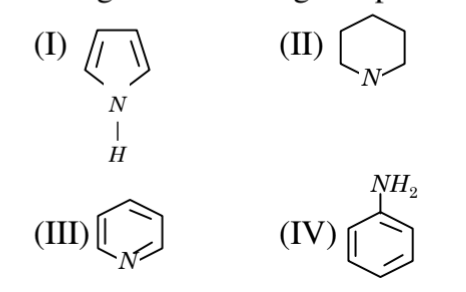
Question 156
The correct order of decreasing basic strength of following compounds is :
Choose an answer to reveal your result and explanation.
Answer & Explanation
The correct order of decreasing basic strength of the given compounds is: Pyrrole > Pyridine > Piperidine > Aniline. This is supported by Option 4: II>III>IV>I.
-
Explanation for Option 4:
-
Pyrrole (II): Pyrrole is a five-membered aromatic heterocycle with a nitrogen atom. The lone pair of electrons on the nitrogen is involved in the aromaticity of the ring, making it less available for protonation. However, in comparison to the other compounds listed, pyrrole's basicity is relatively higher due to its ability to stabilize the positive charge through resonance when it does accept a proton.
-
Pyridine (III): Pyridine is a six-membered aromatic heterocycle with a nitrogen atom. The lone pair of electrons on the nitrogen is not involved in the aromaticity of the ring, making it more available for protonation compared to pyrrole. This makes pyridine more basic than pyrrole.
-
Piperidine (IV): Piperidine is a saturated six-membered ring containing a nitrogen atom. The lone pair on the nitrogen is not involved in any resonance or aromaticity, making it highly available for protonation. This makes piperidine more basic than both pyrrole and pyridine.
-
Aniline (I): Aniline is an aromatic amine where the lone pair on the nitrogen is delocalized into the benzene ring, reducing its availability for protonation. This makes aniline the least basic among the given compounds.
-
-
Explanation for why other options are incorrect:
-
Option 1 (I>II>III>IV): This option suggests that aniline is the most basic, which is incorrect. Aniline's lone pair is delocalized into the benzene ring, making it less basic than the other compounds.
-
Option 2 (II>I>III>IV): This option suggests that pyrrole is more basic than aniline, which is correct, but it incorrectly places aniline above pyridine and piperidine. Aniline is less basic than both pyridine and piperidine due to the delocalization of its lone pair.
-
Option 3 (IV>I>III>II): This option suggests that piperidine is the most basic, which is correct, but it incorrectly places aniline above pyridine and pyrrole. Aniline is the least basic due to the delocalization of its lone pair into the benzene ring.
-
In conclusion, Option 4 correctly represents the order of decreasing basic strength as Pyrrole > Pyridine > Piperidine > Aniline, based on the availability of the nitrogen lone pair for protonation and the influence of resonance and aromaticity.
निम्नलिखित यौगिकों की क्षारीय सामर्थ्य का घटता हुआ सही क्रम है :
Choose an answer to reveal your result and explanation.
Answer & Explanation
निम्नलिखित यौगिकों की क्षारीय सामर्थ्य का घटता हुआ क्रम सही रूप से समझने के लिए हमें उनके रासायनिक संरचना और इलेक्ट्रॉनिक गुणों का विश्लेषण करना होगा।
-
पिपेरिडीन (IV): पिपेरिडीन एक साइक्लिक सेकेंडरी अमीन है जिसमें नाइट्रोजन पर कोई इलेक्ट्रॉन खींचने वाला समूह नहीं होता है। यह नाइट्रोजन पर इलेक्ट्रॉन घनत्व को बढ़ाता है, जिससे यह प्रोटॉन को आसानी से स्वीकार कर सकता है। इसलिए, यह सबसे अधिक क्षारीय है।
-
पिरिडीन (III): पिरिडीन एक हेटरोसाइक्लिक यौगिक है जिसमें नाइट्रोजन पर एक अकेला इलेक्ट्रॉन युग्म होता है। यह इलेक्ट्रॉन युग्म आंशिक रूप से पिरिडीन के एरोमैटिक रिंग के साथ संलग्न नहीं होता है, जिससे यह प्रोटॉन को स्वीकार कर सकता है, लेकिन पिपेरिडीन की तुलना में कम प्रभावी ढंग से।
-
ऐनिलीन (I): ऐनिलीन में नाइट्रोजन पर एक अकेला इलेक्ट्रॉन युग्म होता है जो बेंजीन रिंग के साथ संलग्न होता है। यह इलेक्ट्रॉन युग्म आंशिक रूप से रिंग के साथ संलग्न होने के कारण प्रोटॉन को स्वीकार करने की क्षमता को कम करता है। इसलिए, ऐनिलीन की क्षारीयता पिरिडीन से कम होती है।
-
पिरोल (II): पिरोल में नाइट्रोजन का अकेला इलेक्ट्रॉन युग्म पूरी तरह से एरोमैटिक रिंग के साथ संलग्न होता है, जिससे यह प्रोटॉन को स्वीकार करने की क्षमता को बहुत कम कर देता है। इसलिए, यह सबसे कम क्षारीय है।
इस प्रकार, क्षारीय सामर्थ्य का घटता हुआ क्रम होगा: पिपेरिडीन > पिरिडीन > ऐनिलीन > पिरोल। इसलिए, सही विकल्प 4 है: II>III>IV>I।
अन्य विकल्प गलत क्यों हैं:
- विकल्प 1 (I>II>III>IV): यह क्रम गलत है क्योंकि ऐनिलीन की क्षारीयता पिरिडीन और पिपेरिडीन से कम होती है।
- विकल्प 2 (II>I>III>IV): यह क्रम गलत है क्योंकि पिरोल की क्षारीयता सबसे कम होती है।
- विकल्प 3 (IV>I>III>II): यह क्रम गलत है क्योंकि ऐनिलीन की क्षारीयता पिरिडीन से कम होती है।
इस प्रकार, सही उत्तर विकल्प 4 है।
Question 157
Select the correct order of acidic strength of following oxides:
Choose an answer to reveal your result and explanation.
Answer & Explanation
The correct order of acidic strength of the given oxides is provided as Option 4: SO3>CO2>B2O3. Let's explore why this is the correct order and why the other options are incorrect.
Explanation for Option 4:
-
SO3 (Sulfur trioxide):
- SO3 is a highly acidic oxide. It reacts with water to form sulfuric acid (H2SO4), which is a strong acid. The high oxidation state of sulfur (+6) in SO3 contributes to its strong acidic nature.
-
CO2 (Carbon dioxide):
- CO2 is an acidic oxide that reacts with water to form carbonic acid (H2CO3), which is a weak acid. Although it is less acidic than SO3, it is still considered an acidic oxide.
-
B2O3 (Boron trioxide):
- B2O3 is also an acidic oxide, but it is less acidic compared to CO2. It reacts with water to form boric acid (H3BO3), which is a very weak acid. Therefore, B2O3 is the least acidic among the three.
Thus, the order SO3>CO2>B2O3 correctly reflects the decreasing acidic strength of these oxides.
Explanation for why other options are incorrect:
-
Option 1: SO2>SO3>CO2
- SO2 is less acidic than SO3. SO2 forms sulfurous acid (H2SO3) when dissolved in water, which is weaker than sulfuric acid. Therefore, SO3 should be more acidic than SO2, making this option incorrect.
-
Option 2: Cs2O>K2O>Na2O
- This option lists basic oxides, not acidic ones. Cs2O, K2O, and Na2O are all basic oxides, and their order of basicity is not relevant to the question of acidic strength. Therefore, this option is incorrect in the context of acidic strength.
-
Option 3: CO2>N2O5>B2O3
- While CO2 is more acidic than B2O3, N2O5 is actually a very strong acidic oxide, forming nitric acid (HNO3) in water. It should be more acidic than CO2, making this option incorrect in terms of the given order.
In conclusion, Option 4 is the correct answer as it accurately reflects the order of acidic strength among the given oxides: SO3>CO2>B2O3.
निम्नलिखित ऑक्साइडों की अम्लीय सामर्थ्य के सही क्रम का चयन कीजिए :
Choose an answer to reveal your result and explanation.
Answer & Explanation
Option 4, SO3>CO2>B2O3, is the correct order of acidic strength for the given oxides. Here's a detailed explanation supporting this:
-
SO3 (Sulfur Trioxide): SO3 is a highly acidic oxide. It reacts with water to form sulfuric acid (H2SO4), which is a strong acid. The high oxidation state of sulfur in SO3 contributes to its strong acidic nature.
-
CO2 (Carbon Dioxide): CO2 is less acidic than SO3. It reacts with water to form carbonic acid (H2CO3), which is a weak acid. Although CO2 is acidic, its acidic strength is lower compared to SO3.
-
B2O3 (Boron Trioxide): B2O3 is an acidic oxide, but it is weaker than both SO3 and CO2. It reacts with water to form boric acid (H3BO3), which is a very weak acid. Therefore, B2O3 has the least acidic strength among the three.
Now, let's explain why the other options are incorrect:
-
Option 1: SO2>SO3>CO2 - This option is incorrect because SO3 is more acidic than SO2. SO3 forms a stronger acid (H2SO4) compared to the acid formed by SO2 (H2SO3, sulfurous acid).
-
Option 2: Cs2O>K2O>Na2O - This option is incorrect because these are basic oxides, not acidic. The order of basicity is typically Cs2O<K2O<Na2O, as basicity decreases down the group in alkali metals.
-
Option 3: CO2>N2O5>B2O3 - This option is incorrect because although CO2 is more acidic than B2O3, N2O5 is actually more acidic than CO2. N2O5 forms nitric acid (HNO3), which is a strong acid, making it more acidic than CO2.
In conclusion, Option 4 correctly represents the order of acidic strength as SO3>CO2>B2O3, based on the nature of the acids formed by these oxides and their relative strengths.
Question 158
The pH of blood 7.26 to 7.42 is maintained by buffer:
Choose an answer to reveal your result and explanation.
Answer & Explanation
The pH of blood is tightly regulated between 7.26 and 7.42, and this is primarily maintained by the bicarbonate buffer system, which is represented by Option 1: H2CO3/HCO3−.
Explanation for Option 1:
-
Bicarbonate Buffer System: The bicarbonate buffer system is the most significant buffer system in the blood. It consists of carbonic acid (H2CO3) and bicarbonate ions (HCO3−). This system is crucial because it can quickly respond to changes in pH by shifting the equilibrium between carbonic acid and bicarbonate ions.
-
Mechanism: When the blood becomes too acidic (low pH), bicarbonate ions can neutralize excess hydrogen ions, forming carbonic acid, which can then be converted to carbon dioxide and water, with the carbon dioxide being exhaled. Conversely, if the blood becomes too basic (high pH), carbonic acid can dissociate to release hydrogen ions, thus lowering the pH.
-
Physiological Relevance: The bicarbonate buffer system is directly linked to the respiratory system and the kidneys, which help regulate the levels of carbon dioxide and bicarbonate in the blood, respectively. This makes it highly effective in maintaining the pH within the narrow range necessary for proper physiological function.
Explanation for Why Other Options are Incorrect:
-
Option 2: H3PO4/H2PO4−: The phosphate buffer system is more relevant in the intracellular environment and in the kidneys rather than in the blood. It is not the primary buffer system for maintaining blood pH.
-
Option 3: CH3COOH/CH3COO−: The acetic acid/acetate buffer system is not significant in human physiology for blood pH regulation. It is more commonly used in laboratory settings for buffer solutions.
-
Option 4: NH2CH2COOH/NH2CH2COO−: This represents an amino acid buffer system, which is more relevant in protein buffering within cells and not a primary buffer system for blood pH.
In conclusion, the bicarbonate buffer system (H2CO3/HCO3−) is the primary and most effective buffer system for maintaining the pH of blood within the narrow range of 7.26 to 7.42, making Option 1 the correct answer.
रक्त की pH 7.26 से 7.42 तक बनाए रखने वाला बफर है :
Choose an answer to reveal your result and explanation.
Answer & Explanation
रक्त की pH को 7.26 से 7.42 तक बनाए रखने वाला बफर H2CO3/HCO3− है। यह बफर प्रणाली रक्त में सबसे महत्वपूर्ण बफर प्रणाली है और इसे बाइकार्बोनेट बफर प्रणाली के रूप में जाना जाता है। यह प्रणाली कार्बोनिक एसिड (H2CO3) और बाइकार्बोनेट आयन (HCO3−) के बीच संतुलन पर आधारित है। जब रक्त में pH कम होता है, तो बाइकार्बोनेट आयन हाइड्रोजन आयनों के साथ प्रतिक्रिया करके कार्बोनिक एसिड बनाते हैं, जिससे pH बढ़ता है। इसके विपरीत, जब pH बढ़ता है, तो कार्बोनिक एसिड टूटकर बाइकार्बोनेट आयन और हाइड्रोजन आयन बनाता है, जिससे pH कम होता है। इस प्रकार, यह प्रणाली रक्त की pH को स्थिर बनाए रखने में महत्वपूर्ण भूमिका निभाती है।
अन्य विकल्पों की गलतियों का स्पष्टीकरण:
-
H3PO4/H2PO4−: यह फॉस्फेट बफर प्रणाली है, जो कोशिकाओं के अंदर pH को स्थिर रखने में मदद करती है, लेकिन यह रक्त के pH को नियंत्रित करने में प्राथमिक भूमिका नहीं निभाती।
-
CH3COOH/CH3COO−: यह एसीटेट बफर प्रणाली है, जो आमतौर पर प्रयोगशाला स्थितियों में उपयोग की जाती है और रक्त के pH को नियंत्रित करने में इसका कोई महत्वपूर्ण योगदान नहीं है।
-
NH2CH2COOH/NH2CH2COO−: यह ग्लाइसिन बफर प्रणाली है, जो विशेष परिस्थितियों में उपयोगी हो सकती है, लेकिन रक्त के pH को बनाए रखने में इसका कोई प्रमुख योगदान नहीं है।
इस प्रकार, रक्त की pH को 7.26 से 7.42 तक बनाए रखने के लिए H2CO3/HCO3− बफर प्रणाली सबसे उपयुक्त और प्रभावी है।
Question 159
The pKa for CH3COOH is 4.75. Hence mixture of sodium acetate and acetic acid can be used for preparing buffer solution whose pH is in the range:
Choose an answer to reveal your result and explanation.
Answer & Explanation
To understand why Option 3 is the correct answer, we need to delve into the concept of buffer solutions and the role of pKa in determining the effective pH range of a buffer.
-
Explanation for Option 3 (3.75 to 5.75):
A buffer solution is most effective when the pH is close to the pKa of the acid involved. The pKa of acetic acid (CH3COOH) is 4.75. A buffer solution typically works best within a range of ±1 pH unit from the pKa value. This is because, within this range, the concentrations of the acid and its conjugate base (in this case, acetate ion, CH3COO-) are sufficient to resist changes in pH upon the addition of small amounts of acid or base.
Therefore, for acetic acid with a pKa of 4.75, the effective buffering range is approximately from 3.75 to 5.75. This is why Option 3 is correct, as it falls within this effective buffering range.
-
Explanation for why other options are incorrect:
-
Option 1 (0 to 4.75): This range includes pH values that are too low for the effective buffering capacity of the acetic acid/acetate system. While the upper limit of 4.75 is the pKa, the lower limit of 0 is far below the effective buffering range, where the solution would not effectively resist changes in pH.
-
Option 2 (4.75 to 14): Although the lower limit of this range starts at the pKa, the upper limit extends far beyond the effective buffering range. A pH of 14 is highly basic, and the acetic acid/acetate buffer would not be effective at such high pH values. The buffering capacity diminishes significantly beyond 5.75.
-
Option 4 (1 to 14): This range is too broad and includes pH values where the buffer would not be effective. The lower end (pH 1) is too acidic, and the upper end (pH 14) is too basic for the acetic acid/acetate buffer system to maintain a stable pH.
-
In conclusion, Option 3 is the correct choice because it accurately represents the effective buffering range of a sodium acetate and acetic acid mixture, which is centered around the pKa of acetic acid. This range ensures that the buffer can effectively resist changes in pH, making it the most suitable option.
CH3COOH का pKa 4.75 है अतः सोडियम ऐसिटेट और ऐसिटिक अम्ल का प्रयोग बफर विलयन बनाने में किया जा सकता है उसका pH जिस परास में है :
Choose an answer to reveal your result and explanation.
Answer & Explanation
सोडियम ऐसिटेट और ऐसिटिक अम्ल का बफर विलयन बनाने के लिए pH का परास 3.75 से 5.75 के बीच होता है। इसका कारण यह है कि बफर विलयन का pH उस अम्ल के pKa के आसपास होता है जिसका उपयोग बफर में किया जाता है। ऐसिटिक अम्ल का pKa 4.75 है, इसलिए बफर का प्रभावी pH परास pKa ± 1 के भीतर होता है।
-
विकल्प 1: 0 से 4.75 - यह परास ऐसिटिक अम्ल के pKa से नीचे है और बफरिंग प्रभावी रूप से pKa के आसपास होता है, इसलिए यह विकल्प सही नहीं है।
-
विकल्प 2: 4.75 से 14 - यह परास pKa से ऊपर की ओर विस्तृत है। हालांकि 4.75 इस परास में आता है, लेकिन बफरिंग प्रभावी रूप से pKa ± 1 के भीतर होता है, इसलिए यह विकल्प सही नहीं है।
-
विकल्प 3: 3.75 से 5.75 - यह परास ऐसिटिक अम्ल के pKa 4.75 के ± 1 के भीतर है, जो बफरिंग के लिए आदर्श परास है। इसलिए यह विकल्प सही है।
-
विकल्प 4: 1 से 14 - यह परास बहुत विस्तृत है और बफरिंग प्रभावी रूप से pKa के आसपास होता है, इसलिए यह विकल्प सही नहीं है।
इस प्रकार, विकल्प 3 सही है क्योंकि यह ऐसिटिक अम्ल के pKa के ± 1 के भीतर आता है, जो बफरिंग के लिए उपयुक्त परास है।
Question 160
Calculate pH of a weak acid HA, if the degree of dissociation of 1M solution being 10%:
Choose an answer to reveal your result and explanation.
Answer & Explanation
To calculate the pH of a weak acid HA with a degree of dissociation of 10% in a 1M solution, we need to understand the relationship between dissociation, concentration, and pH.
-
Understanding Degree of Dissociation:
- The degree of dissociation (α) is given as 10%, which means that 10% of the acid dissociates into its ions.
- For a 1M solution, this means that 0.1M of the acid dissociates into H⁺ ions and A⁻ ions.
-
Calculating [H⁺]:
- Since 10% of the 1M solution dissociates, the concentration of H⁺ ions ([H⁺]) is 0.1M.
-
Calculating pH:
- pH is calculated using the formula: pH = -log[H⁺].
- Substituting the value of [H⁺] = 0.1M, we get:
[
\text{pH} = -\log(0.1) = 1
]
-
Justification for Option 1:
- The calculation shows that the pH of the solution is 1, which matches Option 1. This confirms that Option 1 is the correct answer.
-
Explanation of Incorrect Options:
- Option 2 (pH = 2): This would imply that the concentration of H⁺ ions is 0.01M, which is not consistent with a 10% dissociation of a 1M solution.
- Option 3 (pH = 3): This would imply that the concentration of H⁺ ions is 0.001M, which is far less than the 0.1M calculated from the 10% dissociation.
- Option 4 (pH = 4): This would imply that the concentration of H⁺ ions is 0.0001M, which is incorrect given the degree of dissociation.
In conclusion, the correct answer is Option 1, as the pH of the solution, calculated based on the given degree of dissociation, is indeed 1.
एक दुर्बल अम्ल HA के pH की गणना कीजिए। यदि 1 M विलयन के विघटन की मात्रा 10% है :
Choose an answer to reveal your result and explanation.
Answer & Explanation
एक दुर्बल अम्ल HA के 1 M विलयन के विघटन की मात्रा 10% है। इसका अर्थ है कि 1 M HA में से 0.1 M H⁺ आयन में विघटित हो गया है।
pH की गणना करने के लिए, हम H⁺ आयन की सांद्रता का उपयोग करते हैं। चूंकि 10% विघटन का अर्थ है कि H⁺ आयन की सांद्रता 0.1 M है, हम pH की गणना निम्नलिखित सूत्र से कर सकते हैं:
[ \text{pH} = -\log[\text{H}^+] ]
यहाँ, ([\text{H}^+] = 0.1 , \text{M})
[ \text{pH} = -\log(0.1) = 1 ]
इसलिए, pH की गणना 1 आती है, जो विकल्प 1 को सही ठहराता है।
अब, अन्य विकल्पों को गलत साबित करने के लिए:
-
विकल्प 2 (pH = 2): यदि pH 2 होता, तो ([\text{H}^+] = 0.01 , \text{M}) होता। लेकिन यहाँ ([\text{H}^+] = 0.1 , \text{M}) है, इसलिए pH 2 नहीं हो सकता।
-
विकल्प 3 (pH = 3): यदि pH 3 होता, तो ([\text{H}^+] = 0.001 , \text{M}) होता। यह भी गलत है क्योंकि ([\text{H}^+] = 0.1 , \text{M}) है।
-
विकल्प 4 (pH = 4): यदि pH 4 होता, तो ([\text{H}^+] = 0.0001 , \text{M}) होता। यह भी गलत है क्योंकि ([\text{H}^+] = 0.1 , \text{M}) है।
इस प्रकार, विकल्प 1 सही है क्योंकि यह pH की सही गणना को दर्शाता है।