
HTET Exam - Level 1 PRT - Science
HTET exam Level 1 PRT preparation with Clear Cutoff
by Clear Cutoff
Showing 20 of 20 questions
Question 161
For ideal gas compressibility factor Z is:
Choose an answer to reveal your result and explanation.
Answer & Explanation
The compressibility factor ( Z ) is a measure used to describe how much a real gas deviates from ideal gas behavior. For an ideal gas, the compressibility factor is defined as:
[ Z = \frac{PV}{nRT} ]
where ( P ) is the pressure, ( V ) is the volume, ( n ) is the number of moles, ( R ) is the ideal gas constant, and ( T ) is the temperature. For an ideal gas, the equation of state is perfectly described by the ideal gas law:
[ PV = nRT ]
Substituting this into the expression for ( Z ), we get:
[ Z = \frac{nRT}{nRT} = 1 ]
Therefore, for an ideal gas, the compressibility factor ( Z ) is exactly 1. This is why Option 2 is the correct answer.
Now, let's explain why the other options are incorrect:
-
Option 1 (0): A compressibility factor of 0 would imply that the product of pressure and volume is zero, which is not possible for a gas under normal conditions. This would mean either the pressure or the volume is zero, which is not feasible for a gas that occupies space and exerts pressure.
-
Option 3 (greater than 1): A compressibility factor greater than 1 indicates that the gas is less compressible than an ideal gas, often due to repulsive forces dominating at high pressures. This behavior is typical of real gases but not of an ideal gas, which by definition does not experience intermolecular forces.
-
Option 4 (less than 0): A compressibility factor less than 0 is not physically meaningful. It would imply negative pressure or volume, which is not possible for a gas. This option is not applicable to any real or ideal gas scenario.
In conclusion, the compressibility factor ( Z ) for an ideal gas is exactly 1, making Option 2 the correct choice.
आदर्श गैस का संपीड्यता कारक है :
Choose an answer to reveal your result and explanation.
Answer & Explanation
आदर्श गैस का संपीड्यता कारक (compressibility factor) 1 होता है। यह संपीड्यता कारक आदर्श गैस समीकरण ( PV = nRT ) के अनुसार निर्धारित होता है, जहाँ ( P ) दबाव है, ( V ) आयतन है, ( n ) मोल की संख्या है, ( R ) गैस स्थिरांक है, और ( T ) तापमान है। आदर्श गैस के लिए, संपीड्यता कारक ( Z ) को निम्नलिखित रूप में परिभाषित किया जाता है:
[ Z = \frac{PV}{nRT} ]
आदर्श गैस के लिए, ( PV = nRT ) होता है, इसलिए:
[ Z = \frac{nRT}{nRT} = 1 ]
इसलिए, आदर्श गैस का संपीड्यता कारक 1 होता है, जो विकल्प 2 को सही बनाता है।
अब अन्य विकल्पों की गलतियों को समझते हैं:
-
विकल्प 1 (0): यदि संपीड्यता कारक 0 होता, तो इसका अर्थ होता कि गैस का कोई आयतन नहीं है या कोई दबाव नहीं है, जो कि भौतिक रूप से संभव नहीं है। आदर्श गैस के लिए ( Z = 1 ) होता है, न कि 0।
-
विकल्प 3 (1 से अधिक): यदि संपीड्यता कारक 1 से अधिक होता, तो इसका अर्थ होता कि गैस आदर्श व्यवहार से विचलित हो रही है, जो कि आदर्श गैस के लिए सही नहीं है। आदर्श गैस के लिए ( Z = 1 ) होता है।
-
विकल्प 4 (0 से कम): संपीड्यता कारक का 0 से कम होना भौतिक रूप से असंभव है क्योंकि यह नकारात्मक आयतन या दबाव को इंगित करेगा, जो कि वास्तविकता में संभव नहीं है। आदर्श गैस के लिए ( Z = 1 ) होता है।
इस प्रकार, विकल्प 2 सही है क्योंकि आदर्श गैस का संपीड्यता कारक 1 होता है।
Question 162
Spin angular momentum for electron is:
Choose an answer to reveal your result and explanation.
Answer & Explanation
The spin angular momentum for an electron is a fundamental concept in quantum mechanics. It is described by the formula for the magnitude of the spin angular momentum vector, which is given by:
[ S = \sqrt{s(s+1)}\frac{h}{2\pi} ]
where:
- ( s ) is the spin quantum number for the electron.
- ( h ) is Planck's constant.
For an electron, the spin quantum number ( s ) is ( \frac{1}{2} ). Substituting this value into the formula, we get:
[ S = \sqrt{\frac{1}{2}(\frac{1}{2} + 1)}\frac{h}{2\pi} = \sqrt{\frac{1}{2} \times \frac{3}{2}}\frac{h}{2\pi} = \sqrt{\frac{3}{4}}\frac{h}{2\pi} = \frac{\sqrt{3}}{2}\frac{h}{2\pi} ]
This matches the form given in Option 1, which is the correct expression for the spin angular momentum of an electron.
Now, let's examine why the other options are incorrect:
-
Option 2: (\sqrt{2s(s+1)}\frac{h}{2\pi})
- This formula incorrectly includes an extra factor of 2 inside the square root, which does not align with the standard quantum mechanical expression for spin angular momentum.
-
Option 3: (\sqrt{s(s+2)}\frac{h}{2\pi})
- This formula incorrectly uses ( s(s+2) ) instead of ( s(s+1) ). The correct expression for spin angular momentum involves ( s(s+1) ), as derived from quantum mechanics principles.
-
Option 4: (\sqrt{2(s+1)}\frac{h}{2\pi})
- This formula incorrectly modifies the expression by using ( 2(s+1) ) inside the square root, which is not consistent with the established formula for spin angular momentum.
In conclusion, Option 1 is the correct expression for the spin angular momentum of an electron, as it accurately reflects the quantum mechanical principles governing electron spin.
इलेक्ट्रॉन के लिए चक्रण कोणीय संवेग है :
Choose an answer to reveal your result and explanation.
Answer & Explanation
इलेक्ट्रॉन के लिए चक्रण कोणीय संवेग का सूत्र s(s+1)2πh होता है, जहाँ s इलेक्ट्रॉन का स्पिन क्वांटम संख्या है। इलेक्ट्रॉन के लिए स्पिन क्वांटम संख्या s=21 होती है।
अब, इस सूत्र का उपयोग करके, हम इलेक्ट्रॉन के चक्रण कोणीय संवेग की गणना कर सकते हैं:
- s=21 को सूत्र में डालें:
[
\sqrt{\frac{1}{2}\left(\frac{1}{2} + 1\right)}\frac{h}{2\pi} = \sqrt{\frac{1}{2} \times \frac{3}{2}}\frac{h}{2\pi} = \sqrt{\frac{3}{4}}\frac{h}{2\pi} = \frac{\sqrt{3}}{2}\frac{h}{2\pi}
]
यह गणना दिखाती है कि विकल्प 1 सही है क्योंकि यह इलेक्ट्रॉन के चक्रण कोणीय संवेग के लिए सही सूत्र का उपयोग करता है।
अब, अन्य विकल्पों की गलतियों को समझते हैं:
-
विकल्प 2: 2s(s+1)2πh - यह सूत्र गलत है क्योंकि इसमें 2s(s+1) का उपयोग किया गया है, जो कि इलेक्ट्रॉन के चक्रण कोणीय संवेग के लिए सही नहीं है।
-
विकल्प 3: s(s+2)2πh - यह भी गलत है क्योंकि इसमें s(s+2) का उपयोग किया गया है, जो कि इलेक्ट्रॉन के चक्रण कोणीय संवेग के लिए सही नहीं है।
-
विकल्प 4: 2(s+1)2πh - यह भी गलत है क्योंकि इसमें 2(s+1) का उपयोग किया गया है, जो कि इलेक्ट्रॉन के चक्रण कोणीय संवेग के लिए सही नहीं है।
इस प्रकार, विकल्प 1 सही है क्योंकि यह इलेक्ट्रॉन के चक्रण कोणीय संवेग के लिए सही गणना और सूत्र का उपयोग करता है।
Question 163
Which of the following statements about the interstitial compounds is incorrect?
Choose an answer to reveal your result and explanation.
Answer & Explanation
Interstitial compounds are formed when small atoms like hydrogen, carbon, or nitrogen occupy the interstitial spaces in a metal lattice. Let's analyze each option to understand why Option 3 is the correct answer:
-
They have higher melting points than the pure metal.
Interstitial compounds generally have higher melting points compared to the pure metals from which they are formed. This is because the presence of small atoms in the interstitial spaces strengthens the metallic lattice, making it more difficult to break apart. Therefore, this statement is correct and not the incorrect one. -
They retain metallic conductivity.
Interstitial compounds typically retain the metallic conductivity of the parent metal. The presence of interstitial atoms does not significantly disrupt the electron sea that is responsible for metallic conductivity. Thus, this statement is also correct. -
They are chemically reactive.
This statement is incorrect, which is why it is the correct answer to the question. Interstitial compounds are generally less chemically reactive than the pure metals. The small atoms in the interstitial spaces often stabilize the metal lattice, making it less prone to chemical reactions. This reduced reactivity is a characteristic feature of interstitial compounds. -
They are much harder than pure metal.
Interstitial compounds are indeed much harder than the pure metals from which they are formed. The introduction of small atoms into the metal lattice increases the hardness by preventing the layers of metal atoms from sliding over each other easily. Therefore, this statement is correct.
In conclusion, Option 3 is the correct answer because it is the only statement that inaccurately describes a property of interstitial compounds.
अन्तराकाशी यौगिकों के संदर्भ में निम्नलिखित में से कौन-सा कथन सही नहीं है ?
Choose an answer to reveal your result and explanation.
Answer & Explanation
अंतराकाशी यौगिकों के संदर्भ में दिए गए विकल्पों में से सही नहीं होने वाला कथन विकल्प 3 है: "ये रासायनिक रूप से सक्रिय होते हैं।" आइए इसे विस्तार से समझें:
-
विकल्प 3: ये रासायनिक रूप से सक्रिय होते हैं।
अंतराकाशी यौगिक आमतौर पर रासायनिक रूप से निष्क्रिय होते हैं। ये यौगिक धातुओं के बीच एक विशेष प्रकार के बंधन के कारण स्थिर होते हैं, जो उन्हें रासायनिक प्रतिक्रियाओं में भाग लेने से रोकता है। इसलिए, यह कथन सही नहीं है और यही कारण है कि इसे सही उत्तर के रूप में चुना गया है। -
विकल्प 1: इनका गलनांक शुद्ध धातु से उच्च होता है।
अंतराकाशी यौगिकों का गलनांक अक्सर शुद्ध धातुओं की तुलना में अधिक होता है। यह इसलिए होता है क्योंकि इन यौगिकों में धातु के परमाणुओं के बीच मजबूत बंधन होते हैं, जो उच्च तापमान पर टूटने के लिए अधिक ऊर्जा की आवश्यकता होती है। इसलिए, यह कथन सही है। -
विकल्प 2: ये धात्विक चालकता बनाए रखते हैं।
अंतराकाशी यौगिक धात्विक चालकता बनाए रखते हैं क्योंकि इनमें धातु के परमाणुओं के बीच इलेक्ट्रॉनों का मुक्त प्रवाह होता है। यह गुण उन्हें विद्युत चालक बनाता है। इसलिए, यह कथन सही है। -
विकल्प 4: ये शुद्ध धातु से अधिक कठोर होते हैं।
अंतराकाशी यौगिक आमतौर पर शुद्ध धातुओं की तुलना में अधिक कठोर होते हैं। यह कठोरता धातु के परमाणुओं के बीच मजबूत बंधन के कारण होती है, जो यांत्रिक बलों के प्रति अधिक प्रतिरोधी होते हैं। इसलिए, यह कथन सही है।
इस प्रकार, विकल्प 3 को सही नहीं होने वाला कथन माना गया है क्योंकि अंतराकाशी यौगिक रासायनिक रूप से सक्रिय नहीं होते हैं।
Question 164
CsBr crystallizes in a body centred cubic lattice. The unit cell length is 436.6 pm. Given that atomic mass of Cs=133 and that of Br=80 amu and Avogadro number being 6.023×10²³mol−1 the density of CsBr is:
Choose an answer to reveal your result and explanation.
Answer & Explanation
To determine the density of CsBr, which crystallizes in a body-centered cubic (BCC) lattice, we need to use the formula for density ((\rho)) of a crystalline solid:
[
\rho = \frac{Z \cdot M}{a^3 \cdot N_A}
]
where:
- (Z) is the number of formula units per unit cell.
- (M) is the molar mass of the compound.
- (a) is the edge length of the unit cell.
- (N_A) is Avogadro's number.
Step-by-step Calculation:
-
Determine (Z):
- In a body-centered cubic lattice, there is 1 atom at each corner of the cube and 1 atom in the center. However, for CsBr, which is an ionic compound, the Cs and Br ions occupy these positions. In a BCC structure, there is effectively 1 formula unit per unit cell ((Z = 1)).
-
Calculate the Molar Mass ((M)):
- The molar mass of CsBr is the sum of the atomic masses of Cs and Br:
[
M = 133 , \text{amu} + 80 , \text{amu} = 213 , \text{g/mol}
]
- The molar mass of CsBr is the sum of the atomic masses of Cs and Br:
-
Convert the Unit Cell Length ((a)) to cm:
- Given (a = 436.6 , \text{pm}), convert this to cm:
[
a = 436.6 \times 10^{-12} , \text{m} = 436.6 \times 10^{-10} , \text{cm}
]
- Given (a = 436.6 , \text{pm}), convert this to cm:
-
Use Avogadro's Number ((N_A)):
- (N_A = 6.023 \times 10^{23} , \text{mol}^{-1})
-
Calculate the Density ((\rho)):
- Substitute the values into the density formula:
[
\rho = \frac{1 \cdot 213}{(436.6 \times 10^{-10})^3 \cdot 6.023 \times 10^{23}}
] - Calculate (a^3):
[
a^3 = (436.6 \times 10^{-10})^3 = 8.32 \times 10^{-23} , \text{cm}^3
] - Calculate (\rho):
[
\rho = \frac{213}{8.32 \times 10^{-23} \cdot 6.023 \times 10^{23}} = \frac{213}{5.01} \approx 4.25 , \text{g/cm}^3
]
- Substitute the values into the density formula:
Explanation of Options:
- Option 1: 42.5 gcm−3 is incorrect because it is an order of magnitude too high for typical ionic compounds.
- Option 2: 0.425 gcm−3 is incorrect because it is too low for a solid ionic compound like CsBr.
- Option 3: 8.25 gcm−3 is incorrect because it is higher than the calculated density.
- Option 4: 4.25 gcm−3 is correct as it matches the calculated density using the given parameters.
Thus, the correct answer is Option 4: 4.25 gcm−3.
CsBr कायकेन्द्रित घनीय जालक के रूप में क्रिस्टलीकृत होता है। एकक कोष्ठिका लम्बाई 436.6 pm है। दिया गया है परमाणवीय द्रव्यमान Cs=133, Br=80 amu तथा आवोगाद्रो संख्या 6.023×10²³mol−1. CsBr का घनत्व है :
Choose an answer to reveal your result and explanation.
Answer & Explanation
CsBr एक कायकेन्द्रित घनीय (Body-Centered Cubic, BCC) जालक के रूप में क्रिस्टलीकृत होता है। हमें एकक कोष्ठिका की लम्बाई 436.6 pm दी गई है। हमें CsBr का घनत्व ज्ञात करना है।
घनत्व (ρ) की गणना के लिए सूत्र है:
[
\rho = \frac{Z \times M}{a^3 \times N_A}
]
जहाँ:
- (Z) = एकक कोष्ठिका में उपस्थित सूत्र इकाइयों की संख्या (BCC के लिए (Z = 2))
- (M) = यौगिक का मोलर द्रव्यमान
- (a) = एकक कोष्ठिका की लम्बाई (pm में दी गई है, इसे cm में बदलना होगा)
- (N_A) = आवोगाद्रो संख्या (6.023×10²³mol−1)
-
मोलर द्रव्यमान (M) की गणना:
[
M = 133 + 80 = 213 , amu
]
चूंकि 1 amu = 1.66054×10⁻²⁴,g, इसलिए
[
M = 213 \times 1.66054 \times 10^{-24} , g
] -
एकक कोष्ठिका की लम्बाई (a) को cm में बदलना:
[
a = 436.6 , pm = 436.6 \times 10^{-10} , cm
] -
घनत्व की गणना:
[
\rho = \frac{2 \times 213 \times 1.66054 \times 10^{-24}}{(436.6 \times 10^{-10})^3 \times 6.023 \times 10^{23}}
][
\rho = \frac{2 \times 213 \times 1.66054 \times 10^{-24}}{8.316 \times 10^{-23} \times 6.023 \times 10^{23}}
][
\rho = \frac{2 \times 213 \times 1.66054}{8.316 \times 6.023}
][
\rho \approx 4.25 , gcm^{-3}
]
इस प्रकार, CsBr का घनत्व 4.25 gcm−3 है, जो विकल्प 4 के अनुसार सही है।
अन्य विकल्पों की अस्वीकृति:
-
विकल्प 1: 42.5 gcm−3 - यह घनत्व अत्यधिक अधिक है और यथार्थवादी नहीं है क्योंकि यह गणना के अनुसार संभव नहीं है।
-
विकल्प 2: 0.425 gcm−3 - यह घनत्व बहुत कम है और गणना के अनुसार सही नहीं है।
-
विकल्प 3: 8.25 gcm−3 - यह घनत्व भी गलत है क्योंकि यह गणना के अनुसार सही नहीं है।
इस प्रकार, विकल्प 4 सही है और अन्य विकल्प गलत हैं।
Question 165
Match the List I of cubic lattice and List II giving relation between spacing (d) and cell edge (a):
List - I (Lattice) – List - II (Relation between d and a)
(I) bcc – (a) d=2a2
(II) fcc – (b) d=2a3
(III) simple cube – (c) d=2a
Choose an answer to reveal your result and explanation.
Answer & Explanation
घनीय जालक की सूची I को सूची II में दिए गए अंतरण (d) और कोष्ठिका धार (a) के मध्य संबंध से सुमेलित कीजिए :
सूची-I (जालक) – सूची-II (d और a के मध्य सम्बन्ध)
(I) bcc (a) – d=2a2
(II) fcc (b) – d=2a3
(III) सरल घन – (c) d=2a
Choose an answer to reveal your result and explanation.
Answer & Explanation
Question 166
Which of the following is an intensive property ?
Choose an answer to reveal your result and explanation.
Answer & Explanation
In the context of thermodynamics and physical chemistry, properties of substances are categorized into two types: intensive and extensive properties. An intensive property is one that does not depend on the amount of substance or the size of the system. In contrast, an extensive property is dependent on the system's size or the amount of material present.
-
Temperature (Option 1):
Temperature is an intensive property. This means that it remains constant regardless of the quantity of the substance or the size of the system. For example, if you have a glass of water at 25°C and you pour half of it into another glass, both glasses of water will still be at 25°C. The temperature does not change with the division of the system, demonstrating its intensive nature. This is why Option 1 is the correct answer. -
Internal Energy (Option 2):
Internal energy is an extensive property. It depends on the total amount of substance present in the system. If you divide a system into two equal parts, the internal energy of each part will be half of the original system's internal energy. This dependency on the quantity of matter makes internal energy an extensive property, not an intensive one. -
Mass (Option 3):
Mass is a classic example of an extensive property. It directly depends on the amount of substance present. If you take a system and divide it into two equal parts, the mass of each part will be half of the original system's mass. This characteristic clearly shows that mass is not an intensive property. -
Volume (Option 4):
Volume, like mass, is an extensive property. It is dependent on the size of the system or the amount of substance present. If you split a system into two equal parts, each part will have half the volume of the original system. This dependency on the system's size confirms that volume is not an intensive property.
In conclusion, temperature is the only option among the given choices that qualifies as an intensive property, as it remains unchanged regardless of the system's size or the amount of substance present.
निम्नलिखित में से कौन-सा गहन गुण है ?
Choose an answer to reveal your result and explanation.
Answer & Explanation
गहन गुण वे गुण होते हैं जो पदार्थ की मात्रा पर निर्भर नहीं करते हैं। निम्नलिखित में से कौन-सा गहन गुण है, इस प्रश्न के लिए सही उत्तर विकल्प 1, "तापमान" है। आइए इसे विस्तार से समझते हैं:
-
तापमान (Option 1): तापमान एक गहन गुण है क्योंकि यह पदार्थ की मात्रा पर निर्भर नहीं करता है। उदाहरण के लिए, यदि आपके पास एक गिलास पानी है और आप इसे दो भागों में विभाजित करते हैं, तो दोनों भागों का तापमान वही रहेगा। तापमान केवल पदार्थ के औसत गतिज ऊर्जा का माप है और यह पदार्थ की मात्रा से प्रभावित नहीं होता।
-
आन्तरिक ऊर्जा (Option 2): आन्तरिक ऊर्जा एक व्यापक गुण है क्योंकि यह पदार्थ की कुल ऊर्जा का माप है, जिसमें उसके सभी अणुओं की गतिज और स्थितिज ऊर्जा शामिल होती है। यह पदार्थ की मात्रा पर निर्भर करता है; अधिक मात्रा में पदार्थ होने पर आन्तरिक ऊर्जा भी अधिक होगी।
-
द्रव्यमान (Option 3): द्रव्यमान भी एक व्यापक गुण है क्योंकि यह सीधे तौर पर पदार्थ की मात्रा पर निर्भर करता है। अधिक मात्रा में पदार्थ होने पर द्रव्यमान भी बढ़ता है।
-
आयतन (Option 4): आयतन भी एक व्यापक गुण है क्योंकि यह पदार्थ की मात्रा पर निर्भर करता है। यदि आप किसी पदार्थ को दो भागों में विभाजित करते हैं, तो प्रत्येक भाग का आयतन मूल आयतन का आधा होगा।
इस प्रकार, तापमान एकमात्र गहन गुण है जो पदार्थ की मात्रा पर निर्भर नहीं करता है, और इसलिए विकल्प 1 सही उत्तर है।
Question 167
At constant volume, pressure of a fixed amount of a gas varies directly with the temperature. It is the statement of which of the following laws ?
Choose an answer to reveal your result and explanation.
Answer & Explanation
The correct answer to the question is Option 3: Gay-Lussac's law. Let's delve into the reasoning behind this choice and why the other options are incorrect.
-
Explanation for Option 3 (Gay-Lussac's Law):
- Gay-Lussac's law states that the pressure of a given mass of gas varies directly with the absolute temperature when the volume is kept constant. Mathematically, this can be expressed as ( P \propto T ) or ( \frac{P}{T} = \text{constant} ), where ( P ) is the pressure and ( T ) is the temperature in Kelvin. This law is applicable when the volume of the gas does not change, and it clearly aligns with the statement in the question that at constant volume, the pressure of a fixed amount of gas varies directly with the temperature.
-
Why Option 1 (Boyle's Law) is Incorrect:
- Boyle's law describes the relationship between pressure and volume at constant temperature. It states that the pressure of a gas is inversely proportional to its volume when the temperature is held constant, expressed as ( PV = \text{constant} ). This law does not involve temperature as a variable affecting pressure, so it does not match the scenario described in the question.
-
Why Option 2 (Charles's Law) is Incorrect:
- Charles's law focuses on the relationship between volume and temperature at constant pressure. It states that the volume of a gas is directly proportional to its absolute temperature when the pressure remains constant, expressed as ( V \propto T ). Since the question specifies a constant volume and a relationship between pressure and temperature, Charles's law is not applicable here.
-
Why Option 4 (Avogadro's Law) is Incorrect:
- Avogadro's law deals with the relationship between the volume of a gas and the number of moles at constant temperature and pressure. It states that equal volumes of gases, at the same temperature and pressure, contain an equal number of molecules. This law does not address the relationship between pressure and temperature, making it irrelevant to the question.
In conclusion, Gay-Lussac's law is the correct choice because it directly addresses the relationship between pressure and temperature at constant volume, which is precisely what the question describes.
स्थिर आयतन पर किसी निश्चित मात्रा वाली गैस का दाब उसके तापमान के समानुपाती होता है यह कथन निम्नलिखित में से किस नियम का है ?
Choose an answer to reveal your result and explanation.
Answer & Explanation
गै-लुसैक नियम के अनुसार, स्थिर आयतन पर किसी निश्चित मात्रा वाली गैस का दाब उसके तापमान के समानुपाती होता है। इसका अर्थ यह है कि जब गैस का आयतन स्थिर रहता है, तो उसके तापमान में वृद्धि होने पर दाब भी बढ़ता है और तापमान में कमी होने पर दाब भी घटता है। यह नियम गैसों के व्यवहार को समझने में महत्वपूर्ण है और इसे गैसों के तापमान-दाब संबंध के रूप में जाना जाता है।
अब हम अन्य विकल्पों पर विचार करते हैं और समझते हैं कि वे क्यों सही नहीं हैं:
-
बॉयल का नियम: यह नियम दाब और आयतन के बीच संबंध को बताता है, जिसमें कहा गया है कि स्थिर तापमान पर किसी गैस का दाब उसके आयतन के व्युत्क्रमानुपाती होता है। यह नियम तापमान के बजाय आयतन पर केंद्रित है, इसलिए यह विकल्प सही नहीं है।
-
चार्ल्स का नियम: यह नियम आयतन और तापमान के बीच संबंध को बताता है, जिसमें कहा गया है कि स्थिर दाब पर किसी गैस का आयतन उसके तापमान के समानुपाती होता है। यह नियम दाब के बजाय आयतन पर केंद्रित है, इसलिए यह विकल्प सही नहीं है।
-
आवोगाद्रो नियम: यह नियम बताता है कि समान तापमान और दाब पर समान आयतन वाली गैसों में अणुओं की संख्या समान होती है। यह नियम दाब और तापमान के संबंध से संबंधित नहीं है, इसलिए यह विकल्प सही नहीं है।
इस प्रकार, गै-लुसैक नियम (विकल्प 3) ही सही उत्तर है क्योंकि यह स्थिर आयतन पर दाब और तापमान के संबंध को स्पष्ट रूप से परिभाषित करता है।
Question 168
Which allotropic form of phosphorus shows chemiluminescence?
Choose an answer to reveal your result and explanation.
Answer & Explanation
White phosphorus is the correct answer because it is the allotropic form of phosphorus that exhibits chemiluminescence. Chemiluminescence is the emission of light as a result of a chemical reaction. White phosphorus is known for its ability to glow in the dark when exposed to oxygen, due to a slow oxidation process that emits light. This property is a characteristic feature of white phosphorus, making it unique among the allotropes of phosphorus.
Now, let's explain why the other options are incorrect:
-
Red phosphorus: Red phosphorus does not exhibit chemiluminescence. It is more stable and less reactive than white phosphorus. Red phosphorus is used in safety matches and fireworks, but it does not have the property of glowing in the dark.
-
a- Black phosphorus: Black phosphorus is another allotrope of phosphorus, known for its layered structure similar to graphite. It is stable and does not exhibit chemiluminescence. Black phosphorus is used in electronics and optoelectronics due to its semiconducting properties, but it does not emit light through chemical reactions.
-
ß- Black phosphorus: Similar to a- Black phosphorus, ß- Black phosphorus is a stable form of phosphorus that does not show chemiluminescence. It shares similar properties with a- Black phosphorus and is not known for emitting light.
In conclusion, white phosphorus is the only allotrope among the options provided that shows chemiluminescence, which is why Option 1 is the correct answer.
फॉस्फोरस का कौन-सा अपरूप रसोसंदीप्ति प्रदर्शित करता है ?
Choose an answer to reveal your result and explanation.
Answer & Explanation
श्वेत फॉस्फोरस रसोसंदीप्ति प्रदर्शित करता है। रसोसंदीप्ति एक ऐसी प्रक्रिया है जिसमें कोई पदार्थ प्रकाश का उत्सर्जन करता है। श्वेत फॉस्फोरस में यह गुण होता है कि यह हवा के संपर्क में आने पर ऑक्सीजन के साथ प्रतिक्रिया करता है और धीमी गति से ऑक्सीकरण के कारण यह एक हल्की चमक उत्पन्न करता है। यह चमक रसोसंदीप्ति के रूप में जानी जाती है।
अब अन्य विकल्पों पर विचार करते हैं:
-
लाल फॉस्फोरस: लाल फॉस्फोरस रसोसंदीप्ति प्रदर्शित नहीं करता है। यह श्वेत फॉस्फोरस की तुलना में अधिक स्थिर होता है और हवा के संपर्क में आने पर स्वतःस्फूर्त रूप से नहीं जलता।
-
a- काला फॉस्फोरस: a- काला फॉस्फोरस भी रसोसंदीप्ति प्रदर्शित नहीं करता है। यह फॉस्फोरस का एक और स्थिर रूप है और इसकी संरचना श्वेत फॉस्फोरस से भिन्न होती है।
-
ß-काला फॉस्फोरस: ß-काला फॉस्फोरस भी रसोसंदीप्ति प्रदर्शित नहीं करता है। यह भी एक स्थिर रूप है और इसका उपयोग आमतौर पर अर्धचालक उद्योग में होता है।
इस प्रकार, श्वेत फॉस्फोरस ही एकमात्र ऐसा अपरूप है जो रसोसंदीप्ति प्रदर्शित करता है, और इसलिए विकल्प 1 सही उत्तर है।
Question 169
Freundlich adsorption isotherm is expressed as equation :
Choose an answer to reveal your result and explanation.
Answer & Explanation
The Freundlich adsorption isotherm is an empirical model that describes the adsorption of substances onto a surface. It is particularly useful for understanding adsorption on heterogeneous surfaces. The correct expression for the Freundlich adsorption isotherm is given by:
[
\frac{x}{m} = kP^{1/n}
]
where:
- ( \frac{x}{m} ) is the amount of adsorbate per unit mass of adsorbent.
- ( k ) is the Freundlich constant, which is indicative of the adsorption capacity.
- ( P ) is the pressure of the adsorbate (or concentration in the case of solutions).
- ( n ) is a constant that indicates the intensity of the adsorption.
Explanation for Option 4:
Option 4 correctly represents the Freundlich adsorption isotherm equation. The equation (\frac{x}{m} = kP^{1/n}) captures the relationship between the amount of adsorbate adsorbed per unit mass of adsorbent and the pressure (or concentration) of the adsorbate. The term (P^{1/n}) reflects the non-linear nature of adsorption, which is characteristic of the Freundlich isotherm. This equation is widely accepted and used in the study of adsorption processes.
Explanation for Incorrect Options:
-
Option 1: (\frac{m}{x} = kP^{1/n})
- This equation incorrectly places the mass of the adsorbent ((m)) in the numerator and the amount of adsorbate ((x)) in the denominator. The Freundlich isotherm is concerned with the ratio of adsorbate to adsorbent, not the inverse.
-
Option 2: (\frac{x}{m} = kP^{n})
- This equation suggests a linear relationship with respect to (P^n), which does not align with the empirical nature of the Freundlich isotherm. The exponent should be (1/n) to reflect the correct non-linear relationship.
-
Option 3: (\frac{m}{x} = kP^{n})
- Similar to Option 1, this equation incorrectly inverts the ratio of adsorbate to adsorbent. Additionally, it uses (P^n) instead of (P^{1/n}), which does not represent the Freundlich isotherm.
In conclusion, Option 4 is the correct representation of the Freundlich adsorption isotherm, as it accurately describes the empirical relationship between the amount of adsorbate adsorbed and the pressure or concentration of the adsorbate.
फ्रॉयन्डलिक समतापीवक्र को किस समीकरण द्वारा व्यक्त किया जाता है ?
Choose an answer to reveal your result and explanation.
Answer & Explanation
फ्रॉयन्डलिक समतापीवक्र को mx=kP1/n समीकरण द्वारा व्यक्त किया जाता है, जो विकल्प 4 है। यह समीकरण फ्रॉयन्डलिक समतापीवक्र का मानक रूप है और इसे निम्नलिखित कारणों से सही माना जाता है:
-
फ्रॉयन्डलिक समतापीवक्र का सिद्धांत: फ्रॉयन्डलिक समतापीवक्र एक अनुभवजन्य समीकरण है जो गैसों के ठोस सतहों पर अवशोषण को वर्णित करता है। इसमें mx अवशोषित पदार्थ की मात्रा को दर्शाता है, k एक स्थिरांक है जो अवशोषण क्षमता को दर्शाता है, P दबाव है, और 1/n एक प्रयोगात्मक स्थिरांक है जो अवशोषण की तीव्रता को दर्शाता है।
-
विकल्प 4 की सही व्याख्या: विकल्प 4, mx=kP1/n, फ्रॉयन्डलिक समतापीवक्र का सही रूप है क्योंकि यह अवशोषण की मात्रा को दबाव के एक घातांक के रूप में दर्शाता है, जो कि फ्रॉयन्डलिक मॉडल की विशेषता है।
अब, अन्य विकल्पों के गलत होने के कारण:
-
विकल्प 1: xm=kP1/n: यह समीकरण गलत है क्योंकि यह xm के रूप में अवशोषण को दर्शाता है, जो फ्रॉयन्डलिक समतापीवक्र के मानक रूप से मेल नहीं खाता।
-
विकल्प 2: mx=kPn: यह समीकरण गलत है क्योंकि इसमें Pn है, जबकि फ्रॉयन्डलिक समतापीवक्र में P1/n होता है। यह अवशोषण की तीव्रता को गलत तरीके से दर्शाता है।
-
विकल्प 3: xm=kPn: यह भी गलत है क्योंकि यह xm के रूप में अवशोषण को दर्शाता है और Pn का उपयोग करता है, जो फ्रॉयन्डलिक समतापीवक्र के सिद्धांत के विपरीत है।
इस प्रकार, विकल्प 4, mx=kP1/n, फ्रॉयन्डलिक समतापीवक्र को सही ढंग से व्यक्त करता है और अन्य विकल्पों की तुलना में सही है।
Question 170
The type of crystal system when axial distances a=b=c and axial angles α=γ=90∘ and β=90∘ is:
Choose an answer to reveal your result and explanation.
Answer & Explanation
The correct answer to the question is Option 4: Monoclinic. Here is a detailed explanation justifying why this is the correct choice, along with reasons why the other options are incorrect:
-
Monoclinic Crystal System (Option 4):
- In the monoclinic crystal system, the unit cell is characterized by three unequal axial distances, i.e., (a \ne b \ne c). This matches the condition given in the question.
- The angles in the monoclinic system are (\alpha = \gamma = 90^\circ) and (\beta \ne 90^\circ). This is exactly the condition specified in the question, confirming that the crystal system described is indeed monoclinic.
-
Why the Other Options are Incorrect:
-
Tetragonal (Option 1):
- In the tetragonal crystal system, two of the three axial distances are equal, i.e., (a = b \ne c). This does not match the condition (a \ne b \ne c) given in the question.
- Additionally, all angles in the tetragonal system are (90^\circ), which contradicts the condition (\beta \ne 90^\circ).
-
Triclinic (Option 2):
- The triclinic crystal system has all unequal axial distances, (a \ne b \ne c), which matches part of the condition. However, in the triclinic system, none of the angles are (90^\circ), i.e., (\alpha \ne \beta \ne \gamma \ne 90^\circ). This does not satisfy the condition (\alpha = \gamma = 90^\circ).
-
Trigonal (Option 3):
- In the trigonal crystal system, the axial distances can be equal or unequal, but the angles are typically equal and not necessarily (90^\circ). The condition (\alpha = \gamma = 90^\circ) and (\beta \ne 90^\circ) does not fit the trigonal system's characteristics.
-
In conclusion, the monoclinic crystal system is the only one that satisfies all the conditions given in the question, making Option 4 the correct answer.
क्रिस्टल तंत्र का प्रकार जब अक्षीय दूरियाँ a=b=c और अक्षीय कोण α=γ=90∘ और β=90∘ है :
Choose an answer to reveal your result and explanation.
Answer & Explanation
क्रिस्टल तंत्र का प्रकार जब अक्षीय दूरियाँ a=b=c और अक्षीय कोण α=γ=90∘ और β=90∘ है, उसे एकनताक्ष (Monoclinic) कहा जाता है। आइए समझते हैं कि क्यों विकल्प 4 सही है और अन्य विकल्प गलत हैं:
-
एकनताक्ष (Monoclinic) तंत्र: इस तंत्र में तीनों अक्षों की लंबाई अलग-अलग होती है (a=b=c) और दो कोण 90 डिग्री होते हैं (α=γ=90∘), जबकि तीसरा कोण (β) 90 डिग्री से अलग होता है। यह विवरण एकनताक्ष तंत्र के लिए सही है, इसलिए विकल्प 4 सही है।
-
द्विसमलंबाक्ष (Orthorhombic) तंत्र: इस तंत्र में भी तीनों अक्षों की लंबाई अलग-अलग होती है (a=b=c), लेकिन सभी तीन कोण 90 डिग्री होते हैं (α=β=γ=90∘)। चूंकि β=90∘ है, यह विकल्प गलत है।
-
त्रिनताक्ष (Triclinic) तंत्र: इस तंत्र में तीनों अक्षों की लंबाई अलग-अलग होती है और सभी तीन कोण 90 डिग्री से अलग होते हैं (α=β=γ=90∘)। चूंकि α=γ=90∘ है, यह विकल्प गलत है।
-
त्रिकोणी (Trigonal) तंत्र: इस तंत्र में आमतौर पर a=b=c होता है और कोण α=β=γ=90∘ होते हैं। चूंकि a=b=c और α=γ=90∘ है, यह विकल्प गलत है।
इस प्रकार, दिए गए विवरण के अनुसार, एकनताक्ष (Monoclinic) तंत्र ही सही विकल्प है।
Question 171
A substance that is translucent waxy solid and shows chemiluminescence is:
Choose an answer to reveal your result and explanation.
Answer & Explanation
White phosphorus is the correct answer for the substance that is a translucent waxy solid and shows chemiluminescence. Here is a detailed explanation supporting this:
-
White Phosphorus:
- Physical Properties: White phosphorus is known for being a translucent, waxy solid. It is typically stored underwater or in inert gases to prevent it from reacting with oxygen in the air.
- Chemiluminescence: White phosphorus exhibits chemiluminescence, which means it emits light as a result of a chemical reaction. This occurs when white phosphorus is exposed to oxygen, causing it to glow in the dark. This property is unique among the different allotropes of phosphorus.
-
Why the Other Options are Incorrect:
- a-Black Phosphorus: This allotrope of phosphorus is not waxy or translucent. Instead, it is a black, flaky solid that resembles graphite. It does not exhibit chemiluminescence.
- ß-Black Phosphorus: Similar to a-black phosphorus, ß-black phosphorus is also a form of black phosphorus with a layered structure. It is not waxy or translucent and does not show chemiluminescence.
- Red Phosphorus: Red phosphorus is a more stable allotrope compared to white phosphorus. It is a dark red powder or crystalline solid and does not exhibit the waxy, translucent properties or chemiluminescence that white phosphorus does.
In conclusion, white phosphorus is the only allotrope among the options provided that matches the description of being a translucent waxy solid and showing chemiluminescence, which is why Option 4 is the correct answer.
एक पदार्थ जो कि पारदर्शी मोमी ठोस है तथा रसोसंदीप्ति प्रदर्शित करता है :
Choose an answer to reveal your result and explanation.
Answer & Explanation
श्वेत फॉस्फोरस एक पारदर्शी मोमी ठोस पदार्थ है जो रसोसंदीप्ति प्रदर्शित करता है। यह गुण इसे अन्य प्रकार के फॉस्फोरस से अलग करता है। आइए देखें कि क्यों श्वेत फॉस्फोरस सही विकल्प है और अन्य विकल्प क्यों गलत हैं:
-
श्वेत फॉस्फोरस (Option 4): श्वेत फॉस्फोरस एक पारदर्शी मोमी ठोस होता है और यह रसोसंदीप्ति प्रदर्शित करता है, जिसका अर्थ है कि यह अंधेरे में चमकता है। यह गुण इसे विशिष्ट बनाता है और इसे अन्य प्रकार के फॉस्फोरस से अलग करता है। श्वेत फॉस्फोरस की यह विशेषता इसे सही उत्तर बनाती है।
-
a-काला फॉस्फोरस (Option 1): a-काला फॉस्फोरस एक ठोस पदार्थ है, लेकिन यह पारदर्शी नहीं होता और न ही यह रसोसंदीप्ति प्रदर्शित करता है। इसका रंग और संरचना इसे श्वेत फॉस्फोरस से अलग बनाते हैं।
-
ß-काला फॉस्फोरस (Option 2): ß-काला फॉस्फोरस भी एक ठोस पदार्थ है, लेकिन यह भी पारदर्शी नहीं होता और रसोसंदीप्ति प्रदर्शित नहीं करता। इसकी भौतिक और रासायनिक विशेषताएं श्वेत फॉस्फोरस से भिन्न होती हैं।
-
लाल फॉस्फोरस (Option 3): लाल फॉस्फोरस एक ठोस पदार्थ है, लेकिन यह पारदर्शी नहीं होता और न ही यह रसोसंदीप्ति प्रदर्शित करता है। इसका रंग और गुण इसे श्वेत फॉस्फोरस से अलग करते हैं।
इस प्रकार, श्वेत फॉस्फोरस की पारदर्शिता और रसोसंदीप्ति की विशेषताएं इसे सही विकल्प बनाती हैं।
Question 172
In which of the following reactions, the reaction goes in the reverse direction, when pressure is increased:
Choose an answer to reveal your result and explanation.
Answer & Explanation
To determine which reaction goes in the reverse direction when pressure is increased, we need to consider Le Chatelier's principle. This principle states that if a dynamic equilibrium is disturbed by changing the conditions, the position of equilibrium shifts to counteract the change.
-
Option 3: C(s)+CO2(g)⇌2CO(g)
- In this reaction, we have 1 mole of gas (CO2) on the reactant side and 2 moles of gas (2CO) on the product side. When pressure is increased, the equilibrium will shift towards the side with fewer moles of gas to reduce the pressure. Therefore, the reaction will shift to the left, favoring the formation of C(s) and CO2(g), which means the reaction goes in the reverse direction. This supports Option 3 as the correct answer.
-
Option 1: H2(g)+I2(g)⇌2HI(g)
- In this reaction, there are 2 moles of gas on both sides of the equation (1 mole of H2 and 1 mole of I2 on the reactant side, and 2 moles of HI on the product side). Increasing the pressure does not favor either side because the number of moles of gas is the same on both sides. Therefore, the reaction does not shift in the reverse direction due to pressure changes.
-
Option 2: N2(g)+3H2(g)⇌2NH3(g)
- Here, we have 4 moles of gas on the reactant side (1 mole of N2 and 3 moles of H2) and 2 moles of gas on the product side (2NH3). Increasing the pressure will shift the equilibrium towards the side with fewer moles of gas, which is the product side. Thus, the reaction shifts to the right, not the reverse direction.
-
Option 4: CO(g)+3H2(g)⇌CH4(g)+H2O(g)
- In this reaction, there are 4 moles of gas on the reactant side (1 mole of CO and 3 moles of H2) and 2 moles of gas on the product side (1 mole of CH4 and 1 mole of H2O). Increasing the pressure will shift the equilibrium towards the side with fewer moles of gas, which is the product side. Therefore, the reaction shifts to the right, not the reverse direction.
In conclusion, Option 3 is the correct answer because it is the only reaction where increasing the pressure causes the equilibrium to shift in the reverse direction, favoring the formation of reactants.
निम्नलिखित किस अभिक्रिया में, जब दाब बढ़ाया जाता है, तब अभिक्रिया विपरीत (उत्क्रम) दिशा में होती है ?
Choose an answer to reveal your result and explanation.
Answer & Explanation
Explanation:
-
Option 3: C(s)+CO2(g)⇌2CO(g)
In this reaction, solid carbon (C(s)) reacts with carbon dioxide gas (CO2(g)) to form carbon monoxide gas (2CO(g)). According to Le Chatelier's principle, when the pressure is increased, the equilibrium will shift in the direction that reduces the number of gas molecules. In this reaction, the forward direction produces 2 moles of gas (2CO) from 1 mole of gas (CO2), increasing the total number of gas molecules. Therefore, increasing the pressure will shift the equilibrium towards the side with fewer gas molecules, which is the reverse direction (towards the reactants). This makes Option 3 the correct answer.
-
Option 1: H2(g)+I2(g)⇌2HI(g)
In this reaction, 1 mole of hydrogen gas (H2(g)) and 1 mole of iodine gas (I2(g)) react to form 2 moles of hydrogen iodide gas (2HI(g)). The number of gas molecules on both sides of the reaction is the same (2 moles on each side). Therefore, changes in pressure will not favor either the forward or reverse reaction, as there is no net change in the number of gas molecules.
-
Option 2: N2(g)+3H2(g)⇌2NH3(g)
In this reaction, 1 mole of nitrogen gas (N2(g)) and 3 moles of hydrogen gas (3H2(g)) react to form 2 moles of ammonia gas (2NH3(g)). The forward reaction results in a decrease in the total number of gas molecules (from 4 moles to 2 moles). According to Le Chatelier's principle, increasing the pressure will favor the forward reaction, which reduces the number of gas molecules. Therefore, the reverse reaction is not favored by an increase in pressure.
-
Option 4: CO(g)+3H2(g)⇌CH4(g)+H2O(g)
In this reaction, 1 mole of carbon monoxide gas (CO(g)) and 3 moles of hydrogen gas (3H2(g)) react to form 1 mole of methane gas (CH4(g)) and 1 mole of water vapor (H2O(g)). The total number of gas molecules decreases from 4 moles to 2 moles in the forward reaction. Therefore, increasing the pressure will favor the forward reaction, which reduces the number of gas molecules, not the reverse reaction.
In conclusion, Option 3 is the correct answer because it is the only reaction where increasing the pressure favors the reverse reaction, as it results in a decrease in the total number of gas molecules.
Question 173
The wavelength of a ball of mass 100 g moving with a velocity of 10 ms−1 is:
Choose an answer to reveal your result and explanation.
Answer & Explanation
To determine the wavelength of a ball of mass 100 g moving with a velocity of (10~\text{ms}^{-1}), we use the de Broglie wavelength formula:
[
\lambda = \frac{h}{mv}
]
where:
- (\lambda) is the wavelength,
- (h) is Planck's constant ((6.626 \times 10^{-34} \text{Js})),
- (m) is the mass of the object in kilograms,
- (v) is the velocity of the object in meters per second.
First, convert the mass from grams to kilograms:
[
m = 100 , \text{g} = 0.1 , \text{kg}
]
Now, substitute the values into the de Broglie wavelength formula:
[
\lambda = \frac{6.626 \times 10^{-34} \text{Js}}{0.1 , \text{kg} \times 10 , \text{ms}^{-1}}
]
[
\lambda = \frac{6.626 \times 10^{-34}}{1}
]
[
\lambda = 6.626 \times 10^{-34} , \text{m}
]
This calculation shows that the wavelength of the ball is approximately (6.6 \times 10^{-34} , \text{m}), which corresponds to Option 1.
Explanation for why Option 1 is correct:
- The calculation using the de Broglie wavelength formula directly results in a wavelength of (6.6 \times 10^{-34} , \text{m}), which matches Option 1. This confirms that Option 1 is the correct answer.
Explanation for why the other options are incorrect:
- Option 2: (6.6 \times 10^{-35} , \text{m}): This option is incorrect because it suggests a wavelength that is ten times smaller than the calculated value. The calculation clearly shows that the wavelength is (6.6 \times 10^{-34} , \text{m}), not (6.6 \times 10^{-35} , \text{m}).
- Option 3: (6.6 \times 10^{-36} , \text{m}): This option is incorrect because it suggests a wavelength that is one hundred times smaller than the calculated value. The correct calculation yields (6.6 \times 10^{-34} , \text{m}).
- Option 4: (6.6 \times 10^{-37} , \text{m}): This option is incorrect because it suggests a wavelength that is one thousand times smaller than the calculated value. The correct wavelength is (6.6 \times 10^{-34} , \text{m}).
In conclusion, the correct answer is Option 1, (6.6 \times 10^{-34} , \text{m}), based on the accurate application of the de Broglie wavelength formula.
100 g द्रव्यमान और 10 ms⁻¹ वेग से गति कर रही एक गेंद की तरंगदैर्ध्य है :
Choose an answer to reveal your result and explanation.
Answer & Explanation
गेंद की तरंगदैर्ध्य की गणना करने के लिए, हमें डी ब्रोगली तरंगदैर्ध्य सूत्र का उपयोग करना होगा:
[
\lambda = \frac{h}{mv}
]
जहां:
- (\lambda) = तरंगदैर्ध्य
- (h) = प्लांक का स्थिरांक ((6.626 \times 10^{-34} , \text{Js}))
- (m) = द्रव्यमान (100 g = 0.1 kg)
- (v) = वेग (10 ms⁻¹)
अब, इन मूल्यों को सूत्र में डालते हैं:
[
\lambda = \frac{6.626 \times 10^{-34}}{0.1 \times 10} = \frac{6.626 \times 10^{-34}}{1} = 6.626 \times 10^{-34} , \text{m}
]
इस प्रकार, गेंद की तरंगदैर्ध्य (6.6 \times 10^{-34} , \text{m}) है, जो विकल्प 1 के साथ मेल खाता है।
अब, अन्य विकल्पों की गलतियों को समझते हैं:
-
(6.6 \times 10^{-35} , \text{m}): यह विकल्प गलत है क्योंकि यह तरंगदैर्ध्य का एक छोटा मान है जो गणना के अनुसार सही नहीं है।
-
(6.6 \times 10^{-36} , \text{m}): यह विकल्प भी गलत है क्योंकि यह तरंगदैर्ध्य का और भी छोटा मान है जो गणना के अनुसार सही नहीं है।
-
(6.6 \times 10^{-37} , \text{m}): यह विकल्प सबसे छोटा है और यह भी गलत है क्योंकि यह गणना के अनुसार सही नहीं है।
इस प्रकार, विकल्प 1 सही है क्योंकि यह गणना के अनुसार सही तरंगदैर्ध्य प्रदान करता है।
Question 174
For ideal gas compressibility factor Z is:
Choose an answer to reveal your result and explanation.
Answer & Explanation
For an ideal gas, the compressibility factor ( Z ) is defined as the ratio of the molar volume of the gas to the molar volume of an ideal gas at the same temperature and pressure. Mathematically, it is expressed as:
[ Z = \frac{PV}{nRT} ]
where ( P ) is the pressure, ( V ) is the volume, ( n ) is the number of moles, ( R ) is the universal gas constant, and ( T ) is the temperature.
-
Explanation for Option 2 (Correct Answer):
- For an ideal gas, the behavior is perfectly described by the ideal gas law, ( PV = nRT ). When we substitute this into the expression for ( Z ), we get:
[ Z = \frac{PV}{nRT} = \frac{nRT}{nRT} = 1 ] - Therefore, for an ideal gas, the compressibility factor ( Z ) is exactly 1. This indicates that the gas behaves exactly as predicted by the ideal gas law without any deviations.
- For an ideal gas, the behavior is perfectly described by the ideal gas law, ( PV = nRT ). When we substitute this into the expression for ( Z ), we get:
-
Explanation for why other options are incorrect:
- Option 1 (0): A compressibility factor of 0 would imply that the gas occupies no volume or exerts no pressure, which is physically impossible for any real or ideal gas.
- Option 3 (greater than 1): A compressibility factor greater than 1 indicates that the gas is less compressible than predicted by the ideal gas law, which is typical for real gases at high pressures. However, this does not apply to an ideal gas, which by definition does not deviate from the ideal gas law.
- Option 4 (less than 0): A negative compressibility factor is not physically meaningful, as it would imply negative pressure or volume, which is not possible for any gas.
In conclusion, for an ideal gas, the compressibility factor ( Z ) is exactly 1, making Option 2 the correct answer. This reflects the fact that ideal gases perfectly follow the ideal gas law without any deviations.
आदर्श गैस के लिए संपीड्यता कारक Z है:
Choose an answer to reveal your result and explanation.
Answer & Explanation
आदर्श गैस के लिए संपीड्यता कारक Z की सही व्याख्या निम्नलिखित है:
-
आदर्श गैस के लिए संपीड्यता कारक Z का अर्थ: संपीड्यता कारक Z एक माप है जो यह दर्शाता है कि एक वास्तविक गैस कितनी आदर्श गैस के व्यवहार से विचलित होती है। आदर्श गैस के लिए, Z का मान 1 होता है। इसका अर्थ है कि आदर्श गैस का व्यवहार पूरी तरह से आदर्श गैस समीकरण PV = nRT का पालन करता है।
-
विकल्प 2 (Z = 1) क्यों सही है: आदर्श गैस के लिए, संपीड्यता कारक Z का मान 1 होता है क्योंकि यह गैस आदर्श गैस समीकरण का पालन करती है। आदर्श गैसें अणुओं के बीच कोई पारस्परिक आकर्षण या विकर्षण नहीं मानती हैं और अणुओं का स्वयं का कोई आयतन नहीं होता। इसलिए, आदर्श गैस के लिए Z = 1 सही है।
-
अन्य विकल्प क्यों गलत हैं:
- विकल्प 1 (Z = 0): यदि Z = 0 होता, तो इसका अर्थ होता कि गैस का व्यवहार पूरी तरह से आदर्श गैस समीकरण से विचलित है, जो कि आदर्श गैस के लिए संभव नहीं है।
- विकल्प 3 (Z = 1 से अधिक): Z का मान 1 से अधिक तब होता है जब गैस का व्यवहार आदर्श गैस से अधिक विचलित होता है, जैसे कि उच्च दाब पर जहां अणुओं के बीच विकर्षण बल प्रमुख होते हैं। यह आदर्श गैस के लिए लागू नहीं होता।
- विकल्प 4 (Z = 0 से कम): Z का मान 0 से कम नहीं हो सकता क्योंकि यह भौतिक रूप से असंभव है और इसका कोई भौतिक अर्थ नहीं है।
इस प्रकार, आदर्श गैस के लिए संपीड्यता कारक Z का मान 1 होता है, जो विकल्प 2 को सही ठहराता है।
Question 175
Arrange the following in decreasing order of their boiling points:
[A] n-butane
[B] 2-methyl butane
[C] n-pentane
[D] 2, 2-Dimethyl propane
Choose an answer to reveal your result and explanation.
Answer & Explanation
To determine the correct order of boiling points for the given compounds, we need to consider the molecular structure and the factors that influence boiling points, such as molecular weight and branching.
-
n-Pentane (C): n-Pentane is a straight-chain alkane with five carbon atoms. Straight-chain alkanes generally have higher boiling points than their branched counterparts due to greater surface area, which leads to stronger van der Waals forces (London dispersion forces). Therefore, n-pentane is expected to have the highest boiling point among the given compounds.
-
2-Methylbutane (B): 2-Methylbutane is a branched alkane with five carbon atoms. The branching reduces the surface area compared to n-pentane, leading to weaker van der Waals forces and a lower boiling point than n-pentane.
-
2,2-Dimethylpropane (D): 2,2-Dimethylpropane is a highly branched alkane with five carbon atoms. It has even more branching than 2-methylbutane, resulting in a more compact shape and a further reduced surface area. This leads to even weaker van der Waals forces and a lower boiling point than both n-pentane and 2-methylbutane.
-
n-Butane (A): n-Butane is a straight-chain alkane with four carbon atoms. Although it is a straight-chain compound, it has fewer carbon atoms than the other compounds, resulting in a lower molecular weight and weaker van der Waals forces compared to the five-carbon alkanes. Therefore, n-butane has the lowest boiling point among the given compounds.
Based on this analysis, the correct order of boiling points from highest to lowest is: n-pentane (C) > 2-methylbutane (B) > 2,2-dimethylpropane (D) > n-butane (A). This corresponds to Option 4: C>B>D>A.
Explanation of Incorrect Options:
-
Option 1 (A>B>C>D): This option suggests that n-butane has the highest boiling point, which is incorrect because n-butane has the lowest molecular weight and fewer carbon atoms, leading to a lower boiling point than the other compounds.
-
Option 2 (B>C>D>A): This option incorrectly places 2-methylbutane above n-pentane. As explained, n-pentane, being a straight-chain alkane, has a higher boiling point than the branched 2-methylbutane.
-
Option 3 (D>C>B>A): This option suggests that 2,2-dimethylpropane has the highest boiling point, which is incorrect due to its highly branched structure, resulting in the lowest boiling point among the five-carbon alkanes.
Thus, Option 4 is the correct answer, as it accurately reflects the decreasing order of boiling points based on molecular structure and branching.
निम्नलिखित को उनके क्वथनांक के घटते क्रम में व्यवस्थित कीजिए :
[A] n-ब्यूटेन
[B] 2-मेथिल ब्यूटेन
[C] n-पेन्टेन
[D] 2, 2-डाइमेथिल प्रोपेन
Choose an answer to reveal your result and explanation.
Answer & Explanation
निम्नलिखित यौगिकों को उनके क्वथनांक के घटते क्रम में व्यवस्थित करने के लिए हमें उनके संरचनात्मक विशेषताओं और आणविक भार को ध्यान में रखना होगा। क्वथनांक मुख्य रूप से आणविक भार, संरचना और वान डेर वाल्स बलों पर निर्भर करता है।
-
n-पेन्टेन (C): n-पेन्टेन एक सीधी श्रृंखला वाला अल्केन है जिसमें पाँच कार्बन परमाणु होते हैं। इसकी संरचना के कारण, इसमें वान डेर वाल्स बल अधिक होते हैं, जिससे इसका क्वथनांक सबसे अधिक होता है।
-
2-मेथिल ब्यूटेन (B): यह एक शाखित अल्केन है जिसमें चार कार्बन की मुख्य श्रृंखला और एक मेथिल समूह होता है। इसकी शाखित संरचना के कारण, इसका क्वथनांक n-पेन्टेन से कम होता है लेकिन अन्य विकल्पों से अधिक होता है।
-
2, 2-डाइमेथिल प्रोपेन (D): यह एक अत्यधिक शाखित अल्केन है जिसमें तीन कार्बन की मुख्य श्रृंखला और दो मेथिल समूह होते हैं। इसकी अत्यधिक शाखित संरचना के कारण, इसका क्वथनांक n-ब्यूटेन से अधिक होता है लेकिन 2-मेथिल ब्यूटेन से कम होता है।
-
n-ब्यूटेन (A): n-ब्यूटेन एक सीधी श्रृंखला वाला अल्केन है जिसमें चार कार्बन परमाणु होते हैं। इसकी संरचना के कारण, इसका क्वथनांक सबसे कम होता है।
इस प्रकार, क्वथनांक के घटते क्रम में सही क्रम है: n-पेन्टेन (C) > 2-मेथिल ब्यूटेन (B) > 2, 2-डाइमेथिल प्रोपेन (D) > n-ब्यूटेन (A)। इसलिए, विकल्प 4 (C>B>D>A) सही है।
अन्य विकल्प गलत हैं क्योंकि:
- विकल्प 1 (A>B>C>D) गलत है क्योंकि n-ब्यूटेन का क्वथनांक सबसे कम होता है।
- विकल्प 2 (B>C>D>A) गलत है क्योंकि n-पेन्टेन का क्वथनांक 2-मेथिल ब्यूटेन से अधिक होता है।
- विकल्प 3 (D>C>B>A) गलत है क्योंकि 2, 2-डाइमेथिल प्रोपेन का क्वथनांक n-पेन्टेन से कम होता है।
इस प्रकार, विकल्प 4 सही है और अन्य विकल्प गलत हैं।
Question 176
From the Kinetic theory of gases the number of bimolecular collisions per second per unit volume among molecules of one species is given by:
Choose an answer to reveal your result and explanation.
Answer & Explanation
The correct answer to the question regarding the number of bimolecular collisions per second per unit volume among molecules of one species, according to the kinetic theory of gases, is given by Option 1:
[ Z = 2n^{2}\sigma^{2}(8\pi kT/\mu)^{1/2} ]
Explanation for Option 1:
-
Bimolecular Collisions: In the kinetic theory of gases, bimolecular collisions refer to interactions between pairs of molecules. The rate of these collisions is influenced by factors such as the number density of molecules, the cross-sectional area for collisions, and the relative velocity of the molecules.
-
Number Density (n): The term ( n ) represents the number density of molecules, which is the number of molecules per unit volume. For bimolecular collisions, the rate is proportional to the square of the number density, ( n^2 ), because collisions involve pairs of molecules.
-
Collision Cross-Section ((\sigma)): The collision cross-section, ( \sigma ), is a measure of the effective area that a molecule presents for collision. The rate of collisions is proportional to the square of the collision cross-section, ( \sigma^2 ), because it involves interactions between two molecules.
-
Relative Velocity: The term ( (8\pi kT/\mu)^{1/2} ) represents the average relative velocity of the molecules, where ( k ) is the Boltzmann constant, ( T ) is the temperature, and ( \mu ) is the reduced mass of the colliding molecules. The relative velocity is crucial in determining the frequency of collisions.
-
Combining Factors: The expression ( 2n^{2}\sigma^{2}(8\pi kT/\mu)^{1/2} ) combines these factors to accurately describe the rate of bimolecular collisions per unit volume, making Option 1 the correct choice.
Explanation for Why Other Options are Incorrect:
-
Option 2: ( Z = 2n~\sigma(8\pi kT/\mu) )
- This option incorrectly uses ( n ) and ( \sigma ) without squaring them. Since bimolecular collisions involve pairs of molecules, the rate should be proportional to ( n^2 ) and ( \sigma^2 ), not ( n ) and ( \sigma ).
-
Option 3: ( Z = 2n~\sigma(8\pi kT/\mu)^{1/2} )
- Similar to Option 2, this option fails to square ( n ) and ( \sigma ). The correct expression for bimolecular collisions should include ( n^2 ) and ( \sigma^2 ).
-
Option 4: ( Z = 2n^{2}\sigma^{2}(8\pi kT/\mu) )
- Although this option correctly includes ( n^2 ) and ( \sigma^2 ), it incorrectly uses ( (8\pi kT/\mu) ) instead of ( (8\pi kT/\mu)^{1/2} ). The latter represents the average relative velocity, which is essential for calculating the collision rate.
In conclusion, Option 1 is the correct answer because it accurately incorporates all the necessary factors—number density squared, collision cross-section squared, and the square root of the average relative velocity—to describe the rate of bimolecular collisions per unit volume according to the kinetic theory of gases.
गैसों के अणुगति सिद्धान्त से एक ही स्पीशीज के अणुओं में द्विअणुक संघट्ट प्रति सेकेण्ड प्रति इकाई आयतन की संख्या दी जाती है:
Choose an answer to reveal your result and explanation.
Answer & Explanation
गैसों के अणुगति सिद्धान्त के अनुसार, एक ही स्पीशीज के अणुओं में द्विअणुक संघट्ट प्रति सेकेण्ड प्रति इकाई आयतन की संख्या को Z द्वारा दर्शाया जाता है। इस सिद्धान्त के अनुसार, सही विकल्प 1 है:
[ Z = 2n^{2}\sigma^{2}(8\pi kT/\mu)^{1/2} ]
यह विकल्प सही है क्योंकि:
-
अणुगति सिद्धान्त: यह सिद्धान्त गैसों के अणुओं की गति और उनके संघट्टों का अध्ययन करता है। इसमें संघट्टों की संख्या को अणुओं की संख्या घनत्व (n), संघट्ट क्रॉस-सेक्शन (σ), तापमान (T), और अणुओं के द्रव्यमान (μ) के संदर्भ में व्यक्त किया जाता है।
-
संघट्टों की संख्या: विकल्प 1 में 2n2σ2(8πkT/μ)1/2 का उपयोग किया गया है, जो द्विअणुक संघट्टों की संख्या को सही ढंग से दर्शाता है। यहाँ n2 अणुओं की संख्या घनत्व का वर्ग है, जो संघट्टों की संख्या को प्रभावित करता है। σ2 संघट्ट क्रॉस-सेक्शन का वर्ग है, जो संघट्ट की संभावना को दर्शाता है। (8πkT/μ)1/2 अणुओं की औसत गति से संबंधित है, जो तापमान और द्रव्यमान पर निर्भर करता है।
-
अन्य विकल्पों की असंगतता:
- विकल्प 2: Z=2n σ(8πkT/μ) में n2 और σ2 का अभाव है, जो संघट्टों की संख्या को सही ढंग से नहीं दर्शाता।
- विकल्प 3: Z=2n σ(8πkT/μ)1/2 में भी n2 और σ2 का अभाव है, जिससे यह विकल्प भी गलत है।
- विकल्प 4: Z=2n2σ2(8πkT/μ) में (8πkT/μ) के साथ वर्गमूल का अभाव है, जो औसत गति की गणना के लिए आवश्यक है।
इस प्रकार, विकल्प 1 सही है क्योंकि यह सभी आवश्यक घटकों को सही ढंग से शामिल करता है और गैसों के अणुगति सिद्धान्त के अनुसार द्विअणुक संघट्टों की संख्या को सही ढंग से दर्शाता है।
Question 177
Which of the following statement is not true?
Choose an answer to reveal your result and explanation.
Answer & Explanation
Option 2 is the correct answer because it states that "The molecules in a liquid are arranged in a regular pattern." This statement is not true. In reality, the molecules in a liquid are not arranged in a regular pattern. Instead, they are randomly distributed and can move past one another, which allows liquids to flow and take the shape of their container. Unlike solids, which have a fixed, regular arrangement of molecules, liquids have a more disordered structure due to the weaker intermolecular forces that allow for greater movement.
Now, let's explain why each of the other options is incorrect:
-
Option 1: The molecules of a gas occupy all the space available.
- This statement is true. Gas molecules are in constant, random motion and will spread out to fill the entire volume of the container they are in. This behavior is a fundamental characteristic of gases, as they have neither a fixed shape nor a fixed volume.
-
Option 3: The molecules in a solid vibrate about a fixed position.
- This statement is true. In solids, molecules are tightly packed in a fixed, orderly arrangement. While they do not move freely, they do vibrate around their fixed positions. This vibration increases with temperature but does not result in the molecules moving past one another, which is why solids maintain a definite shape.
-
Option 4: The molecules in a gas exert negligibly small forces on each other, except during collisions.
- This statement is true. In an ideal gas, the intermolecular forces are considered negligible except during collisions. This assumption is part of the kinetic molecular theory of gases, which explains that gas molecules are far apart and interact primarily through elastic collisions, with minimal attractive or repulsive forces between them.
In summary, Option 2 is the correct answer because it inaccurately describes the arrangement of molecules in a liquid, whereas the other options accurately describe the behavior of molecules in gases and solids.
निम्नलिखित में से कौन-सा कथन सही नहीं है ?
Choose an answer to reveal your result and explanation.
Answer & Explanation
Option 2: "एक द्रव के अणु नियमित पैटर्न में व्यवस्थित रहते हैं।" सही नहीं है क्योंकि द्रव के अणु नियमित पैटर्न में व्यवस्थित नहीं होते हैं। द्रवों में अणु अपेक्षाकृत स्वतंत्र रूप से गतिशील होते हैं और उनके बीच की दूरी ठोस की तुलना में अधिक होती है। इस कारण से, द्रव के अणु एक निश्चित पैटर्न में नहीं होते हैं, बल्कि वे एक-दूसरे के ऊपर फिसल सकते हैं, जिससे द्रव को उसकी तरलता मिलती है।
अब अन्य विकल्पों की चर्चा करते हैं:
-
"एक गैस के अणु समस्त उपलब्ध स्थान को घेर लेते हैं।" - यह कथन सही है क्योंकि गैस के अणु उच्च गतिशीलता के कारण पूरे उपलब्ध स्थान में फैल जाते हैं। वे किसी भी कंटेनर के आकार और आकार के अनुसार फैल सकते हैं।
-
"एक ठोस में अणु निश्चित स्थिति के चारों ओर कम्पन्न करते हैं।" - यह कथन सही है क्योंकि ठोस में अणु एक निश्चित स्थिति में होते हैं और वे केवल अपनी स्थिति के चारों ओर कम्पन्न करते हैं। ठोस की कठोरता और आकार इसी कारण से स्थिर रहता है।
-
"संघट्ट (टक्कर) के अतिरिक्त, एक गैस के अणु एक-दूसरे पर अनन्त सूक्ष्म बल आरोपित करते हैं।" - यह कथन सही है क्योंकि गैस के अणु एक-दूसरे के साथ टकराते हैं और उनके बीच के बल बहुत सूक्ष्म होते हैं। गैस के अणुओं के बीच का बल इतना कम होता है कि इसे अनदेखा किया जा सकता है, और वे स्वतंत्र रूप से गति करते हैं।
इस प्रकार, विकल्प 2 सही नहीं है क्योंकि यह द्रव के अणुओं की वास्तविक स्थिति का सही वर्णन नहीं करता है।
Question 178
Which of the following has least value of 'packing efficiency' ?
Choose an answer to reveal your result and explanation.
Answer & Explanation
Packing efficiency is a measure of how tightly the constituent particles (atoms, ions, or molecules) are packed in a crystal lattice. It is defined as the fraction of volume in a crystal structure that is occupied by the constituent particles.
-
Simple Cube (Option 4):
- In a simple cubic structure, each corner atom is shared by eight adjacent unit cells. The packing efficiency of a simple cubic structure is approximately 52%. This is because the atoms in a simple cubic lattice touch along the edges of the cube, leaving a significant amount of empty space within the structure. This results in the least efficient packing among the common crystal structures.
-
Body-Centred Cube (Option 1):
- In a body-centred cubic (BCC) structure, there is an additional atom at the center of the cube, which increases the packing efficiency compared to a simple cubic structure. The packing efficiency of a BCC structure is approximately 68%. This is higher than that of a simple cubic structure because the central atom helps fill some of the empty space.
-
Face-Centred Cube (Option 2):
- A face-centred cubic (FCC) structure has atoms at each corner and at the center of each face of the cube. The packing efficiency of an FCC structure is about 74%, which is significantly higher than that of a simple cubic structure. This is because the face-centered arrangement allows for a more compact packing of atoms.
-
Closed Packed Hexagonal (Option 3):
- The hexagonal close-packed (HCP) structure is another highly efficient packing arrangement, with a packing efficiency of approximately 74%, similar to that of the FCC structure. The HCP structure is characterized by layers of atoms arranged in a hexagonal pattern, which maximizes the use of space.
In conclusion, the simple cubic structure (Option 4) has the least packing efficiency at approximately 52%, making it the correct answer. The other structures—BCC, FCC, and HCP—have higher packing efficiencies due to their more compact arrangements of atoms.
निम्न में से किसमें 'संकुलन दक्षता' का मान सबसे कम है ?
Choose an answer to reveal your result and explanation.
Answer & Explanation
'संकुलन दक्षता' का अर्थ है कि किसी क्रिस्टल संरचना में परमाणुओं या अणुओं द्वारा घिरे हुए स्थान का प्रतिशत। सरल घन (Simple Cubic) संरचना में संकुलन दक्षता सबसे कम होती है। आइए इसे विस्तार से समझें:
-
सरल घन (Simple Cubic): सरल घन संरचना में प्रत्येक कोने पर एक परमाणु होता है। इस संरचना में संकुलन दक्षता केवल 52% होती है, जो इसे सबसे कम संकुलन दक्षता वाली संरचना बनाती है। इसका मतलब है कि केवल 52% स्थान परमाणुओं द्वारा भरा जाता है, और शेष 48% स्थान खाली रहता है।
-
अंतः केन्द्रित घन (Body-Centered Cubic): इस संरचना में, प्रत्येक कोने पर एक परमाणु और घन के केंद्र में एक अतिरिक्त परमाणु होता है। इसकी संकुलन दक्षता लगभग 68% होती है, जो सरल घन से अधिक है।
-
फलक केन्द्रित घन (Face-Centered Cubic): इस संरचना में, प्रत्येक कोने पर एक परमाणु और प्रत्येक फलक के केंद्र में एक परमाणु होता है। इसकी संकुलन दक्षता लगभग 74% होती है, जो इसे एक बहुत ही घनी संरचना बनाती है।
-
घन संकुलित षट्कोणीय (Hexagonal Close-Packed): इस संरचना में भी संकुलन दक्षता लगभग 74% होती है, जो फलक केन्द्रित घन के समान है।
इस प्रकार, सरल घन संरचना में संकुलन दक्षता सबसे कम होती है, इसलिए विकल्प 4 सही उत्तर है।
Question 179
A metal crystallizes in 2 cubic phases fcc and bcc whose unit lengths are 3.5 A∘ and 3.0 A∘ respectively. The ratio of their densities is :
Choose an answer to reveal your result and explanation.
Answer & Explanation
To determine the ratio of the densities of the metal in its face-centered cubic (fcc) and body-centered cubic (bcc) phases, we need to use the formula for density in terms of the unit cell dimensions and the number of atoms per unit cell.
Explanation:
-
Density Formula:
[
\text{Density} = \frac{\text{Mass of atoms in unit cell}}{\text{Volume of unit cell}}
] -
Face-Centered Cubic (fcc) Structure:
- In an fcc structure, there are 4 atoms per unit cell.
- The volume of the unit cell is (a^3), where (a) is the edge length.
- Given (a_{\text{fcc}} = 3.5 , A^\circ), the volume is ((3.5 , A^\circ)^3).
-
Body-Centered Cubic (bcc) Structure:
- In a bcc structure, there are 2 atoms per unit cell.
- Given (a_{\text{bcc}} = 3.0 , A^\circ), the volume is ((3.0 , A^\circ)^3).
-
Density Ratio Calculation:
- Let (m) be the mass of one atom.
- Density of fcc: (\rho_{\text{fcc}} = \frac{4m}{(3.5)^3})
- Density of bcc: (\rho_{\text{bcc}} = \frac{2m}{(3.0)^3})
- Ratio of densities:
[
\frac{\rho_{\text{fcc}}}{\rho_{\text{bcc}}} = \frac{\frac{4m}{(3.5)^3}}{\frac{2m}{(3.0)^3}} = \frac{4 \times (3.0)^3}{2 \times (3.5)^3}
]
-
Simplifying the Ratio:
[
\frac{\rho_{\text{fcc}}}{\rho_{\text{bcc}}} = \frac{4 \times 27}{2 \times 42.875} = \frac{108}{85.75} \approx 1.25
]
Conclusion:
- Option 1 (1.25) is correct because the calculated ratio of densities for the fcc and bcc structures is approximately 1.25.
Explanation for Incorrect Options:
- Option 2 (2.04): This value is too high. The calculation shows that the ratio is closer to 1.25, not 2.04.
- Option 3 (0.72): This value is too low. The calculated ratio is greater than 1, indicating that the fcc structure is denser than the bcc structure.
- Option 4 (3.12): This value is significantly higher than the calculated ratio, which is approximately 1.25.
By following the given instructions and calculations, Option 1 is justified as the correct answer.
एक धातु 2 घनीय अवस्थाओं fcc तथा bcc में क्रिस्टलीकृत होता है जिसकी इकाई सेल लम्बाइयाँ क्रमशः 3.5 A∘ तथा 3.0 A∘ and . हैं। इनके घनत्वों का अनुपात है :
Choose an answer to reveal your result and explanation.
Answer & Explanation
धातु के fcc (face-centered cubic) और bcc (body-centered cubic) क्रिस्टल संरचनाओं के घनत्वों के अनुपात को समझने के लिए, हमें इन दोनों संरचनाओं की इकाई सेल की विशेषताओं को समझना होगा।
-
fcc संरचना:
- fcc संरचना में प्रति इकाई सेल 4 परमाणु होते हैं।
- इकाई सेल की लंबाई = 3.5 A∘
- fcc संरचना में घनत्व (ρ) = (\frac{Z \times M}{a^3 \times N_A}), जहाँ Z = 4 (fcc के लिए), M = परमाणु का द्रव्यमान, a = इकाई सेल की लंबाई, और (N_A) = एवोगाड्रो संख्या।
-
bcc संरचना:
- bcc संरचना में प्रति इकाई सेल 2 परमाणु होते हैं।
- इकाई सेल की लंबाई = 3.0 A∘
- bcc संरचना में घनत्व (ρ) = (\frac{Z \times M}{a^3 \times N_A}), जहाँ Z = 2 (bcc के लिए), M = परमाणु का द्रव्यमान, a = इकाई सेल की लंबाई, और (N_A) = एवोगाड्रो संख्या।
अब, घनत्वों का अनुपात (fcc/bcc) निकालते हैं:
[
\text{घनत्व अनुपात} = \frac{\frac{4 \times M}{(3.5)^3 \times N_A}}{\frac{2 \times M}{(3.0)^3 \times N_A}}
]
यहाँ, M और (N_A) दोनों ही रद्द हो जाते हैं, जिससे हमें मिलता है:
[
\text{घनत्व अनुपात} = \frac{4 \times (3.0)^3}{2 \times (3.5)^3}
]
[
= \frac{4 \times 27}{2 \times 42.875}
]
[
= \frac{108}{85.75}
]
[
\approx 1.25
]
इस प्रकार, घनत्वों का अनुपात 1.25 है, जो विकल्प 1 के अनुसार सही है।
अन्य विकल्पों की अस्वीकृति:
-
विकल्प 2 (2.04): यह अनुपात fcc और bcc संरचनाओं के लिए गणना किए गए घनत्व अनुपात से मेल नहीं खाता है।
-
विकल्प 3 (0.72): यह अनुपात भी गणना के अनुसार सही नहीं है।
-
विकल्प 4 (3.12): यह अनुपात भी गलत है क्योंकि यह गणना किए गए सही अनुपात से बहुत अधिक है।
इस प्रकार, विकल्प 1 सही है क्योंकि यह गणना के अनुसार सही अनुपात को दर्शाता है।
Question 180
The apparatus given below is used to study the diffusion of a number of gases at the same temperature and pressure.
Which of the following pairs of gases would diffuse into vacuum at the same speed ? (Given atomic mass of H = 1 u, C = 12 u, N = 14 u, O = 16 u)
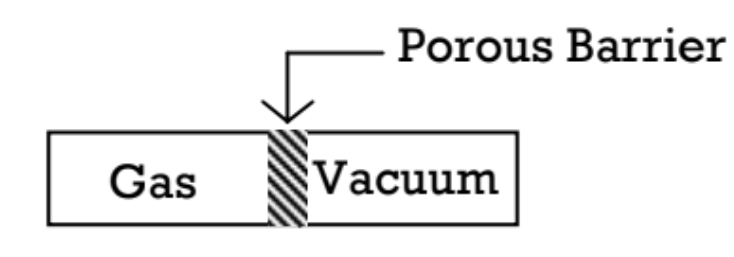
Choose an answer to reveal your result and explanation.
Answer & Explanation
To determine which pair of gases would diffuse into a vacuum at the same speed, we need to consider Graham's law of effusion. According to Graham's law, the rate of effusion (or diffusion) of a gas is inversely proportional to the square root of its molar mass. Therefore, for two gases to diffuse at the same speed, they must have the same molar mass.
Let's analyze each option:
-
Option 1: NH5 and H2
- NH5 is not a chemically stable or recognized compound, so we cannot calculate its molar mass. However, assuming a hypothetical scenario, NH5 would have a molar mass of approximately 19 u (1 for H and 14 for N).
- H2 has a molar mass of 2 u.
- These two gases have significantly different molar masses, so they would not diffuse at the same speed.
-
Option 2: CO and SO2
- CO (carbon monoxide) has a molar mass of 28 u (12 for C and 16 for O).
- SO2 (sulfur dioxide) has a molar mass of 64 u (32 for S and 32 for two O atoms).
- The molar masses are different, so these gases would not diffuse at the same speed.
-
Option 3: CO and N2
- CO (carbon monoxide) has a molar mass of 28 u (12 for C and 16 for O).
- N2 (nitrogen gas) also has a molar mass of 28 u (14 for each N atom).
- Since both gases have the same molar mass, they would diffuse into a vacuum at the same speed. This is why Option 3 is the correct answer.
-
Option 4: NH3 and N2
- NH3 (ammonia) has a molar mass of 17 u (14 for N and 3 for H).
- N2 (nitrogen gas) has a molar mass of 28 u (14 for each N atom).
- The molar masses are different, so these gases would not diffuse at the same speed.
In conclusion, Option 3 is correct because CO and N2 have the same molar mass, allowing them to diffuse at the same speed according to Graham's law of effusion.
नीचे दिए गए उपकरण समान ताप एवं दाब पर विभिन्न गैसों के विसरण का अध्ययन करने के लिए उपयोग में आता है।
निम्नलिखित में से गैसों का कौन-सा युग्म समान गति से निर्वात में विसरित होगा ? (दिया गया परमाण्वीय द्रव्यमान H = 1 u, C = 12 u, N = 14 u, O = 16 u)
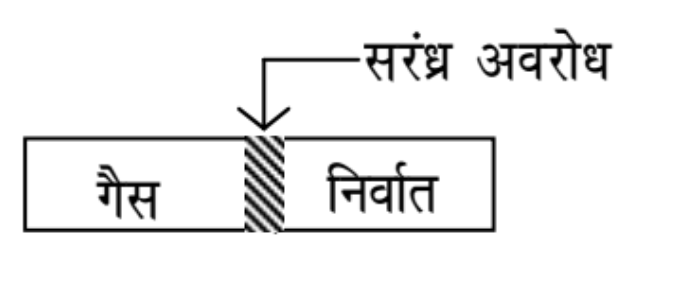
Choose an answer to reveal your result and explanation.
Answer & Explanation
गैसों के विसरण की गति ग्रैहम के विसरण नियम के अनुसार होती है, जो कहता है कि किसी गैस का विसरण वेग उसके मोलर द्रव्यमान के वर्गमूल के व्युत्क्रमानुपाती होता है। इसका मतलब है कि हल्की गैसें तेजी से विसरित होती हैं।
अब हम दिए गए विकल्पों का विश्लेषण करते हैं:
-
NH5 तथा H2: NH5 एक काल्पनिक यौगिक है क्योंकि अमोनिया (NH3) का सामान्य रूप होता है। इसलिए यह विकल्प सही नहीं हो सकता।
-
CO तथा SO2: CO का मोलर द्रव्यमान 28 u (C = 12 u, O = 16 u) है, जबकि SO2 का मोलर द्रव्यमान 64 u (S = 32 u, O = 16 u × 2) है। चूंकि SO2 का मोलर द्रव्यमान CO से अधिक है, इसलिए ये समान गति से विसरित नहीं होंगे।
-
CO तथा N2: CO का मोलर द्रव्यमान 28 u है और N2 का मोलर द्रव्यमान भी 28 u (N = 14 u × 2) है। चूंकि दोनों गैसों का मोलर द्रव्यमान समान है, इसलिए ये समान गति से विसरित होंगी। यही कारण है कि यह विकल्प सही है।
-
NH3 तथा N2: NH3 का मोलर द्रव्यमान 17 u (N = 14 u, H = 1 u × 3) है, जबकि N2 का मोलर द्रव्यमान 28 u है। चूंकि NH3 का मोलर द्रव्यमान N2 से कम है, इसलिए ये समान गति से विसरित नहीं होंगे।
इस प्रकार, विकल्प 3 सही है क्योंकि CO और N2 का मोलर द्रव्यमान समान है, जिससे वे समान गति से विसरित होते हैं।